Latest News and Comment from Education

Wednesday, November 7, 2018

Voters deliver major wins for students, public education in 2018 midterm elections - Education Votes

Voters deliver major wins for students, public education in 2018 midterm elections - Education Votes

Voters deliver major wins for students, public education in 2018 midterm elections


Nicknamed by observers and political pundits as the “Year of the Educator,” the 2018 midterm election results mark a major victory for students and serve as a mandate for real change in our public education system. Harnessing the momentum of the historic #RedForEd movement, with a surge of educators on the ballot and historic educator activism, the National Education Association and its affiliates helped to elect leaders that are positioned to shift the balance of power in state capitals and the U.S. Congress, where victories will add a critical check on policies that have hurt students, their families and communities.
Kitchen table issues typically dominate the discussion during midterm elections, and education was a top issue in races this year. MarketWatch reported that education was the second most mentioned topic in advertisements for gubernatorial candidates of both parties. But education wasn’t just a topic on the campaign trail. The midterm elections saw a spike in educators on the ballot.
“Lawmakers learned an important lesson tonight: You can either work with educators to address the needs of students and public education, or they will work to elect someone who will,” said NEA President Lily Eskelsen García. “Candidates across the country witnessed unprecedented activism by educators in their races. Standing up for students and supporting public education were deciding factors for voters, and educators will hold lawmakers to their promises.”
Nearly 220,000 NEA members and education families were involved in getting out the vote up and down the ballot in the 2018 election. That figure represents a 165 percent increase in activism engagement this election cycle compared with 2016, a presidential year where activism is historically higher than midterms, as measured through time put in phone-banking and canvassing. Local and state races were the biggest beneficiaries of NEA member activism.

See Educators Run

An analysis by NEA revealed nearly 1,800 current or former teachers and other education professionals ran for state legislative seats, and an additional 100 educators ran for top state or federal seats in Election 2018. A bulk of educators come from states that experienced historic #RedForEd walkouts this spring: West Virginia, Kentucky, Oklahoma, Arizona, Colorado and North Carolina. In fact, Oklahoma led the charge with more than 62 educators who were on the general election ballot.
“After decades of starving education funding, educators stepped up and said, ‘I can do better.’ They found themselves asking, ‘Why not have an educator in that lawmaking decision seat?’ And that’s exactly why they ran for office and voters elected them to serve,” added Eskelsen García, a sixth-grade teacher who now heads the nation’s largest union.

See Education Win

The primary focus of NEA’s electoral efforts this election cycle was on state races because education policy is decided by state legislatures and public education funding is a primary responsibility of the state. NEA investments were aimed at elevating our issues and promoting pro-public education candidates through candidate and independent expenditure communications and extensive grassroots field efforts. Significant resources also were devoted to federal races where priority U.S. Senate targets like Arizona, Nevada, Minnesota, Montana, Ohio and Wisconsin were elected and the U.S. House of Representatives flipped to Democratic control, providing a significant check on the power of Donald Trump and Betsy DeVos.
Top targeted statewide races in which NEA and its state-level affiliates conducted aggressive member-to-member field and communications program include:
  • Wisconsin governor-elect Tony Evers, an educator at the top of a state ticket and defeated Gov. Scott Walker
  • Republican Brad Little, who has been elected the next Idaho governor
  • Governor-elect J.B. Pritzker, who defeated incumbent Illinois Gov. Bruce Rauner
  • Kansas governor-elect Laura Kelly
  • Michigan governor-elect Gretchen Whitmer
  • Minnesota governor-elect Tim Walz, a career-teacher and a member of Education Minnesota, NEA’s state-level affiliate
  • Minnesota auditor-elect Julie Blaha, an educator and member of Education Minnesota, NEA’s state-level affiliate
  • New Mexico governor-elect Michelle Lujan Grisham
  • New Mexico land commissioner-elect Stephanie Garcia Richard, a member of NEA-New Mexico
  • Tom Wolf (D-Penn.) was re-elected to a second term
NEA and its affiliates worked to flip the state legislative chambers into pro-public education majorities like:
  • Colorado state senate
  • Connecticut state senate
  • Maine state senate
  • Minnesota state house
  • New Hampshire house and senate
  • New York state senate
The following ballot initiatives were top priorities for NEA and its affiliates:
  • Maryland Question 1, which creates a “lockbox” for gaming revenue dedicated solely for K-12 education funding and has the potential to generate approximately $500 million annually in new funding for Maryland’s public schools. NEA’s affiliate, the Maryland State Education Association, worked with a broad-based coalition to get lawmakers to refer the amendment to the ballot. The Republican governor, Larry Hogan, and all but two Republican legislators supported referring this amendment to the ballot.
  • Missouri Amendment 1, which is positioned to clean up Missouri’s political system, long-plagued by ethics corruption, and create a fair representation system. The passed ballot measure imposes contribution limit, bans revolving-door lobbying and lobbyist gifts and imposes redistricting reform. The Missouri-NEA was an early leader and driving force of the state-level coalition that worked to get the initiative on the ballot.
  • Montana LR-128, which is an education funding levy for Montana’s universities that is up for statewide renewal every 10 years. NEA’s affiliate, the Montana Public Employees Association, was a major driver of the $6 million-levy reaching the ballot.
“Educators have had enough of empty promises from politicians. We told them we’d remember in November, and educators keep their promises,” added Eskelsen García. “As a result of the historic #RedForEd movement and the 2018 midterm election, educators have found their voice, and they are going to continue to hold lawmakers accountable after this election.”
Voters deliver major wins for students, public education in 2018 midterm elections - Education Votes

The midterm elections show America’s major shift in attitude to charter school privatization | Salon.com

The midterm elections show America’s major shift in attitude to charter school privatization | Salon.com

The midterm elections show America’s major shift in attitude to charter school privatization
It’s not hard to find news stories about waste, fraud, abuse and downright theft in the school privatization sector
For years, the policy window for privatizing public schools has been wide open, and what was once considered an extreme or at least rare idea — such as outsourcing public schools to private contractors with few strings attached, or giving parents public tax money to subsidize their children’s private school tuitions — has become widespread as charter schools are now legal in all but a handful of states, and voucher programs have proliferated in many forms across the country.
Politicians of all stripes have been extremely reluctant, especially at the national level, to lean into a real discussion of the negative consequences of redirecting public education funds to private operators, with little to no regulation for how the money is being spent. Candidates have instead stuck to a “safe boilerplate” of education being “good” and essential to “the workforce” without much regard to who provides it.
But policy windows can be fleeting (remember “the deficit crisis”?), and multiple factors can rejigger the public’s views. Indeed, in campaigns that candidates are waging in the upcoming midterm elections, one can see the policy window on school privatization gradually shifting back to support for public schools and increasing skepticism about doling out cash to private education entrepreneurs.
"Vulture schools"

It is the wave of new progressive candidates who appear to be the ones who are shifting the policy window on school privatization.
Take the campaign of progressive superstar Randy Bryce, running for the congressional seat Paul Ryan held in Wisconsin. The Badger State recently expanded statewide a voucher program that was confined to Milwaukee and Racine, and charter schools have expanded significantly under the leadership of Republican Governor Scott Walker.
On his website, Bryce provides the usual bromides about “every child deserves a quality education” and “charter, private and traditional public schools can all thrive,” but he then adds the curious statement that “no student should see money taken from their classroom in order to serve another.” What does that mean? Continue reading: The midterm elections show America’s major shift in attitude to charter school privatization | Salon.com


Vouchers Defeated in Arizona Overwhelmingly, Democrats Take Control of the House | Diane Ravitch's blog

Vouchers Defeated in Arizona Overwhelmingly, Democrats Take Control of the House | Diane Ravitch's blog

Vouchers Defeated in Arizona Overwhelmingly, Democrats Take Control of the House


There were wins and losses yesterday, and they are not all decided at 2 am, when I wrote this post. Some states have not yet declared a winner (thinking of Wisconsin, where I hope that Scott Walker was beaten).
Some losses that I mourn: Beto O’Rourke; Stacey Abrams; Andrew Gillum. All defeated by reactionaries of the worst sort.

Some significant victories:
Democrats gained control of the House of Representatives, which means they have the power of the purse, the power to hold hearings, and the power to block some of Trump’s worst plans. That is huge. Hurrah for checks and balances!
Vouchers were overwhelmingly beaten in Arizona by the teachers and moms of SOS Arizona, who scored a knock-out punch against the Koch brothers, giving vouchers their 21st consecutive loss at the ballot box. The margin was 2-1 against vouchers. Congratulations, SOS Arizona!
Real Democrats gained control of the New York State Senate, ousting the fake Independent Democratic Caucus, who voted with Republicans.
In a very close race, it appears that Democrat Tony Evers beat the vile Scott Walker for Governor of Wisconsin.
Gretchen Whitmer, a Democrat, was elected Governor of Michigan.
Janet Mills, a Democrat, was elected Governor of Maine, and the outgoing Continue reading: Vouchers Defeated in Arizona Overwhelmingly, Democrats Take Control of the House | Diane Ravitch's blog

Tuesday, November 6, 2018

My Message to the Teachers of Los Angeles | Diane Ravitch's blog

My Message to the Teachers of Los Angeles | Diane Ravitch's blog
My Message to the Teachers of Los Angeles


The United Teachers of Los Angeles have voted to authorize a strike. The union has been negotiating with Superintendent Austin Beutner, a former investment banker who has no experience in education.
I sent the following message to the teachers of Los Angeles.
I am writing to my friends who teach in the Los Angeles Unified School District to encourage you to stay strong in your demands for smaller classes and the resources your students need.
Your working conditions are your students’ learning conditions.
You should not be expected to pay out $1,000 or more from your salary for school supplies.
I am astonished that one of the cities with the greatest concentration of wealth in the world is unwilling to pay what it costs to educate its children.
John Dewey wrote more than a century ago: “What the best and wisest parent wants for his children, that must we want for all the children of the community. Anything less is unlovely, and left unchecked, destroys our democracy.”
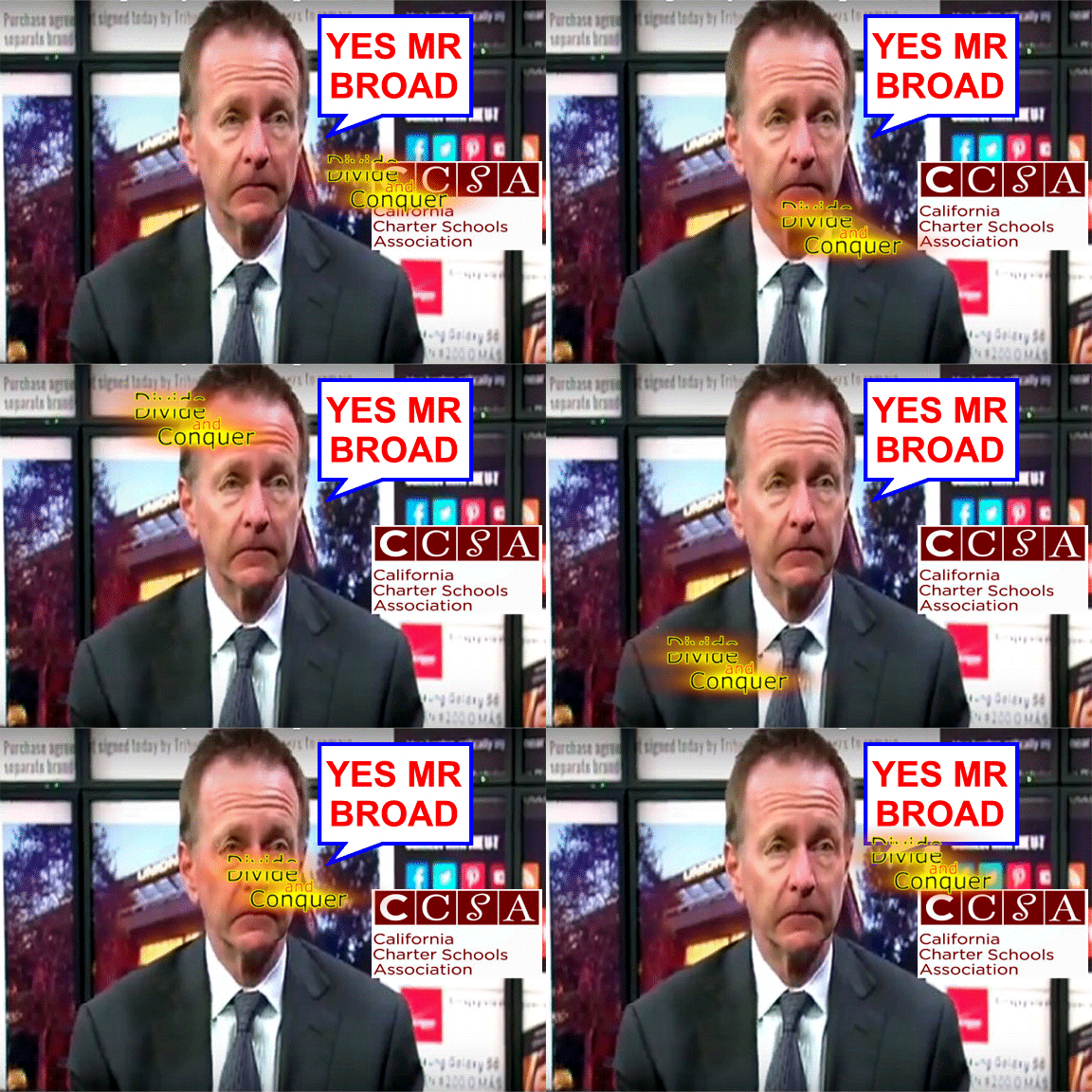
The billionaires who have declared war on public education and who are funding the California Charter School Association would not tolerate overcrowded classrooms, obsolete textbooks, and crumbling buildings in the schools their children attend. They should not tolerate such conditions in the public schools of Los Angeles that other people’s children attend, people without their wealth.

They want the best for their children, and they should demand the best for all children, and pay for it.
Please fight against “school choice,” an idea that was first launched by segregationists in the South to block the Brown decision in the late 1950s. It is now the favorite cause of U.S. Secretary of Education Betsy DeVos, who wants to replace our nation’s democratically-controlled public schools with a menu of “choices,” none of which are as good as public schools.
In California, as elsewhere, charter advocates oppose accountability and Continue reading: My Message to the Teachers of Los Angeles | Diane Ravitch's blog


GET OUT THE VOTE: It’s More than Seats at Stake | Schott Foundation for Public Education

GET OUT THE VOTE: It’s More than Seats at Stake | Schott Foundation for Public Education

GET OUT THE VOTE: It’s More than Seats at Stake


There is so much at stake this mid-term election. Organizers, activists and candidates alike have been focused more than ever on Get Out the Vote efforts, knowing that turnout will be the deciding factor in many tight races. There are signs it’s working – more than 30 million Americans have cast early ballots so far, which has already surpassed 2014 early voting, and more are still coming in. Still, on average only about 40% of eligible voters participate in mid-term elections, and even the best case scenarios do not assume turnout this time around will exceed 50%.

Most of the attention this election is on swing seats in House and Senate, which will determine which party will hold the majority of seats going into the next session. Additionally, all eyes are on historical gubernatorial races in Florida and Georgia, where Andrew Gillum and Stacey Abrams are running on campaigns for fully funding supports-based education, expanding access to health care, protecting voting rights, reforming criminal justice and addressing climate change. The potential for replacing the historic policies rooted in racism and hate with policies that provide love and support to all is what is at stake in these elections, but the candidates aren’t the only reason to get out the vote this election cycle.
Garnering much less attention, but still of critical importance, are the ballot measures that are up for votes in each state across the country. Civic engagement isn’t just about selecting our representatives for national, state and local seats – voters get to shape the actual policies directly with their votes on important measures that go straight to The People, and this cycle there are key decisions shaping social justice that our elected officials are asking the people to weigh in on. Getting out the vote and ensuring people are aware of the measures on their ballots could mean passing critical measures for funding schools and transportation, reinstating voting rights in places where suppression has been allowed for far too long, and reforming the ways our local and state systems work to provide an opportunity for all. Platforms like Justice on the Ballot highlight some of the most critical measures on state ballots this election, and actionable ways to get involved in last minute calls to mobilize voters around those issues.  
Here are some examples of state measures on education equity and social justice that provide yet another reason to get out the vote:
  1. Increasing investments in schools in Colorado (Amendment 73 and local school bond proposals), Georgia, Maine, Montana, New Mexico, Rhode Island and Utah: In Colorado, an unprecedented $3 billion dollars for school funding is on the ballot  to increase the number of classrooms, improve school infrastructure, retain more teachers and counselors, and provide special programs to meet the rapidly growing student population in Colorado. Voters in Georgia, Maine, Montana, New Mexico, Rhode Island, and Utah are also being asked to support measures that open the door for more funding for K-12 and higher education, through sales taxes, property taxes, bonds or fuel taxes. And in Arizona, voters will decide whether to repeal the law that allows families to draw public funds to pay for private school tuition and other education-related expenses.
     
  2. Increasing the minimum wage in Arkansas (Issue 5): This citizen-initiated proposed statue would raise the state’s hourly minimum wage from $8.50 to $11 by 2021. The Loving Cities Index for Little Rock highlights working poverty as a critical issue (people working full-time with income below 200% of federal poverty level). With over 30% of Latino and 15% of Black full-time workers not earning enough to make ends meet in Little Rock (compared to only 5% of White full-time workers), a change to minimum wage could dramatically impact access to resources and supports for children from lower income communities and communities of color.
     
  3. Restoring voting rights (Amendment 4) and banning oil and gas drilling in Florida (Amendment 9): Florida is one of only four states with a lifetime ban on voting because of a prior felony conviction, and as a result, 1.4 million Floridians are permanently excluded from voting. Having a vote, especially for those that have paid their debts and want to be civically engaged, is critical to ensuring our systems are set up to support and provide paths to opportunity. Environmental protection in Florida has also become a central issue with green algae and “red tide” infesting shorelines, killing marine life, harming humans and stifling tourism. With pollution, health and education outcomes inextricably linked, measures and elected officials that will reinstate the environmental regulations gutted under Governor Scott’s watch will contribute to better systems for healthy living and learning environments.
     
  4. Requiring unanimous juries to convict someone of a felony in Louisiana (Amendment 2): Louisiana is one of only two states that allows a jury to convict someone even if two people on the jury don’t think that person is guilty. As a result, Louisiana has the second highest incarceration rate in the world. Reforming our criminal justice systems to restore justice in ways that rehabilitate and keep families together ensures that children have love, support and stability, and can come to school ready to learn.
     
  5. Defeating a voter suppression initiative in North Carolina (Voter ID Amendment): This initiative would add a photo ID requirement for voting to the state constitution, affecting 281,000 residents who do not currently have photo ID by effectively disqualifying them from voting in 2020 if passed.
     
  6. Changing drug possession to a misdemeanor in Ohio (Issue 1): This would cause approximately 10,000 people to be released early from prison in Ohio next year, and contribute to less spending on our prison industrial complex. In addition to keeping people out of jail for drug possession, it would prevent people from being imprisoned for non-criminal probation violations.
     
  7. Creating an independent redistricting commission in Colorado (Amendments Y and Z), Michigan (proposal 2), Missouri (Amendment 1) and Utah (Proposition 4). Several states are taking on partisanship in drawing district lines in favor of independent commissions that would aim to increase transparency and fairness. These ballot initiatives in addition to related measures in these states and others that increase ease of voting and limit campaign spending all aim to make the processes for electing representatives more fair and accessible.
     
  8. Protecting transgender rights in Massachusets (question 3): The law passed in 2016 protecting transgender people from discrimination in public places, including restaurants, stores, hospitals, libraries and gyms, will face potential repeal, which would roll back the hard fought anti-discrimination laws that protect the human rights of transgender people. With the White House considering harmful, hate-inspired changes to the definition of gender under federal civil rights laws, it's more important than ever that we reaffirm our commitment to gender equity and fair treatment of all people at the local and state levels this election.
With one day left to go, VOTE, VOTE, VOTE! And call on your friends and community members to vote as well. There is too much at stake to sit this election out – the future of our children and their access to healthy living and learning environments where they can succeed depends on us. Let’s make sure we are not only electing individuals that will fight for the rights and opportunities for ALL, but that we are taking the time to support the ballot measures that open up resources and supports for children and families.
GET OUT THE VOTE: It’s More than Seats at Stake | Schott Foundation for Public Education


From South Carolina to California, charter school-loving billionaires are plowing money into midterm local and education races - The Washington Post

From South Carolina to California, charter school-loving billionaires are plowing money into midterm local and education races - The Washington Post

From South Carolina to California, charter school-loving billionaires are plowing money into midterm local and education races


In Charleston, S.C., advocates for the public school district are worried. They have watched some of the state’s wealthiest people — including billionaire financier Ben Navarro — form a coalition this year to back school board candidates who support a broad expansion of charter schools.
The Charleston Coalition for Kids has spent hundreds of thousands of dollars in advertising as 11 candidates vie for four seats on the Charleston County School District Board of Trustees. The coalition, which is run by a former Teach For America executive in charge of recruiting educators in the state, has won big endorsements in town, including from former mayors and school board members.
And it has links to Michelle Rhee, the controversial former D.C. schools chancellor and pioneer in the school “reform” movement that sought to use standardized test scores to evaluate teachers, principals and students and pushed for alternatives to publicly governed school districts.
Coalition leaders say they simply want to improve education in the city. But some residents — including pastors, former and current school board members and parents — say the group’s real aim it to expand charter schools, which are publicly funded but privately operated. Those residents say that will harm the 50,000-student school system.

“Though Charleston Coalition for Kids claims to seek to disrupt the status quo, its record suggests it aims to continue experiments in privatization that continue to fail those who need quality public education the most,” said Allison Mackey of the nonprofit Quality Education Project.
What’s happening in Charleston is mirrored in cities, counties and states across the country: The super- Continue reading: From South Carolina to California, charter school-loving billionaires are plowing money into midterm local and education races - The Washington Post


Badass Teachers Association: BAT Eye on the Elections!

Badass Teachers Association: BAT Eye on the Elections!

BAT Eye on the Elections!


Well, it's finally here, election day 2018. We have seen an unrivaled amount of educators running for office across the nation in response to the #RedforEd wave.

BATs have a few of our own long-time members that have sacrificed their own lives to put their name on the ballot.


In Tennessee we have Larry Proffitt. A long time BAT member, former admin and Tennessee power-house, Larry is running for  Tennessee House District 66. He was officially endorsed by NPE Action and this is his second attempt as a candidate.

Janet Garrett, a long-time Ohio BAT and a veteran teacher of 35 years is running for Congress in the 4th district.

Amy Perruso, from the great state of Hawaii, has her sights set on the statehouse.

From Michigan, we have Dayna Polehanki, 2018 Teacher of the Year that is running for State Senate in Michigan's 7th district.

We asked our BAT State Admins (A quick thank you to all of the work that they do!) what races they will be following closely this year. Here are some of their replies:

Utah’s
“Question 1”... we want it...our only education funding through a gas tax

Florida

Governor Gillum vs. DeSantis
Senate Nelson vs. Scott
Amendments especially 4 ~ restoring voting rights:
If Amendment 4 is approved by more than 60 percent of voters on Tuesday, most felons will automatically be able to register to vote after completing all terms of their sentences. An estimated 1.2 million people who currently can't vote would be affected by the change. Those who committed murder or sex crimes are not eligible.

Senator Annette Taddeo

Donna Shalala for Congress

Illinois
Governor .... Rauner (funder of Janus) vs Pritzker.
Sara Dady, (US Rep.) Jake Castanza, Angie Bodine (IL State Rep)

West Virginia
The West Virginia teachers' strike was a staring contest with the West Virginia State Senate. 34 members, 22 Republicans led by State Senator Mitch Carmichael. Half the members (17) are up for election; ten seats either have Republican incumbents or were held by Republicans who lost their primaries. If the Dems don't pick up seven seats, Carmichael will revisit the issues from the strike and will pretend he now has a mandate of some kind.

There's Joe Manchin's race against WV Attorney General and former drug company lobbyist Patrick Morrisey (who treated to put teachers in jail during our strike). Manchin may not be every liberal's dream Senator, but he's an easy pick in that race.

We are also closely watching State Senator Richard Ojeda's bid for the vacant 03 District Congressional seat.


Michigan
In Michigan, the whole ticket is exciting. But the key ones are Gretchen Whitmer for Gov., - Dana Nessel for Atty Gen. - Haley Stevens & Ellisa Slotkin for US Congress. Dayna Polehanki for State Senate (She's a Teacher of the Year and a BAT). Plus Sam Bagenstos & Megan Cavanagh the Dems for Mich Supreme Ct. If they both win the court flips from Republican to Democrat. Yes on Proposal 2 will eliminate gerrymandering so that's huge too. The boots on the ground for the Dems have been more than I've ever seen here in Michigan.

Georgia
The Governor's race!!

Wisconsin 
The Govenor's race and Tammy Baldwin

Ohio
All of our 23 endorsed candidates in OH and Senator Sherrod Brown's re-election, hopefully handily.


Indiana
J.D. Ford vs Mike Delph for State Senator for Indiana District 29. J.D. has a master's degree in education from Purdue University and has been working as a substitute teacher while campaigning. He's liberal, 36 and If he wins, he'll be the state's first openly gay lawmaker.


Pennsylvania
PA Governor Race-Tom Wolf (D) vs Scott Wagner (R)
PA Senate Race-Bob Casey (D) vs Lou Barletta (R)

Texas
Beto!!!

California
Tony Thurmond
Duncan Hunter (R), Mimi Waters (R), Dana Rohrbacher (R).

Arizona
Governor race
Prop 305

New York
The State Senate - we need to flip it!

North Dakota
Senator Heidi Heitkamp

Montana
Senatorial... Incumbent Jon Tester (D) vs. Matt Rosendale.


New Jersey
Andy Kim for Congress District 3


 As I sat here typing this out, I received a personal call from our brother, Larry Proffitt. Much love to you and you will be in our hearts!!!  ~Melissa Tomlinson, Assistant Executive Director


Badass Teachers Association: BAT Eye on the Elections!


Monday, November 5, 2018

School chief's plan would divide L.A. school district into 32 networks - Los Angeles Times #VoteTuesday #LAUSD #UTLA

School chief's plan would divide L.A. school district into 32 networks - Los Angeles Times
School chief's plan would divide L.A. school district into 32 networks

Los Angeles schools chief Austin Beutner is working out a plan to radically reshape the nation’s second-largest school district by greatly shrinking the central bureaucracy and moving decision-making closer to schools.
The aim is to boost student success and also to save money at a time when district officials insist that grave financial problems threaten the Los Angeles Unified School District with insolvency.
Under a proposal being developed confidentially, Beutner, who spent much of his career in business, would divide the school system into 32 “networks,” bringing authority and resources out of the central office and into neighborhoods.

In the downtown headquarters, managers and other employees recently have been asked to explain their duties — and to justify why their particular jobs should continue to exist in a leaner, more efficient, more localized school system.
The network strategy is not a plan to break up or end L.A. Unified, but it could transform the way the school system functions.
“The superintendent is trying to move toward a decentralized system that puts the student first,” said one person close to the process, who requested anonymity because he is not authorized to speak. “He’s trying to generate better educational outcomes. That’s the No. 1 goal.”
“Savings from the central bureaucracy could be plowed back into education at the school level as well as to deal with the fiscal crisis the district faces,” he added.
Beutner declined to comment, saying it would be premature to talk about a work in progress.

The Times learned details of Beutner’s developing strategy through documents and interviews. The broad outlines of the plan were confirmed by numerous people involved in the work at various levels. No one was willing to be quoted on the record.
The record of similar attempts is not necessarily on Beutner’s side. Some past L.A. Unified reorganizations have been short-lived or fell far short of expectations. Sometimes what’s meant to save money turns out to be costly.
“If the underlying services are not different or better, then the structure doesn’t matter Continue reading: School chief's plan would divide L.A. school district into 32 networks - Los Angeles Times


Go vote. The best civics lesson requires you to leave the classroom #VoteTuesday

Go vote. The best civics lesson requires you to leave the classroom

Go vote. The best civics lesson requires you to leave the classroom
Election Day isn’t just for those 18 and older; younger teens can celebrate it too


Election Day is one time you shouldn’t scold your teenagers for cutting class. After all, walking out of school to vote or to support your friends’ constitutional right to do so is evidence they learned something in civics class, their grades notwithstanding. As the philosopher John Dewey wrote in his classic book Democracy and Education in 1903, “Education is not preparation for life; education is life itself.”
On November 6 at 10 a.m., thousands of students under voting age from coast to coast will walk out of school and march with their voting-eligible peers to the polls to make a statement that their voices and votes matter. Election Day is the most sacred of holidays for a democracy, a time when citizens 18 years and older can select representatives charged with shaping our laws and running our governments. In the U.S., elections give meaning to the lofty opening words of the preamble to our Constitution: “We the people…”
The right to vote is paramount, because without it one’s very right to exist can be subject to the whims of others. Immigrants currently recognize the importance of Election Day in ways that women and blacks, who have historically been denied that right, know too well. And our children should understand it too, based on a similar rationale.

By law, youth under the age of 18 can’t vote in an election and are subject to the rulemaking of others on issues such as gun control, net neutrality, climate change and immigration, which affect them perhaps most of all. It’s like being required to attend a school without having a say in how it’s run, which is the prime reason that students must march. Youth should refuse to sit at their desks while others vote on more than 150 ballot measures across the country, dozens of which directly or indirectly impact education, according to the left-leaning think tank Center for American Progress.
The Future Coalition — a national network of youth-led groups — helped organize more than 500 school walkouts on Election Day Continue reading: Go vote. The best civics lesson requires you to leave the classroom


Idaho’s Border-Wall-Costume School Cited in 2016 for Segregating Classrooms by Sex | deutsch29 #VoteTuesday

Idaho’s Border-Wall-Costume School Cited in 2016 for Segregating Classrooms by Sex | deutsch29

Idaho’s Border-Wall-Costume School Cited in 2016 for Segregating Classrooms by Sex


Fourteen Middleton School District (Idaho) teachers and staff have been suspended with pay pending results of an investigation into actions related to the employees’ choosing to dress up as a border wall and Mexicans on Halloween, for what district superintendent Josh Middleton identified as a “week-long team building activity,” according to CBS 2:
“We have talked to the principal and our assistant superintendent human resources director now is conducting interviews up at the elementary school and just to be safe we have beefed up security at our schools,” Middleton says.
He tells CBS 2 that the costumes came from a week-long team building activity, which he says was meant to focus on acts of respect and kindness.
“There were six countries, two of those countries decided to get with the theme and chose to dress in those outfits,” Middleton says.
In efforts to address the situation, Middleton and the school board have posted the following message to the community on the school web page:

Important Message

November 3, 2018
Middleton School District Parents and Community:
I want to bring you up to date on events within the district during this difficult time for our Middleton School District students, staff, and community.
Our school board held a special Board meeting this morning at 10 am.  The Continue reading:  Idaho’s Border-Wall-Costume School Cited in 2016 for Segregating Classrooms by Sex | deutsch29