Latest News and Comment from Education

Thursday, March 9, 2017

Federal Policy on Immigration Actions Near Schools - Year 2017 (CA Dept of Education)

Federal Policy on Immigration Actions Near Schools - Year 2017 (CA Dept of Education):

State Superintendent of Public Instruction Tom Torlakson Asks Federal Authorities to Clarify Policy on Immigration Actions Near Schools


SACRAMENTO – State Superintendent of Public Instruction Tom Torlakson, as part of his efforts to ensure parents and students feel safe at schools regardless of their immigration status, today asked federal law enforcement authorities to explain if they are changing a policy that had avoided immigration actions near schools.
Torlakson wrote a letter to U.S. Homeland Security Secretary John Kelly and requested information if the agency is still following the “Sensitive Locations” guidance, which directs federal agents to generally avoid enforcement activities at schools, school bus stops, college and universities, and other education-related locations.
His letter was prompted by the need to inform school leaders in California, but also by his alarm at an action taken in late February by Immigrations and Customs Enforcement (ICE) agents who took Romulo Avelica-Gonzalez, a 48-year-old father of four, into custody after he dropped off one of his daughters at Academia Avance public charter school in the Lincoln Heights neighborhood of Los Angeles.
His 13-year-old daughter was in the car and videotaped the event as she cried, and the images and sounds gained viral attention. Federal authorities said he was arrested for past, nonviolent misdemeanor convictions and an immigration violation.
“I have consistently told students and their families that they must feel safe and protected at our schools, especially families who are refugees, Muslims, or undocumented immigrants,” Torlakson said. “Recent actions by federal law enforcement agents around schools have raised serious concerns.”
If the Sensitive Locations guidance is changing and will affect public schools, the California Department of Education (CDE) needs that information to communicate accurately with the state’s 6.2 million public school students and their families and more than 10,000 public schools, Torlakson said.


# # # #
Tom Torlakson — State Superintendent of Public Instruction
Communications Division, Room 5602, 916-319-0818, Fax 916-319-0100
Federal Policy on Immigration Actions Near Schools - Year 2017 (CA Dept of Education):


Big Education Ape: Sacramento moves to block immigration officials from student data | 89.3 KPCC - http://bigeducationape.blogspot.com/2017/03/sacramento-moves-to-block-immigration.html

Image result for U.S. Immigration and Customs Enforcement (ICE) and Schools

Big Education Ape: Schools receive guidance on interactions with ICE agents :: SI&A Cabinet Report - http://bigeducationape.blogspot.com/2017/02/schools-receive-guidance-on.html


Big Education Ape: Educators Prepare for Immigration Agents at the Schoolhouse - The New York Times - http://bigeducationape.blogspot.com/2017/03/educators-prepare-for-immigration.html


Big Education Ape: California Schools Join Sanctuary Movement To Protect Students From Deportation - BuzzFeed News - http://bigeducationape.blogspot.com/2017/03/california-schools-join-sanctuary.html


El Superintendente Estatal de Instrucción Pública Tom Torlakson pide a las autoridades federales que aclaren la política sobre las acciones de inmigración cerca de las escuelas


SACRAMENTO - El Superintendente Estatal de Instrucción Pública Tom Torlakson, como parte de sus esfuerzos para asegurar que los padres y estudiantes se sientan seguros en las escuelas independientemente de su estatus migratorio, hoy pidió a las autoridades federales de la ley que expliquen si están cambiando una política que había evitado las acciones migratorias cerca escuelas.


Torlakson escribió una carta al Secretario de Seguridad Nacional de los Estados Unidos, John Kelly, y solicitó información si la agencia sigue siguiendo la guía de "Ubicaciones Sensibles", que dirige a los agentes federales para evitar generalmente las actividades de aplicación en las escuelas, paradas de autobuses escolares, -relacionadas.


Su carta fue motivada por la necesidad de informar a los líderes escolares de California, pero también por su alarma por una acción tomada a finales de febrero por agentes de Inmigración y Aduanas (ICE) que tomaron a Romulo Avelica-González, un padre de 48 años de edad Cuatro, en la custodia después de que él cayó una de sus hijas en la escuela charter pública de Academia Avance en el vecindario de Lincoln Heights de Los Ángeles.


Su hija de 13 años estaba en el coche y grabó en video el evento mientras lloraba, y las imágenes y sonidos adquirieron atención viral. Las autoridades federales dijeron que fue arrestado por convicciones de delitos menores no violentos y una violación de inmigración.


"Siempre he dicho a los estudiantes y sus familias que deben sentirse seguros y protegidos en nuestras escuelas, especialmente las familias que son refugiados, musulmanes o inmigrantes indocumentados", dijo Torlakson. "Las acciones recientes de los agentes de la ley federales alrededor de las escuelas han planteado serias preocupaciones".


El Departamento de Educación de California (CDE) necesita esa información para comunicarse con precisión con los 6,2 millones de estudiantes de escuelas públicas del estado y sus familias y más de 10,000 escuelas públicas, dijo Torlakson.


Unesdoc.unesco.org unesdoc.unesco.org


Tom Torlakson - Superintendente Estatal de Instrucción Pública

División de Comunicaciones, Sala 5602, 916-319-0818, Fax 916-319-0100


Política Federal sobre Acciones de Inmigración Cerca de Escuelas - Año 2017 (Departamento de Educación de la CA):

CURMUDGUCATION: Testing Bribes

CURMUDGUCATION: Testing Bribes:

Testing Bribes


One of the biggest challenges connected with the Big Standardized Test is also one of the most important-- getting students to actually care.

State and district officials all across the country have largely failed-- and they know it.


Why, yes, I am very excited about the PARCC test.


This is less of a challenge with the littles. A primary teacher can tell her students, "I need you to put your dead possum on your head while poking yourself in the bellybutton with a red crayon," and those children will knock themselves out racing to grab the best piece of roadkill like it is the Most Important Thing Ever. When you're eight, hardly anything in the world makes sense, so you just trust the adults you love and do your best to make them proud of you.

Even so, the word has gotten out that the BS Test is a waste of everyone's time, and the parent-driven opt out movement has spread the word that you don't actually have to suffer through this baloney.

And by the time students arrive at the high school level, they have caught on to the con. They know there's nothing of any importance to them riding on this aimless exercise in baloney bubbling.

All of this is why, throughout the modern reform era, we have seen a cottage industry in testing pep rallies and testing pep videos and chirpy songs with new lyrics about how [insert your school here] is just the most awesome school that is going to be so awesome with its awesome results on the awesome test. You can watch them by the hundreds on youtube, each one a well-scrubbed American version of a Hitler youth meeting or a Chinese Communist political rally-- just instead of honoring our Beloved Leader, we bow down to the BS Test instead.

This year, the winner of the test-prep excess award is Eva Moskowitz, whose Success Academy has rented Radio City Music Hall for the annual "Slam the Exam So We Can Generate Good Numbers for Our Marketing Rally." RCMH has reportedly cut Moskowitz a deal on the price but it's still worth 
CURMUDGUCATION: Testing Bribes:


Sample letter to your legislator about establishing screen time guidelines | Parents Across America

Sample letter to your legislator about establishing screen time guidelines | Parents Across America:

Sample letter to your legislator about establishing screen time guidelines 

Image result for screen time guidelines

We are so pleased that a committee of the Maryland state legislature is considering a bill to establish health and safety guidelines for the use of digital devices in schools. This is a great model for other states.
We suggest that you contact your state legislators (and you could also try local city officials) asking them to introduce a similar bill.
Here’s a sample email:
Dear (legislator)
We would like to request that you consider sponsoring a bill in this or the next legislative session that would address the growing exposure to digital devices that our children are experiencing in many schools.
The dangers of overexposure to digital devices are just beginning to be defined and tracked. The national group Parents Across America, of which I am a member, recently published an extensive collection of information and opinion on the dangers of misuse and overuse of digital devices which raises a number of serious concerns.
As parents, we take full responsibility for the amount of time our children spend on devices at home, but we need your help to address the growing use of digital devices and screen time in schools.
We are pleased that the Maryland legislature is considering a bill to establish health and safety guidelines for the use of digital devices in schools, and ask that you consider introducing a similar bill as soon as possible.
The Maryland bill has broad bipartisan support. Here is its simple language:
House Bill 866
Guidelines and procedures for the use of digital devices in public school classrooms.
(a) ThDepartment of Health and Mental Hygienein consultation with the Departmentshall develop health and safety guidelines and procedures for the use of digital devices in public school classrooms.
(b) Beginning in the 2018 – 2019 school year, each county board shall implement the health and safety guidelines and procedures for the use of digital devices in public school classrooms specified in 5subsection (a) of this section
I would be pleased to speak with you or your staff about this important subject. Thank you for your attention.


 Our Children @ Risk: PAA reports detail the dangers of EdTech | Parents Across America - http://parentsacrossamerica.org/?p=6320

Image result for big education ape Parents Across America

Teacher to Ohio Gov. Kasich: ‘You are in the dark about life in the classroom’ - The Washington Post

Teacher to Ohio Gov. Kasich: ‘You are in the dark about life in the classroom’ - The Washington Post:

Teacher to Ohio Gov. Kasich: ‘You are in the dark about life in the classroom’

Ohio Gov. John Kasich’s stewardship of the public schools in his state has not been without problems. During his tenure, issues facing public schools in Ohio have included the growth of a charter school sector as scandal-ridden as any in the country, funding cuts for traditional public schools while charter schools and voucher programs got more state money, a problem-plagued teacher evaluation system and the troubled administration of a new Common Core test.
Recently it came to light that the governor had buried in his 3,512-page fiscal 2018-2019 budget proposal a mandate that all new teachers applying for a license — and all working teachers applying for license renewal in Ohio — get some “on-site work experience with a local business or chamber of commerce.”
Why? Ryan Burgess, director of Kasich’s Office of Workforce Transformation, told reporters that it would help teachers get a better idea for what jobs are available to students and what skills employers need.
Well, Julie Rine is one teacher who begs to differ. She wrote and sent a letter to the governor that appeared on Plunderbund and that she gave me permission to publish. Rine has been teaching in Ohio for more than 20 years. She is now in the Minerva Local School District, teaching Honors English I, Honors English II, Honors American Literature and English III at Minerva High School. She was born in Ohio, earned a bachelor’s degree from Ohio State University and a master’s degree at Marygrove College in Michigan.
Here is her strong letter to Kasich:
Dear Governor Kasich,
Your proposal in the budget to require teachers to complete an “on-site work experience” with a local business as a condition of renewing our teaching licenses is baffling. Even the state legislators in your own party didn’t seem to see the value in it, and have indicated that they most likely will not support it. What exactly did you hope to accomplish by our spending time observing or even participating in a field outside of education? Despite a lot of press coverage, we were given few details about the thinking behind this mind-boggling mandate, 
Teacher to Ohio Gov. Kasich: ‘You are in the dark about life in the classroom’ - The Washington Post:


The Death Tax on Failing Schools/Bad Teachers and TrumpCare - The Wordsmith - The New York Times

The Wordsmith - The New York Times:

The Death Tax on Failing Schools/Bad Teachers  and TrumpCare - The Wordsmith 


When I use a word,” Humpty Dumpty said, in rather a scornful tone, “it means just what I choose it to mean- neither more nor less.”
— Lewis Carroll, Through the Looking Glass

Big Education Ape: Media Consensus on ‘Failing Schools’ Paved Way for DeVos | By Molly Knefel | Common Dreams - http://bigeducationape.blogspot.com/2017/03/media-consensus-on-failing-schools.html

Your new 28-page memo, “The Language of Health Care,” was sent to Republicans in Congress and recommends that they speak about health care reform in ominous phrases. For instance, you suggest that they refer to “a Washington takeover.”
“Takeover” is a word that grabs attention.
Is it a correct description of the president’s plans for reform? 
 We don’t know what he is proposing. We want to avoid “a Washington takeover.”
But that’s not at issue. What the Democrats want is for everyone to be able to choose between their old, private health-insurance plan and an all-new, public health-insurance option. 
 I’m not a policy person. I’m a language person.
If you write the words of the policy, shouldn’t you believe in the content of the policy? 
 That’s why I agreed to write this memo. I deeply believe in patient-centered health care. My whole family was in the dental profession. I grew up with medicine all around me.
Would you describe yourself as a Republican pollster? 
 I’m a pollster, but no one ever cites my polling. Ninety-five percent of my work is as a communications specialist. My mother used to tell people that I was an upholsterer. She would joke that she didn’t understand the difference between pollster and an upholsterer.
Who paid you to write the health care memo? 
 It’s not relevant.
A pharmaceutical company? 
 No pharmaceutical company was involved.
You have devised many phrases to help sell Republican policies to the public. Like “energy exploration” instead of “drilling for oil” in the Arctic. What are some of your other coinages? 
 It’s “death tax” instead of “estate tax” or “inheritance tax.” It’s “opportunity scholarships” instead of “vouchers.” It’s “electronic intercepts” rather than “eavesdropping.”

Photo

CreditBrad Jones for The New York Times

That’s a lot of e’s. 
 Words that begin with b, p or t are words to express anger. I call them spitting words. You actually spit on people as you are saying them.
What if I call someone a bunny? That’s not angry. 
 If I wanted to demonize a bunny, I would use a word like rabbit. The rabbit will ravage your garden. This is a language pivot. A bunny is cute; a rabbit that ravages your garden is a pest.
What do you think of Dick Cheney’s new identity as a TV regular? 
 My issue with Cheney is that he was at one time a great communicator. But when he was asked the question “Over 70 percent of Americans disagree with this war, what is your response?” do you remember what his reaction was?
He said, “So what?” 
 Even worse than that. “So.” So! One-word answer, one syllable, two letters. To the American people it was a slap in the face.
When is your next book coming out? 
In September. It’s called “What Americans Really Want … Really: The Truth About Our Hopes, Dreams and Fears.”
It’s better without the subtitle, which detracts from the wit of the two “really” ’s. 
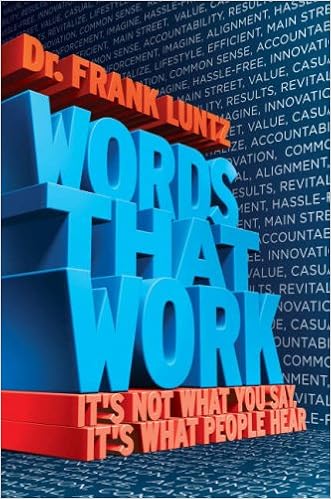
Well, I wrote “Words That Work,” and the subtitle is “It’s Not What You Say, It’s What People Hear,” and that is the most important single line I have ever written.
Where did you grow up? 
 Who cares?
Are you married? 
 No. I may have perfected the language that gets people to vote certain ways, and buy certain products, but I haven’t perfected the language to get some woman to buy me.
It might help if you didn’t speak about yourself, not to mention health care, as a product to be bought and sold. 
 It’s a throwaway line, that’s all. In politics it’s called a pivot. It’s a pivot to a topic I am more interested in. Not all words have equal meaning.interview conducted, condensed and edited byDeborah Solomon
INTERVIEW CONDUCTED, CONDENSED AND EDITED BY DEBORAH SOLOMON


 The Wordsmith - The New York Times:

Common Core Advocates' New Boogeyman: Twitterbots | Truth in American Education

Common Core Advocates' New Boogeyman: Twitterbots | Truth in American Education:

Common Core Advocates’ New Boogeyman: Twitterbots


Bill Gates had to find an explanation as to why Common Core has become increasingly unpopular. He funded a study that found the source of Common Core advocates’ woes.
Twitterbots.
Yes you read that right – Twitterbots are to blame.
The Consortium for Policy Research in Education decided it would look at how social media impacted Common Core so it launched the #CommonCore Project. Apparently that was more important than actually, I don’t know, studying how Common Core has shaped public policy.
Has social media impacted the education debate? Absolutely.
Are Tweetbots to blame? Well that’s the new narrative now.
For several years, university researchers have been watching how the debate surrounding Common Core has played out on Twitter. Between 2013 and 2016, they analyzed about 1 million tweets to understand how the social network was changing political discourse in America ― not only as it related to Common Core, but in a much larger sense.
Their discovery wasn’t pretty. Three years before “fake news” became a mainstream issue, fabrications and misinformation had already intensified the degree of 
Common Core Advocates' New Boogeyman: Twitterbots | Truth in American Education:

Media Consensus on ‘Failing Schools’ Paved Way for DeVos | By Molly Knefel | Common Dreams

Media Consensus on ‘Failing Schools’ Paved Way for DeVos | By Molly Knefel | Common Dreams:

Media Consensus on ‘Failing Schools’ Paved Way for DeVos


The nomination of billionaire voucher enthusiast Betsy DeVos for secretary of Education comes after nearly two decades of a largely bipartisan consensus around “education reform.” That consensus, repeated for years in the pages of the New York Times and the Washington Post, posits, first and foremost, that public schools are failing.
They are, the narrative goes, especially failing the nation’s most vulnerable students. That failure is presented, by education reformers and corporate media pundits alike, not as a result of inequality or poverty or resource scarcity, but of public education itself. The solution, pioneered by pro-privatization reformers and repeated by newspapers since the George W. Bush years, sounds both innocuous and innovative: school choice.
As a result of the uncritical consensus around school choice, major papers like the Times and the Post are unable to report on an extremist figure like DeVos—whose pro-voucher and pro-charter advocacy fits comfortably within the school-choice ethos—without ceding even more ground to the corporate education reform movement. “School choice” is not as value-neutral as it sounds: It is a buzzword not only for the expansion of charter schools and vouchers, but for the divestment of public funds away from public education and into the private sector.
The spectrum of opinions on DeVos presented in corporate media range from skepticism to enthusiasm, but school choice itself is unquestioned. The basic premise of education reform—that privatization is the solution—is taken as a given when papers repeatedly use the language of corporate reform. This leaves them questioning only the extent of that privatization, by way of charters or vouchers or both.
Even where coverage of DeVos has been critical—and much of it has, especially since her confirmation hearing—major papers parrot the language of corporate ed reformers. From the New York Times (1/12/17):
But school choice means different things to different people. Many educators and groups that support charter schools—which are public—do not support vouchers, which steer public money away from public schools by giving families money to spend on private school tuition.
That charter schools are “public” is a talking point put forward by the charter sector. Oversight of charter school performance varies widely state by state. They are run by non-profit organizations and sometimes for-profit companies. Their employees do not have the same rights as public-sector employees. They do not serve proportionate numbers of students with disabilities. They suspend black students at four times the rate of white students, and suspend students with disabilities at rates 2–3 times higher than their non-disabled peers, as the Times itself reported last year (3/16/16).
For the Times to repeat the claim that charter schools are public is an ideological choice, one that erases what makes public schools “public”—particularly, their requirement to serve all students. So-called “public charter schools” may be free, but they aren’t public institutions in terms of funding, employment, regulation or the populations they serve.
Ed reformers and their mouthpieces in corporate media present school choice as the great equalizer. “The only people who do not enjoy this right are those who are too poor to move out of neighborhoods where public schools are failing,” wrote Washington Post editorial page editor Fred Hiatt (1/1/17). He suggested that the federal government should Media Consensus on ‘Failing Schools’ Paved Way for DeVos | By Molly Knefel | Common Dreams:


Linda Darling-Hammond: Education for Sale? | The Nation

Education for Sale? | The Nation:

Education for Sale?

School choice and the future of American education

By Linda Darling-Hammond

Hammond-DeVos_rt_img


On February 7, Betsy Devos was confirmed as the nation’s new education secretary after a contentious 50-50 vote in the Senate, with Vice President Mike Pence breaking the tie. Coming to the job with no experience in public education—either as a student, parent, educator, or board member—DeVos’s only stated commitment is to expand “choice” nationally through charter schools and private-school vouchers, as she worked to do in her home state of Michigan.
There, DeVos was a key player in expanding a free-market system that features the largest number and percentage of for-profit charter schools in the nation: 79 percent of Michigan’s charters are for-profit. This is highly unusual, as more than 80 percent of charters nationwide are nonprofit. DeVos has also owned shares in K12 Inc., the nation’s largest operator of for-profit charter schools. In 2000, she helped fund an unsuccessful effort to change the state constitution in order to permit private-school vouchers.
In a recent interview about her goals as education secretary, DeVos stated that she intends to expand on this vision of choice, saying: “I expect there will be more public charter schools. I expect there will be more private schools. I expect there will be more virtual schools. I expect there will be more schools of any kind that haven’t even been invented yet.”
“Choice” has become a popular mantra in education-reform circles, used primarily to describe initiatives to increase the number of charter schools, which are publicly funded but privately operated, and to increase funding for private schools through voucher systems. The presumption in both of these instances is that they will expand high-quality options for parents and students.
Yet even among ardent charter-school supporters, DeVos’s approach to choice is controversial. In an unexpected twist, the Massachusetts Charter Public School Association opposed her nomination because of concerns about the low quality of many charters under Michigan’s lax accountability rules. In addition, one of the nation’s leading proponents and funders of charter schools, billionaire Eli Broad, sent a strongly worded letter to Senate majority leader Mitch McConnell and Senate minority leader Chuck Schumer stressing his opposition to DeVos. “At the risk of stating the obvious,” Broad wrote, “we must have a secretary of education who believes in public education and the need to keep public schools public.”
Clearly, the issues surrounding school choice are more complex than the typical pro-charter/anti-charter battle lines might suggest. The central question for a public-education system in a democratic society is not whether school options should exist, but whether high-quality schools are available to all children. The fact that choice doesn’t guarantee quality should be clear each time we flick through 500 cable-TV channels without finding a single good viewing option. In public education, this kind of choice is not an acceptable outcome.
The key question, therefore, is whether we can create a system in which all schools are worth choosing and all children are chosen by good schools. How might DeVos’s agenda affect these goals?
THE STATE OF EDUCATIONAL CHOICE
Despite the association of choice with privately operated charter schools and voucher programs, the vast majority of schools of choice are operated by public-school districts. Since the 1960s, districts have sponsored alternatives like magnet schools, themed schools (e.g., schools dedicated to the arts, law, or health professions), language-immersion schools, and Education for Sale? | The Nation:

Trump Education Secretary Betsy DeVos: A Win for the Christian Right - Rolling Stone

Trump Education Secretary Betsy DeVos: A Win for the Christian Right - Rolling Stone:

Betsy DeVos' Holy War
Her appointment as education secretary marks the crowning achievement of the Christian right's campaign to infiltrate America's secular institutions


A few weeks after September 11th, 2001, with the nation reeling from the terrorist attacks on New York and Washington, D.C., about 400 or so of the country's leading Christian conservative investors convened at the luxury Phoenician resort in Scottsdale, Arizona. They were there for the 17th annual meeting of the Gathering, a four-day, invitation-only philanthropic and networking event for the Christian donor class, whose members often describe themselves, simply, as "believers." The perks awaiting them in their off hours included a 27-hole golf course, nine crystalline swimming pools and a luxury spa. At dusk, the ruddy hues of the desert rippled across the stone patios where, warmed by fire pits, some of the most important funders of Christian charity, and the Christian right, sipped cocktails and talked about expanding the Kingdom of God.
Politics was one facet of a much larger effort the DeVoses called the Shfela. This is the biblical name for the fertile crescent of land between Israel's Judaean Mountains and the coastal plain, where David fought Goliath and other historic battles were waged between the Israelites and the Philistines. During a recent trip to Israel, the DeVoses had been highly impressed by a story about an archeological dig that unearthed a trove of ancient pig bones in layers of soil dating to the eras when the pagan Philistines held sway. But in other layers of the Shfela, the archeologists found no pig remains at all, suggesting that during these times, the Jews, who kept kosher, had come down from the mountain to spread their religious values among the people. For the DeVoses, the Shfela offered an essential metaphor of the challenges facing modern America. As Dick put it: "How do we get the pig bones out of our culture?"
In the 16 years since that meeting, the DeVos family – which includes 91-year-old patriarch and Amway co-founder Richard "Rich" DeVos Sr., his wife, Helen, their four children and their spouses – has been one of the driving forces behind a stealth campaign powered by a small group of Republican billionaires to chip away at America's secular institutions: the pig bones, so to speak, of our society. According to a recent analysis by the Center for Responsive Politics, the family, whose net worth is estimated at $5.6 billion, gave $10 million to national GOP candidates and committees during the 2016 cycle alone. But this amount pales to the gargantuan sums they have channeled into state and local races, evangelical and free-market think tanks, advocacy groups, foundations, PACs, Super PACs and other dark-money organs that have effectively created a shadow political party within the GOP.
Regular attendees at the Koch brothers' biannual summits, the DeVoses have been healthy benefactors of several Koch-seeded groups that advance an anti-tax, anti-regulatory agenda, including the charitable arm of Americans for Trump Education Secretary Betsy DeVos: A Win for the Christian Right - Rolling Stone:

Confronting, Finally, Obama as Centrist, Incrementalist—Never The Socialist | radical eyes for equity

Confronting, Finally, Obama as Centrist, Incrementalist—Never The Socialist | radical eyes for equity:

Confronting, Finally, Obama as Centrist, Incrementalist—Never The Socialist


It is certain, in any case, that ignorance, allied with power, is the most ferocious enemy justice can have.
James Baldwin, No Name in the Street (1972)
The Right, specifically the Republican Party, has never been too bright, but it has always depended on the ham-fisted logic of the U.S. public.
As political maneuvering, the Right maintained a persistent drumbeat throughout Obama’s presidency, painting him The Socialist.
Yet, over the past few days, that same Right has unwittingly unmasked both Obama and themselves by noting the similarities between past comments by Obama and recent controversial claims by Ben Carson (slaves as immigrants) and Republican Rep. Jason Chaffetz (iPhones and healthcare).
First, let’s be clear that calling enslaved people “immigrants” and demonizing people trapped in poverty are categorically wrong—regardless of who makes the claims.
And let’s also clarify that although the ends do not justify the means, Obama’s calloused comments were in the context of quite different goals than similar comments made from Republicans: Obama seeking equity and expanding healthcare by working within the system and long-held but false American Myths versus Republicans denying racial inequity (Carson) and working to cast impoverished and working citizens out of the guarantees of publicly funded healthcare and into the dog-eat-dog world of the free market.
But, second, and possibly more importantly, Obama has been unmasked as a centrist, an incrementalist—what we may admit is Ben Carson-light in rhetoric, but not political goals—by the very Right who falsely portrayed him as The Socialist.
As I have detailed in the Big Lie about the Left in the U.S., there simply is no viable or influential Left in this country, not in our two major political parties and not even on our university campuses; the leftwing professor cartoon is just as false as Obama The Socialist.
The Democratic Party in the U.S. is a centrist, leaning right, party; college professors are moderate progressives, comfortable members of the leisure class who are in no way dedicated to upsetting the status quo.
And everyone in power—even Bill Clinton and including Obama—remains trapped in narratives about race and social class that are both enduring and provably false.
Political leadership in the U.S. on both sides of the aisle speak to and perpetuate “get tough on crimes” rhetoric, despite decades of dropping crime rates; “fearing foreigners,” despite ample evidence that homegrown terrorism is far more dangerous; and “lazy minorities” as well as “lazy poor” characterizations beneath bootstrap language, although the bootstrap myth is a lie and systemic inequity remains powerful (racism, classism, sexism) on the lives of many Americas.
We don’t need the Right to pick through Obama’s legacy to highlight that he was never The Socialist, but it certainly would go a long way toward an equitable nation if we all would confront the moral vacuum that exists in U.S. politics because we have no political Left.
Publicly funded—universal healthcare, public education, roads and highways, judicial system and police force, military—is not about giving Confronting, Finally, Obama as Centrist, Incrementalist—Never The Socialist | radical eyes for equity: