Latest News and Comment from Education

Monday, February 6, 2017

Breaking - Malloy proposes half-baked scheme to reform education funding - Wait What?

Breaking - Malloy proposes half-baked scheme to reform education funding - Wait What?:

Breaking – Malloy proposes half-baked scheme to reform education funding


Rather than address the fact that the State of Connecticut underfunds it public schools by almost $2 billion a year and the state should dramatically increase its level of support for public schools in the state, Governor Dannel Malloy went to New Britain today to announce a sham proposal that will further exacerbate Connecticut’s failed school funding policies.
Malloy’s proposal does little more than redirect a relatively small amount of existing funds from wealthier and middle income towns to Connecticut’s poorest communities.  The amount of money won’t have a profound impact for poor towns, but it will certainly ensure major cuts to local schools in a large number of towns and lead to significantly higher property taxes in the majority of Connecticut’s communities.
At the same time, in a truly outrageous maneuver, Malloy is proposing allowing those towns that received a cut in aid to reduce their minimum expenditure requirements, thereby literally lowering education quality in the majority of Connecticut’s towns.
As the CT Mirror explains;
The new pool of money – for educating physically or developmentally disabled students – would be funded almost entirely by redirecting nearly one-quarter of the $2 billion in state dollars that currently go toward the ECS grant and all of the so-called Excess Cost grant, which helps school districts pay for services 
Breaking - Malloy proposes half-baked scheme to reform education funding - Wait What?:


Revealing wording in a pro-Betsy DeVos television ad - The Washington Post

Revealing wording in a pro-Betsy DeVos television ad - The Washington Post:

Revealing wording in a pro-Betsy DeVos television ad

Two ads have been running on television for days now in support of Betsy DeVos, the Michigan billionaire tapped by President Trump to be education secretary. The ads began amid an unprecedented battle over her confirmation, with the Senate expected to vote Tuesday.
The ads, put out by a group run by former Louisiana governor Bobby Jindal, are what you’d expect from a pro-DeVos ad: Democrats angry that Trump won can’t stand her, and her opponents don’t want equal opportunity education for all students like she does. But there’s wording at the end that is interesting.
And here’s the sentence, spoken by someone doing the voice-over, with the revealing language:
DeVos believes in giving families a choice: charter schools, online schools, parochial schools and outstanding public schools.
Charter schools are publicly funded. That technically makes them public schools, even when they are run by for-profit companies that make a lot of money from them, as many do. Charter school supporters are quick to say that charter schools are public when advocates for traditional public schools accuse them of operating like private schools because they aren’t accountable to the public in the same way.
But here, in an advertisement for one of the leaders of the school choice movement in the country, produced by a firm whose president is pro-choice, the language separates charter schools from public schools. It also says that she believes in giving families a choice of “outstanding” public schools, but she doesn’t qualify the charter schools in the same way — or, for that matter, the online and religious schools.
This is the kind of language that infuriates advocates for public education who oppose DeVos, Revealing wording in a pro-Betsy DeVos television ad - The Washington Post:


WATCH LIVE: Senate Democrats conduct 24-hour speech marathon to oppose Betsy DeVos

WATCH LIVE: Senate Democrats conduct 24-hour speech marathon to oppose Betsy DeVos:

WATCH LIVE: Senate Democrats conduct 24-hour speech marathon to oppose Betsy DeVos


Senate Democrats are holding a “24-hour marathon of speeches” to protest Betsy DeVos’s nomination for Education secretary, Politico reports.
“Democrats will hold the floor for the next 24 hours, until the final vote, to do everything we can to persuade just one more Republican to join us,” Sen. Patty Murray (D-WA) explained, according to The Hill.
“The more people learn about Betsy DeVos, the more they realize how wrong she is for our students and schools. The more they hear about her background, the more they see her as one more way President Trump has broken his promise to ‘drain the swamp,’” the senator added in a press release.
Watch live video of the Senate floor below:


WATCH LIVE: Senate Democrats conduct 24-hour speech marathon to oppose Betsy DeVos:

‘Oakland School Finder’ Platform Stirs Public District vs. Charter Debates | EdSurge News

‘Oakland School Finder’ Platform Stirs Public District vs. Charter Debates | EdSurge News:

‘Oakland School Finder’ Platform Stirs Public District vs. Charter Debates


 School officials and education activists in Oakland, California have teamed up in a notable collaboration to simplify public school enrollment. As a step towards universal enrollment—in which families can fill out one application for district and charter schools alike—Oakland Unified School District (OUSD) and nonprofit Enroll Oakland Charters (EOC) are providing newly unified access to resources and applications for the variety of school choices available, a move that is delighting some while worrying others.

The New “Oakland School Finder”


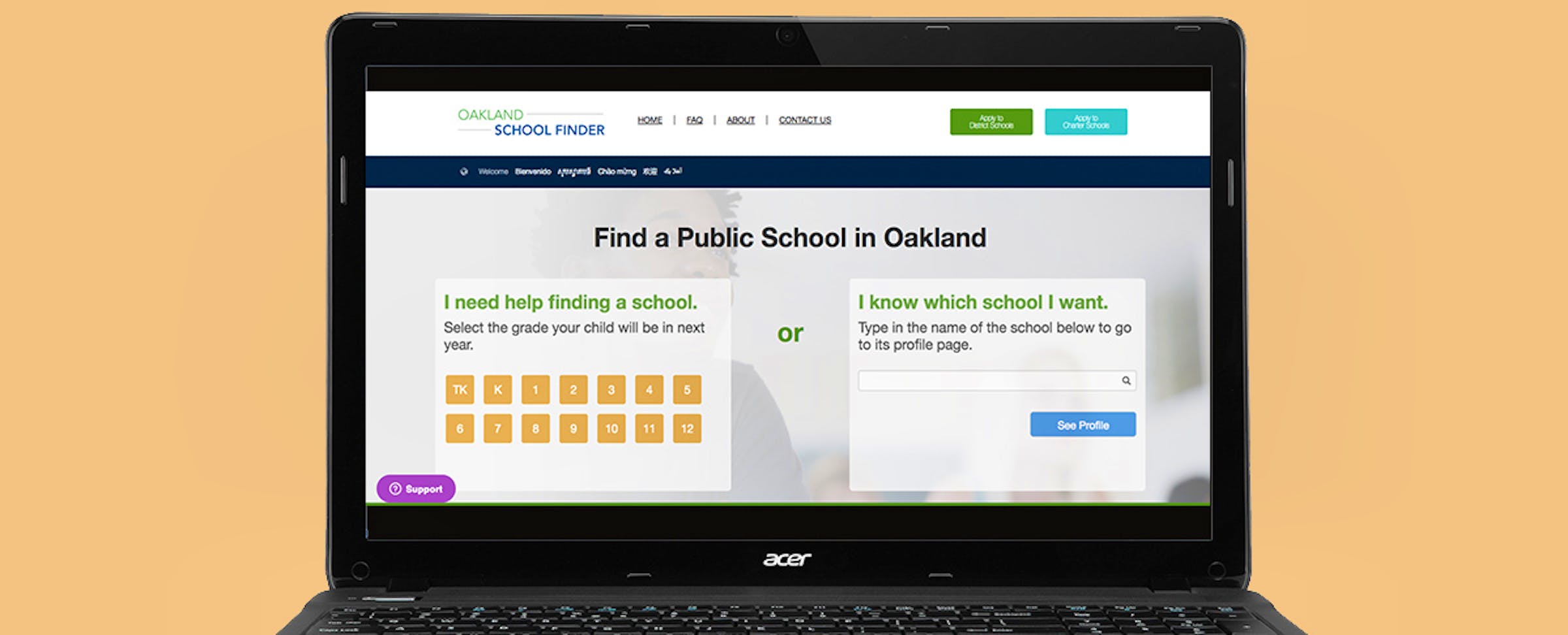
A key piece of this initiative is The Oakland School Finder, which launched in December. The site provides consolidated information about public and district schools, as well as links to applications for both. Using the School Finder wizard from any device, parents can input their address and select criteria that matter to them in a school, like blended learning, an emphasis on the arts, or after-school programming. The School Finder then generates a map that highlights all of the surrounding schools—both district and charter—that fit the parents’ preferences. With additional detail about each school and direct links to applications, this tool seeks to be a one-stop shop for school enrollment.
Additionally, OUSD and EOC partnered with school choice platform provider SchoolMint to provide a unified application platform. While the applications for district and charter schools are still separate, families only have to create one account and profile that they can use for both. With participation from 90% of Oakland’s charter schools, this platform allows families to complete just one application for charter schools (as opposed to one application for each charter school) and one application for district schools. Not only does the platform support the submission of the applications, but it also facilitates key stakeholder communications. From submitting the application to awaiting varying lotteries to actually completing the requirements to enroll, parents can access all of of this pertinent information at any time from their computer or device.
“Any tools that can help streamline these application processes would be useful for today's households,” says Lisa Schultz, a parent in Oakland who began thinking back in late December about school options for her ‘Oakland School Finder’ Platform Stirs Public District vs. Charter Debates | EdSurge News:

Democrats plan all-night protest ahead of DeVos vote | TheHill

Democrats plan all-night protest ahead of DeVos vote | TheHill:

Democrats plan all-night protest ahead of DeVos vote


Senate Democrats are planning a rare all-night talkathon to protest Betsy DeVos's nomination for Education secretary ahead of an expected vote on Tuesday.  
"Democrats will hold the floor for the next 24 hours, until the final vote, to do everything we can to persuade just one more Republican to join us," Sen. Patty Murray (D-Wash.) said from the Senate floor Monday.
Unless Democrats agree to yield back some debate time, a final vote on DeVos is expected for noon Tuesday, when Vice President Mike Pence will likely need to break a 50-50 tie. 
A spokesman for Murray confirmed that "Democrats plan to keep the floor open and there will be speeches over the night in this final push."
Multiple Senate Democrats indicated on Monday afternoon that they would take part in the late-night session to voice their objections to President Trump's nominee to lead the Department of Education.
Sen. Bob Casey Jr. (D-Pa.) said shortly after the Senate came into session at noon Monday that Democrats would speak out against DeVos from the Senate floor "for the next 24 hours."  


Sen. Brian Schatz (D-Hawaii) added that is he is scheduled to speak at 2 a.m. 
DeVos, a GOP mega-donor, has been the subject of fierce opposition from teachers unions and other liberal groups over her support for charter schools and tuition vouchers using public funds.
She cleared a key procedural hurdle during a rare Friday morning session in a party-line 52-48 vote. 
No Democrat is expected to support DeVos's nomination. GOP Sens. Susan Collins (Maine) and Lisa Murkowski (Alaska) are expected to vote against her.
Opponents are running out of time to find a crucial third Republican to help them sink DeVos. Republican Sens. Pat Toomey (Pa.), John Hoeven (N.D.), Dean Heller (Nev.) and Deb Fischer (Neb.) — each considered potential candidates to flip and oppose DeVos — announced late last week that they would support Trump’s nominee.Democrats plan all-night protest ahead of DeVos vote | TheHill:

How I Finally Faced Up To The Hate Unleashed By Trump And Betsy DeVos | The Huffington Post

How I Finally Faced Up To The Hate Unleashed By Trump And Betsy DeVos | The Huffington Post:

How I Finally Faced Up To The Hate Unleashed By Trump And Betsy DeVos


It’s been hard for me to face the whole story explaining why my fellow Oklahomans have embraced Trumpism in general and, too often, his Secretary of Education appointee Betsy DeVos in particular. Even though my conservative state has an extreme record of corruption, we also had an ethic where a politician’s handshake had to be good; an individual’s word had to be true. We believed, “my opponent is my opponent, not my enemy.” In the contact sport of politics, elbows would be thrown, but you don’t take out your opponent’s knee.
Growing up in Oklahoma, I also learned something that I’m less proud of. Although I’ve committed my life to working within the system to make things better for the poorest children of color in Oklahoma City, there is another aspect of my upbringing. If a school reformer looked me in the eye and said what many do in their writing ― that I’m a racist because I try to work inside the education status quo ― I’d likely ask him to step outside.
Or I would have acted according to our code before Trump was elected. Now the stakes are too high to let personal emotion reign.
For the first time in my life, I’m afraid. And the DeVos-subsidized Oklahoma Choice Summit has made me more fearful.
Even though I had registered in advance, there had been a minor protest against the summit’s agenda, and it took some Old School schmoozing to talk my way into the auditorium to see Dr. Steve Perry’s keynote address. Perry is the author of “Push Has Come to Shove: Getting Our Kids the Education They Deserve – Even If It Means Picking a Fight.” I sat down next to an old friend who supports charter and voucher expansion and we shook hands. I then listened, horrified, as Perry shouted insults, non-stop, during his entire presentation. Of course, I’ve seen videos of demagogues firing people up. As a kid too young to understand, I’d witnessed John Birch Society and George Wallace rallies. But, as an adult, I’d never seen anything as frightening as the way Perry worked the crowd.
To be honest, I’d come to listen to fellow audience members more than to a former charter school principal turned showman. I doubted that many in the crowd knew that Perry, the founder of Capital Preparatory Magnet School, is remembered for calling teachers unions “roaches,” for 49 tweets calling education historian Diane Ravitch a racist, and for controversial financial arrangements. Worse, his school would sentence “even the youngest students in the building, to sit at the cafeteria’s How I Finally Faced Up To The Hate Unleashed By Trump And Betsy DeVos | The Huffington Post:

Image result for How I Finally Faced Up To The Hate Unleashed By Trump And Betsy DeVos

Deflecting Trump In LAUSD4 – redqueeninla

Deflecting Trump In LAUSD4 – redqueeninla:
Deflecting Trump In LAUSD4

On March 7, 2017, Los Angeles will play a duplicate round of last November’s presidential election, and we’ll have the opportunity to trump last year’s presidential fiasco.
Since January 20, the billionaires have displayed a dummy hand of hubris, lies and slander. That is, the same hand playing out right now in DC, is being played right here in LA by multi-millionaire, former-mayor Dick Riordan. The choice of the monied-1%, champions a dystopian DeVos-flavored future devoid of truly accountable or equitable public education.
In contrast, our path of Resistance steps neatly across the millions of dollars employed to hobble Steve Zimmer’s policies, that are people-responsive, and people-powered. You vote to resist deep-pocketed, super-wealthy, 1%-politics, when you vote in March for LAUSD School Board District 4’s incumbent, Steve Zimmer.
These are some issues to consider when reviewing the leaflets and immutable forum and conversations littering the landscape:
— A school’s “chartering” agency is tasked with its oversight. That means assuring its policies and operations are truly accountable to the public; that means assuring all the public is served, and not just some of it.
At the same time there is inherent tension between any special interest and its regulators, even not-for-profit Charters.
So what will a school-regulatory system look like when it is governed by electeds who are financed by Charter partisans such as the CA Charter Schools Association and private equity Education-sector investors?
Two of Steve Zimmers’ challengers are beholdened financially to precisely such groups and individuals vested in the special-interests of Charter Schools.
Steve Zimmer is not.
Who will be free of bias to regulate these schools in the best interests of all Deflecting Trump In LAUSD4 – redqueeninla:


DeVos buys influence, Rubio drinks at the trough & it’s not just a FL problem | The Edvocate Blog

DeVos buys influence, Rubio drinks at the trough & it’s not just a FL problem | The Edvocate Blog:

DeVos buys influence, Rubio drinks at the trough & it’s not just a FL problem

Image result for Marco Rubio animated gif


Betsy DeVos, with an estimated net worth of $5.1 billion, has invested at least $200 million buying influence from mostly Republicans and some Democrats. In Florida, Marco Rubio received $98,000 from DeVos and that’s not all. DeVos has covered her bases across the states. In fact seven of the Senators on the Health, Education, Labor and Pensions Committee received generous donations from DeVos and went on to approve her nomination setting her up for a full vote on the Senate floor, Tuesday, February 7th .
Like many ambitious politicians, Florida Sen. Marco Rubio’s need for cash creates conflict over being true to voters or appeasing donors able to secure political futures. Sadly, money wins almost every time.
Job one for every politician is raising cash either for themselves or for the dark money PACs they run. Even first term politicians know their votes are payback for campaign cash.  Constituents be damned. That’s why in the face of an estimated three million calls and letters in opposition, folks like Marco Rubio will close his email box, shut down his voice mail and vote yes for U.S. Secretary of Education nominee Betsy DeVos.
When it comes to pay to play politics, the single, most powerful force standing between voters and money is we, the people. Know this for 2018. The stakes are exponentially high.
For now, contact Sen. Marco Rubio and all the others who took money from Betsy DeVos. Let them know, it’s time to pay the real piper – the voters.
Sen. Marco Rubio:

Black History Month: We can overcome and we must resist! - Lily's Blackboard

Black History Month: We can overcome and we must resist! - Lily's Blackboard:

Black History Month: We can overcome and we must resist!


 “Dr. King, President Lincoln, and other shapers of our American story proudly watch over our National Mall. … They spoke and marched and toiled and bled shoulder-to-shoulder with ordinary people who burned with the same hope for a brighter day.  That legacy is shared; that spirit is American. … So let us honor those who came before by striving toward their example, and let us follow in their footsteps toward the better future that is ours to claim.” ­–2013 National African American History Month  Presidential Proclamation by Barack Obama 

At a moment when our nation’s values are being challenged, when our president scapegoats immigrants and anyone he deems as “other,” and when our American spirit is being put to the test, Black History Month and President Obama’s words from four years ago remind us: We can endure, we can overcome and we must resist.
It’s important to recount the stories of the many African Americans who made sacrifices and endangered their lives and families to push an often-unwilling nation forward. And while February is the month for officially doing so, we can and should remember their struggles, triumphs and achievements all year long.  
Here are some resources to help you bring Black History Month to life in your schools and communities.  
NEA Black History Month Lessons and Resources: A selection of lesson plans that cover a variety of subjects, adaptable to fit all grade levels.
Teaching about the Selma to Montgomery Marches: March 2017 marks the 52nd anniversary of the Selma to Montgomery Marches, and these lesson and resources help students learn about the sacrifices and achievements of the many people involved.
Read Across America in February: This NEA site features a selection of books perfect for exploring Black History Month through thought-provoking and entertaining books for students of all ages. The featured book for this month is Freedom in Congo Square, which describes the lives of slaves who worked sunup to sundown, but gathered in New Orleans’ Congo Square to share music on Sunday afternoons.
Smithsonian Education: Educators can find on this site links to the Smithsonian Institution’s vast educational resources for Black History Month, including those at the brand new National Museum of African American History and Culture.
History Channel.com: This site features a brief history of Black History Month (or National African American History Month), short video clips about such historical figures as Harriet Tubman, Carter G. Woodson, Jackie Robinson and many others, as well as clips on the Harlem Renaissance, African Americans in the military and much more. It also includes snippets of speeches by and interviews with a variety of leaders, such as the late Barbara Jordan, the Texas Congresswoman who in 1976 became the first black woman to be a keynote speaker at a Democratic National Convention, Ralph Ellison, author of the classic book Invisible Man, and Muhammad Ali, interviewed about sports and politics.
PBS.org: On this site, the Public Broadcasting Service has pulled together resources and lesson plans covering topics ranging from civil rights anniversaries to discussions about race in the present day.
ScienceNetLinks: This K-12 science education site sponsored by the Association for the Advancement of Science Black History Month: We can overcome and we must resist! - Lily's Blackboard:

Detroit Free Press Editorial Board: U.S. Senate must reject DeVos appointment

U.S. Senate must reject DeVos appointment:

U.S. Senate must reject DeVos appointment


Make no mistake: A vote to confirm Betsy DeVos as U.S. Secretary of Education is a vote to end public education in this country as we know it.
This isn't conspiracy theory, or ideologically driven slander. Look at DeVos' own words and actions, over her long career advocating against traditional public schools; her funding of an ideologically driven pro-charter lobby; her willingness to spend whatever it takes to ensure her policy preferences become law.
DeVos is unqualified in every respect to serve as head of this critical department, and the U.S. Senate must vote Tuesday to reject her nomination.
West Michigan billionaire DeVos hasn't worked in public education, public administration, or even in mainstream education reform. She's demonstrated a refusal to value outcomes over ideology. But she's contributed millions to the Republican Party and Republican candidates, to the pro-school-choice lobby she essentially founded, and to like-minded candidates whose careers she has financed.
All at the expense of public school students, mostly black, mostly in Detroit -- children a world away from the Grand Rapids area where the DeVos family makes its home.
But nor has she spent her considerable wealth and influence advocating for better schools outside of Detroit; report after report shows Michigan schools are falling dangerously behind, that serious investment and course correction are required to stop this slow slide to the bottom.
DeVos has called traditional public schools a "dead end," a government "monopoly." Husband Dick DeVos said the couple bemoans the role public schools have played at the heart of American communities -- replacing, they believe, the church as the central institution of American life. She has advanced or lobbied for programs that draw taxpayer dollars from those schools, always to those schools' great detriment, to fund unregulated charter schools or to provide public-money vouchers for private education.
There's nothing inherently destructive about charter schools. Properly managed charters can be a viable alternative for parents with few options. But that's not the kind of charter school DeVos has championed -- and nor can an education secretary's educational advocacy be so one-sided. In Michigan, charter schools can be run by for-profit operators. Charter schools can siphon public money for decades, taking taxpayer dollars without making good on the promise of better results.
DeVos' defenders are quick to claim Detroit, where charter schools have proliferated at a record pace, as a victory for her pro-school-choice ideology. They're wrong. A Michigan State Reform Office plan to close failing schools may be stymied, in Detroit, by a dearth of high-quality educational options citywide. Look no further than a map of Detroit schools ranked by academic outcomes -- the same neighborhoods served by failing traditional public schools are also home to failing charters. The problem is not insufficient choice. It's an obstinate refusal on the part of DeVos and her lobby of ideologically driven reformers to acknowledge that school choice is meaningless if all choices are bad.
Last summer, DeVos and members of her family spent more than $1.45 million over seven weeks to reward Republican lawmakers for stripping an education commission -- a body that would coordinate school openings and closings in Detroit, ensuring that quality schools aren't geographically clustered, and ride herd on quality for all publicly funded schools, ensuring Detroit's kids aren't forced to choose between bad and worse -- from Detroit school reform legislation. It was a naked display of influence. But that's something that's long since ceased to trouble DeVos.
“My family is the biggest contributor of soft money to the Republican National Committee,” DeVos wrote in 1997, in the Capitol Hill newspaper Roll Call. “I have decided to stop taking offense at the suggestion that we are buying influence. Now I simply concede the point. They are right. We do expect something in return. We expect to foster a conservative governing philosophy consisting of limited government and respect for traditional American virtues. We expect a return on our investment."
Michigan Sens. Debbie Stabenow and Gary Peters, both Democrats, have said they won't vote for DeVos.
For members of the Senate to vote against DeVos' confirmation as U.S. Secretary of Education would be an act of courage -- billionaire DeVos may be the only cabinet nominee in recent history with both a penchant for buying legislative seats and the means to fund an ballot-box challenge to her elected foes.
But that's just another in the long list of reasons why DeVos is wrong for the job. Traditional conflict of interest restrictions don't apply; DeVos is unlikely to profit from high office, but her ability to hand-pick a sympathetic legislative branch is unprecedented.
In short: This is a really bad idea.
We hope the U.S. Senate will see that.U.S. Senate must reject DeVos appointment:

Schools Matter: Betsy DeVos, Serial Plagiarizer

Schools Matter: Betsy DeVos, Serial Plagiarizer:
Betsy DeVos, Serial Plagiarizer


In one instance she lifted from ALEC, which is entirely fitting, since ALEC will now be writing Rules and Regs at ED.  

Below is a clip from Dr. Roxani Marachi's blog:


. . . .Senator Murray asks,

“If you claim to support accountability and transparency, why do the model voucher policies from the American Federation for Children that you chaired fail to require students in private schools receiving vouchers to take the same assessments and report the same data as those in public schools?”
DeVos answers:

“The model voucher policies include strong accountability provisions. I’ve included the language below for your review:
(C) Academic Accountability Standards. There must be sufficient information about the academic impact Parental Choice Scholarships have on participating students in order to allow parents and taxpayers to measure the achievements of the program, and therefore:
(1) participating schools shall:(a) annually administer either the state achievement tests or nationally norm-referenced tests that measure learning gains in math and language arts, and provide for value-added assessment, to all participating students in grades that require testing under the state’s accountability testing laws for public schools;(b) provide the parents of each student with a copy of the results of the tests on an annual basis, beginning with the first year of testing;(c) provide the test results to the state or an organization chosen by the state on an annual basis, beginning with the first year of testing;(d) report student information that would allow the state to aggregate data by grade 
Schools Matter: Betsy DeVos, Serial Plagiarizer:

Failed common core SBAC/SAT tests punish students by Wendy Lecker - Wait What?

Failed common core SBAC/SAT tests punish students by Wendy Lecker - Wait What?:

Failed common core SBAC/SAT tests punish students by Wendy Lecker


In a weekend commentary piece in the Stamford Advocate entitled, Failed common core tests punish students, education advocate Wendy Lecker writes,
Across the country, states are re-examining their embrace of the hastily implemented common core tests. Membership in the Smarter Balanced Assessment Consortium (SBAC) has dwindled from 31 to 14 states. West Virginia is the latest state to consider dropping the test for all grades.
Last year, Connecticut convened a committee to review Connecticut’s standardized tests, the SBAC and SAT. However, the committee’s final report ignored serious validity problems and concluded Connecticut should plow ahead with these expensive and questionable standardized tests.
Connecticut’s teachers’ unions, CEA and AFT, dissented from this report, because these committee members did their homework. Their enlightening minority report is based on an examination of the evidence on the SBAC, as well as surveys of teachers, administrators, parents and students conducted across Connecticut.
The minority report highlights the evidence ignored by the Mastery Committee. It notes that experts across the country admit that computer adaptive tests such as the SBAC are “in their infancy” and their validity cannot yet be established. Compounding the validity problems is the inconsistency in computer skills among different populations in Connecticut, with poor kids at a particular disadvantage; and the inconsistency in devices used. Shockingly, the minority report emphasizes Connecticut has not proven alignment between the SBAC and our state standards. There is also no evidence that the SBAC is valid to measure student “growth.”
Administrators overwhelmingly agree that the SBAC is not user-friendly Failed common core SBAC/SAT tests punish students by Wendy Lecker - Wait What?:

Foundations aren’t helping anyone if they’re not serious about social justice - The Hechinger Report

Foundations aren’t helping anyone if they’re not serious about social justice - The Hechinger Report:

Foundations aren’t helping anyone if they’re not serious about social justice
Philanthropy needs to become more diverse and fund fight for political change


The National Interest: Once a month, this column is tackling broader questions about what the country should do about gaps in achievement and opportunity, especially for boys of color, in a partnership with The Root.
There are wealthy, white philanthropists in every city saying they want to change urban education, but few are able to save their own organizations from whiteness. That’s because few funders are serious about social justice. And taking their money erodes the seriousness of those who take it.
What makes an organization serious about social justice? Show me the board members, executive staff and the grant recipients. They better look like the public school students they allegedly serve.


Funders are not the experts – communities are. Nonprofits that take money from wealthy donors who aren’t serious about taking on the values of the communities they fund are a major reason why the rich continue to hold on to more power than they deserve while urban schools stay in reform mode.
“Funding practices that get in the way of infrastructure-building for social change need to be confronted,” the National Committee for Responsive Philanthropy (NCRP) says in its new “ten-year strategic framework.” Translation: black and brown people must resist people who give money to our causes but aren’t really down for our struggle. But let’s not be quick to label people sell-outs. The problem is less about who takes money as much as it is about who gives. The NCRP framework is meant to guide philanthropic organizations in how to Foundations aren’t helping anyone if they’re not serious about social justice - The Hechinger Report: