Friday, October 7, 2016

Bruce Lesley: Shortchanging Our Children, Our Schools, and Our Future – Voices4Kids – Medium

Shortchanging Our Children, Our Schools, and Our Future – Voices4Kids – Medium:

Shortchanging Our Children, Our Schools, and Our Future

In a new report by the Urban Institute entitled Kids’ Share 2016, the authors found that state and local spending on education declined dramatically during the Great Recession. Co-author Julia Issacs writes, “As the economy turned downward in late 2008, local revenues fell with the drop in property values, and state revenues fell with declines in earning and income.
In response to the recession, safety net programs like Medicaid provided additional support to a growing number of people living in poverty, including children. However, states cut other areas of their budgets, such as education in order to balance their budgets. According to Isaacs, state and local spending on education dropped by $36 billion from 2008 to 2011 or “by more than $400 per child between 2008 and 2010.”
Fortunately, federal support for education, as part of the American Recovery and Reinvestment Act of 2009 (ARRA), increased during the period and helped compensate for the drop in state and local support for education.Isaacs adds, “Between 2008 and 2010, federal spending on education increased by more than $370 per child. As a result, total spending on education remained fairly steady at about $8,000 per child in 2008–10.”
The bad news, according to the Kids’ Share 2016 report, is that federal support for education has dropped from a high of $74 billion in 2010 to $41 billion in 2015, a decline of more than 40 percent in the last five years. The Urban Institute explains, “Some decline from the ARRA years was to be expected, but it is notable that federal education spending remains 9 percent lower than in pre-recession 2008.”
At the same time, the hope would be that state and local spending on education would have rebounded. Unfortunately, that has not happened. According to analysis by the Center on Budget and Policy Priorities, “In 30 states, total state and local funding combined fell between the 2008 and 2014 school years.”
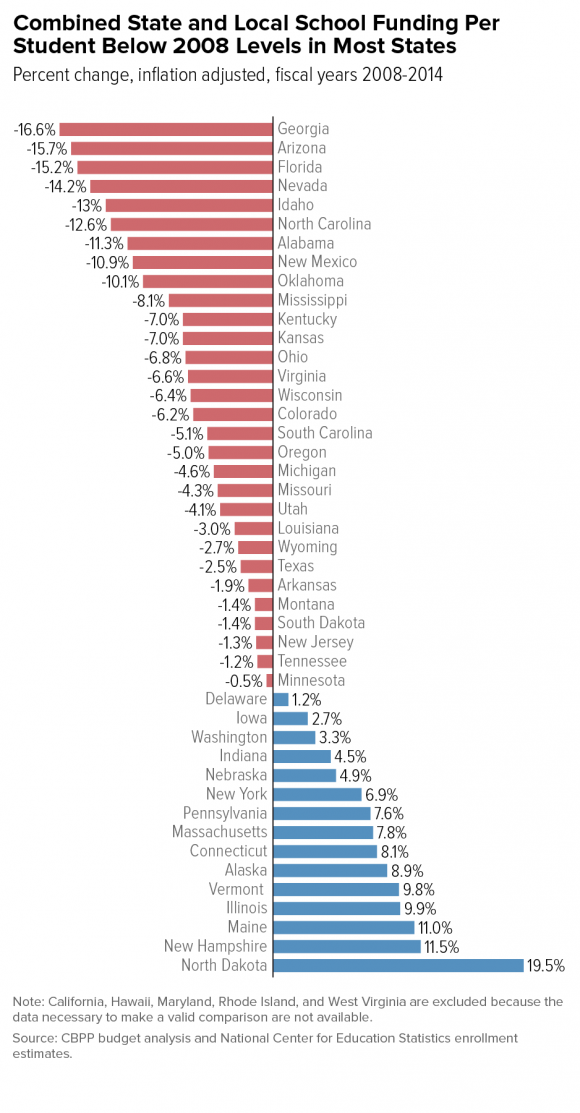
Source: Center on Budget and Policy Priorities

The fact is that money matters (see hereherehere, and here) and the combined drop in federal, state, and local funding to education has been aShortchanging Our Children, Our Schools, and Our Future – Voices4Kids – Medium:


Why bankers got fined for wrongdoing — but teachers went to jail - The Washington Post

Why bankers got fined for wrongdoing — but teachers went to jail - The Washington Post:

Why bankers got fined for wrongdoing — but teachers went to jail


It’s long been common to hear about private companies that are accused of wrongdoing by officials and paying fine to settle a lawsuit — but aren’t required to admit any guilt, even when it is painfully obvious they are. In this post, educator Larry Cuban explains why “[i]mmunity from accountability is currently widespread in the private sector, but not in the public sector.” Cuban was a high school social studies teacher for 14 years, a district superintendent (seven years in Arlington, VA), and is professor emeritus of education at Stanford University, where he has taught for more than two decades. He is the author of numerous books, including “Inside the Black Box of Classroom Practice: Change without Reform in American Education.” This appeared on his blog in two parts (here and here) and he gave me permission to publish.


 By Larry Cuban


Wells Fargo, a bank that made more than $80 billion in revenue  and has a market value of $277 billion, was fined $185 million by federal regulators for creating 1.5 million fake credit card accounts. In the plea bargain that regulators made with bank officials, Wells Fargo admitted no responsibility for the financial misconduct. The company had fired more than 5,000 of its lowest-paid employees, but neither the senior vice president for community banking — where the fraud occurred — nor the CEO have lost their positions.
CEO John Stumpf, who was named in 2013 as Morningstar’s CEO of the Year and earns about $20 million a year, did face U.S. Senate Banking Committee questions about the phony accounts last week. In testimony, he said, “I take full responsibility for all of the unethical practices in our retail banking business.” But Sen. Elizabeth Warren (D-MA), a member of the Banking Committee, said what the bank did was a “scam” and that Stumpf “should resign” and “be criminally investigated.”
Looking back at the fallout from the Great Recession of 2008 in lost billions of investors’ dollars, millions of home foreclosures, and crushed hopes of a generation of hard-working American retirees — apart from one senior trader at Credit Suisse who was convicted and Why bankers got fined for wrongdoing — but teachers went to jail - The Washington Post:
Image result for big education ape but teachers went to jail

Schools Matter: Understanding KIPP Model Charter Schools, Part 11

Schools Matter: Understanding KIPP Model Charter Schools, Part 11:

Understanding KIPP Model Charter Schools, Part 11

Get 20% Off w/code: RLEGEN16

This is Part 11 from Work Hard, Be Hard: Journeys through "No Excuses" Teaching.  It's another piece of the puzzle providing a clear picture of the KIPP Model "Miracle."
Chapter 11

Special Needs Students and the KIPP Model: “A Lawsuit Waiting to Happen”

            Research (Miron, Urschel, & Saxton, 2011; Miron, Urschel, Mathis, & Tornquist, 2010) consistently shows that the majority of total compliance charter schools have significantly fewer English language learners and special education students.  The charts below show trends of students served by KIPP schools and public school districts for 2005 through 2009 (Miron, Urschel, & Saxton, 2011, p. 14).


More recent research (Weber & Rubin, 2014) shows that, when comparing the types of disabilities found at charters with regular public schools, the disabilities of students enrolled in charter schools are ones that require fewer time-consuming and costly accommodations and individual education plans (IEPs).  Based on interviews with former KIPP teachers, these findings become more understandable.
Schools that follow the KIPP model use predominantly large group direct instruction, with the teacher expected to be in complete command of behavioral and academic tasks.  Most school leaders and teachers at KIPP have not completed traditional teacher education programs, and their understanding of special needs children’s learning modalities is most often scant or non-existent.  This reality presented itself for one former KIPP teacher, who had never been consulted regarding his students’ IEPs. 
The lone special education teacher was a faculty member he had seen “once or twice” during his two years at KIPP.  He spoke of the inexperience, isolation, and lack of collaboration at his school that he blamed for a dangerous event involving a special needs student:


So many times I felt like I was just working in isolation. And again, I liked my colleagues and I never felt like there was anybody Schools Matter: Understanding KIPP Model Charter Schools, Part 11:


CURMUDGUCATION: College Digitized and Privatized

CURMUDGUCATION: College Digitized and Privatized:

College Digitized and Privatized


Slice the "a" from 'audacity" and you have Udacity, the leading purveyor of for-profit, on-line college. Udacity is the dead of digitizing, the maharajah of MOOCkery. In them, we can see everything in the digitally privatized future face of higher ed that some folks love and other folks find appalling.


Born in 1967, Sebastian Thrun came from Germany and found a place as a Stanford professor and Google VP. He was the founder of Google X, the big geeky exploratory part of Google, and he has had a hand in everything from hoverboards to self-driving cars.

Thrun is also one of the co-parents ofUdacity, an on-line digitized set of courses that can earn you, among other things, nanodegrees, which appear to be the same basic idea as micro-credentials, but which sound slightly more academically legit. Udacity started out as a few computer courses offered for free by Stanford, and its nanodegree offerings still seem primarily tech oriented, with everything from software debugging to interactive rendering to software development to web design to inscrutable-to-laypeople programs like full stack web developer. Plus a couple of Google-specific programs. And currently their most hugely popular offering is one "taught" by Thrun himself-- Self-Driving Car Engineer. SDCE has pulled huge numbers of interested customers students for the course that will cost $2,400 for three twelve-week terms.

The usefulness, effectiveness, and educational validity of Massively Open On-line Courses has been 
CURMUDGUCATION: College Digitized and Privatized:


Gates Want Taxpayers to Subsidize Ed Tech Research - Living in Dialogue

Gates Want Taxpayers to Subsidize Ed Tech Research - Living in Dialogue:

Gates Want Taxpayers to Subsidize Ed Tech Research 


By Anthony Cody.
Bill Gates has posted a blog in which he argues for government investment in various sectors, including educational technology. He suggests that the government should:
  1. Provide everyone on earth with affordable energy without contributing to climate change.
  2. Develop a vaccine for HIV and a cure for neurodegenerative diseases.
  3. Protect the world from future health epidemics, which might be more infectious than Ebola and more deadly than Zika.
  4. Give every student and teacher new tools so all students get a world-class education.
I agree with him that the government should be supporting research in the first three arenas he suggests. However, his argument for educational technology is not very strong. He writes:
Technology can make teachers’ jobs easier and their work more effective by letting them upload videos of themselves in the classroom, connect with other teachers, watch the best educators at work, and get real-time feedback from their students. The private sector has started work on these ideas, but funding for government research budgets would boost the market and help identify the most effective approaches, giving teachers and students new tools that empower them to do their best work.
But while he suggests that these technologies are “in their infancy,” actually, everything he mentions has been around for a decade or more. Let’s look at his concrete ideas:
Teachers uploading and watching videos of one another teaching: There is no technological barrier to Gates Want Taxpayers to Subsidize Ed Tech Research - Living in Dialogue:

Hupfeld Academy meets 'original vision' of charter schools - NonDoc

Hupfeld Academy meets 'original vision' of charter schools - NonDoc:

Hupfeld Academy meets ‘original vision’ of charter schools

Hupfeld Academy
Text scrolls along a digital marquee Tuesday outside of Stanley Hupfeld Academy in Oklahoma City. (Josh McBee)

Congratulations to Stanley Hupfeld Academy at Western Village for being named an exemplar school by The Partnership for 21st-Century Learning (P21), an organizationdedicated to advancing curriculum that fosters student success in 21st-century work and life.
Hupfeld Academy was honored because it provides “an arts-integrated curriculum and full-time specialists in visual art, music, dance, physical education, technology and literacy arts on staff.” Hupfeld also just happens to be one of the state’s first charter schools.

Before and after NCLB

When founded in 2000, Hupfeld replaced the failing Western Village Elementary School. This was a time before No Child Left Behind, when unionized and nonunion educators supported charters as a means for promoting innovation. Locally, this was during the MAPS for Kids bipartisan, collaborative reform campaign. Like the Oklahoma City American Federation of Teachers’ then-president Ted Metscher, I joined MAPS in supporting Hupfeld and school choice. Oklahoma City has produced a number of excellent charters, but Hupfeld was the only one that met the challenge of the original, constructive vision of charters by serving a poor neighborhood.
Sixteen years later, it’s hard to imagine such a charter being established in Oklahoma City. Hupfeld didn’t engage in the mass exiting of veteran teachers (and their higher salaries) or drill-and-kill, bubble-in accountability. At “Great Expectations” conferences, we could hear the joyous singing and chanting of its faculty long before they entered the room. Because Hupfeld is co-sponsored by INTEGRIS Health, where school founder Stanley Hupfeld served as president and CEO, it was able to “become a community center, serving the health care needs of the students and their families, and providing adult education opportunities.”
If a charter and/or a hospital were now to attempt to do what Hupfeld did, I would encourage it to welcome the teachers’ union. Regardless, I would support any good faith effort to serve an entire high-poverty Oklahoma City neighborhood. Given Oklahoma’s low per-student spending as well as the current test-driven, competition-driven charter Hupfeld Academy meets 'original vision' of charter schools - NonDoc:

Is California's new accountability plan "gobbledygook"? — PS connect

Is California's new accountability plan "gobbledygook"? — PS connect:

Is California's new accountability plan "gobbledygook"? 


Joe Mathews of KCRW's Zocalo thinks so.

I listened to Mathews complain about California's new accountability plan today on Los Angeles' NPR affiliate. He said the new program, which gives feedback on multiple measures rather than API, is confusing and lacks coherence.

He's missing the purpose of this shift.

“People want simplicity (that test scores provide) but simplicity hasn’t gotten us very far,” said former State Superintendent of Public Instruction Bill Honig, in anEdsource interview. “We really have to look at the breadth of what is going on.”

If we encourage parents to choose a school based on a Yelp-like rating, we're encouraging a superficial look--usually based on test scores.

The new accountability plan aims to give parents a picture of many aspects of a school. That's important, because more and more research shows that test scores are a result of a lot that is beyond a school's control.

Encouraging parents to look at the many aspects of the school is a good thing.
Through most of the years of my children's education, schools were reduced to a single number. That meant that schools that were well-resourced, with students who were well supported at home and easy to teach scored high, while those schools that served needier students scored lower.
Should I look only at schools with one type of student? No. Diversity is better than division.

Walgrove Elementary school in my neighborhood of Venice has had a stellar special education program whose families are embraced by the whole school community. It's a large part of the culture of the school. So special ed students come from all over. This impacted the school's overall test scores for a while, making 
Is California's new accountability plan "gobbledygook"? — PS connect:


Segregated Schools are NOT Community or Neighborhood Schools

Coalition for Public Education/Coaliciรณn por la Educaciรณn Pรบblica: Segregated Schools are NOT Community or Neighborhood Schools:

Segregated Schools are NOT Community or Neighborhood Schools

Segregated Schools = Less Funding for Black Schools While Being Controlled by Whitefolks


 This is still happening in the US. It is part of the American education system's DNA. To rid this deformity, serious deep surgery must be performed by those experts known as Black & Latino Parents, Students and Educators.Coalition for Public Education/Coaliciรณn por la Educaciรณn Pรบblica: Segregated Schools are NOT Community or Neighborhood Schools:

Evidence Shows Brutal Impact of Racial and Economic Segregation - Living in Dialogue

Evidence Shows Brutal Impact of Racial and Economic Segregation - Living in Dialogue:

Evidence Shows Brutal Impact of Racial and Economic Segregation

By John Thompson.
Most of the chapters in Learning from the Federal Market-based Reforms: Lessons for the Every Student Succeeds Act (ESSA)edited by William Mathis and Tina Trujillo, place the last 15 years of test-driven, competition-driven reforms in the context of the previous decade and a half.  For instance, Ben Kirshner, Erica Van Steenis, Kristen Pozzoboni, and Matthew Gaertner, in “The Costs and Benefits of School Closure for Students,” astutely discusses school closures within the context of population shifts in cities that have created “a dynamic, ever-shifting school landscape where school closures have become normal.” The ethos of corporate school reform and a broader social and political culture where “dynamism and disruption are watchwords of a capitalist system that celebrates innovation and change,” have combined to create a mess. “For consumers wanting to get cheaper mobile phones or other consumer goods, new disruptive technologies may be desirable,” Kirchsner et. al conclude, “But when it comes to public goods, particularly in communities hard hit by disinvestment in infrastructure, jobs, or social welfare, the disruptions caused by school closures take on a dystopian quality more suited to Season Four of popular television series, The Wire…”

Personally, I learned the most from Learning from the Federal Market-based Reforms when it analyzed the impoverished, contemporary reform vision within the context of the last 50 years. “Educationalizing the Welfare State and Privatizing Education,” by Harvey Kantor and Robert Lowe, explain that until the 1960’s, the New Deal/Fair Deal quest for justice (which had its downsides, especially in terms of racial discrimination) had moved towards economic equity consistent with social democracy in Europe.  The Great Society, for understandable political reasons, backed off from a social science-driven approach to the War on Poverty, starting to give into the dubious claim that education can drive economic equity, not visa versa.

The War on Poverty trade-off would have been one thing if we could have kept up the pressure for racial justice in schools and society. Desegregation produced real gains in public schools but, by the time of Reaganism, integration was seen as too much of a challenge. Since 1983, “many lawmakers have developed an unswerving faith in the power of sanctions to deter what they perceive to be unproductive behaviors by Evidence Shows Brutal Impact of Racial and Economic Segregation - Living in Dialogue:

EdSource symposium focuses on state’s “new vision for school success” | EdSource

EdSource symposium focuses on state’s “new vision for school success” | EdSource:

EdSource symposium focuses on state's "new vision for school success"

Linda Darling-Hammond, president of the Learning Policy Institute, speeks at EdSource's Symposium 2016 about California's new accountability system.
Linda Darling-Hammond, president of the Learning Policy Institute, at  EdSource’s 2016 symposium in Oakland.
Several education reforms currently underway in California have the potential to result in improved student achievement, but more work is needed to ensure that they achieve their goals, speakers at EdSource’s annual symposium said Thursday.
Nearly 600 education leaders, advocates, teachers and parents attended the event, which EdSource has sponsored in one form or another since its founding in 1977. The theme of this year’s symposium was “Making It Work: Implementing California’s New Vision for School Success.”
The symposium was conducted in partnership with the Learning Policy Institute.
“The real shift that’s going on in California is ultimately not a policy shift,” said David Plank, executive director of the Policy Analysis for California Education organization known as PACE. “What’s really at stake here is a culture shift.”
Plank said the state is “trying to move from a system of compliance (to state and federal regulations) to one of continuous improvement.”
That culture shift he referred to includes transitioning from an accountability system that focused largely on test scores to one looking more broadly at student and school success in multiple areas, including social and emotional learning and school climate.EdSource symposium focuses on state’s “new vision for school success” | EdSource:


Chicago is a union town. Public schools and charter schools prepare for a shut down. | Fred Klonsky

Chicago is a union town. Public schools and charter schools prepare for a shut down. | Fred Klonsky:

Chicago is a union town. Public schools and charter schools prepare for a shut down.

chicago-teachers-union-protest

“The Chicago Teachers Union is the most democratic union in the country,” President Karen Lewis told the crowd at The Girl Talk with Erika Wozniak and Jen Sabella last week.
It wasn’t boasting. And it really wasn’t a criticism of anyone else.
She was responding to the Chicago Tribune’s laughable  editorial attacking the second time Chicago union teachers voted strike authorization. The Tribune compared the CTU to North Korea.
Whatever.
The clock is ticking on the strike deadline of Tuesday.
As a result of a law that the state teacher unions, the IFT and the IEA, supported, the CTU and CPS can only bargain and the CTU can only legally strike over salary and benefits.
It was the same law that requires the CTU to get no less than 75% of their members  to authorize a strike.
It was the same law that links teacher evaluation to individual student test scores.
And it undermined teacher seniority and tenure rights.
And that was the law the IFT and the IEA supported as, in the words of IEA Executive Chicago is a union town. Public schools and charter schools prepare for a shut down. | Fred Klonsky:


Demand the Impossible (excerpt # 6) | Bill Ayers

Demand the Impossible (excerpt # 6) | Bill Ayers:

Demand the Impossible (excerpt # 6)

Demand the Impossible! is available now from Haymarket Books:
Image result for DEMAND the IMPOSSIBLE! bill ayers
 Bill Ayers -- Demand the Impossible!: A Radical Manifesto | Haymarket Books -http://www.haymarketbooks.org/pb/Demand-the-Impossible

“Neither slavery nor involuntary servitude, except as a punishment for crime whereof the party shall have been duly convicted, shall exist within the United States, or any place subject to their jurisdiction.”
—Thirteenth Amendment to the US Constitution (1865), Section 1

Say what? Slavery and involuntary servitude were abolished in 1865 “except as a punishment for crime?” So if a person has been legally convicted of crime, he or she could again be enslaved or forced into involuntary servitude, according to the US Constitution. That helps to explain the creepy feeling I’ve always had whenever I’m in or even near a prison: the stench of the slave market in the air, and the specter of the plantation hovering every- where. In many places the prison/plantations didn’t even bother changing their names: Angola Plantation in Louisiana became Angola Prison, Parchman Farm is still Parchman Farm. The language remained intact, and so did the deeper political structure.

We begin to see clearly the tough bond of white supremacy over changing times and reorganized systems, the thick white glob of Elmer’s glue binding slavery to Jim Crow and then to prisons, bondage, and mass incarceration. The slave system and the mass incarceration system each violently subordinate subjugated persons to the will of their masters; each insists that subjects follow strict routines dictated by the rulers; each reduces subjects to dependency for everything including food and shelter; each isolates their subjects from normal human contact or intercourse; and each forces subjects to work for minimal compensation.

For the oppressors and the exploiting class there’s a ready rationale in every age: from the start white supremacy was promoted to justify aggression, theft, occupation, kidnapping, and murder—it was never based on inferiority, real or imagined. Racism has been aggressively employed in the service of cheap labor and in the suppression of wages and the precariousness of workers’ status and racism justified colonial plunder from the start. As the US Empire began its long and dangerous decline and the indus- trial heartland collapsed in the middle of the twentieth century creating, excess labor became a fearsome predicament for the rulers. The Black freedom movement pushed forward at the same time, demanding access, recognition, and equality. But the counterrevolution pushed back—the gains of African Americans were nominally accepted as an accomplished fact, but in reality they were challenged, halted, and reversed wherever possible. When overt bigotry became socially unacceptable to many, coded markers—crime, drugs, violence—took its place. With African Americans on the march and revolution in the air, with unemployment soaring and jobs disappearing, prison became a central strategy to address multiple crises.

All of this is racism in operation, and it’s worth noting here that the word “racism” has multiple meanings: in popular usage it means bigotry, often manifest in ignorant comments, stereotyped views, and backward language. For example, Cliven Bundy, the cattle rancher from Nevada, is a racist—just listen to him and you know he’s an offensive bigot. And since you and I aren’t bigots, we can glibly claim the high moral ground. But there’s a problem: “racism” is also the structures of white supremacy and the institutional practices of oppression based on race. The examples above are instances of the execution of institutional racism. And so the question for antiracists isn’t, Are you a bigot?, but What are you doing to attack the institutional expressions of white supremacy? The mayor of Chicago shuttered more than fifty public schools in predominantly Black communities and never used the N-word; a slick, sophisticated, and “charming” president pushed harsh legislation that resulted in mass incarceration and the overrepresentation of Black people in prisons. This is white supremacy, and racist practice on the ground and in the world. Call its name.Demand the Impossible (excerpt # 6) | Bill Ayers:


CPS Screening Process Discriminated Against Black Candidates | WBEZ

CPS Screening Process Discriminated Against Black Candidates | WBEZ:

CPS Screening Process Discriminated Against Black Candidates

Image result for CPS Screening Process Discriminated Against Black Candidates

Chicago Public Schools has admitted a teacher screening process used since 2012 discriminated against black and Latino applicants.
The process blocked many applicants of color from even getting interviews.
The district agreed the process was unfair and halted it after WBEZ learned of the disparity this year through a Freedom of Information Act request.
According to 2015 data released by CPS, which got the data from the private company that conducted the screenings, 74 percent of the 2,417 white applicants advanced to the pool of potential hires. Of the 430 Latino candidates, 58 percent made it. And of the 729 black candidates, just 45 percent made it.
CPS officials didn’t have an explanation for the disparity. 
“Obviously, when we saw the data it was troubling, which is why we sought to reverse that policy swiftly,” Chief of Education Janice Jackson said. “Obviously, any type of practice that puts people in a disadvantage and -- with this situation where a minority or another subgroup is disproportionately impacted -- we want to shut that down quickly. We want to strike that down quickly.”
But the district could still be in trouble with the U.S. Equal Employment Opportunity Commission for using the screening process, and the numbers call into question if the decline in black teachers is because of the lack of applicants or because of the process.
In 2014-2015, the most recent data available, 22.3 percent of the CPS teaching staff were black, 20 percent were Latino and half were white. Meanwhile, 39.3 percent of students were black, 45.6 were Latino and 9.4 percent were white.
As recently as a decade ago, about 40 percent of CPS teachers were black.
Studies have increasingly shown it is important for black students to have black teachers, who tend to demand more from black students academically and help them build confidence. Black teachers are also role models for black students. 
But studies also found it is important for white students to be exposed to a diverse teaching staff.

‘They can be non-service workers’

Michelle Evans, an African-American teacher at Nettelhorst Elementary School in the Lakeview neighborhood, said she and her roommate, who is white, talk about how her CPS Screening Process Discriminated Against Black Candidates | WBEZ:

Michigan to Retain Children with Lead Poisoning

Michigan to Retain Children with Lead Poisoning:

Michigan to Retain Children with Lead Poisoning

Child drinking water. Boy drinking water from a glass

Michigan has a lead problem with its children in Flint, and a governor who failed badly his own accountability test. Many wonder why he is still governor. Some wonder why he isn’t in jail. But yesterday he signed off on a bill to fail third graders. How many children in Flint will wind up failing third grade due to the leaded water they drank? I’m guessing many.
So children fail, through no fault of their own, while the governor gets a pass. Fancy that.
I know there are exemptions to failing in Michigan, but that doesn’t excuse a rotten bill that highlights retention as something good.
We know that the fear of failing a grade for a child is on the same level as losing a parent. Once a child is humiliated by this action, they will have a difficult time ever fully recovering.
And children who fail third grade don’t do any better than those who are socially Michigan to Retain Children with Lead Poisoning:

Malloy Administration considering 64.5% tuition increase for 17,000 Community College students - Wait What?

Malloy Administration considering 64.5% tuition increase for 17,000 Community College students - Wait What?:

Malloy Administration considering 64.5% tuition increase for 17,000 Community College students


Governor Dannel Malloy and the Democrat controlled General Assembly have already made record cuts to Connecticut’s public colleges and universities, cuts that have resulted in massive tuition increases and reduced services, but as the CT Mirror is reporting, Governor Malloy’s austerity budget strategies may now lead to a 64.5 percent increase in tuition and fees for more than 17,000 of Connecticut’s college students.
While Hillary Clinton, Bernie Sanders, Elizabeth Warren and other national Democratic leaders propose to make a community college education free in the United States, the Malloy administration is floating a proposal that would lead to a massive spike in cost for those attempting to get a college degree at one of Connecticut’s community colleges.
Currently, students who pay full-time tuition can take up to 18 credit hours. A proposal that the Board of Regents’ finance panel will consider next Thursday would charge students $150 in tuition and $74 in mandatory fees 
Malloy Administration considering 64.5% tuition increase for 17,000 Community College students - Wait What?:

U.S. Dept. of Education’s Own Inspector Again Condemns DOE’s Oversight of Charter School Grants | janresseger

U.S. Dept. of Education’s Own Inspector Again Condemns DOE’s Oversight of Charter School Grants | janresseger:

U.S. Dept. of Education’s Own Inspector Again Condemns DOE’s Oversight of Charter School Grants


You may not be aware that the U.S. Department of Education—under President Barack Obama’s appointees, Arne Duncan and John King—has been awarding billions of dollars to promote the growth of charter schools across the states. Even less reported has been the failure by the U.S. Department of Education to ensure good stewardship of federal funds through careful administration of the federal Charter Schools Program.  Although the operation of the federal Charter Schools Program has been little-reported, there have been warnings. A 2012 report from the Department of Education’s internal Office of Inspector General  (1) exposed the Department’s failure to ensure careful oversight of federal funds by the state departments of education who received grants, and (2) confirmed the Department’s failure to regulate the charter school management organizations that have been charged with overseeing the operations of the schools  supposedly under their purview.
Another—September 2016—report from the U.S. Department of Education’s own Office of Inspector General has uncovered the very same problems. On Wednesday, Valerie Strauss of the Washington Post, shared the new scathing, new indictment by the U.S. Department of Education’s Office of Inspector General of the Department’s own Charter Schools Program: “The Education Department has… poured in excess of $3 billion into the creation and operation of charter schools, but according to a new audit by the agency’s own inspector general’s office, it has failed in some cases to provide adequate oversight and as a result has put its own grants at risk.  The audit titled, Nationwide Assessment of Charter and Education Management Organizations, and conducted by the department’s inspector general… looked at the relationship that several dozen charter schools have had with their own charter management organizations (CMOs).  It found, among other things that there were ‘internal control weaknesses’ related to the schools’ relationships to their CMOs that were so severe that the department’s own program objectives were at ‘significant risk.'”
Strauss continues: “The newly released report comes just as the department announced $245 million in new grants to state educational agencies (state departments of education) and CMOs under its Charter Schools Program, which funds the creation and expansion of charters around the country.  The Charter Schools Program has invested more than $3 billion into these schools since 1995, helping more than 2,500 charter schools open… According to the audit… the department didn’t do enough to ensure that some of the charter schools it is funding have been able to reach the stated goals.”


CURMUDGUCATION: Bill Gates Wants Your Tax Dollars

CURMUDGUCATION: Bill Gates Wants Your Tax Dollars:

Bill Gates Wants Your Tax Dollars


On his blog yesterday, Bill Gates made his pitch to get more our of our tax dollars.


Gates notes that the Presidential campaign hasn't touched much on innovations (which I guess is true if you don't count innovative ways to repackage reality).  Invoking the 1961 moon-shot declaration of John F. Kennedy, Gates wants to make a case for four areas in which the government can spur innovation. With money.

He tries to frame this as a centrist idea by creating an imaginary extreme on one end of the debate:

I’ve heard some people argue that life-changing innovations come exclusively from the private sector. But innovation starts with government support for the research labs and universities working on new insights that entrepreneurs can turn into companies that change the world. The public sector’s investments unlock the private sector’s ingenuity.   

If he means, as his essay suggests, that some people argue that the private sector does these things while refusing any dirty government money, well, I haven't heard anybody argue that. Have you heard, for instance, of any charter schools that have insisted on finding their own funding and have refused any solitary cent of government support? No, me neither.

Gates is arguing for the same old, same old-- private corporations getting their hands on that sweet, sweet pile of tax dollars to fund their enterprise. Gates is arguing that we need to elect leaders who see that the government can make progress on the issues that face us by unlocking innovation with a big fat key made out of money. He cites the space race as one of the great public-private partnerships, but what he doesn't discuss is the manner of the partnership and the rules by which it 
CURMUDGUCATION: Bill Gates Wants Your Tax Dollars:

Mike Klonsky's SmallTalk Blog: Busy first day back at Standing Rock

Mike Klonsky's SmallTalk Blog: Busy first day back at Standing Rock:

Busy first day back at Standing Rock

I took this picture at 6:30 p.m. By 8 p.m. the tepee construction was complete

The ride down from Bismarck was easy. I decided to take the main road, Hwy. 1806, to Standing Rock rather than trying to evade the roadblock. It's now manned by National Guardsmen, mobilized by the state's right-wing governor, instead of by state cops, and I wanted to check it out.

The young trooper in well-pressed, camouflaged fatigues was very polite. I suppose he saw an old white guy, driving alone in a rented Ford SUV and figured I was headed over to the casino in Ft. Yates.

"There's a protest going on, about 20 miles down the road," he warns.

"No shit", I don't say.

"So, slow down when you get close. There may be people out on the road."

"I sure will."

He waves me through, smiles and says, "Good luck at the casino."

About 20 minutes later, I pass the now dormant front-line camp and then turn into the main camp. I have a friendly chat with the two guys manning security at the entrance, tell them who I am and why I'm back. They remind me -- no weapons, no drugs, no booze. I'm good with that, of course.

The encampment looks a little different than it did a few weeks ago when heavy rains had left us ankle-deep in mud, car wheels spinning and stuck vehicles needing a push up the hill.  Now everything is dry. But temperatures have dropped and cold winds whip through the camp. You can feel winter coming on and the hard-core people are digging in and building traditional cold-weather housing. I'm going to look at some new, traditional home construction-in-progress Mike Klonsky's SmallTalk Blog: Busy first day back at Standing Rock: