Latest News and Comment from Education

Friday, September 11, 2015

California legislation would prohibit for-profit charter schools like those run by K-12 Inc. - Sacramento Business Journal

California legislation would prohibit for-profit charter schools like those run by K-12 Inc. - Sacramento Business Journal:

Brown to consider axing for-profit charter schools


California would abolish all for-profit charter schools under legislation now pending before the governor.

The bill would only affect a handful of schools in California, according to an aide to Assemblyman Roger Hernández, the bill's author. The aide said the majority of those charter schools belong to K-12 Inc., an online homeschool headquartered in Virginia. K-12 Inc reported revenue of $948 million in the last fiscal year, and an operating income of $18.4 million.


“Charter schools are funded with public dollars and deserve to be held to the same standards as traditional schools,” said Hernández, a West Covina Democrat. "We do not put profits before students."

Assembly Bill 787 is sponsored by the California Teachers Association and two other school employee unions. Trade groups for charter schools have called for its veto.

K-12 Inc. provides course materials and educational programs to California Virtual Academies, a network of 11 online schools across the state. Jeff Kwitowski, a spokesman for K-12 Inc., characterized the company as a vendor to California Virtual Academies, which he said operates as a nonprofit.

It's unknown what affect the bill would have on the organization, if any, he said.

"This legislation is vague and it's unclear what is trying to be accomplished here," said Kwitowski. He promoted California Virtual Academies as a strong alternative for children with special needs or those who have been bullied.

"If the attempt of the bill is to displace thousands of children from charter schools — that's bad policy," he said.

The California Association of Charter Schools said it applauded the idea of eliminating for-profit charter schools, but it pulled back its support of the legislation this year after initially agreeing to support it.

The association is worried that the bill could hurt a charter school's ability to enter into a contract with any private company, said Myrna Castrejón, the association’s acting CEO.

It is normal practice for charters to contract out food services, special education services or other ancillary needs, Castrejón said. She fears the legislation could spark lawsuits between charters and their authorizing school districts.

“Clearly this would put us at a tremendous disadvantage,” she said.


The Hernández aide said the bill would not affect contracting out. The Assemblyman's office had received such assurances from lawyers for the California Teachers Association and other bill sponsors.

California is home to over 1,200 charter schools, said Castrejón from the charter school association. She said she believes California Virtual Academies was the bill’s primary target. On its website, California Virtual Academies advertises itself as a “tuition-free” public K-12 school accredited by Western Association of Schools and Colleges.California legislation would prohibit for-profit charter schools like those run by K-12 Inc. - Sacramento Business Journal:


Teacher Tom on who is ultimately to blame for the Seattle teachers’ strike | Seattle Education

Teacher Tom on who is ultimately to blame for the Seattle teachers’ strike | Seattle Education:

Teacher Tom on who is ultimately to blame for the Seattle teachers’ strike


From the Teacher Tom website:
On Wednesday, I made a bicycle “solidarity tour” of the picket lines of striking Seattle teachers in front of an elementary school, a middle school, and a high school. At each stop, I found teachers I know as well as former students who were out with their parents in support of the strike. No one wants this strike. The teachers sure don’t, the parents sure don’t, the district sure doesn’t, and the children definitely don’t: every one of them with whom I have spoken is eager for school to start.
From where I sit, there seems to be widespread support for this strike, although I’ve learned to avoid the comments sections of the articles I read. Whatever is going on in my world, there are still some very vocal knee-jerk teacher haters out there. I don’t know if there are lot of them because, when polled, Americans tend to think highly of public school teachers, at least compared to members of other professions, but the haters are loud, mean, and dismally uninformed. Of course, much of the bile is directed at the idea of a union more than the teachers themselves, which shouldn’t be surprising given the relentless campaign against working Americans that has been waged by economic elites for the past three decades, an effort that has even succeeded in convincing many working people to oppose unions. (Yes, economic elites have always been engaged in class warfare against the rest of us, but it has really ramped up since the 1970’s, culminating in the election of Ronald Reagan whose first order to business was to bust the air traffic Teacher Tom on who is ultimately to blame for the Seattle teachers’ strike | Seattle Education:

CURMUDGUCATION: Competitive Baloney & Rehabilitating RTTT

CURMUDGUCATION: Competitive Baloney & Rehabilitating RTTT:

Competitive Baloney & Rehabilitating RTTT


At the Stanford SOCIAL INNOVATION Review (I don't know why the yell the middle of their name), Joanne Weiss has unleashed an astonishing stack of deep-fried baloney that attempts to retro-actively legitimize the destructive power-and-money test-and-punish legacy of Race to the Top."Competing Principles" is truly audacious.

Joanne Who??

Weiss has a powerful pedigree. She put in years as an ed tech honcho before going to work for NewSchools Venture Fund, an investment firm for hedge fundies to get their paws in the education biz and that sweet, sweet mountain of public tax dollars. In conjunction with that gig, she served on the boards of Aspire, Green Dot, Rocketship and Leadership charter outfits, to name just a few.

All of this made her perfectly positioned to become Arne Duncan's Chief of Staff and the lead dog for Race to the Top. Are you starting to understand why that program was such a mess?

But when Weiss looks at RttT, she does not see mess, and in this article, she paints with rosy hues the many fine lessons to be learned from the administration's signature education program.

She opens with a brief fantasy-filled recap of RttT's impact (43 states now have super-magical tests that can measure critical thinking), and then moves on to the Eight Big Design Lessons of Race to the Trough.

Create a Real Competition

The administration was not sure that the initiative would be "compelling." But golly gee, 46 states ponied up to give it a try. Weiss believes that the secret was "our decision to leverage the spirit of competition." How, one may ask, does one harness this mysterious and mystical force?

First, they set a very high bar, allowed for very few winners, and offered very big rewards. She forgets to mention another important step-- launch your competition when states have just been 
CURMUDGUCATION: Competitive Baloney & Rehabilitating RTTT:


Not Bill Gates: Meet Ted Dintersmith, an education philanthropist with a different agenda - The Washington Post

Not Bill Gates: Meet Ted Dintersmith, an education philanthropist with a different agenda - The Washington Post:

Not Bill Gates: Meet Ted Dintersmith, an education philanthropist with a different agenda


Most Likely to Succeed Trailer from One Potato Productions on Vimeo.

If you have paid attention to education reform at all in recent years, you know what Bill Gates, Eli Broad, various Waltons and other very wealthy philanthropists have done with their education grants: support charter schools, and/or Teach For America, and/or standardized test-based teacher evaluations, and/or school voucher programs, and/or other elements of corporate school reform. But now meet Ted Dintersmith, a different kind of education philanthropist with a different school reform agenda.
Dintersmith is a highly successful venture capitalist and father of two who is devoting most of his time, energy and millions of his personal fortune to education-related initiatives that call for a radical remaking of what and how students learn. Instead of classrooms in which kids passively take in facts and figures, he said the U.S. education system should be re-imagined into cross-disciplinary programs that allow kids the freedom to develop core competencies through cross-disciplinary, project-based learning.
He discussed his vision in a book he co-authored, titled, “Most Likely to Succeed: Preparing Our Kids for the Innovation Age,” and he funded and produced a compelling documentary called “Most Likely to Succeed,” which goes into a California school, High Tech High in San Diego, where the project-based educational future he wants to see is already here. You could call it the antithesis of “Waiting for Superman,” the Davis Guggenheim-directeddocumentary which presented an often misleading account of public education and how to improve it. In fact, Dintersmith said, “Waiting for Superman” inspired him to do something very different.
The documentary has already been met with enthusiasm at numerous film festivals and audiences around the country (you can see a schedule of screenings here), and some educators, including Pam Moran, the superintendent of Albemarle County Public Schools in Virginia, are paying attention. At Albemarle High School, for example, Moran has started an interdisciplinary project-based program based on what she saw in the the film. Last month, at the private Foxcroft School in Middleburg, Va., faculty and administrators from private as well as public schools came to a screening of the film and a discussion about education reform.
Dintersmith, who was also executive producer of “The Hunting Ground” film about sexual assault on college campuses, is partner emeritus with Charles River Ventures, an early-stage venture capital firm. He earned a PhD in engineering from Stanford University, and in 2012, was appointed by President Obama as an alternate representative of the United States to the Sixty-seventh Session of the General Assembly of the United Nations, where Dintersmith focused on global education and  entrepreneurship. 
He is now on a 50-state tour with “Most Likely to Succeed” to encourage Not Bill Gates: Meet Ted Dintersmith, an education philanthropist with a different agenda - The Washington Post:


Saving the art of teaching from the science of education | The Lens

Saving the art of teaching from the science of education | The Lens:

Saving the art of teaching from the science of education


“Carpe diem,” the character played by Robin Williams whispers to his impressionable young students in “Dead Poets Society.”
“Seize the day, boys. Make your lives extraordinary.” Later, he jumps up on a desk and implores them to see the world from a different vantage. And they do.
My high school years were spent at a place not all that different from the imaginary realm in which Mr. Keating, the Robin Williams character, held forth.
Mr. Poirot, my Latin teacher, football and wrestling coach and college counselor was one of them. He was an expert on early Christian manuscripts, a Volvo enthusiast, and a Bob Dylan devotee. His enthusiasm for teaching and learning was contagious and his success with both was enviable. He was a rock star.
Then there was Rev (short for Reverend), a pipe smoking, cape-wearing, fire-and-brimstone preacher. He would lead druid services, recite Kierkegaard, and, for dramatic affect, take the Lord’s name in vain. Doc, who wrote our Latin textbook, and Mr. Burgess, a charismatic historian and avid birder, were among teachers who inspired me to join their profession.
And, it must be confessed, I have been known to jump up on tables and desks, play obscure songs and design ridiculous projects in my own bid to make students’ lives extraordinary. I once took my seventh-graders to a sausage factory in Opelousas. I had hoped to teach them about business practices. Instead, I converted many of them to vegetarianism.
My goal was to get them fired up about learning. Whatever it took, I was willing to try. Every class was an opportunity to “carpe diem!”
Killing the sage
As the founding leader of a local public school, I once had a group of teachers evaluate Keating’s classroom technique. True to our profession, they sat silently watching clips and frantically jotting down notes. Using a state-mandated rubric developed by Pearson Publishing Corp., a goliath in the field of standardized testing, they analyzed and critiqued Keating’s every move and every word.
So, how did my fictitious mentor fare? Not so well. He was deemed “effective: emerging” by most and “ineffective” by some. “He lectured too much,” they griped. “He didn’t start with standards-aligned assessments,” others complained. “He handed out papers Saving the art of teaching from the science of education | The Lens:

Seattle Schools Community Forum: SPS Updates

Seattle Schools Community Forum: SPS Updates:

SPS Updates


Both President Carr's community meeting and the Board Retreat (scheduled for tomorrow, Sept. 12th) have been cancelled.  What a surprise.  Don't know when Carr will be available again; the Retreat is rescheduled for Sept. 26th.

There is another district press conference with updates on the strike at 3 pm.  I may not be able to make it but again, will track -via Twitter- any new information.

Listened to both the KUOW Week in Review and their noon show as both talked about the strike (and charter schools, remember them?). 

First, I actually like the people at Washington Policy Center as people but man, there is NOTHING they won't say to promote ed reform.  Paul Guppy was on the Week in Review and he had some whoppers:

- He said the strike was the "nuclear option." 

- He says that Aviation High and the Tri-Cities Delta High may be improperly funded with state funds because they aren't overseen by an elected board (as charters are not).  I may be wrong but I thought both those had oversight by Superintendent Dorn; I'll ask his office.

- He echoed something a charter parent had tweeted to me which was that parents don't care how the money gets into the schools.  Well, I can only say that taxpayers do and frankly, I think that is the lens that the Supreme Court should be looking thru.

- He said there are charters in 41 other states and "no controversy" with them.  He said that as the 300th charter school failed in Florida and Ohio and Arizona are overrun with poorly-run charters. Unfortunately it was radio so I could not see if he made that statement with a straight face.

- Eric Barnett made the point that charters are limited and not every can access 
Seattle Schools Community Forum: SPS Updates:

After 25 Years, Teach for America Results are Consistently Underwhelming | Nonprofit Quarterly

After 25 Years, Teach for America Results are Consistently Underwhelming | Nonprofit Quarterly:

After 25 Years, Teach for America Results are Consistently Underwhelming


America has a love-hate relationship with Teach for America. What began as the dream of one idealistic undergraduate in the late 80s is now, some 26 years later, an internationally recognized behemoth in the education reform movement, with more than $200 million (yes, you read that correctly) in investments as of last year.
A recent book, edited by T. Jameson Brewer and Kathleen deMarrais, titled Teach for America Counter-Narratives is the latest to put the organization under scrutiny. In anarticle this week in the Las Vegas Review-JournalWashington Post columnist Esther J. Cepeda writes about the “explosive and jaw-dropping” stories written by 20 of TFA’s alumni, which she says “eviscerate the myth of TFA’s unmitigated success.” Her takeaway is that the book should be a cautionary tale to those studying the education reform movement. The stories reveal the smoke and mirrors (“money and great marketing,” in her words) that TFA uses to recruit the best and brightest while convincing their donors and other partners that they are moving the needle on outcomes.
According to its most recent tax return, TFA has total assets of close to half a billion dollars and revenues of more than $330 million, of which about 90 percent comes from government grants and contributions from corporations, foundations and individuals. An organization of this size and stature has an obligation to its constituents to demonstrate its success, and TFA has accumulated years of research findings about its programming, expansion and scale-up efforts. Marty Levine and Ruth McCambridge asked on this site several weeks ago whether Teach for America’s results justify its pillar status.
In 2013, Mathematica Policy Research concluded a federally-funded controlled study of TFA. Comparing TFA secondary math teachers across eight states with a control group of math teachers in the same schools, the study found that, on average, students in TFA classrooms gained the equivalent of an additional 2.6 months of school, as evidenced by end-of-year math assessments. However, two years later, a subsequent Mathematica evaluation was unable to replicate those results.
While the later study concluded that TFA teachers in early primary grades produced roughly 1.3 months of extra reading gains, that good news was overshadowed by the more troubling evidence that an overwhelming majority of TFA staff (87 percent) reported that they did not plan to spend the rest of their career as a classroom teacher or, for that matter, in any education-related career.
TFA takes great pride in how well it prepares its corps members for the classroom (in a smidgen of the time it takes a teacher to train through traditional avenues). Studies published on its website find that TFA corps members are “as effective” as other teachers in the same schools and that they promote achievement in measures “equal or sometimes greater.” Two state-wide studies in North Carolina and Tennessee demonstrating TFA’s relatively higher effectiveness in teaching STEM content corroborate these findings, although the Tennessee Higher Education Commission report doesn’t go much further than stating that TFA teachers “tend to be” more effective than other beginning teachers.
As NPR correspondents Eric Westervelt and Anya Kamenetz point out, this can be read as either evidence of TFA’s superior pedagogy or an “indictment” of traditional teacher preparation programs. But it should also be noted that some question the reliability of After 25 Years, Teach for America Results are Consistently Underwhelming | Nonprofit Quarterly:

CURMUDGUCATION: PA: Sub Privatizing Bombs

CURMUDGUCATION: PA: Sub Privatizing Bombs:

PA: Sub Privatizing Bombs


Philadelphia schools joined the ranks of school districts that figured they could save a buck by sub-contracting their substitute teaching work to a private company. Then, Philadelphia schools joined the ranks of school districts that found out they'd made a mistake.

Philly gave the contractor a $34 million contract, and then-- well, back before school started, they had barely 10% of the bodies they needed. I didn't run the story at the time because it was before the start of school, and sub rosters always grow once people decide they really aren't getting a job this fall. But now the school year is started, and Philly still has a measly 300 subs on the roster. The company says it has maybe 500 in the pipeline. The school district says once the year gets going, the demand is in the neighborhood of 1,000 per day.

The district hired the company after only being able to get a "fill rate" of about 66%. The company is not even close to that-- and if they don't hit 90% by January, it will start costing them money. They are mystified. Reporter Kristen A Graham quotes one of the honchos

"We've hired a good number of district originals, and many of them are just not accepting jobs," Murphy said. "Frankly, we're a little unsure why."

Source4Teachers is the outfit, and they already handle about 200 districts. Operating out of Cherry Hill, NJ, their chirpy website includes some darkly ironic rotating headlines.

We need tomorrow's teachers today. 

We need them today because we didn't find out about the absence till today. The company has complained that they don't get enough lead time on what needs to be filled, though they've certainly got plenty of lead time on the 99 unfilled teaching jobs, or the maternity leaves, or the long-term illnesses. If all other Philly teachers could plan their illnesses ahead of time, that would be very helpful.

They also need tomorrow's teachers because if they get more people who aren't actually teachers today, it will help fill the ranks with people who don't mind that this outsourcing has pushed sub 
CURMUDGUCATION: PA: Sub Privatizing Bombs:

Civility. | Fred Klonsky

Civility. | Fred Klonsky:

Civility.

civility
Hunger strikers Cesar Chavez (left) with Jesse Jackson and Jitu Brown (right).


Hunger strikers Cesar Chavez (left) with Jesse Jackson and Jitu Brown (right).

While a lot in this world makes me angry I try not to yell and scream. I try and remain civil.

This was not always true. Back when I was teaching and representing teachers I would get pretty mad and I was known to lose it once in a while.

Sometimes this was more of a tactic than real. Sometimes it was real.

Dear Mrs. Douglass would get so worried about me. I would walk past her room after a meeting with administration and the color in my face was slowly moving from red to pink. “Be careful,” she would say. “We don’t want you getting another heart attack.”

She knew I already had one.

Age and retirement have calmed me down. I am better for it.

Last year’s buzz word was “grit.” It didn’t matter if there were adequate resources for poor kids and kids of color. All you needed was grit to succeed.

What nonsense.

This year we are all about “civility.”

I’m for civil conversations even among those with who we disagree. Of course, why would you worry about having a civil conversation with Civility. | Fred Klonsky:

A busy second day of the Seattle teachers’ strike | Seattle Education

A busy second day of the Seattle teachers’ strike | Seattle Education:

A busy second day of the Seattle teachers’ strike


8765807_G
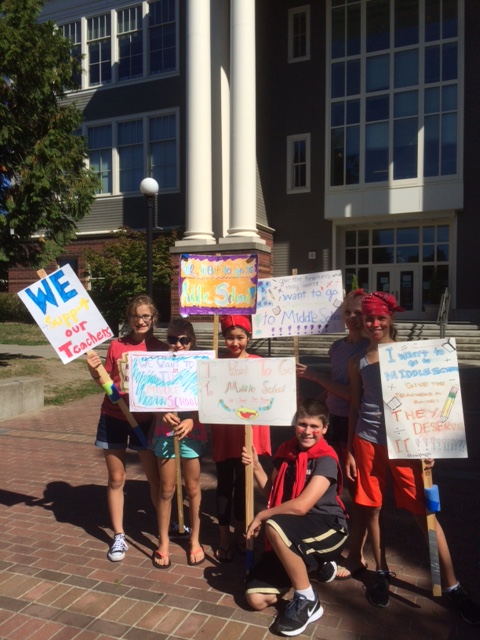
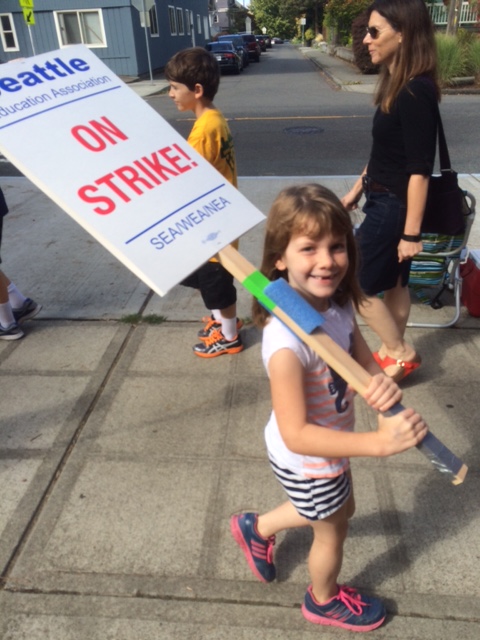
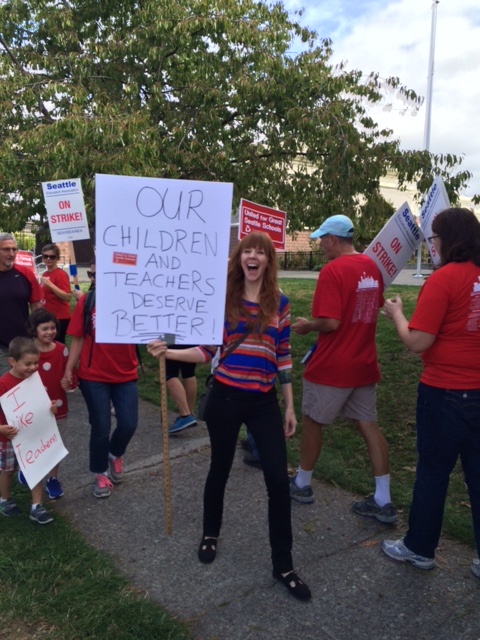
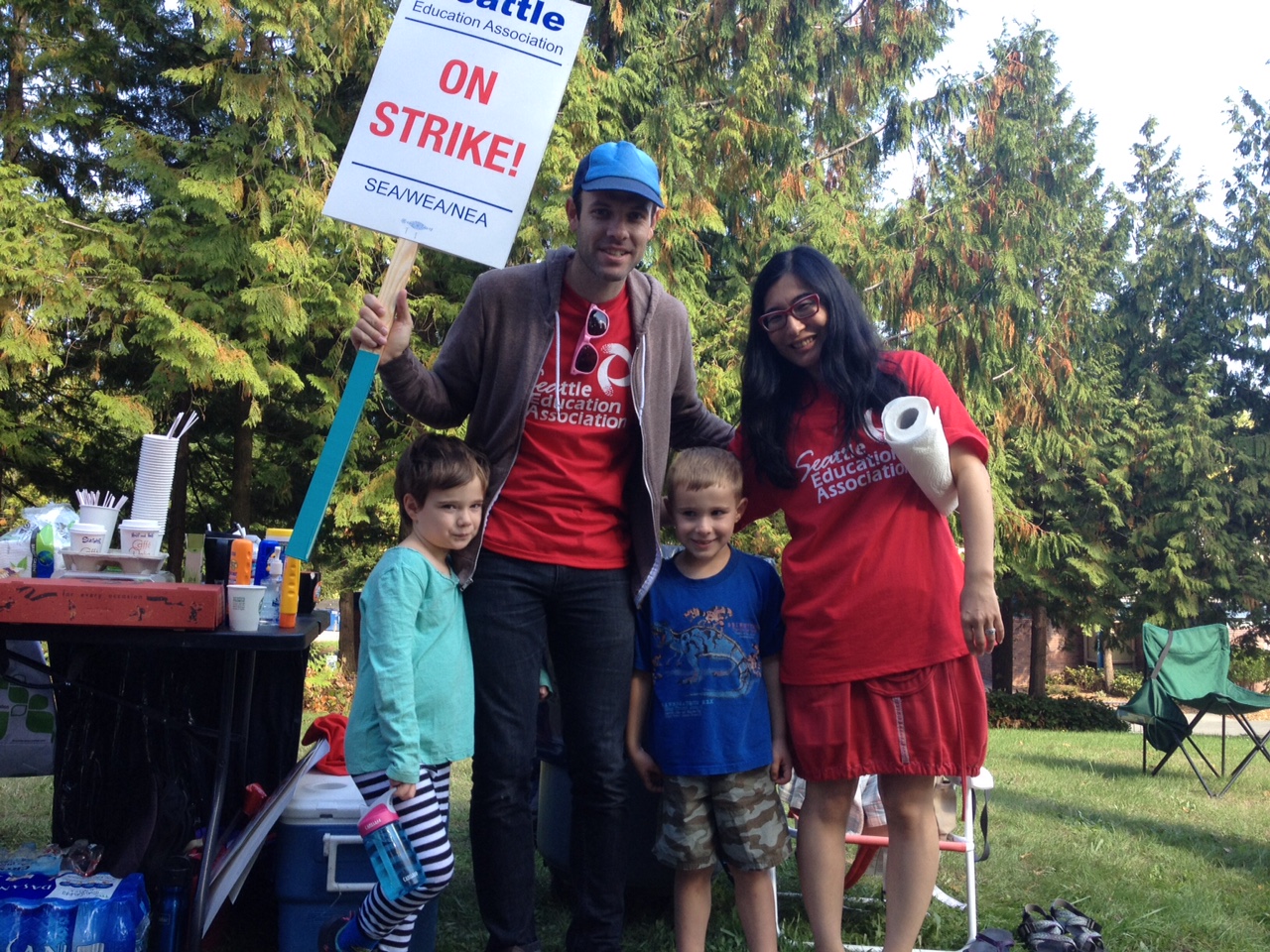
Teachers, parents and students were out on the picket line on day 2 of the Seattle Teachers Association (SEA) teachers’ strike
One parent told me that yesterday morning when she was with the teachers at her daughter’s elementary school, three parents came by in the course of three hours to make sure the teachers had enough water and food.
Because images can say more than any words I can write, to follow are photo’s sent to Seattle Education yesterday and this morning of Day 2 of the Seattle teachers’ strike.
Roosevelt
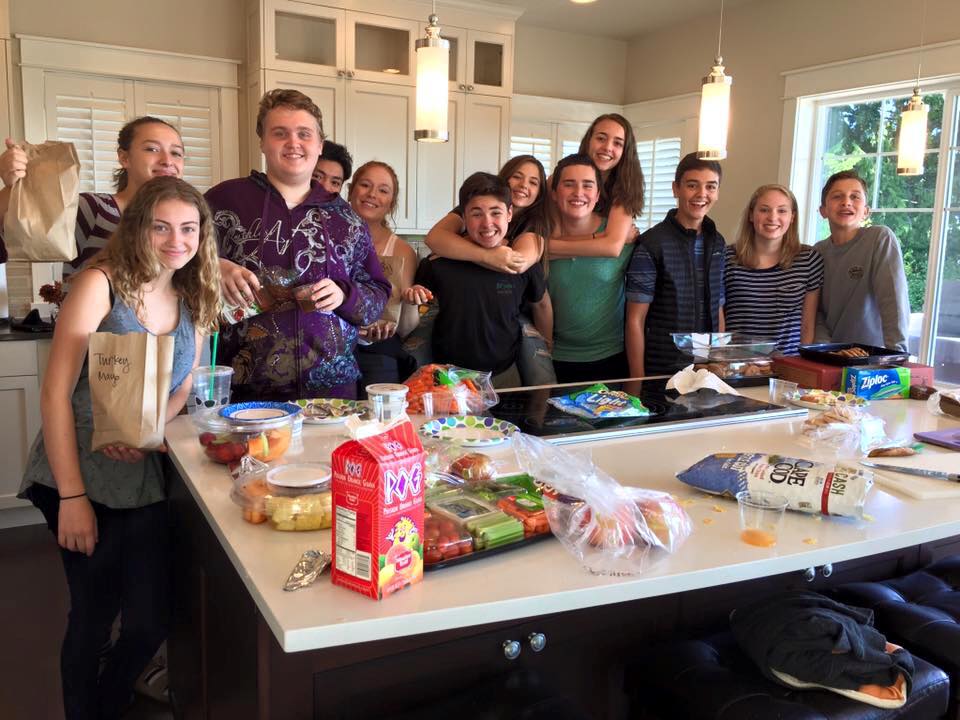
Roosevelt High School students made 200+ brown bag sandwiches for their picketing educators. With food to spare, they ended up visiting 10 schools.
Coe Elementary
Coe Elementary
Coe Elementary
Coe Elementary
Coe Elementary
Coe Elementary
Coe Elementary
Coe Elementary
Franklin High School
Sanislo Ele
Students with their teachers at Sanislo Elementary School.
Yesterday evening was a rally in support of the teachers in the City Council Chambers at Seattle City Hall. The room was overflowing.
Teachers, parents and students spoke. Teachers talked about why they were on strike and parents and students spoke in support of the teachers.
Also yesterday, Wayne Au, PhD, one of the Plaintiff’s in the Supreme Court case challenging the constitutionality of charter schools in Washington State, had an article published in the Washington post titled A Perfect Storm in Washington State.

The misuse of research to support deregulation and privatization of teacher education - The Washington Post

The misuse of research to support deregulation and privatization of teacher education - The Washington Post:

The misuse of research to support deregulation and privatization of teacher education


For years now we’ve been hearing from school reformers that traditional teacher preparation programs at colleges and universities are awful and that what we need is deregulation and market competition. In the following post, two academics evaluate the argument that these programs have failed as well as the value of the programs that school reformers embrace to replace them. This was written by Kenneth Zeichner and Hilary G. Conklin. Zeichner is a professor of teacher education at the University of Washington, Seattle, and professor emeritus in the School of Education at the University of Wisconsin-Madison. A member of the National Academy of Education, he has done extensive research and teaching and teacher education. Conklin is a program leader and associate professor of secondary social studies at DePaul University whose research interests include teacher learning and the pedagogy of teacher education.
This post is an introduction to a paper on the subject by Zeichner and Conklin that is being published by Teachers College Record, titled “Beyond Knowledge Ventriloquism and Echo Chambers: Raising the Quality of the Debate on Teacher Education.”
By Kenneth Zeichner and Hilary G. Conklin
Though there is ample room for debate on how much and what kind of education is best for preparing effective teachers, inferring that one type of preparation does or does not yield better outcomes for students is not warranted by the evidence (National Research Council 2010).
The body of research leads one to expect students in the classrooms of corps members—recruited, trained, and supported by Teach For America—to learn as much or more than they would if assigned a more experienced teacher in the same school (Teach For America, 2014).
Critics of college and university-based teacher preparation have made many damaging claims about the programs that prepare most U.S. teachers–branding these programs as an “industry of mediocrity”–while touting the new privately-financed and- run entrepreneurial programs that are designed to replace them. These critics have constructed a narrative of failure about college and university Ed schools and a narrative of success about the entrepreneurial programs, in many cases using research evidence to support their claims.

The New History Wars Part 3: The College Board is the Real Problem - Living in Dialogue

The New History Wars Part 3: The College Board is the Real Problem - Living in Dialogue:

The New History Wars Part 3: The College Board is the Real Problem 


By Paul Horton.
The Advanced Placement United States History course recently revised by the College Board has recently undergone a second major revision in response to critics from the right who argue that the first revision did not emphasize specific content and that it focused on social history and neglected political and military history.
The second revision responds to these criticisms, but many critics on the right and some who want to see more specific content required continue their criticisms.
Teachers of AP History are growing restless; they have to get on to the teaching of history this year, caught in the middle of a political firefight and another chapter in the culture wars.
The culture wars have no place in history classes except to be taught as a political issue.
Good history is inclusive. Good teachers can combine social history with traditional political and military narratives. Good history teachers understand that religion is a very complex and foundational aspect of United States History. This does not mean that teachers should be teaching “providential history” as some ministers would, it means understanding that the idea of “providential history” has shaped the thinking of some Americans and groups of Americans in very important ways.
The left tends to be identified by the right as promoting social history, identity politics based on victimization narratives, and as hostile to the role of religion in American history. Many veterans don’t believe that the left respects the very real heroism displayed by Americans during wars. There is some truth in this critique because the AP tends to deemphasize military history in favor of free response questions that focus on the more hotly debated issues of race, class, and gender history. On the other hand, the left sees its efforts as attempting to integrate the history of important reform movements, minorities, and political perspectives that were absent from most textbooks and courses until the late seventies as a legacy of Cold War conservatism and McCarthyite anticommunism. So we have a kind of tug of war that intensifies every few years: the debate over the NEH standards in the early and mid nineties is reigniting with the controversy surrounding the Jefferson County, Colorado suspension of the new AP curriculum and the attempts by conservatives to modify the new AP US.
What is written in a textbook or in a set of standards, however, is not history. History is not set in stone. It is The New History Wars Part 3: The College Board is the Real Problem - Living in Dialogue:

Shock Waves Reverberate From Wash. State Charter Ruling - Education Week

Shock Waves Reverberate From Wash. State Charter Ruling - Education Week:

Shock Waves Reverberate From Wash. State Charter Ruling


The Washington State Supreme Court’s ruling earlier this month holding the state’s charter school law unconstitutional has sent shock waves through Washington’s educational establishment, handed charter critics a high-profile victory, and left the schools’ supporters scrambling to keep the state’s small, relatively young charter school sector alive.
In its 6-3 ruling in League of Women Voters v. Washington, the court found that the law approved by voters through a 2012 ballot measure, Initiative 1240, improperly designated charters as “common schools,” and that the schools were not therefore entitled under the state constitution to certain state funds they presently draw on.
Despite the prominent setback for charters, it might be difficult for skeptics of the autonomous, publicly funded schools to create any momentum outside Washington from the decision. For example, in the majority opinion, the justices relied heavily on state precedent regarding the definition of common schools set down in a 1909 state high court ruling. In addition, translating a victory in one state into other states’ legal and political systems won’t necessarily be easy.
All the same, the court’s Sept. 4 ruling delivered a clear rebuke to the state’s charter law that might provide charter critics elsewhere some ammunition.
And it represents the first time that a state supreme court has invalidated an entire charter school law, according to the National Alliance for Public Charter Schools. In a narrower 2011 case, the Georgia Supreme Court ruled in Gwinnett County School Districtv. Cox that the state Charter School Commission improperly approved charters over the objections of local school boards. However, Georgia voters approved a constitutional amendment in 2012 subsequently permitting state-backed charters.
Charter supporters argue that there are potential avenues for Washington legislators to provide public funds to the state’s nine charter schools aside from the general fund budget, even as they vow to keep the schools open through other means such as private donations.
There are ways that the supreme court overlooked to constitutionally fund charter schools in Washington state, said Thomas Franta, the executive director of the Washington State Charter School Association. “These are public schools, and we believe they are absolutely entitled to public funding,” he said.
Meanwhile, critics such as the 85,000-member Washington Education Association, which was a party to the court case, said the victory protected taxpayers who pay for charters but lack the power to oversee them appropriately.
“Public schools should truly be public,” said Rich Wood, a WEA spokesman.
Gov. Jay Inslee, a Democrat who opposed the 2012 ballot initiative to permit charters, so far has resisted calls to convene a special session to work out what’s next for the state’s charters, which serve 1,200 students.

Legal Arguments

The charter ruling is part of a tumultuous political environment for education in the Evergreen State. It’s also the second time in recent years that the court has made big headlines with a ruling about schools. Last month, the court levied a daily $100,000 fine on the state for failing to adequately increase K-12 spending in response to its 2012 ruling in McCleary v. Washington.
The majority opinion in the charter case, written by Chief Justice Barbara Madsen, stated that charters are intended to provide parents with “more options,” then added: “But the new schools came with a trade-off: the loss of local control and local accountability.”
Absent their designation as common schools, charters would lose their funding source from the state’s general budget and therefore no longer be “viable,” Madsen concluded.
“[B]ecause charter schools under 1-1240 are run by an appointed board or nonprofit organization and thus are not subject to local voter control, they cannot qualify as ‘common schools,’” Madsen wrote.
In a partially dissenting opinion, Justice Mary Fairhurst wrote that while she agreed that charter schools were not strictly common schools as set down in state legal precedent, they were still legally eligible to some sort of funding by the state, like other public schools. In addition, charters’ funding source was a separate legal question from the schools’ standing under the state constitution, she argued.
“Nowhere does the act identify a source of funding, it merely states that charter schools must ‘receive funding based on student enrollment just like existing public schools,’” Fairhurst wrote.
The justices returned the case to King County Superior Court to write an order enforcing their ruling by Sept. 26. As of this week, charter backers planned to ask the state supreme court to reconsider its ruling.

Winners and Losers

Those who warned three years ago that the 2012 charter law would distort public education in the state have been vindicated by the ruling, the WEA’s Wood said. Non-traditional public schools that aren’t charters receive public funding, yet are subject to appropriate oversight, he noted.
“The law requires them to be accountable to the voters and the taxpayers who fund them, not just to the small handful of parents who send their children to them,” Wood said.
Last week, the Washington State Charter School Commission decided to explore whether there is a legal remedy to allow charters to remain open for the rest of the school year.
Franta, of the state charter school association, criticized the justices for saying that since charters lacked traditional governance such as elected school boards they were free from meaningful oversight.
“There is more accountability in this public charter school sector than exists anywhere else in the state of Washington,” said Franta, adding that “there is no greater evidence of local control” than where parents choose to send their children to school.
Franta pledged that whether the legislature finds a new way to provide charters with public funds, or if his group has to raise the $14 million needed to operate the charters this school year from private donors, the schools will remain open.
In addition, he suggested that legislators could find avenues in the budget outside the general fund, such as a separate trust fund, to create a state revenue stream for charters that falls outside the court’s ruling.

Wider Ramifications

The ruling’s unique status across the K-12 legal landscape has also raised questions about its implications beyond the state and for the charter sector in general.
The WEA’s Wood cautioned that other states simply don’t have the kind of constitutional Shock Waves Reverberate From Wash. State Charter Ruling - Education Week:

Ed Notes Online: Why Seattle Teacher Strike Matters - MORE and Port Jefferson Station Express Support

Ed Notes Online: Why Seattle Teacher Strike Matters - MORE and Port Jefferson Station Express Support:

Why Seattle Teacher Strike Matters - MORE and Port Jefferson Station Express Support


There's no little irony that social justice oriented teacher unions are leading the way in militancy and a willingness to strike while UFT/Unity type unions are passive. That's why I love it when so-called action oriented UFTers opposed to the leadership try to put down MORE as too "social justicey". They just don't get it.

They should take a good look at Seattle - and Chicago where SJ caucuses - MORE brothers and sisters - CORE and SEE are leading the way against ed deform - 

MORE people are informing their chapters about these events so UFTers who want to fight back understand what it will take - teachers at the school level must go out and work with parents and community to build the kind of support necessary for us to fight back effectively. Or MORE's support for the #FightForDyett – Support the Hunger Strike against School Closings - in Chicago where parents are fighting to keep a school from being closed and savaged by ed deformers. (Chicago teachers lost 10,000 jobs over the past 15 years of deform). 

MORE's Lauren Cohen, Chapter leader at PS 321K, one of the leading opt-out schools in the city, helped organize this support photo:


MORE/ST/UCORE/UFT Chapter Leader Lauren Cohen and her PS 321K chapter
When I began teaching the UFT had a "no contract, no work" mantra - meaning that the day after a contract expired we would be on strike. That only happened in 1967 - and not long after that mantra disappeared, thus leaving us go years without a contract.

Not since 1975 has the UFT been on strike. We know all about the Taylor Law 2 for 1 penalties, the removal of dues checkoff and severe financial - if not crippling - penalties against the union. All these rules came as a result of the 1967 and 1968 UFT strikes. The 1975 strike was an anomaly - no contract on the table - but massive cuts - the leadership did not want to go on strike but was forced to by an outraged membership who saw their schools crippled by massive budget cuts that resulted in the loss of 15,000 jobs. Shanker even went to jail - which we, part of the opposition (Coalition of School Workers - CSW) - 
Ed Notes Online: Why Seattle Teacher Strike Matters - MORE and Port Jefferson Station Express Support:

Mike Klonsky's SmallTalk Blog: Study: Area Union Membership Can Predict Children’s Advancement

Mike Klonsky's SmallTalk Blog: Study: Area Union Membership Can Predict Children’s Advancement:

Study: Area Union Membership Can Predict Children’s Advancement


N.Y. Times

Low-income children rise higher in the income rankings when they grow up in areas with high-union membership.
As unions in this country continue to come under assault, a new study coming out of Harvard, Wellesley (of all places) and the Center for American Progress, finds that unions are key in enabling children from low-income families to escape poverty.

The study shows that unions are needed to push the political system to deliver policies — like a higher minimum wage and greater spending on schools and other government programs — that broadly benefit workers and their families. Three cities that appear to reflect the union effect — San Francisco, Seattle and New York — are all jurisdictions where the minimum wage is rising substantially. This is especially true when you compare them with cities in so-called "right to work" states like North Carolina, Georgia and Mississippi.

Most interesting finding for me... Higher rates of unionization may give rise to certain norms that instill a greater sense of agency in workers.

For example, people who belong to unions are generally aware that Mike Klonsky's SmallTalk Blog: Study: Area Union Membership Can Predict Children’s Advancement:

Why borrowing from the ‘best’ school systems sounds good — but isn’t - The Washington Post

Why borrowing from the ‘best’ school systems sounds good — but isn’t - The Washington Post:

Why borrowing from the ‘best’ school systems sounds good — but isn’t


(Bloomberg)


For years now policymakers have looked at school systems in countries where students excel on international standardized tests, and have attempted to “borrow” what they believe are the practices that result in test-score success. Borrowing best practices seems like a no-brainer, but, in this post, the authors argue that in education, it isn’t always a good idea. This was written by Alma Harris, Yong Zhao and Michelle Jones.
Alma Harris is professor of educational leadership at the Institute of Educational Leadership, University of Malaya, and the Institute of Education, University College London. Yong Zhao is the presidential chair and director of the Institute for Global and Online Education in the College of Education, University of Oregon, where he is also a professor in the Department of Educational Measurement, Policy, and Leadership. Michelle Jones is deputy director at the Institute of Educational Leadership, University of Malaya.

By Alma Harris, Yong Zhao and Michelle Jones
Education policymakers around the globe remain preoccupied with the top-performing systems as the touchstone of their thinking and action, and the appetite for following the “best” education systems shows little signs of waning. Multi-national companies have categorized and summarized the strategies of the most “successful” education systems, and promoted them as a pathway to improvement for less successful systems. To be sure, the process seems logical; if you want to be a better performer, why not borrow or copy the approaches of those who do so much better? The approach is neat, convincing — and potentially misleading.
Let’s imagine that you are a runner and you want to be as good as Hussein Bolt. Would copying his training schedule, his diet and his racing diary really make you an outstanding sprinter? The answer is unequivocally no. The reason for this lies in the complex amalgam of innate ability, physiology, physique, background and personal motivation. In other words, the things that cannot be copied are the things that often matter most.
In education, too, the impact of policy borrowing is far less immediate or Why borrowing from the ‘best’ school systems sounds good — but isn’t - The Washington Post: