Latest News and Comment from Education

Sunday, May 17, 2020

CATCH UP WITH CURMUDGUCATION + ICYMI: Shorts and T-Shirt Edition (5/17)

CURMUDGUCATION: ICYMI: Shorts and T-Shirt Edition (5/17)


Shorts and T-Shirt Edition 

So it's finally almost summery here, for what that's worth. We can at least sit out on the porch. Meantime, here's some stuff to read. Well, a lot of stuff, actually.

Why High Stakes Testing Was Cancelled This Year
Steven Singer looks at some of the less-obvious reasons the Big Standardized Test is cancelled this year (and probably next year, too).

TFA Will Train New Recruits Virtually
So, while everything else is going on, Teach For America has adapted by giving their recruits even less training than usual. Gary Rubinstein has the details.

Who Does the Biden/Sanders Unity Panel Unite
Nancy Bailey has concerns about this cozy moment, and some details about the people on the panel.

CREDO Study Biased Against Public Schools  
Thomas Ultican takes a look at CREDO's long, storied history, and why that gives us reason to doubt the sincerity of their newest researchy thing.

Cyber Charter School Has Failed Students
An op-ed takes Agora cyber-school to task for its consistent failure.

Will Coronavirus Be The Tipping Point That Ends Annual Testing In Schools
The Education Writers Association takes a look at the big testing question. A good survey of some of the views of the issue out there.

Does It Work? The Most Meaningless Question To Ask About Online Education
Yong Zhao cuts right to the chase with five critical reasons that there is no simple answer to that simple question.

A Looming Issue For Schools: Teachers Who Can't Or Won't Go Back
Chalkbeat takes a look at how covid-19 can further affect the re-opening of schools.

Not National, Not Parents, Not A Union
Maurice Cunningham takes a look at the National Parents Union and peels back the layers hiding the group's true nature.

Crazy Pandemic Behavior Messes With AI 
"Machine-learning models are designed to respond to changes. But most are also fragile; they perform badly when input data differs too much from the data they were trained on. " Not about education per se, but this MIT Technology Review piece reminds us that the magic of AI is not very magical.

How Can I Keep From Singing?  
It's going to be a while before things are normal in your school's music department again. Nancy Flanagan with a beautiful piece that tells why that matters.

The Sheer Number of School Districts Is Tilting the Playing Field   
The New York Times looks at the role of district boundaries, the role in perpetuating inequity, and the sheer (large) number of districts in the country.

AP Online Exam Fiasco
Two worthwhile pieces here cover the AP testing mess. Teen Vogue has a piece from an AP teacher looking at just how ugly this mess was, while the indispensable Mercedes Schneider takes a look at how parents and students are reacting. The College Board once again has a not-its-finest-moment
moment.

And here's a bonus that I missed last week-- Diane Ravitch on Full Frontal


CURMUDGUCATION: ICYMI: Shorts and T-Shirt Edition (5/17)


CATCH UP WITH CURMUDGUCATION

Without The Big Standardized Test, Would Schools Be Flying Blind? - https://www.forbes.com/sites/petergreene/2020/05/16/without-the-big-standardized-test-would-schools-be-flying-blind/#5d66109d6722 by @palan57 on @forbes

Successful School Reopening Plans Will Have One Thing In Common - https://www.forbes.com/sites/petergreene/2020/05/12/successful-school-reopening-plans-will-have-one-thing-in-common/#17e61a524721 by @palan57 on @forbes

Why Bill Gates Is Not The Man To Reimagine New York Education - https://www.forbes.com/sites/petergreene/2020/05/08/why-bill-gates-is-not-the-man-to-reimagine-new-york-education/#24563bcb79cc by @palan57 on @forbes


How Dr. Perelman Helped Save Australia
(Note: If you're not in the mood to read the whole piece, skip down to the bold quote at the end-- ikt'll be worth it.) Longtime readers know that Les Perelman is one of my heroes. Retired in 2012 from teaching and administration at MIT, he has continued his work in the world of education, most notably repeatedly poking holes in the balonified field that is robo-grading . Software that can assess
Small Things: Secretary DeVos, Twitter and Teachers Vs. Charters
For quite a while, National Charter School Self-Promotion Week was scheduled for the first week in may-- the same week that the PTA had, for decades, scheduled Teacher Appreciation Week. Last year somebody finally decided that maybe that wasn't the greatest idea and moved Charter Week to the second week in May. So we're just wrapping that lovefest up today. Coincidentally, I recently broke down an

MAY 14

Fordham Advises Conservative Board Members In Parallel Universe
It's a curious little piece in the Fordham Institute's blog, this " Conservative Agenda for School Board Members. " The co-authors are Michael Petrilli and Chester Finn, the current and former head honchos of the right-leaning thinky tank (though I will say-- and I'm just guessing here--the level of pearl-clutching in this piece sounds a lot more like Finn than Petrilli to me). The stock photo is

MAY 13

Biden's Education Unity Task Force
Joe Biden and Bernie Sanders have announced a half-dozen unity task force thingies, one of which will be focused on education , more or less. Folks are reacting with varying degrees of freaking out on the social medias. I'm going to recommend that you take a deep breath. Here are some things to consider. Concerns Alejandro Adler is nobody to be excited about. He's an academic who is associated wit

MAY 12

The Why Of Opening Schools Matters As Much As The When
Originally posted about three weeks ago. Not much has changed; only become more so. At some point, schools are going to open again. Figuring out when will require some complicated medical and political calculus, and while lots of folks are hoping it will be just as easy as life going back to normal sometime over the summer, nobody is ready to bet the farm, or even a few select outbuildings, on th
Private Equity's Destructive Tendencies
This article ( "Why Private Equity Keeps Wrecking Retail Chains Like Fairway ") has been sitting on my desktop since late January, which is now, of course, roughly ten years in our collective past, but it's still worth a look. It's not about education, except that, given the deep and abiding love that hedge funds have for charter schools , this is absolutely about education. Jordan Weissmann at Sl

MAY 11

After The Grieving
The first student death I ever experienced was when I was in fifth grade. Betsy was a kind sweetheart of a girl, but suffered from a cruel variety of health issues. One Monday we came back to school, and she wasn't there. Through the day, the word spread that she had died over the weekend. It was a rough day. Over the years of teaching, there were several student deaths. Suicide. Auto accident. Su

MAY 10

ICYMI: Mothers Day Edition (5/10)
We got some take-out brunch at our house, so my wife is having what appears to be a delicious quiche (I'm not a good judge of egg-based foods) and we're going to try to ignore the return of winter. In the meantime, here's some reading for you. It's a pretty rich week-- enjoy. Appeals Court Decision Guarantees Basic Literacy as a Right Jan Resseger looks at the recent court decision that could chan

MAY 09

Backpack Full of Misdirection
Jeanne Allen called it a backpack full of cash, strapped to the back of each student, who would carry it from school to school like a young mule. It's the child's money. It's the family's money. The money should follow the child. It has been the reformster mantra for years, and it is enjoying a comeback as we discuss very particular dollars, i.e. the stimulus dollars being thrown at the country to
CURMUDGUCATION - http://curmudgucation.blogspot.com/

Annie Abrams: Privatization Vultures Are Circling Our Public Schools | Diane Ravitch's blog

Annie Abrams: Privatization Vultures Are Circling Our Public Schools | Diane Ravitch's blog

Annie Abrams: Privatization Vultures Are Circling Our Public Schools


Writing in the New Republic, New York City public school teacher Annie Abrams warns about the vultures circling public schools during the pandemic, hoping to make remote learning a feature, not a temporary emergency measure.
She cites the recent comments by Governor Cuomo about the seeming obsolescence of “all these buildings, all these physical classrooms; why, with all the technology you have?” And, of course, his invitation to Bill Gates of all people to “reimagine education” in the state. She might have also cited any number of statements by anti-public school individuals like Betsy DeVos and Jeanne Allen of the Center for Education Reform, which supports every kind of school except public schools.
Abrams knows that distance learning cannot replace the person-to-person contact that happens in physical classrooms.
Meaningful education is built on connection, and fostering relationships requires proximity. This is what a classroom does. It’s a space for students to establish relationships while experimenting with being in public. And while we don’t yet know the details of Cuomo’s plan, there’s CONTINUE READING: Annie Abrams: Privatization Vultures Are Circling Our Public Schools | Diane Ravitch's blog

Giving Private Schools Federal Emergency Funds Slated for Low-income Students Will Shortchange At-risk Kids - Education Law Prof Blog

Education Law Prof Blog

Giving Private Schools Federal Emergency Funds Slated for Low-income Students Will Shortchange At-risk Kids


Public schools have faced three distinct challenges since the coronavirus pandemic began – scrambling to make sure that low-income children don’t go hungry, teaching students remotely who lack internet access and bracing for dramatically smaller budgets.
Congress tried to help in the US$2 trillion economic relief package known as the Coronavirus Aid, Relief and Economic Security, or CARES Act, by designating $13.5 billion for public schools. The money was supposed to be distributed to school districts based on the number of low-income students they enroll. A new directive from the U.S. Department of Education, however, tells districts to share far more of the money than expected with private and religious school students, even though fewer than 5% of those children are poor.
I’m a scholar of federal education policy and history who has testified before a congressional commission and federal courts in disputes over federal funds. In my view, this new policy runs counter to what Congress has tried to achieve in public education for the past 50 years and it directly contradicts the CARES Act.

A new formula

The funding is supposed to stabilize public school budgets as local and state revenues, the primary sources of U.S. public school funding, decline and the costs of responding to the pandemic increase.
Schools from coast to coast are buying computers and scrambling to get low-income students the bandwidth they need for distance learning.
The relief package specified that the money would go to school districts based on the number of low-income students they serve. Those are children who are eligible for free and reduced-priced meals. Students whose families are below 185% of the official poverty line – which as of 2020 stands at $26,200 per year for a family of four – fall into this category.
School districts are also to reserve a portion of those funds to ensure equitable services for any low-income CONTINUE READING: Education Law Prof Blog

EdAction in Congress May 17, 2020 - Education Votes

EdAction in Congress May 17, 2020 - Education Votes

EdAction in Congress May 17, 2020


Tell senators to support new COVID-19 bill

The House acted decisively on Friday to stem the mounting damage from COVID-19, passing the $3 trillion HEROES Act by a vote of 208-199. State and local governments are facing huge shortfalls—potentially, even bigger than during the Great Depression. More than 36 million Americans are unemployed, including nearly 40 percent of those from households earning less than $40,000.
“Unfortunately, the COVID-19 pandemic has exposed and exacerbated the inequities facing our most vulnerable students and with the economic downturn now threatening the future of public schools, parents and educators are standing together because we cannot wait. Our nation’s students cannot pay the price in this crisis,” said NEA President Lily Eskelsen Garcia.
Already, too many Americans have lost jobs, homes, and hope. The HEROES Act aims to stave off further disaster. Key provisions for students and educators include:
  • Nearly $200 billion to fill state and local budget gaps. The HEROES Act provides $915 billion in direct relief for state and local governments and $100 billion specifically for the Education Stabilization Fund. The money can be used to maintain student services and support, avoid layoffs of educators and other frontline workers, provide personal protective equipment (PPE), and more—but NOT microgrants or other voucher schemes proposed by Education Secretary Betsy DeVos.
  • Support for narrowing the digital divide and closing the homework gap. The HEROES Act takes steps to equip more students to go online, so they can do schoolwork at home and keep up with their peers. But it needs to do more. Roughly 1 in 5—as many as 12 million students—cannot login from home. A disproportionate share of those students are African American, Hispanic, live in rural areas, or come from low-income families.
  • Relief for student loan borrowers. The HEROES Act extends the suspension of student loan payments and interest through September 2021, includes more types of loans, cancels up to $10,000 in student loan debt for certain borrowers, and grants emergency relief to victims of unscrupulous institutions.
In addition, the HEROES Act provides more direct payments to households, further extends unemployment benefits, picks up the cost of COBRA payments for laid off workers, increases support for free and reduced-price school meals, and takes steps to protect voters’ rights and ensure access to the ballot box. LEARN MORE   TAKE ACTION

Cheers and Jeers

Reps. Brendan Boyle (D-PA) and David Joyce (R-OH) led a letter to Speaker Nancy Pelosi (D-CA) and Minority Leader Kevin McCarthy urging them to support amendments to the Public Service Loan Forgiveness program that provide coronavirus-specific relief.
Sens. Doug Jones (D-AL) and Lisa Murkowski (R-AK) led a letter urging Majority Leader Mitch McConnell (R-KY) and Minority Leader Chuck Schumer (D-NY) to include robust funding for America’s schools, educators, and students in the next round of COVID-19 relief funding. “We are particularly concerned about how the educator workforce and other school personnel will be impacted by COVID-19,” they wrote.
EdAction in Congress May 17, 2020 - Education Votes

Afraid – radical eyes for equity

Afraid – radical eyes for equity

Afraid


But I don’t have the drugs to sort
 I don’t have the drugs to sort it out 
Sort it out
“Afraid of Everyone,” The National

For as long as I can remember, I have been at war with my own body. There have been dramatic battles—being diagnosed with scoliosis the summer before I started ninth grade in 1976, my collapse into debilitating panic attacks in October of 1999—but mostly that tension is pervasive, continuous—an anxiety cocktail of somewhat manageable OCD, ADHD, hypochondria, and depression.
The manageable has been orchestrated behind a dedicated stoic front that hides the main feature of anxiety, the relentless mind manufacturing and obsessing on an infinite list of what-ifs.
These self-imposed terrors are fruitless except for the drain and wear on my mind and body. Like the what-ifs on loop in my thoughts, the war with my body seems to insure that my body is always finding ways to let me down, especially a rotating list of chronic pain.
In South Carolina, where I live, we are shifting quicker than many states back toward some sort of normal after a couple of months of sheltering at home because of the Covid-19 pandemic.
The pandemic has been a paradox for me and my anxiety. Anxiety is mostly wrestling with unfounded threats, being afraid of everything for no rational reason.
Fearing a very real pandemic is rational, but in SC, I have been positioned as irrational for taking Covid-19 seriously since many in the state are following a CONTINUE READING: Afraid – radical eyes for equity

Watch the Video and Read both of Obama’s new commencement speeches - The Washington Post

Read both of Obama’s new commencement speeches - The Washington Post

Obama tells 2020 graduates: ‘If the world’s going to get better, it’s going to be up to you.' Read the transcripts of two speeches.


Former president Barack Obama gave two commencement addresses for 2020 graduates that were made public on Saturday, telling them in one: “If the world’s going to get better, it going to be up to you.”
Obama first spoke at a virtual commencement ceremony for graduates of the country’s historically black colleges and universities (HBCU). He talked about the systemic racism in the United States that harms black Americans and about how the covid-19 pandemic is laying bare long-standing inequities. He also referred to the shooting death by two white men of a 25-year-old black man, Ahmaud Arbery, while he was jogging in Georgia.

“You’re being asked to find your way in the world in the middle of a devastating pandemic and terrible recession,” he said.” The timing is not ideal. And let’s be honest — a disease like this just spotlights the underlying inequalities and extra burdens that black communities have historically had to deal with in this country. We see it in the disproportionate impact of covid-19 on our communities, just as we see it when a black man goes for a jog, and some folks feel like they can stop and question and shoot him if he doesn’t submit to their questioning.”
Then a video of Obama delivering a different commencement, this one to all of America’s 2020 high school graduates, was broadcast on a show called “Graduate Together: America Honors the Class of 2020.”
The transcripts of both speeches are below.
Here’s the video and transcript of Obamas XQ National High School Commencement, broadcast on May 16, 2020:
Hi, everybody. Aniyah, thank you for that beautiful introduction. I could not be prouder of everything you’ve done in your time with the Obama Foundation.
And of course, I couldn’t be prouder of all of you in the graduating Class of 2020 – as well as the teachers, coaches, and most of all, parents and family who guided have you along the way.
Now graduating is a big achievement under any circumstances. Some of you have had to overcome serious obstacles along the way, whether it was an illness, or a parent losing a job, or living in a neighborhood where people too often count you out. Along with the usual challenges of growing up, all of you have had to deal with the added pressures of social media, reports of school shootings, and the specter of climate change. And then, just as you’re about to celebrate having made it through, just as you’ve been looking forward to proms and senior nights, graduation ceremonies – and, let’s face it, a whole bunch of parties – the world is turned upside down by a global pandemic. And as much as I’m sure you love your parents, I’ll bet that being stuck at home with them and playing board games or watching Tiger King on TV is not exactly how you envisioned the last few months of your senior year.
Now I’ll be honest with you – the disappointments of missing a live graduation – those will pass pretty quick. I don’t remember much from my own high school graduation. I know that not having to sit there and listen to a commencement speaker isn’t all bad – mine usually go on way too long. Also, not that many people look great in those caps, especially if you have big ears like me. And you’ll have a chance to catch up with your friends once the immediate public health crisis is over.
But what remains true is that your graduation marks your passage into adulthood – the time when you begin to take charge of your own life. It’s when you get to decide what’s important to you: the kind of career you want to pursue. Who you want to build a family with. The values you want to live by. And given the current state of the world, that may be kind of scary.
If you’d planned on going away for college, getting dropped off at campus in the fall – that’s no longer a given. If you were planning to work while going to school, finding that first job is going to be tougher. Even families that are relatively well-off are dealing with massive uncertainty. Those who were struggling before – they’re hanging on by a thread.
All of which means that you’re going to have to grow up faster than some generations. This pandemic has shaken up the status quo and laid bare a lot of our country’s deep-seated problems – from massive economic inequality to on-going racial disparities to a lack of basic health care for people who need it. It’s woken a lot of young people to the fact that the old ways of doing things just don’t work; that it doesn’t matter how much money you make if everyone around you is hungry and sick; and that our society and our democracy only work when we think not just about ourselves, but about each other.
It’s also pulled the curtain back on another hard truth, something that we all have to eventually accept once our childhood comes to an end. All those adults that you used to think were in charge and knew what they were doing? It turns out that they don’t have all the answers. A lot of them aren’t even asking the right questions. So, if the world’s going to get better, it going to be up to you.
That realization may be kind of intimidating. But I hope it’s also inspiring. With all the challenges this country faces right now, nobody can tell you “no, you’re too young to understand” or “this is how it’s always been done.” Because with so much uncertainty, with everything suddenly up for grabs, this is your generation’s world to shape.
Since I’m one of the old guys, I won’t tell you what to do with this power that rests in your hands. But I’ll leave you with three quick pieces of advice.
First, don’t be afraid. America’s gone through tough times before – slavery and civil war, famine and disease, the Great Depression and 9/11. And each time we came out stronger, usually because a new generation, young people like you, learned from past mistakes and figured out how to make things better.
Second, do what you think is right. Doing what feels good, what’s convenient, what’s easy – that’s how little kids think. Unfortunately, a lot of so-called grown-ups, including some with fancy titles and important jobs, still think that way – which is why things are so screwed up. I hope that instead, you decide to ground yourself in values that last, like honesty, hard work, responsibility, fairness, generosity, respect for others. You won’t get it right every time, you’ll make mistakes like we all do. But if you listen to the truth that’s inside yourself, even when it’s hard, even when its inconvenient, people will notice. They’ll gravitate towards you. And you’ll be part of the solution instead of part of the problem.
And finally, build a community. No one does big things by themselves. Right now, when people are scared, it’s easy to be cynical and say let me just look out for myself, or my family, or people who look or think or pray like me. But if we’re going to get through these difficult times; if we’re going to create a world where everybody has the opportunity to find a job, and afford college; if we’re going to save the environment and defeat future pandemics, then we’re going to have to do it together. So be alive to one another’s struggles. Stand up for one another’s rights. Leave behind all the old ways of thinking that divide us – sexism, racial prejudice, status, greed – and set the world on a different path.
When you need help, Michelle and I have made it the mission of our Foundation to give young people like you the skills and support to lead in your own communities, and to connect you with other young leaders around the country and around the globe.
But the truth is that you don’t need us to tell you what to do.
Because in so many ways, you’ve already started to lead.
Congratulations, Class of 2020. Keep making us proud.


And here’s the video of the speech Obama gave to HBCU graduates:
Hi, everybody. Congratulations to HBCU class of 2020. Michelle and I are so proud of you.
Graduating from college is a big achievement under any circumstances. And so many of you overcame a lot to get here. You navigated challenging classes, and challenges outside the classroom. Many of you had to stretch to afford tuition. And some of you are the first in your families to reach this milestone.
So even if half of this semester was spent at Zoom University, you’ve earned this moment. You should be very proud. Everybody who supported you along the way is proud of you – parents, grandparents, professors, mentors, aunties, uncles, brothers, sisters, cousins, second cousins, and cousins who you aren’t even sure are cousins. Show them some gratitude today.
Now look, I know this isn’t the commencement any of you really imagined. Because while our HBCUs are mostly known for an education rooted in academic rigor, community, and higher purpose – they also know how to turn up. Nobody shines quite like a senior on the yard in springtime. Springfest at schools like Howard and Morehouse is the time when you get to strut your stuff a little bit. And I know that in normal times, rivals like Grambling and Southern, Jackson State and Tennessee State, might raise some eyebrows at sharing a graduation ceremony.
But these aren’t normal times. You’re being asked to find your way in the world in the middle of a devastating pandemic and terrible recession. The timing is not ideal. And let’s be honest – a disease like this just spotlights the underlying inequalities and extra burdens that black communities have historically had to deal with in this country. We see it in the disproportionate impact of COVID-19 on our communities, just as we see it when a black man goes for a jog, and some folks feel like they can stop and question and shoot him if he doesn’t submit to their questioning.
Injustice like this isn’t new. What is new is that so much of your generation has woken up to the fact that the status quo needs fixing; that the old ways of doing things don’t work; that it doesn’t matter how much money you make if everyone around you is hungry and sick; and that our society and democracy only works when we think not just about ourselves, but about each other.
More than anything, this pandemic has fully, finally torn back the curtain on the idea that the folks in charge know what they’re doing. A lot of them aren’t even pretending to be in charge.
If the world’s going to get better, it’s going to be up to you. With everything suddenly feeling like up for grabs, this is your time to seize the initiative. Nobody can tell you anymore that you should be waiting your turn. Nobody can tell you anymore “this is how it’s always been done.” More than ever, this is your moment – your generation’s world to shape.
In taking on this responsibility, I hope you are bold. I hope you have a vision that isn’t clouded by cynicism or fear. As young African Americans, you’ve been exposed, earlier than some, to the world as it is. But as young HBCU grads, your education has also shown you the world as it ought to be.
Many of you could have attended any school in this country. But you chose an HBCU – specifically because it would help you sow seeds of change. You chose to follow in the fearless footsteps of people who shook the system to its core – civil rights icons like Thurgood Marshall and Dr. King, storytellers like Toni Morrison and Spike Lee. You chose to study medicine at Meharry, and engineering at NC A&T, because you want to lead and serve.
And I’m here to tell you that you made a good choice. Whether you realize it or not, you’ve got more roadmaps, more role models, and more resources than the civil rights generation did. You’ve got more tools, technology, and talents than my generation did. No generation has been better positioned to be warriors for justice and remake the world.
Now, I’m not going to tell you what to do with all that power that’s in your hands. Many of you are already using it so well to create change. But let me offer three pieces of advice as you continue on your journey.
First, make sure you ground yourself in actual communities with real people – working at the grassroots level. The fight for equality and justice begins with awareness, empathy, passion, even righteous anger. Don’t just activate yourself online. Change requires strategy, action, organizing, marching, and voting in the real world like never before. No one is better positioned than this class of graduates to take that activism to the next level. And from tackling health disparities to fighting for criminal justice and voting rights, so many of you are already doing this. Keep on going.
Second, you can’t do it alone. Meaningful change requires allies in common cause. As African Americans, we are particularly attuned to injustice, inequality, and struggle. But that also should make us more alive to the experiences of others who’ve been left out and discriminated against. So rather than say what’s in it for me or what’s in it for my community and to heck with everyone else, stand up for and join up with everyone who’s struggling – whether immigrants, refugees, the rural poor, the LGBTQ community, low-income workers of every background, women who so often are subject to their own discrimination and burdens and not getting equal pay for equal work; look out for folks whether they are white or black or Asian or Latino or Native American. As Fannie Lou Hamer once said, “nobody’s free until everybody’s free.” And on the big unfinished goals in this country, like economic and environmental justice and health care for everybody, broad majorities agree on the ends. That’s why folks with power will keep trying to divide you over the means. Because that’s how nothing changes. You get a system that looks out for the rich and powerful and nobody else. So expand your moral imaginations, build bridges, and grow your allies in the process of bringing about a better world.
Finally, as HBCU graduates, you have to remember that you are inheritors of one of America’s proudest traditions. Which means you’re all role models now – whether you like it or not. Your participation in this democracy, your courage to stand up for what’s right, your willingness to forge coalitions – these actions will speak volumes. And if you are inactive, that will also speak volumes. Not just to the young folks coming up behind you – but to your parents, your peers, and the rest of the country. They need to see your leadership – you’re the folks we’ve been waiting for to come along.
That’s the power you hold. The power to shine brightly for justice, for equality, and for joy. You’ve earned your degree. And it’s up to you to use it. So many of us believe in you. I’m so proud of you. And as you set out to change the world, we’ll be the wind at your back.
Congratulations Class of 2020, and God bless you all.
 Read both of Obama’s new commencement speeches - The Washington Post

NYC Educator: Can We Pull Something Positive from the Crisis?

NYC Educator: Can We Pull Something Positive from the Crisis?

Can We Pull Something Positive from the Crisis?


 Maybe there's a silver lining in the Covid crises somewhere. The question is whether or not we'll be able to sufficiently organize ourselves to exploit it. Of course, we have to find a way to do that before Bill Gates gets his slimy little hands on us and our children. I'll come back to that a little later. (But remember, if you're touched by Bill Gates, go home and wash your whole body with Brillo pad.)

There's a reason why someone like me, after having spent years teaching in miserable hot-in-the-summer, cold-in-the-winter trailers, keeps requesting them. That reason is I've frequently gottenstuck teaching in substandard classrooms. My least favorite are the ones in which students end up almost in one another's laps. You give a test and you hope no one's looking at someone else's paper, but you can't imagine how they could not be looking at someone else's paper.

Then the administrators come and scream at you because the kids are sitting on the windowsill. They scream at you when you move the teacher desk into some far corner to create space when you sit on the windowsill. And they know you only do that so as to create space.

Still, the worst classroom I've ever had is the one in my dining room, where I teach now. Sure, it's good that our dining room finally serves a purpose more than once or twice a year, but this notwithstanding, it would be much better to have dinner parties Of course we can't do that either, or I wouldn't be teaching from the dining room.

Now we have woefully ignorant wealthy doofuses like Andrew Cuomo licking his lips over getting rid of school buildings altogether and making us teach from home permanently. Of course he's enlisted the help of uber-wealthy doofus Bill Gates. Gates, as you well know, has extensive experience imposing his stupid ideas upon American education. Every working teacher in the country feels his influence, and absolutely none of it is positive.

This is Shock Doctrine 101. When Katrina flooded and ruined NOLA, a whole bunch of geniuses got together and decided this was a great time to privatize the education system. After all, it was a crisis, and as Chancellor Carranza CONTINUE READING: 
NYC Educator: Can We Pull Something Positive from the Crisis?

NYC: Carranza Says He Can’t Cut $34 Billion Budget | Diane Ravitch's blog

NYC: Carranza Says He Can’t Cut $34 Billion Budget | Diane Ravitch's blog

NYC: Carranza Says He Can’t Cut $34 Billion Budget


Ricard Carranza, NYC Schools Chancellor, says he can’t cut the schools’ $34 billion budget. He says has has cut the budget “to the bone.”
There is no fat to cut, there is no meat to cut — we are at the bone,” Carranza testified Tuesday at a City Council budget hearing.
Education advocates and DOE staffers say his claim belies the bureaucratic bloat and bonanza of pay raises and promotions that have exploded during the tenures of Mayor de Blasio and Carranza.
“It’s just inconceivable there’s not waste in that budget,” said Leonie Haimson, executive director of Class Size Matters. “Clearly there are more savings that can be made by cutting unnecessary contracts, consultants, and the mid-level bureaucracy, which has more than doubled in spending since de Blasio took office in 2014….”
The city has proposed $827 million in DOE cuts, including slashing school budgets by $285 million. This CONTINUE READING: NYC: Carranza Says He Can’t Cut $34 Billion Budget | Diane Ravitch's blog

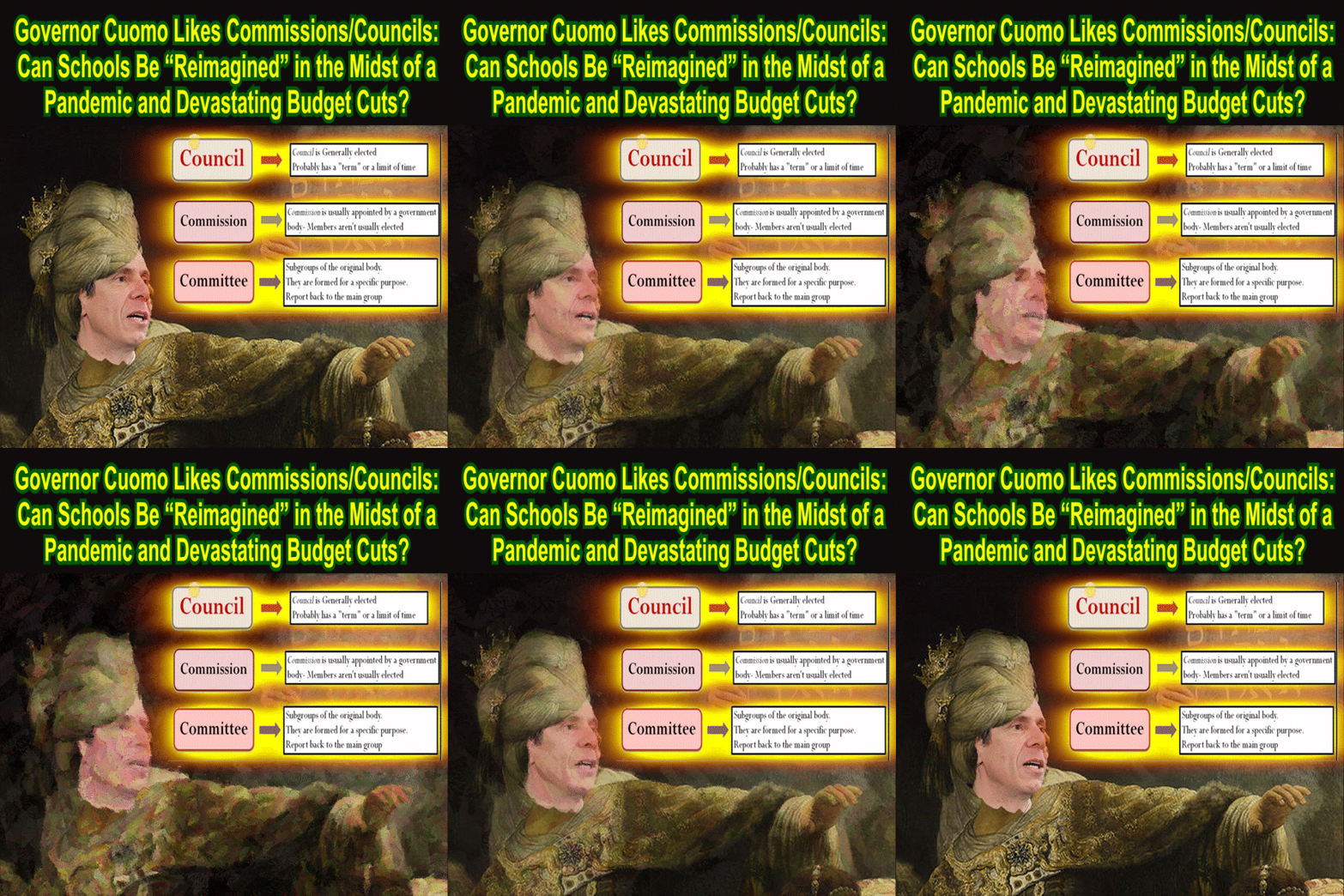
Governor Cuomo Likes Commissions/Councils: Can Schools Be “Reimagined” in the Midst of a Pandemic and Devastating Budget Cuts? | Ed In The Apple

Governor Cuomo Likes Commissions/Councils: Can Schools Be “Reimagined” in the Midst of a Pandemic and Devastating Budget Cuts? | Ed In The Apple

Governor Cuomo Likes Commissions/Councils: Can Schools Be “Reimagined” in the Midst of a Pandemic and Devastating Budget Cuts?


Candidates and electeds will make momentous decisions over the next few months.  For candidate Joe Biden an educational agenda: we all remember the truly terrible decisions made by Obama, decisions that still haunt us.
Candidate Biden appointed an 8-member team; Governor Cuomo appointed a  25-member“Reimagining Education” Advisory group and Mayor de Blasio a 45-member advisory council.
Do these groups, whether you call them Blue Ribbon commissions, task forces or advisory councils actually influence policy?  Are they a method of building consensus among disparate interests?  Or, simply ways to push the crucial decisions down the road?
A neuron fired: didn’t Cuomo establish other commissions?
In 2013 the governor established the “New NY Education Reform Commission: Putting Students First,” a Blue Ribbon commission; led by former American Express CEO Richard Parsons, with a staff of researchers. The members of the commission included a wide range of policy makers, light on teachers and parents. The commission was charged with “assessing the New York State public education system and creating a plan that would better its overall structure, operation and process” as well as “exploring best practices and models from other states and nations that created significant cost savings for taxpayers and improved student achievement.”

Coalition tells the FTC: Time is up for TiKTok | Parent Coalition for Student Privacy

Coalition tells the FTC: Time is up for TiKTok | Parent Coalition for Student Privacy

COALITION TELLS THE FTC: TIME IS UP FOR TIKTOK


The Parent Coalition for Student Privacy is one of twenty advocacy, consumer, and privacy groups that filed a May 14, 2020 complaint with the Federal Trade Commission (FTC), asking them to investigate and sanction TikTok, formerly Musical.ly, for continuing to violate COPPA, the Children’s Online Privacy Protection Act. The complaint argues that TikTok continues to store and collect children’s personal information without notice to and consent of parents, in violation of its 2019 order by the FTC.
If you are not familiar with TikTok, it is a very popular social media app, with 800  million worldwide users, many of them children.  TikTok allows users to record and upload videos of themselves dancing and singing and the app has more downloads than Facebook.  As this Manchester Evening News piece points out,  the recommended ages are for 12 plus, but “online safety experts say it has been designed with the young user in mind and has a very addictive appeal.”

Why this complaint is important

Because TikTok  is a popular platform for children, parents  worry that TikTok is not safe and that it puts kids at risk of sexual predation. For example, this father warned other parents after his 7 year old daughter was asked to send nude pictures of herself on TikTok. In another instance, a 35 year old Los Angeles man was allegedly targeting girls by posing as a 13 year old boy on TikTok and engaging in  “sexual and vulgar conversations with at least 21 girls, some were as young as 9”.  This February 2020 piece in Parents  CONTINUE READING: Coalition tells the FTC: Time is up for TiKTok | Parent Coalition for Student Privacy

We must not Re-Open unless we’ve Re-Thought and Re-Imagined

We must not Re-Open unless we’ve Re-Thought and Re-Imagined

We must not Re-Open unless we’ve Re-Thought and Re-Imagined


What if we chose different metrics? What if we wanted to graduate people who knew how to listen to the news, and listen to politicians, and could come to reasoned understandings? What if we wanted to graduate people who were empathetic enough to wear masks right now in order to protect their communities? What if we wanted to graduate people who could understand the statistics of today and who really understand what ‘flattening a curve’ means?
What if we wanted to graduate people who would not assign stereotyped roles to women, or men, or Black Americans, or Asian Americans, or immigrants? What if we wanted to graduate people who actually knew the difference between bacteria and viruses? What if we wanted to graduate people who knew without question that the murder of Ahmaud Arbery was wrong and criminal? What if we wanted to graduate people who knew how to communicate their experiences and feelings right now, whether in words — spoken or written — in song, in dance, in art, via video, and could do that in ways that increased human knowledge and empathy?
From the Atlantic magazine: The Miseducation of the American Boy by Peggy Orenstein
What if we wanted to graduate people who understood what consent to sexual activity really means? What if we wanted to graduate people who didn’t have white supremacy in their hearts? What if we wanted to graduate people who would never abuse their children? What if we wanted to graduate people curious enough to be hunting for the next medical breakthrough? What if we wanted to graduate people who could lead in a CONTINUE READING: We must not Re-Open unless we’ve Re-Thought and Re-Imagined