Latest News and Comment from Education

Monday, January 20, 2020

Before #BlackLivesMatter: The Roots of Black Digital Activism - Yes! Magazine

Before #BlackLivesMatter: The Roots of Black Digital Activism - Yes! Magazine

Before #BlackLivesMatter: The Roots of Black Digital Activism

n 2015, two colleagues—Deen Freelon and Meredith Clark—and I set out to better understand how Black Lives Matter emerged. Our report, Beyond the Hashtags, the Online Struggle for Offline Justice, crystalized then-NAACP president Cornell Brooks’ sentiment: “This isn’t your grandparents’ civil rights movement.” Our study showed us that Ferguson, Missouri birthed Black Lives Matter. It told us that Twitter named Michael Brown for the world. Traditional news media outlets were a day late, and when they did arrive, Twitter was their primary source for information. It afforded a 24-hour glimpse into a radical new way of making news, of telling stories—giving unfiltered voice to those whose voices are traditionally unheard, ignored, or silenced.

Digital media—social networking platforms, blogging platforms, the open web, user-generated and circulated images—all afforded Ferguson citizens, racial justice activists, organizers, young people, and others a powerful way to counter the Hollywood and newsmaker image machine—one that historically and continuously casts African Americans as criminal, intellectually deficient, and culturally deviant.
Trayvon Martin, Renisha McBride, Eric Garner, Mike Brown, Sandra Bland, and many more women and men like them did not become the usual footnotes in the thick annals of Black, violent, drug-ridden CONTINUE READING: Before #BlackLivesMatter: The Roots of Black Digital Activism - Yes! Magazine

Lead poisoning hits low-income children harder than their affluent neighbors | Salon.com

Lead poisoning hits low-income children harder than their affluent neighbors | Salon.com

Lead poisoning hits low-income children harder than their affluent neighbors
Children from low-income families may be more susceptible to toxic environmental hazards such as lead exposure


In 1904, John Lockhart Gibson, an Australian ophthalmologist, published a study blaming lead present in paint as the reason for impaired eye motion and sight in children. More than 100 years later, lead is now known as one of the most toxic and harmful environmental insults to humans, particularly to children. A new study published in Nature Medicine on Monday shows that two factors — lead exposure and poverty — may be interacting to further impair cognition and brain development in children.

Lead accumulation leads to lead poisoning, which can include symptoms like abdominal pain, headache, anemia, kidney dysfunction, and memory problems in adults. But, unfortunately, as Gibson saw a century ago, the highest risk of lead poisoning falls on children. Children's growing bodies absorb more lead and, due to their exploratory nature, they tend to come into contact more with their surroundings, which potentially exposes them more.
Lead poisoning in children sets off a cascade of negative behavioral outcomes, including learning problems, hearing loss, and intellectual impairment, all linked to impaired brain development. Adults who were exposed to lead during their childhood have decreased brain volume, specifically in areas that are in charge of executive functions and decision-making such as the prefrontal cortex.
However, other factors also affect brain development, among them socioeconomic status. For example, socioeconomic status plays an important role in determining cognitive performance in children.
The study, led by Elizabeth Sowell, Professor of Pediatrics at the University of Southern California, used data CONTINUE READING: Lead poisoning hits low-income children harder than their affluent neighbors | Salon.com

‘I Am Somebody’: Landmark Documentary on 1969 Hospital Workers Strike's Enduring Lesson that Labor Rights are Civil Rights

‘I Am Somebody’: Landmark Documentary on 1969 Hospital Workers Strike's Enduring Lesson that Labor Rights are Civil Rights

‘I Am Somebody’: A Landmark Documentary’s Enduring Lesson That Labor Rights Are Civil Rights

In the spring of 1969, Coretta Scott King stood in front of a packed church in Charleston, S.C., to address a group of striking hospital workers. She wore a simple white dress and layered strands of necklaces, her pressed, shoulder-length hair nestled under a blue cap with 1199 written in large, white lettering.
She called their strike against the Medical College Hospital (MCH) and Charleston County Hospital (CCH) a “crusade of freedom and dignity.” She lambasted the practice of “full-time jobs for part-time pay.” She told the audience, comprised of mostly black women fighting for recognition of their union, that she considered the black woman “perhaps the most discriminated against of all the working women.”
“If my husband were here today, he would be here with you tonight,” King said, receiving thunderous, approving applause in response.
The scene is part of Madeline Anderson’s pioneering civil rights documentary, I Am Somebody, which chronicles a massive strike in which a group of 400 hospital workers—all but 12 of whom were black women–took on the establishment of Charleston, S.C., to fight for fair, livable wages and worker dignity. Covering one of the final marches of the civil rights movement, I Am Somebody was recently selected to become part of the Library of Congress National Film Registry.
The film’s inclusion is reflective of its historic significance: not only is Anderson a trailblazing filmmaker (she was the first black woman to produce and direct a CONTINUE READING: ‘I Am Somebody’: Landmark Documentary on 1969 Hospital Workers Strike's Enduring Lesson that Labor Rights are Civil Rights

Dr. King Describes How to Achieve Greatness | Diane Ravitch's blog

Dr. King Describes How to Achieve Greatness | Diane Ravitch's blog

Dr. King Describes How to Achieve Greatness

In the frontispiece to my new book SLAYING GOLIATH, I quoted four statements that represented different aspects of my book.
One of them is a quotation from Dr. Martin Luther King, Jr., that is not well-known.
It comes from a speech called “The Drum Major Instinct,” which he delivered in the last spring of his life at the Ebenezer Baptist Church in Atlanta on February 4, 1968.
Dr. King said:
“Everybody can be great, because everybody can serve. You don’t have to have a college degree to serve. You don’t have to make your subject and your verb agree to serve. You don’t have to know about Plato and Aristotle to serve. You don’t have to know Einstein’s theory of relativity to serve. You don’t have to know the second theory of thermodynamics in physics to serve. You only need a heart full of grace, a soul generated by love.”
I have no doubt that some readers will wonder why I included this quotation, since it seems to put down the academic learning that is so highly valued in society CONTINUE READING: Dr. King Describes How to Achieve Greatness | Diane Ravitch's blog

Education Research Report TODAY

Education Research Report

Education Research Report TODAY


TODAY

Fnancial development entices low-income parents to substitute out of childrearing and into employment with adverse effects on children’s educatio

This study finds that among low-income families, regulatory reforms: increased mother’s employment hours, reduced parental supervision and parent-child discussions about school and college, and had bigger adverse effects when mothers were not already working full-time and grandparents were not living with the child.
College Access and Adult Health

This study investigates the relationship between college openings, college attainment, and health behaviors and outcomes later in life. Though a large prior literature attempts to isolate the causal effect of education on health via instrumental variables (IV), most studies use instruments that affect schooling behavior in childhood or adolescence, i.e. before the college enrollment decision. The
Principal Quality and Student Attendance

Student attendance is increasingly recognized as an important measure of educational success, which has spurred a body of research examining the extent to which schools can affect this outcome. However, prior work almost exclusively focuses on teachers, and no studies have explicitly examined the importance of school leaders. This study begins to fill this gap by estimating principal value-added
Differences in supportive environments and learning strategies have more to do with online student characteristics than learning mode

Online learning is the fastest growing segment in U.S. higher education and is increasingly adopted in public and private not-for-profit institutions. While the impact of online learning on educational outcomes is becoming more clear, the literature on its connection with student engagement is sparse. Student engagement measures identify key aspects of the learning process that can improve learni
Impact of a Universal Social-Emotional Learning Program on Future State Test Performance

Although the promise of universal social-emotional learning (SEL) programs enhancing student academic outcomes has captured public attention, there has been limited research regarding such programs’ impact on students’ state test scores. This study used multilevel modeling of follow-up data from a multiyear, multisite cluster-randomized efficacy trial to investigate the impact of a brief universa
Perceived and Observed Learning From Professional Development

The success of professional development programs has typically been determined based on their impact on teacher learning, without much attention being given to the data sources used. Large-scale studies have generally relied on teachers’ self-reports, whereas small-scale studies have included more direct assessments and observations of teacher learning. The purpose of this study was to compare te
A Nation at Risk or a Nation in Progress

Complete article Recent results of national and international assessments of student achievement often trigger media and policy comments to the effect that efforts to improve education in the United States are “disappointing” (e.g., Goldstein, 2019 ). The disappointment comes in part from high, probably 
Education Research Report


The Dark Money Behind Union-Owned NPE: Time to Fess Up. | deutsch29

The Dark Money Behind Union-Owned NPE: Time to Fess Up. | deutsch29

The Dark Money Behind Union-Owned NPE: Time to Fess Up.


On January 16, 2020, in an exchange with Forbes education contributor, blogger, and retired Pennsylvania English teacher Peter Greene on Twitter, Education Post CEO Chris Stewart asked about “dark money” behind groups supported by Greene:


Show me. Show me where either group is largely funded by teachers unions.
Hey, you never got back to me about all that “dark money” coming from the 1% to groups you support.


Started in 2014, Education Post is an ed-reform blog and the brainchild of California billionaire, Eli Broad. Right out of the starting gate, EdPost (actual nonprofit name, Results in Education Foundation) had $5.5M to play with in its first year.
EdPost’s first CEO, Peter Cunningham, was paid $1M for 2 1/2 years of blogging. Moreover, in his position as a founding member of EdPost’s board, Stewart was compensated a total of $422,925 for 40 hrs/wk across 30 months as “outreach and external affairs director.” (To dig into that EdPost history, click here and follow the links.)
In ed reform, blogging pays juicy salaries.


But lets turn our attention to “groups that you (Greene) support” and their dark-money, cash-flushiness.
The first organization that came to my mind was the Network for Public Education (NPE), founded in 2013 by education historian Diane Ravitch and retired California science teacher, Anthony Cody.
The short answer is that NPE is not funded by the “dark money” effort of CONTINUE READING: The Dark Money Behind Union-Owned NPE: Time to Fess Up. | deutsch29

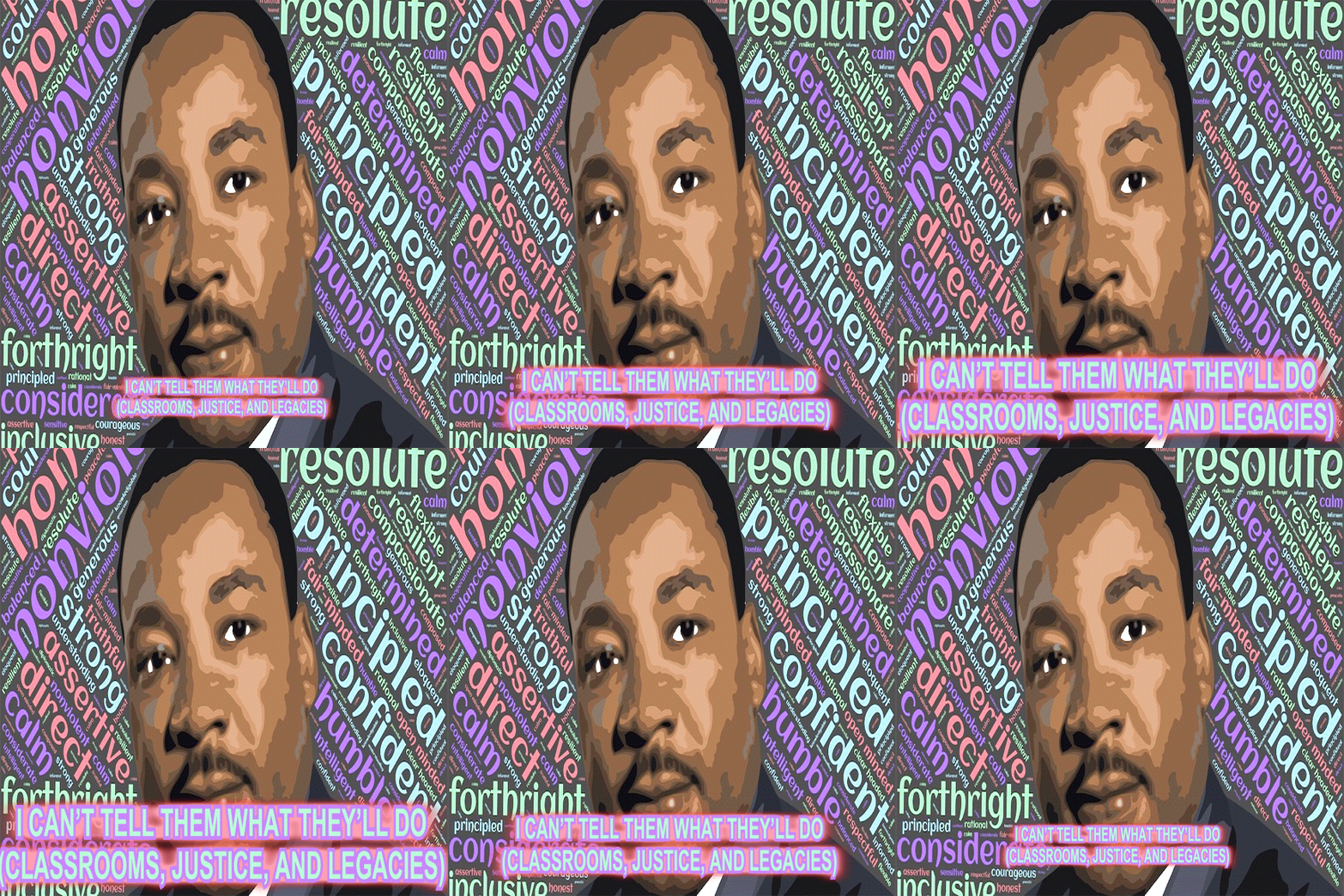
I Can't Tell Them What They'll Do (Classrooms, Justice, and Legacies) | The Jose Vilson

I Can't Tell Them What They'll Do (Classrooms, Justice, and Legacies) | The Jose Vilson

I CAN’T TELL THEM WHAT THEY’LL DO (CLASSROOMS, JUSTICE, AND LEGACIES)


I arrive in my classroom every morning at around 7:20 am, 40 minutes before my students trickle in. The minute hand leans to the right while I drag my feet a few flights of stairs, coffee in hand, lesson plan in mind. A few rays of light creep into my room, usually hitting the likenesses of Malcolm X and Martin Luther King Jr. behind my desk. I glance at Detroit Red, then el-Hajj Malik el-Shabazz, then Dr. King Jr. I take a deep breath, then get my mind set on this lesson plan. I fill out this Word document with an objective, a Do Now / warm-up activity, the materials we’ll need for class, a lesson with an essential question, a box for modifications, an activity, a closing activity, and a homework assignment. I print it. I spend a few minutes wondering whether I told the right story about the math I’ll be teaching.
Students come in. Good morning. I never have an idea of what’ll come next.
The math part of this work is simple enough. Let’s take a ratio and find equivalent ratios in other forms like fractions and decimals and in multiple representations like tables and graphs. Let’s use multiplication and division to keep these ratios consistent and find the patterns between the numerators and denominators, the x’s and y’s, the quotients and constants of proportionality. Let’s determine that a proportional graph cuts through the origin – (0,0) if you must – and makes a CONTINUE READING: I Can't Tell Them What They'll Do (Classrooms, Justice, and Legacies) | The Jose Vilson