Latest News and Comment from Education

Tuesday, July 30, 2019

The pervasiveness of poverty in schools demands real solutions

The pervasiveness of poverty in schools demands real solutions

A school administrator tries to shame poverty away
The pervasiveness of poverty in schools demands real solutions
Last time I checked, being poor was not a crime. But earlier this month, school officials in Kingston, Pennsylvania, treated it as one.
On July 9, Wyoming Valley West School District officials mailed a letter to approximately 40 parents, warning that if they did not pay their child’s debt for school meals, “the result may be your child being taken from your home and placed in foster care.”
The backlash to the letter was immediate and understandable. There were those who criticized the decision to collect a meal debt in this way because it missed the larger point: Parents may not be able to afford reduced-price lunches. Shaking down parents would amount to punishing them for being poor. U.S. Sen. Bob Casey (D-PA) tweeted, “No child should have to imagine the horror of being ripped away from their parents because their family is struggling economically.” Sympathetic responses also sought to solve the real budget hole created by parents not paying.
NPR reported that at least five individuals each offered to pay the accumulated debt of $22,000, representing dozens of students who hadn’t paid for meals. However, the school district’s president, Joseph Mazur, who leads one of the poorest districts in the state, rejected their offers, reportedly because it was owed by parents who could pay. Mazur’s refusal laid bare the real motivations of the letter: He sought to shame parents and their children with an absurd lesson on responsibility. His warning that an educational system is willing CONTINUE READING: The pervasiveness of poverty in schools demands real solutions

LA Unified’s spending plan should be rejected and rewritten, says advocates’ complaint | EdSource

LA Unified’s spending plan should be rejected and rewritten, says advocates’ complaint | EdSource

LA Unified’s spending plan should be rejected and rewritten, says advocates’ complaint
LCAP doesn’t fully document how $1.2 billion will help high-needs students

A public interest law firm that has bird-dogged Los Angeles Unified’s spending has filed a formal complaint demanding that the state’s largest school district redo its 2019-20 school accountability plan.
The complaint argues that the district wrote a vague and deficient Local Control and Accountability Plan — or LCAP – that fails to meet the state’s transparency requirements on how it will spend $1.2 billion in state funding dedicated to high-needs students. The district’s board of education approved the plan last month, although several board members acknowledged at the hearing that they found the LCAP and the budget to be confusing.
In what could eventually could become a lawsuit, Public Advocates, together with the Los Angeles law firm Covington & Burling, expedited their complaint by sending it directly to the California Department of Education instead of first filing it with the district and, if needed, with the Los Angeles County Office of Education.
Public Advocates wrote that going through the channels would be “futile” given the district’s unresponsiveness to past complaints and the county office’s “consistent rubber stamping” of previous LCAPs. Delays in ruling on the complaint would “irreparably” harm children relying on the funding to improve their education, the complaint said.
But Jeff Breshears, an administrator who oversees LCAP complaints for the state, rejected that argument as premature and forwarded the complaint to the district and the county office of education. The county office hadn’t completed its evaluation of the 2019-20 LCAP when the complaint was filed, Breshears’ letter noted. Breshears ordered the district to rule on the complaint within 60 days.
Spokespeople for both the district and the county office declined to comment on the complaint, saying it was under review.
State law requires that districts and charter schools, in consultation with parents and the community, write an LCAP every three years, with annual updates, to account for CONTINUE READING: LA Unified’s spending plan should be rejected and rewritten, says advocates’ complaint | EdSource
Big Education Ape: Growing Scandal at Sacramento School District: Additional Email Reveals More Deception - Sacramento City Teachers Association - https://bigeducationape.blogspot.com/2019/07/growing-scandal-at-sacramento-school.html


Study: California schools earn low grades compared to nation

Study: California schools earn low grades compared to nation

Study: California schools earn low grades compared to nation

(KGTV) - As parents and children prepare for a new school year, a study shows California schools do not earn top grades compared to other states.
California ranked 38th among the 50 states and District of Columbia in 29 categories, according to the Wallet Hub study.
Data considered to measure quality included graduation rate, dropout rate, math and reading test scores, Advanced Placement exam scores, student-teacher ratio, and SAT and ACT results.
Safety was measured by number of school shootings, share of high school students who were armed, participating in violence, or access to illegal drugs, school safety plans, youth incarceration rates, and safety grades of roads around schools.
California was 4th best for the percentage of threatened or injured high school students. The state came in last for its student-teacher ratio.
Other key rankings: 
  • 44th – Math Test Scores
  • 38th – Reading Test Scores
  • 32nd – Median SAT Score
  • 16th – Median ACT Score
  • 22nd – % of Licensed/Certified Public K–12 Teachers
  • 34th – Dropout Rate
  • 7th – Bullying Incidence Rate
Top states for education included Massachusetts, New Jersey, Connecticut, Virginia, and Vermont. The worst states were West Virginia, Mississippi, Arizona, Louisiana, and New Mexico.
Study: California schools earn low grades compared to nation

Fake Play and Its Dangerous Alignment to Standards and Data

Fake Play and Its Dangerous Alignment to Standards and Data

Fake Play and Its Dangerous Alignment to Standards and Data

Where does pretending come in? It relates to what philosophers call “counterfactual” thinking, like Einstein wondering what would happen if a train went at the speed of light.
~Alison Gopnik, “Let the Children Play, It’s Good for Them” Smithsonian Magazine. July 2012.
There’s a troubling phenomenon happening in early childhood education. It involves aligning standards to fake play.
Children own real play.
In Educating Young Children, Mary Hohmann and David P. Weikart discuss the HighScope preschool program and the welcome backseat adults often take to allow children to freely play. They say: When children are playing or starting to play, and are receptive to other players, adults can sometimes join them in a nondisruptive manner. This is real play.
Real play involves children using their imaginations to plan and work things out on CONTINUE READING: Fake Play and Its Dangerous Alignment to Standards and Data

Teacher Preparation and the Kafkan Nightmare of Accreditation | radical eyes for equity

Teacher Preparation and the Kafkan Nightmare of Accreditation | radical eyes for equity

Teacher Preparation and the Kafkan Nightmare of Accreditation

Over three-plus decades of teaching, I have found that students are far less likely to laugh while reading Franz Kafka than, say, while reading Kurt Vonnegut. But Kafka and Vonnegut are essentially satirists, though both traffic mainly in dark humor.
Black-and-white photograph of Kafka as a young man with dark hair in a formal suit
Franz Kafka 1923 (public domain)
The Metamorphosis is the work most people associate with Kafka, but it isn’t readily recognized, I have found, that the work is filled with slapstick humor—the scene when Gregor is revealed as a bug to his family—while also making a damning commentary on the consequences of the bureaucratic life.
You see, Gregor Samsa’s metamorphosis into a bug is merely a physical manifestation of his life as a salesman, which, Kafka illustrates, is nothing more than a bug’s life.
This, of course, was Kafka’s impression of early twentieth century Prussia as well as the corrosive nature of materialism. As I enter my eighteenth year as as a teacher educator, after eighteen years as a public school English teacher, I can attest that Kafka has pretty much nailed my career on the head as well.
So when I saw Teacher-Preparation Programs Again Have a Choice of Accreditors. But Should They? in Education Week, I immediately recognized that this was the wrong question—or at least incomplete.
Accountability, standards, and assessment have been pervasive my entire career in education, which began in 1984. Over that career, I have heard a CONTINUE READING: Teacher Preparation and the Kafkan Nightmare of Accreditation | radical eyes for equity

The Case for Making College Free – Have You Heard

The Case for Making College Free – Have You Heard

The Case for Making College Free


In the latest episode of Have You Heard, economist Marshall Steinbaum talks free college, human capital theory, educationism and why it’s time to disrupt the individualized logic of higher education. If that sounds like a lot, well, it is! You may need to take notes—or lie down for a while, but we guarantee that listening to this episode will add to your stockpile of human capital. Complete transcript available here. And if you enjoy this high-quality content, please consider supporting us on Patreon. You’ll get access to our subscriber-only In the Weeds segment, reading lists, and the satisfaction of knowing that you’re keeping the best little education podcast out there afloat.


CURMUDGUCATION: Why Charter Schools Must Waste Money

CURMUDGUCATION: Why Charter Schools Must Waste Money

Why Charter Schools Must Waste Money
Back in March, the Network for Public Education, a public education advocacy group, released a study showing that the Department of Education has spent over a billion dollars on charter school waste and fraud. Education Next, a publication that advocates for charter schools, offered a reply to that report. The rebuttal to the rebuttal just appeared in the Washington Post, but there is one portion of the Education Next piece that deserves a closer look.
Charter schools should be held accountable for performance, which requires closing them when they don’t meet standards. Even with the best plans and under the ideal circumstances, opening a charter school is difficult. Charter Schools Program funding is intended to serve as seed capital to encourage innovation, and some experiments will fail. That is expected.
This is part of the premise of corporate education reform--that schools should open and close and rise and fall just like a car dealership or a food truck. For these fans of choice, having schools closed down is a sign that the system is working, not a sign of failure.
There are several problems with this feature.
One is the disruption for students. Being booted out of your school (especially if it happenssuddenly, unexpectedly, and in the middle of the school year) is not like discovering that your favorite taco truck isn't at the corner today. Families have to find a new school. Students are wrenched out of familiar surroundings with familiar teachers and school friends. Being the new kid in school is socially isolating. Learning to live by a whole new set of rules is troubling. For a  CONTINUE READING: CURMUDGUCATION: Why Charter Schools Must Waste Money

New thoughts on Charter Schools…. | Deborah Meier on Education

New thoughts on Charter Schools…. | Deborah Meier on Education

New thoughts on Charter Schools….
Just took a long swim in my pond and feel restored—maybe to age…. 50?
I’ve been involved this past year in working with Steve Zimmerman, who has started two community-based charter schools in Queens. He’s helped me do some hard thinking about my divided loyalties.
On one hand I’m a fierce critic of privatizing K-12 schooling. Of course. And that includes all kinds of subtle forms of privatization and using public monies to make a profit off of educating young citizens. I’m also shocked by the many ways in which the corporate and philanthropic world has lied and cheated and abetted the growth of the “charter chains” which operate within the worst of all worlds. They are corporate-style operators with control resting in the hands of privately selected board members who live and operate worlds apart from the communities and families they make decisions for.
BUT. What about colleagues I know (like the late Ted Sizer) who started charter schools because, unlike me, no one in the public school world offered them a chance to have CONTINUE READING: New thoughts on Charter Schools…. | Deborah Meier on Education

Will “Big Ideas” Reduce/End the Achievement/Opportunity Gap? How Will Culturally Relevant Education (CRE) Impact Student Learning? | Ed In The Apple

Will “Big Ideas” Reduce/End the Achievement/Opportunity Gap? How Will Culturally Relevant Education (CRE) Impact Student Learning? | Ed In The Apple

Will “Big Ideas” Reduce/End the Achievement/Opportunity Gap? How Will Culturally Relevant Education (CRE) Impact Student Learning?


For decades researchers, think tanks, politicians, talking heads have chipped in with programs and policies to shrink/eliminate the “achievement gap.” The Moynihan Report (1965), entitled “The Black Family” pointed to dysfunctional Black families as a source of poverty, a Report long since discredited. The Elementary and Secondary Education Act  (1965), at the core of the President Johnson’s War On Poverty provided dollars to poor districts, vital dollars, and has not had the impact we had hoped for.  Court-ordered busing in the 70’s did integrate schools until higher courts intervened. No Child Left Behind (2002) was a bi-partisan widely supported law that ended up as “test and punish.”
Universal Pre-K and 3 for All in New York City will have significant impact over time.  Locally created integration plans will nibble around the edges; Race to the Top dangled dollars if states linked teacher accountability to student test scores, endorsed charter schools and the Common Core, and only succeeded in creating the Opt-Out movement.
All glowed brightly and faded to the dustbin of failed solutions.
In other words, there are no magic bullets.
School systems do need fixes.
More teachers of color, especially male teachers are a goal, although the school district with the largest percentage of teachers of color in New York City is a low achieving district. Around the city about 40% of principals are of color and a  CONTINUE READING: Will “Big Ideas” Reduce/End the Achievement/Opportunity Gap? How Will Culturally Relevant Education (CRE) Impact Student Learning? | Ed In The Apple


Monday, July 29, 2019

Hackers’ Latest Target: School Districts - The New York Times

Hackers’ Latest Target: School Districts - The New York Times

Hackers’ Latest Target: School Districts
Schools handle a lot of personal data and may not have strong technology teams, leaving them vulnerable to attacks, experts say.

Some hackers demand ransom; others sweep up personal data for sale to identity thieves. But whatever hackers’ motives, school systems around the country have been the targets of their cyberattacks.
One attack forced the Houston County School District in Dothan, Ala., to delay the first day of school for 6,400 students. Others crippled computer systems at the Syracuse City School District in upstate New York and at three school districts in Louisiana.
Many public institutions, including hospitalslocal governmentsand colleges, have been hit with ransomware attacks in recent years, but school districts have proved particularly enticing to hackers because they hold troves of private data and often lack the resources to fend off intruders.
Nearly two-thirds of school districts in the United States serve fewer than 2,500 students, and many do not have a staff member dedicated solely to cybersecurity, according to Keith R. Krueger, the chief executive of the Consortium for School Networking, a group that represents technology employees at primary and secondary schools.

Cybersecurity “is a tremendously growing concern for school districts,” Mr. Krueger said, adding that members of his organization now rank it in annual surveys as their top source of anxiety.


In Louisiana, Gov. John Bel Edwards declared a state of emergency after a virus disabled computers at three school districts, including one in which the virus also knocked out the district office’s phone system.
The three Louisiana attacks — on the schools in Sabine and Morehouse parishes and the city of Monroe — had similar traits, according to Christina Stephens, a spokeswoman for the governor. She declined to discuss the attacks in detail because state and F.B.I. investigations of the incidents are still in progress.
Ms. Stephens said state authorities are working with the districts to eradicate the virus before students return to school in early CONTINUE READING: Hackers’ Latest Target: School Districts - The New York Times

Michigan Reading law would hold back almost 5,000 third graders if took effect today | Michigan Radio

Michigan Reading law would hold back almost 5,000 third graders if took effect today | Michigan Radio

Michigan Reading law would hold back almost 5,000 third graders if took effect today


If Michigan’s Read by Grade 3 retention law went into effect for this fall, nearly 5,000 third graders would repeat the third grade, according to Michigan State University researchers.
MSU’s Education Policy Innovation Collaborative (EPIC) reviewed the 2017-2018 Michigan Student Test of Educational Progress, or M-STEP, to get their estimates of literacy. They found that between 2% and 5% of third graders are not proficient in reading. The rates of students that would need to repeat 3rd grade are higher for black students at between 7% and 11%, special education students are at about 10% and for students in Partnership Schools- the lowest performing  schools in the state, between 12% and 20%.
Katharine Strunk, co-director of EPIC and professor of education policy, says although the retention portion of the law has a lot of opposition, it may be useful for children who are very far below the cutpoint and are truly struggling, and whose challenges may impact their ability to learn in all subjects in later years.
“If you're very far below the cut point and you really can’t read or understand at grade level, it’s going to just compound over the rest of your life,”she said. “So for those kids, socially promoting them might just not be in their best interest.”
The  U.S. Department of Education ‘s Institute of Education Sciences gave the Michigan Education Research Institute- a partnership between MSU, University of Michigan, the Michigan Department of Education and the state’s Center for Educational Performance and Information, almost $5 million to evaluate the law’s effects.
Strunk says Governor Gretchen Whitmer is unsupportive of making so many students repeat the third grade.
Joshua Cowen, co-director of EPIC, said Michigan is one of 16 states CONTINUE READING: Michigan Reading law would hold back almost 5,000 third graders if took effect today | Michigan Radio

Oklahoma Officials: Impossible To Track Epic Charter Schools' Alleged 'Ghost Students' | KOSU

Oklahoma Officials: Impossible To Track Epic Charter Schools' Alleged 'Ghost Students' | KOSU

Oklahoma Officials: Impossible To Track Epic Charter Schools' Alleged 'Ghost Students'

Oklahoma investigators believe Epic Charter Schools embezzled money by inflating its enrollment with homeschool and private school students. Because of the state’s dedication to privacy, State Superintendent of Public Instruction Joy Hofmeister says the alleged abuse would not have been preventable under current state law.
The Enrollment Loophole
Virtual charter schools are taxpayer-funded public schools. Like traditional public schools, they are free to families and receive funding from the state based on student enrollment. Unlike traditional public schools, they are run by private companies or non-profits, and student instruction and coursework happen online instead of in-person.  
With over 20,000 students on the books last year, Epic is the largest virtual charter school in Oklahoma, and it appears to be exploiting a loophole in state law. 
All virtual charters are under the purview of a separate agency, the Statewide Virtual Charter School Board, but verifying enrollment falls to the State Dept. of Education.
The education department has the data to easily keeps tabs on kids enrolled in public schools, including Epic, but it cannot track private or homeschooled students because they aren’t required to register with the state government. That makes it nearly impossible to weed out these so-called “ghost students” who are dually or falsely enrolled in homeschool or private school as well as a virtual charter school during routine audits. 
We do not have at the state level a list of homeschool students or private school CONTINUE READING: Oklahoma Officials: Impossible To Track Epic Charter Schools' Alleged 'Ghost Students' | KOSU

CURMUDGUCATION: Mayor Pete Doesn't Get It (And If He Does, That's Even Worse)

CURMUDGUCATION: Mayor Pete Doesn't Get It (And If He Does, That's Even Worse)

Mayor Pete Doesn't Get It (And If He Does, That's Even Worse)

In 2016, Hillary Clinton staked out what was supposed to be the safe territory on the charter school issue-- to be against for-profit charters, but in favor of non-profits. That qualified as enough of a break with the corporate Democrat orthodoxy that DFER felt the need to reassure wealthy donorsthat the Clinton's could be counted on to betray unions.

But a position that depends on distinguishing non-profits from for-profits at best shows some cynical poli-gamesmanship, and at worst reveals a lack of understanding of the issues. In 2016, a candidate might be excused for ignorance, but there's been plenty of education on the subjectsince, and no excuses left for candidates.

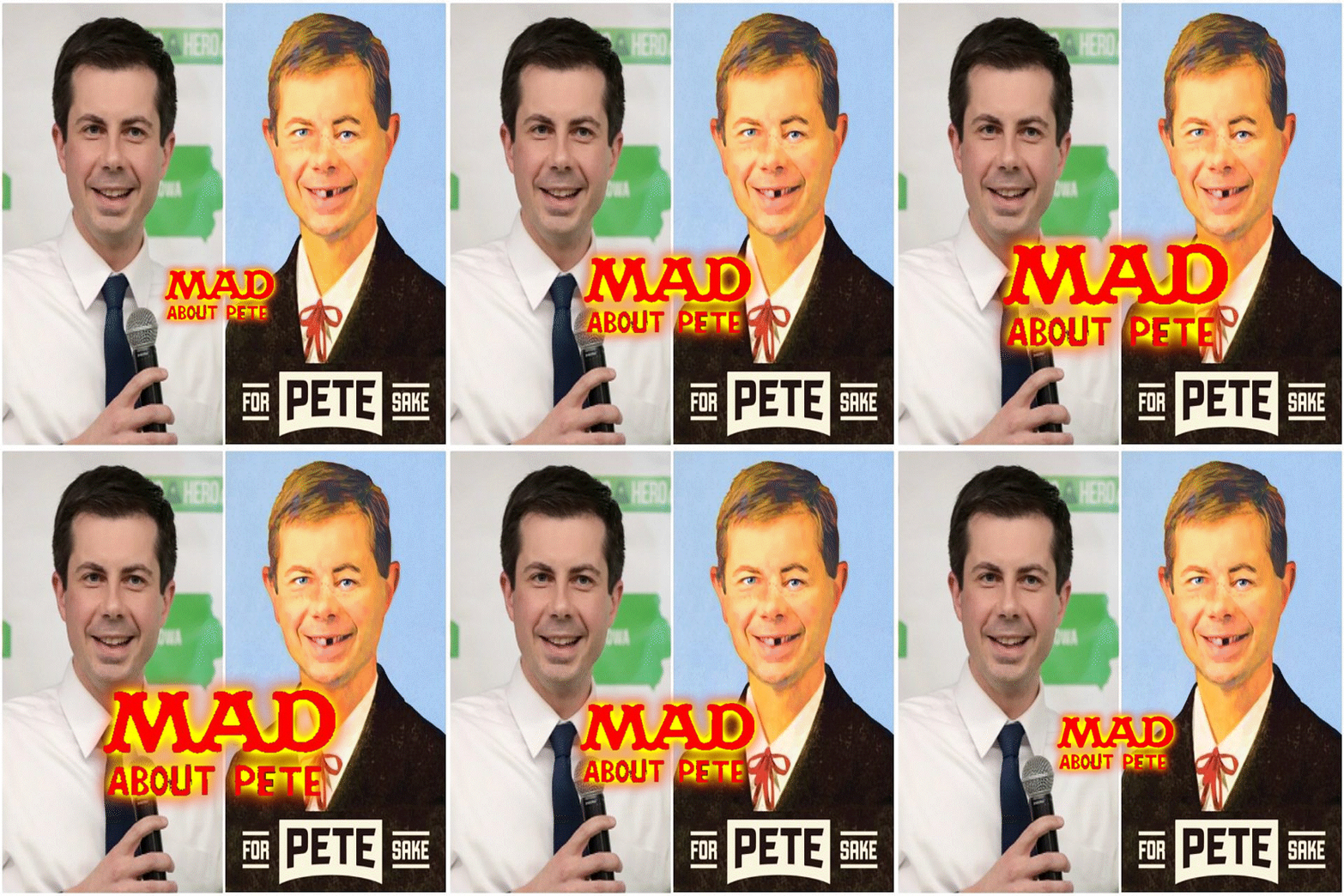
That's why it's a bit discouraging to find high-profile candidates like Mayor Pete Buttigieg resorting to this dodge.

The signs up until this point have not been good. Buttigieg has some time with McKinsey on his resume, and that consulting giant … well...McKinsey is one of the biggest management consulting firms in the world, and long intertwined with the education reform movement; Sir Michael Barber was a partner there before he went to run Pearson, and David Coleman worked as a consultant at McKinsey before he spearheaded the Common Core. McKinsey has also plucked some employees from the world of Eli Broad-- a McKinsey manager was in the first class of the Broad Academy. McKinsey actually pre-dated Broad in the practice of embedding their own people in the Los Angeles school district. They're fans of data-driven analytics baloney, and they are generally a good example of what Anand Giridharadas is talking about inWinner Take All-- the ways rich folks try to fix problems without actually inconveniencing themselves while still managing to profit from the "solution."

Reed "Elected School Boards Should Be Abolished" Hastings held a great fund raiser for Mayor Pete. And as she reported this morning, when Diane Ravitch reached sat down with the campaign to try to share a more balanced view of ed reform, she found herself facing a bunch of folks who came up CONTINUE READING: 
CURMUDGUCATION: Mayor Pete Doesn't Get It (And If He Does, That's Even Worse)


SomeDamPoet: What Happens to a Dream DFERed? (With Apologies to Langston Hughes) | Diane Ravitch's blog

SomeDamPoet: What Happens to a Dream DFERed? (With Apologies to Langston Hughes) | Diane Ravitch's blog

SomeDamPoet: What Happens to a Dream DFERed? (With Apologies to Langston Hughes)

Our blog poet wrote a poem about DFER (Democrats for Education Reform). DFER is a group of wealthy hedge fund managers who may or may not be Democrats, but who are committed to charter schools, test-based evaluation of teachers, high-stakes testing, merit pay, and Teach for America.
The Dream DFERed (with apologies o Langston Hughes)
What happens to a dream DFERed?
Does it disrupt
Like a test in a school?
Or fester like a Common Core–
Or techy tool?
Does it stink like stale pee?
Or rust and fade away-
like Michelle Rhee?
Maybe it just doubles down
like a billionaire
Or does it drown?


Chicago’s school choice system is tracking kids into different high schools

Chicago’s school choice system is tracking kids into different high schools

The Big Sort: How Chicago’s school choice system is tracking kids into different high schools based on achievement


This spring, at grammar schools all across Chicago, thousands of eighth graders donned caps and gowns and walked across auditorium stages to receive their elementary school diplomas. This fall, the graduates from each of those schools will scatter—to more than 130 different Chicago public high schools, and counting.

But who goes where?
Over the past decade, Chicago has opened dozens of new high schools, and will open more this fall. The school district is trying to expand the number of “quality school options” and offer students a choice of where to go to school. And in many ways, Chicago high schools seem to be improving. Graduation rates are inching up. The city now boasts five of the top ten high schools in the state.

But a new WBEZ analysis shows an unintended consequence of the choice system: students of different ability levels are being sorted into separate high schools.
WBEZ analyzed incoming test scores for freshmen from the fall of 2012, the most recent year data is available. That year, the district mandated that every high school give students an “EXPLORE” exam about a month into the school year.
The 26,340 scores range from painfully low to perfect.
But WBEZ found few schools in the city enroll the full span of students. Instead, low-scoring students and high-scoring students in particular are attending completely different high schools. Other schools enroll a glut of average kids.
Think of it as academic tracking—not within schools, but between them.
The findings raise some of the same long-running questions educators have debated about the academic and social implications of in-school tracking. But they also raise questions about whether the city’s school choice system is actually creating better schools, or whether it’s simply sorting certain students out and leaving the weakest learners in separate, struggling schools.

Why I Do Not Support Mayor Pete | Diane Ravitch's blog

Why I Do Not Support Mayor Pete | Diane Ravitch's blog

Why I Do Not Support Mayor Pete

There are many reasons why I would like to support Mayor Pete Buttigieg. He’s young, he is well-educated, he is smart, he has an admirable record of service to his country, he’s brimming with ideas. I find him very attractive on many levels.
But on education, he is a stealth corporate reformer.
I had an inkling of this when I read a review of his autobiography, which described his formative years at McKinsey and his data-driven, technocratic approach to solving problems. But I didn’t reach a judgment.
Then I learned more when a friend sent me an invitation to a fundraiser for Mayor Pete, hosted by Reed Hastings. Hastings is the billionaire founder of Netflix who is a charter school zealot. He served on the California State Board of Education where he used his influence to minimize any regulation of charters. Since then, he has given many millions to charters as well as to the charter lobby, The California Charter Schools Association. He created a fund of $100 million to promote privatization of public schools by charter expansion. Hastings has said he looks forward to the day when all schools are run by corporations, not elected school boards.
I tweeted the invitation and it got a lot of attention. Carol Burris heard from Pete’s National Political Director, Stephen Brokaw. He wanted to correct any misperception we at the Network for Public Education had about where Mayor Pete stands on education. He is against vouchers. He is against for-profit charters. He (or his team) visited Roxbury Prep in Massachusetts and was very impressed with their high test scores. Brokaw cited Roxbury Prep as the kind of nonprofit charter that offered lessons to public schools.
Carol responded that the issue is not whether charters CONTINUE READING: Why I Do Not Support Mayor Pete | Diane Ravitch's blog