Latest News and Comment from Education

Monday, July 29, 2019

As public funding dipped, student loan debt soared

As public funding dipped, student loan debt soared

As public funding dipped, student loan debt soared

 and 
“I HOPE I DIE BEFORE I PAY OFF MY STUDENT LOANS BECAUSE I DON’T THINK I CAN PAY THEM OFF IN MY LIFETIME.  MY GREATEST FEAR IS THAT MY HEALTH WILL FAIL, I WON’T BE ABLE TO WORK, AND THEY WILL COME AFTER ME FOR THE MONEY.”— GARY SIMS, DOCTOR OF OSTEOPATHIC MEDICINE.
Dr. Gary Sims’ story is one of dozens we have heard about student loan debt. Most of the stories come from public education teachers, social workers and other professionals who will never earn a physician’s salary.
While researching the topic of student loan debt, we have heard from people whose Social Security checks, disability checks and paychecks are being garnished. In response to stories like these and quantitative data, financial experts, economists and politicians are labeling student loan debt as a “crisis,” one that can no longer be ignored.
In this article, we begin by examining the impacts of student loan debt on society, then explore the downward trajectory of public education funding, and end with what can be done at the individual, state and local levels.

Currently affecting families and economy

Student loans lead to crushing financial debt for many students and/or their parents. Today, there is nearly $1.5 trillion in student loan debt in the U.S., more than double that of 10 years ago. The debt load of people age 50 and older alone is $292 billion. As of December 31, 2018, Oklahomans had $13.5 billion in student loan debt.
When students and their families are paying down student loan debt, they are unable to save for retirement or other purposes. They are not paying down other debt nor buying homes or cars. Some are even delaying marriage and having children.

How did we get here?

In the late 1960s, state and federal dollars funding public higher education started trickling off. Then the “big bang” of funding reversals began in the 1970s in response to the politically active student generation. Governors and state legislators often perceived universities as failing to keep a “campus house in order” ultimately led to a loss of public and government confidence in colleges and universities.
But universities have also played a role in student loan debt by applying the “business/market” model to higher education. Destructive policies “have led them to destabilize their finances, raise tuition, overbuild facilities, create a national student debt crisis, and lower educational quality,” according to U.C. Santa Barbara professor Christopher Newfield in his book The Great Mistake.
The total burden of financing much of higher education has fallen to its lowest common denominator — the student and his or her family. As legislatures have reduced their funding of higher education, students are now paying 63 percent of higher education costs.
Some argue this is a partisan effort by the Republican Party, “that increasingly relies on CONTINUE READING: As public funding dipped, student loan debt soared

Lead-Based Paint Found In Half Of All Inspected Schools | PopularResistance.Org

Lead-Based Paint Found In Half Of All Inspected Schools | PopularResistance.Org

LEAD-BASED PAINT FOUND IN HALF OF ALL INSPECTED SCHOOLS

With all the emphasis that has been placed on making sure children are safe from the hazards of lead-based paint at home, similar efforts would seem just as important for America’s schools.
After all, outside of the home, young children spend the majority of their day – 6.8 hours a day – at school.
Yet a new federal report found that an estimated 15.2 million children in the U.S. go to schools in school districts that found lead-based paint. This is happening more than 40 years after the United States’ 1978 ban on the use of lead-based paint in housing.
For years, as a nursing professor and parent educator who specializes in treating children with elevated lead levels, I have worked to identify children with lead poisoning and to help parents make their homes lead-safe.
Lead, breathed in or ingested, can affect children’s brain development and result in reduced “intelligence quotient,” or IQ.

Failure To Inspect

The report, released June 24 by the U.S. Government Accountability Office, highlighted how many school districts – 72% – are not even inspecting their buildings for lead-based paint hazards. The Government Accountability Office restricted its analysis to school districts that had at least one school built before 1978, and those that obtained drinking water from a public water system.
Among the 12% that do inspect for lead hazards, more than half found them. That raises questions about what amount could be found in the remaining 88% of schools that aren’t looking.
Lead was more frequently found in large school districts – 51% of the time versus 8% for other districts, according to the report. There could be a number of reasons for these results. These larger districts may have older school buildings, or they may be in larger cities that lack the money to keep schools in a good state of repair.

Parents Unaware

The report also reveals that school districts often don’t notify parents or school board members about lead inspection results.
Specifically, 58% of school districts did not notify parents of their findings and 46% CONTINUE READING: Lead-Based Paint Found In Half Of All Inspected Schools | PopularResistance.Org

It's Larry Ferlazzo's Websites of the Day... A VERY BUSY DAY | The latest news and resources in education since 2007

Larry Ferlazzo's Websites of the Day... | The latest news and resources in education since 2007

It's Larry Ferlazzo's Websites of the Day... A VERY BUSY DAY 

The latest news and resources in education since 2007


Infographic: “Earth Overshoot Day”
WikiImages / Pixabay This infographic came from Statista : Earth Overshoot Day came on July 29 this year. This is the second time the day, which marks the time at which humanity has used up its allotment of natural planetary resources for the year, occurred in the month. It had occurred in August between 2010 and 2017. I’m adding it to The Best Interactives Showing How Long Our Non-Renewables Wil
This Week’s “Round-Up” Of Useful Posts & Articles On Ed Policy Issues
Here are some recent useful posts and articles on educational policy issues (You might also be interested in THE BEST ARTICLES, VIDEOS & POSTS ON EDUCATION POLICY IN 2019 – PART ONE ): WHY ARE MORE SCHOOLS GOING AFTER FAMILIES FOR LUNCH DEBT? is from PS Magazine. How segregation keeps poor students of color out of whiter, richer nearby districts is from Vox. I’m adding it to The Best Resources Fo
The Best Fun and/or Interesting Resources On Venn Diagrams
Clker-Free-Vector-Images / Pixabay The Guardian published a fun article on Venn Diagrams today , and I thought it would be a good excuse to publish a related “Best” list. Of course, I’ve published a bunch of post s explaining different ways I use Venn Diagrams in lessons. This eclectic collection, though, is more on the humorous or unique side, along with a couple of particularly useful ones thro
“Show Me the Money! Ways Teachers Can Raise Funds for Their Classrooms”
Show Me the Money! Ways Teachers Can Raise Funds for Their Classrooms is the headline of my latest Education Week Teacher column. Suggestions on how teachers can raise private monies to support their classroom are offered by Alfonso Gonzalez, Holly Spinelli, Susan Lafond, Amanda Koonlaba, and Barbara Gottschalk. Here are some excerpts: I’m adding it to my other resources on education funding .

YESTERDAY

A Look Back: Ducklings Video Demonstrates Great “Differentiated Instruction”
I thought the summer might be a good time to re-share posts from My All-Time Favorite Posts! list… mcpdigital / Pixabay In this video, some ducklings were able to get over the curb on their own. However, several found that it was just too high. Look at how someone provides assistance to those having trouble, and how he doesn’t tell them what to do. Instead, he offers it as an option, as a choice
Quote Of The Day: Another Reason To Be “Data-Informed” & Not “Data-Driven”
I’m a data scientist who is skeptical about data is an interesting article at Quartz by Andrea Jones-Rooy. She goes on to say: When you encounter a study or dataset, I urge you to ask: What might be missing from this picture? What’s another way to consider what happened? And what does this particular measure rule in, rule out, or incentivize? I’m adding it to The Best Resources Showing Why We Nee
Wow! Wordwall Looks Like A Great – & Free – Site For Creating Online Learning Games
I have just learned about Wordwall from ELT Planning, which has a great post about it In fact, I think the post provides a better explanation of Wordwall than the actual site does! The screenshot above shows all the different templates you can use for creating games, and you can assign them to students (you’re given an url address to share) and get their results. There are also a zillion other ga
“Author Interview: ‘The Right Tools'”
Author Interview: ‘The Right Tools’ is the headline of my latest Education Week Teacher column. In it, Towanda Harris answers a few questions about her new book, “The Right Tools: A Guide to Selecting, Evaluating, and Implementing Classroom Resources and Practices.” Here are some excerpts:
Visual Histories Of World Wars I & II
janeb13 / Pixabay The American Battle Monuments Commission has tons of interactives related to both World War I and World War II. The best ones are: The Great War: A Visual History World War II: A Visual History I’m adding them 


Larry Ferlazzo's Websites of the Day... | The latest news and resources in education since 2007


Big Education Ape: This Week With Larry Ferlazzo's Websites of the Day... The latest news and resources in education since 2007 - https://bigeducationape.blogspot.com/2019/07/this-week-with-larry-ferlazzos-websites_27.html

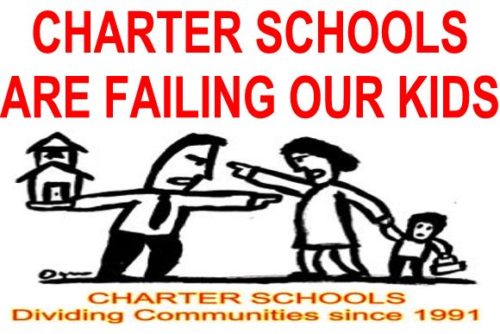
Shawgi Tell: Charter Schools Cannot Be Prettified | Dissident Voice

Charter Schools Cannot Be Prettified | Dissident Voice

Charter Schools Cannot Be Prettified
Recent “Study” Funded by Billionaires Downplays Intensification of Segregation by Charter Schools


A July 2019 “study” funded by the pro-privatization Walton Family Foundation, “Charter School Effects on School Segregation,” reports that charter schools intensify racial and ethnic segregation, but not by much and for reasons that are supposedly understandable and acceptable. The authors of the “study” want the public to believe that we should not be too concerned about the role of charter schools in increasing segregation. We are to believe that deregulated privately-operated charter schools are really not that bad.
As opposition to charter schools grows, the public should expect a non-stop intensification in efforts by charter school advocates to keep mystifying charter schools in order to dupe the gullible. The desperate desire to prettify charter schools so as to keep looting public schools is driven by wealthy private interests obsessed with maximizing profits in the context of an economy that continually lowers the rate and amount of profit for owners of capital.
This unlimited greed compels short-sighted charter school supporters to defend the indefensible while ignoring reality. Pay-the-rich schemes like charter schools are critical to the rich and their allies. An end to segregated charter schools would necessarily mean an enormous loss of public money for wealthy private interests who operate with impunity.
It has long been known that public schools are segregated because we live in a segregated society. American society has been a class-divided society for centuries. But more than two decades of research has definitively shown that CONTINUE READING: Charter Schools Cannot Be Prettified | Dissident Voice

They May Not "Know" Math, But They Can Tell They're Divided | The Jose Vilson

They May Not "Know" Math, But They Can Tell They're Divided | The Jose Vilson

THEY MAY NOT “KNOW” MATH, BUT THEY CAN TELL THEY’RE DIVIDED

In 2012, I had the pleasure of reading a poem dedicated to NYC public schools at a Save Our Schools rally in City Park Hall. In the midst of the rally, a handful of Black elders approached me and said, “Hey, before people came here, we had a rally about Black education and we’d hope you can join us.” I simply nodded and understood the gravity of what he’d been asking. For a generation of Black and Latinx folx, ethnic studies in schools was an extension of asking our school systems to see them as people, citizens deserving of an education as a whole. This solution spotlights racism and all its extensions into our students’ lives. The elders in front of me had seen how the ethnic students movement was borne of the larger civil rights movement and made its way through institutions of higher education.
Sadly, our school systems in PK-12 never addressed this on a substantial level, so while the anti-high stakes testing movement was at a peak in the years of the Obama administration, we still had a centuries-old question as to whether our Black students (and others) felt like full human beings in these spaces. More often, they didn’t, and still don’t.
To many, the basic pillars of education are reading, writing, and arithmetic. Generally, anyone with an opinion on education uses the conversation about these tenets as a touchstone for whether students are learning what they ought to learn. From there, the lines get blurry. Some believe students should learn from rote memorization and basic concepts that they too mastered in their academic careers. Others believe students should learn through so-called “progressive” means: ideation, inquiry, and CONTINUE READING: They May Not "Know" Math, But They Can Tell They're Divided | The Jose Vilson

Sunday, July 28, 2019

CURMUDGUCATION: ICYMI: Post Jet Lag Edition (7/28)

CURMUDGUCATION: ICYMI: Post Jet Lag Edition (7/28)

ICYMI: Post Jet Lag Edition (7/28)

All righty. We are slowly getting back into the swing of things (two year olds do not seem to respond to jet lag well). So my reach might not be quite as far as usual, but I've still got some things for you to look at this week.

This supreme court case made school district lines a tool for desegregation.

A critical piece of history about how school district lines were set up to be a tool for-- or against--desegregation.

Learning To Read  

A reminder from Nancy Flanagan that reading teachers are not the only people who teach reading.

I'm a black teacher who works for a black principal. It's a game changer.

Well, here's a perspective that we see much too rarely. An interesting and worthwhile perspective piece.

Reforming California's dysfunctional charter school law.

Thomas Ultican looks at the continuing struggle to fix California's charter school mess.

State Takeovers vs. Organic Local Turnarounds  

State takeover of school districts are a hot business again, and Jan Resseger has a look at the good, the bad, and the alternative that actually works a lot better for everyone-- except for corporate profiteers.

What Is Really Happening in Camden  

Nobody does a better job of explaining complicated research in plain human language than Jersey Jazzman, and his series on the attempted reform of Camden schools is invaluable as a look at what really happens in such places, and how Reformsters spin it.

Teachers are miserable because they're being held at gunpoint for meaningless data.

Just in case you think this is just a US problem, here's a piece from back in April from the UK. Much of this will seem sadly familiar.


CURMUDGUCATION: ICYMI: Post Jet Lag Edition (7/28)