Latest News and Comment from Education

Sunday, July 28, 2019

CATCH UP WITH CURMUDGUCATION

CURMUDGUCATION

CATCH UP WITH CURMUDGUCATION


FL: Next Surveillance State Deadline Approaching

In the wake of the murders at Marjory Stoneman Douglas High, the great state of Florida decided to make a giant leap forward in establishing a surveillance state , proposing a data base that would collect giant massive tanker cars full of data from every public sources imaginable as well as social media. It will provide a one-stop shop for singling out every troubled child in the state. What could

JUL 26

Eight Weeks of Summer: Where Are We Now? Deprogramming.

This post is week 7 of 8 in the 8 Weeks of Summer Blog Challenge for educators. I've been doing the challenge because why not? Mostly I've been answering as my pre-retirement self, but we may mix it up a bit this week. Here's the prompt: Check-in on where you are in your summer learning journey and your overall professional journey . When I was still teaching, I was always... somewhere. Every sum
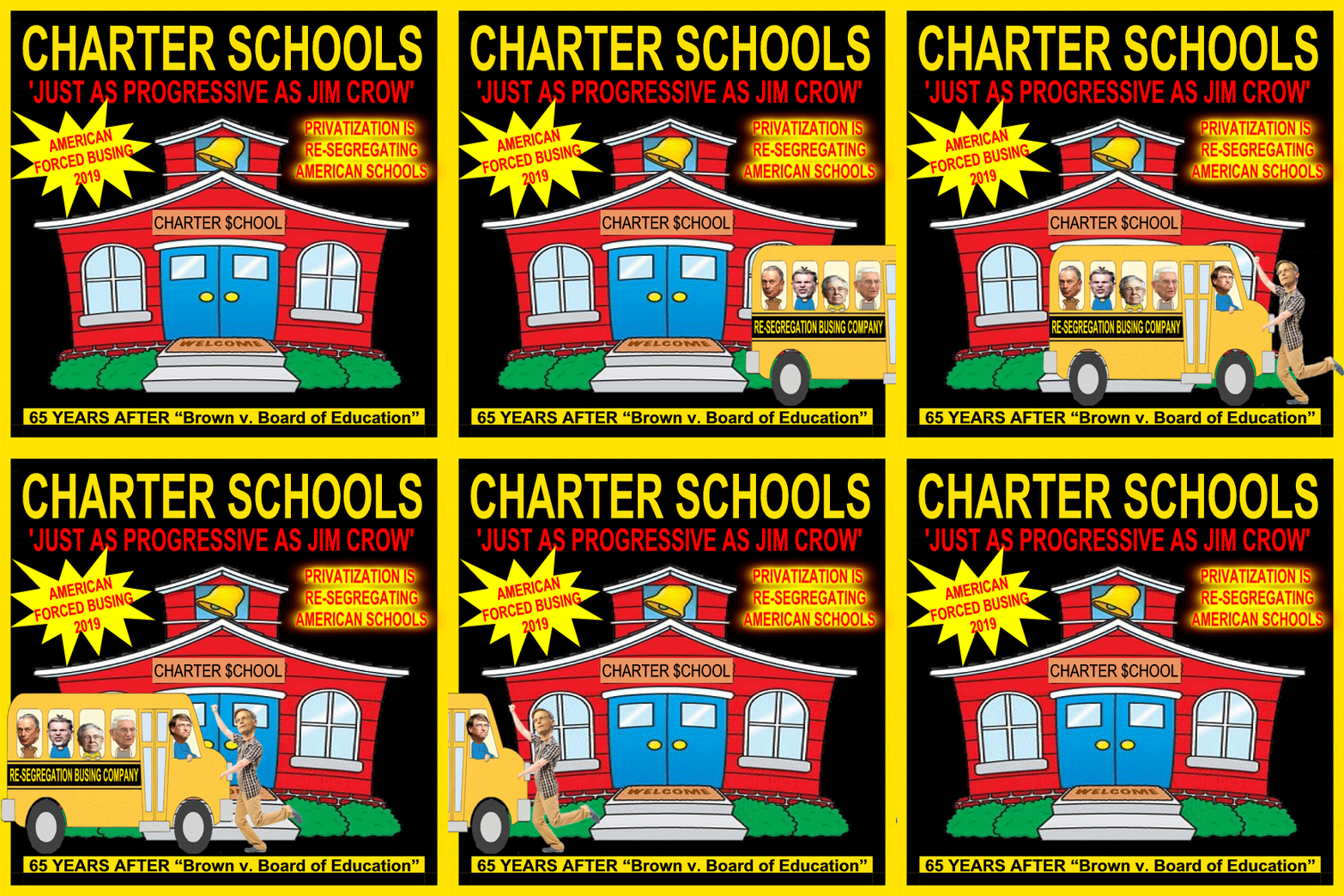
The Busing Conversation We Should Be Having

Originally posted at Forbes (June 29) So apparently, thanks to Joe Biden and Kamala Harris, we're all going to talk about busing some more. That's a conversation many Americans have been having, sort of, for a long time. When Joe Biden was a freshman congressman, I was a high school junior. In my rural small town and mostly white high school, we were aware of racial and racist strife as something

JUL 25

FL: Trees and the Taj Mahal

Florida Education Commissioner is angry with Duval Schools Superintendent Diana Greene. Grr mad. Really really mad. Corcoran was previously the speaker of the house, where he pushed a variety of privatization moves. In particular, he pushed the " Schools of Hope ," a cool plan in which public schools that were having trouble w ould be targeted for direct charter competition , with lots of incentiv

JUL 24

CA: Any Warm Body

California is in the midst of a legislative battle over charters , with the charter business suffering the prospect of a crackdown after years of happy life in the Land of Do As You Please. There are many issues and voices flying about, but the Pasadena Star-News just chose to speak up for one of the odder old arguments of charter fans-- that charter schools shouldn't have to hire qualified teache

JUL 23

How School Choice Undermines Democratic Processes

Opponents of school choice in its many forms often talk about processes and institutions and policies, but one way to grasp choice-created problems is simple, old fashioned, and non wonky. Just look at who is holding the purse strings. In the public school system, the money is controlled by some combination of taxpayer-elected local school board members and taxpayer-elected state legislators (the

JUL 22

What Killed Lesson Planning?

Are lesson plans a big fat waste of time? Well, yes, and no. But is something currently killing them? Sadly, yes. Why Lesson Planning Is Invaluable I read this piece arguing against them and kind of dismissed it and forgot about it until Nancy Flanagan brought the subject up again (Do you follow Nancy Flanagan regularly? You should). As usual, I agree with most everything she said in defense of l

JUL 16

Eight Weeks Of Summer: Getting It Done

This post is week 6 of 8 in the 8 Weeks of Summer Blog Challenge for educators . I've been doing this challenge because why not. I answer the prompts as my pre-tirement self. Here's this week's question: How are you planning to implement change next school year? This often depended on the change. For lots of changes, I just did it. Changing how I approached vocabulary? Just did it. Changing the r

JUL 14


ICYMI: House Painting Edition (7/14)

Yes, we're getting the house painted. If that's not fun, I don't know what is. But in the meantime, here's some reading for you. How Did We Miss This? The story of the Indiana cyberschool collecting money for ghost students. Palm 


CURMUDGUCATION

Busing Worked in Louisville. So Why Are Its Schools Becoming More Segregated? - The New York Times

Busing Worked in Louisville. So Why Are Its Schools Becoming More Segregated? - The New York Times

Busing Worked in Louisville. So Why Are Its Schools Becoming More Segregated?


LOUISVILLE, Ky. — When she saw the news images of angry white mobs pelting school buses with rocks and bottles, Sherlonda Lewis was glad that she was not among the black students being bused to a school in a white neighborhood.
It was 1975, and Louisville had initiated a court-ordered effort to integrate its public schools by busing students out of their racially segregated communities. As a high school senior that year, Ms. Lewis was exempt from being bused from her predominantly black neighborhood of Smoketown in central Louisville. Having seen the violent resistance, she considered herself lucky.
“I didn’t think it would last,” Ms. Lewis, 60, said of the busing plan.
Little did she know, that same integration program would go on to be widely embraced by members of the community, educating three generations of her family.
While some desegregation plans faltered in the face of white resistance, Louisville’s has proved remarkably resilient. It has survived riots and court rulings, skeptical superintendents and conservative lawmakers, making Jefferson County Public Schools, which includes Louisville, one of the nation’s most racially integrated districts.

But if Louisville is proof that busing can work when there is the political will to have an integrated school system, its community is now grappling with what happens when that political will starts to dry up.
These tensions — coming at a time when the nation is once again battling over the effectiveness of school integration — are the latest development in a series of changes that, in recent decades, have steadily chipped away at Louisville’s original integration plan.
A recent survey commissioned by the district showed dwindling support for the plan and a decreased interest in diversity among parents. Struggling schools and a yawning achievement gap between black and white students are drawing more attention these days than the benefits of maintaining racially integrated classrooms.
As the district’s schools slowly become more segregated, officials are considering more reforms that will almost certainly increase segregation.
The state’s Department of Education proposed taking over the district last year after finding myriad problems, from financial mismanagement to flaws in the desegregation program, known as the student assignment plan. State officials agreed to give district CONTINUE READING: Busing Worked in Louisville. So Why Are Its Schools Becoming More Segregated? - The New York Times

Education Insider for July 28, 2019 - Education Votes

Education Insider for July 28, 2019 - Education Votes

Education Insider for July 28, 2019

House passes bipartisan budget bill

On July 25, the House passed the Bipartisan Budget Act of 2019 (H.R. 3877), which lifts the budget caps introduced in 2011 and prevents severe cuts in non-defense discretionary (NDD) funding for fiscal years 2020 and 2021. Bipartisan support for the deal demonstrates how damaging the budget caps’ automatic cuts of $55 billion to NDD programs, including educating funding, would have been. Congress is now on track as the Senate takes up its appropriations bills to make investments to education programs such as Title 1 and IDEA, programs serving students most in need. In addition, the bill adequately funds the 2020 Census, which is critical to ensuring an accurate allocation of federal dollars for programs serving students and their families. In its letter urging passage of the bill, the NEA stated, “Lifting the caps for the next two years is essential if Congress is to move closer to adequate investment in America’s students and schools.”

NEA Supports Social Security 2100 Act

On July 25, the House Ways and Means Committee held a hearing on the Social take actionSecurity 2100 Act (H.R. 860). This legislation would strengthen Americans’ retirement safety net by increasing Social Security benefits across the board, calculating the annual cost-of-living adjustment (COLA) more accurately, by adopting a formula to better reflect the costs incurred by seniors, and increasing the minimum benefit to ensure that low-earning workers do not retire into poverty. NEA wrote to Congress in support of the Social Security 2100 Act, which would also improve the viability of the Social Security program by gradually raising the payroll tax rate from 12. 4 percent to 14.8 percent. For the average worker this would mean paying an additional 50 cents per week every year to keep the system solvent. In addition, the bill would—for the first time ever—subject annual earnings over $400,000 to the payroll tax. Presently, payroll taxes are not collected on wages over $132,900. Send an email urging the House of Representatives to support the Social Security 2100 Act (H.R. 860).

Cheers and Jeers

thumbsupThe House for passing by a vote of 233-195 the Humanitarian Standards for Individuals in Customs and Border Protection Custody Act. The legislation, introduced by Rep. Raul Ruiz (D-CA), sets a minimum standard of care for children, women, and families taken into custody by Customs and Border Protection by establishing basic health and medical standards supported by NEA.
thumbsupDemocratic New Jersey Reps. Mikie Sherrill, Bonnie Watson Coleman, and Bill Pascrell, and Sen. Robert Menendez (D-NJ) for their work on housing affordability, including seeking measures to eliminate homelessness for 112,000 children, who account for 20 percent of the homeless population, according to the 2018 Annual Homeless Assessment Report to Congress.  At an Opportunity Starts at Home event in the U.S. Senate July 24, they presented bills they have offered to address the housing crisis.
thumbsupHouse Transportation and Infrastructure Chairman Peter DeFazio (D-OR), Subcommittee Chairwoman Eleanor Holmes Norton (D-DC), and members of the House Transportation and Infrastructure Subcommittee on Highways and Transit for their July 25 hearing on school bus safety. NEA’s letter supporting the Stop for School Buses Act (H.R. 2218) introduced by Rep. Jackie Walorski (R-IN) was made part of the formal record for the hearing.
thumbsupReps. Bonnie Watson Coleman (D-NJ), Robin Kelly (D-IL), and Yvette Clarke (D-NY), members of the Congressional Caucus on Black Women and Girls, for bringing together a working group to discuss the School-to-Prison pipeline, ways to address it, and their legislative priorities for responding to the problem. NEA is a participant in the working group.
thumbsupRep. Josh Harder (D-CA) for introducing a package of bills (H.R. 3891, H.R. 3892, and H.R. 3893) focused on making higher education more affordable and accessible, expanding career- and technical-education programs, and exposing students earlier in their academic careers to career options.
thumbsdownRep. Kevin Brady (R-TX) for reintroducing the Equal Treatment of Public Servants Act of 2019 (H.R. 3934), which permanently repeals the windfall elimination provision (WEP). The legislation does not eliminate the Government Pension Offset (GPO), and therefore would create winners and losers.
Education Insider for July 28, 2019 - Education Votes

Technology in the Classroom Is Great — When It Works (Benjamin Keep) | Larry Cuban on School Reform and Classroom Practice

Technology in the Classroom Is Great — When It Works (Benjamin Keep) | Larry Cuban on School Reform and Classroom Practice

Technology in the Classroom Is Great — When It Works (Benjamin Keep)

Keep is a “researcher, learning scientist, and writes about science, learning, and technology at www.benjaminkeep.com”
This appeared July 10, 2019 on T74

When it comes to learning technologies, educators and administrators often focus on what technology to use instead of how the technology facilitates learning. This leads to serious costs.
U.S. fourth-graders who report using tablets in all or nearly all of their classes are a full year behind in reading ability compared with peers who report never using tablets in their classes. Internationally, students who report greater use of technology in their classrooms score worse on the PISA exam, the major international student assessment, even when accounting for differences in wealth and prior performance. This is all according to a recent report by the Reboot Foundation.
These findings align with prior research that found essentially the same thing three years ago: High levels of technology use in the classroom tend to correlate with lower student performance.
The question in both of these reports is not whether technology can improve learning outcomes; lots of well-designed experimental research establishes that it can. The question, rather, is whether it is improving learning outcomes. And the answer seems to be: Not really.
Every year, administrators and teachers make major decisions about which new technologies, software platforms and assessment systems should be added to their ed tech arsenal. Companies pitch their products to school representatives at huge conferences. But technology often is misused, underused or even CONTINUE READING: Technology in the Classroom Is Great — When It Works (Benjamin Keep) | Larry Cuban on School Reform and Classroom Practice

Prominent Ex-Labor Leader Fights Teachers’ Unions | Diane Ravitch's blog

Prominent Ex-Labor Leader Fights Teachers’ Unions | Diane Ravitch's blog

Prominent Ex-Labor Leader Fights Teachers’ Unions

This is a puzzlement. Andy Stern was once one of the nation’s most important labor leaders as head of the Service Employees International Union (SEIU). After he stepped down, he became close to Eli Broad and joined the billionaires’ fight against teachers’ unions!  
Hamilton Nolan writes:
Andy Stern spent 14 years as the head of the SEIU, America’s most politically active labor union. He was perhaps the most visible union leader in America. And what is he doing now? He’s lending his name to a billionaire-funded astroturf group that aims to quash the power of teacher’s unions.
When Stern left the SEIU in 2010, he was a true political power player—his official bio, in fact, brags that “Stern has visited the White House more frequently than any other single person during the Obama Administration.” Under his leadership, his union dramatically grew its membership and helped Barack Obama get elected. But his successes came at a cost. Stern developed a reputation as a business-friendly union leader, known for striking deals with companies that were often seen as too weak by many in the labor movement. Under the guise of modernization and growth, Stern seemed to lose his connection to the grassroots, radical, people-powered aspects of the union world. In 2010, The Nation quoted one union leader as saying, “Andy Stern leaves pretty much without a friend in the labor movement.”
His post-SEIU years have only intensified this feeling. Stern has spent the past decade serving on corporate CONTINUE READING: Prominent Ex-Labor Leader Fights Teachers’ Unions | Diane Ravitch's blog

Providence: State Will Takeover District, But Does It Have a Plan? | Diane Ravitch's blog

Providence: State Will Takeover District, But Does It Have a Plan? | Diane Ravitch's blog

Providence: State Will Takeover District, But Does It Have a Plan?


The State Education Department is taking over the Providence School District but thus far it has not released any hint of a plan. 
The only thing that seems sure is that the state will not put any new money to the district where schools are in disrepair.
Despite having been working towards a Providence School takeover for more than three months, Rhode Island’s Commissioner Angelica Infante-Green is now backing away from promises of transparency.
Her office is now refusing to layout plans as to how to improve Providence Schools.
Appearing on GoLocal LIVE this week, Speaker of the House Nick Mattiello discussed Rhode Island Department of Education voting to take over the beleaguered CONTINUE READING: Providence: State Will Takeover District, But Does It Have a Plan? | Diane Ravitch's blog

The New Orleans Charter Fiasco Train: Add Another Car | deutsch29

The New Orleans Charter Fiasco Train: Add Another Car | deutsch29

The New Orleans Charter Fiasco Train: Add Another Car

If you want to read about one charter fiasco after another, look no farther than New Orleans.
In December 2018, I wrote a post about the issues facing the Orleans Parish School Board (OPSB) and its superintendent, Henderson Lewis. As of May 2016, the New Orleans Recovery School District (RSD) began the process of being dissolved, with RSD charters being transferred to the jurisdiction of OPSB. (All-charter OPSB has since been renamed “NOLA Public Schools.”)
Lewis and OPSB/NOLA Public Schools are increasingly finding themselves in the position of chaos clean-up. From my December 2018 post, including my quoting from the Lens:
It seems that Orleans Parish Schools superintendent Henderson Lewis has his hands full in dealing with New Orleans charter schools that find themselves in fiscal trouble.
As the November 13, 2018, New Orleans Lens reports, Lewis has decided to close three charter schools “in the past six months,” and he threatened to close two others “last year”:
Orleans Parish schools Superintendent Henderson Lewis Jr. will seek to revoke Edgar P. Harney Spirit of Excellence Academy’s charter mid-year after financial mismanagement and leadership instability, he told Orleans Parish School Board committee members at a Tuesday meeting. …
Last year, the district began the charter revocation process at two Einstein Charter Schools after the Einstein charter network refused to provide bus service to elementary students. … Einstein ultimately moved to hire a bus company. …
Lewis announced his intention to close Cypress Academy this week. The school had been taken over by the district in May after its former charter board made the surprise decision to close due to financial problems. And last month, Crescent Leadership Academy, the city’s only alternative program that served middle school students, abruptly closed.
The Lens article continues with Orleans Parish School Board (OPSB) member Ben Kleban’s concern about OPSB ability to respond to CONTINUE READING: 
The New Orleans Charter Fiasco Train: Add Another Car | deutsch29

Five Decades of ‘MarketWorld’ Education Reform | tultican

Five Decades of ‘MarketWorld’ Education Reform | tultican

Five Decades of ‘MarketWorld’ Education Reform

By T. Ultican 7/27/2019
There has been a fifty-year push to reform education using business management principles. In the period, Harvard Business School has trumped Columbia Teacher College concerning pedagogy. Unfortunately, the results are an unmitigated disaster for most communities and students. This market based endeavor – financed by billionaires – has transformed public schools into non-democratic profit centers. It is the precursor to the ultimate goal of dismantling universal free public education.
The radical right is pushing to privatize everything from policing; to prisons; to schools. They have spread the gospel that governments are incapable of solving problems and only businessmen can solve problems. In his first inaugural address, Ronald Reagan declared “…, government is not the solution to our problem; government is the problem.” Viewing society as consisting of “makers” and “takers,” these apostles of privatization fear the tyranny of democratic majorities. They strive to make property rights the paramount civil right.
When it came to privatizing school, the right originally tried to use vouchers, but that was a tough sell. Jeff Bryant quoted Jeffry Henig an Education Professor at Teachers College, “The Walton foundation itself was one of the early organizations to transition from vouchers to charters.” In his AlterNet article Bryant explained,
“Henig believes many conservatives view charter schools as a way to “soften the ground” for potentially more private options, though he isn’t entirely sure “the Waltons view charters as a Trojan Horse for eventually providing vouchers universally.’”
When putative progressive organizations like the Center for American Progress or Democrats for Education Reform promote charter schools they are promoting an anti-democratic and anti-union position. When politicians like Corey Booker and Joe Biden say they support public charter schools, they are in fact supporting the radical right’s privatization agenda. When Bill Clinton eliminated CONTINUE READING: Five Decades of ‘MarketWorld’ Education Reform | tultican