Latest News and Comment from Education

Thursday, May 9, 2019

In this Teacher Appreciation Week, Fair Pay Would Show Our Teachers They Really Are Appreciated | janresseger
In this Teacher Appreciation Week, Fair Pay Would Show Our Teachers They Really Are Appreciated | janresseger

In this Teacher Appreciation Week, Fair Pay Would Show Our Teachers They Really Are Appreciated


In 1962, when my mother taught first grade in Havre, Montana, she felt appreciated as a teacher even though the rule was that she had to take the kids outside for recess unless it was below 15 degrees below zero. (Remember that wind chill as a term hadn’t been invented in those days.) She wasn’t paid particularly well, but school did close for an hour at midday, while everybody went home for lunch. She saw her students’ parents all the time in the grocery store, however, and she knew that her opinions and her expertise were valued.
This week has been formally designated as the 2019 Teacher Appreciation Week. But teachers these days aren’t really appreciated. While the Washington Post reports that, merely to sit on Boeing’s board of directors, Caroline Kennedy and Nikki Haley are paid $324,000 annually in cash and stock to attend a day-long meeting every-other-month, school teachers’ salaries haven’t been keeping up at all.
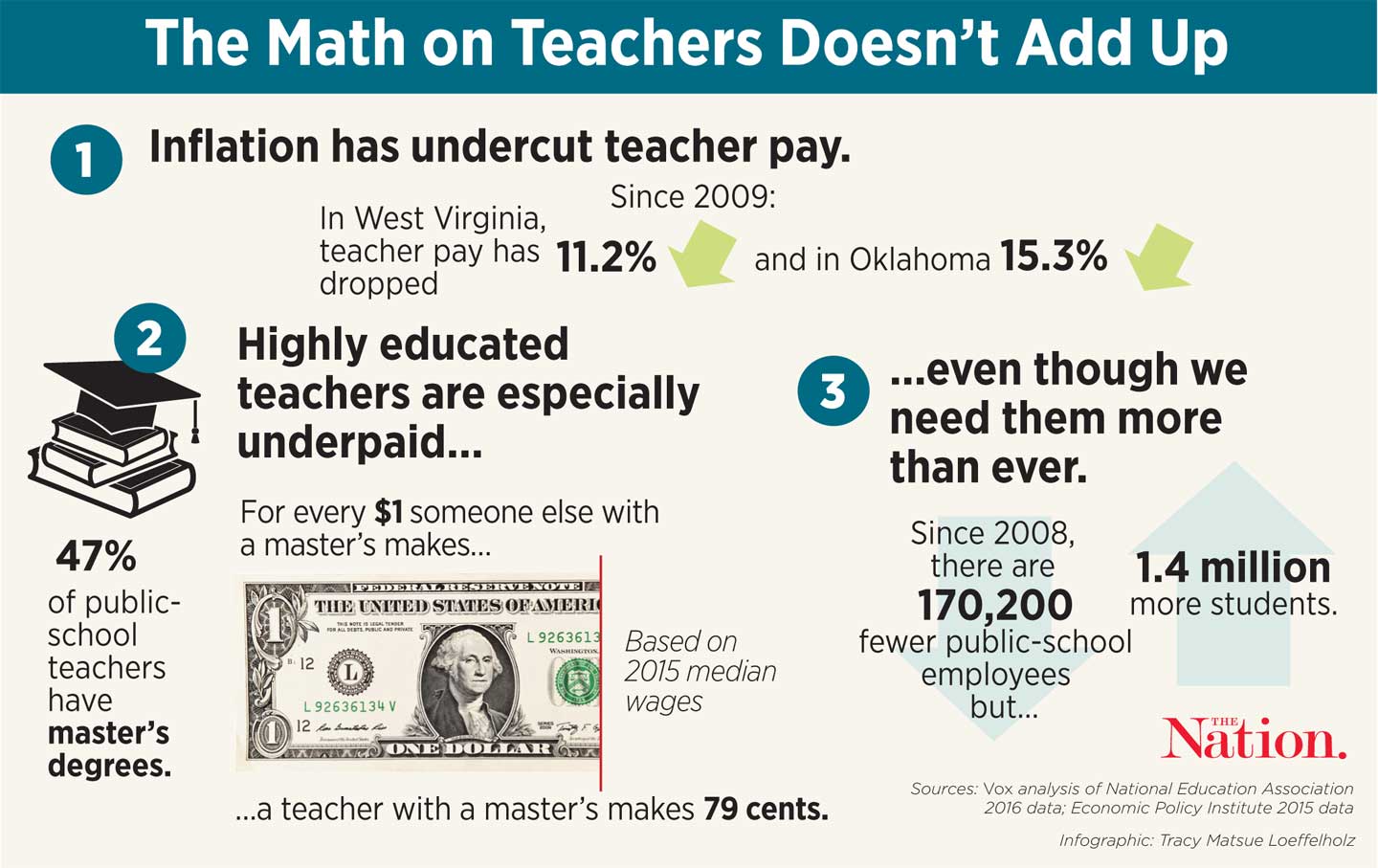
The Economic Policy Institute’s Sylvia Allegretto and Lawrence Mishel just released a report about persistent growth in a teacher wage penalty, which reached an all time high in 2018: “(R)elative teacher wages, as well as total compensation—compared with the wages and total compensation of other college graduates—have been eroding for over half a century.  These trends influence the career choices of college students, biasing them against the teaching profession, and also make it difficult to keep current teachers in the classroom.”
Allegretto and Mishel explain the trend: “(W)omen teachers enjoyed a wage premium in 1960, meaning they were paid more than comparably educated and experienced women workers in other fields. By the early 1980s, the wage premium for women teachers had transformed into a wage penalty… The mid-1990s marks the start of a period of sharply eroding teacher weekly wages and an escalating teacher weekly wage penalty.  Average weekly wages of public school CONTINUE READING: In this Teacher Appreciation Week, Fair Pay Would Show Our Teachers They Really Are Appreciated | janresseger
Image result for TEACHER PAY

Louisiana’s Voucher Program Featured on New Orleans Public Radio for the Failure It Is | deutsch29

Louisiana’s Voucher Program Featured on New Orleans Public Radio for the Failure It Is | deutsch29

Louisiana’s Voucher Program Featured on New Orleans Public Radio for the Failure It Is


Louisiana’s school voucher program has received yet another hefty dose of realistic attention for the utter failure that it is.
There have been local articles calling out the failure of the program in the past (I reference a number of such articles in this July 2016 post), but this May 07, 2019, extensive piece by WWNO New Orleans Public Radio, entitled, “The Cost of Choice: How Louisiana’s Voucher Program Steered Families into D and F Private Schools,” lays bare Louisiana’s school voucher program to such a degree that even “State Education Superintendent John White declined repeated requests for an interview.”
john white 8
John White
Multiple local news outlets were involved in the investigation:
‘The Cost of Choice’ is the result of a reporting collaboration between NOLA.com | The Times-Picayune, WVUE Fox 8 News, WWNO and Reveal from The Center for Investigative Reporting.
Some summary highlights from the article, including Betsy DeVos’ involvement:
Politicians promised the Louisiana Scholarship Program would offer low-income students a way out of bad public schools. Instead, the program steered families into low-performing private schools with little oversight.
Louisiana Gov. Bobby Jindal beamed with pride in April 2012, as he signed into law one of the most sweeping school choice expansions in the nation.
The law was lauded by the American Federation for Children, then chaired by future Education Secretary Betsy DeVos, and other school choice advocates. Like Jindal, they said it would free countless lower-income children from the worst public schools by allowing them to use CONTINUE READING: Louisiana’s Voucher Program Featured on New Orleans Public Radio for the Failure It Is | deutsch29


Badass Teachers Association Blog: Classroom Teachers are the Real Scholastic Experts – Not Education Journalists by Steven Singer

Badass Teachers Association Blog: Classroom Teachers are the Real Scholastic Experts – Not Education Journalists by Steven Singer

Classroom Teachers are the Real Scholastic Experts – Not Education Journalists by Steven Singer

When you want an expert on health, you go to a doctor.
When you want an expert on law, you go to a lawyer.
So why is it that when the news media wants an expert on education they go to… themselves!?
You’ll find them writing policy briefs, editorials and news articles. You’ll find them being interviewed about topics like class size, funding and standardized tests.
But they aren’t primary sources. They are distinctly secondary.
So why don’t we go right to the source and ask those most in the know – classroom teachers!?
According to a Media Matters analysis of education coverage on weeknight cable news programs in 2014, only 9 percent of guests on MSNBC, CNN and Fox News were educators.
This data is a bit out of date, but I couldn’t find a more recent analysis. Moreover, it seems pretty much consistent with what I, myself, have seen in the media.

America’s Teachers vs. Betsy DeVos and the Top 1% During Teacher Appreciation Week

America’s Teachers vs. Betsy DeVos and the Top 1% During Teacher Appreciation Week

America’s Teachers vs. Betsy DeVos and the Top 1% During Teacher Appreciation Week


During this year’s Teacher Appreciation Week, teachers will undoubtedly cherish notes and gifts from grateful children and parents, but they recognize real teacher appreciation is about more than a week of tributes.
They also see through Education Secretary Betsy DeVos and the top one percent who want to destroy public education and the teaching profession.
Teachers live in a unique world where they struggle against many odds to find everyday miracles only they, students, and parents might understand. Teachers in poor schools face especially difficult challenges.
Last week, we watched Betsy DeVos promenade with her husband into the Manhattan Institute gala to receive an Alexander Hamilton Award. DeVos smiled her saintly grin as four-letter expletives were hurled upon her from the crowd.
This reflected America’s educational divide.
If one doubts the hatred DeVos faces, they need only glance at her twitter feed. It’s filled with vile replies to her derogatory statements, which she often cloaks in passive aggressiveness. Her proclamations and the responses they provoke seem dangerous.
DeVos is out of touch with the classroom and the struggles real teachers face. It’s easy to understand why so many people are angry.
A few days after the awards ceremony, DeVos said to the Education Writers Association, As much as many in the media use my name as clickbait or try to make it CONTINUE READING: America’s Teachers vs. Betsy DeVos and the Top 1% During Teacher Appreciation Week
Image result for America̢۪s Teachers vs. Betsy DeVos

Parents Across America’s Chapter Leaders in Action | Parents Across America

Parents Across America’s Chapter Leaders in Action | Parents Across America

Parents Across America’s Chapter Leaders in Action

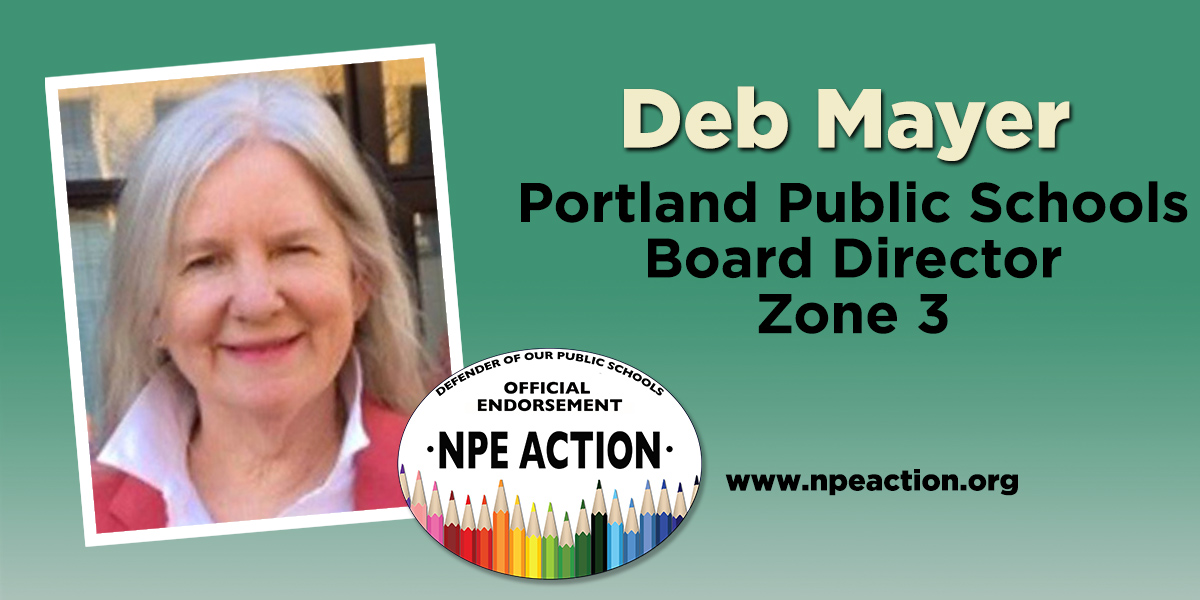
Image result for Deb Mayer Portland Public School Director, Zone 3.


Deb Mayer, leader of Parents Across America-Oregon, is running for Portland Public School
Director, Zone 3.
While PAA does not endorse candidates, we’re thrilled to see one of PAA’s chapter leaders run for elected office, as several other inspiring PAA leaders have done over the past eight years.
Deb has been endorsed by both Network for Public Education Action and Willamette Week.
Here are Deb’s answers to the Oregonian’s school board candidate survey.
Find Deb’s website and Facebook page, here and here.
Parents Across America’s Chapter Leaders in Action | Parents Across America

"If We Don’t Do Something, It’s Never Going to Change"

"If We Don’t Do Something, It’s Never Going to Change"

“If We Don’t Do Something, It’s Never Going to Change”


At the panel discussion on educator walkouts at the National Education Writers Association (EWA) conference this week, NEA President Lily Eskelsen Garcia was asked what was driving this unprecedented activism happening across the country, including the latest action in Oregon this week.

A moment in West Virginia became a movement,” Eskelsen Garcia said. “It is inspiring. It’s energizing. And it’s always a little scary because no one knows how these things will turn out, but so far we’ve had 100 percent success in that every place where teachers have raised their voices and thrown on their #RedForEd t-shirts and gone to the public, they’ve won support. [It’s about ending] the absolute neglect of education funding and giving kids the programs and services they need.”
People are hearing what educators have been saying for years: There is much more that should be done to support public education. It hasn’t been enough for decades.
“Parents, the public, have all marched with their educators in support of more funding for education.” Eskelsen García said. “They’re asking, ‘What do you mean you have to pay for your own supplies? What do you mean you have 40 students in classrooms.’ ”
Panelist Kathereine Strunk, a researcher at the University of Michigan, said we know that kids who miss school on a day unexpectedly miss learning. “If you miss five CONTINUE READING: "If We Don’t Do Something, It’s Never Going to Change"

LAUSD Board Delays Vote on Cutting Public Speaking Time

LAUSD Board Delays Vote on Cutting Public Speaking Time

LAUSD Board Delays Vote on Cutting Public Speaking Time

The time has come for a new era of transparency and accountability. For too long, parents, students, and taxpayers have been kept in the dark about what’s going on in District headquarters
– Nick Melvoin (2017)
As of Monday night, the agenda for the Los Angeles Unified School District’s (LAUSD) Special Board Meeting listed a motion to approve changes to the Board rules that had been recommended by Nick Melvoin’s Rules “Committee.” Included in these proposed new rules was a reduction in the time allotted for public comment from three to two minutes per person. Much like the selection of Superintendent Austin Beutner, the proposed changes had been made behind closed doors and without public input.
After arriving two hours before the start of the meeting and securing my place as the 46th person in line, I was able to sign up for public comment about the item. However, I was notified just minutes before the start of the meeting that the item was probably not going to be heard. This was confirmed by Monica Garcia as the meeting started and she announced that she was using her prerogative as the Board CONTINUE READING: LAUSD Board Delays Vote on Cutting Public Speaking Time

Wednesday, May 8, 2019

Mitchell Robinson: "Poor Betsy" doesn't like being criticized… | Eclectablog

"Poor Betsy" doesn't like being criticized… | Eclectablog

“Poor Betsy” doesn’t like being criticized…


Secretary of Education and Disney villain Betsy DeVos spoke to a group of education writers in Baltimore the other day, and it appears her feelings are hurt.
“I never imagined I’d be a focus of your coverage. I don’t enjoy the publicity that comes with my position. I don’t love being up on stage or on any kind of platform. I’m an introvert,” she told them.
Many in the media, DeVos added, “use my name as clickbait” or “try to make it all about me.”
But education is “not about Betsy DeVos nor any other individual,” she said. “It’s about students.”
Ironically enough, this bit of “poor little me” whining comes on the heels of one of Ms. DeVos’ most outrageous statements, an attempt to redefine the very meaning of “public education”:
“Let’s stop and rethink the definition of public education,” she said. “Today, it’s often defined as one type of school, funded by taxpayers, controlled by government. But if every student is part of ‘the public,’ then every way and every place a student learns is ultimately of benefit to ‘the public.’ That should be the new definition of public education.”
No, Betsy. Just no. That’s not how any of this works. You don’t get to snap your grubby little money-stained fingers and just redefine the very nature of public schooling in our country, like some Teach-for-America-Thanos.
And, Betsy, if you truly believe that most public schools are “failing” (Narrator: “They are not.”), or that “school choice” and “Education Freedom Scholarships” are going to fix the problems in the CONTINUE READING: "Poor Betsy" doesn't like being criticized… | Eclectablog


Oakland Unified offers critical view of charter schools to state task force | EdSource

Oakland Unified offers critical view of charter schools to state task force | EdSource

Oakland Unified offers critical view of charter schools to state task force


Against the backdrop of greater scrutiny of charter school operations across California, officials at the Oakland Unified School District have drawn up a sweepingly critical portrait of the impact of charters on their district.
These include the costs of having to deal with lawsuits and revocations of charters, the turmoil created by charter schools that close during the middle of the year and the negative consequences of locating charter schools on the same campuses as district schools. This practice — called “co-location” — is “harmful to students” because it allows less space for “intervention” programs for students in district schools. It can also require staggered lunch schedules, as well as combining grades in single classrooms.
The catalog of criticisms is contained in a 28-page PowerPoint presentation that district officials, including board president Aimee Eng, made last month to the Charter Task Force, an 11-member body created by State Superintendent of Public Instruction Tony Thurmond at the request of Gov. Gavin Newsom.
The panel is charged with making recommendations by July 1 on how to amend California’s charter school law. As part of its deliberations, it is hearing case studies of districts with large numbers of charter schools. So far, it has heard presentations from Oakland and San Diego Unified, with Los Angeles Unified and its charter schools still to come.
The information that districts with large numbers of charter schools like Oakland provide could have a significant impact on what the task force recommends to Newsom. The panel’s deliberations are not open to the public, but Oakland’s presentation was provided by the district at EdSource’s request. San Diego CONTINUE READING: Oakland Unified offers critical view of charter schools to state task force | EdSource

It's What They Learn, but It's Also How We Teach - Teacher Habits

It's What They Learn, but It's Also How We Teach - Teacher Habits

It’s What They Learn, but It’s Also How We Teach


The tide, it appears, may finally be starting to change. After a generation of test-centered accountability for teachers, the state of Maine has passed a law that removes a requirement that standardized test scores be used to evaluate teachers. I suspect more states will follow, if for no other reason than all educational trends eventually fall out of favor when we realize the old ways maybe weren’t so terrible after all.
No matter what other states do, the question will remain: How do we fairly evaluate the performance of teachers? There is no easy answer, and it’s largely because there are two competing beliefs about how to identify good (and bad) teaching.
I read two articles in the last couple of days that illustrate the tension at the center of teacher evaluations. The first was written by Alfie Kohn way back in 2008, but its message is often repeated today. In It’s Not What We Teach; It’s What They Learn, Kohn asserts that “what we do doesn’t matter nearly as much as how kids experience what we do.” He provides a number of examples, explaining that it doesn’t matter what an adult intends if a child interprets the adult’s words or actions differently. Kohn writes:
“We may think we’re emphasizing the importance of punctuality by issuing a detention for being late, or that we’re CONTINUE READING: It's What They Learn, but It's Also How We Teach - Teacher Habits

Challenging the Grammar of Schooling (Part 3) | Larry Cuban on School Reform and Classroom Practice

Challenging the Grammar of Schooling (Part 3) | Larry Cuban on School Reform and Classroom Practice

Challenging the Grammar of Schooling (Part 3)

The “grammar of schooling” is stubborn. It is the DNA of U.S. public schools.
Because it is taken-for-granted, as common as the air we breathe and seemingly as essential to schooling Americans as sleeping is to decent health, few reform-minded policymakers, practitioners, donors, researchers, and parents challenge it. In Part 2, four researchers described and analyzed efforts to alter substantially this quiet institutional machinery that influences both students and teachers 36 weeks a year. For the most part, these researchers described in their case studies how the “grammar of schooling’ persisted after mighty efforts to reduce or remove it in public schools and districts.
In Part 1, I described private schools that had, indeed, dispensed with the “grammar of instruction.” I ended that post with this paragraph:
The tradition of challenging the dominant structure of the age-graded school and its “grammar of schooling” continues to this day with micro-schools in Silicon Valley and elsewhere illustrating anew that such reforms to the traditional “machinery of instruction” have resided, for the most part, in private schools where tuition runs high and students bring many economic and social advantages school. In a profound way, the high cost of these private schools and the resources available to their founders in experienced teachers, aides, technologies, space, and materials show clearly the prior conditions necessary not only to operate such schools in public venues but also what is needed to contest the prevailing “grammar of schooling.”
Does that mean more money is the answer for public schools to challenge the CONTINUE READING: Challenging the Grammar of Schooling (Part 3) | Larry Cuban on School Reform and Classroom Practice

‘For all the many reasons teachers should be thanked, this should not be one of them' - The Washington Post

‘For all the many reasons teachers should be thanked, this should not be one of them' - The Washington Post

‘For all the many reasons teachers should be thanked, this should not be one of them'

Who is surprised anymore when news breaks that another school has been the scene of a shooting and the lives of everybody in that community are forever changed?
It happened again Tuesday in Colorado when two students allegedly opened fire in STEM School Highlands Ranch — a charter school campus with more than 1,800 students in kindergarten through 12th grade — and killed one person while injuring eight others. A student who charged one of the shooters to help protect others lost his life.
The Colorado shooting followed by just days a shooting at the University of North Carolina at Charlotte that killed two and wounded four. A student tackled the gunman in that case, too.
We are in an era where students and teachers may find themselves in a position of dodging bullets or taking on shooters directly to save others’ lives.
The Colorado shooting occurred during Teacher Appreciation Week, which inspired one educator to write a letter honoring his colleagues and speaking to this moment in the country’s violent history.
The author of the following post is Rich Ognibene, a chemistry and physics teacher in New York who was that state’s 2008 Teacher of the Year and a 2015 National Teacher Hall of Fame inductee.
By Rich Ognibene
Today, during Teacher Appreciation Week, I’m thinking about the teachers (and paras, and secretaries, and administrators) at STEM School Highlands Ranch in Colorado.
Like teachers at Columbine, Sandy Hook, Parkland and myriad other schools, they will be scarred for life from the trauma they’ve faced in a school shooting. They will cry for the students who were killed. They will feel less CONTINUE READING: ‘For all the many reasons teachers should be thanked, this should not be one of them' - The Washington Post

CURMUDGUCATION: Knewton, A Big Name in Ed Tech, Bites The Dust

CURMUDGUCATION: Knewton, A Big Name in Ed Tech, Bites The Dust

Knewton, A Big Name in Ed Tech, Bites The Dust


Adaptive learning. Computer-enhanced psychometrics. Personalized learning via computer. Knewton was going to do it all. Now it's being sold for parts.

Knewton started in 2008, launched by Jose Ferreira. By 2012, Ferreira led the ed tech pack in overpromising that sounded both improbable and creepy. In a Forbes interview piece, Ferreira described Knewton as "what could become the world’s most valuable repository of the ways people learn." Knewton could make this claim because it "builds its software into online classes that watch students’ every move: scores, speed, accuracy, delays, keystrokes, click-streams and drop-offs." How does this work?

Students go at their own pace, and the software continuously adapts to challenge and cajole them to learn based on their individual learning style. As individual students are correlated to the behaviors of thousands of other students, Knewton can make between 5 million and 10 million refinements to its data model every day. 


This guy.
You will be unsurprised to learn that founder/CEO Ferreira has no real background in education. He has a BA from Carleton College and an MBA from Harvard Business School. He worked for Kaplan for a few years, then went into the money biz, first as a derivatives trader for Goldman Sachs and later working venture capital for Draper Atlantic. In between he was strategist for the John Kerry campaign; that may be because he's John Kerry's nephew. From venture capital, it was a quick step to Knewton.

It raises one question that I don't have an answer for. Ferreira obviously had nothing to do with the actual creation of the software that was Knewton's heart and soul. Whose work was Knewton? A puzzle for another day.

Ferreira had a gift for the colorful claim. In the Forbes article, we find the suggestion that "it will CONTINUE READING: 
CURMUDGUCATION: Knewton, A Big Name in Ed Tech, Bites The Dust


Classroom Teachers are the Real Scholastic Experts – Not Education Journalists | gadflyonthewallblog

Classroom Teachers are the Real Scholastic Experts – Not Education Journalists | gadflyonthewallblog

Classroom Teachers are the Real Scholastic Experts – Not Education Journalists

When you want an expert on health, you go to a doctor.
When you want an expert on law, you go to a lawyer.
So why is it that when the news media wants an expert on education they go to… themselves!?
You’ll find them writing policy briefs, editorials and news articles. You’ll find them being interviewed about topics like class size, funding and standardized tests.
But they aren’t primary sources. They are distinctly secondary.
So why don’t we go right to the source and ask those most in the know – classroom teachers!?
According to a Media Matters analysis of education coverage on weeknight cable news programs in 2014, only 9 percent of guests on MSNBC, CNN and Fox News were educators.
This data is a bit out of date, but I couldn’t find a more recent analysis. Moreover, it seems pretty much consistent with what I, myself, have seen in the media.
Take Wyatt Cenac’s “Problem Areas,” a comedy journalism program on HBO. The second season focuses entirely on education issues. Though Cynac interviews numerous people in the first episode (the only one I saw), he put together a panel of experts to talk about the issues that he would presumably return to throughout the season. Unfortunately, only two of these experts were classroom teachers.
There were more students (3), policy writers (3) and education journalists (3). There CONTINUE READING: Classroom Teachers are the Real Scholastic Experts – Not Education Journalists | gadflyonthewallblog


Betsy DeVos as Clickbait | janresseger

Betsy DeVos as Clickbait | janresseger

Betsy DeVos as Clickbait


It surprised me to hear the word “clickbait” in Betsy DeVos’s working vocabulary.  I wonder if it wasn’t put into her speech—on Monday in Baltimore at the Education Writers Association’s annual meeting—by one of her more with-it staffers.  I confess that as a retired person, I was slow several years ago to grasp the meaning of the term, but as a blogger I know I paid attention, even before I knew the word, to the number of people who click on posts about particular topics.  I realize, of course, that my purpose is to do justice, not to pay attention to the number of clicks on different subjects, but like all writers who post on-line, I notice.  And I grieve about the paucity of clicks on worthy topics.
As you have, no doubt, heard by now, Betsy DeVos went to the Education Writers Association and asked the nation’s education journalists not to use her as clickbait.  See hereherehere, and here.
DeVos also described her weird philosophy of public education. The last time I remember her channeling Margaret Thatcher was in July of 2017 at a meeting of the American Legislative Exchange Council—the far-right, corporate driven, bill mill that creates the anti-regulatory and pro-privatization model bills that are then broadcast across the 50 state legislatures to be introduced.
I suspect this time, at the Education Writers Association, Betsy DeVos chose a less sympathetic audience.
In her prepared remarks for Monday’s speech, DeVos, the U.S. Secretary of Education, emphasizes freedom from government as the foundation of her strategy. You’ll remember that DeVos is responsible for administering government programs like Title I and the Individuals CONTINUE READING: Betsy DeVos as Clickbait | janresseger

House Democrats seek cut in federal charter school funding, saying Education Department isn’t a ‘responsible steward of taxpayer dollars’ - The Washington Post

House Democrats seek cut in federal charter school funding, saying Education Department isn’t a ‘responsible steward of taxpayer dollars’ - The Washington Post

House Democrats seek cut in federal charter school funding, saying Education Department isn’t a ‘responsible steward of taxpayer dollars’


House Democrats are proposing a sweeping cut in federal funding for charter schools, saying they are “deeply concerned” that the U.S. Education Department “does not intend to be a responsible steward” of taxpayer dollars used to help the charter movement.
The House Appropriations Committee on Tuesday released its proposed 2020 budget for the Education Department and is seeking $75.9 billion. That is $11.9 billion more than President Trump and Education Secretary Betsy DeVos are requesting, and $4.4 billion more than what was enacted in 2019. There are big boosts for Title 1 — a program intended to help children from low-income families — and special education.
The section on charter schools is seeking $400 million for the federal Charter Schools Program, which is $40 million less than what was given last year and $100 million less than Trump’s proposed budget. Trump and DeVos have said that expanding alternatives to traditional public school systems, including charter schools, is their top priority.
Whether Congress will approve this cut is unclear. But the proposal marks a change for Democrats, who for years have largely been as enthusiastic as Republicans about expanding charters.
Charter schools are funded with taxpayer dollars but operated by nonprofit organizations or for-profit companies with varying levels of oversight. Supporters say they are every bit as public as traditional districts, while critics say these schools are part of an effort to privatize public education.
The Obama administration was instrumental in driving the growth of charters, even including it as a goal for states in its $4.3 billion Race to the Top initiative. But recently the charter movement has arrived at what CONTINUE READING: House Democrats seek cut in federal charter school funding, saying Education Department isn’t a ‘responsible steward of taxpayer dollars’ - The Washington Post