

Saturday, May 4, 2019
KEEP UP/ CATCH UP WITH DIANE RAVITCH'S BLOG | A site to discuss better education for all
Diane Ravitch's blog | A site to discuss better education for all

Diane Ravitch's blog | A site to discuss better education for all


Friday, May 3, 2019
Integrity Florida Study Looks At Political Influence, Growth Of Charter Schools | WJCT NEWS
Integrity Florida Study Looks At Political Influence, Growth Of Charter Schools | WJCT NEWS
Integrity Florida Study Looks At Political Influence, Growth Of Charter Schools


Integrity Florida Study Looks At Political Influence, Growth Of Charter Schools
The nonpartisan research group Integrity Florida has released a new study about Florida’s charter schools and the industry’s political influence. The study took nearly a year to complete, and takes a deep dive into how the charter model became what it is today.
The research tracks how charters have grown and changed since the state’s charter school law was passed in 1996. It asserts charters have strayed from the initial purpose they were meant to serve. Originally launched as teacher-run schools meant to be symbiotic with traditional public institutions, charters now account for 10 percent of Florida’s public enrollment.

“Since charter schools were authorized in Florida in 1996, the sector has grown to more than 650 schools, enrolling almost 300,000 students,” researcher Alan Stonecipher said. He calls charter schools a “phenomenon,” and says their creation is driven by a desire to privatize public schools.
“Increasingly they are managed by for-profit companies — 294 charters have contracts with for-profits, or 45 percent of all charter schools,” Stonecipher said.
By comparison, 15 percent of charters nationally are controlled by for-profit companies. Brad Ashwell is another researcher who contributed to the study. He addressed the increasing political influence behind Florida’s charter companies.
“In regards to campaign finance, we found that charter school interests have given $13 million in Florida to candidates, committees and parties since 1998,” Ashwell said.

Ashwell says that doesn’t include the cost of hiring lobbyists.
“The lobbyist expenditures, we found they spent more than $8 million on legislative lobbyists in Florida between 2007 and 2017,” Ashwell said. “Spending has increased steadily overtime, with spikes in 2013 and 2015. During this period, 10 companies alone spent $5 million hiring 262 lobbyists.”
Ben Wilcox directs research at Integrity Florida. He insists the report was written in the group’s capacity as being a government watchdog. Still, Wilcox acknowledges CONTINUE READING: Integrity Florida Study Looks At Political Influence, Growth Of Charter Schools | WJCT NEWS
35 Ways They Dumb Down America: Still, There’s Hope!
35 Ways They Dumb Down America: Still, There’s Hope!
35 Ways They Dumb Down America: Still, There’s Hope!


35 Ways They Dumb Down America: Still, There’s Hope!
They took all the trees
And put them in a tree museum
And they charged all the peopleA dollar and a half to see ’emDon’t it always seem to goThat you don’t know what you’ve got‘Till it’s goneThey paved paradiseAnd they put up a parking lot
~Joni Mitchell, Big Yellow Taxi
If you’ve ever worried what the future will hold without public schools, watching legislators destroy those schools in Florida and Tennessee this past week was gloomy.
But there they were with smiles in Florida, and a little less jubilant in Tennessee.
These policymakers, who are supposed to represent everyone, seem to take no interest in the research surrounding the importance of democratic public schools and the lack of any evidence supporting vouchers or charter schools.
There’s not even proof that private and parochial schools are great.
But before those of you who care about kids and public schools get too gloomy, there’s always hope! One just needs to know where to look.
Wednesday, hope was found in South Carolina, another anti-union state, where 10,000 teachers marched for the second time to the state capital. One would think by listening CONTINUE READING: 35 Ways They Dumb Down America: Still, There’s Hope!
NO EXCUSES: Charter Schools Should Never Be Allowed to Discriminate Against Any Group of Students | Cloaking Inequity
NO EXCUSES: Charter Schools Should Never Be Allowed to Discriminate Against Any Group of Students | Cloaking Inequity
NO EXCUSES: CHARTER SCHOOLS SHOULD NEVER BE ALLOWED TO DISCRIMINATE AGAINST ANY GROUP OF STUDENTS
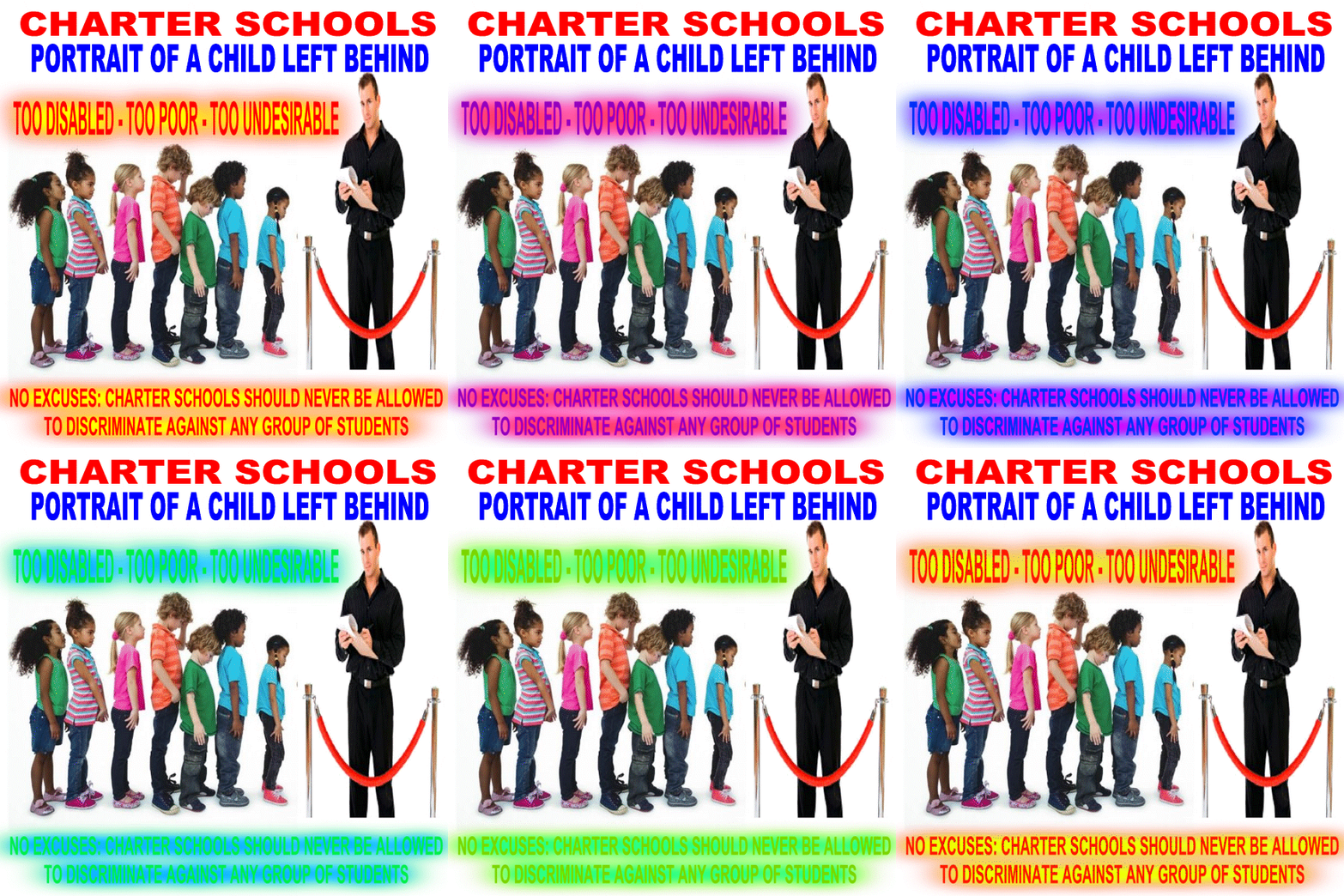

NO EXCUSES: CHARTER SCHOOLS SHOULD NEVER BE ALLOWED TO DISCRIMINATE AGAINST ANY GROUP OF STUDENTS
I’ve done two tours of duty for children in Texas. The first was in the Houston Independent School District’s Research and Accountability Department from 1999-2001. The second was as a faculty member in the University of Texas at Austin Educational Policy and Planning program from 2006-2014. As a result, I have roots in Texas and pay close attention to the developments in education poilcy there. I also volunteer my time for the Texas NAACP whenever they ask. Greg Worthington, one of my former doctoral students at UT-Austin, recently contacted me and asked if I would post a blog about no excuses charter schools that are invading San Antonio and the Texas charter school lobbyists that are wrongfully protecting them. Here are his thoughts.
In an interesting turn of events, the Texas Charter Schools Association’s (TCSA) Facebook page posted an article last Thursday, April 25th, praising a Texas charter school’s disciplinary alternative education program (DAEP) for its ability to give students a second chance, even calling it innovative. This is strange for all sorts of reasons but one reason specifically sticks out. Almost 2 months ago, Starlee Coleman, TCSA’s CEO, recently wrote commentary in opposition to Texas State Rep. Gina Hinojosa’s bill (HB 43) that sounded much like a Trumpian, fear-mongering demand for a wall in an attempt to mislead Texans about Rep. Hinojosa’s bill.In her commentary, Ms. Coleman slandered a particular group of Texas children, portraying them as monsters by citing numbers on violent offenses, as if the bill in question would only impact students who’ve committed such acts. Her fear-mongering playbook mimics one that has been used throughout U.S. history to stoke racist fears towards people of color, such as in these two racist propaganda films: The Birth of a Nation and The Martyrs of the Alamo.The TCSA CEO paired her fear-mongering with a compassionate call to properly educate these “violent” students by segregating them into DAEPs in separate facilities (and away from opportunities to harm the other children). However, Ms. Coleman points out that Texas charter schools just can’t afford these separate facilities (which don’t actually have to be off campus) and shouldn’t be “forced” to accept them onto their campuses and put other children in danger.The problem with Ms. Coleman’s and TCSA’s opposition to bills like HB 43 that have been filed in the past is that they aren’t necessarily about facilities funding or DAEPs. Bills like HB 43 simply seek to strike Sec. 12.111.5(A) from the Texas Education Code. This part of the code allows charter schools to explicitly exclude any student “who has a documented history of a criminal offense, a juvenile court adjudication, or discipline problems.” This means that the 756,000+ Texas students (Ms. Coleman only mentioned 76,000 students) who received disciplinary action last school year are now eligible for legal exclusion from all Texas charter schools. These students are
- 75% black or Latinx,
- 77% impoverished,
- 71% labeled “at-risk,” and
- 14% of all Texas students.
Clearly, Ms. Coleman and TCSA are advocating for charter schools’ discriminatory power over not just students who’ve committed violent acts but any student who’s ever been officially punished anywhere for any perceived unfavorable behavior. This even includes students who were arrested on criminal charges but later had their charges dropped. Sadly, Ms. Coleman shamelessly showcases charter schools’ discriminatory power as a selling point and attempts to gaslight Texans by claiming charter schools’ discriminatory power is actually a good thing for all Texas students.But this discrimination is a glaring example of why competition in education (i.e., school choice) should be abolished in our public school system. School choice forces schools to compete with each other like businesses and ties their survival to student performance. Research has demonstrated this pressure to compete encourages schools to create strategies for gaming enrollment systems so they can enroll “desirable” students to help ensure their survival.Instead of discriminating, Ms. Coleman, the TCSA, and like-minded others should consider the fact that all students are teachable in the general classroom. But if any educator believes they aren’t capable of teaching all students, then they should choose another profession because allowing such perspectives in any classroom is a very real danger to our children.The fact that all students are teachable in the general classroom was confirmed by my teaching experience. I taught in public schools Texas has neglected and short-changed for generations, where students with disciplinary histories are more likely to attend, and I taught students who’ve committed violent acts. Things weren’t perfect but I never had problems with violence in my classroom, nor were any of my students too afraid to learn because of another student in our classroom. By focusing on caring for students instead of declaring them to be threats, we can make our schools safer environments, conducive to the future success of all students and not just the ones you would rather teach.If charter schools are as innovative as they once claimed, then they should be fully capable of fulfilling this forgotten promise by finding better ways to educate students with discipline, juvenile, or criminal histories. However, as seen here (and in research), most charters currently don’t claim to be innovative because the majority mimic instructional practices already existing in public schools nationwide.Truthfully, alternative education programs, other disciplinary actions removing students from the classroom, and labeling children as problems or threats are practices that do real to harm students and hinder their learning. Fortunately, there are alternative practices that can move all students forward towards educational success, like positive behavioral interventions and supports, social and emotional learning, and restorative justice programs.We don’t need business-like competition in our public school system that school choice induces, especially when it enables and incentivizes schools to discriminate against any particular group of students. However, while charter schools are still around, there’s no excuse why they should be allowed to discriminate against any group of students based on any perceived cost or benefit to the school.———————————————————————————————————————
Greg Worthington is a doctoral student at The University of Texas at Austin in the Educational Policy and Planning Program where he earned his Master’s degree in the same program. His current research focuses on school choice issues. Before this, Greg earned his Bachelor’s degree in mathematics at The University of Texas at San Antonio and then taught high school math in Edgewood and Northside ISDs at Memorial HS and John Jay HS, respectively, in his beloved hometown of San Antonio, Texas.E-mail: gregory.worthington@utexas.eduTwitter: pobrezaamada
Parent Advocacy and the New (But Still Misguided) Phonics Assault on Reading | radical eyes for equity
Parent Advocacy and the New (But Still Misguided) Phonics Assault on Reading | radical eyes for equity
Parent Advocacy and the New (But Still Misguided) Phonics Assault on Reading

Parent Advocacy and the New (But Still Misguided) Phonics Assault on Reading

“School days were eagerly anticipated by Francie,” a central character in Betty Smith’s A Tree Grows in Brooklyn (p. 143). The novel often is a powerful fictional account of poverty among white working class people at the turn of the twentieth century.
But Francie Nolan is also a girl who loves books, libraries, and an idealized view of what formal schooling will be. Yet, “[b]efore school, there had to be vaccination,” the narrator explains. “That was the law”:
When the health authorities tried to explain to the poor and illiterate that vaccination was a giving of the harmless form of smallpox to work up immunity against the deadly form, the parents didn’t believe it. … Some foreign-born parents refused to permit their children to be vaccinated. They were not allowed to enter school. Then the law got after them for keeping the children out of school. A free country? they asked. (pp. 143-144)
Left alone by their working mother, Francie and her brother, Neeley, must go for their vaccinations, prodded only by a neighbor who rouses them from playing in the dirt and mud. Francie suffers through not only the shot itself, but also the doctor’s insensitive and classist criticism: “‘Filth, filth, filth, from morning to night. I know they’re poor but they could wash. Water is free and soap is cheap. Just look at that arm nurse'” (p. 146).
Despite the trauma of the vaccinations and the class-shaming by the doctor, “Francie expected great things from school” (p. 151). However, “Brutalizing is the only adjective for the public schools of that district around 1908 and ’09. Child psychology had not been heard of in Williamsburg in those days” (p. 153).
That “brutalizing” included:
The cruelest teachers were those who had come from homes similar to those of the poor children. It seemed that in their bitterness towards those unfortunate little ones, they were somehow exorcizing their own fearful backgrounds. (p. 153)
A decade past a century since this novel, and I must acknowledge there is CONTINUE READING: Parent Advocacy and the New (But Still Misguided) Phonics Assault on Reading | radical eyes for equity
Teachers Union Chief Opposes Powerful Democratic Committee's Blacklist | HuffPost
Teachers Union Chief Opposes Powerful Democratic Committee's Blacklist | HuffPost
Teachers Union Chief Opposes Powerful Democratic Committee’s Blacklist
But Randi Weingarten of the American Federation of Teachers said she understands the DCCC’s concerns.

Teachers Union Chief Opposes Powerful Democratic Committee’s Blacklist
But Randi Weingarten of the American Federation of Teachers said she understands the DCCC’s concerns.
Randi Weingarten, president of the influential American Federation of Teachers, said Thursday that she disagrees with the Democratic Congressional Campaign Committee’s policy of refusing to hire consultants who work with House primary challengers.
“I don’t believe in blacklisting,” she told HuffPost in a wide-ranging interview in Manhattan.
But Weingarten, whose 1.7-million-member union plays an outsize role in national Democratic politics, elaborated at length about why she is nonetheless deeply sympathetic to the DCCC’s considerations in deciding to institute the rule ahead of the 2020 elections.
“What the DCCC is trying to do is use economic power, which is legitimate, to say that we’re not going to have a circular firing squad ― that there are bigger issues,” she said.
After her remarks explaining why she understood the DCCC’s perspective, HuffPost followed up to clarify whether she still opposed the policy.
“Having said that I understand it, I do not believe in blacklisting,” Weingarten replied.
Weingarten’s nuanced remarks are in keeping with her reputation as one of the more liberal members of the Democratic Party establishment. She joins several progressive members of Congress, including Rep. Alexandria Ocasio-Cortez (D-N.Y.), and 26 chapters of the College Democrats in breaking with the new rule.
Justice Democrats, a left-wing group active in Ocasio-Cortez’s upset primary victory last year, has set up a website offering consultants and advocacy groups the chance to “join the blacklist” by promising to ignore the DCCC’s dictum.
The DCCC, which helps elect and reelect Democrats to the House, announced in late March that it would not hire private firms that work with primary challengers to Democratic incumbents and would also discourage individual candidates from doing so.
The party organization maintains that it crafted the protocol with the goal of “protecting and growing” the Democrats’ majority in the House. And it notes that the rule would apply CONTINUE READING: Teachers Union Chief Opposes Powerful Democratic Committee's Blacklist | HuffPost
Subscribe to:
Posts (Atom)