Latest News and Comment from Education

Wednesday, April 24, 2019

Why The Big Standardized Test Is Useless For Teachers

Why The Big Standardized Test Is Useless For Teachers

Why The Big Standardized Test Is Useless For Teachers

In schools throughout the country, it is testing season--time for students to take the Big Standardized Test (the PARCC, SBA, or your state's alternative). This ritual first bloomed way back in the days of No Child Left Behind, but after all these years, teachers are mostly unexcited about it. There are many problems with the testing regimen, but a big issue for classroom teachers is that the tests do not help the teacher do her job.
Folks outside of schools often imagine that one of the benefits of the test is to check to see how students are doing and adjust instruction accordingly. Unfortunately, the tests provide no such benefit.
First, the timing does not serve that purpose. Tests are being given now, close to the end of the year.  By the time test score come back, these students will be in a different teacher’s classroom. There will be zero opportunity for a teacher to say, “Okay, these students are having trouble with fractions, so I’d better review that unit and add some extra instruction on the subject.” Those students are gone. New students arrive with their own test scores, but their new teachers have no first-hand knowledge of how instruction went last year.
But that’s not the worst of it. Even if the tests were great (that's a discussion for another day) and the results came back CONTINUE READING: Why The Big Standardized Test Is Useless For Teachers

The Benefits and Necessity of Interdisciplinary Education - Teacher Habits

The Benefits and Necessity of Interdisciplinary Education - Teacher Habits

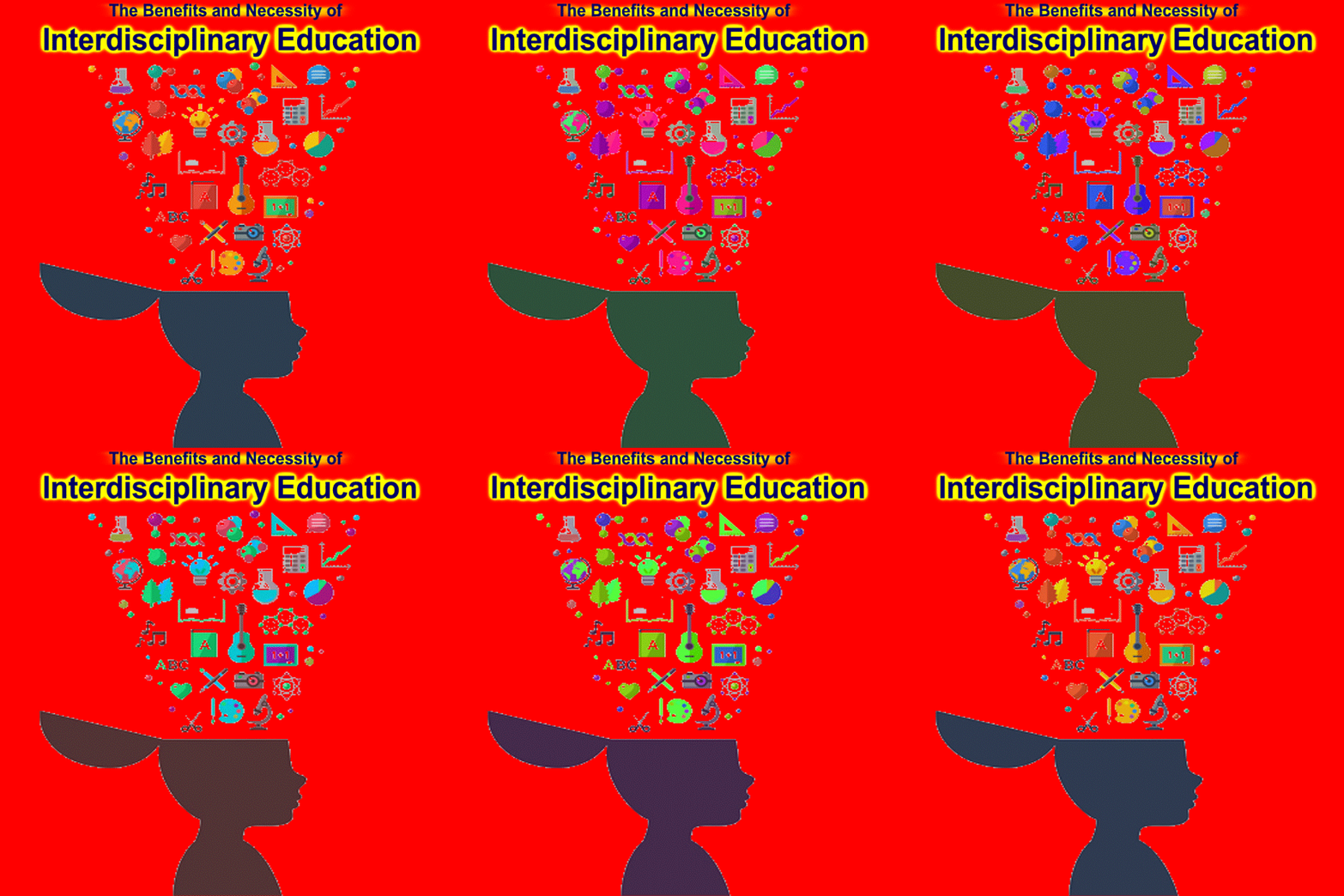
The Benefits and Necessity of Interdisciplinary Education


By Dennis Wesley
Why is interdisciplinary training important? Is it all relevant, let alone necessary, in the context of contemporary education, which is dominated by engineering, the applied sciences, and other disciplines typically associated with good job prospects? Moreover, if one deems it a necessity, what disciplines should one include to make education truly interdisciplinary? These are just some questions advocates of interdisciplinarity encounter rather routinely from both parents and educators. On the other hand, some parents even consider interdisciplinary training a tedious, altogether avoidable complication.
While it is clear that interdisciplinary training includes an introduction to the humanities, it must also be conceded that the sheer breadth of the humanities makes it difficult for educators to zero in on the best, most relevant disciplines. At the same time, the popularity of the humanities has been decreasing rather steadily. See, for instance, Benjamin Schmidt’s August 2018 article on the alarming decline in the number of humanities majors in the US since the 2008 financial crisis. Well-planned interdisciplinary programs, therefore, are also highly likely to inject new life into the humanities.
Addressing Technological Developments from the Interdisciplinary Perspective
As some have argued, the very salience of engineering and the applied sciences, coupled with the technological developments these fields have enabled, has necessitated interdisciplinary training. For instance, as innovations continue to flood the automation and artificial intelligence industry—and indeed other industries—ethics is becoming  CONTINUE READING: The Benefits and Necessity of Interdisciplinary Education - Teacher Habits

Ending Public Funds For Privately-Operated Charter Schools Verses Improving Persistently Deplorable Charter School Transparency and Accountability | Dissident Voice

Ending Public Funds For Privately-Operated Charter Schools Verses Improving Persistently Deplorable Charter School Transparency and Accountability | Dissident Voice

Ending Public Funds For Privately-Operated Charter Schools Verses Improving Persistently Deplorable Charter School Transparency and Accountability


One of the ways that even those who skillfully expose and critique endless charter school problems still miss the mark and (un)wittingly support the destruction of public education through more school privatization schemes is by obsessing over how to improve disturbingly low levels of transparency and accountability in the charter school sector, instead of demanding that no public funds or assets be funneled to charter schools in the first place. This shows that the world outlook guiding such writers and investigators is not free of the grip of capital-centered thinking and categories, which is hindering progress.
The notion that thousands of charter schools engaged in all sorts of fraud, corruption, waste, and other serious problems can be fixed by implementing “smarter” policies, laws, or regulations that somehow “rein them in” ignores the fact that charter schools are deregulated and have loopholes by conscious design. The “Wild West” feature of charter schools is deliberate, inherent, and directly related to their “free market” underpinnings. This is not some aberration, oversight, or the result of poor thinking and planning. Far more importantly though, such a notion ignores the fact that charter schools have no legitimate claim to public funds or assets because they are not public entities in any way, shape, or form. Charter schools are not public schools; they never have been. Public funds belong only to public schools, no one else. To funnel public wealth to private competing interests under the banner of high ideals is irrational, destructive, and unethical.
A school cannot be public in the proper sense of the word if its structures, functions, aims, practices, policies, owners, and results differ significantly from public schools that have been around for generations. Furthermore, something does not become public just because it is blindly called public over CONTINUE READING: Ending Public Funds For Privately-Operated Charter Schools Verses Improving Persistently Deplorable Charter School Transparency and Accountability | Dissident Voice

Capitalism Is in Crisis, and Billionaires Know It | Diane Ravitch's blog

Capitalism Is in Crisis, and Billionaires Know It | Diane Ravitch's blog

Capitalism Is in Crisis, and Billionaires Know It


This article in the Washington Post examines the alarming increase in inequality as a small number of billionaires take control of the economy and the future. The article does not mention the billionaires’ political efforts to gain control of state and local school boards so as to destroy the public schools by replacing them with privately managed charter schools.
The article mentions the deep concern of Seth Klarman, a hedge funder in Boston, but fails to note that he was a Dark Money contributor to the 2016 referendum in Massachusetts that was intended to add 12 charter schools every year wherever they wanted to open. Teachers,  parents, unions, and civil rights groups combined to defeat the billionaires—not only Klarman, but Bloomberg, the Waltons, and others.
My comments are in BOLD.
”PALO ALTO, Calif. —A perfect California day. The sun was shining, a gentle breeze was blowing and, at a Silicon Valley coffee shop, Rep. Ro Khanna was sitting across from one of his many billionaire constituents discussing an uncomfortable subject: the growing unpopularity of billionaires and their giant tech companies.


“There’s some more humility out here,” Khanna (D-Calif.) said.
The billionaire on the other side of the table let out a nervous laugh. Chris Larsen was on his third start-up and well on his way to being one of the wealthiest people in the valley, if not the world.
“Realizing people hate your guts has some value,” he joked.
“For decades, Democrats and Republicans have hailed America’s business elite, especially in Silicon Valley, as the country’s salvation. The government might be gridlocked, the electorate angry and divided, but America’s innovators seemed to promise a relatively pain-free way out of the mess. Their companies produced an endless series of products that kept the U.S. economy churning and its gross domestic product climbing. Their philanthropic efforts were aimed at fixing some of the country’s most vexing problems. Government’s role was to stay out of the way.
“Now that consensus is shattering. For the first time in decades, capitalism’s future is a subject of debate among presidential hopefuls and a source of growing angst for America’s business elite. In places such as Silicon Valley, the slopes of Davos, Switzerland, and the halls of Harvard Business School, there is a sense that the kind of capitalism that once made America an economic envy is responsible for the growing inequality and anger that is tearing the country apart.”
Something is terribly wrong, and even the billionaires know it. Some might want change, but they want to control the change. 
“The 2008 financial crisis may have revealed the CONTINUE READING: Capitalism Is in Crisis, and Billionaires Know It | Diane Ravitch's blog

High School Students Stand Up for Press Freedom and Public Education | janresseger

High School Students Stand Up for Press Freedom and Public Education | janresseger

High School Students Stand Up for Press Freedom and Public Education


A society’s public institutions reflect the strengths and also the faults and sins of the culture they embody. For this reason, America’s public schools that serve over 50 million children in every kind of community will never be perfect. There will be instances of mediocrity and examples of poor school administration and poor teaching. There will be schools stuck in the past and schools where there is sexism and racism—schools where poor children aren’t served up the kind of curriculum that rich children are offered—schools where families persist in segregating their children from others who are “not like them.”  We must expose the problems in our schools and surely, as a society, we are obligated to address our schools’ faults and problems.
But something else has happened in America as we have permitted advocates for privatization to capture our national imagination. How did so many come to view public schools as a problem?  How did we accept the terms “failing schools” and “failing teachers”?  How did we allow policymakers in our very unequal society to extol privately operated schools as a solution?  The education writer and UCLA professor of education, Mike Rose, demands that we be more discerning as we confront the “failing schools” conventional wisdom: “Citizens in a democracy must continually assess the performance of the public institutions.  But the quality and language of that evaluation matter.” (Why School? p. 203)
After he spent four years visiting public school classrooms across the United States—urban schools, rural schools, Midwestern, Eastern, Western, Southern and border schools, and after observing hundreds of public school teachers from place to place, Rose celebrated the schools he had visited in a wonderful book, Possible Lives: “One tangible resource for me evolved from the journey through America’s public school classrooms. Out of the thousands of events of classroom life that I witnessed, out of the details of the work done there—a language began to develop about what’s possible in America’s public sphere.” In the book’s preface, Rose reflects on the learning moments he witnessed during his journey: “The public school gives rise to these moments in a common space, supports them, commits to them as a public good, CONTINUE READING: High School Students Stand Up for Press Freedom and Public Education | janresseger

Louisiana Educator: Louisiana Voucher Students Perform Worse Than Non-Voucher Peers

Louisiana Educator: Louisiana Voucher Students Perform Worse Than Non-Voucher Peers

Louisiana Voucher Students Perform Worse Than Non-Voucher Peers


After 4 years of the Louisiana School Voucher Program, Voucher Students Continue to Perform Lower Than They Would Have if They Had Stayed in Their Public Schools

The University of Arkansas has been studying the Louisiana Voucher Program, which is officially labeled using the more attractive "Scholarship Program". They found that after 4 years the results continue to be disappointing for its boosters. Students in the voucher program continue to do worse than they would have if they had stayed in their original public schools. The researchers were able to draw this conclusion because they used the "gold standard" for research by comparing the voucher results against students who were randomly left out of the program by the lottery process. This provides a true scientific control and therefore more reliable results.
Louisiana's pro-reform media generally ignored this latest study on vouchers, probably because they and the powerful big business lobbyists don't want to report reform failures.
Last week I reported in this blog that The Advocate chose not to report on a bill debated in the Senate Education Committee that would have given local school systems the option to pull out of the Common Core based state standards. My testimony to that committee revealed that since the adoption of the Common Core Based standards 6 years ago, Louisiana students are now performing in last place compared to other states. Technically, we are tied with New Mexico for last place.

The failure of the voucher program was also ignored by most of the larger media sources. It was only reported by a few public radio CONTINUE READING: 
Louisiana Educator: Louisiana Voucher Students Perform Worse Than Non-Voucher Peers

glen brown: “More than a Million Teachers Don’t Have Social Security” by Cory Turner

glen brown: “More than a Million Teachers Don’t Have Social Security” by Cory Turner

“More than a Million Teachers Don’t Have Social Security” by Cory Turner


“Teachers have staged protests in recent weeks in West Virginia, Oklahoma, Kentucky, Colorado and Arizona. Some are fighting lawmakers who want to scale back their pensions. It's no secret that many states have badly underfunded their teacher pension plans for decades and now find themselves drowning in debt. But this pensions fight is also complicated by one little-known fact:

“More than a million teachers don't have Social Security to fall back on. To understand why, we need to go back to Aug. 14, 1935. That is when President Franklin Delano Roosevelt signed the original Social Security Act. ‘This Social Security measure gives at least some protection to at least 50 million of our citizens,’ Roosevelt intoned.

“But of those 50 million citizens, one big group was left out: state and local workers. That was because of constitutional concerns over whether the federal government could tax state and local governments, says Alicia Munnell, director of the Center for Retirement Research at Boston College. ‘So, in the 1950s,’ Munnell says, ‘there were amendments added to the Social Security Act that allowed governments to enroll their workers.’
And many did, leading the Social Security Administration to trumpet in one 1952 promotional film that ‘most American families are now able to ensure for themselves an income that is guaranteed for life.’ Most American families ... except for a lot of teachers, says Chad Aldeman, editor of TeacherPensions.org. ‘Fifteen states do not offer all of their teachers Social Security coverage,’ Aldeman says, ‘and that means about 40 percent of the workforce is not covered.’
“Forty percent of all teachers. That's more than a million educators, in Alaska, California, Colorado, Connecticut, Georgia, Illinois, Kentucky,  CONTINUE READING: glen brown: “More than a Million Teachers Don’t Have Social Security” by Cory Turner

School Vouchers in Tennessee: Closer to Becoming an Inadequate Reality | deutsch29

School Vouchers in Tennessee: Closer to Becoming an Inadequate Reality | deutsch29

School Vouchers in Tennessee: Closer to Becoming an Inadequate Reality


On April 23, 2019, the Tennessee house voted to approve school vouchers (aka “education savings accounts”). The same day, the state senate finance committee had already passed a version of the voucher bill, with the senate finance committee’s version being restricted to Nashville and Shelby County Schools. The full senate has yet to vote on the measure, then, if the senate bill passes, both house and senate need to hash out a final bill.
Tennessee Governor Bill Lee, who really wants to bring school vouchers to Tennessee, chose to amend his proposed budget to include $916,000 worth of vote-changing enticements to freshman congress members, as the April 23, 2019, Tennesseean reports:
A USA TODAY NETWORK-Tennessee review of Lee’s latest budget proposal shows several lawmakers who were once against or on the fence about the governor’s controversial education savings account legislation received funding for their requests.
The lawmakers identified in the review include freshmen Reps. Charlie Baum, R-Murfreesboro; Scott Cepicky, R-Culleoka; Clay Doggett, R-Pulaski; Tom Leatherwood, R-Arlington; and Chris Todd, R-Jackson.
In total, the governor has proposed fulfilling the requests from the group of freshmen lawmakers to the tune of $916,000.
Lee wants school vouchers, and he is on the way to getting his wish. What could go wrong?
Well, as much as Lee wants to take public funding and send it to private schools in the name of “choice,” the reality is that parents cannot simply take the $7,300 per student from the public school system and have that amount clearly cover a CONTINUE READING: School Vouchers in Tennessee: Closer to Becoming an Inadequate Reality | deutsch29

An ADHD Medical Device Again Raises Questions about Classroom Rigor and the Lack of Recess

An ADHD Medical Device Again Raises Questions about Classroom Rigor and the Lack of Recess

An ADHD Medical Device Again Raises Questions about Classroom Rigor and the Lack of Recess


The American Psychiatric Association (APA) says that 5 percent of American children have ADHD. But the Centers for Disease Control and Prevention (CDC) puts the number at more than double the APA’s number. The CDC says that 11 percent of American children, ages 4 to 17, have the attention disorder.
~The A.D.D. Resource Center, Oct 11, 2017
Attention-Deficit/Hyperactivity Disorder (ADHD) and the use of drugs to control behavior has always been controversial. Now, a new medical device approved by the FDA called the eTNS System (TNS stands for Trigeminal Nerve Stimulation) has been approved by the FDA. It’s designed for 7 to 12 year-old children not on ADHD medication.
It once again raises questions about ADHD and whether today’s strict academic classroom rigor, time spent facing screens, and the loss of recess contributes to the problem.
According to the report,
The pocket-sized device is connected by wire to a small adhesive patch placed on the child’s forehead above the eyebrows. Designed to be used at home while sleeping, it delivers a “tingling” electrical stimulation to branches of the cranial nerve that  CONTINUE READING: An ADHD Medical Device Again Raises Questions about Classroom Rigor and the Lack of Recess

Tuesday, April 23, 2019

Bernie Sanders Has a Better Statement on Education than Before | Diane Ravitch's blog

Bernie Sanders Has a Better Statement on Education than Before | Diane Ravitch's blog

Bernie Sanders Has a Better Statement on Education than Before


Today, more than 60 years after the historic Brown v. Board of Education decision ending legal segregation in our public schools, and 50 years after President Johnson signed the Elementary and Secondary Education Act into law, poor and minority students are still not afforded the same education as their wealthier, and often whiter counterparts. This is not only unjust and immoral, it endangers our democracy.
I’m running for president to restore the promise that every child, regardless of his or her background, has a right to a high-quality public education.
Growing inequality is both the cause and the effect of our nation’s desperately underfunded public school system. Many public schools are severely racially segregated—in some parts of the country, worse than before the Brown decision. With funding for public schools in steep decline, students in low-income areas are forced to learn in decrepit buildings and endure high rates of teacher turnover. Public school teachers are severely underpaid and lack critical resources, and their professional CONTINUE READING: Bernie Sanders Has a Better Statement on Education than Before | Diane Ravitch's blog


Things Didn’t Go Well When Betsy DeVos Was Confronted With Her Department’s Charter School Fraud

Things Didn’t Go Well When Betsy DeVos Was Confronted With Her Department’s Charter School Fraud

Things Didn’t Go Well When Betsy DeVos Was Confronted With Her Department’s Charter School Fraud
One billion awarded by the federal government’s Charter Schools Program (CSP) went to charter schools that never opened or opened for only brief periods


During a series of recent congressional hearings in Washington, D.C., U.S. Secretary of Education Betsy DeVos had to respond to a recent report finding the U.S. Department of Education has been scammed for hundreds of millions of dollars by fraudulent or mismanaged charter schools. Her responses reveal not only her inability to counter legitimate concerns over the spread of charter schools but also the charter school industry’s resistance to honestly address a chronic problem with its schools.
The report, which I co-authored with Network for Public Education Executive Director Carol Burris, found that up to $1 billion awarded by the federal government’s Charter Schools Program (CSP) went to charter schools that never opened or opened for only brief periods before being shut down for mismanagement, poor performance, lack of enrollment, and fraud. Our calculation was that a least a third of the $4.1 billion spent by the CSP was wasted.
Members of Congress repeatedly referred to these findings when questioning the secretary’s management of charter school grants and her proposal to increase funding for the program to $500 million annually. In response, DeVos first attempted to deny the problem, saying, “You are always going to have schools that don’t make it.”
When Democratic representatives continued their questions, DeVos then tried to distract attention from the problem, arguing there was a need for “more” charters, “not less.”
In the most recent exchange, DeVos pivoted to attacking the report authors personally rather than disproving their findings, saying, “The study was really funded by and promoted by those who have a political agenda against charter schools.”
That final exchange in particular raised the hackles of my coauthor Burris, who quickly delved deeper into the data to find that incidents of financial fraud, waste, and mismanagement in the charter school grant program are likely worse than our first CONTINUE READING: Things Didn’t Go Well When Betsy DeVos Was Confronted With Her Department’s Charter School Fraud


The Forgotten Disaster of America’s First Standardized Test | gadflyonthewallblog

The Forgotten Disaster of America’s First Standardized Test | gadflyonthewallblog

The Forgotten Disaster of America’s First Standardized Test

 “Those who cannot remember the past are condemned to repeat it.”George Santayana (1905)
The merry-go-round of history continues to spin because the riders forget they are free to get off at any time.
But we rarely do it. We keep to our seats and commit the same stupid mistakes over and over again.
It was a disaster the very first time it was attempted in America – in Boston, Massachusetts, in 1845.
Yet we continue to prescribe the same error to students in schools today.
Judging learners, schools and teachers based on standardized assessments has the same problems now as it did 174 years ago. Yet we act as if it’s the only accurate way to assess knowledge, the only fair and equitable way to assign resources and judge the professionalism of our schools and teachers.
If we simply remembered our history, we’d know that CONTINUE READING: The Forgotten Disaster of America’s First Standardized Test | gadflyonthewallblog

Badass Teachers Association Blog: Know your Rights – The Workplace Bullying You Face May Indeed be Unlawful Harassment

Badass Teachers Association Blog: Know your Rights – The Workplace Bullying You Face May Indeed be Unlawful Harassment

Know your Rights – The Workplace Bullying You Face May Indeed be Unlawful Harassment


In the United States there is no law that protects targets against workplace bullying. While we have seen some state and local laws addressing workplace bullying (i.e. Tennessee and Virginia parts of California), the reality is that for the most part there still are no legal protections for targets of workplace bullying. We also do not have any specific laws addressing workplace harassment. However, what we do have is over thirty years of recognition by the SCOTUS that harassment that is based on a protected status (race, color, national origin, religion, gender, age status over 40 or disability) is a form of discrimination under the Civil Rights Act, the Age Discrimination in Employment Act or the Americans with Disabilities Act. 

The complex system of laws around the US working relationship can cause a great deal of confusion. As a result, many working people believe they have more rights in the workplace than they do. For instance, many workers believe they have a right to only be fired for just cause (which is not the case for most non-unionized workers) or have a right to free speech in their place of work (again not the case for most workers). However, the complexity of the employment laws also leads many to think that certain rights that they do have, do not exist. The area of harassment and bullying often falls into this latter category. 

Unlawful workplace harassment is subset of workplace bullying. The behaviors and outcomes of both are often identical, but for the bullying behavior to be unlawful it must be based on a protected status. So we often differentiate the two based on whether the behavior is based on a protected status and thus is unlawful (harassment) or is not based on a protected status and thus not unlawful (bullying). In my own research, I have found that a definition of bullying that is built around the legal definition of harassment (but expands to include non-status-based behaviors) captures a larger amount and number of bullying incidents than do other definitions CONTINUE READINGBadass Teachers Association Blog: Know your Rights – The Workplace Bullying You Face May Indeed be Unlawful Harassment

Yes, we know what great teaching looks like — but we have an education system that ‘utterly fails to support it.’ What’s wrong and how to fix it. - The Washington Post

Yes, we know what great teaching looks like — but we have an education system that ‘utterly fails to support it.’ What’s wrong and how to fix it. - The Washington Post

Yes, we know what great teaching looks like — but we have an education system that ‘utterly fails to support it.’ What’s wrong and how to fix it.


You could be forgiven if you have gotten the impression that we are still trying to figure out exactly what great teaching looks like. In recent years, the teaching profession has been under assault by those who have sought to deprofessionalize it, and hundreds of millions of dollars have been spent on various projects and studies to find out the so-called “secret sauce” of great teaching.
Actually, we do know — and as this post explains, we also know that the education system doesn’t support it.
It was written by James Nehring, who taught middle and high school for two decades and is now an associate professor in the College of Education at the University of Massachusetts at Lowell.
Nehring has co-written a book coming out in June that looks at the complexities that go into great teaching and how to create a system that supports it. The book, written with Stacy Szczesiul and Megin Charner-Laird, is titled “Bridging the Progressive-Traditional Divide in Education Reform: A Unifying Vision for Teaching, Learning, and System Level Supports.” (Yes, it’s a mouthful.)
In 2013, he won a Fulbright award to work with and learn from schools in the United States and Britain that are doing great work with students in marginalized communities, particularly deeply sectarian neighborhoods in Northern Ireland.
Here is his piece, which tackles an issue as central as any to our great education debate: teaching.
By James Nehring
Good teaching is really complex. Anybody who’s been impacted by a special teacher will likely agree. The problem is that, in the sausage-making of regulatory policy, we act like teaching is simple. The result is a system that makes it just about impossible for good teachers to teach.
I’ve long suspected this was true, but it wasn’t until I teamed up with two other former teachers — Stacy CONTINUE READING: Yes, we know what great teaching looks like — but we have an education system that ‘utterly fails to support it.’ What’s wrong and how to fix it. - The Washington Post


Former teacher's powerful resignation letter goes viral

Former teacher's powerful resignation letter goes viral

Former teacher shares powerful resignation letter: ‘I won’t be in an abusive relationship with public education’

Elementary school teacher Sariah McCall was in her classroom every morning at 6:45 a.m., taught bell-to-bell classes, attended meetings during her planning period and worked assigned lunch and recess duties with little time to eat or go to the restroom. When the bell rang for the 2:15 p.m. student dismissal, she worked an assigned bus or hall duty, followed by lesson and classroom prep. Sometimes, she left school by 5 p.m. At home, McCall would work on more grading and paper work until 11 p.m. or midnight, then finally sleep — and repeat.
Former South Carolina educator Sariah McCall left her teaching position in the middle of the school year. (Credit: Sariah McCall)But the workload was not sustainable for McCall. Now, she’s sharing the powerful resignation letter she wrote explaining why she left teaching for good.
“The only things keeping me from resigning until now were the love I have for my students, the love I have for the act of teaching, and the heavy guilt I feel for my children being negatively impacted by this in any way: emotionally or academically,” McCall wrote to the Charleston County School District in November.
“However, I cannot set myself on fire to keep someone else warm,” McCall wrote as a slight to an “inspirational” teacher quote that likens teachers to candles that must “consume itself to light the way for others.”


South Carolina Teacher Sariah McCall wrote an emotional resignation letter to the Charleston County School District on Nov. 5, 2018. (Credit: Sariah McCall)

“I felt like I was running on a hamster while going nowhere. I was just working all the time and there was still more to do. The to-do-list was never-ending,” McCall tells Yahoo Lifestyle. “I just couldn't do it anymore.”
And McCall isn’t the only one — South Carolina has been dealing with a mass exodus of public teachers leaving their positions. According to the South Carolina Annual Educator Supply & Demand Report, over 7,300 public school teachers left their positions left during or at the end of the 2017 to 2018 school year. Nearly 73 percent of those educators are no longer teaching in any South Carolina public school.
“There’s mass teacher burnout in this state. We’re so overworked,” says 8th-grade math teacher Sanni Perry, a board member for an education advocacy group CONTINUE READING: Former teacher's powerful resignation letter goes viral

Civil Rights Groups On Opposite Sides Of California Charter School Debate - capradio.org

Civil Rights Groups On Opposite Sides Of California Charter School Debate - capradio.org

Civil Rights Groups On Opposite Sides Of California Charter School Debate


Two national civil rights organizations are at odds over a proposal in California to limit the number and increase oversight of charter schools.
The National Action Network, an organization founded by Rev. Al Sharpton in the early 1990s, opposes the legislation. The group claims putting a cap on charter schools would have a disproportionate impact on black communities, where students rely on them as an alternative to traditional public schools.
The NAACP supports the legislation and claims it would help black students by cracking down on failing charter schools. The organization argues the state’s charter school laws have not been substantially changed for more than 25 years and are overdue for revision.
The current proposal would establish a limit on charter schools in California, based on how many the state has by 2020. It would also grant local school districts more authority over their approval.
According to Ryan Anderson, a fiscal and policy analyst at the state Legislative Analyst’s Office, black students make up 8 percent of statewide enrollment at charter schools, compared to 5 percent at traditional public schools.
“There are a number of charter schools throughout the state that are specifically intended to serve predominantly black communities,” Anderson said.
Rev. Jonathan Moseley, the western regional director of the National Action Network, says traditional public schools may not be the best option for some students — especially in underserved areas.
“People should have the right to choose their children’s academics,” Moseley said.
He added that educational materials and resources are often higher quality at charter schools: “You don’t have to worry about getting hand me down products or even books that are CONTINUE READING: Civil Rights Groups On Opposite Sides Of California Charter School Debate - capradio.org

Indicators of School Crime and Safety: 2018

Indicators of School Crime and Safety: 2018

Indicators of School Crime and Safety: 2018


Title: Indicators of School Crime and Safety: 2018
Description:A joint effort by the National Center for Education Statistics and the Bureau of Justice Statistics, this annual report examines crime occurring in schools and colleges. This report presents data on crime at school from the perspectives of students, teachers, principals, and the general population from an array of sources—the National Crime Victimization Survey, the School Crime Supplement to the National Crime Victimization Survey, the Youth Risk Behavior Survey, the School Survey on Crime and Safety, the Schools and Staffing Survey, EDFacts, and the Campus Safety and Security Survey. The report covers topics such as victimization, bullying, school conditions, fights, weapons, the presence of security staff at school, availability and student use of drugs and alcohol, student perceptions of personal safety at school, and criminal incidents at postsecondary institutions.
Online Availability:
Cover Date:April 2019
Web Release:April 17, 2019
Publication #:NCES 2019047
Center/Program:NCES
Authors:Musu, Lauren; Zhang, Anlan; Wang, Ke; Zhang, Jizhi; Oudekerk, Barbara
Type of Product:Compendium
Survey/Program Areas:Crime and Safety Surveys (CSS)
National Teacher and Principal Survey (NTPS)
Schools and Staffing Survey (SASS)
School Survey on Crime and Safety (SSOCS)
Questions:For questions about the content of this Compendium, please contact:
Thomas D. Snyder.


Indicators of School Crime and Safety: 2018