Latest News and Comment from Education

Tuesday, April 23, 2019

Federal Charter Schools Program Wasted Nearly $36 Million on Ohio Schools That Never Opened or Soon Closed | janresseger

Federal Charter Schools Program Wasted Nearly $36 Million on Ohio Schools That Never Opened or Soon Closed | janresseger

Federal Charter Schools Program Wasted Nearly $36 Million on Ohio Schools That Never Opened or Soon Closed


Several weeks ago the Network for Public Education (NPE) released Asleep at the Wheel, a major report on the lack of accountability and subsequent waste and fraud in the federal Charter Schools Program. At the end of last week as part of a letter addressed to Secretary of Education Betsy DeVos (and published by Valerie Strauss in the Washington Post), Carol Burris the executive director of NPE, and Diane Ravitch began releasing state-by-state lists of never-opened or eventually shut-down charter schools that received seed money between 2006 and 2014 from the federal Charter Schools Program (CSP). The numbers are shocking. In my state, Ohio, between 2006 and 2014, the amount of Charter Schools Program money spent on charter schools that never opened or eventually closed amounts to nearly $36 million.
Here is a brief review of the Network for Public Education’s findings in last month’s Asleep at the Wheel report.  A series of federal administrations—Clinton, Bush, Obama, and Trump have treated the Charter Schools Program (part of the Office of Innovation and Improvement in the U.S. Department of Education) as a kind of venture capital fund created and administered to stimulate social entrepreneurship—by individuals or big nonprofits or huge for-profits—as a substitute for public operation of the public schools. Since the program’s inception in 1994, the CSP has awarded $4 billion in federal tax dollars to start up or expand charter schools across 44 states and the District of Columbia, and has provided some of the funding for 40 percent of all the charter schools across the country. The CSP has lacked oversight since the beginning, and during the Obama and Trump administrations—when the Department of Education’s own Office of Inspector General released a series of scathing critiques of the program—grants have been made based on the application alone with little attempt by officials in the Department of Education to verify the information provided by applicants. The Network for Public Education found that the CSP has spent over a $1 billion on schools that never opened or were opened and subsequently shut down: “The CSP’s own analysis from 2006-2014 of its direct and state pass-through funded programs found that nearly one out of three awardees were not currently in operation by the end of 2015.”
I suppose the idea is that if you scatter hundreds of seeds across a state, they’ll grow and enrich the educational environment.  But as I examine Ohio’s list of failed or never-opened, CONTINUE READING: Federal Charter Schools Program Wasted Nearly $36 Million on Ohio Schools That Never Opened or Soon Closed | janresseger

Cartoons on the School Reform to Boost Student Self-Esteem | Larry Cuban on School Reform and Classroom Practice

Cartoons on the School Reform to Boost Student Self-Esteem | Larry Cuban on School Reform and Classroom Practice

Cartoons on the School Reform to Boost Student Self-Esteem


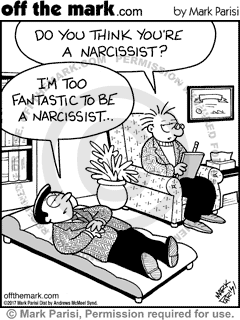
Beginning in the 1980s, a concerted effort by policymakers concerned about U.S. students performing low on international tests involved the idea of how students saw themselves. The thinking was that low self-esteem caused low test scores.
Solution? Raise students’ regard for themselves. The movement spread rapidly especially after a California legislator got his bill through both houses of the legislature and the governor signed the new law that assigned the state’s schools raise students’ self-esteem. Critics, of course, pointed out that the causal arrows that policymakers believed in, that is, if you raise students’ self-esteem, then achievement will rise as well–those arrows could just as well point the other way. That is, higher achievement using direct ways of helping students academically  could result in their higher self-regard.
Without knowing for sure which way the causation goes, cartoonists have had a field day with this school reform as it permeated through the rest of society.  So enjoy the cartoons on what started out as a school reform called the “self-esteem movement” and became a running joke for all aspects of human behavior.


toon-1478.gif

Color-US-self-esteem.jpg

ME_349_Instant_Self_Esteem.png
2017-03-31B-240x331.gif
MORE CARTOONS: Cartoons on the School Reform to Boost Student Self-Esteem | Larry Cuban on School Reform and Classroom Practice

NYC Public School Parents: Success charters and Eva Moskowitz continue to violate children's rights as the US Department of Education rewards them with another ten million dollars

NYC Public School Parents: Success charters and Eva Moskowitz continue to violate children's rights as the US Department of Education rewards them with another ten million dollars

Success charters and Eva Moskowitz continue to violate children's rights as the US Department of Education rewards them with another ten million dollars


Today yet another lawsuit was filed against Success Academy charter schools today by Tanwa Omolade, a Brooklyn mom whose special needs son was repeatedly suspended, sent to the police station for misbehavior and who herself had the city's Administration for Children's Services (ACS) called on her by Success administrators in a “campaign of harassment” to convince her to pull her child out of the school. More on the lawsuit and the filings at Chalkbeat here.  As Chalkbeat writes,

The lawsuit makes a number of allegations that have popped up against Success and other charter networks before: that they have threatened parents with child welfare investigations, held students back from advancing to the next grade level for disciplinary reasons, and generally use harsh discipline practices that have a disproportionate effect on students with disabilities.

Success Academy has been repeatedly sued for abusing its students and violating their rights, as well as calling ACS on parents who complain;  here are just some of the previous and ongoing lawsuits against this chain of charter schools

Yet in its wisdom, the US Department of Education just awarded this serial violator of civil rights ten million dollars to add to the $43.4 million they had already given the Success chain.

In addition, Tufts has announced they will provide Eva Moskowitz an honorary degree, the head of Success Academy and a defendant in these lawsuits.  The former president of Tufts, Lawrence Bacow, who is the current president of Harvard is scheduled to speak at the Success high school's graduation, which last year only graduated 16 out of the 73 students who entered the school in Kindergarten  or first grade.  No doubt both occurrences were influenced by the fact that the head of the Success board, hedge funder Steve Galbreath, is also on the Tufts board of trustees and heads its investment committee


The chaotic and abusive treatment suffered by her high school students and which caused most of the teaching staff to quit in disgust last year was extensively chronicled, CONTINUE READING: 
NYC Public School Parents: Success charters and Eva Moskowitz continue to violate children's rights as the US Department of Education rewards them with another ten million dollars


McPherson KS students join the rebellion vs Summit and depersonalized learning and win the right to opt out | Parent Coalition for Student Privacy

McPherson KS students join the rebellion vs Summit and depersonalized learning and win the right to opt out | Parent Coalition for Student Privacy

MCPHERSON KS STUDENTS JOIN THE REBELLION VS SUMMIT AND DEPERSONALIZED LEARNING AND WIN THE RIGHT TO OPT OUT


Yesterday, in a NY Times front page story, the reporter Nellie Bowles explored the many problems experienced by Kansas students and parents when the online Summit Learning program was imposed on their schools, including health problems, poor curriculum and lax privacy. “It sounded great, what they sold us,” said one parent. “It was the worst lemon car that we’ve ever bought.”  Please read the article and if you’re a Summit parent anywhere in the country, share your experiences in the online portal at the end of the article.
I’ve written about the resistance to the Summit platform since 2016, hereherehere , here and here, including my visit to a Summit charter school here.  Though the NY Times article gives short shrift to the issue of privacy it does contain a quote from me about the tremendously intrusive wealth of personal data that Summit and the Chan Zuckerberg Initiative are collecting. Mark Zuckerberg has repeatedly broken every promise he’s made about keeping personal data private and neither CZI nor the new nonprofit that will take over Summit headed by Zuckerberg’s wife have provided any reason that parents should trust them any more.
What’s particularly moving about the article is that while Summit and its funders, including Bill Gates, Mark Zuckerberg, and  the Chan Zuckerberg Initiative all claim Summit students are able to demonstrate ” “greater ownership of their learning activities,” the McPherson Kansas students are actually taking ownership of their education by walking out of school and engaging in sit-ins.  Though of a very different demographic, they resemble the remarkable Brooklyn students who earlier this year walked out of the Secondary School of Journalism in protest against Summit, and who followed up by writing an open letter to Mark Zuckerberg, saying “We refuse to allow ourselves to be experimented on in this way.“ 
This is a growing phenomenon.  Note the thousands of Ontario students who organized a mass walk-out earlier this month of schools throughout the province,  against rising class sizes and the requirement that all high school students  take online courses.  All of these students are showing courage and agency by resisting the CONTINUE READING: McPherson KS students join the rebellion vs Summit and depersonalized learning and win the right to opt out | Parent Coalition for Student Privacy

Mystery Machines or Master Teachers: Which Do You Prefer? | One Flew East

Mystery Machines or Master Teachers: Which Do You Prefer? | One Flew East

MYSTERY MACHINES OR MASTER TEACHERS: WHICH DO YOU PREFER?


What’s optimal for education, the teacher as adjunct to the machine—or the other way around?
Whatever the rest of us might decide, Silicon Valley has answered this question to its own satisfaction—one way for other people’s children, another for its own. While the kids of tech millionaires study in small groups led by expert teachers accompanied by minimal technology, these same parents peddle cheap educational “solutions” like the Summit program to cash-strapped schools across the country. Classic rich-folk attitude: what’s sufficient for the masses will never do for our precious babies.
Crazy Machine
In an unintentional parody of Fred Keller’s Personalized System of Instruction, the programs these millionaires are making more money on are lauded as also “personalizing” instruction.
Personalizing? Oh, come on.
They take the person out, both the student and the teacher. Their idea of personalizing is much like the auto industry’s of customizing. In both cases, an array of choices created by marketers and designers is claimed to make the options “personal” or “custom.” They are neither; all they really are is controlled variety.
Again, adapting machines from afar to individual ends isn’t “personalizing.” It’s “enfolding,” wrapping the individual so tightly in a commercial and/or mechanical web that the individual effectively disappears. Just look at Disney fans: They are so wrapped in product that you can’t see who they are.
Trying to “personalize” something for someone from a thousand miles away of necessity does the opposite. If you want to personalize something, you need to be right there with it. Look at the word: It involves a person.
But let’s get back to education: If you want to educate someone, it takes two. Two there in person. You can’t CONTINUE READING: Mystery Machines or Master Teachers: Which Do You Prefer? | One Flew East

Monday, April 22, 2019

Republican Teachers: Tell legislators to support public education | Live Long and Prosper

Republican Teachers: Tell legislators to support public education | Live Long and Prosper

Republican Teachers: Tell legislators to support public education


Indiana’s Republican State Superintendent of Public Instruction, Jennifer McCormick, was careful to speak in non-partisan terms when she visited Fort Wayne last week. She didn’t call out one specific party for its anti-public education legislation, even though everyone in Indiana knows that the Republicans are doing their best to privatize and skimp on funding for public education.
McCormick is a Republican.
McCormick’s predecessor, Glenda Ritz, was also a Republican before she ran for the Superintendent’s position in 2012. She took office, however, as a Democrat…and ran into the wall of the Republican Supermajority for everything she wanted to do for public schools in Indiana.
In the 2016 election, Ritz and McCormick had similar platforms. McCormick, however, said that she could get things done because she was a Republican. She could talk to the members of her own party and get them to understand what public schools and public school teachers needed. She tried, but she was also stopped by the Republican legislators.
It doesn’t take the logic of Spock to deduce that the Republicans in the Indiana legislature are against public education. For the last dozen years the Republicans in the Indiana House and Senate have introduced and passed legislation aimed at funding vouchers and charters, deprofessionalizing the teaching profession, and starving public education.
But Glenda Ritz was a Republican before she was a Democrat, and she supported public education…and Jennifer McCormick is a Republican and she supports CONTINUE READING: Republican Teachers: Tell legislators to support public education | Live Long and Prosper


Badass Teachers Association Blog: Cower and the World Cowers With You; Stand Up and You Stand Alone

Badass Teachers Association Blog: Cower and the World Cowers With You; Stand Up and You Stand Alone

Cower and the World Cowers With You; Stand Up and You Stand Alone


The blog post you are about to read may be painful to digest, but carries some hard truths.
Teachers in public schools have been under siege since the 1983 President Reagan Report,
“A Nation At Risk.” This report heralded in an era of privatization of public entities, and planted the seed to privatize public education.
A few decades later Corporate policies have nearly obliterated America’s Public Schools; a former Public Social Institution is now run as a business and Principal teachers have been replaced with CEOs.
There have been many casualties as a result of this Corporate Reform run approach to public schools. Experienced older teachers were summarily eliminated while their colleagues stood by, and younger less experienced teachers were hired who came through the ranks of Corporate-sponsored “Education” programs with Teach for America being the most well-known.
What may not be apparent about this culling of teachers is that many of them were victims of Workplace Bullying. While most teachers acknowledge there are Administrators who engage in bullying behaviors, what is not usually acknowledged is the accompanying bullying by fellow colleagues.

Nurses, social workers, and teachers are the most likely to participate in bullying their colleagues, the so-called “Caring Professions.” (1) Surprised to learn this?  Most people are. Perhaps that is why it catches so many people off-guard because they see teachers as part of a caring and nurturing profession.
This bullying by colleagues can take several forms.  The most common being active participants or by being passive bystanders.  Passive bystanders? How on Earth can they be responsible for workplace bullying of their colleagues?
According to the Alberta Bullying Research, Resources and Recovery Centre this bullying by bystanders often manifests itself as “moral disengagement.”  People develop standards that guide their moral behavior; what they will or will not do according to their own personal CONTINUE READING: Badass Teachers Association Blog: Cower and the World Cowers With You; Stand Up and You Stand Alone


Things Didn’t Go Well When Betsy DeVos Was Confronted With Her Department’s Charter School Fraud - LA Progressive

Things Didn’t Go Well When Betsy DeVos Was Confronted With Her Department’s Charter School Fraud - LA Progressive

Things Didn’t Go Well When Betsy DeVos Was Confronted With Her Department’s Charter School Fraud


uring a series of recent congressional hearings in Washington, D.C., U.S. Secretary of Education Betsy DeVos had to respond to a recent report finding the U.S. Department of Education has been scammed for hundreds of millions of dollars by fraudulent or mismanaged charter schools. Her responses reveal not only her inability to counter legitimate concerns over the spread of charter schools but also the charter school industry’s resistance to honestly address a chronic problem with its schools.
The report, which I co-authored with Network for Public Education Executive Director Carol Burris, found that up to $1 billion awarded by the federal government’s Charter Schools Program (CSP) went to charter schools that never opened or opened for only brief periods before being shut down for mismanagement, poor performance, lack of enrollment, and fraud. Our calculation was that a least a third of the $4.1 billion spent by the CSP was wasted.

Members of Congress repeatedly referred to these findings when questioning the secretary’s management of charter school grants and her proposal to increase funding for the program to $500 million annually. In response, DeVos first attempted to deny the problem, saying, “You are always going to have schools that don’t make it.”
When Democratic representatives continued their questions, DeVos then tried to distract attentionfrom the problem, arguing there was a need for “more” charters, “not less.”
In the most recent exchange, DeVos pivoted to attacking the report authors personally rather than disproving their findings, saying, “The study was really funded by and promoted by those who have a political agenda against charter schools.”
That final exchange in particular raised the hackles of my coauthor Burris, who quickly delved deeper into the data to find that incidents of financial fraud, waste, and mismanagement in the charter school grant program are likely worse than our first estimate.

Federal Money Wasted on Defunct Charters Is Actually Worse

DeVos’ lame defense of the federal government’s charter school grant program before Congress should draw more scrutiny of the program rather than alleviate concerns.

DeVos’ lame defense of the federal government’s charter school grant program before Congress should draw more scrutiny of the program rather than alleviate concerns.
By denying, distracting, and personally attacking the report authors, she encouraged us to delve further into the evidence that much of the money awarded by the program went to charter schools that are, at best, bungling attempts to start up education businesses that should never have been financed to begin with or, at worst, scam operations that willfully intended to make off with taxpayer money and not suffer any negative consequences.

Recommendations to reform California's charter school law

Recommendations to reform California's charter school law

Panel faces tight deadline to recommend reforms of California’s charter school law
Task force has until July 1 to come up with solutions


Each Thursday a group of educators and representatives of labor unions meets — out of the public eye — for several hours at the California Department of Education building in Sacramento to take on arguably the most contentious current issue on California’s education reform landscape: charter school reform.
Known as the Charter Task Force, it was set up by newly elected State Superintendent of Public Instruction Tony Thurmond in March at the request of Gov. Gavin Newsom.
The 11 members of the task force, with Thurmond facilitating their discussions, have what some might view as a nearly impossible task — coming up with recommendations by July 1 on tough issues that have been simmering in California for years, but have exploded on the state’s public policy agenda largely as a result of heightened teacher activism in Oakland, Los Angeles and other districts.
With over 1,300 charter schools serving over 10 percent of California’s public school children, the stakes are high. The Charter Task Force, so far, has focused on two of the most difficult issues: who can authorize charter schools and whether school districts can take the financial impact of charter schools into account in deciding whether to grant or renew a charter.
Under current law, county boards of education or even the State Board of Education can overrule decisions by local school districts to deny a charter school application. Teachers’ unions have argued that school districts should have the final say and that districts should be able to consider the financial impact of charter schools during the authorizing process. Some charter school advocates, in turn, worry that such reforms could not only halt charter expansion, but potentially kill the entire sector.
The focus during task force meetings has been hearing from a range of experts and school districts with the goal of “making sure all task force members have the same understanding of the trends and practices regarding charter schools in California,” Thurmond said.
One feature of the task force is that it is not open to the public.
“I care about transparency as much as anyone else,” Thurmond said. “I wish there were a way to have everyone in the state involved in the group, but at the end of the day, we also want to find a balance, to have a workable group.”
Just six weeks ago Gov. Newsom signed a bill requiring greater transparency in charter school operations. Asked why the task force shouldn’t be similarly “transparent,” CONTINUE READING: Recommendations to reform California's charter school law
Thurmond said that he is working on ways for the public to provide input. That includes setting up an email account that people can send information to (chartertaskforce@cde.ca.gov). He said he has also been in touch with parent groups and hopes to figure out a way for students to provide input.


Some North Carolina Schools Cancel May 1 Classes as Teachers Set to Protest

Some North Carolina Schools Cancel May 1 Classes as Teachers Set to Protest

Some North Carolina Schools Cancel May 1 Classes as Teachers Set to Protest


The four largest school districts in North Carolina canceled their May 1 classes because many of their teachers will be flocking to the state’s capital for a May Day protest.
May 1, or May Day, was chosen as the International Workers Day by socialists and communists.
The Raleigh News and Observer reported earlier in April that the number of employees taking a day off for the protest is so high that they’ve canceled classes. Other districts are staying open, asking that a small delegation travels to the protest instead.
State lawmakers applauded the districts that kept schools open.
“We don’t think it’s appropriate or healthy to keep hundreds of thousands of students out of the classroom, especially when education funding is at a historic high and teacher funding has increased at the third-highest rate in the entire country,” Pat Ryan, a spokesman for state Senate leader Phil Berger, told the Observer.
The May Day protest is organized by the Red for Ed movement, which is a headed by Noah Karvelis, a 24-year-old socialist in his second year as a teacher in Arizona. Karvelis spoke at the Socialism 2018 conference last year.
The Red for Ed movement is coordinated and funded by the largest labor union in the United States, the National Education Association (NEA). Red CONTINUE READING: Some North Carolina Schools Cancel May 1 Classes as Teachers Set to Protest

Later school bells, alternative testing: California lawmakers try again on quashed K-12 bills | CALmatters

Later school bells, alternative testing: California lawmakers try again on quashed K-12 bills | CALmatters

Later school bells, alternative testing: California lawmakers try again on quashed K-12 bills 


California hit the snooze button last year on legislation that would have let middle and high school students sleep in a little longer. The later—and, experts say, healthier—school start time would have been a national first had Gov. Jerry Brown not vetoed it.
This year, Democratic state Sen. Anthony Portantino of La Cañada Flintridge, author of Senate Bill 328, is bringing that bill back. And he’s not the only one looking for a do-over on bills that would impact California school kids.
From funding to testing to charter school regulations, many legislators this session are reviving past education proposals that either stalled at the Capitol or fell to the stroke of Brown’s veto pen. 
It’s not unusual for a bill to be run up the flagpole more than once before a majority of state lawmakers pass it. This year, however, the political landscape on education has shifted, both because of big electoral victories in November for legislative Democrats and California teachers’ unions and because, for the first time in eight years, the Golden State has a governor with small children.
Gov. Gavin Newsom, a father of four who was elected with strong labor backing, has already signed into law a charter school bill that had been vetoed by Brown twice, requiring charters to follow the same open-meeting and conflict of interest laws as traditional public schools. Other hotly debated charter regulation proposals this session include a bill vetoed twice by Brown that would prohibit districts from operating charters outside of their geographic boundaries.
Meanwhile, hotly debated legislation that would essentially prohibit low-income schools from hiring teachers through programs such as Teach For America passed the Assembly Education Committee this year after fizzling out last year without any hearings.
Also up for re-examination are school funding proposals that were viewed as nonstarters in years past, due to the likelihood of pushback in the Legislature from Republicans and moderate Democrats. This year, Democrats not only control the Capitol, but have mega-majorities in both legislative chambers, with anti-tax conservatives fairly solidly outnumbered.
So in the Senate, legislators are advancing a long-sought proposal to lower the threshold of votes school districts need to pass local parcel taxes, from two-thirds to 55%. The authors of Senate Constitutional Amendment 5 have said that Democrats’ supermajorities offer reassurance that the effort will have the required two-thirds votes in the Assembly and Senate to put a referendum on the 2020 ballot.
Its passage would be consequential, both for schools and taxpayers. The number of local school bond measures has exploded since the voter permission threshold for that kind of public borrowing was similarly lowered. Voters have passed more than 85% of local school bond measures since 2012, while parcel taxes remain a more uncertain and infrequent gamble for schools.
The school start time bill, which the Assembly Education Committee will discuss Wednesday, was one of the most CONTINUE READING: Later school bells, alternative testing: California lawmakers try again on quashed K-12 bills | CALmatters

Minus 5: How a Culture of Grades Degrades Learning | radical eyes for equity

Minus 5: How a Culture of Grades Degrades Learning | radical eyes for equity

Minus 5: How a Culture of Grades Degrades Learning


About midway through my first 18 years in education as a high school English teacher, I had mostly de-graded and de-tested my courses except, of course, for having to comply with mandates such as midterm/final exams and course grades.
At some point, my students and I began to openly parody grade culture in a sort of wink-wink-nod-nod way that included my saying “Minus 5!” any time a student offered an incorrect answer during a class discussion.
We all smiled and laughed.
As I approach the same amount of time in the second wave of my career as an educator, now a university professor at a selective college, I continue to use that skit, adding at times a “Plus 10!” with exuberance when someone offers something really thoughtful.
My college students are hyper-students, having been very successful in school for many years while receiving as well as expecting high grades because of the student-skills they have developed.
Despite my careful and detailed explanations upfront that I do not grade and do not give tests, these college students struggle, some times mightily, in a de-graded classroom. Once, for example, a student emailed me about how to make up the “minus 5” I had taken away in the class discussion.
This semester in my educational foundations course and an upper-level writing/research course, many of the greatest flaws with grading culture have sprung up once again.
Even as we approach the end of the semester, I have had several students email me asking for extensions on submitting their major essay. I have to carefully reply that the concept of an extension isn’t relevant in a course that doesn’t grade and is grounded in the requirement that all assignments must be completed fully (and ideally on time) and resubmitted in a final portfolio.
In all of my courses, essays must also be submitted in multiple drafts or I cap the final course grade.
I explain repeatedly to my students that we are here to learn and that if I focus on artifacts of their learning while requiring that all work be CONTINUE READING:Minus 5: How a Culture of Grades Degrades Learning | radical eyes for equity

Schools Matter: Kansas Parents Take on Summit Learning

Schools Matter: Kansas Parents Take on Summit Learning

Kansas Parents Take on Summit Learning

This is not about education. This is about plans to make education for-profit and to minimize overhead by gradually rendering human teachers -- and brick and mortar schools -- obsolete. --pjc (top comment at New York Times story)

 Summit Learning, which is a Silicon Valley business scheme to depersonalize school learning (see explanations gathered here), save money on teachers and facilities, and to make more tech millionaires, has been around since 2003.  In 2014, the sociopathic Mark Zuckerberg got personally involved, and it wasn't long after that he started buying up politicians in Kansas and other places that had no clue what an insidious, destructive, and oppressive system of schooling that was about to be foisted on their children.

The New York Times has done a bang-up story on what is happening in Kansas, where parents and students are striking back against their compromised school officials and the Silicon Valley oligarchs who have bought them.  A clip:


. . . .Silicon Valley had come to small-town Kansas schools — and it was not going well.
“I want to just take my Chromebook back and tell them I’m not doing it anymore,” said Kallee Forslund, 16, a 10th grader in Wellington.
Eight months earlier, public schools near Wichita had rolled out a web-based platform and CONTINUE READING: Schools Matter: Kansas Parents Take on Summit Learning

CURMUDGUCATION: Guest Post: The True Cost of College

CURMUDGUCATION: Guest Post: The True Cost of College

Guest Post: The True Cost of College


I've known Beth Pfohl for years. She was a top student in my Honors English class, and years before that I cast her as Annie in our community theater production. When she was a senior, I installed her as editor of the yearbook. She's an exceptional human being. Beth is currently finishing up her college education at Miami of Ohio, and it is from that vantage point that she wrote the following post for her own blog, which I am reprinting here with her permission.

I am heartbroken, and I am furious.

So you know what, I’m going to discuss the forbidden topic: money, and more specifically the absurd amount American students must pay for quality university educations.

You might ask, “Why today?”


Because today my heart broke, not for myself, but for someone I love. Today, she had to say goodbye to her dream school, not because she wasn’t accepted. Not because the reality when visiting the school was a disappointment. Not because it was too far away from home. Not because she is lacking support from her family. Not because she hasn’t saved up enough money.

Because college is too damn expensive.

This open letter isn’t meant to be about me, but I think it would not leave as great an impact if I did not speak in specifics.

I am a senior, graduating in May from Miami University (Ohio). I absolutely love this school and CONTINUE READING: 
CURMUDGUCATION: Guest Post: The True Cost of College