Latest News and Comment from Education

Thursday, April 11, 2019

Seattle Schools Community Forum: Testing Season 2019

Seattle Schools Community Forum: Testing Season 2019

Testing Season 2019


Image may contain: one or more people and textSeattle Schools is coming up for the testing window for the SBAC.

Opt out info here, including opt-out form.

I again urge you to opt your child out.
#OptOut #RefuseTheTest


From Ignite Fire:

No child has a standardized mind. All are unique and different. In Finland, the first standardized test is taken at 16. Plenty of time to develop and mature. 


➡️Why are we pushing and rushing children to high achievement so early?➡️Why do we care if they are showing college and career readiness in 3rd grade? ➡️Why are we robbing children of their childhood? ➡️Why are we stealing their opportunities to explore and find their passions?

From Stop Fed Ed:

By now, most states have chosen not to use the PARCC (Partnership for the Assessment of Readiness for College and Career) and Smarter Balanced (SBAC) assessments, which were designed after the Common Core State Standards Initiative.

The states remaining in Smarter Balanced are: California, Connecticut, Delaware, Hawaii, Idaho, Maine, Michigan, Montana, Nevada, New Hampshire, North Dakota, Oregon, South Dakota, Vermont, Washington, West Virginia, and Wisconsin.

Five Things every parent, educator, and legislator should know about high-stakes, standardized testing


NYC Public School Parents: Public school parents and advocates relieved that their family’s information will no longer be used to help charters market their schools

NYC Public School Parents: Public school parents and advocates relieved that their family’s information will no longer be used to help charters market their schools

Public school parents and advocates relieved that their family’s information will no longer be used to help charters market their schools


The Daily News this morning said this decision was "tabled," but the DOE was  still telling parents as of 10:50 AM that they are going ahead and withdrawing permission from charter schools to access student information for their mailings.
For immediate release: April 11, 2019
For more information contact: Leonie Haimson, 917-435-9329; leoniehaimson@gmail.com

Public school parents and advocates relieved that their family’s information will no longer be used to help charters market their schools
This morning, parents and advocates thanked the Mayor and Chancellor for finally reversing the long-standing practice of allowing charter schools to access their family’s information for mailings sent to their homes for marketing and recruiting purposes.
Said Johanna Garcia, public school parent and President of Community Education Council in District 6 in Upper Manhattan:  “It is unconscionable that this practice has gone on as long as it has.  For more than a decade, parents and advocates have complained about the privacy violations incurred by DOE allowing charters to access our children’s personal information without our consent; I filed a  FERPA complaint to the US Department of Education about this practice in November 2017.  Moreover, I am not aware of another school district in the country that voluntarily makes this information available to charter schools to help them boost their enrollment, diverting students and funding from our public schools.  “
Nequan McLean, co- chair of the Education Council Consortium and the President of Community Education Council in District 16 Brooklyn said: “The DOE never had our permission in the first place to allow charter schools to access this personal information. As a result,  I along with other parents. have been routinely inundated with two or three charter mailings a week, and our district has been overrun by charter schools.  These charter schools are allowed to flood black and brown communities with their promotional materials, often full of exaggerations and lies, that the public schools cannot afford.” 
Shino Tanikawa, the co-chair of the ECC and a member of NYC Kids PAC, said, “For years, DOE has ignored parents’ complaints about this practice, which started in 2006, when Joel Klein agreed to help Success Academy charter schools expand their “market share” as Eva Moskowitz put it in an email.  The result is that this year, more than two billion dollars has been diverted from our public schools, leaving our schools with less space and less funding for our neediest students.” 
Leonie Haimson, co-chair of the Parent Coalition for Student Privacy, pointed out: “In Chicago, after student information was disclosed to Noble charter schools without parent consent, resulting in parents receiving postcards urging them to enroll their children in their schools, this sparked a huge controversy and led to an investigation by the city’s Inspector General.  As a result, the Chicago staffer who released the information to Noble was fired and the district apologized to parents in mailings paid for by Noble.  And this CONTINUE READING: NYC Public School Parents: Public school parents and advocates relieved that their family’s information will no longer be used to help charters market their schools

Internal memo contradicts DeVos on using federal money to buy guns for teachers - The Washington Post

Internal memo contradicts DeVos on using federal money to buy guns for teachers - The Washington Post

Internal memo contradicts DeVos on using federal money to buy guns for teachers


Education Secretary Betsy DeVos refused to say yes — or no — when asked last year whether schools could use federal money to buy guns for teachers. She said the law was vague and she couldn’t take a side.
The result was de facto permission for states to go ahead.
On Wednesday, House Democrats released an internal Education Department memo that showed the matter was viewed differently inside the agency. The memo advised that the agency’s general counsel believed DeVos did have the power to make a call about the funding and laid out arguments that could be made on both sides.
“The Department’s Office of the General Counsel has advised that the Secretary has discretion to interpret the broad language of the statute as to its permissiveness regarding the purchase of firearms and training on the use of firearms,” reads the July 16 memo.
The memo was sent to DeVos adviser Kent Talbert from Jason Botel, who at the time was principal deputy assistant secretary for the Office of Elementary and Secondary Education. A spokesman for the House education committee, which made the memo public Wednesday, said the internal document was obtained from “a reliable source.”
The question of arming teachers has proved emotional following deadly school shootings. Many Democrats, teachers unions, education groups and gun-control activists say weapons in classrooms will make schools more dangerous, not safer. But President Trump and gun rights supporters argue that arming teachers would “harden” schools, making them less likely targets for shootings.
Federal funding has never been used to buy firearms for educators. Last year, Congress passed a school safety CONTINUE READING: Internal memo contradicts DeVos on using federal money to buy guns for teachers - The Washington Post

‘A Deal is a Deal’: Sacramento Educators Go on Strike - NEA Today

‘A Deal is a Deal’: Sacramento Educators Go on Strike - NEA Today

‘A Deal is a Deal’: Sacramento Educators Go on Strike


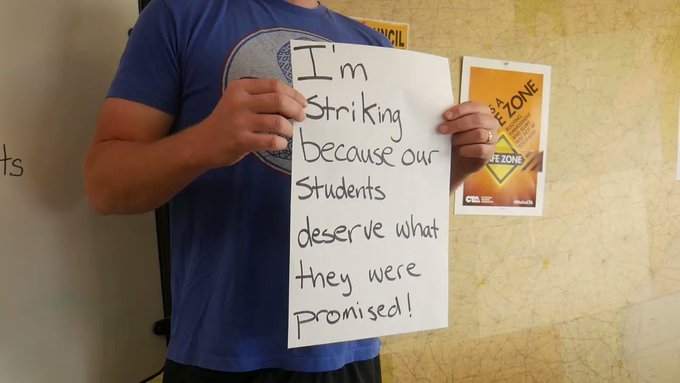
The #RedForEd wave hits Sacramento. Today, April 11, more than 2,800 Sacramento educators are on strike to protest the Sacramento City Unified School District’s (SCUSD) bad faith bargaining and to support a fair settlement that includes additional resources, such as art and music, smaller class sizes, more school nurses, and psychologists. The contract also includes an 11 percent increase in teacher salaries.
sacramento teachers strike
“[The strike] grows out of frustration of the failure of the superintendent to honor a contract that he signed more than a year ago, and the continued treatment of our contract [as] optional, [instead of] something that’s binding on both parties,” David Fisher, a second-grade teacher and president of the  Sacramento City Teachers Association (SCTA), said in an interview.
The superintendent is Jorge Aguilar, whose refusal to honor the contract has led to the city’s first strike in nearly 30 years. SCTA members voted by 92.3 percent to protest the unlawful, unfair labor practices by superintendent and the school board.
In November 2017, after more than a year of bargaining, SCTA and the district settled and signed a bargaining contract with a commitment to reprioritize resources toward students and classrooms. Since then, the district has committed 31 unfair labor practices. Now, the district is back tracking on the mutually agreed upon contract that meets the needs of students.
Thousands of educators, students, and parents will hit the picket lines to demand that SCUSD keep its promise to lower class sizes and increase student services—and to act lawfully and remedy its illegal actions that are hurting nearly 50,000 Sacramento public school students.


Sacramento’s Kara Synhorst, an English teacher of nearly 20 years, captured the sentiments of many educators in a video posted to Facebook: “I’m offended and insulted at the way teachers are being portrayed…My union has offered ways for the district to save money…If anyone is refusing to come to the table, it’s Mr. Aguilar and the district. We have a contract. Don’t ask us to negotiate a new one when you CONTINUE READING: ‘A Deal is a Deal’: Sacramento Educators Go on Strike - NEA Today


Well-Intentioned Ohio School Finance Plan Must Be Revised to Eliminate Savage Inequalities | janresseger

Well-Intentioned Ohio School Finance Plan Must Be Revised to Eliminate Savage Inequalities | janresseger

Well-Intentioned Ohio School Finance Plan Must Be Revised to Eliminate Savage Inequalities


After a decade of tax cuts brought by Governor John Kasich and a supermajority Republican Ohio Legislature,  Ohio—still dominated in the House, Senate and Governor’s mansion by Republicans—is considering a new school funding formula intended to address what have been glaring problems for the state’s public schools. The new plan is bipartisan. We all owe enormous thanks to Representatives Robert Cupp and John Patterson for their leadership.
Currently, only 107 (18 percent) of the state’s 610 school districts are receiving their calculated formula level of school funding from the state—an amount that supposedly represents what the state should contribute based on each school district’s capacity to raise local revenue. All the rest—503 school districts—are operating on guaranteed or capped funding.  We have reached a point—years and years after the last funding formula adjustment, where nobody can really explain how the state is dividing up its contribution through the formula.
The proposed Fair School Funding Plan is designed to consider each school district’s capacity to raise local revenue—with factors reflecting the district’s property tax base and the aggregate income of the residents.  And, we’ve been told, the new formula will distribute school funding based on the cost of what it takes to educate children—what experts identify as the cost of teachers, support staff, school operations, and school administration.
It is not yet possible to see how all this has been figured out, because the calculations and the numbers that were plugged into the calculations haven’t yet been released.  The new funding plan does get more school districts back inside a formula designed to address the number of children who live in the district, however, and supposedly to address the needs of those CONTINUE READING: Well-Intentioned Ohio School Finance Plan Must Be Revised to Eliminate Savage Inequalities | janresseger


Intrinsic Motivation is Key to Student Achievement – But Schools Can Crush It (Tara Garcia Mathewson) | Larry Cuban on School Reform and Classroom Practice

Intrinsic Motivation is Key to Student Achievement – But Schools Can Crush It (Tara Garcia Mathewson) | Larry Cuban on School Reform and Classroom Practice

Intrinsic Motivation is Key to Student Achievement – But Schools Can Crush It (Tara Garcia Mathewson)


Tara Mathewson wrote this for The Hechinger Report. It appeared March 27,2019.
Mathewson describes how “traditional” schools “crush” motivation. The age-graded organization–a mid-19th century innovation in organizing public schools (recall the “traditional” one-room school that it replaced)–is the quarry she targets. She describes students who do poorly in such schools.
Mathewson then compares another kind of organization that has arisen in some high schools across the country where teachers and administrators alter significantly the key structures of age-graded schooling. She profiles a Big Picture school called The Met (Providence, RI).  I have been describing another Big Picture school in Oakland Unified School District (CA) called MetWest in a series of posts over the past month.
When Destiny Reyes started elementary school, she felt highly motivated. Like most young children, she liked learning new things, and she excelled at school. She got good grades and reveled in her success, thriving in an environment that, at least implicitly, set her up in competition with her peers. She was at the top of her class, and she proved herself further by testing into a competitive, private middle school. But there, among Providence’s brightest, it wasn’t as easy to be at the top of the class, and her excitement about school – and learning – subsided. Eventually, she says, nothing motivated her. She went to school because she had to.

NYC Educator: No English for You!

NYC Educator: No English for You!

No English for You!


The cynical, morally bankrupt thugs in NYSED face issues far differently than you or I might. For example, there's been a perennial shortage of ESL teachers as far back as I can recall. In fact, one of the reasons I'm an ESL teacher is that I could never get a job as an English teacher. Someone told me, "Go teach ESL," and though I didn't know what it was at the time, I grew to love it.

There are few things more satisfying than observing the rapid progress of beginners, or noticing that your students are suddenly fluent in the language. I remember one girl who struggled for two years and then caught it. I said, "You see? I told you you could do it." She said, "Yeah. I was surprised." Another milestone is the first time a student reads a book in English. "You forced me to do that, and I hated you for it. But now I'm glad you did it."

There's another thing you'll see if you teach beginners. You'll have kids thank you for teaching the one class that they can understand. Imagine what torture it is to go through five or six that they don't understand. 

Of course that's changed now. How do you deal with a teacher shortage? In some states, you just lower the standards and hire anybody. Sure, that's a terrible approach, but it keeps bodies in the teacher chairs. In NY State, they've got a different approach. They take a regulation called CR Part 154, and rig it so you barely require direct English instruction at all. Then, they take the test that ostensibly measures English ability and make the standard so low that my dog could pass. Finally, when everyone advances, they say, "You see that? Our plan worked."

I'm fortunate enough to be in a building in which the principal thinks learning English is important for newcomers. Our principal, in fact, thinks it's so important that he holds classes of multiple levels in which students are explicitly taught English. This, of course, is old school. Official NY State policy is that direct English instruction exists only to support advancement in core courses. Who cares if you can introduce yourself, ask where the bathroom is, order a pizza, or make friends? As long as you can pass a bunch of rigged tests, that's good enough for the geniuses up in Albany.

So all over the state, only rank beginners are required to have only one period of direct English instruction per day. Once they advance, via that NYSESLAT exam that my dog can pass (and granted, he's a smart dog), you plant an ESL teacher in a classroom twice a week and you meet the standard. According to NY State, the kids are being served. What exactly is that teacher supposed to do? Who knows?

One thing the teacher is likely not supposed to do is plan. I know that because co-planning is a serious endeavor. If you're with more than one co-teacher, it becomes nigh CONTINUE READING:
NYC Educator: No English for You! 


USC and the College Admissions Scandal: Implicated Students Not Allowed to Dodge Investigation via Withdrawal | deutsch29

USC and the College Admissions Scandal: Implicated Students Not Allowed to Dodge Investigation via Withdrawal | deutsch29

USC and the College Admissions Scandal: Implicated Students Not Allowed to Dodge Investigation via Withdrawal


Actress Lori Loughlin and her husband, fashion designer Mossimo Giannulli, are facing multiple charges associated with a massive college admissions scandal, including fraud and money laundering. Both appear unlikely to escape prison time.
Loughlin and Giannulli allegedly spent $500,000 to have their two daughters, Isabella and Olivia Giannulli, fraudulently admitted to the University of Southern California (USC) by passing the young women off as members of the university’s rowing team. Neither daughter has any experience in the sport. According to FBI wiretaps, Loughlin and Giannulli funneled $400,000 in the form of two $200,00 payments through a nonprofit and sent $100,000 in the form of two $50,000 payments to a USC coach. (See page 88 of this FBI key complaint for the details of the Loughlin-Giannulli emails and phone conversations related to the scam.)
It seems that one of the questions raised concerns whether USC allowed Isabella and Olivia Giannulli to withdraw from the university– a move that arguably could distance the Louiglin-Giannulli family from investigation by the university– and help the daughters dodge having a documented history of the fraudulent incident follow them if they apply to other colleges or universities in the future.
In a formal statement released on March 16, 2019, and updated several times since, USC said it would not allow any students associated with the scandal to withdraw until the university completes its review. Information about reviewing student status was added on April 08, 2019.
The full USC statement, with updates, is as follows:

USC Information on College Admissions Issue

April 8, 2019
On Tuesday, March 12, 2019, the U.S. Justice Department announced an ongoing investigation of a college admissions scheme that targeted several universities across the country, including USC.  This page provides information from USC about these issues and will be updated as new information becomes available.
What is USC doing in response to the alleged admissions scheme? CONTINUE READING: USC and the College Admissions Scandal: Implicated Students Not Allowed to Dodge Investigation via Withdrawal | deutsch29

Why can’t Betsy DeVos give a direct answer to a direct question? - The Washington Post

Why can’t Betsy DeVos give a direct answer to a direct question? - The Washington Post

Why can’t Betsy DeVos give a direct answer to a direct question?
Lawmakers wanted to hear yes or no from the education secretary. They usually didn’t.


Education Secretary Betsy DeVos seems to have a problem answering direct questions with direct answers — at least when testifying before Congress.
DeVos was on Capitol Hill on Wednesday to testify about her department’s policies and priorities before the House Committee on Education and Labor and was asked repeatedly to provide yes-or-no answers to questions. She rarely did.
It wasn’t one of DeVos’s most memorable appearances before Congress, such as in 2017 when she said schools might need guns to protect against grizzly bears. But her performance still angered Democrats, who questioned her on transgender rights, literacy programs and using federal funds to arm teachers.
In some cases, her responses skirted the actual question as she attempted to change the subject. When Rep. Donald W. Norcross (D-N.J.) tried to get her to directly answer questions about whether she supported coercing teachers to leave their unions, she said her interest was in helping teachers develop in their profession.
NORCROSS: What does that have to do with joining unions? You are not answering that . . .
DEVOS: It doesn’t have anything [to do with it]. It has to do with supporting teachers . . .
NORCROSS: But I’m not asking if you are supporting teachers . . .
In other cases, she tried to answer with a longer answer but was cut off by lawmakers who didn’t like the answer or wanted to move to a different subject.
How she answered became a point for discussion. Rep. Virginia Foxx (R-N.C.) said at the end of the questioning that it was “a gotcha hearing,” with some lawmakers trying to twist the secretary’s words. Rep. Van Taylor (R-Tex.) gave DeVos a reprieve earlier.
TAYLOR: You haven’t had a chance to answer a lot of questions. Is there anything you want to say?
DEVOS: There have been a number of things on which I was not able to comment. I think it’s difficult if issues are being conflated, and I also am here not to answer multiple-choice questions but to have an exchange on a number of issues.
Here are some of the exchanges:
---
Rep. Jahana Hayes (D-Conn.), a former National Teacher of the Year, asked DeVos whether she believed that as education secretary she had the authority to tell school districts they could use federal money to arm teachers and train them in using guns.
DeVos said she did not believe she had the authority, but Hayes produced an Education Department memo that clearly says she does have that authority.
Hayes tried to get DeVos to state her position on using federal funds to arm teachers, but the secretary would not. Nor would she say whether she had the authority to provide guidance on the issue.
DEVOS: I have neither advocated for or against.
HAYES: No, you are absolutely right. You have not advocated for or against, but in light of the contents of this memo, you have the ability to make a decision. Your silence is a decision. You have the authority to say that we cannot use federal funds to arm teachers. You are in line for presidential succession. Make a decision CONTINUE READING: Why can’t Betsy DeVos give a direct answer to a direct question? - The Washington Post


CURMUDGUCATION: IN: Go Ahead And Shoot Teachers

CURMUDGUCATION: IN: Go Ahead And Shoot Teachers

IN: Go Ahead And Shoot Teachers


When the story first broke that teachers at Meadowlawn Elementary School in Monticello, Indiana had been shot with pellets--execution style--as part of an active shooter drill, I decided not to get in to it here. The sheriff's department had agreed to knock it the hell off, the legislature had already moved to ban the practice, and the whole business was so clearly over the line, so obviously unnecessarily abusive of teachers, so clearly just a stupid thing to do-- well, I figured we'd heard the last of it.

I should have known better.

Some Indiana legislators have decided to change their minds. Maybe, they figure, it's actually a good idea to shoot teachers.

"It's got to do with reality and making sure they experience the emotions and adrenaline," said Sen. Jeff Raatz, chair of the Senate's education committee and author of the new amendment to allow for the use of pellets.


This frickin' guy.
Raatz is an ordained minister who served as principal of Richmond Academy, a private Christian school that recently closed due to low enrollment. None of which would lead you expect him to lead the charge to make sure that teachers get shot, but here we are.

The good news-- is there good news-- is that the bill still prohibits shooting students. And teachers have to give consent before the training. I do not even want to start imagining what kind of pressure a really crappy administrator could bring to bear if he decided that his teachers should volunteer to be shot. Nor am I sure exactly how that would work-- would teachers who volunteered to be shot wear big targets on their backs, or "shoot me" t-shirts? What would be the process for handling a little "oopsie"? Since Indiana wants to arm teachers, will the armed teachers get to shoot back?

I don't know the answer to any of these questions, but I do know that active shooter training is harrowing and the CONTINUE READING: 
CURMUDGUCATION: IN: Go Ahead And Shoot Teachers


Philanthropy: Not The Answer For Connecticut’s Public Schools | Real Learning CT

Philanthropy: Not The Answer For Connecticut’s Public Schools | Real Learning CT

Philanthropy: Not The Answer For Connecticut’s Public Schools


The news is full of the story of the Dalio Philanthropies donating $100 million to the Connecticut public schools. But is private philanthropy the best way to fund public education? I think not.
The Prize by Dale Russakoff documents the disaster it was when Mark Zuckerberg donated $100 million, which was matched by another $100 million from other philanthropists, to improve public education in Newark, NJ.  The failure has been attributed to the “parachuting in”  of outside consultants rather than rallying the forces within the school system and to the political football the $200 million became among local officeholders, among them Cory Booker and Chris Christie. Similarly, Bill and Melinda Gates gave over $400 million to design, promote, and implement the Common Core Standards. The Common Core Standards, designed without input from educators,  have greatly reduced the quality of education for students and produced absolutely no increase in student achievement, even by the weak measure of standardized test scores. The results of these well-intentioned philanthropic efforts: NOTHING.
The way to create a state of the art public school system is not found in hand-outs, no matter how generous or how headline-worthy. Instead the way to CONTINUE READING: Philanthropy: Not The Answer For Connecticut’s Public Schools | Real Learning CT

The Toll College and Career Readiness Has Taken on Students

The Toll College and Career Readiness Has Taken on Students

The Toll College and Career Readiness Has Taken on Students

First day of school! Wake up! Come on. First day of school.~Finding Nemo
Children usually start school excitedly. They might even think they’re superheroes!
But it doesn’t take long before their belief in themselves is challenged. Much has been done to public education in the name of college and career readiness. It’s difficult to understand how students continue to like learning.
Corporate reformers bemoan that children don’t learn fast enough for jobs they will face when they finish school. What jobs? We’re told no one knows. But students must start young to prepare for X jobs so America’s economy won’t suffer.
They must be tested often and early so they prove they’re on the right track. If they aren’t tested with standardized tests, they will be tested by nonstop online testing. Data will track student progress for those “whatever” jobs.
Meanwhile, we continue to hear that young people are more stressed than ever. From JAMA Pediatrics:
In the United States, suicide is a major public health concern and the second leading cause of death among youths age 10 to 18 years, persisting into early adulthood.
Many want to blame social media, and that’s certainly a concern. But what about how CONTINUE READING: The Toll College and Career Readiness Has Taken on Students