Latest News and Comment from Education

Tuesday, March 5, 2019

Jobs and Automation: Anxiety is Historic | Larry Cuban on School Reform and Classroom Practice

Jobs and Automation: Anxiety is Historic | Larry Cuban on School Reform and Classroom Practice

Jobs and Automation: Anxiety is Historic


A new report predicts that by 2030, as many as 800 million jobs could be lost worldwide to automation. The study, compiled by the McKinsey Global Institute, says that advances in AI and robotics will have a drastic effect on everyday working lives, comparable to the shift away from agricultural societies during the Industrial Revolution. In the US alone, between 39 and 73 million jobs stand to be automated — making up around a third of the total workforce.
But, the report also states that as in the past, technology will not be a purely destructive force. New jobs will be created; existing roles will be redefined; and workers will have the opportunity to switch careers. The challenge particular to this generation, say the authors, is managing the transition. Income inequality is likely to grow, possibly leading to political instability; and the individuals who need to retrain for new careers won’t be the young, but middle-aged professionals.
The First paragraph jump-starts anxiety. Second paragraph is supposed to ease it with words about “new jobs will be created.” But it doesn’t when its mentions growing income inequality, political instability, and retraining middle-aged professionals.
The fact is–and it is a fact that I document below in cartoons–fear of job loss to new machine has been part of American and global culture for the past century.
The larger question of preparing children and youth for future jobs–one of at least four historic purposes of U.S. public schooling– becomes apparent in light of predictions of job loss (“between 39 and 73 million jobs stand to be automated” by 2030). When the primary focus of school reform for the past four decades has been preparing the next generation for the workplace, such predictions question whether job preparation should be the purpose of tax-supported public schools. So the anxiety over job loss to new machines spills over what curriculum to teach the young, what forms of instruction, and how CONTINUE READING: Jobs and Automation: Anxiety is Historic | Larry Cuban on School Reform and Classroom Practice

CURMUDGUCATION: The $5 Billion DeVos Money Laundromat

CURMUDGUCATION: The $5 Billion DeVos Money Laundromat

The $5 Billion DeVos Money Laundromat


You have read by now that Betsy DeVos is finally going to get one of her favorite policy ideas floated past Congress. But what the heck is it, and why is it a problem? To understand, we have to look first at what's been happening in some states.

The financial device we're talking about is a Tax Credit Scholarship, and it's a bit of a clever dodge.

Let's say I'm the State of New West Virkota. The state would like to collect a tax of $100 from Bob and give it to Come To Jesus Academy, but there are rules in place that say that the state can't give taxpayer money to a private religious school. So instead, the state tells Bob that he can give $100 to the Good Neighbor Scholarship Fund instead of to the state, and then the Good Neighbor Scholarship Fund can spend the $100 to pay tuition for some child to attend Come To Jesus Academy. It is a transaction not unlike money laundering, or a fifteen year old paying a college kid to buy beer for him. In Georgia, your contribution can be earmarked for a specific school where "the funds will be equally divided among all approved, eligible students." So, yeah-- it's a donation  to the school, not a scholarship for a student. Georgia can't give Bob's tax dollars to a private religious school, so it just gives Bob credit for giving the money for them.


And it's not just the shadiness of skirting the law. In some states, like Virginia, by leveraging state and federal deductions and credits, you can actually make a profit on your contribution. Here's a wealth management firm explaining how to turn $10,000 into $10,960. The definitive research on just how crazy this stuff gets has been done by Carl Davis of the Institute on Taxation  Economic Policy (his name appears in virtually every article that has been written about the Trump-DeVos proposal). Here's a whole paper, or you can catch him in an informative interview here; I advise you to be sitting down while you're reading it. According to Davis, ten states have that little profit quirk, and they aren't shy about saying so:

"When you donate, you will receive both a Georgia state tax credit AND a federal charitable CONTINUE READING: 
CURMUDGUCATION: The $5 Billion DeVos Money Laundromat


Real Faces Behind Corporate Reform? Look Closer. | deutsch29

Real Faces Behind Corporate Reform? Look Closer. | deutsch29

Real Faces Behind Corporate Reform? Look Closer.


A few days ago, I read this February 28, 2019, Forbes article entitled, “The Real Faces Behind the ‘Corporate Reform’ of America’s Public Schools,” by Emily Langhorne, policy analyst for the Reinventing America’s Schools project at The Progressive Policy Institute.
In her piece, Langhorne features three DC charter school CEOs; she does so to counter words spoken by National Education Association (NEA) president, Lily Eskelsen Garcia, regarding the Los Angeles teachers’ strike– words that Langhorne misquotes, and in which she employs one strategically-placed ellipsis, as follows:
Unfortunately, those listening to coverage of the Los Angeles teachers strike received a very different definition of charter schools from National Education Association President Lily Eskelsen García. On MSNBC, she explained that the Los Angeles Unified School District had no money because “they’ve given it away to for-profit charters. If you’re in the charter industry, what do you want to do? You want to create horrible public schools…. The billionaires who are behind this, the venture capitalists, the Wall Street guys, are out to make money on public schools.”
This statement is absurd: California has never had many for-profit charters, and the legislature banned them entirely last year. Nationwide, less than 15% of the roughly 7,000 charters are run by for-profit operators.
First of all, Eskelsen Garcia does not say “for-profit charters.” She says “for-profit companies.”
I can operate a nonprofit charter school and make money by the way I distribute contracts for school services to for-profit companies, even ones to which I am connected. (Arizona is a fine example of a state in which one can handily use a nonprofit charter school to serve oneself. Charter advocates sell this as “free from bureaucratic red tape,” like Langhorne does in her article.)
money voting
That error right there kills Langhorne’s piece: One can siphon public education funding into for-profit company coffers via nonprofit entities, including charter CONTINUE READING: Real Faces Behind Corporate Reform? Look Closer. | deutsch29


Candidate Red Flags: Democracy Lies In Your Vote in the Special Election, March 5th, 2019

Candidate Red Flags: Democracy Lies In Your Vote in the Special Election, March 5th, 2019

Candidate Red Flags: Democracy Lies In Your Vote in the Special Election, March 5th, 2019


As a candidate in tomorrow’s election, I am asking you to read this post before you go to the polls. Our nation’s Democracy is at stake. We are at a very critical moment in Los Angeles’ political and social history. City Hall’s pay-to-play, corrupt culture has been publicly exposed by the FBI’s raid of a former LAUSD School Board President and the current City Councilman Jose Huizar. Although charges have not been filed, the raids have given light to the overt corruption and fraud that many suspected but was rarely covered by the press.
Overt corruption and fraud also entered our public school system with the election of Dr. Refugio Rodriguez. His indictment and conviction on felony charges exposed more of what we knew about the charter school privatizing industry and the individuals behind his rise to power, Eli Broad and his billionaire posse, including Betsy DeVos. Our city’s public institutions are supposed to work towards the best interests of Angelenos from all races, creeds, religions, sexual orientation, socio-economic status, but they have lost their way and are failing us. The Angelenos that represent the 99% have been left behind.  Democracy was put up for sale and We, the people, are on the losing end of reality. It has been clear to me for quite some time that We, the people, must take back our democracy from special interests, corporate ideologues and all the billionaire money that has been CONTINUE READING: Candidate Red Flags: Democracy Lies In Your Vote in the Special Election, March 5th, 2019

Charters and Vouchers: The Threat to Public Schools is Real - Living in Dialogue

Charters and Vouchers: The Threat to Public Schools is Real - Living in Dialogue

Charters and Vouchers: The Threat to Public Schools is Real 


Across the nation, educators have awakened to the reality that charter schools are a threat to the health and even survival of public schools. For that reason, charters have become a major point of contention in teacher strikes, from Oakland to Los Angeles, and even in West Virginia.
But at Education Week’s blog, Charters and Choice, staff writer Arianna Prothero tells us these fears may be overblown. She acknowledges that charter school expansion is “a salient issue,” but only for those who live in urban areas like Los Angeles and Oakland, where charters enroll as many as 30% of the students.
But after acknowledging this, she asserts:
But are the expansion of charter schools and school vouchers really an existential threat to traditional public schools? In most parts of America, it’s hard to argue that they are.
Charter schools educate only about 3 million students, or 7 percent of all public-school students, according to federal data. It’s taken charter schools more than 25 years to get to that 7 percent enrollment share—and it looks as though that growth has been slowing in recent years.

Prothero apparently only consulted one side of this contentious issue, as all the statistics she cites are from the National Alliance for Public (sic) Charter Schools.
By “most parts of America,” the author seems to be referring to rural areas, which are the focus of the rest of her post. She writes:
…areas with less population density struggle to support robust school choice, which requires lots of schools clustered close enough together that families can reasonably get to them.
She then notes that “it’s mostly rural states that still don’t allow for charter schools…”
And then she suggests that the West Virginia proposal recently defeated by a teacher strike was no real threat:
In West Virginia, lawmakers wanted to allow up to seven charter schools to open and to create 1,000 education savings accounts, a voucher-like program, for students with disabilities.
Make no mistake, this would have been an important symbolic victory for school choice advocates, especially charter school supporters who have been pressing to get charters in the state for a while.
But based on the rate of charter school growth so far, and where charters have been successful in expanding, it seems unlikely West Virginia would have been overrun by charter schools anytime soon, if at all.

Wow. That is quite a conclusion! It would be reassuring if this were not the way that almost every charter CONTINUE READING: Charters and Vouchers: The Threat to Public Schools is Real - Living in Dialogue


Chaz's School Daze: Why Defined Pensions Are Great For Teachers.

Chaz's School Daze: Why Defined Pensions Are Great For Teachers.

Why Defined Pensions Are Great For Teachers.


One of the great benefits in being a teacher in New York State is the defined pension benefit we have.  For the 40% of state teachers that are vested for a pension, the pension benefit averages about $41,703 annually, that is 54% of the teachers final three year salary, not including Social Security and other retirement plans like a 403b program.  In other words, most New York State teachers can expect to enjoy a well funded retirement.

The defined benefit pension plan is mostly funded by the State's School Districts.  For most Tier IV employees, the vast majority of recent retirees, the employee only pays a 3% contribution for the first ten years and nothing thereafter.  That means the School Districts pay the lion's share to fund the pension.

The table below shows how much the School Districts pay to adequately fund the teacher pension system.


Year.........School District Contribution

2010-11.............8.62%
2011-12............11.11%
2012-13............11.84%
2013-14............16.25%
2014-15............17.53%
2015-16............13.26%
2016-17............11.27%
2017-18.............9.80%
2018-19............10.62%


The estimated School District contribution is CONTINUE READING: Chaz's School Daze: Why Defined Pensions Are Great For Teachers.


Monday, March 4, 2019

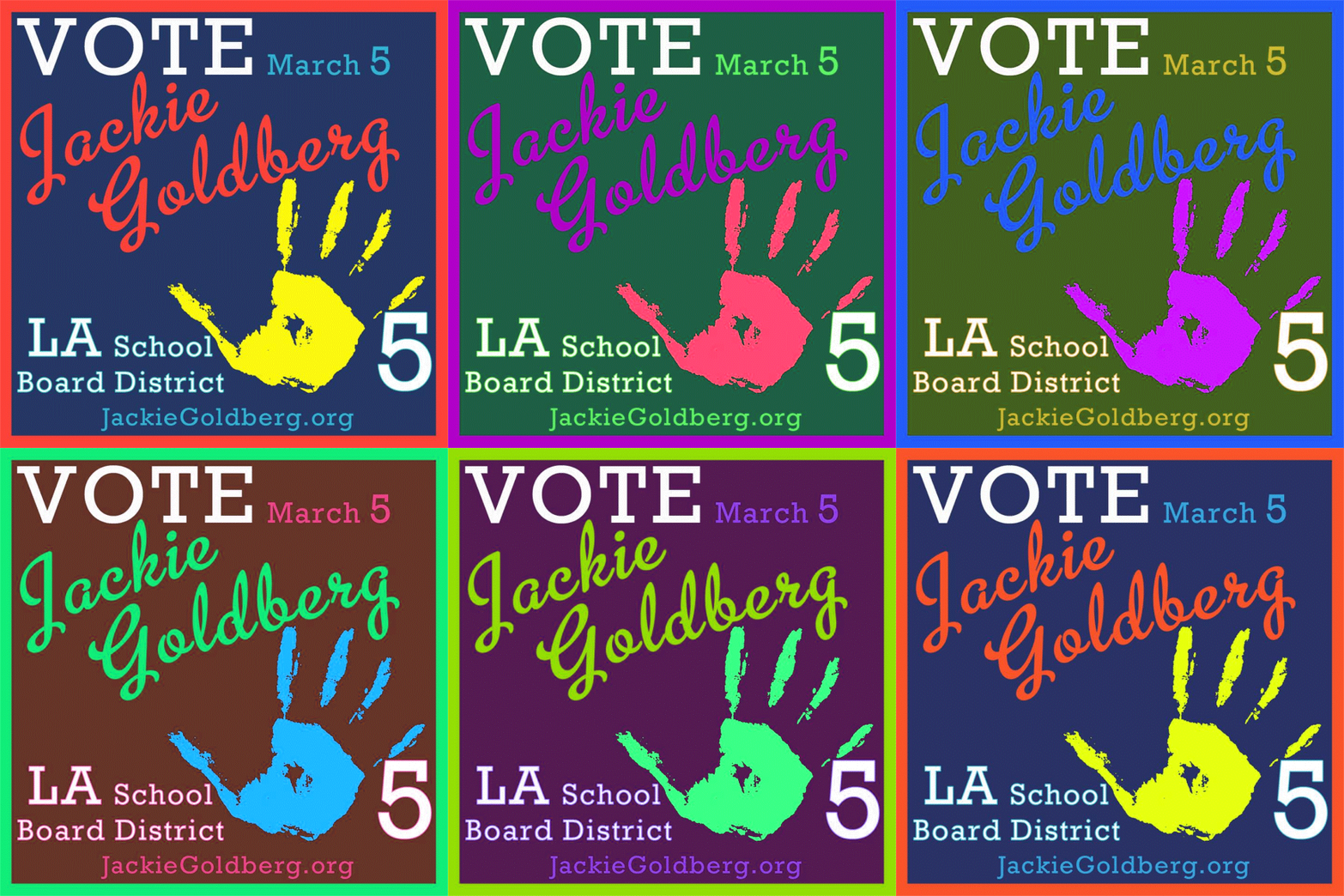
Alex Caputo-Pearl: UTLA Endorses Jackie Goldberg for LAUSD School Board! | Diane Ravitch's blog #VOTEJackieGoldberg #TEAMGoldberg

Alex Caputo-Pearl: UTLA Endorses Jackie Goldberg for LAUSD School Board! | Diane Ravitch's blog

Alex Caputo-Pearl: UTLA Endorses Jackie Goldberg for LAUSD School Board!


This was just released by Alex Caputo-Pearl, president of the United Teachers of Los Angeles, which endorsed Jackie Goldberg for the vacant seat on the LAUSD school board. 
The special election is tomorrow, to fill a seat left empty when a member who happened to be a charter school founder was convicted of money laundering charges.
Jackie was a teacher for many years; a member of the Los Angeles City Council; a member of the LAUSD school board; and a member of the State Assembly, where she was chair of the education committee.
Her knowledge and wisdom would be a huge benefit for the LAUSD board.
If you live in District 5, please vote for Jackie!
Alex Caputo-Pearl writes:

Educators and parents who walked our picket lines in January have been walking precincts for Jackie Goldberg. The reason is simple.  Jackie will continue the battle for more school funding and against privatization. That’s why everyone in Los Angeles Unified School District Board District 5 must vote for Jackie Goldberg tomorrow, March 5.
Jackie exemplifies our struggle.  She has been a teacher and she has trained teachers.  She has been an LAUSD parent and is an LAUSD grandparent.  She has fought for students and working families as an elected member of the LAUSD School Board, LA City Council, and California State Assembly.
Jackie can beat the millions from the billionaire privatizers in this 2019 special election, and she can do it again in the November 2020 regular election for the same seat.  It takes a particular person to stand up to this – Jackie is one of these people.  If no one in the field of 10 candidates gets over 50% of the vote this Tuesday, March 5, the top two candidates will go into a run-off for May.  If that comes to pass, it won’t matter who the candidate is running against Jackie in the run-off — the charter industry privatizers will put millions behind that person.  That is how mercenary the billionaires are – they’ll bankroll anyone to prevent Jackie from getting elected.
We need to end this on Tuesday, March 5, by getting Jackie over the 50% threshold.  We need to close the door on the billionaire privatizers NOW.
Jackie builds movements.  Whether through her bold leadership for the living wage or her fights for immigrant rights and racial justice, Jackie inspires and develops new leaders.
Jackie is with us on the issues.  She has been a fierce advocate for class size reduction, most recently penning an op-ed in the Los Angeles Times that influenced the debate on class size during the strike.  She initiated a grassroots organization calling for transparency, equity, and regulation in the charter school sector.  She has relentlessly fought for more social and emotional supports for students, after-school programs, and more say for educators and parents in the curriculum.  She knows from experience how to fight the fight in Sacramento for more school funding, and will push unapologetically for progressive redistribution of wealth to get it.
The victories of the LA strike give us tremendous opportunities.  Jackie will walk shoulder-to-shoulder with us to implement every single one of them.  She will work with us to make sure the district implements every single aspect of the class size reduction wins, and brings in every single one of the new nurses, librarians, counselors, and other health and human services staff for our students.  Jackie will work with us to make sure the district follows through on its commitment to reduce standardized testing by 50% and broaden the curriculum for our students.  Jackie will work with us to ensure LAUSD follows through on its MOU to invest in Community School programs that bring more supports to students and families, and involve parents from the ground level.  Jackie is the perfect voice to ensure LAUSD is full-throttle behind both local and state measures to increase school funding, and to press Sacramento relentlessly for a charter school cap, which there is now legislation supporting.
We must continue building our movement to reinvest in public education.
Eloisa Galindo, a parent founder of Eastside Padres En Contra De La Privatizacion, is getting out the vote for Jackie for Tuesday in the Eastside BD 5 precincts.  Fidencio Gallardo, BD5 resident, teacher at South Gate High School, and Mayor of Bell, is getting out the vote for Jackie for Tuesday in the southeast cities.  Karla Griego, BD5 resident, teacher at Sotomayor Learning Complex and UTLA North Area Chair, is getting out the vote for Jackie in the northeast parts of the district.  And, long-time labor leader and State Senator Maria Elena Durazo and labor and civil rights icon Dolores Huerta are getting out the vote all over the district for Jackie.
We all must join them.  Let everyone you know from Eagle Rock, Atwater, Los Feliz, Silver Lake, Echo Park, Glassell Park, Highland Park, South Gate, Bell, Huntington Park, El Sereno, Cudahy, and surrounding areas to vote for Jackie tomorrow, Tuesday, March 5.  This is the most important action they can take to build on the LA strike, support students and educators, and fight for more school funding and against privatization.
We all have a part to play.  Let’s continue building this movement.

Los Angeles: Tomorrow, Vote for Jackie Goldberg for School Board | Diane Ravitch's blog #VOTEJackieGoldberg #TEAMGoldberg

Los Angeles: Tomorrow, Vote for Jackie Goldberg for School Board | Diane Ravitch's blog

Los Angeles: Tomorrow, Vote for Jackie Goldberg for School Board 

Tomorrow is the day when voters in Los Angeles will pick the swing vote on the school board.
Mid you live in District 5, please vote for Jackie Goldberg.
She is the most experienced and most knowledgeable candidate in the race. She will speak out against the billionaires who hope to control the board. She will speak up for students, teachers, parents, and public schools.
To learn where the money is coming from and who is getting it, read the latest from Sara Roos, the Red Queen in LA.
Los Angeles: Tomorrow, Vote for Jackie Goldberg for School Board | Diane Ravitch's blog

Elizabeth Warren Calls Betsy DeVos “The Worst Secretary Of Education This Country Has Ever Seen” – Mother Jones

Elizabeth Warren Calls Betsy DeVos “The Worst Secretary Of Education This Country Has Ever Seen” – Mother Jones

Elizabeth Warren Calls Betsy DeVos “The Worst Secretary Of Education This Country Has Ever Seen”
A report from two Democratic lawmakers makes the case.


In her first year overseeing the Education Department, Secretary Betsy DeVos has been “a boon for for-profit colleges, student loan companies, and advocates of school privatization,” while harming public school students of all ages, according to a report released Thursday by two Massachusetts Democrats, Sen. Elizabeth Warren and Rep. Katherine Clark.
“Betsy DeVos is the worst Secretary of Education this country has ever seen—by a large margin,” Warren said in a statement. “Secretary DeVos has spent her first year bending over backwards to allow students to be cheated, taking an axe to public education, and undermining the civil rights of students across the country. Secretary DeVos has failed in her job and she must be held accountable.”
The report found that DeVos:
Has looming conflicts of interest: Before she joined Donald Trump’s cabinet, DeVos, a Michigan billionaire, evangelized for school choice. Her ethics agreement disclosure, unveiled after her memorable confirmation hearing, revealed that she had at least $580 million in assets and had to divest from 102 financial holdings that conflicted with her work as education secretary—including stakes in a student loan debt collection agency, a for-profit college operator, and other education-related companies. She still holds three family trusts and “has yet to disclose the assets in two trusts,” notes the report. “By ignoring longstanding ethical norms for powerful public officials, Secretary DeVos has left the possibility that she has used this power to enrich herself and her family wide open.” 
Hired department officials with ties to the for-profit college industry: In her pursuit to roll back regulations at the Education Department, DeVos has focused on reversing for-profit college guidelines put in place by the Obama administration. Weeks after she was narrowly confirmed by the Senate, DeVos hired Taylor Hansen—who spent years working as a lobbyist for the Career Education Colleges and Universities, the largest association of for-profit colleges—as her special assistant. Hansen had long rallied against the so-called gainful employment rule, an Obama-era provision that lets the government stop giving loans to for-profit colleges whose graduates are unable to make enough money to repay their debt. After ProPublica reportedon Hansen’s past affiliations, he resigned—but not before the department rescinded an Obama-era rule that prevented loan collectors known as “guaranty agencies” from charging fees on student borrowers who default and agree to repay the loans. Hansen’s father was running one such agency, United Student Aid Funds, when it sued the Education Department over the rule in 2015. (The company has since changed its name to Strada Education Network and denies its involvement in reversing the rule.)
That same month, DeVos tapped Robert Eital as her next special assistant. The report points out that Eital, who worked as vice president of regulatory legal services for Bridgepoint Education, a for-profit college operator, remained employed by Bridgepoint for two months while he was working as DeVos’ assistant. Bridgepoint had been under federal investigation, and it recently settled a lawsuit alleging deceptive lending practices. Last April, Eital became DeVos’ special counselor, overseeing the department’s regulatory reforms. In August, DeVos brought on Julian Schmoke Jr., a former dean of the for-profit DeVry University, to oversee the department’s chief enforcer against fraud in higher education. 
Overhauled and delayed regulations on for-profit colleges: Within the CONTINUE READING: Elizabeth Warren Calls Betsy DeVos “The Worst Secretary Of Education This Country Has Ever Seen” – Mother Jones


Providing police over school counselors leads to disastrous consequences

Providing police over school counselors leads to disastrous consequences

OPINION: 7 million students attend schools with police but no counselor — ACLU report
Over-policed schools increase a student’s likelihood of entering the criminal justice system

LOS ANGELES — Teachers are demanding more counselorsand mental health support to better meet the needs of students, with Oakland’s educators becoming the latest to join in the red wave of those striking for better conditions.
Here in California, many counselors are responsible for supporting more than 1,000 students each, and this is quadruple the ratio recommended by the American School Counselors Association. In Los Angeles, teachers launched a historic strike in January, in part because 80 percent of elementary schools do not have a full-time nurse.
Why don’t schools hire more counselors? A report out today from my organization, the ACLU, shows that schools are indeed hiring: police officers. Instead of spending their money on a long-proven solution, counseling, they are putting their resources into enforcement and discipline, even though there’s little evidence that these measures keep students safe, much less improve their emotional well-being. When educators fail to address students’ record levels of depressionanxiety and trauma, schools become a conduit into the justice system, and then into prisons, instead of to a better life.
The U.S. Department of Education, for the first time in history, recently required every public school to report the number of social workers, nurses and psychologists employed. Our study is the first to analyze and compare some of this data at the state and national levels. We found that more than 90 percent of the 93,000 public schools in our analysis failed to meet professionally recommended student-to-staff ratios in the 2015-16 school year.
The nation­al student-to-counselor ratio was 444:1. This suggests counselors are seriously over­worked, with student caseloads 78 percent greater than what is recommended by experts. Arizona (758-to-1), Michigan (693-to-1) and California (682- to-1) had the highest CONTINUE READING: Providing police over school counselors leads to disastrous consequences


The Money In LAUSD5’s Mouth – redqueeninla #VOTEJackieGoldberg #TEAMGoldberg

The Money In LAUSD5’s Mouth – redqueeninla

The Money In LAUSD5’s Mouth


From Los Feliz to Southgate, voters need to show up on Tuesday to fill LAUSD’s swing school board seat with Jackie Goldberg.

The fifth LAUSD Board District is wedged in the middle between educators and privateers; between board members ensconced by financiers interested in charter schools as a lucrative investment (Garcia-Melvoin-Gonez), and a couple old-time school superintendents (Schmerelson-McKenna-(Vladovic)).

The last dude from LA Board District 5 was so focused on securing the approbation of his Charter paymasters that he transformed a perfectly legal if ginormous monetary contribution to his own campaign, into a felonious obfuscation of monies and manipulators. The whole quagmire of the last election for this school board seat extracted such a toll on integrity, truth and democratic representation, that this week’s choice ought to be plain to bear:  stay far away from the dirt, influence peddling and crooks that sullied LAUSD’s recent past elections.


Tuesday presents two clear ideological extremes, between the civil rights activist,Jackie Goldberg and the Charter acolyte, Greenwood-Bajracharya. In between where once were more than a dozen candidates, remains now just eight in the wake of several who endorsed Jackie Goldberg, stepping aside in deference to LAUSD’s immediate, time-sensitive need for Goldberg, the battle-tested legislator.

Among the top seven fundraisers are two quite similar political functionaries, Repenning and Ortiz. Both – and to a lesser extent the Arts Commissioner Valdez, have all simply gained appointment to a political position as part of a political, self-sustaining, patronage machine. They are cringingly light on knowledge of Education and embarrassingly laden with massive, mechanized, quid-pro-quo gifts. Acceding to this machinery of bully-pulpit kingmaking betrays the vast awakening of public consciousness regarding peril to our public education system through privatization, hard-won just these six weeks past during January’s UTLA strike.


Similarly candidate Cubas is a charter-lite version of Greenwood-Bajracharya, CONTINUE READING:The Money In LAUSD5’s Mouth – redqueeninla


West Virginia Teachers’ Rapid Strike Victory Shows Why Progressives Must Join Fight Against Privatization

West Virginia Teachers’ Rapid Strike Victory Shows Why Progressives Must Join Fight Against Privatization

West Virginia Teachers’ Rapid Strike Victory Shows Why Progressives Must Join Fight Against Privatization


West Virginia’s most recent statewide teacher walkout came and went so quickly there was too little time and attention to comprehend and appreciate the impact the teachers’ actions will likely have long-term on changing the narrative of the teacher movement and how politically progressive advocates and candidates relate to it.
In the very first day of the strike, teachers squelched new state legislationthey objected to and then held out an additional day to ensure it would die. The day after schools reopened, the teachers got what they wanted—a “clean” bill increasing teacher pay five percent.
But, unlike their largely successful labor action from last year, this time the teachers weren’t making pocketbook issues the focal points of their demands. Instead, it was all about stopping school privatization through charter schools and a new voucher program. The point of the strike was to oppose a Senate bill that included bringing charters and a voucher program to the state even though the measure included the pay raise teachers wanted. Teachers accompanied their protests in the capitol building with chants of “Hey-hey, ho-ho, charter schools have got to go.”
This was a huge gamble for the teachers, not only because they risked a confrontation with the wealthy establishment that backs charters and vouchers but also because they could alienate the coalition of progressive activists who had supported teachers in the past but had never forcefully opposed charter schools.
Teachers Take a Risk
“There had been no widespread debate on charter schools in West Virginia until now,” Gary Zuckett tells me. Zuckett and the West Virginia Citizen CONTINUE READING: West Virginia Teachers’ Rapid Strike Victory Shows Why Progressives Must Join Fight Against Privatization