Latest News and Comment from Education

Monday, March 4, 2019

Philadelphia’s 5th District City Council Race: A Call For A Town Hall on Social Impact Investing – Wrench in the Gears
Philadelphia’s 5th District City Council Race: A Call For A Town Hall on Social Impact Investing – Wrench in the Gears

Philadelphia’s 5th District City Council Race: A Call For A Town Hall on Social Impact Investing

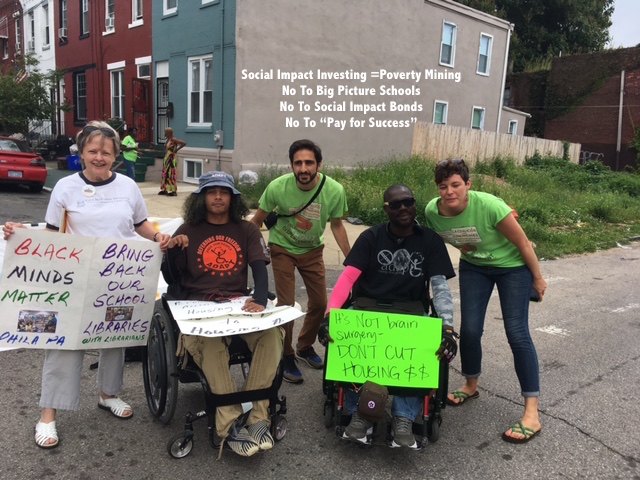
The image above was taken at a fall 2017 protest at the ribbon cutting for the Vaux Big Picture School in the Sharswood neighborhood of North Philadelphia, a HUD “Choice Neighborhood.” The middle school was closed for several years and reopened under the management of a private operator (though titularly still a “public” school). Big Picture is an international franchise and partner in the first education social impact bond in the UK. Additional information on the Doncaster / Big Picture SIB available at the Innovation Unit, UK website here. What is taking place in the 5th City Council District of Philadelphia is part of a much larger move towards the global financialization of public services, including education. It is imperative that we talk about this.
The 5th Council District of Philadelphia embodies economic inequality. Extending from North Philadelphia, a bastion of Black culture battling an onslaught of post-redlining gentrification, to Rittenhouse Square, a district of penthouse views and high-end retail; it contains neighborhoods where parents can raise $100,000 to pay for extras that have been cut from school budgets AND Black and Brown communities where most of the neighborhood schools have been closed or taken over by charters.
It runs east from the Rocky statue, through Spring Garden, Yorktown, and Northern Liberties, ending in the hipster enclave of Fishtown. “Investing in Opportunity Zone” census tracts spread across Brewerytown, along East Fairmount Park, and up North Broad Street (interactive map here, zoom in). Real estate development and new businesses launched within these zones and held for ten years pay NO capital gains tax upon sale. Temple University exerts a powerful influence over the northern part of the district, its overreach resisted for decades by vigilant community activists, the most recent wave led by Stadium Stompers and the No Stadium, No Deal Coalition.
It is a district of gourmet food halls and food deserts; unsheltered people dying in underground corridors of transit stations a stone’s throw from CONTINUE READING: Philadelphia’s 5th District City Council Race: A Call For A Town Hall on Social Impact Investing – Wrench in the Gears

Can Scholars Be Too Literal in Post-Truth Trumplandia? | radical eyes for equity

Can Scholars Be Too Literal in Post-Truth Trumplandia? | radical eyes for equity

Can Scholars Be Too Literal in Post-Truth Trumplandia?


Recently, I was invited to join a class discussion of Margaret Atwood’s The Handmaid’s Tale in a local International Baccalaureate (IB) high school class. For many years, I taught the novel in my Advanced Placement course, and in 2007, I published a volume on teaching Atwood’s writing.
During the discussion, one very bright and engaged student eagerly noted that Atwood evokes elements of communism in her novel. The use of the term “communism” prompted me to offer a gentle reframing—that the student probably was recognizing elements of totalitarianism, elements often blurred into the mainstream American pejorative use of the word “communism” (see also “socialism” and “Marxism”).
This is an important moment, I think, in understanding how academia works: Language and the teasing out of ideas are often laborious, if not tedious. While teaching first-year writing especially, but in most of my courses, I stress that college students need disciplinary awareness—how each discipline functions and why—and typically emphasize that academics are prone to carefully defining terms, and then holding everyone to those precise meanings.
Political, media, and public discourse, however, tend along a much different path. Language and terminology are treated with a cavalier disregard for meaning. Misusing a term or making a false claim is quickly glossed over before railing against the initial false claim.
Because of that gap between academia and the so-called real world, some educators and scholars call for the importance of public intellectuals grounded in academia. Public scholarship, however, remains controversial within the academia and tends to be received with disdain and CONTINUE READING: Can Scholars Be Too Literal in Post-Truth Trumplandia? | radical eyes for equity
Related image


With A Brooklyn Accent: Donald Trump's Three R's: Ruthlessness, Racism and Riches

With A Brooklyn Accent: Donald Trump's Three R's: Ruthlessness, Racism and Riches

Donald Trump's Three R's: Ruthlessness, Racism and Riches


When I learned from Michael Cohen’s testimony that Donald Trump threatened to sue Fordham to prevent them from releasing his grades and SAT scores, it not only reaffirmed my perception of Donald Trump’s character, it also gave me telling evidence of his chosen  path to success.

    Here is a person who constantly boasts of his intelligence and athletic ability who goes crazy at the thought of anyone researching whether his college record matches his rhetoric 

      As someone who is the same age as Donald Trump, attended similar colleges, and likes to think of himself as a scholar athlete, I find Mr Trump’s indignation both amusing and revealing. Anyone who knows how to use Google can find evidence of my athletic career at Columbia, the fellowships I received or the academic awards I earned. You don’t have to ask Columbia for that information, it’s all there on the internet.  By contrast, a Google  search of Mr Trump’s  college years will find no evidence of academic or athletic success. What’s going on? 

         That someone  whose record displays a modest level of athletic and academic success  ends up as a professor and the one whose record is shrouded in myth, if not outright fabrication, ends up being President is a telling commentary on where our country is at at this historical moment. 

       Although I have an extremely happy life and have  no  desire to trade places with Mr Trump, the comparison does lead me to examine CONTINUE READING: With A Brooklyn Accent: Donald Trump's Three R's: Ruthlessness, Racism and Riches

[PODCAST] What is Betsy DeVos hiding? – With special guest U.S. Senator Gary Peters | Eclectablog

[PODCAST] What is Betsy DeVos hiding? – With special guest U.S. Senator Gary Peters | Eclectablog

[PODCAST] What is Betsy DeVos hiding? – With special guest U.S. Senator Gary Peters


U.S. Senator Gary Peters on Twitter: @SenGaryPeters
Sen. Peters’ website: Peters.senate.gov
Gary Peters Senate reelection website: PetersForMichigan.com
Sen. Peters’ response to Betsy DeVos firing the Education Department watchdog: Peters, Colleagues Press Secretary DeVos for Information on Attempts to Improperly Remove Department of Education Watchdog
Sen. Peters’ response to Betsy DeVos weakening civil rights protections: Peters & Stabenow Press DeVos on Department of Education Actions to Weaken Discrimination Protections
Sen. Peters’ statement on EPA’s PFAS Announcement is HERE.
Jordan Zakarin on Twitter: @JordanZakarin
Progressives Everywhere on Twitter: @Progressives50
Progressives Everywhere website: ProgressivesEverywhere.org
Help Progressives Everywhere elect progressive candidates in Pennsylvania, including Congressional candidate Marc Friedenberg, by clicking HERE. You can read Jordan’s interview with Marc HERE. More information about Marc’s candidacy is HERE.

Jordan’s new project: Election-Calendar.com

Give us a five-star review at iTunes!

The GOTMFV Show Facebook page is HERE!
[PODCAST] What is Betsy DeVos hiding? – With special guest U.S. Senator Gary Peters | Eclectablog

Meet the candidates for the District 5 L.A. school board seat - Los Angeles Times #VOTEJackieGoldberg #TEAMGoldberg

Meet the candidates for the District 5 L.A. school board seat - Los Angeles Times

Meet the candidates for the District 5 L.A. school board seat

The 10 candidates running to fill a vacancy on the Los Angeles Board of Education all want increased funding for local schools, but they differ strongly on other issues, including the growth of charter schools and the leadership of L.A. schools Supt. Austin Beutner.
The special election, which takes place Tuesday, will fill the seat left open last July when Ref Rodriguez resigned after pleading guilty to violating campaign finance laws.
No candidate claims to be against charter schools, but perspectives vary on these privately operated campuses, which are mostly non-union. Charters compete with district-run schoolsfor students — and their growing numbers in a school system with declining enrollment have been a flashpoint issue. Some candidates favor a moratorium on new charters. The most critical of charters are Jackie Goldberg and Rocio Rivas; the most supportive is Allison Bajracharya.
All the candidates have ties to children in local public schools — in Goldberg’s case, her grandchildren. But the parents of school-age children — Bajracharya, Rivas, Cynthia Gonzalez, Nestor Enrique Valencia and Heather Repenning — assert this as a particular qualification.


Jackie Goldberg
Jackie Goldberg (Kirk McKoy / Los Angeles Times)
Chairwoman of the city’s local hiring working group
After establishing herself as a teacher in the Compton school district, Goldberg, who lives in Echo Park, served two terms on the L.A. school board, ending in 1991. She later served on the L.A. City Council and in the state Legislature. In her current job, she oversees efforts to help former inmates and the formerly homeless find city jobs. Goldberg says the district should do much more to raise revenue but also can find ways to make change without more funding, such as by moving more authority to parents, teachers and administrators at schools. She also says that more thoughtful effort is needed for the reform of student discipline policies — which emphasize counseling over punishment — to be successful.
What she thinks about:
  • The state of the district: She believes it is reasonably strong “given that it is so underfunded” and that the district’s budget is further challenged by declining enrollment, for which she holds charters substantially responsible. She says more work needs to be done to ensure that all children graduate from school knowing at least two languages.
  • Charter schools: She supports a moratorium on new charters and says existing charters need more stringent monitoring — fiscally and educationally — at the state and local level.
  • Austin Beutner and the school board: She opposed hiring Beutner: “I’m old-fashioned. I think educators should run school districts, not finance managers.” She also says that he’s been too secretive and did not do a good job managing events leading up to the teachers’ strike. All the same, she says, “I’m not coming on the board to fire him. My goal is to see if we can all work together.”
Endorsements and funding: The teachers union and its parent organizations have poured more than $570,000 into an outside campaign on her behalf. Her own campaign has raised about $200,000. Many other unions and a long list of current and former public officials and activists have endorsed her.
CONTINUE READING: Meet the candidates for the District 5 L.A. school board seat - Los Angeles Times


Ganey Arsement: About Louisiana’s State-Funded, $1,000 Teacher Raise | deutsch29

Ganey Arsement: About Louisiana’s State-Funded, $1,000 Teacher Raise | deutsch29

Ganey Arsement: About Louisiana’s State-Funded, $1,000 Teacher Raise


The following Educate Louisiana article was published on February 28, 2019, by Louisiana special education teacher, public education advocate, and writer, Ganey Arsement. (In this reproduction, some links added and mild editing to photos/captions):
IMG_1445

Ganey Arsement

Supt. Voitier Suggests $10k Raise For Teachers.

Ganey Arsement
On February 28th, in what proved to be the most exciting meeting of the MFP task force, to date, Superintendent Doris Voitier suggested that the $1000 raise for teachers, recommended by the governor, is not enough and stated that she’d like to give teachers a $10, 000 raise. Voitier also happens to be a member of BESE, appointed by Gov. John Bel Edwards.
IMG_1442

Doris Voitier
To be clear, what I said in the first paragraph actually did happen; however, without context related to Voitier’s statement, you likely made the wrong assumption based on what you read. To understand what really happened, let’s examine the events leading up to this meeting and the actual role of the MFP task force.
In the Summer of 2018, Gov. John Bel Edwards began to assert that he would be prioritizing raises for teachers in the upcoming legislative session. The average salary of Louisiana teachers is approximately $2500 below the Southeastern Regional average. Edwards acknowledges that $1000 won’t get us to the average, but hopes to make incremental increases over multiple years.
There was much ado about the announcement because when the story ran, it was accompanied by the photo shown on the right (*see below in this reposting). Supt. John White agreed with, and supported, Edwards’ proposal. Right away, the usual players in education policy began to weigh in on the matter. The Louisiana Association of Educators stated that it was a start and supported the $1000. The Louisiana Federation of Teachers supported the $1000, but urged Edwards to revisit and consider $2500. Chairman of the House Education Committee, Rep. Nancy Landry, made multiple public statements criticizing the $1000 while saying $1815 was more in line. Former chairman of the Senate Education Committee, Conrad Appel, protested saying that public schools have shown no progress and teachers don’t deserve a raise. (Edit: I originally stated that Nancy Landry supported a $2500 raise, but couldn’t confirm, or link to it, because she has resorted to blocking constituents, myself included. There  CONTINUE READING: Ganey Arsement: About Louisiana’s State-Funded, $1,000 Teacher Raise | deutsch29

Sunday, March 3, 2019

enrique baloyra: Fla House speaker calls pregnant women "host bodies" - YouTube

Fla House speaker calls pregnant women "host bodies" - YouTube

Fla House speaker calls pregnant women "host bodies"


Florida House Speaker Jose Oliva stepped in it this week when, on live television, he referred to pregnant women as “host bodies” five times during an interview with Jim DeFede. Throughout his political career Oliva has championed small government and individual freedom. But somehow he doesn’t think these freedoms apply to pregnant women when determining their own healthcare needs. The Miami Lakes Republican later tried walking back his comments by saying he was only trying to use a technical term. But then he forgot to refer to use the technical term for his own body: a lying sack of fertilizer. Florida Democratic Chair Terrie Rizzo characterized his remarks as, “hurtful, dehumanizing, and misogynistic.” “You’d expect to hear this offensive language in the Handmaid’s Tale,” referring to the book and popular TV series depicting a dystopian present, where Christian fundamentalists have taken control of the government. What makes the Speaker’s comments even more chilling are “fetal heartbeat” bills filed by Pensacola Rep. Mike Hill and Ocala Sen. Dennis Baxley, blocking doctors from performing abortions as early as six weeks. “Oops, someone said the quiet part out loud. No surprises here: the anti-choice movement has never valued women as people.” https://twitter.com/NARAL/status/1101... “[M]y Baptist school saw me as a potential incubator who smiled on demand and cleaned things.” https://twitter.com/AmazonAutism/stat... “I only wish these same people who act pro life would extend that same philosophy to those who are living and support our rights to be free of gun violence. That would be pro life.” https://twitter.com/fred_guttenberg/s... You see, it’s these same, self-described “pro lifers” who laugh at brown children in cages, make it easy for criminals and people on the FBI Terrorist Watchlist to get guns, and have never met a war they didn’t love. They shrug their shoulders when police officers shoot and kill black kids, saying they were probably up to no good. And their rhetoric is dangerous, because it incites wing nuts to bomb women’s health clinics and synagogues. They’re not pro life at all, just pro birth. Until it comes to their own mistresses, whom of course they fly to liberal states, where privater doctors can get rid of the “problem” discreetly. It never ceases to amaze me the number of women these forced birthers fool every election cycle. Legislative session incoming. Brace for impact.


How to Kill Public Schools – I Love You but You're Going to Hell

How to Kill Public Schools – I Love You but You're Going to Hell

How to Kill Public Schools
simpsons school
Who will pay to educate Mr. Burns’s doctor?

In some senses, of course, the United States has always had schools FOR the public. Even before the Revolution, there were schools that students without tuition money could attend. I’m finding out way more than I want to about the funding of early American “public” schools in my current research. As I’m finding, these “charity” schools had a wild mix of financial backers. Churches, taxpayers, wealthy individuals, and even not-so-wealthy people gave a lot or a little to educate impecunious children.
At different times in different places, a funding revolution swept the world of American education in the 1800s. Basically, this revolution replaced schools that were FOR the public with schools that were BY and FOR the public. That is, instead of parents, charities, philanthropists, churches, and governments all kicking in here and there to fund worthy students and schools, local and state governments committed to provided tax-funded educations to children. Those governments took tax money from everyone—whether or not they sent kids to the public schools—and in return promised to run schools for the benefit of the entire community.
There were big problems with this funding revolution. Not all children were included. Most egregiously, African-American students were often segregated out of public schools, or shunted off to lower-quality schools. And not all states participated equally. New England and the Northeast jumped early to the new model, while other regions hesitated. Plus, people without children and people who chose not to send their children to the public schools ended up paying for schools they didn’t personally use.
The heart and soul of public education, however, was that the public schools would be administered as a public good, like fire departments and roads. Everyone paid for them, everyone could use them, and everyone could in theory claim a right to co-control them. Even if your house didn’t catch fire, in other words, you paid taxes to support the firefighters. And even if you didn’t drive a car, you paid to maintain the public roads. And those firefighters and road crews were under the supervision of CONTINUE READING: How to Kill Public Schools – I Love You but You're Going to Hell

Betsy DeVos wants $5 billion, Should we Oblige? | Cloaking Inequity

Betsy DeVos wants $5 billion, Should we Oblige? | Cloaking Inequity

BETSY DEVOS WANTS $5 BILLION, SHOULD WE OBLIGE?

Betsy DeVos just proposed a $5 billion school choice proposal, asking the Congress for a national tax credit scholarship program that would allow parents to send their children to a private K-12 school of their choice. What are the particulars? She does not use the word “voucher” (likely because voters keep turning back the approach), but instead uses “education savings accounts.” Essentially, the tax dollars are redirected into “scholarship” US News describes this launderific approach,
Individual donors would be able to contribute up to 10 percent of their adjusted gross income to a scholarship-granting organization approved by a state, and businesses would be able to contribute up to 5 percent of their net taxable income.
It’s already a switcheroo that is being used at the state level. The financial malfeasance associated with Arizona and Florida’s “education scholarship accounts” has been notorious. The Chattanoogan reports,
Fraud, accountability and transparency have been persistent negative problems associated with the implementation of ESA programs. As reported in the Arizona Republic, an October 2018 audit by the Arizona Attorney General found that more than $700,000 was misspent on any number unrelated items such as beauty supplies, sports apparel, computer technical needs, and unwarranted spending outside of the needs of students. Fraud has grown so rampant in Florida that for the last two years the Orlando Sentinel has run a series entitled, Schools Without Rules, where they have documented the effects of unlicensed and untrained educators, mismanagement of funds, failure to pay teachers and pecuniary expenses, and inadequate services provided to special needs students along with a wide assortment of unmet and unfulfilled assurances.


Furthermore, Michelman summarizes the lack of student success associated with vouchers and ESAs. While Oscar Jimenez-CastellanosWilliam J. Mathis, and Kevin G. Welner discuss the problematic legal implications.
To be frank, Betsy’s proposal is likely DOA in the US House and even perhaps the US Senate. US News posits,
…the proposal faces a steep uphill battle in Congress, where Democrats now control the House of Representatives and even the more moderate Republicans in the Senate, including Sen. Susan Collins of Maine and Sen. Lisa Murkowski of Alaska, have been wary of school choice policies that originate at the federal level.
I had the chance to talk with NPR’s Marketplace about the proposal for 20 minutes last week. Here is the 2-minute program where they probably used the least interesting 5 seconds of our conversation (just being honest).
DeVos is up to exactly what everyone said she would be up to, in fact, Trump promised $20 billion for school choice during his campaign.
Researchers and civil rights organizations are taking notice. I am honored to relay that I have been asked to join a new a new initiative called Public Funds Public Schools (PFPS). This will encompass will involve a collaboration with the Education Law Center, as well as colleagues at the Southern Poverty Law Center. This startup initiative will engage with issues of vouchers and other uses of public funds to private education. While PFPS will be primarily law-focused, researchers will be closely connected to almost all of the group’s initiatives. They have invited a short list of a dozen researchers whose work concerns domestic and international vouchers. Stay tuned for more information as it becomes available.
They asked me to give them a summary of my work on vouchers to apply to join the initiative, so I’d like to list those resources for you here.

Peer-Reviewed articles

Portales, J., & Vasquez Heilig, J. (2015). Understanding universal vouchers and urban public schools in Santiago de Chile: Educational administrators’ responses to choice. Multidisciplinary Journal of Educational Research, 5(2), 194-237.*
Portales, J. & Vasquez-Heilig, J. (2014). Understanding how universal vouchers have impacted urban school districts’ enrollment in Chile. Education Policy Analysis Archives, 22(68). Retrieved from http://epaa.asu.edu/ojs/article/view/1427/1314*

Policy Briefs

Vasquez Heilig, J., LeClair, A.V., Lemke, M., & McMurrey, A. (2014). Remarkable or poppycock?: Lessons from school voucher research and dataAustin, TX: Texas Center for Education Policy, University of Texas at Austin.
Vasquez Heilig, J. & Portales. (2012). Are vouchers a panacea?: Data from international implementation. Austin, TX: The Institute for Urban Policy Research and Analysis, University of Texas at Austin.

Articles in The Progressive Magazine

Cloaking Inequity blog posts

Please Facebook Like, Tweet, etc below and/or reblog to share this discussion with others.
Check out and follow my YouTube channel here.
Twitter: @ProfessorJVH
Click here for Vitae.


Betsy DeVos wants $5 billion, Should we Oblige? | Cloaking Inequity

Oakland Teachers Strike Ends With Tentative Deal for Raise | PopularResistance.Org

Oakland Teachers Strike Ends With Tentative Deal for Raise | PopularResistance.Org

OAKLAND TEACHERS STRIKE ENDS WITH TENTATIVE DEAL FOR RAISE


Striking teachers in Oakland, California, celebrated after reaching a contract deal Friday with school administrators to end a seven-day walkout.
To cheers and applause, union leaders from the Oakland Education Association announced that teachers had won everything they demanded — higher pay, smaller classes and more school resources — in a week of marathon negotiating sessions with the district.
“This is a historic contract with a win in every major proposal we made,” the Oakland Education Association said in a statement.
“We have achieved so much in the seven days of our historic strike in Oakland,” union President Keith Brown told a news conference. “Our power in the streets prevailed.”
The deal includes an 11 percent salary increase and a one-time 3 percent bonus, once the deal is ratified, Brown said.
Teachers were expected to vote Saturday, and if the deal is approved, return to classrooms next week.
“On Monday, March 4, we look forward to everyone being together again in the classroom,” Superintendent Kyla Johnson-Trammell said in a statement. “The contract will help ensure more teachers stay in Oakland and that more come to teach in our classrooms and support our students.”
Oakland’s 3,000 teachers walked off the job Feb. 21, effectively shutting the city’s 86 schools.
The district kept Oakland schools open during the strike staffed by a skeleton crew of substitutes. But most students stayed away in support of their striking teachers. The district said about 6 percent of students came to class during the weeklong action.
The walkout affected 36,000 students.
The Oakland Education Association said educators were forced to strike because administrators had not listened to their demands for two years. Teachers had been working without a contract since 2017.
Among their demands was a 12 percent retroactive raise covering 2017 to 2020 CONTINUE READING: Oakland Teachers Strike Ends With Tentative Deal for Raise | PopularResistance.Org


Oakland, CA: Billionaires Will Convene to Discuss New Plans for Privatizing Public Schools | Diane Ravitch's blog

Oakland, CA: Billionaires Will Convene to Discuss New Plans for Privatizing Public Schools | Diane Ravitch's blog

Oakland, CA: Billionaires Will Convene to Discuss New Plans for Privatizing Public Schools


What exquisite timing! The teachers in Oakland went out on strike to demand a decent living wage and to protest the destruction of their schools by privatizers, and guess who is planning to come to town?
The summit is sponsored by the usual suspects: The Walton Family Foundation (anti-union, anti-public schools, pro-privatization), The Bill & Melinda Gates Foundation (ditto), The Chan-Zuckerberg Initiative (selling computers and depersonalized learning), and The Carnegie Foundation of New York (once a friend to public schools, but no longer).
Make plans to be in Oakland to send your greetings to the Robber Barons of our day.
Who knows? Maybe Betsy DeVos will be their keynote speaker.
They are planning to disrupt your public schools, destroy your unions, and continue marauding where they are uninvited and unwelcome.