Latest News and Comment from Education

Saturday, February 9, 2019

Teaching at MetWest: A Big Picture School (Part 1) | Larry Cuban on School Reform and Classroom Practice

Teaching at MetWest: A Big Picture School (Part 1) | Larry Cuban on School Reform and Classroom Practice

Teaching at MetWest: A Big Picture School (Part 1)
Image result for Oakland MetWest


It is a Monday and the schedule at Oakland’s MetWest calls for an 8:30-10AM session with an Advisor/Teacher. I enter a spacious, well-lit room where 18 ninth graders are sitting in a circle with Nick Palmquist. He is wearing black jeans, a button-down grey shirt over the jeans and dark tennis shoes. The assignment for these students had been to write down their goals for high school. I noted that more than half had a sheet of paper in hand.
Nick–students call him by his first name–began by holding a multi-colored cloth volleyball and stating what his goals have been for life and teaching. He then passed the ball to his left. Student didn’t say anything and passed the ball to another student who read off his goals. As the ball went from student to student, their goals fell into a familiar pattern of ninth graders: get good grades, graduate, and go to college. Two students said they wanted to get “good” jobs. After the ball traveled around the circle and returned to Nick, he summarizes what most students had said were their goals and says: “we are about to close the circle. Does anyone have “any appreciation to share.” He waits at least five seconds, no response. Nick then say” please return to you tables.”
Students pick up their chairs and put them at tables where two students sit. The tables and chairs are arranged in a horseshoe facing a front whiteboard with the open center space holding a small table upon which Nick’s laptop and erasable markers rest. Students sitting at tables see classmates across the open space. On one side of the whiteboard is marked “Homework.” Listed are the following:
*Semester goals + vision board/road map–due Tuesday AM
*Observation notes on my learning this week–due Monday AM
*Binder check Tuesday
Nick passes out a two-page worksheet from which the rest of the lesson unfolds. The worksheet lists “Lesson Targets”: “I can explain and creatively portray my CONTINUE READING: Teaching at MetWest: A Big Picture School (Part 1) | Larry Cuban on School Reform and Classroom Practice

CURMUDGUCATION: IA: Choice Is Taxation Without Representation

CURMUDGUCATION: IA: Choice Is Taxation Without Representation

IA: Choice Is Taxation Without Representation


An Iowa state senator has caught on to one of the problematic side effects of many choice programs-- disenfranchised taxpayers. Or, as somebody put it a while ago, taxation without representation.

Iowa has long allowed open enrollment; an Iowa family can enroll their student in any public school district, whether they live there or not. Currently the full per-pupil expenditure follows the student-- including the part of the expenditure that is collected by the taxpayer in the student's home district.


In other words, if I live in East Spamwich and pay taxes on my home there to fund the school. Only a large number of students from the area may attend school in West Spamwich. I'm able to vote for the school board members in the East Spamwich school board, but in West Spamwich, where much of my money goes to be spent, I have no say at all.

Republican State Senator Tom Greene (no relation, as far as I know) was newly elected in an upset contest in 2016. In real life, he's a pharmacist, but he was also the board president of Burlington School Board, andthat gives him some perspective (from Radio Iowa).

“The Burlington School District totally surrounds the West Burlington School District. The West Burlington School District has 800 and 900 students; 53 percent of those students reside outside the CONTINUE READING: 
CURMUDGUCATION: IA: Choice Is Taxation Without Representation


Friday, February 8, 2019

The myth of de facto segregation  - kappanonlineorg #BlackLivesMatterAtSchool #CounselorsNotCops #blackhistorymonth

The myth of de facto segregation  - kappanonline.org

The myth of de facto segregation 

Today’s high levels of school segregation can be traced to specific government policies that created distinct White and Black neighborhoods. 
 PDK_100_5_Rothstein_Art_554x350px
For nearly 30 years, the nation’s education policy makers have proceeded from the assumption that disadvantaged children would have much greater success in school if not for educators’ low expectations of them.  In theory, more regular achievement testing and tougher accountability practices would force teachers to pursue higher academic standards for all children, resulting in improved instruction and greater student proficiency. 
However, there never was any evidence to support this theory, and even its most eager proponents have come to realize that it was flawed all along. In fact, there are a host of reasons why disadvantaged children often struggle to succeed academically. Undeniably, one is that some schools in low-income neighborhoods fall short in their traditional instructional roles. Another is that many schools have failed to embrace effective out-of-classroom programs — such as health clinics or early childhood centers — that might enable students to be more successful in the classroom. Perhaps most important, however, is the influence of children’s out-of-school social and economic conditions, which predict academic outcomes to a far greater extent than what goes on in the classroom. Researchers have long known that only about one-third of the Black-White academic achievement gap results from variations in school quality. The rest stems from social and economic factors that render some children unable to take full advantage of what even the highest-quality schools can offer.   
Racial segregation exacerbates achievement gaps between Black and White children because it concentrates students with the most serious social and economic challenges in the same classrooms and schools. Consider childhood asthma, for example: Largely because of poorly maintained housing and environmental pollution, urban African-American children have asthma at as much as four times the rate of White middle-class children. Asthmatic children often come to school drowsy and inattentive from sleeplessness, or they don’t come to school at all. Indeed, asthma is the single most important cause of chronic absenteeism. No matter how good the teacher, or their instruction, children who are frequently absent will see less benefit than children who come to school well rested and regularly. Certainly, some asthmatic children will excel — there is a distribution of outcomes for every human condition — but on average, children in poorer health will fall short. 
Children from disadvantaged families suffer disproportionately from a number of other such problems, including lead poisoning that diminishes cognitive and behavioral capacity; toxic stress, from experiencing or witnessing violence; irregular sleep or meal times, related to their parents’ working multiple jobs with contingent work schedules; housing instability or homelessness; parental incarceration, and many others. A teacher can give special attention to a few who come to school with challenges that impede learning, but if an entire class has such problems, average achievement inevitably declines.  
We cannot expect to address our most serious educational issues if the most disadvantaged of the nation’s children are concentrated in separate neighborhoods and schools. Today though, racial segregation characterizes every metropolitan area in the United States and bears responsibility for our most serious social and economic problems: Not only does it produce achievement gaps but it predicts CONTINUE READING: The myth of de facto segregation  - kappanonline.org


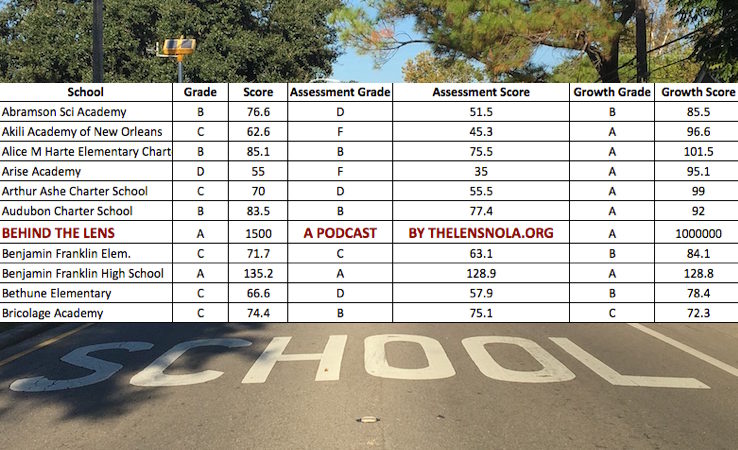
Behind The Lens episode 18: A preview of reporter Marta Jewson’s work on the tricky question of when to close failing schools in New Orleans. | The Lens

Behind The Lens episode 18: ‘A very difficult and unpleasant decision that is part of the landscape in New Orleans’ | The Lens

Behind The Lens episode 18: ‘A very difficult and unpleasant decision that is part of the landscape in New Orleans’


This week on Behind The Lens, New Orleans’ approach to education has resulted in a revolving door of education providers — charter schools — for the city’s students. Sometimes, changes at poorly performing schools don’t seem to come soon enough.
We have a preview of reporter Marta Jewson’s work on the tricky question of when to close failing schools in New Orleans.
Also, Louisiana’s Coastal Protection and Restoration Authority has a complex plan for reconnecting the Mississippi River with disappearing coastal regions. The agency has a plan for the effort and, right now, a lot of money to work with.
But they still have to win over a skeptical part of the public in South Louisiana. Part of that is a series of “Coastal Connections” meetings throughout the region. The latest one was in Braithwaite. Host and producer Tom Wright went there and spoke to the CPRA’s project manager for the Mid-Barataria and Mid-Breton diversions.
Behind The Lens is available on Apple PodcastsSpotifyGoogle Play and Stitcher.
Behind The Lens episode 18: ‘A very difficult and unpleasant decision that is part of the landscape in New Orleans’ | The Lens


Hundreds of OUSD Students Walked Out of Class Today: Student Organizers tell us what’s next for their movement. | East Bay Majority #Unite4OaklandKids #WeAreOEA #WeAreCTA #strikeready

Hundreds of OUSD students walked out of class today. Two student organizers tell us what they’re protesting and what’s next for their movement. | East Bay Majority

Hundreds of OUSD students walked out of class today. 
Two student organizers tell us what they’re protesting and what’s next for their movement.

Students participate in a sickout and march in support of Oakland teachers, Feb. 8

Hundreds of Oakland students walked out of their schools this morning to protest low teacher pay, school closures that target working-class families of color, and overcrowded, under-resourced classrooms.
Although the student organizers of today’s student walkout are young, today’s success shows they’ve already worked through political complications that dog organizers twice their age: how to nurture a multiracial movement that draws power and legitimacy from popular material demands.
Majority interviewed two of the organizers behind today’s action, Lauren K. and Theo Z., both seventeen-year-old students at Oakland Tech. They began their work as student organizers in the wake of the Parkland shooting, when thousands of Oakland students walked out off class to join the March for Our Lives.
However, the broad popularity of that walkout didn’t translate into a diverse membership for their core organizing club at Oakland Tech, which dwindled to a handful of white students in the months after the march.

Majority: What’s different about this week’s walkout?

Theo: What the district is doing is disproportionately targeting minorities and low-income families, and the schools that are closing, none of them are in the hills, they’re in East and West Oakland. It’s a more relatable issue for more students [than school shootings]. The interesting thing about school shootings is they’re the only type of gun violence based in the suburbs.
Lauren: A problem we had was [the original members of the organizing club] basically just reached out to their friends to join, and the school is segregated into small schools that break down by race. Everyone is reaching out to their friends within this segregated school, so the club wasn’t diverse. But with this event, we’ve joined students from all over the school, people who’d never been part of the club. This time around, we have a very diverse group of leaders.

Why did you call a sickout?

Lauren: I’m sure you heard about the teachers’ sickout they had a couple weeks ago. So a few problems we noted with that: a) all the teachers lost money because they were not teaching, they were not in class, and that’s the same problem they will have with the strike, so while teachers will put pressure on the district they’ll also be losing money, and b), when the teachers did their sickout all the students who were absent were marked present which is…
Theo: Super illegal.
Lauren: Very, very wrong. And the district didn’t lose any money from that because according to them we were all present. … The difference in the student-only sickout is that the teachers will be in class so they will be making money which I think sends a powerful message that we support them, they can keep making money, and work is being done.

Why are you organizing in support of the teachers?

Lauren: As students, we see better than anyone how hard our teachers work, and we know that they’re not getting paid enough to live in  Oakland which is ridiculous. They should be able to afford to live here. And on top of that, we see our counselors who CONTINUE READING: Hundreds of OUSD students walked out of class today. Two student organizers tell us what they’re protesting and what’s next for their movement. | East Bay Majority

The Privatization of Teaching Teachers How to Teach Reading: Cashing In on Kids!

The Privatization of Teaching Teachers How to Teach Reading: Cashing In on Kids!

The Privatization of Teaching Teachers How to Teach Reading: Cashing In on Kids!


Wondering about all the recent articles claiming teachers don’t know how to teach reading, and their education schools are failing them?
It appears to be about nonprofits! These groups are competing with universities. They promise to better prepare teachers to teach reading, for a fee, of course!
But there’s no proof they will do teacher preparation better. It’s unclear why nonprofits are considered experts.
The goal along with making money appears to be to place children on digital devices for most of their learning.
Here are some examples. Click the titles for the links.
The Wall Street Journal recently promoted a group called Early Reading Matters “Nonprofit Trains Teachers on the ABCs of Reading in the Classroom.”
Early Reading Matters is a part of Teachers Matter which promotes itself as an organization to teach teachers a variety of skills. Here’s the link. 
Why is this group untrustworthy?

Hire More Black Teachers Now!: A research statement from BLM@School & J4J – Black Lives Matter At School

Hire More Black Teachers Now!: A research statement from BLM@School & J4J – Black Lives Matter At School

Hire More Black Teachers Now!: A research statement from BLM@School & J4J


What Does Public Education Have Against Black Teachers

You may think this is an exaggeration, but an analysis of the data from Journey 4 Justice Alliance and the #WeChoose Coalition, shows that in at least six major cities, Black teachers are becoming extinct. The same data shows us that each of these cities has a growing population of students of color, but many of them will not see a teacher who looks likes them. Instead, they will face discriminatory discipline and gaps in opportunities and attainment that negatively impact their future. From a 3% gap in Oakland to a 30% gap in Pittsburgh, Black students are attending schools increasingly taught by white educators (The Purge of Black Teachers Cities, 2019).
This gap is even larger in charter schools that tend to serve more black students and hire fewer black teachers. Both New York City and Chicago have seen gaps of 38% and 39% respectively, between the population of black students and the number of black teachers within the charter school system (The Purge of Black Teachers Cities, 2019).

To understand how the decline in black teachers began, we must first look at New Orleans. After hurricane Katrina, privatizers were able to push out Black teachers and turn the school district over to charter operators.  In 2004, 71% of teachers in New Orleans were Black. In 2005, all New Orleans teachers were summarily fired, a mass dismissal of 8% of Louisiana’s teachers and 24% of the state’s Black teachers. (The Purge of Black Teachers, 2019). By 2013, only 35% of new hire teachers were Black, and only 22% of dismissed teachers were rehired, down from 33% in 2007 (The Purge of Black Teachers, 2019).  Nationally, we have seen a decline of Black teachers to 6%, while Black students make up 15 % of the student population, and students of color account for more than half of the student population (The Purge of Black Teachers, 2019).
Often the removal of Black teachers is part of a broad effort to privatize public education by turning the public schools into charter schools. With an influx of charter schools comes an increase in mostly white teachers who have less experience and are likely trained in alternative teacher certification programs.  New Orleans went from CONTINUE READING: Hire More Black Teachers Now!: A research statement from BLM@School & J4J – Black Lives Matter At School

Time to get real about ‘open’ enrollment: what works, what’s a workaround? | The Lens

Time to get real about ‘open’ enrollment: what works, what’s a workaround? | The Lens

Time to get real about ‘open’ enrollment: what works, what’s a workaround?

I was proud that, as the most recent school performance scores were released,  the state honored Harriet Tubman Charter School for both “equity” in its admissions practices and for achieving “top gains” in its academic performance.
The twin designations mean that Tubman students of all ethnicities, economic backgrounds, and special-need status are making strong academic gains at the same rate. The designations were especially meaningful to me, as principal, because Tubman, alone among this year’s crop of honorees, is both a formerly failing school and one with an open-enrollment or come-one-come-all admissions policy.
And yet, newspaper columnist Jarvis DeBerry saw fit to criticize Tubman as one of the equity honorees “being rewarded for gatekeeping.” DeBerry’s columns are often worth reading, but on this occasion his criticism reveals a misunderstanding of a much larger issue that should be the focus of district-wide discussion and debate, a debate rooted in hard facts.
I agree that exclusionary enrollment practices in any school that is designated open-enrollment blunt the meaning of the “equity” honor and become a source of confusion to parents. These exclusionary practices make the term “open-enrollment” meaningless, and they aren’t fair because they give preference to the middle class. In our district, “open-enrollment” should be easily defined, but it’s not.

I believe there are exclusionary practices in the district, but DeBerry’s placement of Harriet Tubman in that category is wrong.  First, let’s take a closer look at Tubman: To characterize the school as seeking to exclude kids whose backgrounds make them harder to educate is simply not true.

At Tubman, 97 percent of our kids are economically disadvantaged, 95 percent are non-white, and 20 percent qualify for special education services. We were an early adopter of the OneApp enrollment process, and, without exception, we embrace open-enrollment both conceptually and in practice.

Where DeBerry goes wrong is in his conclusion that our practice of giving  preference to our pre-k students seeking admission to our kindergarten is exclusionary.
Three facts are worth bearing in mind:
One is that every New Orleans public school that offers pre-k gives preference to those students when it comes to kindergarten CONTINUE READING: Time to get real about ‘open’ enrollment: what works, what’s a workaround? | The Lens


Sacramento City teachers ask state schools chief to investigate district, superintendent #REDFORED #SCTA #CTA

Sacramento teachers union requests investigation into school district

Sacramento City teachers ask state schools chief to investigate district, superintendent


The Sacramento City Teachers Association sent a letter to state officials requesting an investigation into the Sacramento City Unified School District and the superintendent.
The request comes as the school district works to cut $16 million from its budget.
The union sent the letter Tuesday to California Superintendent of Public Instruction Tony Thurmond, requesting a Department of Education investigation. The union asked for three specific things:
  • An investigation into the potential misallocation of district resources.
  • An investigation into potential conflicts of interest for district Superintendent Jorge Aguilar.
  • Requested a comprehensive audit.
    Two of the specific grievances include: a vacation buyout program for administrators and Aguilar's part-time position at UC Merced.
    The school district responded, saying there is no merit to these allegations. It also said Aguilar’s work with UC Merced should be applauded, not criticized.
    “We will not allow meritless attacks against our Superintendent to distract us from continuing to advance work that is meeting the needs and interests of our students,” the Sacramento City Unified School District Board of Education said in a statement.
    The school district is in middle of a financial crisis, forced to cut millions from the budget by November. If the budget is not cut down, the district will run out of money -- and the state would have to take over.
    Sacramento Mayor Darrell Steinberg spoke up in support of Aguilar, saying he is standing behind the superintendent.
    “He inherited a severe financial crisis. Our city needs all the district’s key partners -- teachers, classified employees, parents, community members, and students -- to rally behind a common cause. Get through this crisis, make hard choices, and prepare for a better day when the district can begin to reinvest in our children,” Steinberg said in a statement.
    The union said it will meet with state officials to answer any questions about what it wants investigated. Sacramento teachers union requests investigation into school district


    Sacramento City teachers ask state schools chief to investigate district, superintendent

    The teachers union in the financially troubled Sacramento City Unified School District on Tuesday sent a letter to California’s schools chief requesting an investigation of the district and its superintendent, alleging misuse of district resources and conflict of interest.
    The Sacramento City Teachers Association also requested a “comprehensive audit” of the district amid a budget crisis that began after an independent financial audit in December identified a $30 million shortfall. The district expects to run out of money by November 2019 and faces a potential takeover by the state.
    The letter to California Superintendent of Schools Tony Thurmond and the California Department of Education asked the state to look into a number of concerns, including:
    ▪ A vacation buyout program for district administrators.
    ▪ Superintendent Jorge Aguilar’s part-time position at UC Merced and outside speaking engagements.
    ▪ Alleged mismanagement of money and hiring at two high schools.
    ▪ Oversight at New Technology High School.
    In its letter, the SCTA said it raised questions about vacation buyouts for district administratorsin 2017-18, and asked the state to check if staff members were paid for work they did not perform. The teachers union said the estimated cost of the buyouts was $6 million, but claimed discrepancies in figures the district provided regarding how much money was spent on the program, which gave administrators cash for accrued vacation time.

    District spokesman Alex Barrios said he did not receive the union’s letter but is aware of some of the concerns raised by the SCTA. He said in an email to The Sacramento Bee that the program, which was “not unusual for a public agency,” was a money saver for the district, and any alleged discrepancies were due to differences in the time frame that employees were cashing out.
    The district released two statements last year explaining the large sums of money being cashed out over time. Under the policy requiring employees to use their vacation or cash it out, it said, “the district prevents situations where employees are hoarding vacation time and then receiving large lump sum payouts when they leave.”
    The SCTA also called attention to Aguilar’s part-time position at UC Merced.
    Before being hired by Sacramento City Unified in July 2017, Aguilar was associate vice chancellor for educational and community partnerships at UC Merced. With the Sacramento City school board’s approval, he is still employed in a limited role as associate vice chancellor, a job that pays $171,972 per year but for which he now has a 5 percent appointment.
    “When they hired him, it was with an understanding that he will bring all of his expertise here,” Barrios said. “His connection to UC Merced is to utilize the team to find post-secondary choices for our students.”
    The teachers union alleges a conflict of interest for Aguilar because shortly after being hired in Sacramento, he entered the district into a “data sharing agreement” with UC Merced that pays the college $1.75 million over four years. The teachers union says it’s not clear on whose behalf he’s working.
    “We will not allow meritless attacks against our Superintendent to distract us from continuing to advance work that is meeting the needs and interests of our students,” the Sacramento City Unified board said in a prepared statement. “Superintendent Aguilar’s appropriate and long-standing affiliation with the University of California should be lauded, not criticized.”
    Sacramento Mayor Darrell Steinberg, who helped recruit Aguilar to the district and helped broker the most recent contract between Sacramento City Unified and the teachers union in November 2017, also affirmed his support for the superintendent. Steinberg tweeted his statement Wednesday, saying, “I’ve got your back, Jorge.”
    Barrios said the data sharing agreement was approved by the board, and is a powerful tool that allows universities to send personalized packages to students with academic profiles that match their programs.
    “The school board approved the contract so that our students get into higher education in the state of California,” Barrios said. “UC Merced happens to have the expertise we need to run an analysis on which colleges our students are eligible to apply to.”
    The board statement said the data sharing agreement helps the district determine the success rate of students at Los Rios community colleges, Sacramento State and UC Davis, as well as UC Merced.
    The union also alleged that Aguilar has violated school board policy by accepting honorarium payments for speaking engagements.
    The district’s bylaws state that designated employees shall not accept any honorarium with some CONTINUE READING: Sac City teachers ask CA superintendent to investigate district | The Sacramento Bee - https://www.sacbee.com/news/local/education/article225550275.html 

    Portfolio School Governance Creates Unstable Charter Sector with Too Many School Closures | janresseger

    Portfolio School Governance Creates Unstable Charter Sector with Too Many School Closures | janresseger

    Portfolio School Governance Creates Unstable Charter Sector with Too Many School Closures

    In an important brief from the National Education Policy Center, William Mathis and Kevin Welner define “portfolio school reform”—a school district governance theory which originated at the Center on Reinventing Public Education: “A key, unifying element is the call for many neighborhood schools to be transformed into privately managed charter schools… The operational theory behind portfolio districts is based on a stock market metaphor—the stock portfolio under the control of a portfolio manager. If a stock is low-performing, the manager sells it.  As a practical matter, this means either closing the school or turning it over to a charter school or other management organization.”
    Peter Greene recently suggested one of the inevitable implications of portfolio school reform: “(G)iven the portfolio emphasis on continually closing bottom-ranked schools, you can think of the portfolio model as trying to fire your way to excellence on the institutional scale.” It’s all about closing schools.
    Chicago was an early example of portfolio school governance, which now dominates the school districts in a number of big cities. Because of a study last year by the University of Chicago Consortium on School Research and a book by University of Chicago sociologist Eve Ewing, we’ve finally begun paying attention to the resulting closure of too many traditional neighborhood schools.  In Chicago the researchers have described widespread community grieving for public schools that were once central in the lives of generations of families.

    School closure is also characteristic of charter schools. A school district committed to shedding its poorest investments—its so-called “failing” schools—will be shutting down the low-performing or poorly managed charter schools as well.  The underlying assumption is that the parent-choosers buying into a market approach will just accept the notion of the closure of “failing” charters because it’s all part of the cycle of school improvement.
    Parents of students in charter schools, however, are not calmly accepting the closure of their schools.  Why should they?  Like other parents, charter school parents are looking for stability when they choose a setting for their child’s education. Here are just three examples of churn and disruption as charters are shut down in districts and states dominated by the theory of  CONTINUE READING: Portfolio School Governance Creates Unstable Charter Sector with Too Many School Closures | janresseger


    Thursday, February 7, 2019

    Charter Schools Are Pushing Public Education to the Brink

    Charter Schools Are Pushing Public Education to the Brink

    Charter Schools Are Pushing Public Education to the Brink

    When striking Los Angeles teachers won their demand to call for a halt to charter school expansions in California, they set off a domino effect, and now teachers in other large urban districts are making the same demand.
    Unchecked charter school growth is also bleeding into 2020 election campaigns. Recently, New York magazine columnist Jonathan Chait berated Democratic Massachusetts Senator and presidential candidate Elizabeth Warren for having opposed a ballot initiative in her home state in 2016 that would have raised a cap on the number of charter schools. “There may be no state in America that can more clearly showcase the clear success of charter schools than [Massachusetts],” declared Chait.
    But while Chait and other charter school fans claim Massachusetts as a charter school model, the deeper reality is that charters are driving Boston’s public education system to the financial brink.
    As the Boston Globe recently reported, the city is experiencing an economic boom, but its schools resemble “an economically depressed industrial center.” The state’s unfair funding formula is part of the problem, but an ever-expanding charter school industry also imposes a huge financial drain.
    Charter School Money Sucks
    “Two decades ago, state educational aid covered almost a third of Boston’s school expenses,” writes Globe reporter James Vaznis. Today, “city officials anticipate that in just a few years every penny from the state will instead go toward charter-school costs of Boston students. Boston is slated to receive $220 million in state education aid; about $167 million will cover charter- CONTINUE READING: Charter Schools Are Pushing Public Education to the Brink

    Cory Booker Has a Betsy DeVos Problem – Mother Jones

    Cory Booker Has a Betsy DeVos Problem – Mother Jones

    Cory Booker Has a Betsy DeVos Problem
    “I became a pariah in Democratic circles for taking on the party orthodoxy on education.”


    In the spring of 2012, Cory Booker delivered the keynote address at the third annual School Choice Policy Summit at a Westin hotel in Jersey City, New Jersey. For a half hour, the then-Newark mayor told hundreds of attendees dining in the hotel ballroom that the traditional public school system “still chokes out the potential of millions of children…Your destiny is determined by the zip code you’re born into, [and] some children by law are locked into schools that fail their genius.” The most promising solution, he said, was one aligned with the sweeping educational reform he was currently undertaking in Newark that was replacing failing neighborhood schools with publicly funded, privately managed charters that students could opt into based on their desires and needs.
    Booker’s address that evening was notable for a number of reasons. He was one of the only Democrats speaking in a lineup that included Louisiana GOP Gov. Bobby Jindal and Fox News commentator Juan Williams. The school choice plan he championed had become a plank of the Republican platform, while many of his fellow Democrats, who generally preferred direct investment in public education and enjoyed political backing from teachers’ unions, opposed it.
    And then there was the group that organized the event. His appearance that evening was at the invitation of the American Federation for Children, a group chaired by Betsy DeVos. Booker told attendees he’d been involved with AFC “in its most nascent stages,” and his relationship with the DeVos family dated back to his days on Newark’s city council. DeVos, a Republican megadonor, had become known as one of the fiercest proponents of school choice—especially of for-profit charter schools and voucher programs that would allow students to use public funds to attend private schools. She also addressed the group that evening, and in a press release announcing the event’s speakers, DeVos, who had served with Booker on the board of AFC’s predecessor organization, said she was “proud and honored” to include Booker in the “committed group of education leaders who have courageously stood up to put the interests of children first by supporting expanded educational options for families.”
    Nearly seven years later, Cory Booker has announced he would like to be the Democratic candidate for president in 2020, and Betsy DeVos is in her CONTINUE READING: Cory Booker Has a Betsy DeVos Problem – Mother Jones

    Judge Orders District to Arbitrate Its Refusal to Implement Our Restructured Salary Schedule - Sacramento City Teachers Association

    Judge Orders District to Arbitrate Its Refusal to Implement Our Restructured Salary Schedule - Sacramento City Teachers Association

    JUDGE ORDERS DISTRICT TO ARBITRATE ITS REFUSAL TO IMPLEMENT OUR RESTRUCTURED SALARY SCHEDULE


    Upholds SCTA Motion to Compel Sac City to Honor Arbitration Clause of our Contract
    Sacramento (February 6, 2019): In a huge legal victory, the Sacramento County Superior Court late this afternoon granted the Union’s motion to force the District to arbitrate the parties’ ongoing salary dispute.
    The court ruled that the issue was “not even a close call” and that the dispute must be presented to a labor arbitrator because that is what the parties’ collective bargaining agreement requires. This puts the parties right back where we were in mid-November 2018, when the District abruptly called off arbitration and instead sued us over the salary dispute, in a thinly veiled effort to delay the inevitable. The whole dispute could have been resolved months ago.
    With this victory, an experienced labor arbitrator can resolve the dispute, and the District’s lawsuit is stayed.
    The District’s gambit, in other words, failed spectacularly. It also undoubtedly came at considerable financial cost to the District, which sees no problem paying hefty legal fees to its outside attorneys even as it pleads financial distress to its teachers and pupils.
    “It’s a clear victory. It’s a shame that the District frivolously spent precious resources on attorneys,” said David Fisher, president of SCTA, “rather than using those resources in our classrooms.”
    Judge Orders District to Arbitrate Its Refusal to Implement Our Restructured Salary Schedule - Sacramento City Teachers Association