Latest News and Comment from Education

Friday, February 1, 2019

Where Did the Money Go? U.S. GAO - K-12 Education: Challenges to Assessing Program Performance and Recent Efforts to Address Them

U.S. GAO - K-12 Education: Challenges to Assessing Program Performance and Recent Efforts to Address Them

Challenges to Assessing Program Performance and Recent Efforts to Address Them


The Department of Education provides billions of dollars in grants for programs to improve K-12 outcomes.
Do they work?
We found that Education faces challenges determining whether these programs work. Specifically, problems persist with:
Oversight. For example, some program grant files were missing descriptions of what grantees achieved.
Data quality. Education lacks assurance that some state-submitted data are accurate.
Capacity. A lack of qualified staff has impacted monitoring, and Education hasn’t updated hiring plans in years.
Study design. Measuring long-term outcomes can be difficult.
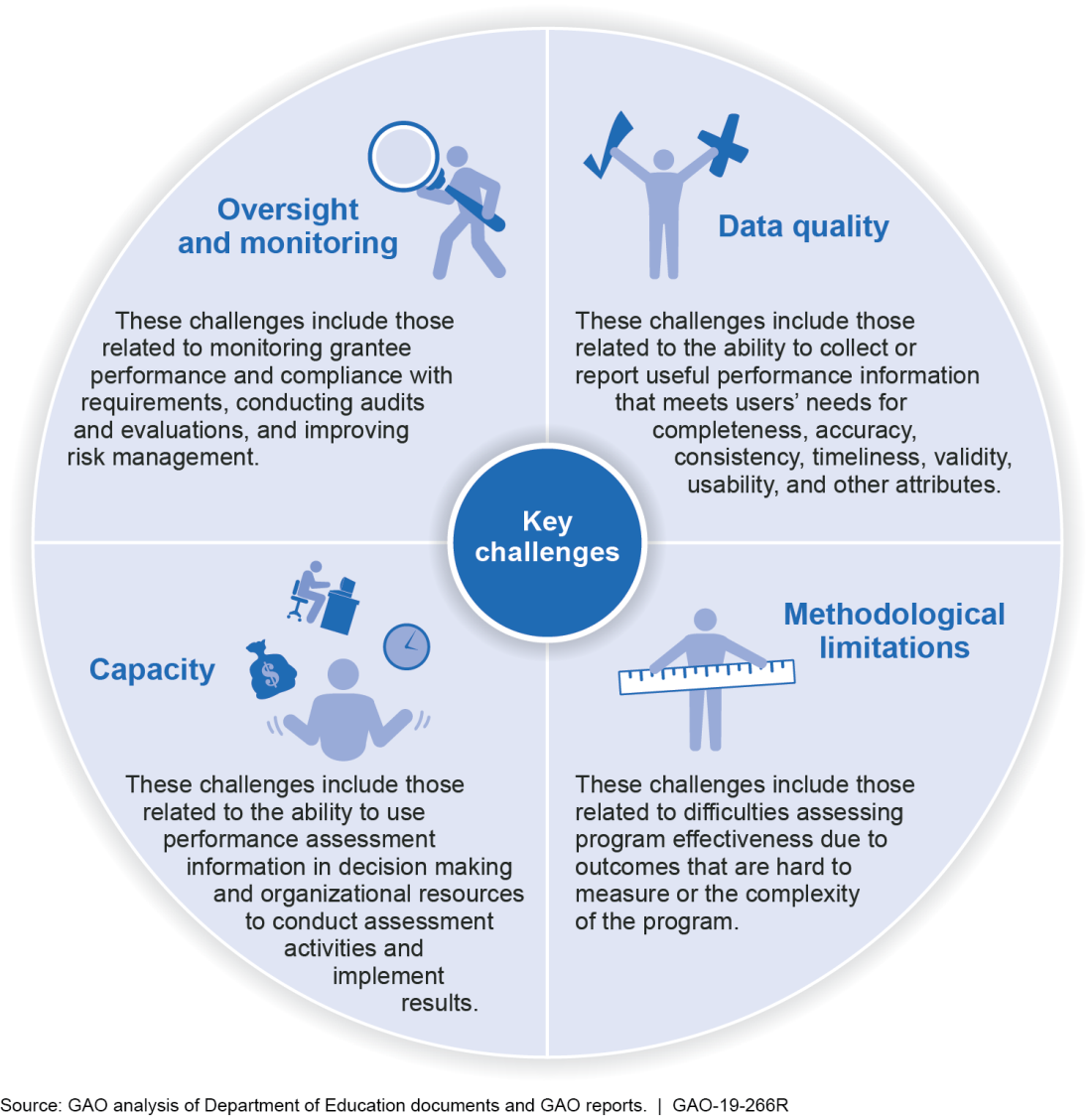

Oversight and monitoring. Weaknesses in Education's internal controls have hindered its oversight and monitoring of grantees and its assessments of K-12 program performance. In April 2017, GAO reported that Education's oversight of discretionary grants monitoring was limited. Some offices, including the Office of Elementary and Secondary Education, did not consistently document required monitoring activities in official grant files. GAO recommended that Education establish and implement written supervisory review procedures for official grant files. In response, Education officials said they are developing a standard operating procedure for maintaining official grant records, which they plan to issue in early 2019.
Data quality. Persistent quality issues with K-12 data that grantees submit to Education have limited Education's ability to use those data to assess performance. In April 2017, GAO reported that Education lacks reasonable assurance that data submitted by grantees for its 21st Century Community Learning Centers grant program are accurate, and that these data may not be useful for decision making and reporting. GAO recommended that Education check the accuracy of federal-level data submitted by grantees. In response, Education officials said they modified and improved the agency's data system to perform these types of checks and reduce errors.
Capacity. Education's ability to oversee and monitor grantees, collect and report quality data, and use performance assessment information in decision making is directly related to its capacity and organizational resources. According to Education officials, capacity has been and remains a challenge to assessing K-12 program performance. In its 2016 report on the Rural Education Achievement Program, Education's Office of Inspector General (OIG) concluded that Education's inadequate monitoring of program grantees was partly due to its limited human capital capacity. In response, Education requested additional staff and implemented a risk-based approach for selecting grantees to monitor, according to Education officials cited in the OIG report.
Methodological limitations. Education has faced methodological limitations assessing program performance, including difficulties assessing the benefits of flexible grant programs, isolating program impact, and measuring long-term outcomes. Education officials told GAO that these types of methodological challenges are difficult to address, although Education has taken steps to mitigate them. For example, GAO reported in May 2014 on the difficulty Education faces in evaluating the effectiveness of the Promise Neighborhoods program in part because the program provides certain flexibilities to grantees. Partly in response to GAO's recommendation that Education develop a plan to conduct a national evaluation of the program, Education awarded a contract in fiscal year 2018 to develop options for evaluating the program's effect on student outcomes. In November 2018, Education officials stated that they intend to award a new contract in late fiscal year 2019 to evaluate the effectiveness of the program nationwide.

Why GAO Did This Study

Education plays a key role in supporting educational opportunities for K-12 students, including awarding grants and overseeing compliance with federal education laws. However, questions have been raised about how Education assesses program performance. Both GAO and Education's OIG have reported on various management and oversight issues related to Educations program performance. GAO was asked to review Education's K-12 program performance assessment activities and related barriers. This report describes challenges Education faces in assessing the performance of its K-12 programs, as well as steps it has taken to address them.
To identify challenges to program performance assessment and learn about how Education addressed these challenges, GAO examined documents from Education, reviewed prior GAO work on government-wide performance assessment activities and Education's K-12 programs, and interviewed Education officials. To identify specific examples of K-12 programs that illustrate each of the challenges, GAO reviewed prior related GAO reports and relevant Education OIG reports and considered the views of Education officials. Although these examples are not generalizable, they reflect a variety of K-12 programs and show a range of Education's actions in response to the challenges. GAO also reviewed relevant federal laws and regulations.
For more information, contact Jacqueline M. Nowicki at (617) 788-0580 or nowickij@gao.gov.
U.S. GAO - K-12 Education: Challenges to Assessing Program Performance and Recent Efforts to Address Them

Jack Schneider: Betsy DeVos Should Stop Making Stuff Up About America’s Schools | Diane Ravitch's blog

Jack Schneider: Betsy DeVos Should Stop Making Stuff Up About America’s Schools | Diane Ravitch's blog

Jack Schneider: Betsy DeVos Should Stop Making Stuff Up About America’s Schools


Schneider offers a capsule of education history and concludes:
“When critics contend that America’s public schools are preparing students for the jobs of the past, they are engaging in a kind of rhetorical feint. The implication is that today’s students are already being trained for work, and that such a focus has always been an aim of schooling. It suggests that vocational training is something that Americans broadly agree upon, and that is simply in need of an update.
“In reality, workforce preparation would represent a significant shift in the mission of schools. President Donald Trump made this shift plain in 2018 when he unveiled a plan to combine the Department of Education with the Department of Labor into a new agency called the Department of Education and the Workforce. (There seems to be little movement on the proposal since it was announced.)
“Jobs certainly matter, and the future labor productivity of today’s students will impact the entire economy. Yet even if schools could be reoriented to focus effectively on job training, the result would hardly be an unqualified good. Any shift in the present orientation of schools will come at the expense of school activities organized around the preservation of rights and liberties, as well as the inherent value of education. By and large, Americans of the past were unwilling to make that trade-off. If they’re aware of what’s happening, Americans of the present may be no different.”
in the past, vocational training was often designed to prepare students for occupations that would soon be obsolete.
As a basic rule of thumb, never believe anything DeVos says. If she is not lying, she simply speaks from ignorance. Her knowledge of the real world is very limited.Jack Schneider: Betsy DeVos Should Stop Making Stuff Up About America’s Schools | Diane Ravitch's blog


Tennessee: Is This Possible?
Blogger Andy Spears reports that an admitted sex offender in the legislature has a key role in shaping education policy. He wrote: Yesterday, the House Education Administration Subcommittee met for the first time. The meeting was the first chaired by admitted sex offender David Byrd. Readers will recall that while both former House Speaker Beth Harwell and current Lt. Governor Randy McNally calle
Dutch Historian Tells Davos Elite That Biggest World Problem is Failure of Rich to Pay Taxes
Dutch historian Rutger Bergman stunned the super-elite at the World Economic Forum at Davos by telling them that the biggest problem in the world today is the refusal of the richest to pay their fair share of taxes. He said that listening totheir discussions was akin to a fireman’s conference that never mentioned water. He became an instant folk hero for his bold truth telling. Davos is an annual
Jack Schneider: Betsy DeVos Should Stop Making Stuff Up About America’s Schools
Jack Schneider, historian of education, urges Betsy DeVos to stop telling lies about our nation’s schools. Schneider offers a capsule of education history and concludes: “When critics contend that America’s public schools are preparing students for the jobs of the past, they are engaging in a kind of rhetorical feint. The implication is that today’s students are already being trained for work, an
Michigan: Education Funding Declined More Than Any Other State in 25 Years
The DeVos Plan is working! Education funding in Michigan declined more in the past 25 years than in any other state. Charters and choice were a substitute for funding. Michigan’s NAEP scores dropped from the middle of the pack to the bottom 10. DeVos and the Koch brothers will destroy American education if allowed to continue, and they do so with the help of Bill Gates, Eli Broad, Arne Duncan, An

YESTERDAY

Dallas: Reporter Seeks Information about “Social Impact Bonds”
A reporter in Dallas wants to know why social impact bonds are a bad idea. Or if they are a good idea. Please write him. brett@brettshippmedia.com
Nevada Chief Resigns, after Failure as Charter Cheerleader
Nevada’s State Commissioner Steve Canavero and two of his deputies are leaving. “Nevada’s K-12 system consistently ranks as one of the worst-performing in the nation, according to NAEP scores and Education Week ‘s Quality Counts. This has frustrated state and local politicians, technocrats and practitioners and led to a series of ambitious efforts over the years to improve the system. “Canavero,
Kansas: Students Walk Out to Protest Tech-Based Summit Learning Program
Mark Zuckerberg and the Chan Zuckerberg Initiative funded the Summit learning program, which is computer-based online instruction. not personalized learning. Students in Kansas sent a message to Zuckerberg: Another student #walkout vs #SummitLearning – this time at McPherson MS in Kansas. Like earlier one in Brooklyn, protest was sparked by students’ frustrations about inadequacies of the online
Justin Parmenter: School Choice in North Carolina
Justin Parmenter, an NBCT high school teacher in North Carolina, writes here about the rapid expansion of charter schools in his state, which is doing serious damage to public schools. Charters were not promoted in North Carolina but by Tea Party Republicans who want to destroy public schools and make money. Charter schools are playing a damaging role in North Carolina, acting as a vehicle for re
Washington State: Charters Fail to Make a Difference
“ Poor Bill Gates. He has poured billions into reinventing education, and nothing has worked. Nothing! Not even in his home state. One of his fondest desires was to open charter schools in Washington State. He poured millions into a referendum (the fourth in the state), and it barely passed. Then the highest court in the state said the charters couldn’t be supported by the general fund, because t
West Virginia: Governor Refuses to Add Charter Schools to Pay Increases
Republican legislators in West Virginia want to tie pay increases for teachers—which they were promised when they went on strike last year—to the introduction of charter schools and vouchers. They think that school choice will 

Trump Endorses Teaching Religion in the Public Schools. What Can He Be Thinking? | janresseger

Trump Endorses Teaching Religion in the Public Schools. What Can He Be Thinking? | janresseger

Trump Endorses Teaching Religion in the Public Schools. What Can He Be Thinking?


In the Washington PostJohn Wagner reports that legislators in six states—North Dakota, Missouri, Indiana, West Virginia, Virginia, and Florida—have introduced bills to permit public schools to teach the Bible as literature.  President Donald Trump endorsed this effort last week in a tweet: “Numerous states introducing Bible Literacy classes, giving students the option of studying the Bible.  Starting to make a turn back?  Great!”
The President advocates teaching about the Bible to “make a turn back”—to Make America Great Again.  He wants to appeal to his base.
I suspect the promoters of teaching “about the Bible” also have something else in mind.  Their purpose is obscured by some vague language that very likely tries to hide a violation of the First Amendment of the U.S. Constitution.  Some promoters of the “teach about the Bible” movement describe wanting their schools to teach Biblical literacy, and some say they are interested in “teaching about the historical significance of the Bible.”  What is implied here can mean very different things to different people.

For 12 years before my retirement, when I worked as an advocate for public education in the setting of the national office of a Protestant denomination, the United Church of Christ, I chaired the Committee on Public Education and Literacy of the National Council of Churches.  The National Council of Churches is an ecumenical partnership of 38 Christian communions in the United States.
During those 12 years, I remember only one intense, heated discussion that ran our committee’s meeting long past the time we were supposed to have concluded.  We had been asked to read and review a lavishly illustrated and expensively produced textbook, supposedly to be used in public schools to teach about the Bible as literature. The book also covered what its authors considered “the historical significance of the Bible.”
The amazing thing about that long and very heated meeting was that we all agreed.  Every one of us believed that the textbook in question should never be used in a public school. And, as CONTINUE READING: Trump Endorses Teaching Religion in the Public Schools. What Can He Be Thinking? | janresseger


Remember the 2018 teachers strikes in Republican-led states? Now legislators in 3 states are trying to retaliate. - The Washington Post

Remember the 2018 teachers strikes in Republican-led states? Now legislators in 3 states are trying to retaliate. - The Washington Post

Remember the 2018 teachers strikes in Republican-led states? Now legislators in 3 states are trying to retaliate.


Remember the 2018 teachers strikes in Republican-led states that captured the attention of the country?
The Red For Ed — or #RedForEd — movement started when West Virginia teachers who were sick and tired of working for low pay and in resource-starved schools walked out of class even though such labor action is illegal in the state. The teachers started the strikes, and their unions followed.
Teachers in other red states saw what was happening and decided to do something exceedingly rare for teachers — stand up for themselves — and they struck, too, in Oklahoma, Arizona, Colorado and other places, and managed to win financial concessions from state legislators.
Now, in three of those states, Republican-led legislatures are retaliating, trying to pass bills that would make teachers' working lives more difficult. Here’s what’s happening:
West Virginia
More than 22,000 West Virginia teachers walked out en masse on Feb. 22, 2018, closing schools in every county for the first time in nearly 30 years. They demanded higher pay and lower health-care costs in a place where many teachers have had to take second jobs to pay their bills.
With the state ranking 48th in average teacher salaries in 2016, according to National Education Association data, legislators finally agreed to a 5 percent pay raise — less than the teachers were seeking — while offering no promise on relief for health-care costs. The teachers returned to class March 7.
West Virginia legislators are taking steps that teachers strongly oppose. In a budget bill the legislature is fast-tracking, teacher raises and funding for the health-care system for state employees would be tied to provisions including:
  • Increasing class sizes.
  • Denying pay during future strikes.
  • Support for “school choice” in the form of charter schools and a program to use public money for private and religious-school education. 
The state’s Republican governor, Jim Justice, who opposed last year’s strike, said he would veto such a bill, but that won’t stop the legislature from trying.
Oklahoma
Oklahoma teachers walked out April 2 demanding higher pay and more resources for schools in a state where tax cuts have slashed public spending on education. They returned to class 10 days later after winning raises and additional school funding, but did not win everything they wanted. Some teachers opposed ending the CONTINUE READING: Remember the 2018 teachers strikes in Republican-led states? Now legislators in 3 states are trying to retaliate. - The Washington Post