Latest News and Comment from Education

Thursday, January 31, 2019

Video: Black Lives Matter At School–“I know my people are strong.” – Black Lives Matter At School

Video: Black Lives Matter At School–“I know my people are strong.” – Black Lives Matter At School

Video: Black Lives Matter At School–“I know my people are strong.”


We are excited to announce the release of our newly produced Black Lives Matter At School video! This short primer for the movement gets its subtitle from the words of high school student Israel Presley who says, “All I ever see is us being slaves. Why don’t you ever teach me about how we fought back, because I know my people are strong.


Black Lives Matter At School week of action will take place this year from February 4-8th in school districts across the country. Support the movement by signing the petition, sharing the video, and teaching for Black lives.

Video: Black Lives Matter At School–“I know my people are strong.” – Black Lives Matter At School

Betsy DeVos’ new Title IX rules might already be hurting students - Vox

Betsy DeVos’ new Title IX rules might already be hurting students - Vox

Betsy DeVos’s new sexual harassment rules might already be hurting students
One school just got rid of its Title IX coordinator. The debate could be a sign of things to come.


For many students who experienced sexual assault or harassment at Drew University in Madison, New Jersey, Title IX coordinator Emily Ralph was a supportive ear when they needed it most, students and alumni say.
Ralph was responsible for overseeing formal Title IX complaints at the university, as well as the university’s other efforts to prevent and address harassment and assault. With a master’s degree in social work as well as a law degree, she was both empathetic toward survivors and fair to everyone involved, one Drew alum told Vox.
“When Emily was put in place, reports went up,” said Sarah O’Brien, a graduate student at Drew. “That’s not because there was a problem all of a sudden — it’s because students felt comfortable reporting.”
But in early January, Ralph was let go. In what appears to be a cost-cutting measure, the university eliminated the position of full-time Title IX coordinator and announced that the role would be filled by an eight-member team, all of whom have other jobs at the university.
Drew president MaryAnn Baenninger told Vox that “with this distributed model, there will be more people who will be able to offer a knowledgeable approach that will help our whole community.” But some students and alumni are concerned that the move will make it harder for survivors to report, and easier for the university to sweep problems under the rug.
Meanwhile, advocates say situations like the one at Drew could become more common under new Title IX regulations issued in November by the Department of Education under Secretary Betsy DeVos. Anti-harassment groups fear the new regulations will make it easier for schools CONTINUE READING: Betsy DeVos’ new Title IX rules might already be hurting students - Vox

In a major step, the Los Angeles school board calls for a moratorium on new charter schools - The Washington Post

In a major step, the Los Angeles school board calls for a moratorium on new charter schools - The Washington Post

In a major step, the Los Angeles school board calls for a moratorium on new charter schools


The Los Angeles Board of Education is calling on the California legislature to impose a moratorium on new charter schools, a remarkable shift by the pro-charter panel that struck a blow to the charter movement and may lead to stronger oversight of the schools.
The vote appears to signal an inflection point in the charter school debate in California, which has more charter schools and charter school students than any other state. California has allowed charters — which are publicly funded but privately operated — to flourish with little oversight amid growing controversy over financial scandals and other issues.
Charters have become a focus of activists around the country who say the schools provide families with options in districts with failing classrooms. Opponents, including the Los Angeles teachers union, say charters drain resources from the traditional schools that most students attend and encourage further privatization of an important civic institution.
Education Secretary Betsy DeVos is a big supporter of charter schools, as are many of America’s wealthiest individuals, including billionaire Eli Broad, who several years ago promoted a plan to open enough charter schools in Los Angeles to serve at least half of the district’s more than 600,000 students.
But a growing number of education advocates and groups, including the NAACP, have called for a moratorium on charters until issues involving transparency and operations are resolved. California voters just elected a new schools superintendent, Tony Thurmond, who has said he wants to spend more money on traditional schools and stop the expansion of charters until concerns are addressed. He defeated a candidate who was supported by the charter lobby. Newly elected Gov. Gavin Newsom (D) has emphasized his desire to spend more on schools within traditional public systems.
The Los Angeles school board resolution and vote — which happened Tuesday as pro-charter protesters picketed outside board headquarters — came out of last week’s agreement between the city’s school district and the teachers union. That pact ended a six-day strike by educators in the nation’s second-largest school district.
The school board voted Tuesday to ratify the strike-ending deal between the Los Angeles Unified School District and United Teachers Los Angeles. The new contract provides teachers with 6 percent pay increases, more resources for schools and small reductions in class size.
The strike ended with other agreements, too, including what many saw as a surprising promise by the school district to support a state moratorium of up to 10 months on charter schools while the state studies their effects.
The Los Angeles Board of Education has six members, at least half of whom were elected with the help of financial support from the charter lobby. The district superintendent, Austin Beutner, is a former investment banker who is a charter backer.
“LAUSD has joined the NAACP and other key organizations in calling on the state of California for a CONTINUE READING: In a major step, the Los Angeles school board calls for a moratorium on new charter schools - The Washington Post

Dana Goldstein: In 13 Years of Education Reporting, So Much Has Changed - The New York Times

In 13 Years of Education Reporting, So Much Has Changed - The New York Times

In 13 Years of Education Reporting, So Much Has Changed

Covering recent teachers’ strikes, including the latest showdown, in Los Angeles, has brought into relief a shift in the conversation.


Times Insider explains who we are and what we do, and delivers behind-the-scenes insights into how our journalism comes together.
I first met Alex Caputo-Pearl, the strike-leading president of the Los Angeles teachers’ union, in 2011, when I shadowed him for a day at Crenshaw High School.
I was working on a book about the history of public school teaching, and Mr. Caputo-Pearl, then a social studies teacher, had a fascinating personal story. He had served in the very first class of Teach for America recruits, in 1990, and was part of a small group of original T.F.A. members who were, 20 years later, still working in urban public school classrooms.
But Mr. Caputo-Pearl didn’t remain in the Teach for America fold. He became a union activist and a critic of T.F.A., charter schools and the entire landscape of test-driven accountability for children and educators. At Crenshaw High, he helped develop a social-justice curriculum in which students organized their learning around the question of how to improve conditions in their low-income South Los Angeles neighborhood. It was unapologetically activist — outside the mainstream of what education reform looked like at the time.
The school district later ended that program, and in 2014, Mr. Caputo-Pearl was elected president of the United Teachers Los Angeles, the local union. He represented a new, more militant generation of teachers’ union leaders. This month, he led 30,000 educators in a weeklong strike for higher pay and more classroom funding, and against the growth of the charter school sector. It’s a story I covered with Jennifer Medina, my fantastic National desk colleague in Los Angeles, and our editors Julie Bloom, Dave Kim and Marc Lacey.
I’ve been reporting on education for 13 years, but I am absolutely stunned by the extent to which teachers’ strikes and walkouts are now a day-to-day part of my job. The Los Angeles action was the eighth mass teacher protest I’ve reported on in just 11 months, shutting down schools for one million students across the country. The reappearance of Mr. Caputo-Pearl in my professional life was just one of several uncanny moments that have made me, at age 34, feel old in beat-reporter years. So much has changed in education, as the focus shifts from calling out and overhauling bad teachers and schools to listening more carefully to what educators say about their working conditions and how students are affected by them.
I was at the Democratic National Convention in 2008, when one of the hottest tickets was to a panel discussion in which rising stars in the party, including Cory Booker, then the mayor of Newark, spoke harshly of teachers’ unions and their opposition to charter schools, which are publicly funded, privately run and generally not unionized. Union leaders argue that charters draw public dollars and students away from traditional schools like Crenshaw High.
Back then, it was hip for young Democrats to be like Barack Obama, supportive of school choice and somewhat critical of teachers’ unions. But CONTINUE READING: In 13 Years of Education Reporting, So Much Has Changed - The New York Times

Leaving Childhood Out in the Rain!

Leaving Childhood Out in the Rain!

Leaving Childhood Out in the Rain!


Why do corporate CEOs, foundations, and policymakers want kindergartners to learn more advanced material at a faster rate? Why is this important to them? If children are made to grow up quickly, what happens to childhood?
Why are they against play and art for children in public schools? Why do they push children to read earlier and earlier?
They claim they want to ensure that children will get a great start, that a rigorous kindergarten will lead to a better future. But when does it turn into child abuse?
Pushing children to learn more difficult material in kindergarten will not be found in wealthy private schools. Those schools still have recess, include a well-rounded curriculum, and they make kindergarten an enjoyable experience.
Child development specialists, the experts, disagree with pushing advanced work in kindergarten.

Koch Brothers Plan New Scheme Fully to Privatize American Education—at Public Expense | janresseger

Koch Brothers Plan New Scheme Fully to Privatize American Education—at Public Expense | janresseger

Koch Brothers Plan New Scheme Fully to Privatize American Education—at Public Expense


Last Friday, Washington Post columnist Dana Milbank described this year’s wave of strikes and walkouts by school teachers: “Something funny happened on the way to the labor movement’s funeral.  When Justice Samuel A. Alito Jr. and his antilabor colleagues on the Supreme Court handed down the Janus v. AFSCME decision last June, unions braced for the worst.”  But, Milbank concludes: “Labor leaders ought to thank Alito—and send chocolates to the Koch brothers for bankrolling the anti-union court case.  Their brazen assault, combined with President Trump’s hostility toward labor, has generated a backlash, invigorating public-sector unions and making a case for the broader labor movement to return to its roots and embrace a more militant style.”
I don’t know about the implications for all of labor, and I’d argue with Milbank’s point that this year’s strikes by teachers have been primarily a response to the Janus decision. The growing wave of teachers’ strikes has instead been a cry for help from a profession of hard-working, dedicated public servants disgusted with despicable working conditions, lack of desperately needed services for their students, and insultingly low pay.
But Milbank is correct that the Janus decision has not undermined membership in the two big public sector teachers’ unions, the American Federation of Teachers and the National Education Association: “The American Federation of Teachers expected it might lose 30 percent of its revenue after the high court gave public-sector workers the right to be free riders, benefiting from union representation but paying nothing.  Instead, the 1.7 million-member union added 88,500 members since Janus—more than offsetting the 84,000 ‘agency-fee payers’ it lost because of the Supreme Court ruling… The NEA had projected a loss of as many as 200,000 members, based on previous drop-membership campaigns.  Instead, the 3 million-member union is actually up 13,935 members…and the increase in membership among new teachers is particularly encouraging.”
Milbank quotes Lily Eskelsen-Garcia, the president of the National Education Association, CONTINUE READING: Koch Brothers Plan New Scheme Fully to Privatize American Education—at Public Expense | janresseger


Chaz's School Daze: Where Does School Funding Come From By State?

Chaz's School Daze: Where Does School Funding Come From By State?

Where Does School Funding Come From By State?


.....................Federal.......State....Local

Alabama11.2%54.9%33.9%
Alaska15.3%59.7%25.0%
Arizona15.4%38.6%46.0%
Arkansas10.7%50.3%39.0%
California8.9%58.0%33.1%
Colorado7.5%45.7%46.8%
Connecticut3.5%42.2%54.4%
Delaware11.0%56.4%32.6%
District of Columbia8.9%-91.1%
Florida11.7%42.0%46.2%
Georgia11.2%43.4%45.4%
Hawaii11.9%86.1%1.9%
Idaho9.9%64.9%25.3%
Illinois7.9%24.0%68.2%
Indiana9.8%59.1%31.1%
Iowa5.5%57.7%36.8%
Kansas8.3%66.4%25.3%
Kentucky8.9%62.8%28.3%
Louisiana14.6%42.6%42.8%
Maine15.9%35.9%48.2%
Maryland6.7%45.7%47.6%
Massachusetts5.0%40.0%55.0%
Michigan14.9%66.1%19.0%
Minnesota5.2%71.9%22.9%
Mississippi19.4%46.9%33.8%
Missouri8.4%33.0%58.5%
Montana13.7%52.6%33.8%
Nebraska6.5%36.0%57.4%
Nevada11.4%37.0%51.6%
New Hampshire5.9%34.3%59.9%
New Jersey3.8%40.9%55.3%
New Mexico12.4%70.7%16.9%
New York4.7%37.3%58.0%
North Carolina10.4%59.1%30.6%
North Dakota7.7%42.1%50.2%
Ohio7.8%44.3%47.8%
Oklahoma11.1%47.9%41.0%
Oregon7.0%51.0%42.0%
Pennsylvania7.9%35.2%56.9%
Rhode Island8.4%39.3%52.3%
South Carolina9.0%47.7%43.3%
South Dakota13.8%29.8%56.4%
Tennessee12.0%49.2%38.8%
Texas8.6%41.3%50.1%
United States8.4%46.0%45.6%
Utah11.4%49.0%39.6%
Vermont5.7%89.2%5.1%
Virginia7.7%36.7%55.6%
Washington7.6%58.3%34.1%
West Virginia14.5%59.7%25.8%
Wisconsin6.4%46.1%47.5%
Wyoming5.7%57.0%37.3%
Data from the National Education Association
The list shows the breakdown from Federal, State, and local sources for school funding, 

Chaz's School Daze: Where Does School Funding Come From By State?

Wednesday, January 30, 2019

State officials say Thrive charter schools should be closed - The San Diego Union-Tribune

State officials say Thrive charter schools should be closed - The San Diego Union-Tribune

State officials say Thrive charter schools should be closed

he California Department of Education says the San Diego-based Thrive charter schools should not be renewed for another five years because of its poor academic performance, according to recently published department documents.
Thrive Public Schools perform worse academically than the district schools its students would have otherwise attended, and its petition to remain open “is not consistent with sound educational practice,” according to a 45-page report by state education department staff.
Since the first school site opened in 2014, Thrive has quickly grown to serve roughly 1,000 students on four campuses, including transitional kindergarten through 11th grade. The State Board of Education is its authorizer.
Thrive opened a new school building in Linda Vista last fall. It advertises a personalized and project-based learning approach.
The state department's recommendation does not yet mean that Thrive will be forced to close.
The State Board of Education will have the final vote on whether Thrive can stay open. However, the State Board has typically followed the department’s recommendations.
Since January of last year, the State Board has approved the establishment or renewal of 14 charter school petitions and denied five, according to meeting minutes. Only twice in the past year has the State Board approved a charter school for which the department recommended denial.
Thrive is seeking a five-year renewal of its charter, which is its required license to remain open, from the State Board after the San Diego Unified School Board voted unanimously to deny Thrive’s renewal request in November. Getting approval from the State Board this spring is Thrive’s last chance to remain open for next school year.
Thrive’s CEO and founder, Nicole Assisi, said in a statement that she expects the State Board will approve Thrive’s renewal despite the staff recommendation.
“Although we are disappointed with the California Department of Education’s recommendation, we remain confident that the State Board of Education will see the CONTINUE READING: State officials say Thrive charter schools should be closed - The San Diego Union-Tribune

Charter School Forces Can't Believe WE Don't Believe Their Bullshit - LA Progressive

Charter School Forces Can't Believe WE Don't Believe Their Bullshit - LA Progressive

Charter School Forces Can’t Believe WE Don’t Believe Their Bullshit


The polls say their cause took a heavy hit in the wake of the LA teacher strike, but don’t count them out. The charter school movement never takes “no” for an answer.
We saw the parents of charter school kids, some of the charter school teachers, and a larger complement of ideological allies descend on the LAUSD board meeting yesterday, expecting to intimidate an already charter-friendly board to renege on its agreement with UTLA to petition the state legislature for a moratorium (or “pause”) on authorizing more charters.
Likewise, the LA Times lost no time in giving prominent Sunday space to David Osborne, an ideological ally of the charter movement, who whined in his ill-tempered Op-Ed that the national teachers’ unions unfairly scapegoat charters for the problems facing conventional unionized schools.

On cost and on relative performance, less than half of charter school kids actually do better academically than children served by regular schools.

Osborne trotted out the familiar arguments developed over the years by the billionaire supporters of charter schools and the related privatization movement (people with names like Koch, Walton, Broad, DeVos, Bloomberg, etc.) To wit, that charter schools provide needed choice for the “victims” of underperforming conventional schools, that they represent liberation for low-income kids of color, and that they cost less to operate and produce better results (i.e., test scores) than conventional schools.
All of this is bullshit.
On “choice,” it’s always the most motivated and involved parents who tend to choose specialized charters for their kids. Relatively uninvolved parents, and the parents of special needs children, are often unable, in practical terms, to “choose” the charter path. There’s no question that the charter operators don’t want the kids of such parents; they choose the kids they want and leave the others behind. There is also no question that the next step, in the billionaires’ playbook, is giving parents nationwide the option of choosing fully private and religious schools while having taxpayers pick up CONTINUE READING: Charter School Forces Can't Believe WE Don't Believe Their Bullshit - LA Progressive

`Crumbling’ Schools Spur Democrats to Renew Infrastructure Push

`Crumbling’ Schools Spur Democrats to Renew Infrastructure Push

‘Crumbling’ Schools Spur Democrats to Renew Infrastructure Push

Students at Coughlin High School in Wilkes-Barre enter their school building through a shed, a safety precaution in case part of the school’s crumbling façade falls at the wrong moment.
Two elementary schools closed in Arizona after the district found structural defects that could pose safety risks to students. And in Baltimore, students wore coats to class after heaters broke. Some schools didn’t bother to open.
“It’s hard to educate people in schools that are crumbling,” said Rep. Bobby Scott (D-Va.), who introduced a $100 billion school infrastructure bill in 2017 that was co-sponsored by 119 House Democrats but stalled in the GOP-run House. “In a lot of areas that’s unfortunately what’s happening.”
With the new Democratic majority this year, Scott holds the gavel of the House Education and Labor Committee and plans hearings to show the need for better buildings and how many jobs can be created. Infrastructure is also a major priority for Speaker Nancy Pelosi (D-Calif.). They’ll need to persuade Republicans who traditionally view school buildings as a state and local responsibility.
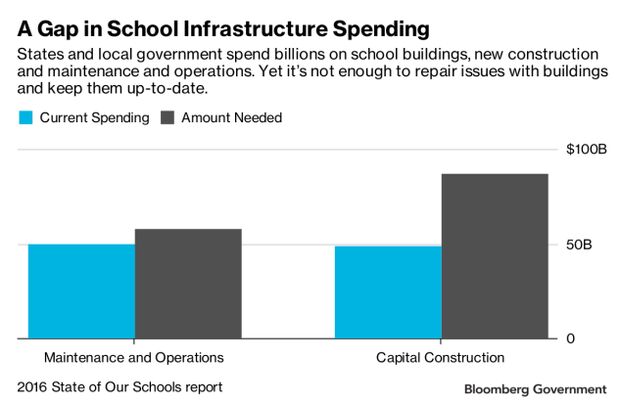
The federal government currently spends money to repair schools only in cases of disasters. That leaves states and localities pouring billions of dollars into fixing buildings each year, about $46 billion short of the needs, according to a 2016 “State of Our Schools” study by three groups: 21st Century School Fund, the National Council on School Facilities, and the U.S. Green Building Council.


While a federal study from the National Center for Educational Statistics found that three-fourths of schools were in good or excellent condition or better, at least half of all school districts said their facilitiesneeded major repair.
Dan Urevick-Ackelsberg, a staff attorney with the Public Interest Law Center which is suing Pennsylvania over inadequate funding for schools, said the state alone can’t get schools to where they need to be.
“Our federal government has the power to really knock this out,” he said. “There might not be a constitutional obligation, but there would sure seem like there’s a moral obligation to get it done.”

`LIKE AN OLD CAR’

About 32 percent of school districts reported there were fewer funds available in 2017 than 2016 in a survey of 133 school districts by the magazine School Planning and Management. Only 12 percent said more funding was CONTINUE READING: `Crumbling’ Schools Spur Democrats to Renew Infrastructure Push

States Key to Undoing School Reform’s Federal Era | Ray Domanico, City Journal

States Key to Undoing School Reform’s Federal Era | Ray Domanico, City Journal

School Reform’s Lost Momentum
The legacy of education’s federal era won’t be undone quickly, but states and localities should lead the way forward.

The 2018 midterms marked the second straight electoral cycle paring back the education reforms favored by the Barack Obama and George W. Bush presidential administrations. Education reform was relegated to the background in the 2016 election, but a well-funded effort to increase modestly the number of charter schools in Massachusetts went down to defeat. In 2018, Wisconsin voters replaced a strong supporter of school choice with a candidate more likely to raise educational spending. And New Yorkers flipped the state senate, the last refuge of charter school support, from Republican to Democrat. In these and other states, voters backed candidates promising more funding for traditional public schools.
Reformers set themselves up for these defeats with their bipartisan support for reforms driven from Washington, seemingly at the expense of local control. Prior to the mid-twentieth century, American educational policy had largely been a local matter. Schools operated under local and state control, in close collaboration with parents. This model had much to recommend it. Sociologist Anthony Bryk has shown that schools succeed where trust exists between school professionals and the local families they serve.
Starting in the mid-1960s, Washington took a growing role in education policy, culminating in large-scale efforts by the Bush and Obama administrations to establish local education directives at the federal level. We’re now seeing a reaction against those efforts. The Trump administration’s secretary of education, Betsy DeVos, seemed to grasp this at the outset of her term, stating: “You cannot fix what ails education by telling people how to do things from the Washington-level down; it really has to be a grassroots local initiative.” Yet the Education Department she leads has only begun to introduce the changes necessary to make this vision a reality. The divided government delivered by the midterms almost guarantees that we’ll be stuck with some of the legacy of education’s federal era, while lasting reform efforts will have to take place at the state and local levels. The diversity of outcomes that will likely mark these initiatives should not be feared, however; it is truer to America’s historical approach to education policy.
At the height of 1960s federal activism, Lyndon B. Johnson’s administration had to fight hard to enact a major education-funding program, Title I, as part of its War on Poverty. Given the venerable American tradition of local control of schools, the 1965 legislation established only a limited federal role: “In recognition of the special educational needs of children of low-income families and the impact that concentrations of low-income families have on the ability of local educational agencies to support adequate educational programs, the Congress hereby declares it to be the policy of the United States to provide CONTINUE READING: States Key to Undoing School Reform’s Federal Era | Ray Domanico, City Journal

L.A. school board calls for moratorium on new local charter schools - Los Angeles Times

L.A. school board calls for moratorium on new local charter schools - Los Angeles Times

L.A. school board calls for moratorium on new local charter schools

Los Angeles school officials made good on a deal with the teachers union on Tuesday, bringing forward and passing a resolution that calls for a local moratorium on new charter schools until their impact can be studied.
The resolution is non-binding for state officials, but it was vigorously opposed by charter supporters — more than 1,000 turned out to protest at district headquarters. The resolution was one product of a deal to end this month’s six-day teachers’ strike.
Earlier in the same meeting on Tuesday, the Los Angeles Board of Education unanimously approved a contract with the teachers’ union, despite a warning from an oversight agency that the costs of it are “unsustainable.”
Just before school board members voted, they received a report from the L.A. County Office of Education, which provides financial oversight for local school districts. While the agency stopped short of urging a rejection of the new contract, it did issue a warning, saying the district would have to submit a revised three-year budget plan that meets the county’s parameters.
Under the new contract, the school system appears to be unable to meet all of its budget obligations. The pact is “not sustainable on an ongoing basis,” according to the county agency’s analysis.
If the district does not take the necessary steps to avoid financial risk, then the county agency can appoint a fiscal advisor who will have the authority to override district spending decisions.
The sober analysis did not prevent the L.A. school board from approving the new contract quickly and with little discussion.
L.A. schools Supt. Austin Beutner said he was well aware of the district’s financial challenges— indeed, he had repeatedly called attention to them during contract negotiations. Still, he said, the contract was the right step forward and that all parties had compromised to get to an agreement. Resolving the labor conflict would allow all groups to focus on shared challenges, such as cutting costs, winning more revenue from the state and voter initiatives.
“We are at a historic moment to start addressing these issues,” Beutner said. “This contract is not an end. It is a beginning.”
Board member Nick Melvoin said the district would have to make sure that its budget remained solvent.
“It’s up to us, collectively, to make it sustainable,” Melvoin said of the new contract.
The bigger drama inside the building and outside on the streets Tuesday was over another part of the deal that brought teachers back to the classroom this month — a resolution calling on state officials to place a moratorium on the opening of new local charter schools.
Well over 1,000 charter school supporters rallied Tuesday outside district headquarters, west of downtown.
“I felt that it was important to be here today because students and families should have the choice of where to go to school,” said Lexi Hopp, 18, a senior at Granada Hills Charter High School. “Not every school is perfect. So every school, every family, needs to have their choice of where to send their student, to have the best fit possible for them.”
Charters are privately operated public schools that compete with L.A. Unified — and with CONTINUE READING: L.A. school board calls for moratorium on new local charter schools - Los Angeles Times


Here We Go: Another Billionaire Push to “Remake” K12 Ed from the Koch Network | deutsch29

Here We Go: Another Billionaire Push to “Remake” K12 Ed from the Koch Network | deutsch29

Here We Go: Another Billionaire Push to “Remake” K12 Ed from the Koch Network

Some more billionaire experimentation with K12 ed, as the January 29, 2019, Washington Post reports (sort of— guinea pig districts still not revealed)– this time by the American legislative Exchange Council (ALEC) money funnel, Charles Koch:
THE BIG IDEA:
INDIAN WELLS, Calif. — The donor network led by billionaire industrialist Charles Koch will launch a new organization next month to focus on changing K-12 education as we know it.
The effort will begin as a pilot project focused on five states with a combined school-age population of 16 million kids, but officials said Monday that they aren’t ready to identify them yet because they’re still finalizing partnerships with some of the country’s leading educational organizations.
The still-unnamed entity purportedly plans to focus on three buckets: changing public policy to address “the root causes” of failing schools, developing new technologies to promote individualized learning, and investing in teachers and classrooms.
The announcement came Monday at the end of a three-day seminar where 634 donors who have each committed to contribute at least $100,000 annually to Koch-linked groups gathered under palm trees at a luxury resort in the Coachella Valley.
The article later has the phrase, “questions their motives” in the same paragraph as’ “Education Secretary Betsy DeVos has been a longtime ally”– which does nothing to bolster confidence in this billionaire, the-world-is-our-laboratory, uh-oh:
[Koch chairman Brian] Hooks recognizes that many will question their motives, but he said the goal is to “really shake things up” by “coming alongside concerned teachers” to “find a better way.” Teachers union leaders, who are closely aligned with the Democratic Party, have accused CONTINUE READING: Here We Go: Another Billionaire Push to “Remake” K12 Ed from the Koch Network | deutsch29