Latest News and Comment from Education

Saturday, January 26, 2019

Texas Public Schools are in the Portfolio District Crosshairs | tultican

Texas Public Schools are in the Portfolio District Crosshairs | tultican

Texas Public Schools are in the Portfolio District Crosshairs


Radical market theorists are reshaping Texas education governance by instituting the portfolio district school model. It is a scheme promoted by the University of Washington based think tank, Center on Reinventing Public Education (CRPE). To advance this design, the accountability system and justifications for closing public schools is adopted from Rahm Emanuel’s Chicago Public Schools. This top down plan is being guided by Mike Morath Commissioner of the Texas Education Agency (TEA).
A quick glance at the CRPE web site reveals they see Texas as a target of opportunity. It states,
“We’re currently working on:
Analyzing how state education agencies can support local leaders on the portfolio strategy, such as through the Texas Education Agency’s new System of Great Schools Network.”
Here are a few of the benefits that TEA claims for the System of Great Schools (SGS):
  • “Membership in a professional learning community of superintendents and senior staff that come together regularly to build understanding of the SGS strategy, …”
  • “Regular connection points with Commissioner Morath.”
  • “The district increases access to school choice options and helps families identify and attend their best-fit school.”
The SGS web site offers a complex excel file that is a roadmap for implementing SGS strategies.
sgs implementation road map
Image of SGS Roadmap Excel Page Labeled “Top 12 Deliverables”
The “School Performance Framework” hyperlink in the Excel sheet opens Chicago Public School’s “School Quality Ratings Policy (SQRP) Handbook.” Much of the “objective” justification used for closing 50 schools in Chicago in one year is in this handbook. Those 50 schools were almost all in predominantly CONTINUE READING: Texas Public Schools are in the Portfolio District Crosshairs | tultican


CURMUDGUCATION: WV: Legislative Extortion

CURMUDGUCATION: WV: Legislative Extortion

WV: Legislative Extortion


Last spring, West Virginia's teachers stood up and stood up loud, shutting down every single school in the state. They were out with five demands-- better wages, health insurance, defeating an expansion of charter schools, keeping seniority, and killing a "paycheck protection" bill. They won, the governor signed a pay raise, and teachers won the right to shout at the end, "Who made history? We made history!"

They should have forced the legislature to swear "No take backs."

Republicans in the West Virginia Senate have introduced a bill that aims to undo some of the results of the 2018 strike.

"This is a vision that’s been worked on with input from many,” said Senate Education Committee Chairwoman Patricia Rucker, R-Jefferson. She forgot to say many what, as the bill, wit versions clocking in at well over 100 pages (one draft version is online here), was put together with zero input from the teachers union.

That makes sense, since the goal here is to shaft West Virginia's teachers yet again.


A picturesque WV cliff off which the WV GOP would like to throw public ed
Teachers struck for a 5% wage hike; the bill has a 5% average wage hike. Teachers struck for CONTINUE READING: CURMUDGUCATION: WV: Legislative Extortion


Denver Teacher Strike Scabs Could Include Central Office Personnel | deutsch29

Denver Teacher Strike Scabs Could Include Central Office Personnel | deutsch29

Denver Teacher Strike Scabs Could Include Central Office Personnel


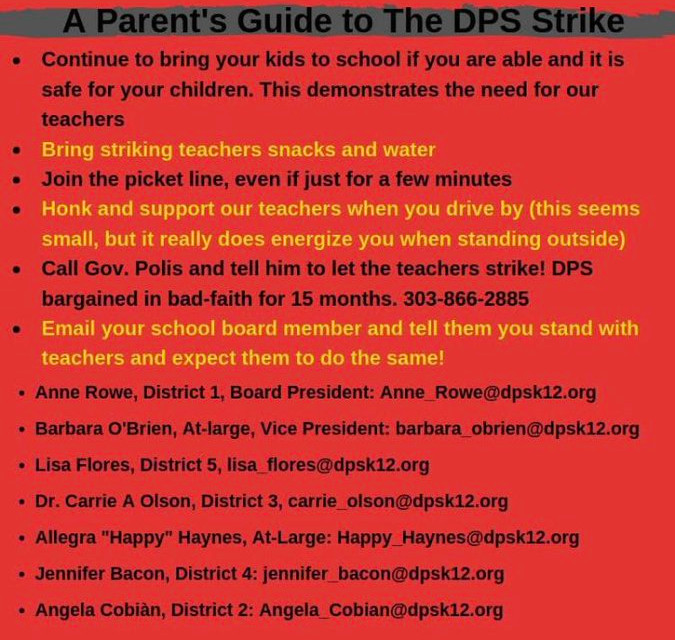
Denver Public Schools (DPS) is on the verge of a strike, which may be delayed for as long as several months, as it turns out, because DPS has called upon the state to intervene.
Still, the threat of a strike looms.
As such, DPS superintendent Susana Cordova and the DPS board have a plan in place to pressure central office staff to become scabs. From the January 25, 2019, Denver Post:
A memo from DPS Superintendent Susana Cordova this week alerted central office workers that all non-essential district operations at the central office will be suspended until a strike is resolved, and everyone will be expected to work in schools, whether that be in substitute teaching roles, working on lunch duty or being a hall monitor. …
A “minimal number” of central office employees who are needed to keep the district operating, such as those involved in payroll and security, would be notified by their supervisor to continue their roles in the event of a strike, Cordova wrote in her memo to staff.
Those with an active teaching or administrative license were told to support in classrooms. Central office employees have the option to obtain a guest teaching license paid for by the district or do non-instructional work like helping serve students lunch and patrolling the hallways.
“We ask that those with school-facing instructional roles, such as curriculum specialists or ELA partners, obtain their guest teaching CONTINUE READING: Denver Teacher Strike Scabs Could Include Central Office Personnel | deutsch29
Image result for Denver Teacher Strike
Denver school system threatens to report to U.S. any teachers working on visas who join a strike — but then takes it back and apologizes - The Washington Post - https://www.washingtonpost.com/education/2019/01/25/denver-school-system-threatens-report-us-any-teachers-working-visas-who-join-strike-then-takes-it-back-apologizes/?utm_term=.758b9ea2523a

Strict and Nurturing Parents: Cycles in Child Rearing and Schooling | Larry Cuban on School Reform and Classroom Practice

Strict and Nurturing Parents: Cycles in Child Rearing and Schooling | Larry Cuban on School Reform and Classroom Practice

Strict and Nurturing Parents: Cycles in Child Rearing and Schooling


In 2011, Amy Chua laughed all the way to the bank at the fuss she kicked up about her tough-love parenting of daughters–no sleepovers–in “Battle Hymn of the Tiger Mother.”  Time magazine reported that her Wall Street Journal op-ed garnered over a million readers, 5000 comments, and an animation made in Taiwan. (video of Chua describing book is here).
For educated, financially comfortable non-Tiger Moms, however, the thought of giving up “Baby Mozarts,” chants of “well done” to build self- esteem, and, yes, even sleepovers–is too much.  In response to Tiger Moms, Ayelet Waldman said, developing empathy in children, nurturing them, and giving them room to decide things for themselves, while still achieving high grades and gathering awards, are traits that she and other non-Tiger Moms want to develop.
Competing ways of rearing children, of course is nothing new. Since the 17th century, ministers, mothers, and, later, physicians, and psychologists have written manuals to guide parents in raising children. My wife and I read Dr. Benjamin Spock’s Baby and Child Care –the prevailing advice of the day–as each of our daughters were infants, toddlers, and when they began preschool and kindergarten. “Read,” of course, does not mean we followed the friendly and “use CONTINUE READING: Strict and Nurturing Parents: Cycles in Child Rearing and Schooling | Larry Cuban on School Reform and Classroom Practice

With A Brooklyn Accent: In the Shadow of The Great Depression- Car Imagery in Post War Rhythm and Blues Country Music and Early Rock and Roll

With A Brooklyn Accent: In the Shadow of The Great Depression- Car Imagery in Post War Rhythm and Blues Country Music and Early Rock and Roll

In the Shadow of The Great Depression- Car Imagery in Post War Rhythm and Blues Country Music and Early Rock and Roll


In the Shadow of The Great Depression- Car Imagery in Post War Rhythm and Blues Country Music and Early Rock and Roll


You may have heard of jalopies
You've heard the noise they make
But let me introduce you to my Rocket '88
Yes it's great, just won't wait
Everybody likes my Rocket '88
Baby we'll ride in style
Movin' all along
V-8 motor and this modern design
Black convertible top and the gals don't mind
Sportin' with me, ridin' all around town for joy
Blow your horn, Raymond blow your horn
"Rocket 88"-- Jackie Brenston and His Delta Cats 1951
"As I was motivatin' over the hill
I saw Maybellene in a coup de ville.
A Cadillac a-rollin' on the open road,
Nothin' will outrun my V8 Ford.
The Cadillac doin' 'bout ninety-five,
She's bumper to bumper rollin' side by side."
"Maybelline"  Chuck Berry, 1955

      One of the most striking aspects of post war rhythm and blues and country music, as well signature songs in the early years of Rock and roll (1954-1964) the prevalence of car imagery, particularly imagery boasting of  cars as objects of personal consumption.   Whether it is  Hank Williams going "Honky tonkin round this town"   or Chuck Berry "Riding around in my automobile, my baby beside me at the wheel" there are literally hundreds of country, R&B and rock and roll songs where racing cars, driving to dates, or impressing a women with a luxury car is a central theme
      The most obvious explanation for this car imagery is the long and deep post war prosperity that put disposable income in the hands of working class as well as middle class Americans, . and allowed CONTINUE READING: With A Brooklyn Accent: In the Shadow of The Great Depression- Car Imagery in Post War Rhythm and Blues Country Music and Early Rock and Roll

Friday, January 25, 2019

How Have Charter Schools Affected Students with Special Education Needs

How Have Charter Schools Affected Students with Special Education Needs

How Have Charter Schools Affected Students with Special Education Needs


On February 20, 2018, the LAUSD School Board put the proposed Holding GHCHS Accountable to Their Charter on the agenda of their Committee of the Whole meeting. The following is the written statement that I provided to the Board:


Honorable LAUSD Board Members:
This is Chanda Smith. She was an LAUSD student with special education needs who fell through cracks in the system. In 1993, lawyers from the ACLU filed a class action suit under her name. The result of that suit is a consent decree that the District is still struggling to comply with 22 years after it was signed.
Around the same time that Ms. Smith’s lawyers were filing their paperwork, California began its experiment with charter schools. Since charters claimed that this would give parents more choice, the LAUSD embraced these new types of schools and became the largest charter authorizer in the country. Did those in charge consider the effect on students like Chanda Smith? Were these students given more choices or were they left behind?
Granada Hills High School was not converted to a charter because the school was not performing well. In fact, it was “one of the highest-achieving schools in the Los Angeles Unified School District”. Instead, some saw it as a way to end the district’s practice of diverting their Title I funds to schools with needier populations and to end the practice of busing students from downtown and the East Valley into “their” school. This conversion took away access to a high performing LAUSD school for children like Chanda Smith and provided less opportunity for choice.
At the time of the conversion, 6% of Granada’s students identified as African American. By 2012, African Americans represented only 4% of the school’s population. This seems to contradict the Charter School Division’s (CSD) assertion “that GHCHS has generally increased its diversity over time.”

When it comes to those who are English Language Learners (ELL), the CONTINUE READING: How Have Charter Schools Affected Students with Special Education Needs


Big Education Ape: Special Education in California - https://bigeducationape.blogspot.com/2013/01/special-education-in-california.html

The L.A. Teachers’ Strike Settlement Is a Victory for Students - The Atlantic

The L.A. Teachers’ Strike Settlement Is a Victory for Students - The Atlantic

L.A.’s Teachers Got What They Wanted—For Their Students
The strike showcased unions' strategy of advocating not just for their members but also for better resources for schools.


Teachers across Los Angeles fought hard and, after just over a week of striking, got more or less what they had hoped for: more librarians and nurses for their schools, smaller class sizes, and nicer campuses. Not on that list? Higher pay—the teachers had already successfully negotiated a 6 percent raise before the strike.
This is the most significant part of the L.A. teachers’ strike story, and the key to understanding the broader dynamics of today’s teachers’ movement. Salaries were never a major sticking point in the negotiations: The final figure for the raise is 6 percent, identical to the numbers that the Los Angeles Unified School District (LAUSD) had outlined in its most recent set of offers—and, in fact, pretty much the same as the number negotiated even before the strike began.
“Our salary demands have pretty much been met, so we’re clearly not striking for that issue per se,” Martha Infante Thorpe, a veteran social-studies teacher and Eastside L.A. native, told me on the eve of the walkout. Instead, she—like the handful of other educators I interviewed—stressed that she and her fellow LAUSD teachers were striking as a last-ditch effort to improve the educations of the nearly 500,000 children they serve.
Topping the union’s list of priorities were demands around class sizes, which in many schools often exceeded the limits stipulated in the teachers’ previous contract—and in some cases were well upwards of 40 kids. While research on the benefits of class-size reduction is mixed, a number of compelling studiessuggest that smaller class sizes can be a significant predictor of student success. Another concern: the paucity of school staff tasked with supporting students’ extracurricular needs and well-being. Many campuses, for example, have for CONTINUE READING: The L.A. Teachers’ Strike Settlement Is a Victory for Students - The Atlantic


The Black Lives Matter At School Coloring Book–Make this year’s week of action beautiful! – Black Lives Matter At School

The Black Lives Matter At School Coloring Book–Make this year’s week of action beautiful! – Black Lives Matter At School

The Black Lives Matter At School Coloring Book–Make this year’s week of action beautiful!


Black Lives Matter At School is excited to announce our new, free, downloadable coloring book for young children and all those young at heart. To download the coloring book, visit: https://drive.google.com/drive/folders/1OLYjlPEAyVN8BEMHL82B6LfUmp2juC05
This coloring book is designed to help teachers, students, parents and community members in their conversations about race and the core values of Black Lives Matter. This book was created as part of the Black Lives Matter At School movement by educators to bring these ideas to the classroom in an age appropriate way to young children.
This book allows kids to colorfully and creatively relate the 13 principles of Black Lives Matter to their own lives and is an excellent classroom activity for our week of action, from Feb. 4-8, 2019.
So sharpen that crayon–and your mind–and make BLM@School week beautiful!
The Black Lives Matter At School Coloring Book–Make this year’s week of action beautiful! – Black Lives Matter At School


Black Lives Matter At School Makes Educator Unions Stronger | PopularResistance.Org - https://popularresistance.org/?p=142283

How Philanthropy Can Get Serious About Racial Healing | Schott Foundation for Public Education

How Philanthropy Can Get Serious About Racial Healing | Schott Foundation for Public Education

How Philanthropy Can Get Serious About Racial Healing


Today, as a member of the Lumbee Tribe and a foundation official, I plan to join with people across the United States to observe the third annual National Day of Racial Healing. Started by the W.K. Kellogg Foundation, this national day is designed to bring Americans together to demonstrate solidarity and work toward healing our racial divides. But what does it take to truly heal?
When historians and sociologists document the legacy of imperialism and slavery, we sometimes question whether travesties that occurred centuries earlier still influence the world today. As the saying goes, "Time heals all wounds." And yet, how can time actually heal absent concrete and specific plans to permit victims of suffering to voice their pain, receive an acknowledgment of their suffering, or restitution?
In reality, time is not an elixir, nor does it, alone, have the power to heal.
One of the ways society has responded to communal suffering is through charitable giving. We see a problem, and we reach in our wallets or foundation coffers to give.
But we have sometimes done so without upending imperialist practices. Consequently, the day-to-day operations of the foundation world can sometimes impart further harm on historically marginalized communities. Many of the people managing philanthropic resources, including the people determining the process for gaining access to those resources, are doing so without deep relationships with the communities closest to the pain of social, racial, and economic injustice. They are also doing so without a deep analysis of how their internal systems perpetuate harm.
Indigenous people, people of African descent, and many other people of color — must often apply for access to the very wealth stolen from our ancestors. To apply for financial support, prospective grantees must demonstrate proficiency with the technical aspects of the process.
Never mind that people who are leading the real work to bring about change in our neighborhoods and on the streets do not always have the skills they need to be proficient grant seekers. After all, their energy and skill must be deployed to do critical work, not to understand how to navigate a competitive and disconnected grant-seeking environment. So even foundations and other donors that have declared they want to support grassroots nonprofits and activists are not accessible to the organizations that are most effective and deserving of aid.

Us vs. Them

Wealthy families, individuals, foundations, and other institutions that seek to improve society by giving money away must acknowledge the ways in which their privileged lives blind them to solutions that work best for all people. They must also CONTINUE READING:  How Philanthropy Can Get Serious About Racial Healing | Schott Foundation for Public Education


43 Teens, 1 Adult: Los Angeles Teachers Describe a Typical Day in a Crowded Classroom - The New York Times

43 Teens, 1 Adult: Los Angeles Teachers Describe a Typical Day in a Crowded Classroom - The New York Times

43 Teens, 1 Adult: Los Angeles Teachers Describe a Typical Day in a Crowded Classroom
We asked some of the more than 30,000 teachers who went on strike last week to tell us how they teach their largest classes.


While walking the picket line of the Los Angeles teachers’ strike last Wednesday, Linda Bieber and her friend Jessica Rhee carried signs that outlined a primary grievance of their labor union, United Teachers Los Angeles: overcrowded classrooms.
“I can TEACH 43, but I can’t REACH 43,” said the sign that Mrs. Rhee held.
Ms. Bieber and Mrs. Rhee, along with more than 30,000 other Los Angeles Unified School District teachers, went on strike last week, demanding, among other things, decreased class sizes. The strike ended Tuesday with the district agreeing to cap class sizes, as well as to other resolutions.
Middle and high school math and English classes will be capped at 39 students — as elementary school classes already are — effective immediately. By 2022, academic classes at all grade levels will be reduced by four students.
When we asked teachers to tell us what it’s like to teach their largest classes, we heard from a wide range of them, some of whom teach classes of 60 or more students.

Here is a selection of their stories, which have been condensed and edited for clarity.
49 kids. 45 desks. Some students were sitting on the floor until I got extra chairs. They have nothing to write on; they’re using their binders as desks.
It’s impossible to do presentations. We never get through everyone, even in groups, and it’s impossible to give feedback effectively. I run around like crazy trying to get to everyone in class.
I teach marching band, and my largest class has 68 students. Most other CONTINUE READING: 43 Teens, 1 Adult: Los Angeles Teachers Describe a Typical Day in a Crowded Classroom - The New York Times


Fables of School Reform | Audrey Watters

Fables of School Reform | Audrey Watters

Fables of School Reform


OVER THE PAST FIVE YEARS, more than $13 billion in venture capital has been sunk into education technology startups. But in spite of all the money and political capital pouring into the sprawling ed-tech sector, there’s precious little evidence suggesting that its trademark innovations have done anything to improve teaching and learning.
Perhaps, though, that’s never really been the point. Rather, it may be that all the interest in education technology has been an extension of a long-running campaign to make over American schools into the image of corporate endeavor—to transform education into a marketplace for buzzword-friendly apps and instruction plans, while steadily privatizing public institutions of learning for the sake of enhancing the bottom lines of the business interests promoting investment-friendly school “reforms.”
Viewed in this light, the boom in ed tech has ideological roots that stretch back to the first wave of modern school reform in the Progressive Era. Even pre-internet efforts to upgrade the technological prowess of American schools came swathed in the quasi-millennial promise of complete school transformation. The vision of more efficient classrooms and more “personalized learning” thanks to various kinds of teaching machines appeared in virtual lockstep with the Taylorite quest to impose a new gospel of efficiency on American factory floors. But as a matter of policy, the tech-based overhaul of our schools became firmly enshrined as reformist orthodoxy in the wake of the Reagan-era publication of A Nation at Risk. The report, issued with great fanfare by the ominously named National Commission on Excellence in Education, argued that American schools were failing and, as a result, the prospects for the country’s future economic growth were dire.
To drive this point home, A Nation at Risk seized on a recent decline in SAT scores. But as is often the case with alarmist factoids, this one was wrenched out of historical context: since the 1960s, more students were taking the exam than ever before—and what’s more, SAT performance had actually increased among all subgroups. But these mere empirical concerns were no match for an alarmist media narrative. What mattered was the story, not the research: the system was broken, and business should fix it. The rhetoric of A Nation at Risk helped justify a number of education reform CONTINUE READING: Fables of School Reform | Audrey Watters


In Lease Agreements, Charter Management Companies Rip Off Their Students and the Public | janresseger

In Lease Agreements, Charter Management Companies Rip Off Their Students and the Public | janresseger

In Lease Agreements, Charter Management Companies Rip Off Their Students and the Public


On January 10, 2019, as one of his final actions as Ohio Auditor of State, Dave Yost released a report about how three Charter Management Companies (CMOs)—National Heritage Academies, Imagine Schools and Concept Schools—have been profiting when their own real estate subsidiaries demand outrageous leasing fees from the charter schools managed by the same National Heritage Academies, Imagine Schools and Concept Schools.
Without any competitive bidding, charter schools being managed by the three CMOs have been forced to pay above market rents for school buildings, when they could have spent the per-pupil dollars allotted to them by the state for paying teachers or otherwise serving their students.
For the Columbus DispatchJim Siegel reports: “In 2015, 77 percent of charter schools leased their buildings. Yost looked at lease agreements with eight schools managed by National Heritage, 13 by Imagine Schools and 17 by Concept Schools.  His office found that the average rent paid per pupil ranged from $1,472 at Concept to $2,325 at Imagine, considerably higher than the $848 paid by a random sampling of six other Ohio charter schools not under a management agreement.”
In the new report, Community School Facility Procurement, Yost blames weak charter school regulation by the Ohio Legislature: “Shortcomings in current Ohio law, lax oversight, and support programs geared toward community schools (Ohio’s name for charter schools) have allowed private companies to enter into questionable lease agreements with community CONTINUE READING: In Lease Agreements, Charter Management Companies Rip Off Their Students and the Public | janresseger

CDC: Nearly 2 percent of high school students identify as transgender — and more than one-third of them attempt suicide - The Washington Post

CDC: Nearly 2 percent of high school students identify as transgender — and more than one-third of them attempt suicide - The Washington Post

CDC: Nearly 2 percent of high school students identify as transgender — and more than one-third of them attempt suicide


Nearly 2 percent of high school students in the United States identify as transgender, according to data published Thursday by the U.S. Centers for Disease Control and Prevention.
Other data show:
  • 27 percent feel unsafe at school or traveling to or from campus.
  • 35 percent are bullied at school. 
  • 35 percent attempt suicide.
Amit Paley, chief executive and executive director of the Trevor Project, the world’s largest suicide prevention and crisis intervention organization for LGBTQ youth, called the report’s findings “groundbreaking.”
“This is the first time we’ve had a federal government report of this magnitude showing that transgender youth exist in this country and in larger numbers than researchers had previously estimated,” he said in an interview. The report, he said, shows “the very real health risks” transgender youth face in school.
Paley said the Trump administration has moved to “erase the identity of transgender youth.” The administration has rolled back or frozen Obama-era anti-discrimination rules aimed at protecting the LGBTQ community in health, education and other areas.
The Supreme Court on Tuesday allowed President Trump’s broad restrictions on transgender people serving in the military to go into effect while the policy is fought in lower courts. In 2017, Education Secretary Betsy DeVos’s first major policy act was to support Trump’s decision to rescind the guidance protecting the right of transgender students to use the bathroom of their choice.
The data published by the CDC comes from the 2017 Youth Risk Behavior Survey in 10 states and nine large urban school districts. The survey is conducted biennially among a representative sample of U.S. high school students in the ninth through 12th grades. The findings were published in the CDC’s Morbidity and Mortality Weekly Report, an epidemiological digest with public health information and recommendations sent to the CONTINUE READING: CDC: Nearly 2 percent of high school students identify as transgender — and more than one-third of them attempt suicide - The Washington Post

CURMUDGUCATION: DeVos Has A Hammer

CURMUDGUCATION: DeVos Has A Hammer

DeVos Has A Hammer


Secretary of Education Betsy DeVos has been busy lately, making actual somewhat-public appearances and talking about all her favorites subjects. Thursday it was the 87th annual United States Conference of Mayors Winter Meeting, and her remarks included many of her favorite points. But she's not just beating a drum; she's working with a big, heavy hammer. Bang bang bang. Here are some highlights:

Droll understatement: "I was active in local politics and policy" sounds so much humbler than "I used to run the GOP in Michigan" and so much cleaner than flat-out admitting that you're buying influence. Bang.

The 100 year complaint: Everything has changed in the last hundred years but "approaches to education have largely remained the same." Bang.


Meat widgets: There are millions of unfilled jobs in this country. Somehow, she fails to see any connection between this unfilled need and the push to stop immigration. Bang.

Fake statistics: Well, at least she didn't use an actual number. But she still claimed that "majority of the jobs that today's students will do just ten short years from now haven't been invented." This oft-cited factoid is bogus. Bang.

Odd transitions: In discussing the fact that employers say they can't find trained people (could it be that they are trying to fill jobs that didn't exist ten years ago?), DeVos unleashes this transitional gem: "There is a disconnect between education and the economy, just as there is often a disconnect CONTINUE READING: 
CURMUDGUCATION: DeVos Has A Hammer