Latest News and Comment from Education

Tuesday, August 7, 2018

Despite LeBron’s admirable efforts, most black millionaires can’t save public education

Despite LeBron’s admirable efforts, most black millionaires can’t save public education

Despite LeBron’s admirable efforts, most black millionaires can’t save public education

To improve America’s public schools, we need community-based decision-making, redistributed wealth and better leadership

LeBron Speaks Basketball
LeBron James speaks at the opening ceremony for the I Promise School in Akron, Ohio, on July 30. The I Promise School is supported by The LeBron James Family Foundation and is run by the Akron Public Schools. Phil Long/AP Photo

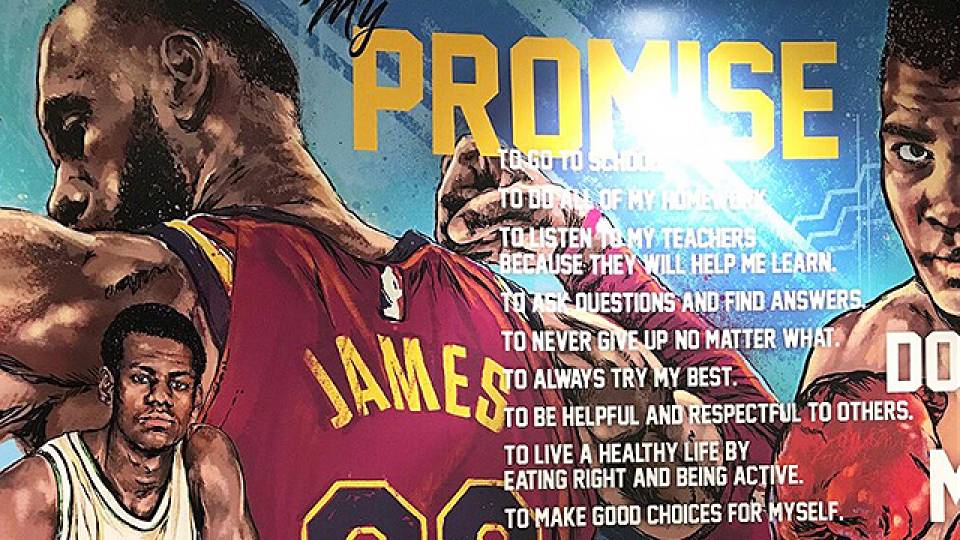
LeBron James has partnered with Akron Public Schools in Ohio to open I Promise, a beautiful new $8 million public elementary school in his hometown. James is one of the most prominent athletes in the world and he has repeatedly used this platform to speak out in support of underserved communities and social justice causes.
He explicitly stated that the founding of the school is the greatest achievement of his career — one that also includes multiple NBA championships and individual accolades. James and the school deserve all of the praise that they have received. However, as admirable as James’ philanthropic efforts are, they are not a solution to the problems in public education.
The public praise and excitement over the opening of I Promise are also a testament to the erosion of our society’s collective commitment to public education and public institutions generally. Over the course of the last 30 years, a new bipartisan common sense has emerged about public education. This common sense presumes that corporate reorganization, public-private partnerships, charitable donations and philanthropy can provide what should be a guaranteed public good: public education.
This policy turn promoting privatization, the proliferation of charter schools, school voucher programs, and reforms based on “choice,” has contributed to the social dislocation of black students, black educators, and black neighborhoods — particularly in Ohio. In their study Closed By Choice, researchers found that the growth of privately managed charter schools in Chicago contributed to the mass closure of public schools in black neighborhoods, “education insecurity,” “fiscal stress” on the entire district, and “the widespread denigration of public education.” While James’ school is not a charter school or a private school accepting vouchers, his involvement still suggests that private wealth is necessary to create quality public education.
The personal-origins story that James credits with inspiring the opening of the school really is an indictment of the ravages of racism and capitalism that created prolonged urban crises for African-Americans in cities such as Akron. Families who settled in Akron and other Rust Belt cities for decent-paying jobs in the industrial economy were devastated when these same jobs evaporated with the onset of deindustrialization. James credits teachers, mentors and family with helping him to find his way. However, structural factors beyond personal relationships created the conditions that led James to miss 83 days of school in the fourth grade. His family did not have secure housing, adequate employment, or sufficient public transportation to get him to school. His phenomenal talent as a basketball player provided him with a lane out of these conditions, a lane not available to so many other children.
Black educational organizers have long argued for the very type of  Continue reading: Despite LeBron’s admirable efforts, most black millionaires can’t save public education

Image result for black millionaires


The Undefeated — Sports, Race, Culture, HBCUs and More - http://bit.ly/1Cz30d6 on TheUndefeated
Image result for The Undefeated

The King and the Queen: How LeBron James and Beyoncé are rewriting the rules of celebrity - https://undf.td/2M4c2Zk by etoddbreland on TheUndefeated

LeBron bankrolls I Promise School in Ohio

LeBron bankrolls I Promise School in Ohio

LeBron is dishing out assists to a local school district in Ohio

The basketball player opens his I Promise school to widespread applause

Image result for lebron james school
Last week President Trump scoffed – albeit indirectly – at basketball icon LeBron James’ intelligence in a tweet, stating, “Lebron James was just interviewed by the dumbest man on television, Don Lemon,” Mr. Trump wrote. “He made Lebron look smart, which isn’t easy to do. I like Mike!” But it looks like LeBron is the one taking Trump to school.
Last week, LeBron announced the opening of his I Promise School. It is open to 240 low-income, at-risk third- and fourth-grade students in his hometown of Akron, in northeast Ohio. Each year, the school will add grades, expanding to first through eighth grades by 2022.
I Promise is a public-private partnership between the Akron School District and the LeBron James Family Foundation, a unique model that exemplifies LeBron’s exceptional abilities to see the bigger picture in the role education plays in community development.
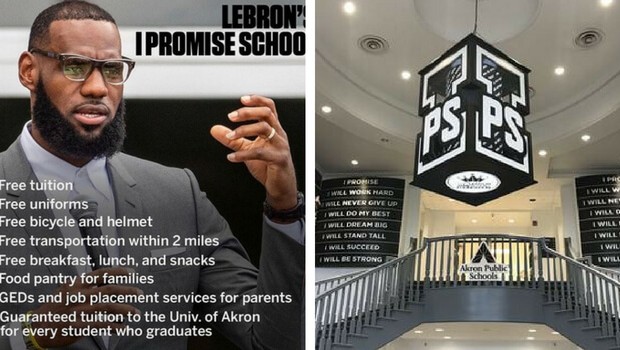
The new school is open for more days than the traditional school year, provides parents with job placement services, has a food bank on site, gives each kid a free bicycle and helmet, guarantees college tuition for every student who graduates and offers social and emotional support and other wrap-around services, something researchers and practitioners recognize as important. The school accounts for and addresses the structural discrimination that has long hurt black families — and black school districts. In a way, by connecting social assistances to the school, I Promise is providing wrap-around services for the entire district.
Amplifying the school’s offerings so far beyond the curriculum certainly isn’t conventional, but LeBron is deliberately stepping out-of-bounds, and kudos to him for that.
“Everything these kids are going through — the drugs, the violence, the guns, everything they’re going through as kids, I know,” said LeBron, the son of a single parent, during his remarks at the school opening. “For me to be in the position where I have the resources, the finance, the people, the structure and the city around me — why not?”
There have been other celebrities who’ve opened charter schools in the past, such as former basketball player, now sports analyst, Jalen Rose; entertainment mogul Sean “P. Diddy” Combs; former tennis standout Andre Agassi; and rapper Pitbull, to name a few. Those who see opening a school as a means of giving back, like LeBron, have also leveraged charter school legislation to do so, to the applause of education reformers.
Charters, which are publicly financed but independently managed, give founders the freedom to do more than what a traditional school may provide. So it’s perhaps unsurprising that the launch of I Promise spurred comparisons with the charter and education reform movements, which prize school choice, voucher systems, and competition.
“[T]he fact that this school opened only because of the good graces of a very wealthy, civic-minded athlete underscores the continuing problem with education funding in this country,” wrote education writer Valerie Strauss in her blog for the Washington Post. She gives him props for situating his school within the public school district, as opposed to launching a charter, but argues that this isn’t how civic institutions should be run. “America’s public schools should not have to depend on any wealthy individual or private entity to be sustained or improved.”
Image result for lebron james school
Reform advocate and writer Robert Pondisco replied to Strauss’ column with this short-sighted tweet: “As ever, no one asks ‘What about the other kids?’ when white parents move to affluent towns, or pull their kids out of zoned district schools. But it’s a problem when poor black and brown parents want something better — and when someone tries to offer it.”
It’s clear that LeBron has done his homework. His school offers a considered response to criticisms that have been levied against charter schools — that they impose what outsiders believe black kids need to learn, sidestep structural inequality, reduce the number of experienced black teachers and purposely erode locals’ voting power on school boards.
First, LeBron is a son of Akron. Local communities have learned to be Continue reading: LeBron bankrolls I Promise School in Ohio


lebron james new school i promise feat (1)
Image result for lebron james school

Senate Democrats Want Answers From Jeff Sessions Over Repealed Memos On Racial Diversity In Schools

Senate Democrats Want Answers From Jeff Sessions Over Repealed Memos On Racial Diversity In Schools

Senate Democrats Want Answers From Jeff Sessions Over Repealed Memos On Racial Diversity In Schools
The lawmakers asked Attorney General Sessions and the Education Department to hand over records.


Twenty-one Senate Democrats criticized Attorney General Jeff Sessions on Tuesday for his decision to rescind guidance memos on affirmative action — which instructed schools how they can legally consider the race of applicants to promote diversity — and pressed him to hand over records on racial discrimination complaints.
“We are deeply concerned your actions will make it more difficult for institutions to open up doors of opportunity to students and communities that have been historically underrepresented or have been left behind,” said a letter to Sessions and Education Sec. Betsy DeVos.
Guidance documents don’t amount to law, but they carry particular weight for education institutions, which rely on the Education Department for billions of dollars in federal grants.
Rescinding the memos in July, along with a swath of other guidance memos, came after the Justice Department has grown increasingly hostile toward affirmative action policies and threats of litigation around a case at Harvard University.
The lawmakers asked for a list of the complaints of discrimination based on race or ethnicity made to the Department of Education’s Office for Civil Rights since January 1, 2016. Further, they asked, “How will the Department advise schools about how to seek diversity in their student body consistent with the Constitution?”

Led by Sen. Patty Murray of Washington State and Sen. Dianne Feinstein of California, the lawmakers also pressured Sessions and DeVos’s larger rollback of civil rights enforcement more broadly.
“With almost daily attacks from your Administration on the protections for immigrants, women, children, people of color, people with disabilities, survivors of sexual assault, and LGBTQ students, it is clear there is a coordinated and systematic effort to undermine the law, divide communities, and destabilize American values at every level and in every community,” the senators wrote.
On July 3, Sessions rescinded seven so-called guidance documents that explain how the Continue reading: Senate Democrats Want Answers From Jeff Sessions Over Repealed Memos On Racial Diversity In Schools


Monday, August 6, 2018

LeBron James Akron school: Why it matters that I Promise is public.

LeBron James Akron school: Why it matters that I Promise is public.

It’s a Big Deal That LeBron James Decided to Fund a Public School
Image result for LeBron’s Education Promise

The only upside to Donald Trump’s petulant Friday night Twitter swipe at LeBron James was that it gave an extra publicity bump to the basketball star’s big new philanthropic project. Last week, James opened a new elementary school for at-risk students in his native Akron that he’s funding in partnership with the city. Some headlines about the I Promise School have focused on the fact that James has offered to pay college tuition for any of its graduates. But that’s not what’s really intriguing about the effort.

The most interesting thing about I Promise is that it’s a genuine public school, not a charter or a private school. James is shaping the school’s mission, and his family foundation is committed to spending at least $2 million annually to fund it. But Akron Public Schools will run the operation and provide the bulk of its resources. As the Cleveland Plain Dealer explains:
It’s a district-owned building. The district will hire and pay the teachers and administration. Kids will ride district buses to school. And they will all eat the free breakfast and lunch the district gives all students.
I Promise will eventually cost about $8 million a year to run out of the district’s regular budget, covered mostly by shifting students, teachers and money from other schools, the district says.
This is a refreshing departure from most celebrity forays into education, which have tended torevolve around the politically contentious charter school movement. Publicly funded and privately operated, charter schools are seen by their detractors as little more than vehicles for drawing resources away from traditional public schools and undercutting teachers unions. This is not entirely fair; some charters do great work and benefit from having a bit of freedom to try new education models. But many are middling or outright atrocious and have attracted less than savory for-profit management companies—sometimes with disastrous results for children. Michigan, for instance, has watched its rankings in reading and math collapse as the state has become home to more for-profit charters than anywhere else in the nation.

I Promise has a lot of qualities ordinarily associated with the better charters. It will have longer-than-normal school days, running from 9 to 5; a curriculum focused on science and tech; and beefed-up professional training and support programs for teachers. Every kid gets a Chromebook. And, following in the footsteps of charter projects like the Harlem Success Academy, it’s also going to offer wraparound services aimed at helping its students’ families, such as a food pantry, a GED program for parents, and a seven-week summer science and tech camp to help kids keep from sliding back on their academic progress. There are also some bells and whistles: Every kid is getting a bicycle.Continue reading: LeBron James Akron school: Why it matters that I Promise is public.


OMG: Arizona school districts and charters that pay teachers the most, least

Arizona school districts and charters that pay teachers the most, least

Arizona school districts and charters that pay teachers the most, least
Arizona is Building Tiny Homes for Teachers Instead of Paying Them a Living Wage | Diane Ravitch's blog - https://wp.me/p2odLa-ktP via @dianeravitch


The highest-paying Arizona school district will be paying its teachers an average of nearly $71,000 in the 2018-19 school year, while teachers in some schools will be making just over an average of $30,000.
That wide range of average teacher salaries is reflected in financial data district and charter schools have reported to the Arizona Department of Education.
The state budget the Legislature approved and Gov. Doug Ducey signed included $306 million intended for teacher pay as part of the governor's promise to boost teachers' salaries by 20 percent in three years.
Practically every district and charter school gave its teachers raises, but those bumps varied widely.
Districts reported giving average teacher-salary increases between $1,049 and $9,162. Charters' average increases varied between $1,011 and $7,694.
Similarly, the state's financial data show that 15 of the top 20 school systems for average teacher salary are school districts, while all but one of the 20 lowest-paying Arizona school systems were charter holders.
Eight school districts and two charter holders were among the top 10 in the state to give the largest average teacher pay raise increases this year. 
Arizona public schools, for the first time, are required to report to the Arizona Department of Education the increase in average teacher salaries from last school year.
Below are the Arizona district and charter schools with the highest and lowest teacher pay.
Some disclaimers: Not all schools have submitted budgets to the Arizona Department of Education. The department has not yet audited the data the schools submitted.
And the data indicate that some schools incorrectly reported their teacher salary information to the state.
The Republic did not include schools that appeared to include errors in its financial reporting. These lists also do not include schools that listed average salaries below $30,000.

Highest-paying Arizona school districts

1. Chinle Unified School District: $70,720 average 2018-19 teacher salary
2. Baboquivari Unified School District: $66,505
3. Alpine Elementary School District: $65,369
4. Phoenix Union High School District: $64,218
5. Tempe Union High School District: $61,266

Lowest-paying Arizona school districts

1. St. David Unified School District: $36,404 average 2018-19 teacher salary
2. Douglas Unified School District: $37,413
3. Red Rock Elementary School District: $37,602 
4. Duncan Unified School District: $37,660
5. Crown King Elementary School District: $38,000

Highest paying Arizona charter schools

1. Heritage Academy, Inc.: $60,598 average 2018-19 teacher salary
2. Maricopa County Community College District dba Gateway Early College High School: $58,204
3. International Commerce Secondary Schools Inc.: $58,127
4. Heritage Academy Queen Creek Inc.: $57,693
5. Salt River Pima-Maricopa Community Schools: $57,547

Lowest paying Arizona charter schools

1. Pillar Charter School: $30,287 average 2018-19 teacher salary
2. Patagonia Montessori Elementary School: $31,650
3. Painted Pony Ranch Charter School: $32,100
4. Discovery Plus Academy: $32,275
5. Mexicayotl Academy Inc.: $32,364

Largest average pay raise increases

1. Chinle Unified School District: $9,162 increase in average salary (15 percent increase)
2. Casa Grande Union High School District: $9,131 (18 percent)
3. Sahuarita Unified School District: $8,801 (19 percent)
4. Agua Fria Union High School District: $8,085 (16 percent)
5. Destiny School Inc.: $7,694 (21.9 percent)
6. Tempe Union High School District: $7,549 (14 percent)
7. Wellton Elementary School District: $7,407 (19 percent)
8. Antelope Union High School District: $7,296 (18 percent)
9. Heber-Overgaard Unified School District: $7,090 (17 percent)
10. Young Scholars Academy Charter School Corp.: $6,978 (14.4 percent)
READ MORE:
Arizona school districts and charters that pay teachers the most, least


Sunday, August 5, 2018

Wendy Lecker: As public education stumbles, democracy falls - StamfordAdvocate

Wendy Lecker: As public education stumbles, democracy falls - StamfordAdvocate

Wendy Lecker: As public education stumbles, democracy falls

This artwork by Kevin Kreneck refers to Betsy DeVos and how she might change and influence the Department of Education. Photo: Kevin Kreneck
There is a disturbing trend in American policy where a powerful few use government to benefit themselves at the expense of the many. The most recent example is Treasury Secretary Steven Mnuchin’s proposal to implement a $100 billion tax cut that would primarily benefit the 0.1 percent of earners, including himself. Simultaneously, there are proposals to impose punitive work requirements on SNAP and Medicaid recipients, hurting mostly children, the elderly and the disabled.
This pattern extends to state policy. The American Federation of Teachers reports that more than half the states invested less in public education in 2016 than they did in 2008, even as most of these states enacted tax cuts during that period. The poorest districts are the hardest hit, as they cannot recoup lost state funding with local revenue.

Scholars Jamila Michener and Sally Nuamah have found that when government is unresponsive to the most underserved, e.g., erecting barriers for Medicaid recipients or closing public schools over community objections, those communities disengage from political participation. When government serves the privileged few, democracy also suffers.
U.S. Education Secretary Betsy DeVos views her role in government as advancing the interests of the few. While accelerating privatization of public schools by expanding charters and vouchers, she has declared: “we should be funding and investing in students ... not in institutions, not in systems.” She commodifies education, likening it to Uber, cellphones and Blockbuster video. DeVos prioritizes “parents’ fundamental right to choose” over equity.


As the political theorist Benjamin Barber noted, private choice cannot be a surrogate for the public good. “(A)ggregating our private choices … yields an inegalitarian and highly segmented society in which the least advantaged are further disadvantaged.” Indeed, school choice has accelerated segregation and the diversion of funds from public schools. Charters and vouchers also often exclude the neediest, leaving public schools to serve them with fewer resources.
Barber also observed that choice is an illusion: “the real power... is in the determination of Continue reading: Wendy Lecker: As public education stumbles, democracy falls - StamfordAdvocate

Big Education Ape: Charter Schools: ALL ABOUT THE MONEY - http://bigeducationape.blogspot.com/2018/08/esj-capital-partners-llc-bought-four.html


Charter Schools: ALL ABOUT THE MONEY

ESJ Capital Partners | Charter Schools

Aventura firm makes $45M addition to its portfolio of school properties
ESJ Capital Partners, LLC, bought four charter school campuses in Arizona, Ohio and Washington, D.C., with a total of 176,000 square feet and 3,000 students


Aventura-based ESJ Capital Partners, LLC, acquired four charter school properties for $45 million.
ESJ bought the four school properties totaling 176,000 square feet from publicly held EPR Properties, listed on the New York Stock Exchange under ticker symbol EPR.
The schools in Arizona, Ohio and Washington, D.C., serve more than 3,000 students, from kindergarten through eighth grade. The operator of the schools is Imagine Schools, a national network of charter schools.
“This acquisition is consistent with our long-term strategy in this arena,” Arnaud Sitbon, president and CEO of ESJ, said in a prepared statement.
ESJ supports the facility needs of private and charter schools through closed-end investment funds and has accumulated the facilities of 26 such schools, valued at more than $650 million.

ESJ has invested more than $100 million in the facilities of Imagine-run schools.
“The Imagine campuses that we just acquired have been open over 13 years and are thriving financially and academically, with consistent high enrollment,” Matthew Fuller, chief investment officer of ESJ, said in a prepared statement. – Mike Seemuth
ESJ Capital Partners | Charter Schools


Charter Schools


charter school | The Real Deal Miami -https://therealdeal.com/miami/tag/charter-school/ on @trdmiami