Latest News and Comment from Education

Thursday, July 5, 2018

The Problem With Generalizing About ‘America’s Schools’ - The Atlantic

Revisiting Reagan's 'A Nation at Risk' Report 35 Years Later - The Atlantic

The Problem With Generalizing About ‘America’s Schools’
It’s an abstraction that has obscured the true workings of the country’s education system for decades.

Revisiting Reagan's 'A Nation at Risk' Report 35 Years Later 

Thirty-five years ago, in April of 1983, Ronald Reagan appeared before the press to publicize a government report warning of “a rising tide of mediocrity” that had begun to erode America’s education system. Were such conditions imposed by an unfriendly foreign power, the authors declared, “we might well have viewed it as an act of war.”
Despite its grave tone, the report, titled “A Nation at Risk,” had little direct impact on policy. It did, however, establish a new way of talking about public education in the United States, a master narrative that has endured—and even subtly changed American education policy for the worse—over the past several decades.
Across that stretch of time, politicians and policy makers have spoken often of the inadequacy of “America’s schools.” In fact, this trope is one of the few things that Betsy DeVos, Donald Trump’s regulation-averse secretary of education, has in common with her predecessors; she and previous education secretaries have regularly discussed the nation’s schools as a cohesive whole. This phrasing is useful shorthand for a national official, but it obscures the fact that the United States does not actually have a national education system. Many countries do. In France, for example, a centralized ministry of education governs schools directly. But in the U.S., all 50 states maintain authority over public education. And across those 50 states, roughly 13,000 districts shape much, possibly even most, of what happens in local schools.

The abstraction of “America’s schools” may be convenient for rousing the collective conscience, but it is not particularly useful for the purpose of understanding (or improving) American education. Consider the issue of funding. On average, federal money accounts for less than 10 percent of education budgets across the country, and the rest of the financial responsibility falls to states and local schools. If local schools are unable to raise what they need, the state is usually well positioned to make up the difference, but states differ dramatically in their approaches. On average, states spend roughly $13,000 per student on public education—but looking at the average alone is misleading. Only about half of states spend anything close to that figure: A dozen spend 25 percent more than the national average, and 10 states spend 25 percent less. The result is significant disparities, and some striking incongruities. New York’s schools, for instance, spend roughly three times as much per student as Utah’s schools—a huge difference, even after accounting for New York’s higher cost of living.
Additionally, some states do much more than others to ensure that each district is properly funded. Local property taxes help fund schools nationwide, but in some places, like Massachusetts, the state steps in to provide additional resources for lower-income areas. In other places, like Illinois, property taxes are simply the primary sources of school funding, which means less money for poor districts than for wealthy ones.
Though states often take similar approaches on curricula and teacher licensure, they tend to differ considerably in policy and practice. Things like early  continue reading: Revisiting Reagan's 'A Nation at Risk' Report 35 Years Later - The Atlantic


Wednesday, July 4, 2018

Q&A: Will the New Charter School Bill Impact Commercial Real Estate? WTF is a PRIVATE CHARTER SCHOOL?

Q&A: Will the New Charter School Bill Impact CRE?

Q&A: Will the New Charter School Bill Impact Commercial Real Estate? WTF is a PRIVATE CHARTER SCHOOL?


A new school law, the controversial House Bill 7069, has been causing quite a stir in Florida since coming into effect in 2017. The recent change in legislation targets charter schools and includes a series of provisions that support the creation of an expansive educational system outside of the public school districts’ control. In other words, county school boards are now required to share local tax revenues—such as their construction budget—with private charter schools, among other clauses.
Another significant change brought on by the bill is the creation of Schools of Hope—a new charter school network. More precisely, the legislation encourages out-of-state charter school operators to move into regions where the nearest traditional public schools have persistent low ratings. Construction work, renovations or repairs at the new facilities get funded through local tax revenue granted by school districts. Board approval is not required for the allocations.
Joey Blakley, vice president of the Religious, Education & Not-For-Profit Group at Foundry Commercial, believes the new legislation could impact the commercial real estate market by empowering smaller operators to build or expand their charter schools due to funding from the county. Blakely told Commercial Property Executive how the bill influences new construction and what type of real estate assets developers might target.
What was the status of charter school development before the passing of HB 7069 and how has it changed since?
Blakely: It’s difficult to track charter school development, but according to the state, 34 new charter schools opened in the fall of 2017. Schools just started getting the new share of property tax funds, so it may be a year or two before we see significant changes. We expect to see charter schools use the funds to help expand and upgrade current facilities and develop new ones.
How does the new legislation impact the commercial real estate market? Continue reading: Q&A: Will the New Charter School Bill Impact CRE?

‘Educator spring’ spawns wave of teacher candidates - POLITICO

‘Educator spring’ spawns wave of teacher candidates - POLITICO

‘Educator spring’ spawns wave of teacher candidates
Teachers are building the next blue wave — without much help from Democrats.


Angry educators are flooding down-ballot races in the wake of recent red-state teacher strikes, accelerating the Democratic Party’s rebuilding process at the statehouse level and raising the prospect of legislative gains after years of decline.

Nearly 300 members of the American Federation of Teachers union are running for political office this year, more than double the number in each of the years 2012 and 2016. The teacher candidacies are part of a rising tide of political activism in 2018, with nearly 800 candidates running in the first round of Oklahoma's primaries, breaking the previous record of 594 set in 2006, and more than 200 filing to run in next month's Arizona primary — more than ran during each of the previous three election cycles.

The teacher candidacies suggest that the wave of teacher strikes and protests that began last winter in West Virginia and later spread to Oklahoma, Arizona and elsewhere created a grass-roots political opportunity. With their unions still reeling from a Supreme Court decision last month that's expected to deal a heavy financial blow, the teacher candidates are hoping to unseat conservative majorities that have dominated state legislatures since the Obama years.

“We’re receiving applications by the hour. It’s amazing,” said Lily Eskelsen Garcia, president of the National Education Association. “We’re really seeing the sun, moon and stars line up with the women’s march, the educator spring.”

There are some early signs of success, and not just among Democrats. In May, high school math teacher Travis Brenda defeated the majority leader of the Kentucky House, Jonathan Shell, in the Republican primary. In Oklahoma, three Democrats won special elections in state legislative districts in which President Donald Trump enjoyed huge margins. And in West Virginia, the local teachers union helped defeat Robert Karnes, one of its main antagonists in the state Senate, and voted in Continue reading: ‘Educator spring’ spawns wave of teacher candidates - POLITICO

Tuesday, July 3, 2018

DeVos goes deep with anti-regulatory mission at Education Department

DeVos goes deep with anti-regulatory mission at Education Department

DeVos goes deep with anti-regulatory mission at Education Department
California is the latest state to lob legal challenges at the Education Secretary's controversial policies.


WASHINGTON — Education Secretary Betsy DeVos is expected to take new steps as early as this week toward reversing Obama-era protections for students in debt to for-profit schools, including those that go out of business. It’s the latest in a broader effort by DeVos to recast the mission of her department and to relax safeguards intended to protect economically vulnerable students.
DeVos is also expected to rewrite rules requiring for-profit schools to equip students with minimal employment skills to qualify for federal aid.
DeVos’ plans to transform her department have gone largely unheralded, despite the outcry that greeted her appointment last year as President Donald Trump’s leading voice on education policy. But her push to ease regulations on for-profit colleges has opened a new front in the Democratic resistance effort, sparking lawsuits from state officials.
California added another legal challenge Friday when the state sued the nation’s biggest loan company, Navient, arguing it had engaged in illegal conduct servicing federal student loans. Continue reading: DeVos goes deep with anti-regulatory mission at Education Department


The Janus Supreme Court ruling is bad news for all of us: If you can read this, thank a teacher. If you don’t work the weekend, thank a union

If you can read this, thank a teacher. If you don’t work the weekend, thank a union

If you can read this, thank a teacher. If you don’t work over the weekend, thank a union

The Janus Supreme Court ruling is bad news for all of us


Is this Supreme Court decision the end of teachers unions?” asked an NPR article responding to last week’s shattering decision in Janus v. the American Federation of State, County and Municipal Employees. In the 5-4 decision, the justices overturned an older ruling that said public sector unions could require non-union members to pay “fair share fees” as a condition of union representation for negotiating things that benefit all workers, such as work hours, pay, vacation time and grievance procedures. This will undoubtedly rob unions of fees from “free riders” who benefit from collective bargaining while not paying for the privilege.
Yet if the last 12 months of organizing by teachers’ unions across the country has shown us anything, it is that unions will not go quiet into the night. In the right-to-work states of West Virginia, Kentucky, Arizona, and Oklahoma, teachers have organized quite dramatically in regional and statewide strikes. With their actions, they grabbed headlines in national papers, prodded Republican leadership to action, and in some cases won long overdue concessions in their contracts. Teacher won pay raises in West VirginiaArizona, and Oklahoma, and the legislature agreed to increase the amount of money in the Department of Education budget in Kentucky.
In fact, the Supreme Court decision might even spark more such actions: With fewer negotiating tools available to them, teachers may feel their only option is to strike. This is not a good outcome — for teachers; for students who spend much of their week in schools; for black people, who have higher rates of union membership than white people; the Democratic Party, which benefits from political contributions from unions and their boots on the ground; and for all of the rest of us, even if we don’t believe in unions. After all, collective bargaining gave us the weekend.
Among full-time wage and salary workers, according to the Bureau of Labor Statistics (BLS), union members had median usual weekly Continue reading: If you can read this, thank a teacher. If you don’t work the weekend, thank a union


Monday, July 2, 2018

Randi Weingarten Has 'Hope in the Darkness.' And Also Some Fear.

Randi Weingarten Has 'Hope in the Darkness.' And Also Some Fear.

Randi Weingarten Has 'Hope in the Darkness.' And Also Some Fear.

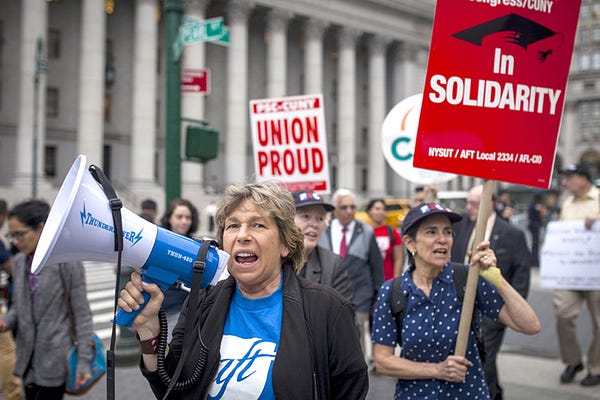
Our nation’s teachers unions have had a whiplash of a year, from the statewide teachers’ strikes that have swept the country to last week’s Supreme Court ruling in the Janus v. AFSCME case that could severely hurttheir membership. America’s most powerful teachers’ union leader says there is much, much more to come.
For the past decade, Randi Weingarten has led the 1.7 million-member American Federation of Teachers. She has been a prominent voice in battles over public education, organized labor, and national politics. In the dark aftermath of last week’s Janus ruling, which will almost certainly drain members and money from public unions nationwide, she spoke to us about how working class interests can possibly try to survive and thrive in the age of Trump.
SplinterIs it possible that the Janus ruling was even worse than you thought it would be?
Randi Weingarten: No, I expected it. I helped write the amicus brief for both Friedrichs [a nearly identical case on which the court deadlocked] and for Janus, and I had sat through the Janus hearing, which I found to be absolutely worse than the Friedrichs hearing. Gorsuch said nothing, but Alito and Kennedy clearly had their minds made up. Alito has had his mind made up for six years—how to weaponize the First Amendment against working people. And if you think about it, if you go back and read the Citizens United case, which uses the First Amendment to give corporations unfettered right to participate in politics, and now at the same time they’ve used the First Amendment to limit the rights of workers through their unions to have any power. It is the most ideological court that we’ve seen in modern history, and ideological about corporate power and about unfettered markets.
Splinter: What do you think Anthony Kennedy’s retirement means for labor law?
Weingarten: I know Kennedy gets a good rap because of what he did on marriage and what he did on sustaining Roe v. Wade. As a lesbian who just got married this March, I appreciate that. But on economic issues,  continue reading: Randi Weingarten Has 'Hope in the Darkness.' And Also Some Fear.

Sunday, July 1, 2018

Today Is My Birthday | Diane Ravitch's blog

Today Is My Birthday | Diane Ravitch's blog

Today Is My Birthday


I mention this only because it is a milestone. Today I am 80. I can’t believe it. That is so old. I mean really old. I don’t feel 80. I am full of piss and vinegar and spoiling for a fight. I’m angry that the country I love is rolling backward to before the New Deal. I’m angry that people who don’t love America are dissing our allies and showering kisses on tyrants. I want to kick some serious A—.

The year I was born was a bad year. 1938. A very bad year. Chamberlain went to Berlin and returned with a piece of paper promising “peace in our time.” 1938 was also the year of the Evian Conference, where the nation’s of Europe and the U.S. met to consider “the Jewish Problem.” Delegates from 32 countries met and agreed that no one wanted to accept Jewish refugees. Sorry, no room for them. Germany was amazed that no one wanted “the Jews,” and they would have to devise their own solution. They did.
The next seven years were hell for the world. Many of my European relatives disappeared into Hitler’s camps and ovens. Somehow, the world came through. Many millions of people died before this scourge was eliminated.
I hope and pray we will come through this horrible era as well. A fascist in the White House, eager to define people and castigate them for their religion and ethnicity. A man so heartless that he would order border guards to rip children, babies, from their mothers’ arms, then lose them. This can’t continue. It is up to us to save our country.
Don’t send me birthday greetings. Send some money to the Network for Public Education. Anthony Cody and I co-founded it in 2013. We created it to fight the billionaires. They have the money. We have the millions of parents and teachers and graduates of America’s public schools on our side. Believe it or not, we have them on the run. We blog, and no one pays us. They have to pay out millions of dollars to set up bought-and-paid-for-blogs like The 74 and Education Post. We do it for nothing. No one pays me or Mercedes Schneider or Peter Greene or Tom Ultican or Gary Rubinstein or or Julian Vasquez Heilig or Jesse Hagopian or Nancy Bailey or Paul Thomas or dozens of other people who post about kids and teachers and schools and the corporate raiders.

If you want to, say Happy Birthday with a check to:
The Network for Public Education
PO BOX 150266
Kew Gardens, NY 11415-0266
We are a lean, mean organization with a staff of 1.5 people. We make as much noise as possible.
If you have a million, we won’t refuse it. If you have $5, that’s welcome too.
Plan to join us in Indianapolis October 20-21. We can celebrate the collapse of corporate reform together.
I’m angry about the fools in Washington, but right now I’m very happy because I know that DeVos and her wrecking crew will be footnotes in the history books. They will be forgotten, except as the bad people who fought democracy and lost. If they are remembered at all, it will be with contempt.
Courage, my friends, do the right thing, do what is best for children, do what matters most for real education, and you can look at yourself in the mirror every day and find the strength to keep fighting for what is right.
I’m staying around around to cheer you on.

Today Is My Birthday | Diane Ravitch's blog


#Union – Randi Weingarten – Medium

#Union – Randi Weingarten – Medium

#Union – Randi Weingarten

Right-wing groups have been waging war against public sector unions for many years, and, last week, a divided 5–4 conservative majority on the U.S. Supreme Court handed them a win in Janus v. AFSCME Council 31. This case, which overrules decades of precedent, was about stripping unions of resources, with the ultimate aim of eradicating labor unions altogether. Why was this such a prized goal for these right-wing groups? Because unions help level the imbalance between the rich and powerful and everyone else, and help working people get ahead.

Stamping out unions has long been the aim of many wealthy conservatives, because it’s easier for them to win elections, maintain economic dominance, and disempower workers when individuals can’t collectively improve their lives through the strength and solidarity of a union.
Janus’ supporters argued that the “fair share” feesnonmembers pay for union representation violate their First Amendment rights, even though workers have the right not to join a union or pay for any of the union’s political work. Justice Elena Kagan dismissed the majority’s opinion as “weaponizing the First Amendment,” noting that the same argument was raised — and unanimously rejected — 41 years ago in Abood v. Detroit Board of Education, a precedent the Supreme Court has upheld six times. With this reversal, public employees who benefit from a collective bargaining agreement but choose not to join the union can opt to be “free riders” and not contribute anything for the benefits they receive, while the union must still represent them.
While right-wing groups are mobilizing and spending many millions of dollars Continue reading: #Union – Randi Weingarten – Medium