Latest News and Comment from Education

Wednesday, April 18, 2018

Betsy DeVos, Matt Bevin, and the Smarmy Attack on Teachers | GQ

Betsy DeVos, Matt Bevin, and the Smarmy Attack on Teachers | GQ:

Betsy DeVos, Matt Bevin, and the Smarmy Attack on Teachers

It’s easy to oppose education strikes if you don’t believe teaching is a job.
Image result for matt bevin teachers
In February, West Virginia teachers shut down every public school in the state. For nearly two weeks, the striking teachers stood their ground, disregarding the advice of union leaders and holding out for a 5 percent raise and a promise from the governor to address the sharply rising cost of health care. Following their success, teachers in Oklahoma organized their own state-wide strikes, while those in Arizona are also threatening strikes for the end of the month if the legislature doesn't finally come through on pay raises. And in Kentucky, educators across the state staged walkouts last Friday.
Kentucky governor Matt Bevin was particularly irked by the walkout in his state, and had a lot to say about it. "I guarantee you somewhere in Kentucky today, a child was sexually assaulted that was left at home because there was nobody there to watch them," he told reporters, adding, "I'm offended that people so cavalierly, and so flippantly, disregarded what's truly best for children."
To be 100 percent clear, Bevin had no information about any sexual assault that happened during the walkout. His "guarantee" was a total fabrication. He's since apologized in a four-minute video, but only after facing outrage from teacher organizations and Kentucky politicians alike—the state's Republican-dominated House of Representatives even passed resolutions condemning the remarks. But he isn't the only political leader trying to make the teachers into the villains of this story. Just days before Bevin basically blamed teachers for child abuse, Oklahoma governor Mary Fallin compared teachers striking in that state to a "teenage kid that wants a better car." In Fallin's metaphor, the perfectly good car the teachers already have includes broken desks, four-day weeks, stagnant wages since 2008, and tattered, decades-old textbooks.
Even education secretary Betsy DeVos weighed in, according to the Dallas Morning News:
"I think about the kids,” DeVos said. “I think we need to stay focused on what’s right for kids. And I hope that adults would keep adult disagreements and disputes in a separate place, and serve the students that are there to be served.”
Although DeVos uses the word "adults" here, and not specifically "teachers," she's making the same argument as Bevin in Kentucky: Teachers are doing a disservice to students by letting these "adult disagreements" get in the way of their teaching. We often talk about teaching as a "calling," something that people are innately drawn to out of some altruistic impulse. And there's nothing wrong with having a sense of duty for your job, that feeling that your work is tied to a broader social good. But this romanticized view of teaching actually lionizes and devalues it at the same time. If we don't think of teaching as a job—instead of a calling, a sacrifice, a duty—then we can't talk about job conditions, material things like class size, shortened school weeks, or teacher pay. And it's not just a problem from the right. Teach for America, well-intended as it may be, is founded on the bedrock principle that minimal training and boundless passion can prepare college grads to teach in under-served communities, essentially de-professionalizing education.
Opponents of well-funded public education, people like DeVos and Bevin who want to see schools as privatized as possible, are relying on this same mindset when they attack teachers pushing for better working conditions. Teachers are caretakers, the argument goes, and therefore if some teachers are willing to walk out of school,  Continue reading: Betsy DeVos, Matt Bevin, and the Smarmy Attack on Teachers | GQ:


Tuesday, April 17, 2018

FIND A NATIONAL SCHOOL WALKOUT | Indivisible Guide #NationalSchoolWalkout #MarchForOurLives #NeverAgain

FIND A NATIONAL SCHOOL WALKOUT | Indivisible Guide:

Image result for national school walkout logo

Image result for NATIONAL SCHOOL WALKOUT
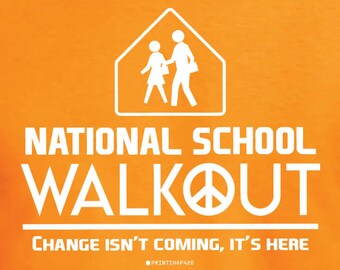
National School Walkout is a movement powered and led by students across the country. We’re protesting congressional, state, and local failures to take action to prevent gun violence. America is the only country in the world where so many people are killed by guns, and yet our leaders do nothing about it. In many states it’s more difficult to register to vote than it is to buy a rifle. Apparently to some politicians, a vote is scarier than a gun.
We’re changing that.

FIND A NATIONAL SCHOOL WALKOUT

Related image
The National Student Walkout is a nationwide protest of our leaders’ failure to pass laws that protect us from gun violence. Mass shootings happen far too frequently in America, and we as a nation have become numb to seeing the news. After each one, the same cycle takes place: the media spend less than a week on the story, politicians offer their “thoughts and prayers,” and nothing ever changes. But after the horrific massacre at Marjory Stoneman Douglas High School in Parkland, Florida, young Americans are taking matters into their own hands.
On April 20th, the anniversary of the Columbine High School shooting, American students will walk out of class and protest.
Together, we will send a message that we won’t tolerate any more inaction on this issue. And if cowardly politicians fail to act, young people will show them the consequences of letting so many Americans die by voting them out in November.
Can't find a walkout near you? Create your own hereAnd get your #NationalSchoolWalkout merch here
There are 2362 events open for signup FIND A NATIONAL SCHOOL WALKOUT | Indivisible Guide:


Beutner emerges as a top pick for L.A. schools superintendent amid last-minute jockeying

Beutner emerges as a top pick for L.A. schools superintendent amid last-minute jockeying:

Beutner emerges as a top pick for L.A. schools superintendent amid last-minute jockeying


Austin Beutner has emerged as a leading contender to run the Los Angeles school district, with backers saying he is smart enough and tough enough to confront its financial and academic struggles.

Though he does not have a background in education, the former investment banker has in the last year examined some of the district's intractable problems, serving as co-chair of an outside task force with the support of then-Supt. Michelle King.

Sources inside and outside the school district said Beutner appears to have more support on the seven-member board than other finalists, and his name could come up for a vote as early as Tuesday.

But with the choice looming, board members last week received documents from the district's general counsel David Holmquist, notifying them that the charity Beutner founded, Vision to Learn, could lose its contract with the L.A. Unified School District. The nonprofit, according to the documents, has fallen far short in its commitment to provide vision screenings and glasses to thousands of low-income students this school year.

The Times was alerted to the Vision to Learn documents by sources who requested anonymity because they were not authorized to discuss the matter. The leaks appear to represent a last-gasp effort to thwart Beutner's appointment, reflecting some insiders' concerns about his qualifications and about the direction in which he might take L.A. Unified.

Reached Monday, Beutner declined to comment on the superintendent search and referred questions about the nonprofit to its administrative staff, which is in charge of day-to-day operations. Vision to Learn quickly challenged the accuracy of the district findings, saying it has served more students than recorded in district tallies and that the school system caused early delays.

The school board received documents about that contract as Beutner, a former Los Angeles Times publisher, appeared to emerge as one of four finalists for the job of superintendent. He is scheduled to be interviewed a second time on Tuesday, sources said.

Interim Supt. Vivian Ekchian, who has been managing the district since King left on medical leave last fall, also made it to the second round, according to insiders. The other two apparent finalists are more difficult to confirm, but several sources have named Indianapolis Supt. Lewis​ ​Ferebee and former Baltimore Supt. Andres Alonso, who teaches at the Harvard Graduate School of Education.

The nation's second-largest school district faces long-term budget problems because of rising pension costs, vastly underfunded retiree health benefits and declining enrollment. Despite incremental progress, most district students perform below the California average on state test scores, a challenge L.A. Unified has in common with other large urban school systems.

Politically, L.A. Unified is governed by an elected board split by ideological differences and sometimes pulled in conflicting directions by influential outside groups. The most prominent combatants are the teachers union and charter-school supporters, who typically back opposing slates for the school board. Charter schools, which are independently operated, are a major factor in the steep enrollment drop at many district-operated schools. Most charters are non-union.

In recent months, the task force Beutner has helped lead has delivered numerous proposals about how to improve the district. It has looked at student attendance, real estate holdings and oversight of district operations.

It's far from clear whether the information regarding Vision to Learn has eroded Beutner's support on the board.

A key document among those delivered to board members was a letter from the district to Vision to Learn dated April 11, stating that the nonprofit had provided exams and glasses for only about 5% of this school year's target of 30,000 students.

Unless a plan is put in place to correct the problem by early May, "LAUSD may terminate the agreement for default," wrote Bruce Trenbeth, contract administration manager for L.A. Unified.

Vision to Learn's executive director, Ann Hollister, said L.A. Unified's numbers are out of date. The district, she said, seems to be counting only the students for whom the nonprofit has so far been paid. The actual number of students screened, she said, is about 55% of the target, while about 18% received eye exams and 15% received glasses.

"We have an electronic medical record for every child we examined and screened," Hollister said.

But even the nonprofit's figures put Vision to Learn well behind its projected schedule, with less than two months left in the school year.

The district's letter to Vision to Learn said "numerous schools (with returned consent forms) dating as far back as Fall 2017 [requesting] services have not been contacted, had their calls continue reading: Beutner emerges as a top pick for L.A. schools superintendent amid last-minute jockeying


Who Is LA Times' Austin Beutner: Billionaire for Mayor? http://anewdomain.net/?p=82517

Monday, April 16, 2018

National School Walkout: Everything to know about the upcoming event to end gun violence - #MarchForOurLives #NeverAgain

National School Walkout: Everything to know about the upcoming event to end gun violence - ABC News:

National School Walkout: Everything to know about the upcoming event to end gun violence

Image result for April 20 walkout


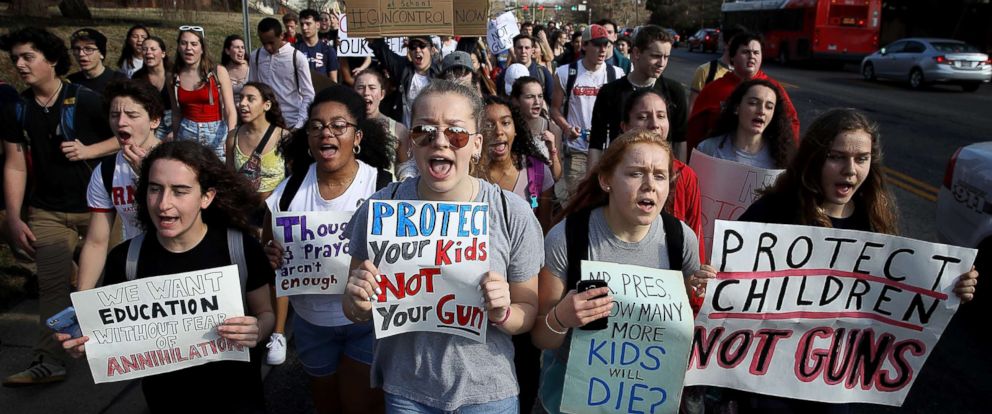
Thousands of students across the country will come together next week to rally against school gun violence -- an event the teenage organizers hope will empower students to continue their momentum in a push for common-sense gun reform.


The event -- called the National School Walkout -- focuses on high schools and will take place on April 20, the anniversary of the massacre at Columbine High School in Colorado, where two students opened fire in 1999, killing 12 of their fellow students and a teacher.

Who is participating?

The event was organized by 16-year-old Lane Murdock, a sophomore at Ridgefield High School in Connecticut, along with three of her classmates.
More than 2,000 events are registered across the country, with at least one in every state and several globally, according to the organizers.

Image result for April 20 walkout

When will it start?

The walkout begins at 10 a.m. in each local time zone.
When students head outside, they will first take part in 13 seconds of silence to honor the 13 people killed at Columbine High School.


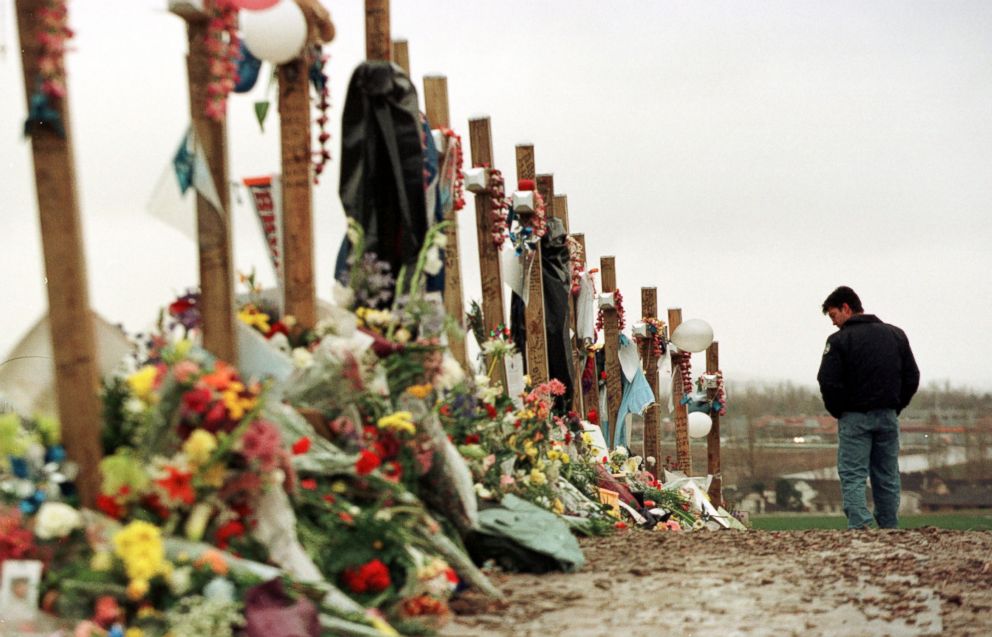
PHOTO: Ryan Foreman of Denvers South Metro Fire Department, visits a memorial for the victims of Columbine High School tragedy in Clement Park, April 30, 1999.Steve Peterson/Getty Images
Ryan Foreman of Denver's South Metro Fire Department, visits a memorial for the victims of Columbine High School tragedy in Clement Park, April 30, 1999.more +


Then the format of the walkout is up to each school. Lane told ABC News she proposes that schools incorporate open mics, guest speakers and voter registration. She said some students plan to write letters to those in communities impacted by school shootings.
This is a problem that needs to be addressed longer than 17 minutes.
But this event differs in one major way from last month's nationwide school walkout, which was held on March 14, one month after the shooting at Florida's Marjory Stoneman Douglas High School that killed 17 students and staff.
The March 14 walkout officially lasted for 17 minutes to mark the 17 lives lost. After the 17 minutes, many students returned to their classrooms.


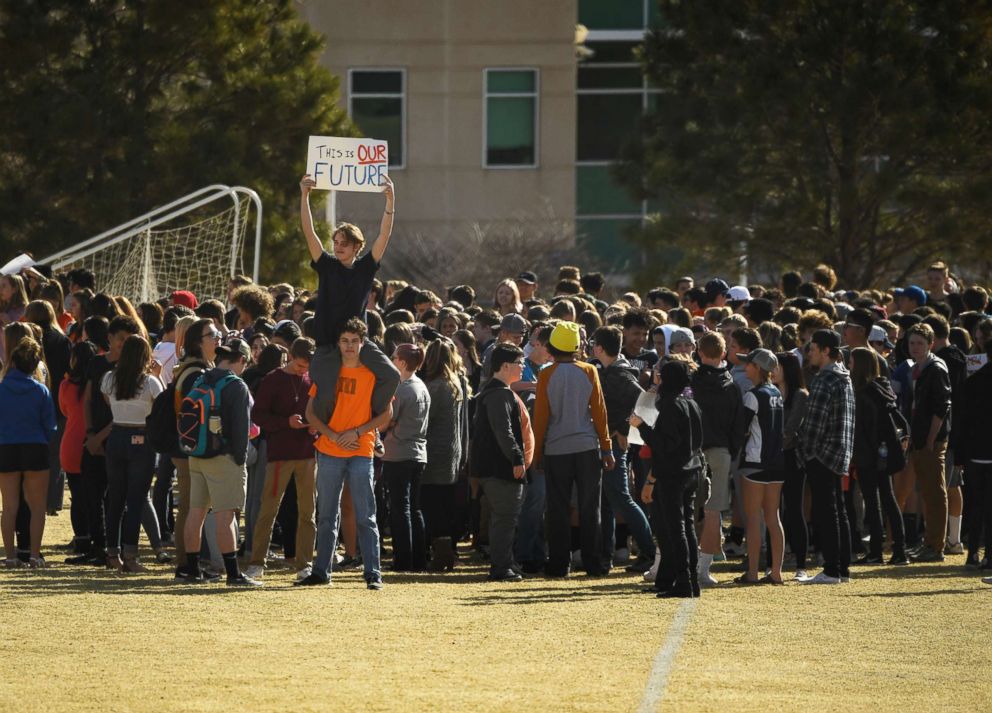
PHOTO: Students at Columbine High School walk out of classes in protest of gun violence for 17 minutes, one minute for each Florida high school shooting victim, March 14, 2018 in Littleton, Colo.RJ Sangosti/The Denver Post via Getty Images
Students at Columbine High School walk out of classes in protest of gun violence for 17 minutes, one minute for each Florida high school shooting victim, March 14, 2018 in Littleton, Colo.more +


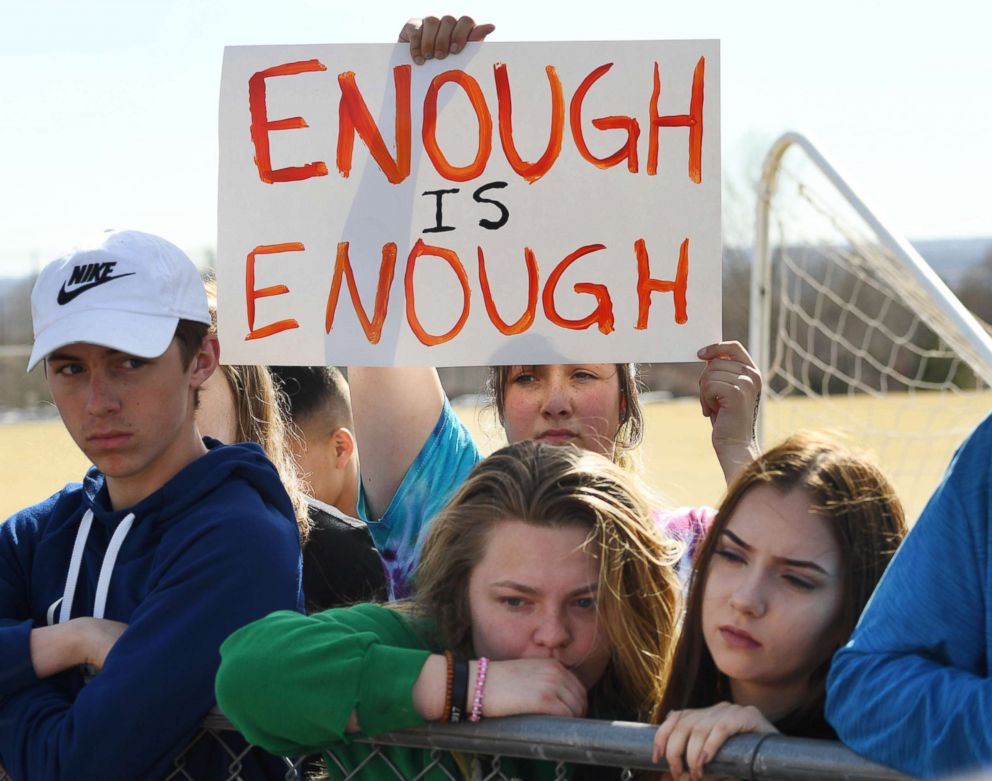
PHOTO: Leah Zundel, 15, a student at Columbine High School, holds a sign that reads Enough is Enough as she and other students walked out of classes in protest of gun violence for 17 minutes, March 14, 2018 in Littleton, Colo.RJ Sangosti/The Denver Post via Getty Images
Leah Zundel, 15, a student at Columbine High School, holds a sign that reads "Enough is Enough" as she and other students walked out of classes in protest of gun violence for 17 minutes, March 14, 2018 in Littleton, Colo.more +


The April 20 walkout, meanwhile, is set to last from 10 a.m. until the end of the school day.
"This is a problem that needs to be addressed longer than 17 minutes," Lane explained.
"As a student who can't vote, you don't have a lot of power. But what you have that's Continue reading:  National School Walkout: Everything to know about the upcoming event to end gun violence - ABC News:
Image result for April 20 walkout

Teachers rising up in rebellion of 'everyday heroes': Randi Weingarten

Oklahoma teachers' walkout happens when you don't prioritize education:
Teachers rising up in rebellion of 'everyday heroes': Randi Weingarten


Melissa Smith has 30 students in her criminal justice class in an Oklahoma City high school — but only 20 desks. Remedial help for students struggling with reading and writing is gone at English teacher Anna Graven’s Oklahoma City high school, so each year they fall further behind. A student in Ada, Okla., just found Blake Shelton’s name in the plate pasted on the inside of one of her dog-eared textbooks. The country music star used the very same book in 1982 — 36 years ago. Many textbooks (if teachers even have any to distribute) are even older and held together with duct tape. A 20-year science teacher in the Sooner State left the profession to make more money as a part-time dog groomer.

Teacher advocacy for excellent, equitable, safe and well-funded public schools and livable wages started long ago, but the recent walkouts that started in West Virginiaand spreading across the country have captured the attention of the public because of the David vs. Goliath nature of the battle.


Teachers are standing up for their students and themselves against largely red states with weak labor laws and where governors and legislators have opted for tax cuts for the wealthy instead of investments for children. This has left education conditions deplorable and educators pauperized. The movement has even become a verb of sorts. “Don’t Make Me Go West Virginia on You” was the message on an Arizona teacher’s sign as she protested at her state capitol.
This movement is a rejection of years of austerity budgets that have stiffed education funding and kids’ futures in favor of tax breaks for the wealthy and corporations. Twenty-nine states spend less today on public education than when the recession began in 2007. But educators, students and parents are taking on the budget shortfalls with tangible results.
West Virginia, with a Republican governor and GOP-majority House and Senate, voted to give public employees, including educators, a 5% raise, and created a task force to fix health insurance costs, rescinding the premiums hikes in the meantime.
Oklahoma, also with a Republican trifecta, voted for the first time in 28 years to raise taxes to provide new revenue for teacher pay raises and school funding. 
The days of passive resignation are over. Educators, students, parents and concerned Continue reading: Oklahoma teachers' walkout happens when you don't prioritize education:

Saturday, April 14, 2018

Teaching for Black Lives book release: #BlackLivesMatter “Required reading for all who care about the future of Black youth.” – I AM AN EDUCATOR

Teaching for Black Lives book release: “Required reading for all who care about the future of Black youth.” – I AM AN EDUCATOR:

Teaching for Black Lives book release: “Required reading for all who care about the future of Black youth.”

Opal_blrub_T4BL
ORDER TEACHING FOR BLACK LIVES, EDITED BY DYAN WATSON, JESSE HAGOPIAN, AND WAYNE AU
Teaching for Black Lives is officially released today by Rethinking Schools and I couldn’t be more hopeful for it’s impact on schools around the country.

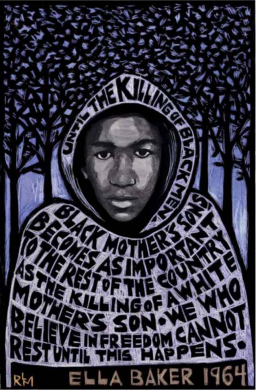
Trayvon
By RICARDO LEVINS MORALES

I have spent the past many months in collaboration with two other leading anti-racist educators, Professor Dyan Watson and Professor Wayne Au, writing and editing this book to bring alive Black excellence and struggle in the classroom.
This beautiful full color book is a compilation of essays, teaching activities, role plays, poems, and artwork, designed to illuminate, the movement for Black student lives, the school-to-prison-pipeline, Black history, gentrification, intersectional Black identities, and more. As we write in the introduction to the book,
We recognize that anti-Black racism constructs Black people, and Blackness generally, as not counting as human life. The chapters in Teaching for Black Lives push back directly against this construction by not only providing educators with critical perspectives on the role of schools in perpetuating anti-Blackness, but also by offering educators concrete examples of what it looks like to humanize Black people in curriculum, teaching, and policy. Throughout the book, we demonstrate how teachers can connect the curriculum to young people’s lives and root their concerns and daily experiences in what is taught and how classrooms are set up. We also highlight the hope and beauty of student activism and collective action.
Leading educators, intellectuals, activists, and artists have contributed to this collection including, James Baldwin, Michelle Alexander, Eve Ewing, Bill Fletcher, Renée Watson, Monique Morris and many more.
And the book couldn’t have come out at a more important time.

holdinghands
By ERIN ROBINSON 

To start, given that I am about to begin teaching a unit on Black history for my ethnic studies class on Monday, I am personally excited to use the book right away in my classroom. But beyond just my four walls, this book is being released in the wake of the police killing of Stephon Clark, an unarmed Black man in Sacramento California. The book is also coming out in the wake of the release of the video showing Kern County Sheriff Donny Youngblood saying that it was “better financially” to kill suspects than wound them, saying, “Because if you cripple them you have to take care of them for life and that cost goes way up.” And it’s coming at a time of resurgence in activism in the streets against police terror of Black communities.
But the attack on Black people isn’t only of their bodies.
As Teaching for Black lives points out in the introduction of the book, the attack is also on their minds: “From the north to the south, corporate curriculum lies to our students, conceals pain and injustice, masks racism, and demeans our Black students. But it’s not only the curriculum that is traumatizing students.” And as Keeanga-Yamahtta Taylor, author of From #BlackLivesMatter to Black Liberation writes of Teaching for Black Lives,
In this edited volume, we learn that Black Lives Matter is not just a rallying cry in the movement against police abuse and violence but it is a critical framework for understanding the persistent attacks on public education.
Teaching for Black Lives is also coming out not long after of the first national Black Lives Matter at School week of action and it helps to chronicle the development of this movement. This action during the first week of February 2018 saw thousands of educators and students across the country teach lessons around the 13 themes of the Black Lives Matter Global Network with the demands of:
  • Hire More Black teachers
  • End Zero Tolerance Discipline; Institute Restorative Justice
  • Mandate Black History and Ethnic Studies

chalkboardCell
By OLIVIA WISE

We bring you this book with the hopes that it will become a precious resource to educators seeking to empower students in a struggle for their lives and to anyone who is interested in joining the struggle to defend the bodies and minds of Black youth.

Order Teaching for Black Livestoday. Then encourage your community to do the same by sending out this announcement for the book to your union leaders, school principal, education reporters, educator Facebook pages, and beyond. Follow the discussion of the book on social media at #Teaching4BlackLives, or if you have press inquiries, get in touch with our managing editor, Ari Bloomekatz, at: ari@rethinkingschools.org
As Teaching for Black lives co-editor Dyan Watson said of the reason she helped produce the book,
I have two Black sons. For me, this collection is about their survival, and the survival of children like them throughout the United States. Teaching for Black Lives is a handbook for all educators, students, and families who truly care about Blackness and the intersections of learning, teaching, and race.

Jesse Hagopian teaches Ethnic Studies at Garfield High School. He is an editor for Rethinking Schools magazine, The Seattle Fellow for The Progressive magazine, and blogs at www.IAmAnEducator.com. Jesse is the co-editor of the book, Teaching for Black Lives. and editor of the book, More Than a Score: The New Uprising Against High Stakes Testing. You can follow Jesse on Twitter, @JessedHagopian.
Teaching for Black Lives book release: “Required reading for all who care about the future of Black youth.” – I AM AN EDUCATOR:


Thursday, April 12, 2018

Revealed: Secret rightwing strategy to discredit teacher strikes | Education | The Guardian

Revealed: Secret rightwing strategy to discredit teacher strikes | Education | The Guardian:

Revealed: Secret rightwing strategy to discredit teacher strikes
Manual provides ‘dos and don’ts’ for how to smear the strikes
Top of the list: ‘teacher strikes hurt kids and low-income families’


A nationwide network of rightwing thinktanks is launching a PR counteroffensive against the teachers’ strikes that are sweeping the country, circulating a “messaging guide” for anti-union activists that portrays the walkouts as harmful to low-income parents and their children.
The new rightwing strategy to discredit the strikes that have erupted in protest against cuts in education funding and poor teacher pay is contained in a three-page document obtained by the Guardian. Titled “How to talk about teacher strikes”, it provides a “dos and don’ts” manual for how to smear the strikers.
Top of the list of talking points is the claim that “teacher strikes hurt kids and low-income families”. It advises anti-union campaigners to argue that “it’s unfortunate that teachers are protesting low wages by punishing other low-wage parents and their children.”


The “messaging guide” is the brainchild of the State Policy Network (SPN), an alliance of 66 rightwing “ideas factories” that span every state in the nation. SPN uses its $80m war chest – funded by billionaire super-donors such as the Koch brothers and the Walton Family Foundation that flows from the Walmart fortune – to coordinate conservative strategy across the country.

Another financial backer of SPN is the billionaire DeVos family of the Amway empire. Betsy DeVos is the current education secretary in the Trump administration.
SPN’s previous campaigns have included a plan to “defund and defang” public  continue reading: Revealed: Secret rightwing strategy to discredit teacher strikes | Education | The Guardian:


Fake Teachers, Fake Schools, Fake Administrators Courtesy of DPE | tultican

Fake Teachers, Fake Schools, Fake Administrators Courtesy of DPE | tultican:

Fake Teachers, Fake Schools, Fake Administrators Courtesy of DPE


The destroy public education movement (DPE) has given us teach for America (Fake Teachers), Relay Graduate School (Fake Schools) and the Broad Superintendents Academy (Fake administrators). None of these entities are legitimately accredited, yet they are ubiquitous in America’s major urban areas.


There was a time in the United States of America when scoundrels perpetrating this kind of fraud were jailed and fined. Today, they are not called criminals; they are called philanthropists. As inequitable distribution of wealth increases, democratic principles and humane ideology recede.
It is time to fight the 21st century robber-barons and cleanse our government of grifters and sycophants.
Philanthropy in America is undermining the rule of law and democratic rights. Gates, Walton, Broad, DeVos, Bradley, Lily, Kaufman, Hall, Fisher, Arnold, Hastings, Anschutz, Bloomberg, Jobs, Zuckerberg, Dell and the list goes on. They have afflicted us with teach for America (TFA), charter Schools, vouchers, phony graduate schools, bad technology and bogus administrators implementing their agendas.
Without these “philanthropists” and their dark money schemes none of this would exist. Public schools would be healthy and teen-age suicide rates would be going down; not up. Instead we have mindless testing, harmful technology and teaching on the cheap.
This “philanthropy” is about profits, reducing tax burdens on the wealthy, imposing religious dogma and subjugation of non-elites. It is harmful to America’s children. The attack on public education was never primarily about benefiting children. It certainly was never based on concern for minority populations.
The Absurdity of Fake Teachers from TFA
 Over the last five years, there have been several wonderful books written on the Fake Teachers, Fake Schools, Fake Administrators Courtesy of DPE | tultican: