Latest News and Comment from Education

Saturday, March 11, 2017

Catch up with CURMUDGUCATION

CURMUDGUCATION:

Catch up with CURMUDGUCATION


Noble Teachers Forming Largest Charter Union
The 800 teachers and staff of Chicago's Noble charter school chain is working to form the largest charter teacher union in the country. They would not become the first charter union in the country, or even in Chicago. In fact, the Aspire network of charter schools just averted a strike by their own teachers' union by agreeing to wage increases, shorter workdays, and, apparently, occasionally liste
ESSA Big Mess
ESSA is caught in the middle of a very bad movie right now. It's the sequel to "How A Bill Becomes A Law," and it has no heroes. After the bill becomes a law, the work still isn't done. Because to build a bi-partisan agreement, you write the law with statements like "Treatment of mugwumps will be fair." (Perhaps not that vague, but as always, allow me to exaggerate to make a point). So Republicans

MAR 09

Testing Bribes
One of the biggest challenges connected with the Big Standardized Test is also one of the most important-- getting students to actually care . State and district officials all across the country have largely failed-- and they know it. Why, yes, I am very excited about the PARCC test. This is less of a challenge with the littles. A primary teacher can tell her students, "I need you to put your dead

MAR 08

Why School Choice Is Not A Thing
The promise, the dream of school choice is a system in which every family can choose from a wide range of schools, selecting the one that best fits their own child. If we would just break the public school "monopoly," the reasoning goes, even poor families would have the same wide range of choices available to upper and middle class families. This is not a true thing. It is not even an accurate po
8 Reasons To Opt Out
Depending on your state, it is that time again-- time to waste students' school time on the Big Standardized Test. Whether it's the PARCC or the SBA or whatever mutant offspring of the testing industry that your state prefers, it's headed your way like a hungry wildebeast. Maybe you have opted your child out in the past. Maybe you've thought about it, but ultimately decided not to. Maybe you've ev

MAR 07

Choice: The New Argument
The argument in favor of school choice continues to evolve, and post-DeVos, the conservative version is taking on its most honest form to date. It has been peeking its head out here and there for a while, but this week emerges full-blown in a US News piece from Robert Pondiscio (Fordham Institute). In " Asking the Wrong Questions on School Choice ," Pondiscio looks at the argument prompted by news

MAR 06

Can Choice Return To Its Roots?
Deborah Meier wrote in Education Week recently wit an interesting question. " Can school choice return to its progressive roots? " she asked. She goes back to the days in which she became involved in starting charter schools, to get out from under the heavy hand of regulation and red tape and start a school run by educators who would focus on the stuff that really matters, serving students who has
Real Performance Based Education
This afternoon the set was struck and the stage swept clean. We've come to the end of this year's spring musical. As always it was one of the highlights of my year, and as always, it reminded me of how inadequate so many of our educational models are. There are weeks of rehearsal, learning music, learning choreography, working on blocking and lines and the underlying character work that goes with

MAR 05

Making Students Pledge Test Security
When it comes to the Big Standardized Tests, we know that one thing is important before all else-- not the soundness of the questions or the validity of the test or the value of the scoring or the careful construction of questions that truly measure what they're alleged to measure. No, only one thing matters most-- Protecting the proprietary materials that belong to the test manufacturer. You may


ICYMI: In Like a Lion Edition (3/5)
As always, I recommend that you pass on, tweet, share and otherwise amplify the pieces that speak to you. It matters which voices we amplify and which we do not. Milwaukee's Voucher Verdict Milwaukee has been doing vouchers for 
CURMUDGUCATION:


Presentation for Advocacy 101: My Personal Journey | Seattle Education

Presentation for Advocacy 101: My Personal Journey | Seattle Education:

Presentation for Advocacy 101: My Personal Journey

12565347_860192087425384_7582081830729322473_n
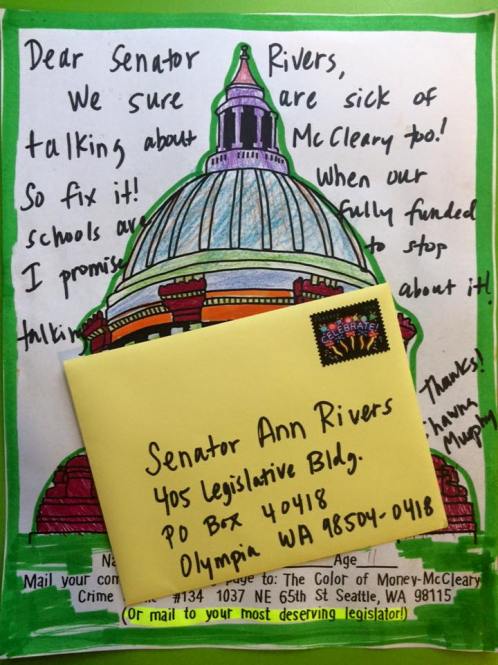
On March 5th, my friend Shawna Murphy, co-hosted a roundtable discussion on advocacy. I was invited to participate on the panel. These are my opening remarks. 
My name is Carolyn Leith and I write for the Seattle Education blog. However, I think the real reason why I’m sitting at this table is because I’m a gifted trouble maker. 
I want to share with you what I believe are the three ingredients to advocacy.
First, by being here, you’re demonstrated the first ingredient: A willingness to act on your passion to make a difference.
I started out sitting in the same place you are now. I wanted to do something, but couldn’t see how I could fit into the organizations that were doing the work.
One day, it hit me.
I didn’t need to join a group to work on the things I cared about. I could do it myself, with friends who were worried about the same things.
That’s when I started to write for the blog.
Writing led to making a connection with other people who were concerned about the brand new Smarter Balanced Assessment. Together we formed the Seattle Opt Out Facebook Group.
how_many_cookies
Through Seattle Opt Out, I met Shawna Murphy and we decided to create the tongue-in-cheek group, Teacher Retention Advocate Parents or TRAP.
Together we threw a half-baked bake sale at district headquarters to protest school Presentation for Advocacy 101: My Personal Journey | Seattle Education:


In Defense of Independent Reading - Teacher Habits

In Defense of Independent Reading - Teacher Habits:

In Defense of Independent Reading


In the entire history of stupid school tricks, there may be none dumber than the practice of banning independent reading from classrooms. Not only does the research not support such a drastic measure, but administrators who take such action should have their brains scanned to see if common sense has somehow slipped out their ears.
While there is vigorous debate about Malcolm Gladwell’s 10,000 hour rule, no one claims that practice isn’t vitally important. You can’t become proficient at playing the piano, cooking gourmet meals, shooting a basketball, cross-stitch, writing novels, or carpentry by watching others do it, listening to them talk about how they do it, and completing worksheets about it. You actually have to do those things. Why would the skill of reading be any different?

Reasons for Independent Reading

Two goals of independent reading in the classroom that teachers regularly cite are to promote positive attitudes about reading and to provide students the opportunity to practice reading to achieve proficiency (Allington, 1977, 2009, Gambrell, 2009).
To these reasons I would add a third, more logistical reason: teachers have students read independently because many districts require progress monitoring and intervention time with identified students. While the teacher’s attention is with the at-risk learner(s), the other students must be engaged in an independent activity that is both beneficial and requires no teacher assistance or monitoring so that she may concentrate her efforts on the at-risk learner(s). Many teachers feel that independent reading is a more effective use of students’ time than other independent activities. In this belief they are supported by reading researcher Richard Allington, who says that time spent reading contributes to reading achievement in ways that simply doing worksheets or other activities does not (Allington, 2002; Foorman et al., 2006).

Does Independent Reading Increase Achievement?

Much of the criticism about independent reading is because of a report by the National Reading Panel. It states:
With regard to the efficacy of having students engage in independent silent reading with minimal guidance or feedback, the Panel was unable to find a positive relationship between programs and instruction that encourage large amounts of independent reading and improvements in reading achievement, including fluency. In other words, even though encouraging students to read more is intuitively appealing, 
In Defense of Independent Reading - Teacher Habits:


Don’t fall for the White lies. – Educate Louisiana

Don’t fall for the White lies. – Educate Louisiana:

Don’t fall for the White lies.

Parents across the nation have let it be known that they do not want their children subjected to standardized test.  In 2015, Louisiana parents initiated a statewide opt-out movement. With just weeks to go before testing, and under immense pressure from districts, Supt. John White agreed not to penalize schools with large opt-outs. Schools with 10% or more students opting out would receive the same score they received the previous year. Of course, schools with up to 10% were penalized, although technically the law didn’t allow penalties until 5%, but that’s another story. The most notable districts with opt-outs were Caddo Parish, Calcasieu Parish and Central School District. Calcasieu garnered the most with about 1300 students opting out of the PARCC assessment.
In 2015, the opt-out numbers dropped, considerably, for a couple of reasons.
  • The test name was changed from PARCC to LEAP 2025.
  • White declared that he would not give a free pass to schools with excessive opt-outs.
As a result, the districts were faced with the possibility of having their performance scores penalized because of parents exercising their right to exclude their child from the assessment. While most districts honored the parents’ decisions, some resorted to strict testing policies up to, and including, “sit and stare” policies. This means students who opted out would be placed in the testing room with a test booklet, but not forced to take the test. Policies such as this are damaging to the relationships that schools have with the very people they serve and subject children to unjust punishment.
Since his very first days in office, John White has masterfully spun a deceitful web. Often times, his narratives are referred to as “White Lies.” I want to address some of those very common  White lies, regarding opt-outs, which filter down to districts when parents ask about opting-out.
We are still under NCLB.
This is the most common response when a parent says, “ESSA specifically allows parents to exclude their children from Don’t fall for the White lies. – Educate Louisiana:


 Slow your roll, Mr. White.


A draft ESSA plan has been submitted to the governor for review, and Superintendent John White is pressing forward with plans to submit the plan to U.S. Department of Education (USDOE) in April. USDOE has originally issued a timeline of implementation with April as the deadline submission. That 

The ignorance and callousness of Betsy DeVos' 'gaffe' (Opinion) | OregonLive

The ignorance and callousness of Betsy DeVos' 'gaffe' (Opinion) | OregonLive.com:

The ignorance and callousness of Betsy DeVos' 'gaffe' (Opinion)


Secretary of Education Betsy DeVos ironically touted historically black colleges and universities as a successful example of her beloved pet cause of "school choice." Of course, the existence of historically black institutions in America, in many cases, is the result of the opposite of school choice. Instead, they are a legacy of the "separate but equal" regime of segregated public schools that existed prior to the Supreme Court's decision in Brown vs. Board of Education, which in reality was a regime of separate but unequal and inadequate funding for black education.
In 1865, Congress created the federal Bureau of Refugees, Freedmen, and Abandoned Lands to assist former enslaved people in the South, including with the creation and supervision of schools. The Freedman's Bureau and black community organizations sponsored the creation of 24 private black colleges and training schools, primarily in the South, in response to the systematic state-sanctioned regime of racial segregation preventing black Americans from being integrated into existing white schools.
The school privatization movement that DeVos champions itself has its roots in racial oppression.
In 1890, Congress passed the Morrill Act, allowing Southern states to appropriate existing black colleges and to create new land-grant public universities for African Americans. Following the Supreme Court's infamous decision in Plessy vs. Ferguson, "separate but equal" became the organizing principle of public education throughout much of the United States. Even after Brown formally ended segregated education in 1954, many black college students chose to attend historically black institutions in order to escape prejudice and institutionalized racial discrimination in historically white colleges. Studies have continued to show that predominantly white universities suffer from institutionalized bigotry and racism, both overt and subtle.
But Secretary DeVos's "gaffe" not only reflected ignorance and callousness about the history of American school segregation, it was cruelly Orwellian in its level of distortion. The school privatization movement that DeVos champions itself has its roots in racial oppression. The "school choice" movement originated in white resistance to school integration, when, after Brown, Southern states offered vouchers to white students so they could attend all-white private schools -- beyond the reach of the Equal Protection Clause -- to escape their newly The ignorance and callousness of Betsy DeVos' 'gaffe' (Opinion) | OregonLive.com:


Congress Erases K-12 Rules, A Financial Aid Foul-Up And Other Education News : NPR Ed : NPR

Congress Erases K-12 Rules, A Financial Aid Foul-Up And Other Education News : NPR Ed : NPR:

Congress Erases K-12 Rules, A Financial Aid Foul-Up And Other Education News

The case of transgender high school student Gavin Grimm, seen here last year, has been sent back to a lower court by the Supreme Court.
Steve Helber/AP

Once again, it was another big week for national education news. Here's our quick take on the top stories.
Senate scraps federal regulations
On Thursday, the Senate voted to roll back Obama-era rules that clarified and elaborated on a wide range of accountability requirements in the federal education law known as The Every Student Succeeds Act.
The vote was narrow, 50 to 49. To be clear, Congress is not scrapping or even changing the law itself. When it comes to school accountability, ESSA still requires that states flag schools where groups of students are "consistently underperforming." And it requires that the measurement of school performance include not just test scores and graduation rates but also some other indicator of school quality, including absenteeism or access to AP courses.
After ESSA became law, the Obama administration was tasked with writing rules to clarify key sections. What the Senate voted to do this week was to scrap the previous Education Department's interpretation of the law's accountability requirements, not the requirements themselves.
If that's not clear enough, here's a handy, point-by-point comparison of the law and that interpretation by Education Week's Alyson Klein.
Senator Lamar Alexander, the Tennessee Republican who is himself a former Education Secretary, hailed the change. He called the vote "a victory for everyone who was fed up with Washington telling them so much about what to do about their children in 100,000 public schools, and I look forward to President Trump's signature of this resolution."
The Education Trust, an advocacy group where John B. King Jr., the most recent education secretary under President Obama, is now president and CEO, called the rollback "misguided." "This resolution will cause unnecessary confusion," the group said in a statement, "disrupting the work in states and wasting time that students — particularly those who are most vulnerable — cannot afford for us to waste."
New Executive Order on Immigration


Jersey Jazzman: NJ Charter Schools - A Fool's Gold Rush: Prelude

Jersey Jazzman: NJ Charter Schools - A Fool's Gold Rush: Prelude:

NJ Charter Schools - A Fool's Gold Rush: Prelude


Chris Christie begins his last year in Trenton as the least popular governor in the nation. But that doesn't mean he still can't impose his will on New Jersey; the governorship here is one of the most powerful in the nation. So even though many communities throughout the state may not like Christie, he can still act against their wishes and jam through any numbers of policies in his last year simply because he can.

Take, for example, charter schools:

Trenton, NJ – The New Jersey Department of Education (NJDOE) is announcing decisions on new public charter school applications, charter renewals, amendment requests for expansions, and closures. 
“All New Jersey public schools, which include charter schools, must be held to a high standard in order to ensure that all of our children receive the quality educational experiences they deserve,” said Acting Education Commissioner Kimberley Harrington. “These decisions reflect this Administration’s continued commitment to hold low-performing charter schools accountable, while expanding access for New Jersey families to high-quality charter schools.”
Sure, it reflects Christie's commitment to charter schools -- no matter what local communities may think. As regular readers know, New Jersey charters are only answerable to the NJDOE, which is under the direct control of the governor. Local school boards have no say in charter approvals or renewals, even though they must fund them -- no matter how damaging those charters may be to the local public schools.

The greatest fiction produced by the New Jersey charter school industry -- and, for that Jersey Jazzman: NJ Charter Schools - A Fool's Gold Rush: Prelude:


Keeping retirement weird. TrumpCare is Soylent Green. | Fred Klonsky

Keeping retirement weird. TrumpCare is Soylent Green. | Fred Klonsky:

Keeping retirement weird. TrumpCare is Soylent Green.


Good morning from Brooklyn.
We are here to celebrate Anne’s birthday with kids and grandkids. So not even Donald Trump can put me in a bad mood.
Episode #6 of the podcast of Hitting Left with the Klonsky Brothers is in the can. It is an hour-long convo with tenth ward Alderwoman Susan Sadlowski Garza and I think it is good one. You can subscribe to our weekly show at Liberated Syndication or iTunes.
One of my trolls wrote this morning to comment on our show saying nobody cares. He must care, since he writes me daily. And the number of subscribers is growing every show.
Let’s talk about TrumpCare, the dismantling and replacement of the Affordable Care Act and its potential impact on seniors.
The New York Times’ Paul Krugman wrote in Friday’s paper, “Affluent young people might end up saving some money as a result of these changes. But the effect on those who are older and less affluent would be devastating. AARP has done the math: a 55-year-old making $25,000 a year would end up paying $3,600 a year more for coverage; that rises to $8,400 for a 64-year-old making $15,000 a year. And that’s before the death spiral.”
What is the “death spiral”?
Soaring premiums and collapsing coverage.
TrumpCare would allow insurers to charge older customers up to five times as much as younger customers.
The costs could be even higher for older people in blue state regions, where the cost of living is higher. The new legislation would give a flat amount for subsidies to buy coverage based on age, as opposed to their income, and the cost of insurance in their area, as with Obamacare.
Two of the biggest tax cuts in Republican proposals to repeal the Keeping retirement weird. TrumpCare is Soylent Green. | Fred Klonsky:

Some want and expect the GENERAL education teacher to do it all.
-By Bev Johns Some want and expect the GENERAL education teacher to do it all. In the future there will be ONLY one special ed funding formula (every bill ELIMINATES the Chicago special ed Block Grant). The still secret Amendment to Senate Bill 1, and the language now in House Bill 2808 would change all of the school funding formulas in Illinois, and for special education, aims to reduce the clai

Poor old grandma is a special interest group.
Available now. Download this week’s podcast. Hitting Left with the Klonsky Brothers with Alderwoman Sue Sadlowski Garza.

Suspending California students costs the state billions, report finds | EdSource

Suspending California students costs the state billions, report finds | EdSource:

Suspending California students costs the state billions, report finds

Image result for Suspending students

Students in the class of 2014 who never graduated because they were suspended from school will cost California an estimated $2.7 billion in increased criminal justice costs and lower taxes paid over the course of their lifetimes, according to a new study from two University of California researchers.
The researchers said they hoped putting a financial cost on school discipline practices that send students out of school would mobilize communities to urge their districts to lower suspension rates.
“This puts the price tag on it,” said Russell Rumberger, director of University of California Santa Barbara’s California Dropout Research Project and co-author of the report with Daniel Losen, director of UCLA’s Civil Rights Project at the Center for Civil Rights Remedies. “For people who say, ‘I don’t care about kids, jail ’em up or whatever,’ these are fiscal costs. It affects taxes, and your taxes are building more prisons.”
The $2.7 billion includes $809 million in direct taxpayer costs for criminal justice services as well as the reduced revenue that is generated by the lower wages earned by most who don’t hold a high school diploma. The total also includes $1.9 billion in social costs, such as reduced economic productivity and higher health care expenses. On average, a single person without a high school diploma will experience $579,820 in economic losses over a lifetime compared to a high school graduate, the report states.
The impact of school discipline practices on students, staff and communities has been under a state spotlight during the past several years, and as a result of the  Obama administration’s “Rethink Discipline” initiative, a federal spotlight as well. U.S. Secretary of Education Betsy DeVos has yet to issue guidance to schools related to school discipline.
“California is a leader in addressing suspensions,” Losen said, noting that alternatives to suspensions, such as restorative justice and Positive Behavioral Intervention and Supports, have become more commonly used in school districts. The shift has been prompted in part by the development of the new state education Suspending California students costs the state billions, report finds | EdSource:
 Image result for Suspending students