Latest News and Comment from Education

Wednesday, February 15, 2017

Influential conservative group: Trump, DeVos should dismantle Education Department and bring God into classrooms - The Washington Post

Influential conservative group: Trump, DeVos should dismantle Education Department and bring God into classrooms - The Washington Post:

Influential conservative group: Trump, DeVos should dismantle Education Department and bring God into classrooms


A policy manifesto from an influential conservative group with ties to the Trump administration, including Education Secretary Betsy DeVos, urges the dismantling of the Education Department and bringing God into American classrooms.
The five-page document produced by the Council for National Policy calls for a “restoration of education in America” that would minimize the federal role, promote religious schools and home schooling and enshrine “historic Judeo-Christian principles” as a basis for instruction.
Names of the council’s members are closely held. But the Southern Poverty Law Center published a 2014 membership directory showing that Stephen K. Bannon — now chief White House strategist for President Trump — was a member and that Kellyanne Conway — now counselor to the president — served on the council’s executive committee.
DeVos was not listed as a member, but her mother, Elsa Prince Broekhuizen, was namedon the council’s board of governors. Her father-in-law, Amway founder Richard DeVos Sr., twice served as president, most recently from 1990 to 1993. And she and her husband have given money to the council as recently as 2007 through their family foundation, according to federal tax records.
The council’s “Education Reform Report” says it is intended to help DeVos and Trump map a path toward change. The proposal to abolish the department dovetails with the longheld views of many Republicans, and President Trump suggested during the 2016 campaign that the agency could be “largely eliminated.” But Trump has given no sign since taking office that he aims to act on that idea, and DeVos embraced the mission of the department when she took Influential conservative group: Trump, DeVos should dismantle Education Department and bring God into classrooms - The Washington Post:


Should Schools Get back to our "Historic Judeo-Christian Principles?" - Seattle Schools Community Forum

Seattle Schools Community Forum: Should Schools Get back to our "Historic Judeo-Christian Principles?":

Should Schools Get back to our "Historic Judeo-Christian Principles?"


No, no and no. 


From the Washington PostInfluential conservative group: Trump, DeVos should dismantle Education Department and bring God into classrooms


A policy manifesto from an influential conservative group with ties to the Trump administration, including Education Secretary Betsy DeVos, urges dismantling the Education Department and bringing God into American classrooms.

The five-page document produced by the Council for National Policy calls for a “restoration of education in America” that would minimize the federal role, promote religious schools and homeschooling and enshrine “historic Judeo-Christian principles” as a basis for instruction. 

Names of the council’s members are closely held. But the Southern Poverty Law Center published a 2014 membership directory showing that Stephen K. Bannon — now chief White House strategist for President Trump — was a member and that Kellyanne Conway — now counselor to the president — served on the council’s executive committee.
Further,  

It also says states should encourage K-12 public schools to post the Ten Commandments, teach Bible classes and recognize Seattle Schools Community Forum: Should Schools Get back to our "Historic Judeo-Christian Principles?":


Oregon Save Our Schools: End SBAC! Send a postcard! Comment to Oregon Department of Education!

Oregon Save Our Schools: End SBAC! Send a postcard! Comment to Oregon Department of Education!:

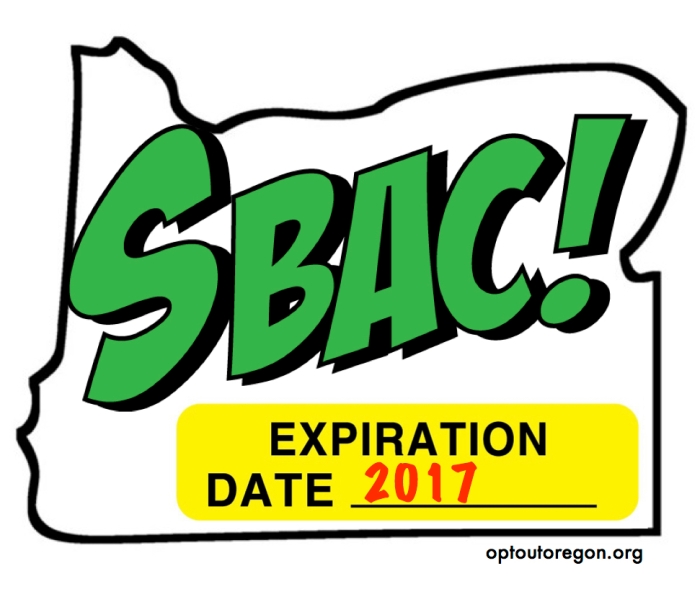
End SBAC! Send a postcard! Comment to Oregon Department of Education!

Image result for NO MORE SBAC

This spring the Oregon Department of Education will be going to the State Board of Ed. asking them to renew their contact with the Smarter Balanced Consortium. Meanwhile many states are dropping out of the consortia. The SBAC and multi-state longitudinal data system associated with it are very expensive, particularly at a time when funding is scarce. If you would like to help end this money wasting, abusive system and put those funds into programs and classrooms, you can do the following:

1. Take this survey put out by ODE and tell them NO MORE SBAC!

2. Let your legislators and the Oregon State Board of Ed. know how you feel! Contact the Oregon Senate Education Committee membersHouse Education Committee membersOregon State Board of Education, and your own legislators.

3. Send a postcard to Governor Brown, who is the designated Superintendent of Public Instruction since 2015 and tell her to END SBAC! Send your own or download the postcard on the link to Governor Brown.

4. Opt your child out of SBAC! Easy to do! Find the form here.

Please take action to stop this incredible waste of time and resources in our schools!Oregon Save Our Schools: End SBAC! Send a postcard! Comment to Oregon Department of Education!:


 Image result for NO MORE SBAC

DeVos’s Stumbles Right Out Of The Gate Are Nothing To Laugh About

DeVos’s Stumbles Right Out Of The Gate Are Nothing To Laugh About:

DeVos’s Stumbles Right Out Of The Gate Are Nothing To Laugh About


The Trump administration’s national security scandals may have obscured Betsy DeVos’s rough start as the new Secretary of Education, but her stumbles right out the gate reveal disturbing characteristics of her leadership.
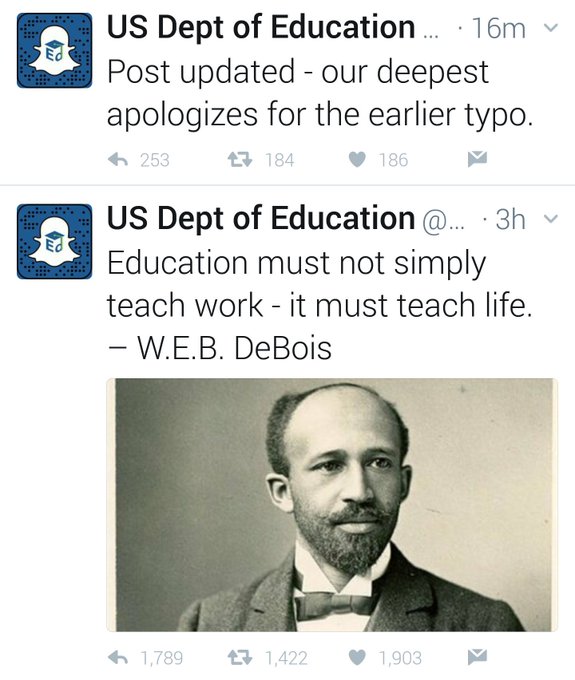
Unfortunately, the least significant gaffe is the one that has gotten the most notoriety so far. As Politico reports, “In quoting civil rights activist W.E.B. Du Bois, the Department of Education on Sunday sent out a tweet misspelling his name as “DeBois.” And then it sent out an apology that misspelled the word ‘apologies'” as “apologizes.”


Hey @usedgov you misspelled "Du Bois" as "DeBois", got busted & apologized, then you misspelled "apologies" as "apologizes" in your apology
What’s even more embarrassing: The misspelled shout out to Du Bois took place during Black History Month.
As part of a presidential administration that’s already distinguished itself for prominent typos in President Donald Trump’s tweets and on official White House releases, it’s perhaps not surprising that DeVos and her team would also be sloppy on social media. But she is head of the Department of Education. The public mocking is to be expected.
Nevertheless, there are gaffes, and then there are disturbing omens of what may be in store for the nation’s schools under the Trump-DeVos regime.
No IDEA
Perhaps most ominous is the report, from an outlet focused on developmental disability news, that a day after DeVos took her oath of office, content relating to IDEA disappeared from the Education Department’s website. IDEA, the Individuals with Disabilities Education Act, is the federal government’s program that guarantees students with disabilities and their parents have access to free education that is appropriate for their needs.


DeVos, recall, had one of her most difficult moments during her rocky confirmation hearing when she became “confused” about enforcing IDEA. While answering a question about the federal program, she promised that DeVos’s Stumbles Right Out Of The Gate Are Nothing To Laugh About:


Charter Schools Are Overrated @IQ2US – Cloaking Inequity

Charter Schools Are Overrated @IQ2US – Cloaking Inequity:

Charter Schools Are Overrated @IQ2US


Are charter schools overrated? In the 25 years since Minnesota passed the first charter school law, these publically funded but privately operated schools have become a highly sought-after alternative to traditional public education, particularly for underserved students in urban areas. Between 2004 and 2014 alone, charter school enrollment increased from less than 1 million to 2.5 million students. Many charter schools boast of high test scores, strict academic expectations, and high graduation rates, and for some, their growth is evidence of their success. But have these schools lived up to their promise? Opponents argue that charters, which are subject to fewer regulations and less oversight, lack accountability, take much-needed resources from public schools, and pick and choose their student body.
We will debate the motion “charter schools are overrated” at an upcoming IQ2US forum on Wednesday, March 1st 2017 06:45 – 08:45 PM at the Kaufman Center 129 West 67th Street New YorkNY. 
Intelligence Squared @IQ2US is a nonpartisan, nonprofit organization that was founded in 2006 to restore civility, reasoned analysis, and constructive public discourse to today’s often biased media landscape. They host discussions grounded in facts and informed by reasoned analysis. More than 500 “of the world’s greatest minds” have debated in the IQ2US forums. Buy tickets (and maybe popcorn) for the upcoming March 1 debate. You also cast your vote and watch the debate streaming live at .
 Argument For The Motion


Unlike traditional public schools, charter schools can choose who attends through complex admissions processes and attrition stemming from strict performance and disciplinary standards.
Many charter schools do not not answer to local school boards and are not subject to the same levels of accountability and transparency as traditional public schools.
Academic outcomes at charters have largely been found to be comparable to those of traditional public schools.  While some do better, even more have been found to do worse.
Charter schools are exacerbating the re-segregation of our schools by race and income.
Debators For the Motion
Gary Miron
Professor, College of Education, Western Michigan University
Gary Miron is Professor in Evaluation, Measurement, and Research at Western Michigan University.  He has extensive experience evaluating school reforms and education policies in the United States and Europe. Miron has directed more than 60 evaluations and research studies that have been funded with grants and contracts from state, federal, and international agencies as well as private foundations. He has been hired by state education agencies to undertake nine comprehensive evaluations of charter school reforms.  For the U.S. Department of Education, he led a study on the correlates of success in American charter schools.  In addition to his evaluations of charter schools, Miron has provided technical assistance and training for charter schools in 5 states.  In recent years, his research has focused on the private education management organizations as well as the performance of virtual and blended learning schools.

Julian Vasquez Heilig
Professor, California State University Sacramento
Julian Vasquez Heilig is an award-winning teacher, researcher, and blogger. He is currently a professor of educational leadership and policy studies and the director of the Doctorate in Educational Leadership at California State University Sacramento. His work has been cited by the New York Times, Washington Post, Associated Press, USAToday, Education Week, Huffington Post and other print and electronic media outlets. He has appeared on local and national radio and TV including PBS, NBC, NPR, Univision, Al Jazeera and MSNBC and blogs at Cloaking Inequity.

Argument Against The Motion

Greater autonomy and flexibility gives charter schools the opportunity to innovate and demand more from both their teachers and students.
Charter schools are accountable to the communities they serve, and it is the demand for admission that determines their success or failure.
Charter schools don’t discriminate by zip code. They promote equality by accepting all students that want to attend–when they’re oversubscribed, through need-blind lotteries.
Studies have found that low-income students benefit from attending charter schools, and that overall, charter school students do better on standardized test 
Debators Against the Motion
Jeanne Allen
Founder & CEO, The Center for Education Reform
Jeanne Allen has been on the front lines of education policy development and innovation for more than 30 years. She served for five years at the Department of Education during the Reagan administration, where she was responsible for policy development and implementation in the areas of student financial aid, accreditation, and Historically Black Colleges and Universities.  Following her government service, she served at the Heritage Foundation, where she developed the organization’s education policy program and also launched Town Hall, one of the earliest online social networks. In 1993, she founded the Center for Education Reform, one of the most influential organizations in the education field dedicated to developing and promoting innovative reforms in schools throughout the nation. CER was an early advocate for school choice, and played an important role in the creation and development of the charter school movement. Jeanne is its CEO.

Gerard Robinson
Resident Fellow, AEI & Former Florida Commissioner of Education
Gerard Robinson is a resident fellow at the American Enterprise Institute, where he works on education policy issues including choice in public and private schools, regulatory development and implementation of K-12 laws, the role of for-profit institutions in education, prison education and reentry, rural education, and the role of community colleges and Historically Black Colleges and Universities in adult advancement. Robinson served as commissioner of education for the State of Florida and secretary of education for the Commonwealth of Virginia. As president of the Black Alliance for Educational Options, Robinson worked to ensure that children in low-income and working-class black families in several states and the District of Columbia were given the opportunity to attend good schools. Throughout his career he has evaluated the effects of reform initiatives on parental choice and student achievement and advocated for lawsto improve delivery of teaching and learning.
IQ2US
Since its inception in 2006, the goals have been to provide a new forum for intelligent discussion, grounded in facts and informed by reasoned analysis; to transcend the toxically emotional and the reflexively ideological; and to encourage recognition that the opposing side has intellectually respectable views.
IQ2US has presented more than 130 debates on a wide range of provocative and timely topics. From clean energy and the financial crisis, to the Middle East and the death of mainstream media, IQ2US  brings together the world’s leading authorities on the most important issues of the day.
IQ2US reaches millions through multi-platform distribution, including radio, television, live streaming, podcasts and interactive digital content. It has ranked as one of top 25 most popular podcasts on iTunes and has been recognized by Forbes as one of the “top podcasts to change the way you think.”
Where do you stand in the charter school debate? Cast a vote in “America’s Debate Series” and join the charter school discussion here.
The text for this blog was directly excerpted from IQ2US website announcement.

Personalized Learning Increases Role of Computers in Class - The Atlantic

Personalized Learning Increases Role of Computers in Class - The Atlantic:

Are Teachers Becoming Obsolete?

A veteran educator reflects on the personalized-learning trend that’s left him wondering if a computer is more capable of doing his job than he is.

Leaving my school building the other day, I had an unexpected realization: Perhaps a computer was a more effective teacher than I currently was. The thought unnerved me, and still does as I’m writing this. I’m a nearly 13-year veteran educator dedicated to reflecting upon and refining my teaching craft. But I’m now considering the real possibility that, for at least part of a class period or school day, a computer could—and maybe should—replace me.
For the past several weeks, I’ve begun class with a simple routine: Students enter the room, grab a new Chromebook, log on to the Reading Plus program, and spend roughly 20 minutes working at their own pace. I stroll around the room and help with technology troubleshooting or conference with students, quietly chatting about academic progress or missing work. I’ve also found myself pausing, marveling at what this program promises to accomplish: meeting students where they are academically and, at least in theory, helping a wildly diverse group of students improve their literacy skills.

Developments in education technology promise to assist teachers and school systems in supporting struggling students by providing individualized instruction. But at what cost? As a teacher, it’s difficult to adapt to and embrace a machine that—at least for part of the time—takes over for me. The processes of teaching and learning are complex and innately human; I value the time I take to develop relationships with my students. But it’s hard not to wonder if that time could better be spent with adaptive learning technology.
My third-period sophomore English class at Fern Creek High School in Louisville, Kentucky, contains a wonderful mix of students hailing from the neighborhood and around the globe—my students represent Jordan, Afghanistan, Democratic Republic of Congo, Tanzania, Russia, and Mexico. I’ve thoroughly enjoyed getting to know how students arrived in our classroom in addition to hearing about their hopes, fears, and dreams. With this diversity also comes a huge range of student ability. Computerized reading assessments and other benchmarked tests reveal that roughly 90 percent of my class isPersonalized Learning Increases Role of Computers in Class - The Atlantic:


Educating Betsy DeVos

Educating Betsy DeVos:

Educating Betsy DeVos


 Betsy DeVos does not understand what it is like to teach in any school let alone poor public schools. She does not understand what the lives of real teachers and students are like.

She does not understand the problems facing many of America’s children. These problems won’t be solved with a voucher. They also won’t be fixed by substandard charter schools run by those who know little about children.
I do not believe she should be barred from public schools. Public schools are supposed to be open to everyone.
I think she should face parents and teachers who disagree with her platform within those schools–not sit and politely talk with those who agree with her at a photo op with President Trump. Neither one of them know anything about public schools.
Betsy DeVos should spend time with the many moms of students with disabilities who homeschool not because they want to, but because schools have cut special education Educating Betsy DeVos:

Seattle Schools Community Forum: Want the Official Trump Portrait in Your Child's School?

Seattle Schools Community Forum: Want the Official Trump Portrait in Your Child's School?:

Want the Official Trump Portrait in Your Child's School?


Apparently some schools/districts across the nation put up the official portrait of the current president.  Here's Trump's original one (now being fixed). 

Speaks volumes about current administration including Betsy DeVos who has her own English language issues (see Twitter).
Seattle Schools Community Forum: Want the Official Trump Portrait in Your Child's School?:
 Suggested Uses: 

Education Reform in the Absence of Political Courage: Charleston (SC) Edition | radical eyes for equity

Education Reform in the Absence of Political Courage: Charleston (SC) Edition | radical eyes for equity:

Education Reform in the Absence of Political Courage: Charleston (SC) Edition

Image result for Education Reform in the Absence of Political Courage: Charleston (SC) Edition

Words matter, and thus, I must apologize by opening here with a mundane but essential clarification of terms.
As I have written over and over, everything involving humans is necessarily political, even and especially teaching and learning. Therefore, no teacher at any level can truly be apolitical, objective. Taking a neutral or objective pose is a political choice, and an endorsement of the status quo.
Key to that claim is recognizing the difference between political and partisan. Partisan politics involves allegiance to and advocacy for organized political parties, notably Republicans and Democrats.
A partisan feels compelled to place party loyalty above ideology or ethics. To be political can be and should be a moral imperative.
We can avoid being partisan, even as that is political. And when many people call for education and educators to avoid being political, what they really are seeking is that education and educators not be partisan—a position that is achievable and one I endorse.
This distinction matters in public education and public education reform because all public institutions in the U.S. are by their tax-supported status at the mercy of partisan politics.
From around 1980, in fact, politicians at the local, state, and national levels have discovered that public education is a powerful and effective political football. The standard politician’s refrain is “Schools are horrible, and I can make them better!”


Malloy eliminates all state funding for Connecticut’s Regional Educational Service Centers (RESCs) - Wait What?

Malloy eliminates all state funding for Connecticut’s Regional Educational Service Centers (RESCs) - Wait What?:

Malloy eliminates all state funding for Connecticut’s Regional Educational Service Centers (RESCs)


At a time when school districts must be expanding their efforts to cooperate regionally, Governor Dannel Malloy’s new budget eliminates state funding for a vital and successful regionalization operation – the Regional Education Service Centers.
The six Regional Education Service Centers (RESCs) provide Connecticut communities and school districts with a wide variety of important cooperative services that save taxpayers tens of millions of dollars. While most of the costs are picked up by the districts, the state of Connecticut provides about $600,000 a year to support these critically important networks.
The RESCs develop and manage a wide variety of cost-effective, high quality programs including efforts to regionalize special education services, professional development, minority teacher recruitment, English language learner efforts, transportation and a myriad of other programs.
To eliminate RESC’s would be disastrous for Connecticut’s schools, so it is important to see Malloy’s budget scam for what it is – simply dumping responsibility to fully fund the Regional Education Service Centers onto the backs of local taxpayers.