Latest News and Comment from Education

Saturday, February 11, 2017

Vouchers: a Love Story – Have You Heard

Vouchers: a Love Story – Have You Heard:

Vouchers: a Love Story

Big Education Ape: Why I’m Saying Farewell to EduShyster – Have You Heard - http://bigeducationape.blogspot.com/2017/02/why-im-saying-farewell-to-edushyster.html


Have You Heard kicks off season 2 with a look at all things voucher-y. Jack Schneider and I talk about the history of school vouchers, the movement’s strange bedfellows, and why the public has remained remarkably skeptical towards vouchers. We mix it up with school choice superfan Travis Pillow over who is really using vouchers in states like Indiana, Maryland and Wisconsin. And I use an, um, unusual descriptor to describe the results of Louisiana’s voucher program. Let me know what you think!


‘Bad Dude’? No, but Deported Anyway - The New York Times

‘Bad Dude’? No, but Deported Anyway - The New York Times:

‘Bad Dude’? No, but Deported Anyway


By no standard of common sense or decency should Guadalupe García de Rayos have been a priority for deportation. Ms. Rayos, a 35-year-old mother of two, was arrested on Wednesday by Immigration and Customs Enforcement agents in Phoenix. On Thursday she was deported to Mexico, a country she left 21 years ago. Her devastated family, including her American-born children, remains in the United States.
President Trump persists in the absurd claim that America will be safe and great again only after an assault on “bad dudes” and “criminal aliens,” whom he has promised to arrest and remove by the millions.
But Ms. Rayos fits no such definition and was no threat, though she had been living in the United States illegally since she was 14. She had been known to the authorities since she was caught in a workplace raid in Phoenix in 2008. In the years since, she would check in regularly with immigration officials, who chose not to deport her, having more important things to do.
Mr. Trump ran for office promising to eliminate such discretion and replace it with heedless and pointless enforcement. His campaign amplified the nativist passions of his supporters and hard-line advisers, including the man who is now his right hand in the Justice Department, Attorney General Jeff Sessions.
What was always most alarming about Mr. Trump’s posturing on immigration wasn’t the wall, which will never be built in the way he describes it. It is instead the prospect of ramped-up enforcement that promises to increase misery on both sides of the border. The criminalizing of law-abiding immigrants who have lived in the United States for years, and of the migrants from Central America who arrive desperate for refuge. The households sundered, the jobs lost, the brutal idiocy of it all.
Mr. Trump, or the ideologues who speak into his ear and guide his pen, came up with executive orders the first week of his presidency that vastly expanded the universe of potential deportation targets to include anyone found guilty of any offense, no matter how old or minor, and people accused of crimes but not convicted. The orders sweep away the priorities set by President Barack Obama and his homeland security secretary, Jeh Johnson, under which agents were told to focus strictly on public-safety risks.
Mr. Trump’s federal force, especially if it re-enlists state and local law enforcement agencies in a widening immigration dragnet, threatens to return America to a disgraceful era of workplace raids, indiscriminate sweeps and mass arrests. This will fix nothing, except perhaps the bottom lines in the private prison industry.
It is time to watch closely what Mr. Trump says, and what he and his administration do. Watch Mr. Sessions, Immigration and Customs Enforcement and the Border Patrol, agencies with rogue officers who have abused immigrants and broken the law, and local law enforcement, like the Phoenix police, whose officers abetted ICE in subduing protesters who tried to block Ms. Rayos’s removal.
Where does hope lie? Perhaps in the courts, where judges have resisted unconstitutional anti-immigrant policies. (Reinstatement of Mr. Trump’s travel ban from certain predominantly Muslim countries was blocked by a ‘Bad Dude’? No, but Deported Anyway - The New York Times:


John Thompson: Ending charter wars: 'The problem is the problem' - NonDoc

Ending charter wars: 'The problem is the problem' - NonDoc:

Ending charter wars: ‘The problem is the problem’
Image result for Ending charter wars

My previous post discussed the first issue of two that should inform the OKCPS school board election: making teaching a team sport. It drew upon the work of former PBS education reporter John Merrow, who wrote in 2011 that instead of focusing primarily on “making a better teacher,” America should make teaching a better job by creating cooperative school cultures. Merrow read the piece and responded with a repost of his 2011 column calling for creating a team effort to improve education.
(One reason why I support Rebecca Budd and Stanley Hupfeld is that I have seen the way both of them have reached out to people with different viewpoints. They could help transform education into a team sport.)
This second post urges the OKCPS to seek a compromise that would move us beyond our charter wars, which should seem easier to achieve compared to the call for collaborative school improvement.

Charters: From promoting innovation to encouraging competition

In the 1990s, charters were widely supported as a means for promoting innovation. As a member of the MAPS for Kids coalition, I joined the American Federation of Teachers in endorsing local charters. These charters, like magnet and enterprise schools, played a major role in persuading families to remain in the OKCPS. At that time, many families happily sent their children to OKCPS elementary schools but moved to the suburbs to avoid its secondary schools. Because charters, magnets and enterprise schools offered instruction as good as or better than low-poverty suburban schools, the OKCPS graduation rate doubled, even as overall student performance remained stagnant. (In other words, students who would have graduated anyway walked across an OKCPS stage rather than receiving a diploma on a suburban one.)
At first, it didn’t make much of a difference to high-challenge secondary schools whether it was choice or suburban schools that “creamed” the top students. After about a decade, however, OKCPS middle and high schools crossed a tipping point. For instance, in the 1990s, OKC high schools were all about 65 percent to 70 percent low-income. After the proliferation of choice crossed a certain point, OKCPS high schools were all 90 percent to 100 percent low-income.
With the No Child Left Behind Act of 2001, charters started to change from a means for Ending charter wars: 'The problem is the problem' - NonDoc:


BATs: Teachers Don All Black To Protest DeVos’ Confirmation For Ed Secretary | PopularResistance.Org

Teachers Don All Black To Protest DeVos’ Confirmation For Ed Secretary | PopularResistance.Org:

Teachers Don All Black To Protest DeVos’ Confirmation For Ed Secretary 


If you see a sea of teachers dressed in black this week, there’s a reason why.
Teachers and supporters of public education are donning all-black outfits this week to protest the confirmation of U.S. Secretary of Education nominee Betsy DeVos, sending a message of resistance against Trump’s controversial pick for the country’s top education job.
Badass Teachers Association organized the blackout protest via social media, calling on teachers, educators, parents and supporters of public education to wear all black to encourage lawmakers to vote against her confirmation.
“We want our senators to dump DeVos,” the group wrote on Twitter.
On Monday, teachers around the country joined in solidarity to say “no,” to DeVos, whose nomination has caused a commotion since Trump made the announcement in November.
Social media feeds lit up with teachers from all corners of the U.S. snapping photos of themselves joining in the resistance via their all-black wardrobes.
“Every black piece of clothing in my closet says don’t vote for private school lady to run public schools,” wrote one teacher.
With nearly 60,000 BATs across the country, their voices have been loud in their opposition to DeVos.
The U.S. Senate will vote on DeVos’ confirmation this week, and while senators are expected to give her the green light for the job, the vote is also anticipated to be extremely close.
All GOP senators — except for two — are likely to vote for DeVos, which would result in a 50-50 split  requiring Vice President Mike Pence to break the tie.
Opponents of DeVos have flooded the phone lines of senators for weeks, pleading with their lawmakers to vote against her confirmation. The sheer number of calls has been unprecedented, leaving many senators scrambling to take all of the calls to hear their constituents’ concerns.
Like many other teacher groups, the BATs say DeVos is wrong for public education since she has never been a teacher, nor has she held any sort of education-related public office.
DeVos is also a strong supporter of the school choice program, which teachers say funnels important funding away from public schools.
DeVos’ nomination threatens to figuratively dismantle teachers unions, whose positions are often at odds with DeVos’.
Those that don’t vote against her confirmation can expect pushback from teachers, who say they won’t forget the vote when it comes time for reelection in 2018.
Florida’s own senators are split with their votes — Bill Nelson says he will vote against her confirmation, while Marco Rubio says he will vote “yes” to DeVos.
“I support @BetsyDeVos’ nomination, because every child deserves a good #education regardless of their zip code or how much money they have,” Rubio wrote on Twitter last month.
National Education Association president Lily Eskelsen García said America would see what senators were made of during the floor vote this week.
“The moment of truth is now,” García said. “Will senators stand with our students and the public education system that educates nine out of every 10 students or will they ignore the growing chorus of bipartisan voices urging them to vote no on the controversial pick?”
“Senators: we are watching,” she continued. “America is watching to see if you do what is right—reject the DeVos nomination—on behalf of students and public education.”

Ed Notes Online: Irony surealism: I’m Just Wild About Betsy (sort of) - Norm in The Wave

Ed Notes Online: Irony surealism: I’m Just Wild About Betsy (sort of) - Norm in The Wave:

Irony surealism: I’m Just Wild About Betsy (sort of) - Norm in The Wave

Published Friday, Feb. 10, 2017 at www.rockawave.com

I’m Just Wild About Betsy (sort of)
By Norm Scott

While most of my colleagues rend their clothes in anguish over Betsy DeVos becoming education secretary after VP Mike Pence had to break a tie vote in the Senate, the first time in history, I am seeking out the positives, one of which is the negative reaction to DeVos of so much of the pro-charter, pro-choice movement for which on the surface, this should seem to be a slam dunk. 

Pro-choice advocate Marco Petruzzi writes:

Following DeVos’ controversial congressional hearing, on the eve of the Senate’s vote to confirm her nomination, charter supporters and leaders like myself must pause and consider what it means to be an Education Reformer. A wholesale embrace of Betsy DeVos and President Trump’s pro-choice policies ­ — and whether they include vouchers, for-profit charters, and more freedom from transparency and accountability as has been hinted — poses serious threats to our movement and potentially to public education in America….. tinyurl.com/zfuwpp6

He wants do defend public education from DeVos. The difference between us is that he views charters as public schools. I don’t since public schools are open to all and managed by a public agency accountable to elected officials. But some important elements of the charter industry are clearly nervous about DeVos and Trump.

When billionaires like Eli Broad, who helped found and support so much of the anti-teacher, anti-union rhetoric came out against DeVos I knew something interesting might end up brewing ¬ – that an aggressive move to voucher the nation and undermine the entire concept of the public school system might actually lead to the public turning away from the entire concept of a free market approach to education and return to supporting the concept of making sure every neighborhood has a quality zoned public school that has the support of the community.

In fact, to some extent that is already happening as the battle over DeVos brought a lot of people to start thinking of their own public school experience in their own neighborhood and how they were not willing to throw that away. For two Republican Senators from Alaska and Maine, both women who represent mostly rural states where there is no budget to put competing schools all over the place, voted against DeVos, that was ground-breaking as a few others on the fence were besieged by calls and emails from around the nation. Anytime DeVos does something dumb they will be reminded. For a change the Democrats hung together, many of them in fear of their own base rising up in a left version of the tea party. There were actually hundreds of people marching to Chuck Shumer’s house to protest his voting for some of the cabinet appointments. 

What I think is happening is that the charter industry is trying to continue to brand itself as part of the public schools and get the benefits of their sudden popularity. Our job is to point out that putting competing schools across the street from each, with the charter having enormous outside resources for ads and recruitment while the public schools had to use every resource internally, is an existential attack on public schools.

What is interesting about DeVos is that she doesn’t care about school quality or even spending much time or money monitoring schools. She cares more about profit than performance. Her attitude is “It is not our job to tell parents their 
Ed Notes Online: Irony surealism: I’m Just Wild About Betsy (sort of) - Norm in The Wave:


Know Your Rights - Immigration - Conozca Sus Derechos - Inmigración

GREATER SACRAMENTO PROGRESSIVE ALLIANCE: Know Your Rights - Immigration:

Know Your Rights - Immigration
Image result for ice know your rights

Image result for ice know your rights

Image result for ice know your rights

Keeping retirement weird. Immigration raids and a citizen’s responsibility in the Time of Trump. | Fred Klonsky

Keeping retirement weird. Immigration raids and a citizen’s responsibility in the Time of Trump. | Fred Klonsky:

Keeping retirement weird. Immigration raids and a citizen’s responsibility in the Time of Trump

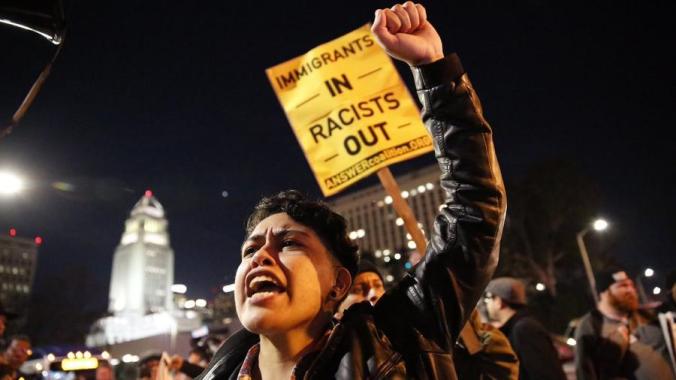
la-me-immig-arrest-protest-pictures-20170209-001


Our guest on yesterday’s Hitting Left radio show with the Klonsky brothers was dean of the Chicago City Council’s Hispanic and Progressive Caucuses, Alderman Ricardo Muñoz of the 22nd Ward.
The 22nd Ward includes Little Village, home to tens of thousands of Mexican immigrants in a city that  Alderman Muñoz accurately describes as the Mexican Capital of the Midwest.
The issue of Trump’s immigration policies was a center piece to our conversation with the Alderman.
Only the day before a three-judge federal panel upheld the stay of the Executive Order Tump has issued banning Muslim entry into the United States.
Our conversation shifted to how Trump’s immigration policies would impact the nearly one million Mexicans and their families that live in Chicago.
Hours later this happened.
U.S. immigration authorities arrested hundreds of undocumented immigrants in at least a half-dozen states this week in a series of raids that marked the first large-scale enforcement of President Trump’s Jan. 26 order to crack down on the estimated 11 million immigrants living here illegally.
The raids, which officials said targeted known criminals, also netted some immigrants who did not have criminal records, an apparent departure from similar enforcement waves during the Obama administration that aimed to just corral and deport those who had committed crimes.
Trump has pledged to deport as many as 3 million undocumented immigrants with criminal records. Last month he also made a change to the Obama administration’s policy of prioritizing deportation for convicted criminals, substantially broadening the scope of who the Department of Homeland Security can target to include those with minor offenses or no convictions at all.
Immigration officials confirmed that agents this week raided homes and workplaces in Atlanta, Chicago, New York, the Los Angeles area, North Carolina and South Carolina, netting hundreds of people. But Gillian Christensen, a spokeswoman for the Department of Homeland Security, which oversees Immigration and Customs Enforcement (ICE), said they were part of “routine” immigration enforcement actions. ICE dislikes the term “raids,” and prefers to say authorities are conducting “targeted enforcement actions.”

The Rise of Crony Appointees and the Inexpert Ruling Class | radical eyes for equity

The Rise of Crony Appointees and the Inexpert Ruling Class | radical eyes for equity:

The Rise of Crony Appointees and the Inexpert Ruling Class


Imagine the U.S. president appointing the Secretary of Education based almost entirely on that appointee being connected, and not because of a wealth of experience and expertise in public education.
No, this is not about Trump and Betsy DeVos—or at least not just about the most current spit in the eye of educators. The opening comment applies to Barack Obama appointing Arne Duncan, his Chicago basketball buddy.
The line from Duncan to DeVos is not some dramatic leap, but very direct and incredibly short.
“In the disciplinary societies one was always starting again (from school to barracks, from barracks to the factory),” wrote Gilles Deleuze in Postscript on the Societies of Control, “while in the societies of control one is never finished with anything—the corporation, the educational system, the armed services being metastable states coexisting in one and the same modulation, like a universal system of deformation.”
Many would discount this as so much French philosophical hokum, but when Deleuze turns to the fiction of Franz Kafka, the more concrete warning of this examination appears. Writing over a century ago, Kafka was keenly aware of the soul-destroying consequences of the bureaucratic existence.
Just as Kafka himself offered dark humor in his existential tales, more recently we have the comic strip Dilbert and two versions, UK and US, of the TV sitcom The Office as well as cult class films such as Office Space to dramatize exactly what Deleuze and Kafka feared: the rise of crony appointees and the inexpert ruling class.
Duncan and DeVos are inners, building careers on being connected and buying connections. And education has been a harbinger for the inevitability of Trump for three decades now since being without expertise and experience has driven who controls public education and what policies are implemented.
Education and education policy have been a playground for Innovators! who have no historical context or real experience in day-to-day teaching and learning.
The policy equivalent to DeVos being confirmed as SOE is the charter The Rise of Crony Appointees and the Inexpert Ruling Class | radical eyes for equity:


Badass Teachers Association: BETSY DEVOS: The Illusion of Choice by Jake Jacobs

Badass Teachers Association: BETSY DEVOS: The Illusion of Choice by Jake Jacobs:

BETSY DEVOS: The Illusion of Choice by Jake Jacobs

Since the nomination of Betsy DeVos for Secretary of Education, the nation has been contemplating her pet issue, school choice. School choice sounds great, like it’s giving the people back the power, for example to decide where and how your child will be learning. This idea, unfortunately, is a smokescreen for a major cash grab, introducing corporate middlemen between taxpayers and classrooms.
It’s called privatization and it devastated healthcare, leading to spiraling premiums and a crisis of millions uninsured. Look also at the military, as private contracts fabulously enriched cronies at Halliburton and Blackwater (whose CEO is Betsy DeVos’ brother — coincidence?). The privatization of the military has been expensive, opaque, and riddled with well-documented corruption costing taxpayers billions while worsening conditions on the ground.
ART OF THE BAD DEAL: Trump is also using the same trickery on unsuspecting investors — the GOP majority just rescinded the regulation that required brokerage firms must put the customers’ interest ahead of their own. The GOP justified the change by claiming investors want “better choices” of financial products.
The same goes for healthcare — they say the ACA should be repealed without any replacement, to let the marketplace offer “choice” such as unregulated low-cost insurance plans with loads of exclusions hidden in the fine print. We already tried this. Before the ACA, insurers denied care, refused to cover pre-existing conditions and imposed lifetime caps.
Republicans also tried unsuccessfully in 2001 to privatize Social Security, claiming account holders would have greater choice and control over their savings as Wall Street subsumed the nation’s piggybank. That one failed spectacularly.
So “choice” is the way corporate politicians deliver you to their Badass Teachers Association: BETSY DEVOS: The Illusion of Choice by Jake Jacobs:

Trump to Dems: 'Pocahontas is now the face of your party' - CNNPolitics.com

Trump to Dems: 'Pocahontas is now the face of your party' - CNNPolitics.com:

Trump to Dems: 'Pocahontas is now the face of your party'


Washington (CNN)President Donald Trump taunted Democrats by telling them "Pocahontas is now the face of your party" -- his insult of choice for Sen. Elizabeth Warren -- during a meeting with senators earlier this week, sources told CNN.
The President also used the Thursday meeting at the White House to again surface unfounded claims of voter fraud during the 2016 presidential election.
The sources said the Warren moment came up in the context of Trump's impromptu analysis of the state of the Democratic Party. Trump made his comments in what appeared to be a reference to Warren's criticism of Attorney General Jeff Sessions during his confirmation process. Her comments prompted Republicans to invoke an arcane rule to cut her off.
The moment galvanized Democrats and has elevated Warren's standing among progressives.
Trump used his pejorative campaign nickname for Warren -- a reference to her claims of having Native American ancestry -- several times during the meeting, which one source described as "equal parts bizarre and completely awkward."
At one point, Trump said the only reason Warren claimed Native American heritage was "because she has high cheekbones," one of the sources said.
The White House and Warren's office haven't responded to a CNN request for comment. The story was first reported by Politico.
For Trump, it was a unscheduled -- and unsolicited -- return to a frequent campaign riff attacking Warren, who at the time served as a top surrogate to Democratic nominee Hillary Clinton. In doing so, he was digging back into questions over Warren's ancestry from her 2012 Senate race, which Warren defended at the time, in part, by citing the high cheekbones of her grandfather.
"She's got less Native American blood in her than I have, OK?" Trump said during a July rally in North Carolina. "Believe me ... She goes, 'Well look at my cheekbones.'"
Trump, in a similar line of attack during a Washington state rally in May, called Warren "a total phony."Trump to Dems: 'Pocahontas is now the face of your party' - CNNPolitics.com:


Seattle Schools Community Forum: That Was Short

Seattle Schools Community Forum: That Was Short:

That Was Short

Image result for they're back poltergeist

It appears my hiatus is coming to an end.

It's kind of Godfather-like - I keep trying to do less but I keep getting pulled back in.

But there are too many stories popping up. 

I think it important to keep up with:

- what is happening (or not) in Olympia

- what is happening with Advanced Learning (I attended both the Board Work Session and a two-day summit at UW on Equity and Gifted Education.  There seemed to be something of a disconnect between the two - by SPS staff, no less - and I learned a lot.  I think I can tell you - without being a fortuneteller - what's going to happen.  But it's a little troubling that one program can somehow become a central focus for our district. It would almost seem like perhaps - somehow - this issue might be being used for some other less clear purpose.).

It will probably be a very long post but I sense this might be important.

- where do we go now we have Betsy DeVos as Secretary of Education.  Today, she apparently couldn't enter a middle school because of what looked to be a small number of very loud protesters.  I have to wonder how she would have done in front of a whole room of middle school students.

However, she is the secretary of Education and could impose some trying things on states but really, it does appear that the new focus is on state legislatures and districts.  So the discussion/fight will be local. 

- the issue of high schools in Seattle Schools - issues in all directions

- the continued rise of faux education groups in our state who appear to be trying to get control of the discussion about public education.

- charter schools

- student data privacy

But, as I stated, I am less interested in the district.  So I'm probably not going 
Seattle Schools Community Forum: That Was Short:


DeVos Public School Visits: A Brief Guide | deutsch29

DeVos Public School Visits: A Brief Guide | deutsch29:

DeVos Public School Visits: A Brief Guide


 If US Ed Sec Betsy DeVos is truly interested in the goings-on at public schools, she should first contact the school and arrange a visit. DeVos should not spring a “pop-in” on stakeholders.

Admin should not surprise their faculty and students with a DeVos pop-in.
DeVos should be certain that parents are notified and included in the visit.
The visit should occur at a time that teachers are able to interact with her. DeVos told the US Dept of Ed employees that she is a listener. Therefore, let her listen.
Stakeholders should be candid with DeVos but not ugly. Adults should model respectful disagreement for the students who are watching and listening.
If parents and teachers decide to include students in the visit, then students should be included if they wish. However, DeVos has been major news, and some students might not trust her because they have heard that she does not care for public schools.
Schools should have the right to say no to a DeVos visit. That way, the “yes” will be genuine.
DeVos and her people should take no pictures. Let the stakeholders take the photos, if they choose.
Finally, DeVos should not make these visits if she cannot honestly assure stakeholders (parents, students, teachers) that she intends to invest in public schools. If her goal is to dismantle America’s public schools via voucher-glutting, fiscal erosion, then any attempt at assurance of DeVos investment in public schools will come across for what it is– a lie– and building trust with stakeholders will be impossible.
It all comes down to whether DeVos wants a relationship with public school stakeholders or just a photo op.
The preponderance of DeVos evidence to date points to a photo op motive.
DeVos needs to decidedly own as much if she truly wants a relationship with the nation’s public schools.DeVos Public School Visits: A Brief Guide | deutsch29:

Creswell follow-up responses to Commission in opposition to a comprehensive federal student database | Parent Coalition for Student Privacy

Creswell follow-up responses to Commission in opposition to a comprehensive federal student database | Parent Coalition for Student Privacy:

Creswell follow-up responses to Commission in opposition to a comprehensive federal student database 

Parent Coalition for Student Privacy


Following Cassie Creswell’s testimony on behalf of our Coalition on January 5, 2017 to the Commission on Evidence-Based Policy, the Commission sent her some follow-up questions.  Here are her responses.
10 February 2017
Commission on Evidence-Based Policymaking
Washington, DC

Dear Commission Members:
Thank you for requesting additional information about the Parent Coalition on Student Privacy’s position on unit record systems. Below we address all three of the Commission’s follow-up questions:
  • Can you please clarify whether your objection is to unit record systems for elementary and secondary school students or if you also object to unit record systems for postsecondary students?
See the discussion of this issue below.
  • You argue for local control of student data and specifically for parental and teacher data stewardship. At what point should adult students in postsecondary education become the stewards of their own data?
The control of their data should pass to post-secondary students when they become adults, as occurs currently in Federal law.
  • Would your concerns about the intrusiveness of a student-unit record system be mitigated if the data were only maintained without personal identifiers that could be used to track an individual student, and if there were statutory protections that guaranteed that the data could only be used for aggregate, statistical analysis?
No, because data can easily be re-identified. If only aggregate data is used, only aggregate data should be collected.
We have significant reservations about the creation of any universal unit record system for students, whether for elementary, secondary or post-secondary students.
Elementary and secondary student unit record systems present a particular set of risks because the majority of information in a child’s K12 educational record should not be made “permanent.” Childhood is a time of growth, experimentation and development; and mistakes and challenges should not be part of a record that could follow one into adulthood and hamper a child’s chance of future success.
A unit record system for post-secondary education does not present an identical set of concerns. Students in post-secondary institutions do expect that some aspects of their transcript, including grades and credits, will persist into adulthood with the expectation of being  shared with employers and other educational institutions—with their consent. Yet other contents of their education records should never be made public.
Records from these years may also contain sensitive information about immigration status, counseling records, mental and physical health and disabilities, etc. At the age of 18, control of the record is transferred from a parent or guardian to the students themselves, but, crucially, privacy controls are still maintained.
We have several concerns about the need for and use of any universal post-secondary unit record system:
  1. The efficacy of methods to de-identify or anonymize personally-identifiable data is questionable. De-identified data can often be re-identified and exposed.[1]
  2. The government should not have access to a comprehensive database for all post-secondary students as this information could be easily abused for political or immigration reasons.  This is especially of concern given the current political climate. The Home Office in Great Britain has now requested access to a similar government student database for the purposes of “immigration control” that was promised to only be used for research.[2]
  3. Once the federal government starts collecting post-secondary data, this could easily lead to a creeping expansion of data collection from K12 institutions and districts.
  4. The quality of research based on large-scale correlational studies is of greatly varying quality[3] and does not justify the risks of universal tracking.
  5. Large amounts of data used for the purposes of evaluating post-secondary institutions’ effectiveness are already available, including the Department of Education’s College Scorecard, the Mobility Report Card Project—a collaboration of the US Treasury and the Department of Education, and the privately-run National Student Clearinghouse.
  6. Extensive regulations have already been implemented to ensure that post-secondary institutions are protecting student’s long-term financial interests, e.g. Negotiated Rulemaking on Gainful Employment implemented in Fall 2014.
We acknowledge that given the investment of taxpayer funds that support institutions of higher education, the federal government has a strong practical interest to make certain that those funds are being used efficiently and effectively.
We do not, however, think that a universal student record system created and administered by the federal government is a necessary component of fulfilling that interest and duty.
The federal government spends billions of dollars in medical research and health care as well, and yet there has been no proposal that we know of for the federal government to collect the personal health data for every person in the United States.
We support only the use of aggregated student data for the evaluation of postsecondary institutions. The collection of such data must include asking for consent for participation from either a parent/guardian or the students themselves if over the age of 18. Clear, transparent information about how any data is to be used and who it may be shared with must be presented before asking for consent. And, there should be no financial benefit or loss contingent on granting the consent.
We continue to urge the Commission to recommend against the creation of any universal federal student unit record system.
On behalf of the Parent Coalition for Student Privacy,
Sincerely,
Cassandre Creswell, PhD
Co-executive director
Raise Your Hand Action
Chicago IL
_____
[3] See discussion from a variety of fields (medicine, psychology and linguistics) in “Data dredging, bias, or confounding.” Smith, G.D. and S. Ebrahim. BMJ. 2002; “Why Most Published Research Findings Are False.” Ioannidis, J. P. A. PLOS Medicine. 2005; “False-Positive Psychology: Undisclosed Flexibility in Data Collection and Analysis Allows Presenting Anything as Significant.” Simmons, J.P., L.D. Nelson and U. Simonsohn. Psychological Science. 2011; and “Linguistic Diversity and Traffic Accidents: Lessons from Statistical Studies of Cultural Traits.” PLoS ONE. 2013. Roberts S. and J. Winters.
Creswell follow-up responses to Commission in opposition to a comprehensive federal student database | Parent Coalition for Student Privacy: