Latest News and Comment from Education

Friday, February 10, 2017

RFA: Public Charter Schools Grant Program Planning and Implementation Grant--Round 2 (CA Dept of Education)

RFA: Public Charter Schools Grant Program Planning and Implementation Grant--Round 2 (CA Dept of Education):

Request for Applications

Public Charter Schools Grant Program Planning and Implementation Grant--Round 2


Due: Thursday, March 9, 2017
The Federal Public Charter Schools Grant Program (PCSGP) a discretionary grant program administered by the Charter Schools Division. Grant applications are reviewed by peer evaluators and are awarded to nonprofit entities and local educational agencies to assist in the development to open high-quality charter schools. The primary focus of the PCSGP is to create charter schools that will provide public school choice to students whose assigned traditional public school is chronically low performing.
Program Questions: PCSGP TEAM, e-mail: pcsgp-apps@cde.ca.gov, tel. 916-322-6029
Downloading Questions: PCSGP TEAM, e-mail: PCSGP-APPS@cde.ca.gov, tel. 916-322-6029 

Request for Applications

Public Charter Schools Grant Program Planning and Implementation Grant

Round 2

The Federal Public Charter Schools Grant Program (PCSGP) is a discretionary grant program administered by the Charter Schools Division. Grant applications are reviewed by peer evaluators and are awarded to nonprofit entities and local educational agencies to assist in the development to open high-quality charter schools. The primary focus of the PCSGP is to create charter schools that will provide public school choice to students whose assigned traditional public school is chronically low performing.
A listing of the Education Programs Consultant assigned to a specific region.

DocumentDescription
Request For Applications (DOC)Complete description of the PCSGP Planning and Implementation grant, eligibility requirements, funding, and sub-grantee accountability. Precharter grants and dissemination grants are not being offered at this time.
Application Checklist (DOC)PCSGP Application Checklist.
Application Cover Sheet (DOC)PCSGP Form 1 Application Cover Sheet (Required). (Must be signed in BLUE INK by primary applicant.)
Narrative Response Part 1 (DOC)PCSGP Form 2 Narrative Response-Part 1 (Required). Limit 15 Pages.
Narrative Response Part 2 (DOC)PCSGP Form 3 Narrative Response-Part 2 (If applicable). Limit 4 Pages.
Budget Instructions (DOC)PCSGP Form 4 Budget Instructions.
Proposed Budget Summary (XLS)PCSGP Form 5 Proposed Budget Summary (Required).
Proposed Budget Narrative (XLS)PCSGP Form 6 Narrative (Required).
Charter School Work Plan/Activities (DOC)PCSGP Form 7 Charter School Work Plan/Activities (Required) Limit 15 Pages.
Object of Expenditure Codes (DOC)PCSGP Form 8 List of Expenditure Codes.
General Assurances and Certifications (DOC)PCSGP Form 9 General Assurances and Certifications. Applicants will need to download, read, and file (in their school files) the General Assurances and Certification document. This document is to be kept on file for compliance reviews, complaint investigations, or audits.
Sub-grant Conditions and Assurances (DOC)PCSGP Form 10 Sub-grant Conditions and Assurances. Applicants will need to download, read, and file (in their school files) the Sub-grant Conditions and Assurances document. This document is to be kept on file for compliance reviews, complaint investigations, or audits.
STD 204 Payee Data Record (DOC)Required when receiving payment from the State of California in lieu of IRS W-9. Prompt return of this form (Sections One through Five) will prevent delays when processing payments. Information provided in this form will be used by State agencies to prepare Information Returns (1099). NOTE: Governmental, federal, State, and local (including school districts) entities are not required to submit this form. Only non-profit organizations developing schools that have not opened their doors to serve students need to complete this form. If the application is approved, verification of non-profit status will need to be submitted.

Certifications and Assurances


DocumentDescription
Required as a condition prior to receiving funds. Applicants will need to download, read, and file (in their school files) the General Assurances and Conditions document. This document is to be kept on file for compliance reviews complaint investigations, or audits.
OMB Control No. 1894-0005
(Exp. March 31, 2017)
Notice to applicants for federal funds to include in the application a description of the steps the applicant proposes to take to ensure equitable access to its federally assisted program for participants with special needs.

Dyslexia, The DeVos Vote, and a Senator’s Lost Credibility

Dyslexia, The DeVos Vote, and a Senator’s Lost Credibility:

Dyslexia, The DeVos Vote, and a Senator’s Lost Credibility


There were several senators who I expected would change their vote on Betsy DeVos. In the end none of them did, and I think they need to called-out. Their votes for DeVos were especially unethical due to their past positions, or where they are from.
I will write today about one, William Cassidy, M.D., who is the Republican senator from Louisiana.
Cassidy is a doctor and has been outspoken on the issue of dyslexia.
In his opening statement to the Senate Health, Education, Labor and Pensions (HELP) committee meeting, in 2016, titled “Understanding Dyslexia: The Intersection of Scientific Research & Education,” he stated, The goal of the hearing is to gain a better understanding of what Americans need to know about dyslexia and to raise awareness in Congress about the parents and children affected by this disorder.
Does Sen. Cassidy think Betsy DeVos will raise awareness about dyslexia when she doesn’t understand the federal law surrounding special education?
Most children with dyslexia attend public schools. Because of underfunding and a lack Dyslexia, The DeVos Vote, and a Senator’s Lost Credibility:

Schools In The Nation's Capital Are Embarrassingly Segregated | The Huffington Post

Schools In The Nation's Capital Are Embarrassingly Segregated | The Huffington Post:

Schools In The Nation’s Capital Are Embarrassingly Segregated
Washington, D.C., is still very separate and unequal.


Even several decades ago, it wasn’t hard for Gary Orfield to convince white parents in his Washington, D.C., neighborhood to send their kids to a racially segregated black school. 
At the time, his eldest daughter was one of only a handful of white students in her neighborhood elementary school. Most of the school’s students were black and low-income, but Orfield’s daughter had a positive experience. She had good teachers and a dedicated principal. 
Still, Orfield, now a professor and co-director of the Civil Rights Project at UCLA, was invested in increasing the school’s diversity. It’s not that Orfield had a problem with his daughter attending an all-black school. Rather, he knew that integrated schools can have academic and social benefits for black and white students. Orfield decided to organize a group of local white parents around the issue. He sent them notices about the school’s highlights. He held a meeting at his house with the school’s principal, and invited friends to attend. 
At the end of the night, “we had signed up enough people to integrate the first grade and the second grade,” Orfield said. 
In subsequent years, the school remained racially mixed, having an indelible impact on the surrounding neighborhood, Orfield said. However, Orfield’s story is an anomaly, and in surrounding areas, most of Washington, D.C., did not follow his lead. Schools In The Nation's Capital Are Embarrassingly Segregated | The Huffington Post:

Bipartisan Education Politics a Thing of the Past | Education News | US News

Bipartisan Education Politics a Thing of the Past | Education News | US News:

Bipartisan Education Politics a Thing of the Past
House Republicans voted to block Obama-era education regulations.


hen Congress passed a sprawling rewrite of the federal education law at the tail-end of 2015, it was hailed as a "Christmas miracle."
Drafted, negotiated and passed by members on both sides of the aisle and in both chambers, the Every Student Succeeds Act, which overhauled the widely reviled No Child Left Behind by returning much of the authority over education to states, stood out as a shining example of bipartisanship in an ever-partisan, log jammed political system.

RELATED CONTENT

Secretary of Education Betsy DeVos addresses department staff on her first day in office after her controversial confirmation by the Senate the day before, on Feb. 8, 2017, in Washington, D.C.

Decoding DeVos' To-Do List


A little more than a year later, that milieu of goodwill in the education sphere has seemingly evaporated.
“We have been able to work together well for the past two years, and it’s because we have worked in good faith and across party lines to make sure we have what we needed to proceed,” Sen. Patty Murray, D-Wash., the top Democrat on the Senate education committee, said prior to the committee vote that cleared billionaire school-choice advocate Betsy DeVos, now Secretary of Education, for consideration by the full Senate.
Confirming DeVos in spite of staunch Democratic opposition, she warned committee Chairman Lamar Alexander, R-Tenn., was “a massive break with that strong bipartisan record, and it will dramatically impact our ability to work together in good faith going forward.”
Alexander, for his part, accused Democrats of unfairly holding up DeVos' confirmation process.
While DeVos' contentious confirmation garnered the lion’s share of media attention, across the Capitol and out of the spotlight House Republicans were moving on something just as noteworthy: They passed two, separate resolutions that would block the Department of Education from implementing rules set by the Obama administration.
The first resolution, which comes as states begin implementing the bipartisan Every Student Succeeds Act, prevents the Department of Education from dictating prescriptive requirements for how they measure that achievement, using metrics such as school ratings, timelines for interventions for failing schools and student participation in state assessments.
“By blocking implementation of the Obama administration’s accountability rule, we are giving states the certainty they need to move forward with their own efforts to implement the law,” said Rep. Todd Rokita, R-Ind., who authored the resolution.
Citing similar concerns of federal overreach, the second resolution negates an Obama-era regulation that dictates specific requirements states must use to determine the effectiveness of teacher preparation programs.
Democrats blasted the adoption of the resolutions, which passed the House on a party-line vote Tuesday afternoon.
“This resolution will cripple the Department of Education, and it will leave states like Colorado blind on how to implement the Every Student Succeeds Act,” said Rep. Jared Polis, D-Colo. “After months of bipartisan work on a new education law, it’s both Bipartisan Education Politics a Thing of the Past | Education News | US News:


A comprehensive list of what Betsy DeVos can — and can’t — do next - Vox

A comprehensive list of what Betsy DeVos can — and can’t — do next - Vox:

A comprehensive list of what Betsy DeVos can — and can’t — do next


After barely surviving a contentious confirmation process, Betsy DeVos is now in charge at the Education Department.
She and her fiercest opponents might be surprised by how little power she actually has in the job.
Liberals’ biggest worry about DeVos, aired at the rallies to oppose her and the hundreds of thousands of calls to senators, is that she would “destroy” public education. It will be hard for DeVos to make changes that big on her own. Even a modest school voucher program will face a tough battle to become law.
What she can do is carry out smaller surgical strikes on some of President Obama’s most controversial policies.
Guesses about DeVos’s agenda are, at this point, based more on liberal nightmares and conservative wish lists than anything she’s said in public. So far, DeVos has shown a lot of enthusiasm for her signature cause, vouchers, to the exclusion of much else. In her speech to Education Department employees Wednesday, DeVos praised the department’s “unique role” of keeping students “free from harm.”
But now that she’s officially in power, she’s going to be under pressure to change which students the department prioritizes for protection. The effects might not be obvious to everyone. But they could make schools and colleges a less welcoming place for millions of students — from transgender kids to victims of sexual assault — who have had the federal government in their corner for the past eight years.

DeVos needs Congress to expand school vouchers

The issue: Trump promised a $20 billion federal school voucher program on the campaign trail, and he suggested that he’d get states to kick in enough money to send children living in poverty in the US to private school with vouchers. Picking DeVos, a champion of voucher programs, suggested Trump was serious.
What DeVos can do on her own: Not much. DeVos’s abilities are limited to tinkering around the margins — adjusting existing federal grant programs, for example. But DeVos promised Republican senators she wouldn’t try to force voucher programs on the states, and the amount of money involved in existing grants is small enough that it’s not likely to leverage much change.
A lot of Republicans in Congress support school vouchers, too, and once they’re involved, the options expand. But a national school voucher program is still highly unlikely, even with Republicans dominating the majority of state governments. One of the many hurdles: 38 states have constitutional amendments that block public funding from going to religious schools.
Working with DeVos, Congress could make changes that fall short of a national voucher program. It could pass Trump’s voucher plan, which would turn $20 billion worth of federal education funding into vouchers for kids living in poverty (but wouldn’t, on its own, offer low-income families enough money to pay private school tuition in most places). Republicans could also return to an often-proposed idea to make Title I funding, which goes to schools with a high share of low-income students, into a sort of voucher by allowing the money to “follow” students to any public school they attend.
One conservative idea getting attention in education circles is a federal tax credit scholarship: a tax break for people and businesses that donate to scholarship funds for private schools. Those tax credits, which already exist at the state level, essentially provide federal support to private schools, which eventually benefit from the scholarship funds. Congress could pass them through the tax reform process, though, rather than as part of a more contentious education bill.

DeVos can ease regulations on for-profit colleges

The issue: Michigan, DeVos’s native state, allows for-profit companies to operate charter A comprehensive list of what Betsy DeVos can — and can’t — do next - Vox:

#HITTINGLEFT17 Brother Fred & I will be HITTING LEFT & streaming live this morning Mike Klonsky's SmallTalk Blog

Mike Klonsky's SmallTalk Blog: Brother Fred & I will be HITTING LEFT & streaming live this morning.:

Brother Fred & I will be HITTING LEFT & streaming live this morning.


Tune in this morning at 11 (CST) for week 2 of Klonsky Brothers, HITTING LEFT on Lumpen Radio at 105.5 FM and streaming live here. Fred and I will be joined by Chicago's 22nd Ward Ald. Rick Munoz, who definitely hits lefty.


He's a member of both the Progressive Caucus and the Latino Caucus in the City Council. His Little Village ward is the main debarkation point for Chicago's one million Mexican immigrants.

It's a perfect time to talk to Rick as #PEEOTUS blames "immigrant gang members" for Chicago's rising murder rate. Says he wants to invade our Sanctuary City, round up immigrants and have posse of sheriffs running the city.

Mayor Rahm Emanuel says he's willing to deal with Trump. But what possible deal could he make? If Trump agrees to "give us more resources", will Rahm agree to... do what? Abandon Sanctuary City? What?

And what's up in the upcoming race for mayor? In the last election, Rick backed his mentor, Chuy Garcia. What about this time around?

Can't wait to hear Rick's response.

Tune in and Tweet us at #HITTINGLEFT17.

What Was Accomplished in the DeVos Confirmation Process? | janresseger

What Was Accomplished in the DeVos Confirmation Process? | janresseger:

What Was Accomplished in the DeVos Confirmation Process?


Public education supporters relentlessly made phone calls and wrote letters to Senators to complain about Betsy DeVos. Despite that the entire Democratic Senate Caucus held an all-night session enumerating problems with the Education Secretary nominee—her ignorance, her ideology of privatization, her entangled finances and potential conflicts of interest, DeVos has now been confirmed and sworn in. Her confirmation was always pretty much a sure thing, because today Republicans have more seats in the Senate and because Cabinet nominee confirmations cannot be filibustered.
But commentators have been noting significant accomplishments from the DeVos confirmation process. Here are three examples.
Dana Milbank, opinion writer for the Washington Post, explains that we should all be encouraged by the kind of incompetence Betsy DeVos demonstrated through her confirmation hearing: “Republicans, apparently recognizing the billionaire’s lack of familiarity with the rudiments of education policy, tried to shield DeVos from public view. They scheduled her testimony in the evening and limited questions. But this did not save the heiress from getting schooled… DeVos was ‘confused’ by questions about the Individuals with Disabilities Education Act, and befuddled when asked about the raging debate about measuring student proficiency and growth.”
Milbank believes that the DeVos confirmation hearing exposed an unusual level of ignorance among appointments by the Trump White House, and that Democrats can someday use such cluelessness to their own advantage: “Democrats in the long run may thank the majority Republicans for confirming DeVos. In the fight against President Trump’s agenda, the new What Was Accomplished in the DeVos Confirmation Process? | janresseger:


Mother Jones on Betsy DeVos’ Sheltered Background (and More) | deutsch29

Mother Jones on Betsy DeVos’ Sheltered Background (and More) | deutsch29:

Mother Jones on Betsy DeVos’ Sheltered Background (and More)


In January 2017, Mother Jones originally published an article entitled, “Betsy DeVos Wants to Use America’s Schools to ‘Build God’s Kingdom.'” It has since been updated.
I did not read the original article; however, I am intrigued by the details I read today on US Ed Sec Betsy DeVos’ sheltered and privileged background, a background that decidedly contradicts her fitness as overseer of the nation’s public schools.
Thus, I offer my readers excerpts from what is an extensive article.
Here we go:
More than 150 years ago, Dutch immigrants from a conservative Protestant sect chose western Michigan as the setting for this idealized replica of Holland, in part because of its isolation. They wanted to keep American influences away from their orthodox community. … If city officials decide that a fence or a shed signals decay, they can tear it down and mail the owner a bill. Grass clippings longer than eight inches have to be removed and composted, and snow must be shoveled soon after it lands on the streets. … It’s also where President Donald Trump’s pick for education secretary, billionaire philanthropist Betsy DeVos, grew up. …
Most people I meet in Holland tell me that it’s hard to understand the DeVos and Prince families without learning about the history of Dutch Americans in western Michigan. In the mid-1800s, a group of mostly poor farmers known as the “Seceders” rebelled against the Dutch government when it tried to modernize the state Calvinist church, including by changing the songbooks used during worship and ending discriminatory laws against Catholics and Jews. In 1846, an intensely devout Calvinist clergyman named A.C. van 
Mother Jones on Betsy DeVos’ Sheltered Background (and More) | deutsch29:


CURMUDGUCATION: Impersonal Personalization

CURMUDGUCATION: Impersonal Personalization:

Impersonal Personalization


Your child sits at a desk, alone in the room. No teacher ever enters the room. An aid comes into the room periodically to give your child a quiz, or a worksheet. Your child fills out the sheet, the aid scores it. Maybe the aid gives it back to your child to do again, but the aid can't explain anything. All the worksheets and quizzes are written so that the aid, or anyone, really, can correct them. Eventually, the aid takes the paper out of the room. A few moments pass, and then the aid returns with a new standardized worksheet or quiz.

If you go to the school to see what the heck is going on, you may follow the aid to another room, maybe a huge room. In that room there are a few hundred of stacks of worksheets and quizzes. The aid brings in a completed one, and the worker in that room looks at the results and based on those, selects another paper to be carried back to the student.

"Where did all these stacks come from?" you ask.

The worker explains. "They were all written out years ago by some teacher, or at least someone expert in writing worksheets."
"Well, can I meet that person? Can I talk to the person who created all these stacks? Can I ask her how she makes sure they are right for my child?"

"Ha," laughs the worker. "She's long gone. She moved on as soon as she finished writing these out. She's never met your kid. She's never even laid eyes on your kid. Excuse me a minute." The aid comes back with a new paper. The worker scans it, looks around at a few stacks of fresh papers, grabs one, muttering, "Well, this comes as close as anything we've got."

"Comes close!?!"

"Hey, we don't have infinite assignments in here. And we stacked these up long before your kid even 
CURMUDGUCATION: Impersonal Personalization:


BAT Educators: Why Did You Go Into This Profession? by Priscilla Sanstead and Dr. Michael Flanagan Badass Teachers Association:

Badass Teachers Association: BAT Educators: Why Did You Go Into This Profession? by Priscilla Sanstead and Dr. Michael Flanagan:

BAT Educators: Why Did You Go Into This Profession?
 by Priscilla Sanstead and Dr. Michael Flanagan

We recently posed the question on the Badass Teachers’ Association Facebook group, “Why did you become educators?” The answers were as interesting, as inspiring, and as diverse, as the dedicated professionals who populate BATs. Teachers have taken a lot of hits in recent years; let’s look back to what brought us to the teaching profession in the first place in the hopes that it will keep us energized to fight for the future.  (Comments posted with permission).


LOVE OF TEACHING
  • “I came into this profession because I love children and want them to succeed.”                     - Debbie Doty Reddick

  • “I teach to teach children that's it's ok to be yourself, even if you're different even if you're weird, even if it seems like no one understands you. I teach so that my weirdest, loneliest kids can know someone out there cares about them and accepts them for who they are. I teach kids that the world is wide and diverse and we should explore it with kindness.” - Anonymous

  • “I loved school and wanted to be a teacher from the time I entered kindergarten. I grew up in a military family and moved frequently. Everywhere I went, I loved school and was a good student. I realized that other kids didn't love learning like I did and it didn't come as easily to them as it did to me. I wanted to make a difference. I was a special education teacher for 20 years. This is my first year out.” - Lisa Heater Gerard

School district chiefs: Proposed Medicaid changes would hurt poor children and students with disabilities - The Washington Post

School district chiefs: Proposed Medicaid changes would hurt poor children and students with disabilities - The Washington Post:

School district chiefs: Proposed Medicaid changes would hurt poor children and students with disabilities


A new survey of school district leaders across the country finds that they are deeply worried that Republican proposals to refinance Medicaid, if they become law, would hurt students who live in poverty and those with disabilities and in special education.
A big cut in Medicaid spending would mean, the survey report said, that many districts would have to furlough or lay off school personnel, that the percentage of uninsured children could go from 12 percent to an estimated 21 percent or higher, and critical benefits could be eliminated. Furthermore, new local tax levies or requests for higher taxes could result in an effort to make up for lost funding to special education programs and health services for students in poverty.
Nearly 40 percent of children in the United States receive their health care through Medicaid, according to AASA, the School Superintendents Association which did the survey, titled “In Cutting Medicaid: A Prescription to Hurt the Neediest Kids.” It was administered by the AASA as well as the Association of School Business Officials International and the Association of Educational Services Agencies.
Republicans have long been eager to refinance Medicaid, the program in which the federal and state governments share the cost of helping to cover medical costs for millions of disabled and low-income Americans. The election of Republican President Trump has spurred Republican legislators in Congress to move toward an overhaul. Here’s how this Washington Post storydescribes what they are interested in doing to Medicaid:
But many key Republicans are especially interested in changing Medicaid, the nation’s health insurance program for the poor — including Trump, House Speaker Paul D. Ryan (Wis.) and Tom Price (Ga.), Trump’s nominee to head the Department of Health and Human Services. Each of those three has proposed converting Medicaid from a program funded jointly by the federal government and the states into a block grant program. Doing so would send a set amount of money to each state, thus capping total Medicaid spending, and would let each state decide how to disburse those funds. … Historical data suggest that a shift to block grants would result in a gradual decline in Medicaid funding. A 2016 report by the Center on Budget and Policy Priorities (CBPP) showed that when the federal government uses block grants, the funding for the programs shrinks over time.
The AASA survey noted that Republicans have said they want to cut Medicaid spending by 25 percent through the block grant or a per capita cap, though other estimates say that it could be School district chiefs: Proposed Medicaid changes would hurt poor children and students with disabilities - The Washington Post:


PA Senate Regulates Union Political Spending But Not Corporate Political Spending | gadflyonthewallblog

PA Senate Regulates Union Political Spending But Not Corporate Political Spending |

PA Senate Regulates Union Political Spending But Not Corporate Political Spending

screen-shot-2017-02-09-at-9-39-55-am
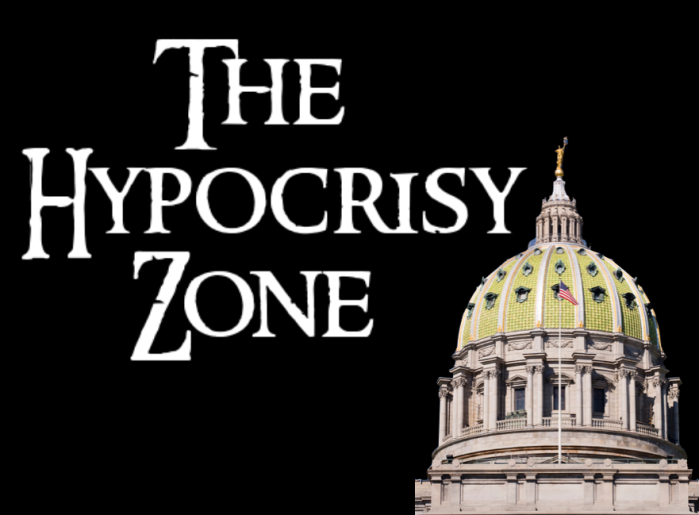
In a display of blatant hypocrisy, the Pennsylvania state Senate voted yesterday to further regulate labor unions political spending but not that of corporations.
By a vote of 28-22the Senate passed a bill blocking government agencies from deducting union dues used for political activity from employees’ paychecks.
Even though six Republicans joined all Democrats in opposing SB 166, it now goes to the state House for consideration.
Typically only about 10 percent of union dues are used in politics. These are voluntary contributions employees ask to be deducted from their pay for lobbying in their own interests. Like contributions to the United Way or other charities, it’s an issue of convenience for employees but poses no significant burden on employers.
However, businesses such as insurance companies, big banks and financial companies also are involved in politics. Shouldn’t their spending be subject to similar controls?
Apparently not, according to Senate Republicans.
Leading Democrat Sen. Jay Costa (D-Forest Hills) proposed an amendment to the bill that would have put similar regulations on corporations in the state. It was defeated by a party line vote of 16-34.
Costa’s amendment would have required corporations that are organized in the Commonwealth to get shareholders consent before spending any more than $10,000 a year on politics.
It was a common sense measure meant to ensure that CEOs and board of directors are acting in the interests of their shareholders. However, Senate Republicans turned PA Senate Regulates Union Political Spending But Not Corporate Political Spending |
Image result for PA Senate Regulates Union Political Spending But Not Corporate Political Spending