Tuesday, November 29, 2016

When White Educators Talk about Race - SF Public School Mom #EDUCOLOR

When White Educators Talk about Race - SF Public School MomSF Public School Mom:

When White Educators Talk about Race
The prospect of a Trump presidency has brought with it a rise in hate crimes and a heightened visibility for white supremacy in our country. As disturbing as this is, recent events have had at least one positive side-effect. More and more White educators are embracing conversations about race.
I’ve been thinking a lot about the ways we talk (or don’t talk) about race in our schools. This article on the Teaching Tolerance website sums up my experience as a student, educator and parent:
“Many black and brown students are educated in school systems and classrooms where they, despite making up the racial majority, are taught how to understand a world by a staff comprised of a powerful minority. When their teachers choose to remain silent about moments of racial tension or violence—violence that may well touch students’ own communities or families—these children are overtly reminded of their inferior place in society.”
Read more here.]
dontsaynothing
SFUSD will be rolling out Inclusive Schools Week across the district, December 5-9, 2016. As my daughters’ middle school prepares to have conversations around equity and inclusion, I wonder: “How will educators include conversations about race?”

When “well-meaning” White folks talk about race…

I’m glad that they are taking on these tough conversations. The 6th grade team at my daughters’ school has shown a high level of skill in creating warm and welcoming classrooms. Just last week I chaperoned a school field trip to a ropes course, and was so impressed with the way students cheered for one another as they climbed and repelled off 30 foot wooden columns! With this in mind, I know my daughters’ When White Educators Talk about Race - SF Public School MomSF Public School Mom:

New Orleans researcher says Trump’s education secretary supports the wrong kind of reform | The Lens

New Orleans researcher says Trump’s education secretary supports the wrong kind of reform | The Lens:

New Orleans researcher says Trump’s education secretary supports the wrong kind of reform


President-elect Donald Trump’s selection of Betsy DeVos for U.S. Secretary of Education should concern anyone who wants to improve public education, wrote Doug Harris, director of the New Orleans-based Education Research Alliance, in a New York Times op-ed.
DeVos heads American Federation for Children, a school-choice nonprofit. She and her husband have worked to expand school choice in Michigan with public charters and vouchers for private schools.
As Harris noted, Michigan’s charter schools have been dominated by for-profit companies that operate with little oversight. They’re often cited as a failure of education reform.
According to Harris, DeVos created a Wild West atmosphere in Detroit’s schools:
It’s hardly a surprise that the system, which has almost no oversight, has failed. Schools there can do poorly and still continue to enroll students. Also, after more than a decade of Ms. DeVos’s getting her way on a host of statewide education policies, Michigan has the dubious distinction of being one of five states with declining reading scores.
The Detroit Free Press found the state has little power to close charter schools. An 18-year-old charter and 20-year-old charter were in the first and third percentile of schools statewide.
Harris contrasted Michigan’s approach to Louisiana’s standards for charters and New Orleans’ centralized systems to handle enrollment and expulsions.
Louisiana’s Board of Elementary and Secondary Education is set to review charter renewals next week.
Two of the schools up for renewal received Fs this year, including McDonogh 42 Elementary Charter School in Treme. The state generally requires that a school earn a D or higher in order to get its initial charter renewed, though the state board of education can approve a probationary extension.
Harris’ Education Research Alliance recently found that school closures and takeovers in New Orleans and Baton Rouge were beneficial to students when they ended up in better schools.
DeVos has written in the Free Press that she favors aggressive intervention, including closure, for failing traditional and charter schools.
She is a proponent of school vouchers, in which taxpayer dollars pay for children to attend private schools. In Louisiana, Harris’ group has found that students who moved to private schools with vouchers did more poorly on achievement tests.
In 2013-14, 61 percent of charters in Michigan were run by full-service, for-profit management companies, the Detroit Free Press reported. The charter school DeVos founded, West Michigan Aviation Academy, is run by a for-profit group.
While the contract with that company is public, its employees’ salaries are not, a chief complaint of critics of such arrangements.
The five for-profit operators hired to run New Orleans charters after Hurricane Katrina had left the city by 2013, according to The Hechinger Report. Charter schools advocate Leslie Jacobs, whose stature in Louisiana’s education scene is on par with to DeVos’ in Michigan, described their track record as “at best mediocre.”New Orleans researcher says Trump’s education secretary supports the wrong kind of reform | The Lens:

Trump's Billionaire Education Secretary Has Been Trying to Gut Public Schools for Years | Mother Jones

Trump's Billionaire Education Secretary Has Been Trying to Gut Public Schools for Years | Mother Jones:

Trump's Billionaire Education Secretary Has Been Trying to Gut Public Schools for Years

Meet Betsy DeVos, the anti-union, pro-voucher surprise nominee.

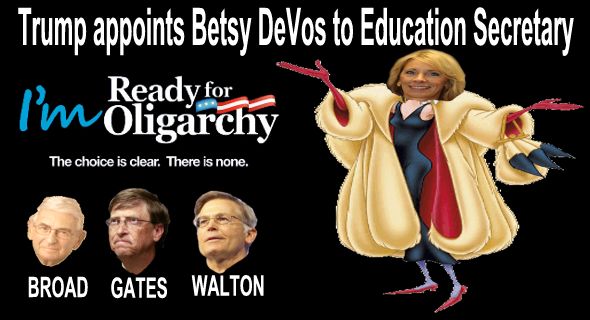
Last Wednesday, President-elect Donald Trump announced that he would nominate billionaire activist and Republican fundraiser Betsy DeVos as his education secretary. The news came as a shock to the education world—DeVos' ideas for school reforms are even more radical than what Trump proposed on the campaign trail.
Trump's signature education proposal calls for dedicating $20 billion in federal money to promote "school choice": market-driven education reforms that help families move away from what Trump has called "failing government schools" and instead choose private, religious, or charter schools. The movement for charter schools is bipartisan: Republicans and many centrist Democrats support it. But the DeVos family has been promoting a much more radical idea of choice—one that favors moving public funding to private and religious schools over charters.
Education historian Diane Ravitch believes that—if confirmed by the Senate—DeVos will become the most radical, anti-public-school education secretary since the Office of Education was established in 1867. "Never has anyone been appointed to lead in the past 150 years who was hostile to public education," Ravitch told Mother Jones.
Here are the three most important things to know about Trump's education nominee:

The DeVos family is among America's most wealthy, conservative clans

A daughter of privilege, DeVos is married to Richard (Dick) DeVos Jr., whose father, Richard Sr., co-founded the multilevel-marketing empire Amway and was worth an estimated $5.1 billion. In 1992, Dick DeVos succeeded his father as the president and CEO of Amway and has been the face of the DeVos political dynasty. While the DeVoses aren't as well known as conservative philanthropists like the Koch brothers, they played a key role in building the modern conservative movement and pushing the Republican Party further to the right.
Since 1970, the DeVoses have invested at least $200 million in various right-wing causes—think thanks, media outlets, political committees, and advocacy groups—as a 2014 Mother Jones investigation revealed. "There's not a Republican president or presidential candidate in the last 50 years who hasn't known the DeVoses," Saul Anuzis, a former chairman of the Michigan Republican Party, told my former colleague Andy Kroll.
As Kroll wrote in that 2014 piece:
Ahead of the 1980 elections, Ronald Reagan personally asked [Richard DeVos Sr.] to lead the GOP's national fundraising efforts. Short on cash and reeling Trump's Billionaire Education Secretary Has Been Trying to Gut Public Schools for Years | Mother Jones:

DeVos nomination could be bad for LGBTQ students | Fusion

DeVos nomination could be bad for LGBTQ students | Fusion:

Trump’s pick to run the department of education could spell disaster for LGBTQ students

Related image

President-elect Donald Trump’s latest cabinet pick, Betsy DeVos for Secretary of Education, doesn’t bode well for LGBTQ students across the country: She’s been known to cozy up to a number of “family values” groups, some of whom have called for “conversion therapy” for gay people.
DeVos currently serves as chairwoman for an advocacy group called the American Federation for Children, a booster of “school choice” legislation, which pushes for vouchers to subsidize the cost of sending kids to private schools. She has also been a vocal proponent of for-profit charter schools, and was herself instrumental in establishing Michigan’s charter school system.
Teachers’ unions across the country swiftly condemned her nomination: “In nominating DeVos, Trump makes it loud and clear that his education policy will focus on privatizing, defunding and destroying public education in America,” American Federation of Teachers President Randi Weingarten wrote.
Her husband, Richard “Dick” DeVos, is the son of Richard DeVos, a co-founder of Amway, the Michigan-based multi-level marketing empire that has long entangled itself with the Republican political machine (and has been accused on more than one occasion of being a pyramid scheme, which the company has denied in ensuing court cases).
Concerns from multiple LGBTQ rights groups—including the National Center for Transgender Equality and the Human Rights Campaign—stem from her family’s close ties with a host of major anti-LGBTQ rights initiatives and groups, including donating hundreds of thousands of dollars to Focus on the Family, a conservative Christian group that fought for anti-same sex marriage legislation in several states.
Amway’s current president, Douglas DeVos, is Betsy’s brother-in-law and has contributed to the National Organization for Marriage, according to a report published by Mother Jones as part of their dark money reporting.
Betsy and Dick DeVos, as well as other members of the extended DeVos family, have contributed money to anti-same sex marriage groups that include the Heritage Foundation and the Acton Institute. The couple have also contributed to conservative groups espousing “traditional values,” like the Federalist Society, and “Judeo-Christian values,” like the Council for National Policy, according to Mother Jones.
Perhaps the most troubling group DeVos supports is Focus on the Family, which champions so-called gay “conversion therapy,” a practice discredited by medical professionals as misleading and harmful, and with no medical basis. The group ran an “ex-gay” ministry called Love Won Out from 1998 until 2009, when that program merged with another “conversion therapy” program, Exodus International. The American Medical Association, the American Psychological Association, and several other professional groups that set medical standards oppose any use of “conversion therapy.” Five states, plus D.C., have outlawed“conversion therapy” for minors, citing the harm it can cause to young LGBTQ people.
Civil rights and LGBTQ rights groups are also concerned that a Department of Education headed by DeVos would likely backtrack onletters and guidances that the department has issued in recent yearstaking a strong position against transphobic and homophobic policies in school districts nationally.
Those guidances aren’t legally enforceable, but school districts with contradictory policies faced the threat of losing federal funds and legal action from LGBTQ students, who would have the favorable department guidance on their side in a court battle. Thirteen states filed briefs in federal court in July asking a judge to block any action the Obama administration could take as a result of state departments of education opposing the guidances; another 10 states filed a case against the administration shortly thereafter.
Trump himself has said that he thinks the rights of transgender students should be decided on at a state level, without federal protections. Both Trump’s transition team and DeVos’ office did not immediately return requests for comment.
DeVos’ nomination shouldn’t come as too much of surprise given that the vice president-elect is Mike Pence, who has ushered in some of the most homophobic legislation in the nation as Indiana governor.
Politico points out that one of DeVos’ top advisors, Greg McNeilly, is gay, and that perhaps that could indicate her personal politics are not as anti-LGBTQ as her other affiliations and her family’s record up to this point would suggest. But even if that’s the case, current federal support for the rights of LGBTQ students seem unlikely to last for long in a Trump-Pence White House.DeVos nomination could be bad for LGBTQ students | Fusion:


Teachers Plan Protests Against Trump Education Secretary Pick Betsy DeVos | Sunshine State News | Florida Political News

Teachers Plan Protests Against Trump Education Secretary Pick Betsy DeVos | Sunshine State News | Florida Political News:

Teachers Plan Protests Against Trump Education Secretary Pick Betsy DeVos

Image result for Teachers Plan Protests Against Trump Education Secretary Pick Betsy DeVos

School choice advocates may have heaped praise upon President-Elect Donald Trump’s Education Secretary pick Betsy DeVos, but teachers aren’t too happy with the future head of the national education system -- and they’re fighting back.
In Florida, teachers are even organizing protests against DeVos, a figure they say is wholly out of touch with the public school system.
School choice advocates praised Trump's selection shortly after the announcement last week, saying it was the right step on a new path for U.S. education. In Florida, powerful state lawmakers even joined in the chorus of positivity about DeVos' new job.
“Students, parents, and education reformers across the United States should be thrilled by the selection of Betsy DeVos to serve as Secretary of Education.  Betsy is a tireless, fearless, and intelligent national leader in high quality education,” House Speaker Richard Corcoran said in a statement. 
But not everyone agreed. 
“Trump stated that she is ‘a brilliant and passionate education advocate’, but her brand of passion is not that of preserving and protecting public education,” wrote a group protesting DeVos in St. Petersburg this week. “She has never attended a public school nor have her children. She has never worked in or for a public school, but has worked actively against them.”
The group of teachers expressed their apprehensions over DeVos’ support of school vouchers, which many public educators vehemently oppose.
"By nominating Betsy DeVos, the Trump administration has demonstrated just how out of touch it is with what works best for students, parents, educators and communities,” National Education Association President Lily Eskelsen Garcia said. The NEA is the nation's largest teachers' union.
The Badass Teachers Association,  a group of 80,000 teachers and education activists,  has also taken issue with Trump’s appointment of DeVos.
Members, who call themselves "BATs," say the former chairwoman of the Michigan Republican Party has used her money and influence to push an agenda which does not benefit public education.
The teachers have also taken issue that none of DeVos’ own children actually attended public school and have criticized her for having no education degree or any experience teaching -- two things they believe are a must-have for anyone who wants to have a job in the education field.
“Students and families across the nation will pay for her lack of understanding that it is the responsibility of elected officials, and the public, to provide a quality public education for all children,” they wrote in a statement. 
“Public education is not a business.  Public education is not a competition.  In competition and business there are winners and losers.  Public education should be about nurturing our most valuable resource – our children.  Our children deserve a Secretary of Education who is an advocate for public education not privatization.” said Executive Director of BATs Marla Kilfoyle.
Now that DeVos is scheduled to steer the national education ship, the BATs are fighting back.
Scores of teachers have vowed to push their federal, state and local lawmakers to promote public education values as the teachers see fit.
On Dec. 1, the BATs are planning to take to social media airwaves, taking to Twitter for an online protest using the hashtag #NotMySOE. 
Others are organizing protests, like the one in St. Petersburg, which has already gathered nearly 30 RSVPs, mostly from local teachers.
Teachers, it seems, feel a lot of fear and anger as a result of DeVos’ nomination.
“She will work to demolish this system which provides a free appropriate public education for our students with disabilities and strives to provide all students with equitable access to education,” the protest group wrote.Teachers Plan Protests Against Trump Education Secretary Pick Betsy DeVos | Sunshine State News | Florida Political News:

Reach reporter Allison Nielsen by email at allison@sunshinestatenews.com or follow her on Twitter: @AllisonNielsen.
 Big Education Ape: NPE begins campaign to oppose DeVos - Network For Public Education - http://bigeducationape.blogspot.com/2016/11/npe-begins-campaign-to-oppose-devos.html


#NotMySOE

‘Worse‘ than you think: Betsy DeVos and the far-right - NonDoc

‘Worse‘ than you think: Betsy DeVos and the far-right - NonDoc:

‘Worse‘ than you think: Betsy DeVos and the far-right

Betsy DeVos

Yes, the Donald Trump nominee for the U.S. Secretary of Education is the same Betsy DeVos who cheered the defeat of SQ 779 and helped fund pro-voucher candidates for the Legislature. She’s the same Amway heiress who pushed the expansion of Oklahoma City’s KIPP charter school.
And that is just the tip of the iceberg.
Betsy DeVos wants to make America’s public education sector into a national version of the starved Oklahoma school system. The founder of the American Federation for Children wants to complete the full ALEC, Koch Brothers, Walton Foundation for-profit, privatization agenda in our state and the rest of the nation.
But it is even worse than that.

DeVos’ political ties like a who’s who of conservatism

A comprehensive 2014 analysis of the DeVos family’s right-wing agenda concluded that they “sit alongside the Kochs, the Bradleys, and the Coorses as founding families of the modern conservative movement.”
As the Mother Jones analysis reports, Richard DeVos Sr. “was an early member and funder of the Council for National Policy, a secretive network of hardline conservative leaders founded by Left Behind author Tim LaHaye.”
Betsy’s father was also a founder of the conservative, Christian, anti-choice Family Research Council. Her brother founded the infamous Blackwater private-security company. Disgraced Texas congressman Tom DeLay advanced their agenda under the informal name of the Amway caucus.
Other DeVos allies include gambling tycoon Sheldon Adelson, Texas investor Harold Simmons, activist attorney Jim Bopp, general counsel for the National Right to Life Committee, who also was the chief architect behind the controversial 2010 Citizens United case and, last, Vice President-elect Mike Pence, of course. DeVos also used the ‘Worse‘ than you think: Betsy DeVos and the far-right - NonDoc:

Send special ed funding directly to districts, not regional agencies, report says | EdSource

Send special ed funding directly to districts, not regional agencies, report says | EdSource:

Send special ed funding directly to districts, not regional agencies, report says
Image result for Send special ed funding directly to districts, not regional agencies, report says


The state should dismantle its system for distributing special education funding for California’s 718,000 students with disabilities and send the money – billions of dollars – directly to local school districts, according to a much anticipated report that’s expected to draw the attention of Gov. Jerry Brown and state education leaders.
The recommendations, made by researchers at the nonpartisan Public Policy Institute of California and released Tuesday, would upend the way special education finance has worked in the state for nearly 40 years and potentially put out of business 133 regional special education agencies known as Special Education Local Plan Areas, or SELPAs.
State money for special education would be folded into the Local Control Funding Formula, completing Brown’s goal of creating a unified funding system for all children. Funding earmarked for students with disabilities would continue to be spent for general special education, but districts would have “no firm restrictions on use,” the report recommended. Districts would have more flexibility to respond to individual needs earlier, before formally designating students as having disabilities.
“We recognize some may find this option threatening,” said the PPIC report’s authors, led by Laura Hill and Paul Warren. “Nevertheless, we view it as a critical step towards a more integrated system of special and general education.”
If Brown and the Legislature were to adopt the recommendations, school districts would face new challenges to ensure students are properly identified as needing Send special ed funding directly to districts, not regional agencies, report says | EdSource:


6 potential brain benefits of bilingual education | 89.3 KPCC

6 potential brain benefits of bilingual education | 89.3 KPCC:

6 potential brain benefits of bilingual education

145799 full


Part of our ongoing series exploring how the U.S. can educate the nearly 5 million students who are learning English.
Brains, brains, brains. One thing we've learned at NPR Ed is that people are fascinated by brain research. And yet it can be hard to point to places where our education system is really making use of the latest neuroscience findings.
But there is one happy nexus where research is meeting practice: Bilingual education. "In the last 20 years or so, there's been a virtual explosion of research on bilingualism," says Judith Kroll, a professor at the University of California, Riverside.
Again and again, researchers have found, "bilingualism is an experience that shapes our brain for a lifetime," in the words of Gigi Luk, an associate professor at Harvard's Graduate School of Education.
At the same time, one of the hottest trends in public schooling is what's often called dual-language or two-way immersion programs.
Traditional programs for English-Language Learners, or ELLs, focus on assimilating students into English as quickly as possible. Dual-language classrooms, by contrast, provide instruction across subjects to both English natives and English learners, in both English and in a target language.
The goal is functional bilingualism and biliteracy for all students by middle school.
New York City, North Carolina, Delaware, Utah, Oregon and Washington State are among the places expanding dual-language classrooms.
The trend flies in the face of some of the culture wars of two decades ago, when advocates insisted on "English first" education. Most famously, California passed Proposition 227 in 1998. It was intended to sharply reduce the amount of time that English-language learners spent in bilingual settings.
Proposition 58, passed by California voters on Nov. 8, largely reversed that decision, paving the way for a huge expansion of bilingual education in the state that has the largest population of English-language learners.
Some of the insistence on English-first was founded in research produced decades ago, in which bilingual students underperformed monolingual English speakers and had lower IQ scores.
Today's scholars, like Ellen Bialystok at York University in Toronto, now say that research was "deeply flawed."
"Earlier research looked at socially disadvantaged groups," agrees Antonella Sorace 6 potential brain benefits of bilingual education | 89.3 KPCC:

The Constructive Work of Teaching and Learning - Bridging Differences - Education Week

The Constructive Work of Teaching and Learning - Bridging Differences - Education Week:

The Constructive Work of Teaching and Learning 

Bridging Differences

Deborah Meier continues her conversation with Harry Boyte. To read their full exchange, please visit here.
Dear Harry and friends,     
Yes, democracy is not just voting—deciding who has the power to do what. Yes, it's not just protest. The "this is what democracy looks like" chant at many protests is far from true. Yes, both may stem from a sense of self-agency: "I make  difference" and "I make choices." Even if I'm just one vote, just one protester, one member of my class.  .
I like your distinction between organizing and mobilizing. But treasuring mobilization as an act of democracy does not diminish the organizing part, or the everyday acts we engage in—or don't. 
Organizing at its best comes before and remains after "the event"; it's about our common WORK, as you call it. Not all the teachers at Mission Hill may have been friends, but what kept us together was our dedication to a shared piece of work—the endless time we spent together listening to and responding to each other to make the school a more effective setting for children's empowerment—the knowledge, the wisdom, and the habits of heart and mind we hoped we were together strengthening. In ourselves and our students and their families. It was as teachers of the kids we shared that we grew to care about each other.
We are born with the strength to act—as well as to think. The capacity is there from the start, and it is through action and thought that babies learn the world they live in. We are born theorists and activists. It seems so "miraculous" in those early years that we tend to imagine it's pre-programmed rather than the willed act of a human being. We may be innately a speaking animal, but what we speak is learned, neither simply copied nor innate. It's our brains putting the world into order.
It requires human agency then as it does now.
But we are sometimes more easily discouraged as we grow older, doubtful of our strength and our will. (Could we cry without stop for hours to get our way, as my son Roger did when I read the new Spock and followed his advice?) We're more easily cowed by experts (like Spock) perhaps? More easily led to believe that this is just the way it is. How often do we as teachers imply that "It's the rule"? No wonder we are often so angry at the student who ignores the rules and gets away with it—or tries to. Part of our annoyance is envy at a freedom we think we have lost.
The way teachers' unions are organized strengthened their collective power, but they didn't do what they could have done in terms of the power and time that working teachers need to do their best work. When we have to fight for ourselves we often become mad. At the union. 
If teachers thought of the school as belonging to "us," if it helped build relationships between each other that rested on knowing that we would back each other up, we wouldn't depend on the union's permission. So many lacked prior experience and didn't imagine that they could fall back on their colleagues when scared or angry.
This was more true for elementary school teachers, often women facing a male authority. Yet, when finally roused, these women could be fierce defenders. 
Schools are not designed to break down such bad habits, but to strengthen them. It was to change this, first and foremost, that I vowed not to be intimidated. If I intimidated anyone, it should be someone more powerful than ourselves. Starting CPE in 1974 was not my act, but "our" act. I was a fulltime teacher. We decided everything together including delegating tasks. We came to this with our past experiences and often fell into allowing me more say-so than others wanted me to have.  I had to stop calling CPE "my school" but ours. My classroom was "ours" as well. All of us had to get used to this strange arrangement. It changed not only our relationships to each other though, but how students and families related to us. 
The kids started calling us by our first names. They hadn't known the first names of other teachers who had referred to their colleagues by last names also. But sometimes they allowed themselves to be bullied by colleagues. Changing habits takes time and lots of reinforcing experiences.
None of this denies the importance or casting your ballot. Democracies have elections to avoid worse ways of deciding things. That goes for schools as well. It's why we sat around a big table or circle so that when it came time to vote no one could hide unseen, buried in another task in the second row, etc. At Mission Hill we adopted a system of consensus that required everyone's participation as well as everyone's willingness to compromise. Such meetings were more important than any other time of the week—better to make a dentist appointment during teaching hours than during meeting hours. Responsibility comes more easily when one has had a part in the decision-making. 
So too in our society at-large. It's why voting should take place on weekends, over more than one day as well as by mail. There should be no good excuse for failing to speak up. It would be nice if we had plenty of opportunities to hear each others views, argued, civilly tried to persuade and brought to our gatherings "evidence" to share that backed up our positions. In a strong democracy that's part of what voting means. In most large schools voting is probably farce, as it often is on November 8th. But it doesn't have to be.   
Yes, Harry, organizing the American publics, not just civics courses about government,  but experiencing democracy in its many forms. This must include the culture of the school every child spends so many of hours of their impressionable youth.

Education Research Report: New TIMSS and TIMSS Advanced Results Compare U.S. Students with their Peers Around the World

Education Research Report: New TIMSS and TIMSS Advanced Results Compare U.S. Students with their Peers Around the World:

 New TIMSS and TIMSS Advanced Results Compare U.S. Students with their Peers Around the World
Image result for New TIMSS and TIMSS Advanced Results Compare U.S. Students with their Peers Around the World

Scores of U.S. high school seniors in advanced mathematics and physics in 2015 show no measurable change since 1995, according to a new report. However, in that same time period, U.S. fourth- and eighth-graders have improved in mathematics. The results of the Trends in International Mathematics and Science Study (TIMSS) show that U.S. eighth graders have also improved in science since 1995, while science scores for fourth graders are not measurable different than in 1995. 

The report, Highlights from TIMSS and TIMSS Advanced 2015, was released today by the National Center for Education Statistics in the Institute of Education Science. It compares the performance of U.S. fourth- and eighth-grade students in mathematics and science to the performance of their peers in more than 60 countries and other education systems across six continents. The report also includes results from TIMSS Advanced, which was administered to advanced students in the last year of secondary school in nine countries.

The report shows that males scored 46 points higher than females in physics and 30 points higher than females in advanced mathematics. However, there was no measurable difference between males and females in eighth-grade mathematics, and a five-point difference between males and females in eighth-grade science.

In fourth-grade math, 10 education systems scored higher, on average, than the United States, while eight systems had higher average scores in eighth-grade math. Mathematics scores improved for U.S. eighth graders since the last TIMSS assessment in 2011; fourth-grade scores did not change. 

In fourth- and eighth-grade science, seven education systems had higher average scores than the United States overall. Eighth-grade U.S. science scores were, on average, higher in 2015 compared to 2011, while average U.S. fourth-grade science scores were not measurably different. 

State-level results are available for one U.S. state, Florida, for fourth- and eighth-grade mathematics and science. Average scores in both subjects for Florida eighth-grade students were lower in 2015 compared to 2011 but not measurably different for fourth-graders.

The Trends in International Mathematics and Science Study (TIMSS) 2015 is the sixth administration of this international comparative study since 1995 when first administered. TIMSS is used to compare over time the mathematics and science knowledge and skills of fourth- and eighth-graders. TIMSS is designed to align broadly with mathematics and science curricula in the participating countries. The results, therefore, suggest the degree to which students have learned mathematics and science concepts and skills likely to have been taught in school. In 2015, TIMSS was administered in 49 IEA member countries and 6 other education systems at grade 4, and in 38 IEA member countries and 6 other education systems at grade 8. 

TIMSS Advanced assesses the advanced mathematics and physics knowledge and skills of students at the end of high school who have taken courses in advanced mathematics and physics. TIMSS Advanced 2015 represents only the second administration in which the United States has participated since the first administration in 1995, and is designed to align broadly with the advanced mathematics and physics curricula in the participating countries. The results, therefore, suggest the degree to which students have learned the advanced mathematics and physics concepts and skills likely to have been taught in school. Nine countries participated in TIMSS Advanced 2015. 

The focus of the report is on the performance of U.S. students relative to their peers in other countries on TIMSS and TIMSS Advanced 2015, and, for TIMSS results, on changes in achievement since 2011 and 1995. For a number of participating countries and education systems, changes in achievement can be documented over the last 20 years, from 1995 to 2015. This report also describes the characteristics of students who participated in the advanced mathematics and physics assessments at the end of high school, and describes the performance of males and females in these subjects. In addition, it includes achievement in Florida, a U.S. state that participated in TIMSS both as part of the U.S. national sample of public and private schools as well as individually with state-level samples of public schools. 

In addition to numerical scale results, TIMSS also includes international benchmarks. The TIMSS international benchmarks provide a way to interpret the scale scores by describing the types of knowledge and skills students demonstrate at different levels along the TIMSS scale. 
Education Research Report: New TIMSS and TIMSS Advanced Results Compare U.S. Students with their Peers Around the World:

Feds Give States More Time to Bolster Struggling Schools - ABC News

Feds Give States More Time to Bolster Struggling Schools - ABC News:

Feds Give States More Time to Bolster Struggling Schools


States will have more time to identify failing schools as part of new Obama administration rules aimed at supporting troubled public schools and students who are struggling.
The rules, released Monday, provide a broad framework for states as they design new accountability systems to evaluate schools, to improve ones that aren't adequately educating students and to narrow achievement gaps. It's a key part of the bipartisan education law passed almost one year ago and signed into law by President Barack Obama to replace the widely criticized No Child Left Behind Act.
Under the law, states may design accountability systems that consider measures beyond test scores and high school graduation rates. They may decide how much weight to give to each of those indicators of success — and others such as school climate, advanced coursework and chronic absenteeism — as long as they measure the performance of all students, including "sub-groups of students" such as racial minorities, children from low-income families, and special education students.
Education Secretary John B. King Jr., says the department considered concerns from states, Congress, civil rights groups, educators and others in drafting the rules. "That feedback resulted in a better regulation," King said in a phone call with reporters.
Republicans and teachers unions had complained that the draft rules released in May didn't provide states and districts with sufficient time to assess schools in need of help.
Sen. Lamar Alexander, chairman of the Senate Health, Education, Labor and Pensions Committee, said he will review the final rules before deciding if Congress needs to intervene. Alexander — a chief architect of the new education law — said he would have moved to overturn the earlier version of the regulation "because it was not authorized by the new law, and included provisions specifically prohibited by the new law."
The new law overhauling No Child shifts significant control over education policy back to the states. Students will still be required to take annual math and reading tests in third through eighth grade and once in high school. But, other measures of student growth and learning could be considered when evaluating school performance.
States will have to single out the lowest-performing 5 percent of schools and high schools with graduation rates below 67 percent. Under the new regulation, though, states will get an additional year — until the 2018-19 school year — to identify those schools. And schools with "consistently underperforming" subgroups of students will have to be identified by the 2019-20 school year.
The accountability systems will have to provide an overall rating for schools — an overall rating — but also specific information for parents and the public about how schools performed on the individual measures that states choose to incorporate into how they evaluate schools.
The ratings would not have to be a grade such as "A," ''B," or "F." Instead, states and districts could choose to rate schools in broad categories — such as those in need of comprehensive improvement or targeted support — or they can choose others ways to rate their schools.
Chris Minnich, executive director of the Council of Chief State School Officers, said it was clear the department listened to concerns from school chiefs across the country. "We look forward to working with the new administration to offer states the guidance, flexibility and stability they need to create plans under this new law," Minnich said.
It's not clear what the incoming administration of President-elect Donald Trump might do with the regulation. King said he wouldn't speculate on what others might do in the future, but he added, "states and districts are eager to move beyond the outdated No Child Left Behind" and begin implementing the new law.
States have to submit their plans for their new accountability systems to the department by either April 3 or Sept. 18 of next year.Feds Give States More Time to Bolster Struggling Schools - ABC News:


MSNBC: Lily reacts to Betsy DeVos' Nomination as Education Secretary - Lily's Blackboard

MSNBC: Lily reacts to Betsy DeVos' Nomination as Education Secretary - Lily's Blackboard:

MSNBC: Lily reacts to Betsy DeVos’ Nomination as Education Secretary


Lily spoke with MSNBC’s Craig Melvin to discuss President-Elect Trump’s nomination of Betsy DeVos to lead the Department of Education.


 MSNBC: Lily reacts to Betsy DeVos' Nomination as Education Secretary - Lily's Blackboard: