Latest News and Comment from Education

Tuesday, October 18, 2016

A request for financial support because “Democracy’s a very fragile thing. You have to take care of democracy…”    - Wait What?

A request for financial support because “Democracy’s a very fragile thing. You have to take care of democracy…”    - Wait What?:

A request for financial support because “Democracy’s a very fragile thing. You have to take care of democracy…”   

Image result for Democracy’s a very fragile thing


In 2004 the playwright and actor Sam Shepard wrote,
“Democracy’s a very fragile thing. You have to take care of democracy.   As soon as you stop being responsible to it and allow it to turn into scare tactics, it’s no longer democracy, is it? It’s something else. It may be an inch away from totalitarianism.”
With less than three weeks until Election Day, we are witnessing the horrifying effects of what happens when our democratic system begins to unravel. The dangerous ravings of a psychotic, narcissist is threatening to undermine the most fundamental elements of what we regard as our democracy.
While all eyes are rightfully focused on the developments that are taking place at the national level there are a myriad of examples were individuals and small groups of citizens are striving to breathe live into the democratic institution that we call voting and our electoral process.
As the Green Party candidate for Congress in eastern Connecticut, I’m proud to report that we are continuing our effort to enhance and upgrade the quality of debate in Connecticut’s 2nd Congressional District.
The two major newspapers in the district are holding candidate debates over the next ten days and both have invited the district’s 3rd party congressional candidates to participate.  In addition, a variety of media coverage, along with other candidate forums, are providing a vehicle to raise and discuss a wide array of issues that would not otherwise be discussed during this campaign cycle.
Pelto 2016 campaign mailings and other voter outreach activities are providing yet another opportunity to educate, persuade and mobilize people to step up and speak out on the problems that are challenging our communities, state and nation.
In the face of those who seek to tear down our democracy, we will continue to strive to reinforce the recognition that a working democracy requires serious and substantive discussion and debate, not scare tactics and baseless claims of  a “rigged” election.
With that as the backdrop, I’m writing to ask – yet again – for your financial support for my campaign for Congress.
A group of dedicated donors and supporters have provided the required campaign resources that we’ve needed to date.  Some have even sent in two or three donations, and to them, I am deeply grateful.
Now, with Election Day in sight and important campaign activities yet to take place, I’m asking that you do what you can to support our effort.
Please consider making a donation to Pelto 2016.  It is quick and easy and the funds you provide will have a dramatic impact on our ability to further the debate and discussion during campaign 2016.
You can donate to Pelto 2016 on line by clicking on Pelto for Congress 2016 orhttps://pelto2016-ectgreens.nationbuilder.com/donate
Alternatively, print off and send the following form with your check to Pelto 2016, PO Box 400, Storrs, CT. 06268
Thank you so much,
Jonathan
 A request for financial support because “Democracy’s a very fragile thing. You have to take care of democracy…”    - Wait What?:

After School Satan Club pushes back start date at Portland elementary school | OregonLive.com

After School Satan Club pushes back start date at Portland elementary school | OregonLive.com:

After School Satan Club pushes back start date at Portland elementary school

afterschoolsatan.jpg

The Portland Chapter of The Satanic Temple has pushed the start date of their After School Satan Club at Sacramento Elementary School back to November.
Finn Rezz, one of the heads of the Portland Chapter of The Satanic Temple, said that The After School Satan Club is a program focused "on science and rational thinking."
The club is a direct response to the fundamentalist Christian Good News Club, a "Bible-centered" after-school program "whose purpose is to evangelize boys and girls with the Gospel of the Lord Jesus Christ and to establish (disciple) them in the Word of God and in a local church for Christian living."

Satanic Temple brings club to Portland elementary school
The Portland chapter of the Satanic Temple has succeeded in bringing its after-school program to an elementary school inside city limits.


In a press release sent out by the Satanic Temple, the organization wrote, "Unlike the Good News Club, After School Satan Club does not try to convert children to one religious ideology."
"Instead," the release continued, "it teaches children to think for themselves."
The Satanic Temple describes itself as "a non-theistic religion." It's a national group, headquartered in Salem, Mass.

Is After School Satan Club coming to your kids' school?
"We're focused on science and rational thinking," Finn Rezz says, adding that the After School Satan Club will promote "benevolence and empathy for everybody."


The first installment of the program, an open house parents, students, teachers and staff, was set to happen on Oct. 19, but the group has moved that date to an unspecified day in November.
The Satanic Temple said their after school program "will include healthy snacks and creative learning activities: literature and science lessons, puzzle solving, and art projects."
The program is free.
-- Lizzy Acker
 After School Satan Club pushes back start date at Portland elementary school | OregonLive.com:

The deets on DFER, Democrats for Education Reform | Seattle Education

The deets on DFER, Democrats for Education Reform | Seattle Education:

The deets on DFER, Democrats for Education Reform

DFER_logo_JPG.jpg

The following is the most comprehensive investigation and reporting that I have read so far about Democrats for Education Reform (DFER), a group disguising themselves as a Democratic political group. DFER is a group working for business interests that pushes all things corporate education reform including charter schools, the dismantling of the teachers union, and support for Teach for America along with the Common Core Standards, among a myriad of other actions that are not in the best interest of students in public schools.
To follow is the white paper written by two teachers on Democrats for Education Reform also referred to as DFER:
By: Marla Kilfoyle and Melissa Tomlinson
Peer Reviewed by Dr. Deborah Cornavaca and Dr. Mitchell Robinson
The Democrats for Education Reform have initiated a shameless war on publiceducation, even as they claim to support children, teachers, and schools.
DFER History and Background
The purpose of this report is to expose that the education platform of the Democrats for
Education is not one rooted in research or supportive of sound pedagogical practice. In
their mission statement the organization claims to be the champions of high-qualityThe deets on DFER, Democrats for Education Reform | Seattle Education:
Image result for big education ape dfer
 Image result for big education ape dfer

Mike Klonsky's SmallTalk Blog: The Chicago Pipeline Connection

Mike Klonsky's SmallTalk Blog: The Chicago Pipeline Connection:

The Chicago Pipeline Connection


Back from Standing Rock and already thinking about returning. There was some great news out of Morton County yesterday. A judge tossed out the "riot" charges against Democracy Now's Amy Goodman. Standing Rock friends tell me this morning that all the other felony cases have also been dropped.

But still, almost everywhere I turn, racist symbols abound. Watching Cleveland vs. Toronto in the ALCS, the racist Indian insignia is constantly in your face. If you Google Cleveland Indians you won't find the symbol on their page. Too embarrassing? But watching the game itself, it's displayed prominently.


Then I read this headline in the WSJ: Elizabeth Warren Claims a Scalp Remember, Trump is fond of referring to Sen. Warren as "Pocahontas".


I'm trying to write something for the MSM about the Chicago connections with Standing Rock and the pipeline protests. There's plenty of connections to write about. That's for certain.

For one thing, IL is on the asshole end of the 1,134-mile-long Black Snake that transports fracking oil from the Bakken region of ND down through IA, crossing about 40 rivers, threatening the drinking water of millions of people, before dumping it all out in our state.

Environmental racism is another connection. Remember, the pipeline was originally supposed to run through predominantly-white Bismark until residents protested and pushed it down to Lakota Sioux territory. In Chicago, isolated, poor black and Latino neighborhoods have Mike Klonsky's SmallTalk Blog: The Chicago Pipeline Connection:


Who’s More Valuable – a Union Busting Lawyer or a Union Worker? | gadflyonthewallblog

Who’s More Valuable – a Union Busting Lawyer or a Union Worker? | gadflyonthewallblog:

Who’s More Valuable – a Union Busting Lawyer or a Union Worker?

man-laughing-loudly-300
There he was standing in front of me in line.
New gray pinstriped suit. Silk red Armani tie. White button down shirt so bleached it hurt my eyes.
We were waiting to board our plane to take us to Houston. Me, a public school teacher. Him, a union busting lawyer.
I was on my way to an education and civil rights summit. He was going to an annual lawyers conference, one of many he attends each year.
I got all this information not from talking to the guy. He was jovial enough but he just couldn’t contain his backstory to a single audience. He was in the mood to talk to anybody and everybody as we waited for the stewardess to tell us it was okay to board.
He spent most of his time talking with two representatives of the natural gas industry who had visited my home of Pittsburgh to invest in our rich deposits of Marcellus shale – and incidentally poison our environment. He also joked with Who’s More Valuable – a Union Busting Lawyer or a Union Worker? | gadflyonthewallblog:

In a Nightmare for Neoliberal Ed Reformers, Chicago Charter School Teachers May Strike This Week - Working In These Times

In a Nightmare for Neoliberal Ed Reformers, Chicago Charter School Teachers May Strike This Week - Working In These Times:

In a Nightmare for Neoliberal Ed Reformers, Chicago Charter School Teachers May Strike This Week

In preparation for a possible strike, dozens of teachers, parents and supporters picketed in front of the charter network’s swanky downtown headquarters last week. (Christine Geovanis/ Flickr)   

When the Chicago Teachers Union (CTU) struck in 2012, then-CEO of the United Neighborhood Organization (UNO) Juan Rangel took the opportunity to sing the praises of the city’s charter schools, which remained open as CTU members walked the picket lines.
"I think parents are going to be frustrated when they see 50,000 kids (charter students) having an education, going to school without interruption and their kids” are not, Rangel told the Chicago Tribune.
Four years later, the tables have turned. An eleventh-hour agreement between the CTU and the school district headed off a second strike in Chicago Public Schools (CPS) last week. But there’s another teacher walkout still brewing—this time, at the UNO Charter School Network (UCSN), a group of 15 publicly-funded, privately-managed schools established by Rangel’s organization, from which he resigned in 2013. For the past seven months, UCSN teachers have been in a tough contract fight with management. If no agreement is reached this week, teachers plan to strike starting this Wednesday.
A walkout by charter teachers would not be totally unprecedented. Former American Federation of Teachers (AFT) organizer Shaun Richman notes in Jacobin that teachers at a Philadelphia charter school engaged in a “sick-out” during contract negotiations in 2011. But disruptive labor actions are a rare sight in the traditionally union-free charter industry, and UCSN teachers’ overwhelming vote this month to authorize a network-wide strike breaks new ground.
As education reformers have aggressively pushed the nationwide expansion of charter schools in recent years, teachers unions have fought back on two fronts. In addition to opposing continued charter growth, they have poured resources into unionizing existing charters in order to thwart what many believed was the central rationale of charter schools: chipping away at unions and driving down wages and working conditions in the industry.
“The city thought they were going to use charters to break the unions,” says Erica Stewart, a 5th-grade teacher at UNO’s Sandra Cisneros elementary school. “It didn’t work.” Stewart, who has taught within UCSN for six years after being laid off by CPS, helped bring a union into the network in 2013 and now serves on the bargaining committee. 
Chicago has been a hotbed for charter organizing. The Chicago Alliance of Charter Teachers and Staff (Chicago ACTS), an affiliate of the AFT that launched in 2009, now represents 32 charter schools, about one-fifth of the city’s total. Chicago ACTS’s numbers and leverage got a In a Nightmare for Neoliberal Ed Reformers, Chicago Charter School Teachers May Strike This Week - Working In These Times:


The United States’ growing teaching shortage: How it looks state by state - The Washington Post

The United States’ growing teaching shortage: How it looks state by state - The Washington Post:

The United States’ growing teaching shortage: How it looks state by state

See fully interactive map below.

There are growing teacher shortages in various states across the country (despite some media reports that insist otherwise)  and the problem looks like it is only going to get worse. The numbers, which you can see in the interactive map below, tell the story.
According to a recent study, titled “A Coming Crisis in Teaching? Teacher Supply, Demand and Shortages in the U.S.” (see below):
Tens of thousands of teachers were hired in the fall of 2015 on emergency or temporary credentials beo meet these needs, and the same pattern has emerged as schools opened in 2016. In addition to hiring individuals who are not prepared to teach, districts and schools facing shortages have a small number of undesirable options: They can increase class sizes, cancel classes, use short-term substitutes, or assign teachers from other fields to fill vacancies. All of these stopgap solutions undermine the quality of education, especially for the students who most need effective schools.
Nearly every state has reported some shortage of teachers to the U.S. Education Department, but the problems are different from state to state, according to the report, published by the nonprofit Learning Policy Institute, which is headed by Linda Darling-Hammond, seen as the nation’s leading expert on teacher preparation and Charles E. Ducommun Professor of Education Emeritus at Stanford University.
In 2015–16, 48 states identified special education as a shortage area in their reports to the Education Department, while 42 states reported shortages in mathematics, and 40 states The United States’ growing teaching shortage: How it looks state by state - The Washington Post:


Yohuru Williams: Seattle Students on the Cutting Edge of New Civil Rights Movement | The Progressive

Seattle Students on the Cutting Edge of New Civil Rights Movement | The Progressive:

Seattle Students on the Cutting Edge of New Civil Rights Movement

The entire Garfield High School football team and cheerleading team kneel in protest during the national anthem on Friday, September 23, 2016 (Lauren Frohne/The Seattle Times)
Remembering the late Muhammad Ali, New York Times reporter Robert Lipsyte described how the brash young champion, who stood for civil rights and social justice early in his career, was morphed by the media and his admirers into "something of a secular saint" and "a legend in soft focus" by the time of his death.
It’s also an apt description of what the scholar Cornel West has described as the "Santa Clausification" of another "legend in soft focus," the Reverend Dr. Martin Luther King, Jr. Reduced to a collection of sound bites, King, in many ways, stands today a caricature of the movement he helped to define, disconnected from the struggle and sacrifice that was needed to carry it forward.
Lost in the hagiography surrounding figures such as King and Ali is the radical call to action they made.
This is what makes the current flap over San Francisco 49ers Quarterback Colin Kaepernickso interesting. Kaepernick continues to face a torrent of criticism for his decision not to stand during the national anthem in solidarity with the Black Lives Matter Movement. On Friday Supreme Court Justice Ruth Bader Ginsburg issued a formal apology calling "inappropriately dismissive and harsh" her recent comments that athletes, like Kaepernick, have the right to protest, "if they want to be stupid."
Ginsburg's remarks would not have been as stinging if they only applied to professional Seattle Students on the Cutting Edge of New Civil Rights Movement | The Progressive:


Webinar: Protecting an Opportunity to Learn Through ESSA State Accountability Plans | Schott Foundation for Public Education

Webinar: Protecting an Opportunity to Learn Through ESSA State Accountability Plans | Schott Foundation for Public Education:

Webinar: Protecting an Opportunity to Learn Through ESSA State Accountability Plans


The Every Student Succeeds Act (ESSA) was signed by President Obama on December 10, 2015, reauthorizing President Lyndon B. Johnson’s Elementary and Secondary Education Act of 1965. The previous version of the law, the No Child Left Behind Act, enacted by President Bush in 2002, sparked controversy regarding federal overreach, high-stakes testing and harsh accountability measures, but also provided disaggregated information regarding student achievement by demographics such as race, gender, and English language proficiency. According to ed.gov, the goal with ESSA was to “create a better law that focused on the clear goal of fully preparing all students for success in college and careers.” The law first and foremost provides states with more latitude when it comes to education policy. On October 5, 2016, the Schott Foundation was joined by Topeka Public Schools Superintendent Dr. Tiffany Anderson and California State Board of Education President Dr. Michael Kirst for a webinar, “Protecting an Opportunity to Learn Through ESSA State Accountability Plans,” to discuss how schools can use ESSA as a tool to improve public education.  
Dr. Kirst pointed out that many of the state policies on federal aid have not been overhauled in more than ten years. He explains California’s state strategy when approaching ESSA, which was to first look at what federal aid funding (10% of total expenditures in K-12 in CA) is currently doing: “often these programs have been running on auto pilot, deep in bureaucracies.” California will then assess how federal aid can be changed to reach these new college-ready standards, how the state will integrate the various titles of ESSA (there are 4 major ones), and how to overhaul local applications. 
California has already approved an accountability system, identifying 5 key top-line indicators required by the federal government, Dr. Kirst said. The indicators chosen by California include English Language Arts and the mathematics assessments, English learner proficiency, graduation rates, chronic absenteeism, and suspension rates. Schools will report this data to parents, as well as a further breakdown of these indicators into 13 different subgroups which may exist at the school. Dr. Kirst sees this as an opportunity to understand and measure school climate better at a local level. “School climate predicts achievement in a much different way, and are much higher predictors than I expected”, he said.
Dr. Anderson described this new state flexibility as both a challenge and an opportunity. As Dr. Kirst also highlighted, there are now state and local requirements that will have to be tracked very closely. Flexibility, such as states’ ability to define what “highly qualified” means in terms of teacher evaluations, is much needed, Dr. Anderson said. She pointed out that once the accountability plan is put in place, it allows a very comprehensive and holistic plan, not “one size fits all like No Child Left Behind.” In order to get there, however, she reminded us that we need to develop a comprehensive system, and that there’s a “timeline by which these things are to be implemented.”
Both Dr. Kirst and Dr. Anderson spoke highly of the flexibility of assessments that differ from that of NCLB. Dr. Anderson explained that with ESSA, the focus is shifted on college and career readiness: “We’re now focusing on college and career readiness, which means getting them ready for college, not focusing on getting them ready for a test. A test only gives you a number or a score, which is only part of the picture. We’re about serving the whole child.” Along with this flexibility comes the responsibility of understanding how students are being assessed – something that Dr. Anderson urged parents to look into at their children’s schools. She encouraged parents to research their child’s school district accountability plan, what measurements their child is being assessed by, and to take advantage of intervention opportunities if they desire. Because of this flexibility, implementation of ESSA will most likely look different from state to state. ESSA provides states with the flexibility to improve in ways that are specific to their communities, but in order to use ESSA to our advantage, we need to be aware of how states, districts, and schools are implementing it. Only then can we hold policymakers accountable for ensuring that ESSA means a step forward for all children.Webinar: Protecting an Opportunity to Learn Through ESSA State Accountability Plans | Schott Foundation for Public Education:

Schools Matter: Will NAACP Courage on Charters Blaze a New Trail?

Schools Matter: Will NAACP Courage on Charters Blaze a New Trail?:

Will NAACP Courage on Charters Blaze a New Trail?

Image result for Will NAACP Courage on Charters

Ever since Bush II and the dregs of Bill Clinton's DLC successfully framed NCLB's undeniable assault on public education, poor children, and their teachers as a civil rights crusade, I have been amazed at how acquiescent the NAACP has remained during the years of unrelenting denigration and humiliation of black and brown children in urban charter schools.  

Did the NAACP really believe the cynical rhetoric of the corporate usurpers and the predatory privatizers who built education industry empires on the backs of unpaid child laborers working 10 hour days to grind out test scores that are then held up as tangible signs of "educational equity?"  

Could the punishing segregated test prep charter schools for black children really become choice enough for NAACP leaders, who once led the charge for high quality integrated schools for all children?

How long would it take for civil rights leaders to throw off their passivity and inattention, so that schools might once more become instrumental in bending the arc of the moral universe toward justice?

One might argue that the NAACP has begun its awakening.  The ratification on October 15 of the resolution passed in July at the annual convention is a significant first step.  

Even so, there is evidence in the press release accompanying the ratification vote that the pressure from the neoliberal corporate press, the education industry, and the corporate foundations has had some 
Schools Matter: Will NAACP Courage on Charters Blaze a New Trail?:


Apples to Apples – EduShyster

Apples to Apples – EduShyster:

Apples to Apples


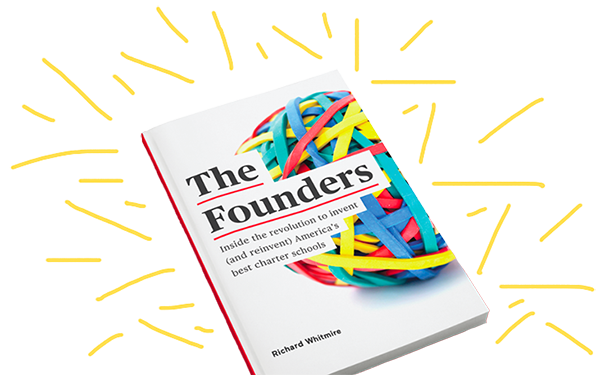
I talk to Richard Whitmire, author of The Founders, about the NAACP moratorium, the *charter pushback movement* and how to measure Success… 
1471902369_3354.png (600×375)EduShyster: Let’s start at the end of your new bookThe Founders: Inside the revolution to invent (and reinvent) America’s best charter schoolsYou wrap up with three challenges facing charter school expansion, one of which is what you call *the charter pushback movement.* It seems to be gaining steam, even since the book came out. How concerned are you about, say, the NAACP moratorium or the Black Lives Matter platform which makes many of the same demands?
Whitmire: I’m concerned about it because any time you start playing race cards it gets a little dicey. I think the unions are pushing any edge that they can get in this battle and they’re doing quite a good job of it. Frankly it doesn’t surprise me at all because if you’re looking at this from a political perspective, in other words, how to build a political base in *x* city, then the traditional school system—forced assignment, no charters—really works out better for you. I saw that in Washington DC when I was doing the Rhee book. Marion Barry had that Department of Education just overflowing with people. It was all part of his political machine. And it worked out really really well for him and it worked out really really well for the people who were employed there. The only people it didn’t work out well for were the kids. But from a political machine point of view, that’s the model you want. That’s the model that’s preferable. So it’s understandable why they’d push for that. But again, you have to look at those who are aspiring to be political leaders or already are and then those parents, and I come back again and again to those 4,000 parents on the waiting list for the Brooke Charter School in Boston. They’re all either Black or Hispanic. Who are you going to listen to: the NAACP or those parents? I choose the latter.
EduShyster: But so much of the business model of these charter networks seems to depend upon access to an endlessly replenish-able young labor force that sees charter schools as the civil rights issue of our time. Can charters continue to expand if their Apples to Apples – EduShyster:

BRIDGEGATE TRIAL: Was Baroni an altar boy in Christie’s political brothel? |

BRIDGEGATE TRIAL: Was Baroni an altar boy in Christie’s political brothel? |:

BRIDGEGATE TRIAL: Was Baroni an altar boy in Christie’s political brothel?


Bill Baroni, literally fighting for his freedom and trying to save his future, set himself an all but impossible task in federal court: Trying to portray himself as just an honest bureaucrat innocently working in an atmosphere of corruption and cronyism and deception that, under Gov. Chris Christie, had turned the Port Authority of New York and New Jersey into a political brothel. The words he repeated again and again  to assert his innocence–“David Wildstein said it and I believed him”–simply won’t provide him with the cover, or redemption, he seeks.
He knew Wildstein–and, for that matter, Christie–well enough to know he shouldn’t believe either was a straight-shooter. He knew Wildstein, a boyhood chum of the governor, told lies about himself.
No one who had risen as far as Baroni had risen could be so naïve.
Especially not someone who spent five years as an informant for the FBI. The FBI under then US Attorney Chris Christie. Too bad Judge Shirley Wigenton wouldn’t allow Baroni to say what he had done as an informer from 2005 to 2010.
Carefully and gently led through his testimony by defense lawyer Jennifer Mara, Baroni repeatedly  sought to persuade the jury he was flat-out duped by Wildstein, a political operative, into believing the governor wanted a study done about what would happen if three lanes of traffic leading from Fort Lee to the toll BRIDGEGATE TRIAL: Was Baroni an altar boy in Christie’s political brothel? |:

Is the NAACP’s Charter School Moratorium an “Edge” for a “Political Machine”? | deutsch29

Is the NAACP’s Charter School Moratorium an “Edge” for a “Political Machine”? | deutsch29:

Is the NAACP’s Charter School Moratorium an “Edge” for a “Political Machine”?


Richard Whitmire is a former editorial writer for USA Today. He has written several books. Among them is one about education leaving males behind; highly controversial former DC chancellor Michelle Rhee wrote the foreword for this book. Whitmire then decided to write a book about Michelle Rhee, The Bee Eater, described in brief as “the inside story of a maverick reformer with a take-no-prisoners management style.”
I too wrote about Michelle Rhee, both on my blog and in my first book. I describe her as a sociopath who dodged any accountability for suspiciously rising DC test scores that plummeted once she was no longer DC chancellor.
Still another of Whitmire’s books is on Rocketship charter schools. In June 2016,NPR wrote about Rocketship Education, and it cited Whitmire’s book:
“Students rotating into Learning Labs meant employing fewer teachers,” Whitmire writes. “Thus a school such as Rocketship Mosaic could successfully serve 630 students with only 6 teachers plus aides.”
Whitmire is impressed with the Rocketship model. However, NPR also mentioned very large numbers of children left under the supervision of incompletely trained adults and describes the turnover of these “learning lab supervisors” as “”chronic.”
NPR also noted that Rocketship students are discouraged from using the bathroom to such a degree that kids “were getting urinary tract infections.” Not to worry: What it disallowed in bathroom breaks Rocketship made up for in computerized test retakes, so much so that at one Rocketship campus, “superiors found retesting to be so rampant that they disabled the refresh button the following year.”
Finally, Whitmire just published another book, this one called, The Founders: Inside the Revolution to Invent (and Reinvent) America’s Best Charter Schools.
On October 17, 2016, education blogger Jennifer Berkshire interviewed Whitmire about his Founders book, which is available on Kindle as of August 28, 2016, and Is the NAACP’s Charter School Moratorium an “Edge” for a “Political Machine”? | deutsch29:

Charter backers can stop the NAACP moratorium — by meeting these four demands - The Hechinger Report

Charter backers can stop the NAACP moratorium — by meeting these four demands - The Hechinger Report:

Charter backers can stop the NAACP moratorium — by meeting these four demands

Why that’s good for black people

nce the NAACP at its national convention voted on a resolution that placed a moratorium on charter schools, the backlash from charter advocates has been angry, well-financed and sometimes just plain mean leading up to a vote of ratification by the national board, which occurred this past weekend.
By singling out the NAACP with multiple editorials, protests and letter-writing campaigns, the charter lobby threw cheap shots at one of our most historic civil rights organizations with the intent to rally the charter base. But charter backers didn’t stop the NAACP from ratifying its moratorium; they didn’t shame them into submission.
Now, the only way that charter advocates can get the moratorium removed is for charter operators to meet the NAACP’s demands. And that’s good for black people.
Join the conversation later on Andre Perry’s radio show, “Free College,” hosted Tuesdays on WBOK1230 in New Orleans at 3pm Central/4pm Eastern 504.260.9265.
In a statement, the NAACP outlined four demands that if met would remove the moratorium.
First, that charter schools are subject to the same transparency and accountability standards as public schools.
Second, that public funds are not diverted to charter schools at the expense of the public school system.
Third, charter schools must cease expelling students that public schools have a duty to educate.
Fourth, they must cease to perpetuate de facto segregation of the highest performing children from those whose aspirations may be high but whose talents are not yet as obvious.
Are these not reasonable goals? Given some of the illogical attacks hurled at the NAACP, don’t expect charter groups to use the moratorium as an opportunity to improve the sector.
Charter advocates have said the moratorium is an attack on black parents, as if NAACP members aren’t parents and don’t represent Charter backers can stop the NAACP moratorium — by meeting these four demands - The Hechinger Report:


Teacher Training As 'Part Theater, Part Sport' : NPR Ed : NPR

Teacher Training As 'Part Theater, Part Sport' : NPR Ed : NPR:

Teacher Training As 'Part Theater, Part Sport'

Teacher training is growing quickly through Relay Graduate School of Education thanks to its hands-on approach.
Rain beats against the windows of a downtown New York City building on a soporific Friday morning. A high school teacher is reading out loud from a sample recommendation letter when she notices a few students fidgeting and texting.
"I'm not seeing all eyes ..." she says, her voice trailing off.
Naama Wrightman, who is coaching the teacher, jumps in.
"All right, pause. It's the right correction. How can you frame it positively? ... Take out the 'not.' "
"All eyes on me?"
"Exactly, give that quick scan again."
The teacher starts reading, pauses, looks around, and says, " ... All eyes on me, up here?" but it sounds more like a question.
"I'm going to pause you again," says Wrightman. "I want you to say it with that confidence."
"Up. Here."
"Yes, there it is!"
For student teachers in their first year at Relay Graduate School of Education, Friday mornings are all about sweating the small stuff — down to the intonation of a single word.
Relay set out nearly a decade ago to prepare a new generation of teachers for the nitty-gritty of the classroom in the way, critics have long charged, traditional graduate schools of education do not.
A now-famous 2006 report found that 62 percent of new teachers said they didn't feel Teacher Training As 'Part Theater, Part Sport' : NPR Ed : NPR: