Latest News and Comment from Education

Tuesday, October 18, 2016

“We’ve got your back”: These luminaries for social justice support the hundreds of Seattle educators

“We’ve got your back”: These luminaries for social justice support the hundreds of Seattle educators wearing Black Lives Matter shirts to school on Oct. 19th | I AM AN EDUCATOR:
“We’ve got your back”: These luminaries for social justice support the hundreds of Seattle educators wearing Black Lives Matter shirts to school on Oct. 19th

jc_supportsblmatschool


 With over 2,000 Seattle educators now having ordered “Black Lives Matter” shirts to wear to school on Oct. 19th, #BlackLivesMatterAtSchool day is shaping up to be a historic demonstration. In addition to wearing the shirts, many educators will also use the day to lead discussions about institutional racism and what Black Lives Matter means. This action has been endorsed by the Seattle Education Association, the Seattle council PTSA board, the Social Equality Educators, and the Seattle NAACP. In addition, over 200 scholars from around the country have issued their support in a collective statement of solidarity.

Now some of the country’s preeminent activists, racial justice advocates, and authors, have added their voice to the calls of support for this unprecedented action!
Seattle teachers who choose to wear T-shirts that read “Black Lives Matter” and “We Stand Together” have our full support. In the United States today, we cannot do enough to affirm and support our black students. Seattle’s teachers are not only well within their right to exercise freedom of speech by wearing such T-shirts, they are making an important gesture of solidarity — one that gives us hope for the future.
Seattle teachers: we’ve got your back!
Signed,
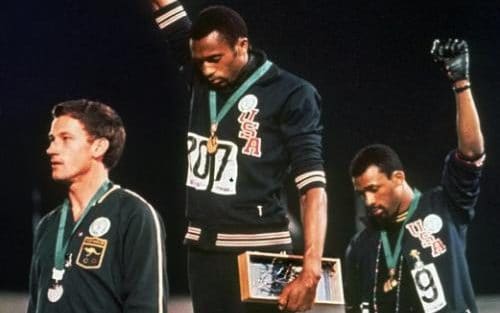
John Carlos was was the bronze-medal winner in the 200 meters at the 1968 Summer Olympics and raised his fist on the podium with Tommie Smith, in what became an iconic protest of racism in the U.S. Today, he is an author, human rights activist, and speaker.
Nancy Carlsson-Paige is Professor Emerita at Lesley University where she taught teachers for more than 30 years and was a founder of the University’s Center for Peaceable Schools. Nancy is the author of five books and numerous articles and op-eds on media and technology, conflict resolution, peaceable classrooms, and education reform. Her most recent book is called Taking Back Childhood: A Proven Roadmap for Raising Confident, Creative, Compassionate Kids.
Noam Chomsky is a Professor Emeritus at the Massachusetts Institute of Technology (MIT), and is the author of over 100 books on topics such as linguistics, war, politics, and 
“We’ve got your back”: These luminaries for social justice support the hundreds of Seattle educators wearing Black Lives Matter shirts to school on Oct. 19th | I AM AN EDUCATOR:

GLSEN Study Shows LGBT Youth Disproportionately Bullied - The Atlantic

GLSEN Study Shows LGBT Youth Disproportionately Bullied - The Atlantic:

LBGT Students Are Not Safe at School

They are disproportionately harassed, and few teachers are trained to help.

Image result for LGBT Students Are Not Safe at School

When Salem Whit walked through the hallways of their high school in Spring Grove, Pennsylvania, overhearing classmates ask one another, “What is that thing?” happened with nearly enough frequency to become background noise. Unlike the sound of lockers slamming, however, comments about Salem’s gender identity were too targeted for the teen to treat them as white noise. “I actually thought I was inhuman,” Salem recalled when thinking about the years of bullying and harassment they experienced in high school. “I thought I was an alien. I definitely thought I was going to hell.”
Salem graduated from high school in 2015 but says the process of getting to that point was far from easy. “I’m not sure how my grades were good enough to graduate,” the 19-year-old explained. After years of experiencing gender dysphoria—feeling an intense and innate disconnect from their body, gender presentation, voice, and name—Salem came out as transgender during their senior year of high school. More specifically, Salem identifies as both non-binary and agender, meaning that while Salem does not identify with the female sex they were assigned at birth, they also do not identify as male or use male pronouns.
As classmates and teachers struggled to use Salem’s preferred pronouns and accept their gender presentation, however, the high-schooler found that the greatest relief came from avoiding school altogether. “I skipped classes,” they admitted. “I quit every extracurricular. I stopped participating in sports, gym, and drama—anything that separated us by gender. I even stopped talking for a while, because my gender dysphoria caused me to really hate the sound of my own voice.” At 16, feeling lost and lonely, Salem attempted suicide.
* * *
Disturbingly, Salem’s story is more common than not among youth who identify as LGBT. According to the Gay, Lesbian and Straight Education Network’s new report, “Teasing to Torment: School Climate Revisited,” LGBT youth in middle GLSEN Study Shows LGBT Youth Disproportionately Bullied - The Atlantic:


 Image result for LGBT Students Are Not Safe at School

CURMUDGUCATION: Dear Hillary. Re: Education

CURMUDGUCATION: Dear Hillary. Re: Education:

Dear Hillary. Re: Education

Image result for be the change you want to see


We already know that there is no public education candidate running in this Presidential election. But we find ourselves in the unenviable position of having to choose between someone would subject public education  to bad, disruptive, destructive, dismantling policies and someone who would just drop a nuke on public education. 

Not that anyone really wants to talk about public education, mind you. Man, remember the old days, when everyone thought that education was going to be a marquee topic in this election cycle? (So sorry, Jeb! Too bad, Campbell.)


So Valerie Strauss at the Washington Post sent out some questions about education. The Trump campaign didn't actually answer ("Go look at our website, you journalistic losers!"). But the Clinton campaign did, and their answers give us an idea of the sorts of things we will need to bombard them and their Secretary of Education about over the next four years (if Trump somehow wins, we will be hunkering down while he bombards us). Here's the short form of the Q & A, with my thoughts about what we need to say in our Dear Hillary letters.

WP: Property tax-based funding of school seems to be Not Very Fair. You want to fix that?

HRC: Before I pretend to answer that, let me toss on the "every child deserves a great education 
CURMUDGUCATION: Dear Hillary. Re: Education:


California Charter Reports - Network For Public Education

California Charter Reports - Network For Public Education:

California Charter Reports


#CounselorsNotCops: Youth Justice Against the Police State - LA Progressive

#CounselorsNotCops: Youth Justice Against the Police State - LA Progressive:

#CounselorsNotCops: Youth Justice Against the Police State

Youth Justice Coalition


At the corner of Central Avenue and 120th Street in South Central Los Angeles, an abandoned Boys and Girls club trailer sits across from a fast food place and a liquor store.  The trailer is a few blocks from high achieving King-Drew Magnet of Medicine and Science, a predominantly African American and Latino school and unsung model of culturally competent instruction in the Los Angeles Unified School District.
In neighboring Compton, children navigate vacant lots, brown fields and abandoned buildings to get to school. Several miles away at Gardena High School, students are handcuffed for the “crime” of truancy.  By contrast, their white South Bay and Westside counterparts a few freeway exits away have an array of extracurricular and recreational resources to choose from, largely free from the yoke of police state suppression.
The recent murder of 18 year-old Carnell Snell by the LAPD in the Westmont community near Washington Prep High School in South L.A. highlights how the constant threat of state violence fatally undermines the learning environments of students of color.  Drive down the stretch of Western Avenue near where Snell was gunned down and the most prominent public spaces are fast food joints, storefront churches, 99 cent stores and beauty salons.

On a daily basis our youth contend with unsafe conditions that white teens in middle class and affluent areas of the city either don’t have to deal with or have a social safety net to shield them from.

On the corner of Manchester and Western, Jesse Owens Park is one of the few in an area that has been branded “park poor” (a term that that accurately describes the need but still carries a deficit laden stigma). On a daily basis our youth contend with unsafe conditions that white teens in middle class and affluent areas of the city either don’t have to deal with or have a social safety net to shield them from. From high rates of gun violence to sexual violence, sex trafficking, police abuse and school pushout, youth of color in L.A. must navigate criminalization on multiple fronts.
It’s been well-documented that simply having a massive police presence in the community increases the risk that youth of color will be stopped, harassed, frisked, arrested, or, tragically, murdered by law enforcement.  This threat, coupled with the dearth of community centers, afterschool programs and recreational spaces, further institutionalizes violence as a norm in working class neighborhoods of color.  The psychic and emotional trauma of living in this state of siege often goes unrecognized and untreated.
With the largest juvenile jail system and probation populations in the U.S., Los Angeles and California are world leaders in incarceration.  L.A. has the distinction of being the poorest city in the #CounselorsNotCops: Youth Justice Against the Police State - LA Progressive:

Lawsuit alleges Flint schools are failing to serve lead-poisoned children - The Washington Post

Lawsuit alleges Flint schools are failing to serve lead-poisoned children - The Washington Post:

Lawsuit alleges Flint schools are failing to serve lead-poisoned children


Public officials failed children in Flint, Mich., by allowing the city’s supply of drinking water to remain contaminated with lead, a known neurotoxin, for 18 months. The government is again falling short, a lawsuit filed Tuesday alleges, by failing to provide those children with educational services that they legally deserve and that could counter the effects of the Flint lead exposure.
The complaint, filed in U.S. District Court in the Eastern District of Michigan, argues that the public school system in Flint is not meeting its legal obligation to screen lead-exposed children for disabilities or provide services and interventions that could make a difference in their ability to learn and thrive. It also alleges that the state education department has failed to provide Flint schools, which have cut teachers and other staff in the face of a $10 million deficit, with the resources and funding they need to provide those services.
There are 30,000 children under the age of 19 in Flint, and 8,000 of them are younger than five and particularly vulnerable to the effects of lead exposure. Lead exposure can result in diminished academic achievement and a greater tendency to be hyperactive, impulsive and aggressive. Without meaningful action soon, the complaint says, children’s opportunities to reach their full potential will be “permanently foreclosed.”
“In the wake of the Flint lead crisis, Flint children face an unprecedented educational and civil rights disaster,” says the 133-page complaint. “It is impossible to overstate the resounding effects of the failure to provide meaningful education opportunities, and to provide them now.”
A spokesman for the Michigan Department of Education said that the agency has not yet seen a copy of the complaint; the agency generally declines to comment on pending litigation. A spokeswoman for Flint Community Schools did not immediately respond to a request for comment.
Bilal Tawwab, the superintendent of Flint schools, acknowledged in February before a congressional committee that his schools need more support to measure “the intellectual and emotional damage done to each, and possibly every child.” Tawwab said students have profound needs — for lead-free facilities, trained and talented teachers, early intervention and year-round schooling — but the district’s budget is already strained.
The complaint was filed on behalf of Flint families by the American Civil Liberties Union of Michigan; the Education Law Center, a New Jersey-based public interest law firm; and White & Case, a Manhattan law firm. It seeks class certification to represent all Flint children who were exposed to lead and are — or may be — eligible for special education services.
The plaintiffs are 15 children, ages 3 to 17, each of whom was exposed to lead in Flint. They allege that they have been denied the special-education services they need and deserve under the federal Individuals with Disabilities Education Act, the Americans with Disabilities Act and Michigan state law.
The plaintiffs also allege that Flint Community Schools has a history of problems with special Lawsuit alleges Flint schools are failing to serve lead-poisoned children - The Washington Post:


Strike Deadline Looms for UNO Charter School Network, Teachers Union | Chicago Tonight | WTTW

Strike Deadline Looms for UNO Charter School Network, Teachers Union | Chicago Tonight | WTTW:

Strike Deadline Looms for UNO Charter School Network, Teachers Union


Some Chicago parents may be facing a teachers’ strike this week, even though Chicago Public Schools narrowly avoided one just last week.
On Wednesday, 8,000 students could be out of the classroom if management for the UNO Charter School Network can’t reach an agreement with its teachers union by Tuesday night.
One of the big differences between UCSN and the United Educators of UNO, or UEU, is a matter of compensation. Class size and the term of the contract are also points of contention.
UCSN operates 16 schools at 15 campuses across the city, mostly on the South and West Sides, but several on the North Side as well. Just this month, 531 of the union’s 532 members voted to authorize a strike.
Teachers say management is proposing something that will sound familiar: the pension pickup. Currently, UCSN pays 7 percent of the teachers' 9 percent pension contribution. The network is asking to roll that back, but not entirely, as CPS asked of the Chicago Teachers Union. They’re asking teachers to pay 4 percent of that 9, instead of the current 2 percent they’re paying.
The union is also concerned about the salary schedule for its lowest-paid members.
“We also have support personnel throughout our class, so anybody who helps with IT, our clerks at the front office, and all of our special education aides, so, somebody who works full time with a student who has high needs or some kind of learning disability. And then, our kindergarten classes also have what we call an apprentice, but it’s basically a teacher’s aide, because there’s 32 5-year-olds in one room, so they need that extra help,” said Erica Stewart of UEU.
“Those people all did not get any raises at all this year, and they’re only being offered 1 percent moving forward to next year.”
Stewart says that the proposed pay cut is in addition to the extra pension contribution management is requesting.
Last week, the union picketed UCSN’s downtown offices. The union says the network could save hundreds of thousands of dollars on cheaper office space in a neighborhood closer to the students it serves, and says the network is management-heavy, overpaying too many executives in those downtown offices.
The union is also requesting a cap on class sizes at 32 students per class, and opposes a proposed “reopener” where management could reopen the contract if school funding is reduced further.
If there’s no deal by Tuesday at midnight, teachers say they are prepared to walk out. It would be the first time a charter school in the country has faced a teachers strike.
There were more negotiations Monday afternoon between the two sides, and more are expected Tuesday. For now, management at the network isn’t saying much to reporters. Though they are working to keep parents informed of what would happen in the event of a strike.
If a walkout does occur, the network’s 16 schools would be closed. Also, sports and extracurricular Strike Deadline Looms for UNO Charter School Network, Teachers Union | Chicago Tonight | WTTW:

Huntington Park leaders want to ban new charter schools for a year - LA Times

Huntington Park leaders want to ban new charter schools for a year - LA Times:

Huntington Park leaders want to ban new charter schools for a year


Image result for Charter School Moratorium
e small, densely populated city of Huntington Park is peppered with schools, about two dozen in 3 square miles. At least 10 are charters, and city leaders contend they’re bringing in unwanted traffic. 
Their solution is to try to ban new charter schools.
Last month, Huntington Park City Council members voted 4 to 1 to place a temporary, 45-day moratorium on new charters in the city. On Tuesday, they plan to vote on whether to extend that restriction for 10 months and 15 days, effectively making the ban yearlong. 
Charter schools are publicly funded but often are privately run. Unlike most traditional public schools, they can accept students from anywhere, not just from the neighborhoods around them.
Huntington Park Mayor Graciela Ortiz isn’t sure drawing students from elsewhere is in the best interest of the city. She also said she wants to see a greater focus on revitalizing businesses.
The city once was a cultural and shopping destination for Mexican and Central American immigrants in southeast Los Angeles County, but local businesses have struggled recently.
Ortiz says the city needs time to review its zoning policies and determine whether it has room for more schools. 
“Our community has enough [school] options,” Ortiz said. “Right now our priority is going to be development and finding park space, green space for our kids.”
In a September report to the council, City Manager Edgar Cisneros used increased traffic to justify the moratorium. “Communities within the vicinity of charter schools have experienced impacts to vehicle circulation, parking, and noise,” he wrote.
It’s unclear whether the city has the legal authority to ban new charter schools. School districts, counties and the state are the only bodies that can authorize or reject charter schools. Cities do control zoning, however — so if a charter wants to operate in a city, it often must request a municipal conditional use permit.
Huntington Park would be on more solid legal ground if the ordinance banned all new schools, including private and parochial ones, UCLA law professor Jonathan Zasloff said. 
“It is not clear whether...you can use local land use authority to make education policy,” Zasloff said. 
The California Charter Schools Assn. will consider suing the city if the moratorium passes, Huntington Park leaders want to ban new charter schools for a year - LA Times:

State rates its own oversight of charter schools "ineffective": How did that happen? | cleveland.com

State rates its own oversight of charter schools "ineffective": How did that happen? | cleveland.com:

State rates its own oversight of charter schools "ineffective": How did that happen?


COLUMBUS, Ohio - Ohio's new charter school oversight ratings raised a few eyebrows last week, including over the state rating itself as "ineffective."
The state issued ratings of "poor" to 21 overseers, known as "sponsors" or "authorizers," which blocks them from doing any more work with charters if they cannot win an appeal.
The Ohio Department of Education also rated 39 of the organizations as "ineffective," which gives them two more years to improve their work or they will also be shut down.
Among them: the department's own Office of School Sponsorship.
That drew sharp comments from the state's largest charter school, the online Electronic Classroom of Tomorrow (ECOT).
"Either the sponsorship ratings are out of whack or ODE is so bad that it's going to go out of business at the same time they are judging others," ECOT spokesman Neil Clark said. "It's like having a student who doesn't know his alphabet teaching the rest of the class how to read Shakespeare."
ECOT and the state have been feuding in court all year over how attendance and participation in online schools is counted - a battle which puts more than $60 million of ECOT's state funding in jeopardy.
The department did not back down from that "ineffective" rating today, but offered reasons for it.
A different part of the Ohio Department of Education performed the reviews from the part that was under review,  spokesperson Brittany Halpin said.
The main reason for the low rating, she said, was the equivalent of an F grade for the academic performance of all 18 charters overseen by the state. Though academics make up one third of a sponor's rating and the state scored very well on the other two portions, Halpin noted that state law caps the rating of any sponsor at "ineffective" if its fails any of the three portions.
Because of that cap, poor grades at the 18 schools made a better rating impossible.
But why did the state oversee such bad schools? Why didn't it oversee them better?
State law wouldn't let it, Halpin said.
The state has to take over oversight of schools when a sponsor goes out of business, as the Educational Service Center of Portage County did last year. Three of the 18 schools, including Imagine Akron and Global Village Academy in Parma, were forced on the state by that closure.
In addition, state law used to require the state to sponsor the first few schools that applied each year. Other than making sure some minimum standards were met, the state had no discretion over whether to approve them.
Cleveland Mayor Frank Jackson and his school quality panel the Transformation Alliance were among those objecting to that law, after some charter schools were approved in Cleveland in 2013 without anyone being able to object to their operator's track record of the schools' education plans.
But that requirement ended last fall through House Bill 2, a state charter school reform bill passed last November.
"Prior to House Bill 2 becoming effective, we did not get to choose which schools we sponsored," Halpin said. "Since the legislation became effective on Feb. 1, 2016, we now have the ability to approve or deny sponsorship to schools based on academic quality, financial position and other criteria."
Last spring, after the law took effect, the state denied all 10 requests to sponsor schools, she said.State rates its own oversight of charter schools "ineffective": How did that happen? | cleveland.com:

THE DEBATE OVER CHARTER SCHOOLS

John White Makes “Urgent Moral Case” for School Reform | The Hayride

John White Makes “Urgent Moral Case” for School Reform | The Hayride:

John White Makes “Urgent Moral Case” for School Reform


In an op-ed piece that appears over at The Daily Beast this weekend, Louisiana Superintendent of Education John White and New York City Chancellor of Schools Joel Klein make the “urgent moral case” for school reform. And it’s pretty good.
No issue in school reform has proven more contentious than the nationwide push to improve persistently struggling schools in low-income communities. In cities across the country, attempts to transform hulking high schools into clusters of more nurturing small schools, or to create innovative public charter schools in low-income neighborhoods, have yielded debate and protest.
Last year, heeding calls for “local control” of education decisions and less invasive interventions in underperforming schools, Congress passed the Every Student Succeeds Act, granting states and local school boards, rather than the federal government, broad latitude in determining how to rate the performance of schools and how to intervene when performance lags.
The overall idea here is that replacing bigger, largely overcrowded schools with smaller schools and offering more choice to parents will create better academic environments and improve the education system overall. It’s a message that we really should be touting more and more, because choice and competition is not a bad thing. Education needs to be challenged to improve.
Interestingly, however, White and Stein find themselves indirectly opposed by the NAACP, which this weekend voted to formally call for a moratorium on charter schools. At least, they say, until charter schools are held to the same level of transparency as public schools.
The Wall Street Journal did not respond well to that one.
Hello? Inner-city schools are the definition of unaccountable as they promote failure year after year. Charters should be held accountable, and some charter operators have done a poor job. But they can be and are shut down. The proof of charter performance are the long waiting lists in most cities to get in. Parents vote for charters with their feet when spaces are available.

What both pieces get right is that the status quo simply doesn’t work. Yet, it’s the status quo that groups like the NAACP and teachers unions want to keep. It does irreparable damage to the groups most affected by a low performing education system – namely poor, black children. Change and innovation have to happen. And, hopefully, it will.
I just wish we had an election cycle to talk about it.John White Makes “Urgent Moral Case” for School Reform | The Hayride:


Charter School Turkeys May Be Coming Home to Roost in LAUSD (Just in Time For Thanksgiving) - LA Times

Solid academics may not be enough to keep six L.A. charter schools open - LA Times:

Solid academics may not be enough to keep six L.A. charter schools open


When the Los Angeles Board of Education meets Tuesday, it is expected to vote on whether to shut down six charter schools. The main reasons have nothing to do with academics and may not be made public, which outrages charter advocates.
Magnolia Public Schools, which runs three of the campuses, has attracted international attention for its past practice of importing foreign teachers, other school workers and their immediate family members. Magnolia brought in nearly 100 workers, almost all from Turkey.
Celerity Educational Group, which operates two of the schools, is under investigation for possible conflicts of interest among corporations to which it has ties.
And El Camino Real Charter High School has been dogged by allegations that officials misused credit cards and violated open-meeting rules. 
The Magnolia and Celerity schools were scheduled for what were to be routine five-year reauthorizations, but now the charter division of the L.A. Unified School District is recommending denials. El Camino, in Woodland Hills, was renewed last year, but that could be moot if the district eventually revokes its authority to operate. 
All the schools do pretty well or better academically, which leads those who support charters to assert that the recommendations are unfair. Critics of charters — and those who have issues with the six under review — are applauding L.A. Unified for holding these schools accountable for their entire operations, inside and outside the classroom.
The California Charter School Assn. says that L.A. Unified has approved 155 of 159 charter renewals over the last five years, and that the current recommendations are out of line. Over the weekend it put together a letter to the school board from charter leaders whose schools enroll more than 90,000 students.
L.A. Unified is the U.S. school system with the highest number of independently operated charters, and it oversees them even as it competes with them for students and resources. 
“It is distressing and quite simply unacceptable that district staff have taken unexpected and unprecedented steps to close some of our higher-performing academic schools and prevent others from continuing to serve the students who already rely on them,” the letter said.
The head of the district’s administrators union, however, said LAUSD’s long track record of approving renewals suggests such outrage is misplaced.
“I think they’re doing their due diligence, although I also think they are taking closer looks than in the past,” said Juan Flecha, president of Associated Administrators of Los Angeles.
The Magnolia schools have attracted increased attention since the Turkish government accused it and other U.S. charters with mostly Turkish boards of helping to finance a failed coup attempt in Turkey in July. The charters have denied any such ties.
But charter critics across the nation have seized on the controversy. Prominent East Coast education historian Diane Ravitch, who is generally anti-charter, has used her blog to weigh in. 
“I hope the Magnolia schools will not be renewed,” Ravitch told The Times on Monday. “It would demonstrate that LAUSD has the backbone to insist upon accountability and transparency.” 
When it comes to turning down a renewal petition, the school district must chose a reason sanctioned by state law. Because the threatened schools have met or surpassed academic requirements, the rationale for denying Magnolia and Celerity is that they are “unlikely to successfully implement” their programs and that their petitions do not contain “a reasonably comprehensive description” of areas they are required to cover. 
Neither rationale appears to cover concerns about Magnolia’s foreign teachers.
“There probably should be a higher standard for public institutions using the immigration law to hire people for jobs resident workers could fill, but I do not think there is anything in the federal law to that effect,” said David North, a fellow at the Center for Immigration Studies in Washington.  
The investigation of Magnolia by the district’s inspector general is both confidential and unfinished.
The same is true for Celerity, though a review of correspondence indicates the district is Solid academics may not be enough to keep six L.A. charter schools open - LA Times:


Another Sad Charter School Tale: Honeymoon is over for Metro schools’ Joseph

Honeymoon is over for Metro schools’ Joseph:

Honeymoon is over for Metro schools’ Joseph


img_0309
We are familiar with the first stage of a relationship, whether personal or professional, the “Honeymoon Period” is the time when we are too dazzled to care, or even notice, that we are ignoring an immutable fact of life, that nobody, and no relationship, is perfect.
Metro Nashville Director of Schools Shawn Joseph, who started work on July 1, might be experiencing one of the shortest honeymoons I’ve seen, raising questions about Nashville’s commitment to building a school system that meets the needs of every child who comes through its doors seeking to learn and grow.
Who’s in charge?
Business consultant Jeremy Marchant calls stage two the “Power Struggle Stage,” which he describes like this:
“Pretty soon there is trouble in paradise,” he writes on his Emotional Intelligence at Work website.
“What is happening,” he writes, “is that each person in the relationship is now fighting to ensure their needs are met from the relationship—fighting to be in control of it.”
Director in charge
In 2015, the Metro school board struggled with a process to find a replacement for director Jesse Register, and to most observers, the board epitomized dysfunction.
After Mayor Megan Barry was elected, the board began a more deliberate and inclusive process to choose a new chief. There was broad agreement on the requirements, including the willingness to pay what it took to bring the right kind of leader here.
It took just 30 minutes for the Metro school board to unanimously choose Joseph, a traditional schools advocate, from six finalists, and it quickly approved his contract.
Joseph understood that the school board regularly went around Register to engage his management team on a range of issues and problems, and the new director did not want that to continue. Paragraph six in Joseph’s contract states:
“The Board, individually and collectively, shall promptly refer to the Director, orally or in writing, for his study and recommendation any and all criticisms, complaints, suggestions, communications or other comments regarding the Director’s performance of his duties of the operation of MNPS. Individual board members agree that they will not give direction to the Director or any employee of MNPS regarding the management of the District or the solution of specific problems ....”
In addition to his annual pay ($285,000) and the provision of a full-size automobile, his contract also stipulates that he “shall select all personnel…”
Joseph was determined that he would be a strong and independent superintendent, and his contract reflected that intent.
The board raised no objections to the terms, and publicly praised the deal in May.
Once signed, Joseph went to work almost immediately, six weeks before his July 1 start date. He met with teachers and parents; got involved in a new principal selection process; and changed the community conversation between leadership and the community. In his first official week on the job, he tapped four dozen school and community leaders to help steer change.
Five months later, the picture is not so cheery, with some school board members chaffing at the deal they struck and criticism bubbling from parents and others.
Angry teachers
Diane Ravitch, the New York University professor of education and former assistant Honeymoon is over for Metro schools’ Joseph:

Big Education Ape: Anger Grows in Nashville « Dad Gone Wild - http://bigeducationape.blogspot.com/2016/10/anger-grows-in-nashville-dad-gone-wild.html