Latest News and Comment from Education

Friday, October 14, 2016

State will take charter schools away from 21 sponsors slapped with "poor" ratings | cleveland.com

State will take charter schools away from 21 sponsors slapped with "poor" ratings | cleveland.com:

State will take charter schools away from 21 sponsors slapped with "poor" ratings

Ohio's charter school sponsor authorizers.jpg
These key officers of charter school oversight organizations had their groups groups rated by the state today. Clockwise from the upper left are Apryl Morin of the Educational Service Center of Lake Erie West, Peggy Young of the Buckeye Community Hope Foundation, Stephanie Klupinski of the Cleveland school district and Lenny Schafer of the Ohio Council of Community Schools. (Plain Dealer staff)


COLUMBUS, Ohio - The state today slapped ratings of "poor" on 21 charter school oversight organizations, including the Cincinnati, Lorain and Youngstown school districts, starting the process of yanking away their oversight power.
All 21 are either school districts or county "education service centers," public agencies that consolidate services for multiple school districts and who sometimes help create and monitor charters.
The Cleveland school district, which oversees charter schools as part of its "portfolio" model of offering school choices, was rated as "ineffective." That was the most common rating and one that puts the district on a three-year deadline to improve or also lose charter oversight ability.
Stephanie Klupinski, who handles oversight for the district, said she hopes to appeal part of the score, which could bumo the district up to "effective" if successful. She said the state seems to have overlooked some of the documentation she submitted.
"We might be effective if we get the errors corrected," she said.
Five oversight agencies, known as "sponsors or authorizers, were rated as "effective," but none earned the highest possible rating of "exemplary."
None of the "poor" sponsors were non-profit groups like the St. Aloysius Orphanage orBuckeye Community Hope Foundation housing agency, that some consider to be non-educators and weak links in the state charter system. Some were even rated as "effective."
And most of the "poor" sponsors oversee just one or two schools, not dozens like some of the non-profits do.
"It's the folks that dabble in this with one or two schools, more than those that do a lot," said State Sen. Peggy Lehner, chair of the Senate Education Committee. 
The oversight ratings are a key part of Ohio's plan to improve its $1 billion charter school industry that is the butt of national ridicule for low academic performance. By threatening to take away oversight power if sponsors do not do a good job, state officials hope to pressure them to improve their schools.
The sponsors are not to be confused with school leaders or management companies that can run charters - public schools that are privately-run. They are the groups that offer quality control on a school's plan and should shut down poor schools that can't improve.
"If we want a quality community (charter) school sector, we need quality sponsors," said State Superintendent Paolo Demaria.
The evaluations, he said, are an important "policy lever" to separate strong sponsors from poor ones and to help weaker ones improve. 
But Peggy Young, head of the Ohio Association of Charter School Authorizers, said the ratings are unfair. Sponsors should have the same "safe harbor" from penalties that school districts have as Ohio shifts to new learning standards and state tests, she said.
She also noted that a third of the ratings is based on how well schools and sponsors comply with state law . That portion was mishandled by the state, she said, giving sponsors too little time to complete documentation.
"Just as the (state) report cards for the 2015-2016 school year released last month do not accurately reflect the quality of educational opportunities provided to Ohio's public school students, the results of the sponsor assessment do not State will take charter schools away from 21 sponsors slapped with "poor" ratings | cleveland.com:
 

Communities of Co-Creators - Bridging Differences - Education Week

Communities of Co-Creators - Bridging Differences - Education Week:

Communities of Co-Creators

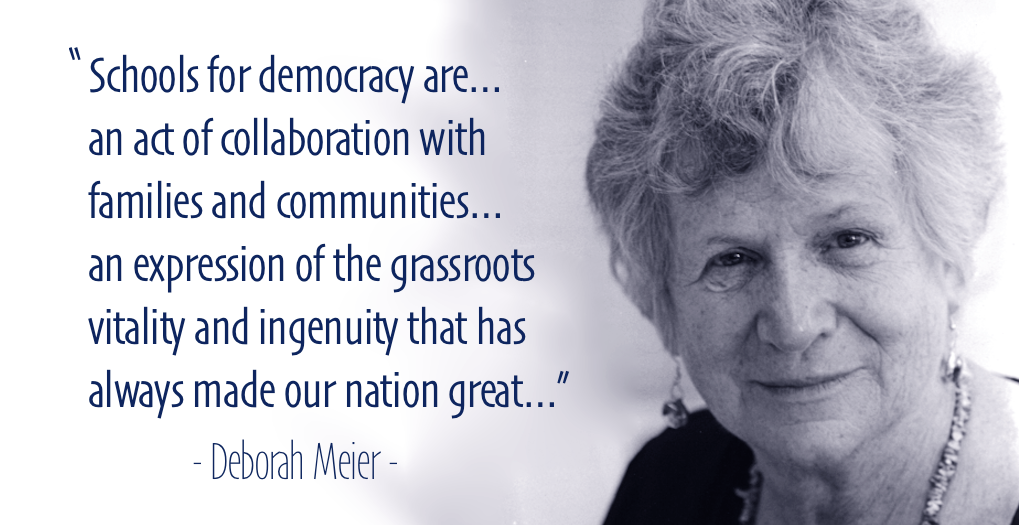
Image result for Deborah Meier

Deborah Meier continues her conversation with Harry Boyte. To read their full exchange, please visit here.
Dear Harry and friends,
Well, the one good thing about being out of service for so long—with my peculiar eye condition—is that I think a lot about what to say.
Democracy is one of those topics that can be talked about substantively and operationally for ever, and has been.
This election reminds me about the limited value of being able to vote (better than not being able to)—and shout what you think from the rooftops or social media or even a letter-to-the-editor.  It's been a long time since The New York Times has published anything I sent them.
So democracies—so-called—can range from complete frauds to pretty strong and healthy vehicles for self-governance. The latter is always a compromise, since some good ideas contradict each other—or are fuzzy. If we want those who are most affected by decisions to have the most to say that runs counter to another idea—that everyone has a right to a voice and vote even if only partially affected. Should the school custodian have a voice and vote on curricular decisions? School schedules? Classroom organization?
Without democracy liberty is a joke, but with it it's often pretty close to it—if we mean (as we mostly do) my own individual right to do what I want. Who decides when what "you want" interferes with others having what "they want"? I know of no perfect solution—but that doesn't mean I'm not always seeking a better one. 
Of course the greater the inequality—means of access of media, to hiring lobbyists and researchers to back-up one's views—the harder it is to imagine any democracy having a lot of meaning. Still we've seen even in this unequal U.S. times when the rich and powerful have been defeated. But it's rare and generally requires a division of opinion and self-interest among the powerful.
But in the sense that we use the word—it assumes the existence of a community with community self-interests that are shared, although of course arguable. It's hard today to think about a community at all—some entity outside of our immediate personal circle—whose interests we would sacrifice for—if convinced.
A more full democracy assumes some locations where people easily get a range of information and opportunities to share what they think with others who think differently. Scale, of course, makes it harder. But even in small schools we had to devote more time than we imagined to create such shared conversation, and that would not have been possible if the participants didn't usually get Communities of Co-Creators - Bridging Differences - Education Week:

Policy-to-Practice Metaphors: Chain of Command, Pasta, or Medley Relay Races? | Larry Cuban on School Reform and Classroom Practice

Policy-to-Practice Metaphors: Chain of Command, Pasta, or Medley Relay Races? | Larry Cuban on School Reform and Classroom Practice:

Policy-to-Practice Metaphors: Chain of Command, Pasta, or Medley Relay Races?


Metaphors can get people to think about the essence of organizations and how they work.
Take the U.S. Army’s command-and-control structures, generals believe that their decisions can steer what infantry platoons do in the field. Yet the metaphor of the “fog of war” and a history of misunderstanding orders at the company and platoon levels during battles suggest that even in command-and-control structures,decisions moving down the chain of authority may turn out far differently than intended. Novels and memoirs from War and Peace to Jarhead, films from The Longest Day to Platoon, and officer and enlisted men reports make that point.
School district organizational charts resemble military organizations with structures showing authority flowing downward from the board of education to teachers. Here also, the belief that policymakers can frame problems, adopt solutions, and steer classroom practice prevails. Yet school districts are hardly command-and-control operations since new policies get interpreted and re-interpreted by different actors at each link of the supposed chain of authority as they proceed downward into classrooms.
And it is in classrooms where teachers make decisions about what the policy is and which parts, if any, get implemented. What was intended by policymakers may well turn out to be something quite different. The metaphor of a linked chain for putting educational policies into practice is inapt. A better image than links in a chain is pasta to represent the policy-to-practice journey. Consider the following two examples.
Mrs. O., a veteran California second grade teacher in the late-1980s had embraced a new math curriculum aimed at replacing students’ rote memorization with mathematical understanding. A researcher observed Mrs. O teach and interviewed her many times. She saw herself as a success story, a teacher who had revolutionized her mathematics teaching. But classroom observations revealed Policy-to-Practice Metaphors: Chain of Command, Pasta, or Medley Relay Races? | Larry Cuban on School Reform and Classroom Practice:


Killing Teacher Prep During a Teacher Shortage: A Mystery? (Maybe Not)

Killing Teacher Prep During a Teacher Shortage: A Mystery? (Maybe Not):

Killing Teacher Prep During a Teacher Shortage: A Mystery? (Maybe Not)

Mystery printed on a typewriter


Are you in the mood for a mystery?
They will do this by denying future teachers TEACH grants to go into teacher preparation programs. So even if you want to be a teacher, if you can’t afford college, you won’t be able to realize such a dream.
Isn’t this strange during a teacher shortage?
If anything, King should be canvasing the country to bring back teachers who are no longer teaching due to draconian reforms. There should be incentives aplenty for real teacher prep programs in our colleges of education.
Instead, King is yapping about how bad those old college programs are, and how they Killing Teacher Prep During a Teacher Shortage: A Mystery? (Maybe Not):

Pruning Teacher Education | The Merrow Report

Pruning Teacher Education | The Merrow Report:

Pruning Teacher Education


“If half of the 1400 places that train teachers went out of business tomorrow, we’d be better off.” The Harvard professor paused. “And, with very few exceptions, it wouldn’t matter which half.”
His is a widely held view of teacher education: too many institutions doing a lousy job. Most teachers I’ve met over the years weren’t happy with, or proud of, their training, which, they said,  didn’t prepare them for the ‘real world’ of teaching.
And so the question is, HOW to put half of the institutions out of business?  Should we trust ‘the market’ or rely on government regulations?
The federal government thinks that tighter regulation of these institutions is the answer. After all, cars that come out of an automobile plant can be monitored for quality and dependability, thus allowing judgments about the plant.  Why not monitor the teachers who graduate from particular schools of education and draw conclusions about the quality of their training programs?
That’s the heart of the new regulations issued by the U.S. Department of Educationthis week: monitor the standardized test scores of students and analyze the institutions their teachers graduated from.  Over time, the logic goes, we’ll discover that teachers from Teacher Tech or Acme State Teachers College generally don’t move the needle on test scores. Eventually, those institutions will lose access to federal money and be forced out of business. Problem solved!
Education Secretary John B. King, Jr., announced the new regulations in Los Angeles.  “As a nation, there is so much more we can do to help prepare our teachers and create a diverse educator workforce. Prospective teachers need good information to select the right program; school districts need access to the best trained professionals for every opening in every school; and preparation programs need  Pruning Teacher Education | The Merrow Report:

Relay Graduate School Indoctrination | Seattle Education

Relay Graduate School Indoctrination | Seattle Education:

Relay Graduate School Indoctrination

rejectrelayfinal-1
Editor’s note:
Recently, Seattle Schools Community Forum published a guest post about the Summit Atlas Public Forum that was held on September 29th. The Summit charter school chainset up in Seattle last year and there is one to open in West Seattle in 2017 even though there is a second charter school lawsuit pending in the courts as of this writing. I found three details about Summit’s new principal,  Kathryn Bubalo, very troubling. First, she is a Teach for America graduate and she worked as a teacher at a New Orleans charter school. Thirdly, Ms. Bubalo is a product of the Relay Graduate School.  Relay Graduate School, to me, is a red flag, so I wanted to share with our readers Peggy Robertson’s experience with this organization. -Carolyn Leith
This blog post, and many future blog posts, are going to be focused on the Relay Graduate School indoctrination occurring in my school and many schools across the country this year, due to the Relay principal academy which occurred this past summer. Colorado folks should also know that Relay intends to set up a permanent campus here in Denver.  Relay Graduate School was created to support the needs of charter schools, specifically KIPP, Uncommon and Achievement First.  Many of the individuals who work with  Relay also publish books that detail scripted ways of teaching, disciplining and leading. If you start researching the leaders of Relay Graduate School you will see that they are ripe with all sorts of training and experience that ultimately does not equate to true experience within the field of education. And one cannot equate charter school experience (like KIPP for example) as teaching experience.
I’d call it school to prison pipeline training.
At the Relay Graduate School of Education (RGSE), teacher education that balances Relay Graduate School Indoctrination | Seattle Education:
 

A Quick Note About This 40 Under 40 List Thing | The Jose Vilson

A Quick Note About This 40 Under 40 List Thing | The Jose Vilson:

A Quick Note About This 40 Under 40 List Thing

Image result for A Quick Note About This 40 Under 40 List Thing

You’re right: I don’t look under 40. I’m an old soul and I’ve stopped trying to correct folks en masse.Audrey and Chris decided to congratulate me for still being under 40. I have enough mileage in teaching years that I might disqualify myself.
But alas, I’m here.
And with that, I’d like to thank the Hispanic Coalition of New York for putting me on their list and for nominating me for their Rising Star of the Year Award. I’m used to just doing the work and vexing people in the process, so getting this type of recognition is cool. It’s more important because, as a classroom teacher, I recognize that I’m not just representing myself. As with anything I do outside of the classroom, I’m representing my students, current and present, and the educators who’ve come before and still walk this path.
With that said, I’m proud of the folks who’ve been nominated with me. As I looked through the roster, I was happy to see so many folks who do the work of serving others. I’m a glutton for public service. If that’s a thing.
If you’d like to vote for me, here are three ways to do such a thing:
1) Vote for me using this link to their website. (https://www.hcnewyork.com/2016-star-of-the-year.html) It’s at the bottom of the page.
2) For Facebook users, like my picture in their post here.
3) For Twitter users, copy and paste this tweet ->
“.@HispCoalitionNY #2016RisingStarOfTheYear #JoseLuis”
But please know, Margarita, William, and other members of the list are deserving of their recognition as well. Those of us who do the work know that we’ll be doing so in silence, when others aren’t watching. We might postpone the social gatherings and the networking opportunities because the people work is so necessary. Those papers won’t grade themselves. Those relationships won’t build themselves. Those houses won’t paint themselves. Those restorative policies won’t write themselves.
So please do vote. But also, recognize the power of the work itself. It’ll mean that much more.A Quick Note About This 40 Under 40 List Thing | The Jose Vilson:

Rich Reformers Reject Research - Living in Dialogue

Rich Reformers Reject Research - Living in Dialogue:

Rich Reformers Reject Research 


By John Thompson.
As test-driven, competition-driven school reform gets closer to scrap heap of history (at least in terms of improving schools), we will see more great journalists, such as Dana Goldstein, Dale Russakoff, Nikole Hannah-Jones, and Paul Tough document its failures. We can expect more analyses where the contemporary reform movement’s defeats are cited, and the writer says that we have learned a lot more about cognitive science, teaching, and learning since accountability-driven reformers sought to scale up school improvement. It is not worth quibbling over such diplomatic statements. For the record, however, we now know much more about the reasons why output-driven, market-driven reform was a mistake, but that is only part of the story.
Long before corporate reformers began their technocratic quest, a huge body of social science explained why their top-down movement was unlikely to improve actual schools. One of the great things aboutLearning from the Federal Market-based Reforms: Lessons for the Every Student Succeeds Act (ESSA), edited by William Mathis and Tina Trujillo, is that it reviews that research as it also provides new understandings of why the test, sort, reward, and punish school of reform failed, and why it did so in such a predictable manner. Unfortunately, it also explains why the educational failure of corporate school reform might continue along with more short-term, political victories for market-driven, competition-driven policies.
Venture philanthropists at the Gates, Broad, and Walton foundations, and other members of the Billionaires Boys Club have made an incredible mess, but the problem isn’t inherent in education philanthropy. The Forward of Learning from the Federal Market-based Reforms is written by Jeannie Oakes, the former Director of Education and Scholarship of the Ford Foundation. She observes, “We have a long history of ignoring research when it is out of synch with ideology, parochial interests, or other preconceptions.” Oakes explains, “Researchers over the past 40 years have produced and replicated an enormous body of theory and evidence that explains the causes and consequences of educational inequality.”
Sadly, the contemporary reform movement sought shortcuts for battling poverty. It abandoned our “vision of a richer common good,” and replaced it with “market-based, test-driven reforms [that] have only reinforced Rich Reformers Reject Research - Living in Dialogue:


State report cards reveal test opt-out effects; With fewer Bend-La Pine juniors taking standardized test, scores go down

State report cards reveal test opt-out effects; With fewer Bend-La Pine juniors taking standardized test, scores go down:

State report cards reveal test opt-out effects

With fewer Bend-La Pine juniors taking standardized test, scores go down


State report cards for schools and school districts released Thursday point to the impact of Bend-La Pine high school juniors opting out of standardized tests.
They also show more Bend-La Pine students in grades three to five passed the English portion of the standardized test than last year, and the exact same percentage passed the math section as the year prior.
The Oregon Department of Education released the so-called report cards, which give information including how students’ Smarter Balanced standardized tests fared compared to state averages, as well as similar-school or similar-district averages.
While the score comparisons can be a useful tool for districts to analyze their performance, Bend-La Pine Schools takes into consideration standardized test participation rates, according to Jay Mathisen, deputy superintendent of Bend-La Pine Schools. Under a law that went into effect in January, students can opt out of the Smarter Balanced standardized tests. The opt-out rate for Bend-La Pine juniors was especially high, at 50 percent, because, as Mathisen pointed out, students at that age are often more worried about Advanced Placement and International Baccalaureate tests, which can earn them college credit, and college admission tests.
Bend-La Pine Schools’ report shows while 64.2 percent of juniors met the English language arts standards in the 2014-15 school year, 50.6 percent met it in 2015-16.
Mathisen said the district found that a high percentage of the students who opted out of the 2015-16 Smarter Balanced tests had passed the year before. For that reason, the district sees the decreased rates of passing for juniors as unreliable data.
About 10 percent of students in grades six through eight opted out, Mathisen said, adding the district also sees scores for those students as not truly representative, because of the opt-out rate. But in grades three through five, where less than 5 percent of students opted out, Mathisen said, the district can use the data.
In English language arts, 64.7 percent of Bend-La Pine third-, fourth- and fifth-graders passed in 2015-16, compared to 61.5 percent the year before. At a 64.7 percent pass rate, those students did considerably better the state average, at 52.4 percent, and better than the average for similar districts, at 58.4 percent. Bend-La Pine students in grades three through five had the exact same percentage pass rate in math in 2015-16 as the school year before: 56.7. That percentage was higher than the state and similar districts’ average pass rates in 2015-16.
To boost the turnout rate for testing juniors, Bend-La Pine Schools is advocating for the state to allow the ACT, a college admissions test, to count as the standardized test at that grade level. Juniors are more likely to want to do well on the ACT than on the Smarter Balanced test, because Smarter Balanced doesn’t count toward grades, and college admissions don’t look at the results.
Plus, for about the past 10 years, Bend-La Pine Schools has paid for all juniors to take the ACT on State report cards reveal test opt-out effects; With fewer Bend-La Pine juniors taking standardized test, scores go down:


NEA Wants States to Go For Bold Changes Under ESSA, Listen to Teachers - Politics K-12 - Education Week

NEA Wants States to Go For Bold Changes Under ESSA, Listen to Teachers - Politics K-12 - Education Week:

NEA Wants States to Go For Bold Changes Under ESSA, Listen to Teachers

Thumbnail image for ESSA_900x500.jpg

The National Education Association wants to see states and school districts make serious changes under the Every Student Succeeds Act, not just put in a few tweaks to the accountability plans that were already on the books under the No Child Left Behind Act and its waivers.
The union is especially concerned about places where leaders "believe that not much change needs to happen," said Donna Harris-Aikens, the union's director of policy and practice in a call with reporters Thursday.
Some states, she said, might be "looking to add one or two more things to their state plans and calling it done. Our members are working so hard to make sure that's not the case and not happening. "
NEA hasn't written off any state yet, she added. "[We] presume at this point that every state is still an opportunity," because every state must submit a plan by next summer for implementing the law to the U.S. Department of Education, which will be under new management starting in January.
ESSA_button.jpgOnce states get their plans approved, it could be tough to make changes, said Lily Eskelsen García, the president of the NEA.  
"It's very hard to undo something that's been done poorly," she said. "That's why we're pulling out all the stops on this."
The NEA has model legislation, regulations, and even school board resolutions for its affiliates to promote in their states. It's also held webinars for its members and will now be holding them for the general public.

California Dreamin' 

The union held up a couple of examples of places that its leaders see as embracing ESSA's potential, including California, which is developing an accountability system driven in large part by local districts.
The state's approach includes a "dashboard," which is aimed at giving parents and the public a sense of how a school is doing on a bunch of different measures—from school climate to college readiness—but has no overall score for a school.
It's not clear if California's proposed system will pass muster with the department, which wants to see every school be given an overall summative score. But the state's proposal doesn't include plans for a summative score Eric Heins, the California Teacher Association president, said that would only "drive up housing prices."
The NEA also spotlighted Mesa  Colo., which is seeking flexibility to create its own formative and NEA Wants States to Go For Bold Changes Under ESSA, Listen to Teachers - Politics K-12 - Education Week:


Here's What Chicago Teachers Won & Lost In Contract Deal - Gladstone Park - DNAinfo Chicago

Here's What Chicago Teachers Won & Lost In Contract Deal - Gladstone Park - DNAinfo Chicago:

Here's What Chicago Teachers Won & Lost In Contract Deal

 Chicago Teachers Union President Karen Lewis (c.) and Vice President Jesse Shakey (r.) are advising teachers to start saving for a possible strike.
Chicago Teachers Union President Karen Lewis (c.) and Vice President Jesse Shakey (r.) are advising teachers to start saving for a possible strike.

CHICAGO — Eight months ago, the leadership of the Chicago Teachers Union was prepared to accept a new contract that would have forced all teachers to pay more for their pensions and health care insurance and would do nothing to reverse hundreds of millions of dollars in cuts to classrooms.
But that deal — touted by Chicago Public Schools officials as a fair sacrifice — wasrejected out of hand by the union as unacceptable, a decision that would bring the city to the brink of a teachers strike that was averted at the last minute.
"There's no doubt that it was a gamble," Chicago Teachers Union Vice President Jesse Sharkey said. "Our people, our members accepted that risk. It was a fraught period of time."
A comparison by DNAinfo of the tentative agreement inked Monday and the agreement rejected Feb. 1 found the union won significantly more resources for classrooms across the city while maintaining — and in some cases expanding — lucrative perks for teachers and support staff members by forcing CPS to renegotiate the pact while threatening to strike.
In total, the deal means about $300 million more for schools, including compensation for teachers and programs for students, Sharkey said.
"There is no doubt we achieved concrete victories," Sharkey said. "But it is not the best contract ever."
The tentative agreement will be reviewed by the union's House of Delegates Wednesday, and then submitted to the union's rank-and-file membership, including nearly 30,000 teachers and support staff members for ratification.
CPS spokeswoman Emily Bittner said the deal was "fair to both sides."
"For the district, not only does this deal provide teachers with a raise and secure their Here's What Chicago Teachers Won & Lost In Contract Deal - Gladstone Park - DNAinfo Chicago:


Charter school teachers remain in contract battle, could strike next week - Chicago Tribune

Charter school teachers remain in contract battle, could strike next week - Chicago Tribune:

Charter school teachers remain in contract battle, could strike next week

Image result for Charter school teachers remain in contract battle, could strike next week
Adrian Segura, staff member at the Noble Network of Charter Schools, chants with a group of supporters during a protest held outside of the Chicago Public Schools headquarters on Oct. 6, 2016. Chicago charter schools advocates gathered to protest a provision that would cap the number of charter schools in the city under a contract with the Chicago Teachers Union. 
 (Alyssa Pointer / Chicago Tribune)
zens of educators rallied outside the UNO Charter School Network's downtown headquarters Thursday to call attention to a threatened strike that could halt classes for about 8,000 students.
Three days after the Chicago Teachers Union called off its threat of a strike after reaching a tentative agreement with Chicago Public Schools, the charter teachers remain in a contract fight with operators of one the city's biggest independently run charter school networks.
Teachers were scheduled for a Thursday evening bargaining session with the UNO Charter School Network, or UCSN, which like other charters falls under CPS but is not directly run by the district. The charter networks' unionized teachers are moving ahead with plans to strike Wednesday if they can't land a deal by then.
The UCSN said Thursday that if teachers walk off the job, the charter's school buildings would close and extracurricular activities would be canceled.
Stumbling blocks to a new contract are similar to those in the CTU's recent high-stakes battle with the city, including calls to maintain a practice of the school system paying the bulk of teacher pension contributions. The charter union also wants to impose limits on class sizes.
"We're still looking at the compensation and pension pickup issues, which stand to cause our members to take a pay cut on their paychecks," said Erica Stewart, a bargaining unit spokeswoman who helped organize the charter's union and teaches fifth grade at a school in the Brighton Park neighborhood.
The demonstration Thursday was "to get them to realize that we need to work together for a quality education for our students," Stewart said.
The charter network, which endured a messy split with the politically connected United Neighborhood Organization, pointed to its finances as an issue in coming to terms on a new contract.
"Unlike CPS, UCSN does not have access to TIF funds for additional revenue, so any agreement we reach has to be cognizant of our financial constraints," the charter network said in a statement Thursday, referring to Mayor Rahm Emanuel's sweep of tens of millions of dollars from tax increment financing districts to help finance CPS' pending deal with the CTU.
The United Educators of USCN are represented by a branch of the American Federation of Teachers that oversees unionized charter school teachers. Robert Bloch, a labor lawyer who also works with the CTU, is representing the charter teachers.
"UCSN is willing to continue negotiating even though the UEU and their contracted CTU representatives have declined UCSN's offer to extend the previous contract as well as our offer to have a federal mediator assist in negotiations to help bring this matter to a conclusion," the network said.
The potential for a walkout could upend the notion that charter schools are immune from labor strife.
"The city thought they were going to use the charter schools to break the unions, and it didn't work," Stewart said. "It's not working. We've got more charter schools that are coming on board all the time. That's a good thing, because it protects teachers, and when you protect teachers you protect students."

California's preschools are deeply segregated, new report finds | 89.3 KPCC

California's preschools are deeply segregated, new report finds | 89.3 KPCC:

California's preschools are deeply segregated, new report finds

55238 full

Preschools around the United States and in California are deeply segregated, a new report from Penn State finds. 
Around the country, white children are overwhelmingly going to preschool with only other white children, and more than half of all black and Latino children under five attend preschool where 90 percent of the students are children of color.
That's also the case in California, one of two states with the lowest enrollment of white children in public preschool programs.
In fact, a smaller proportion of white children in California are enrolled in public preschools than in the state’s K-12 public school, the report finds.
Furthermore, California’s Latino preschoolers are “likely to be in racially isolated nonwhite schools but such schools also offer little cross-racial exposure, such as to other students of color.”
“The typical Hispanic preschool student attends a school with more than three-quarters of students who are same-race peers,” the report states. 
Socioeconomic status largely determines where children go to preschool in California, though the report was unable determine family income from the federal data set used.
In large school districts in California, like LAUSD, only children whose family income is at the poverty line are eligible for public preschool. Head Start programs are also means-tested and while new rules allow centers to accept fee-paying families, the majority of Head Start programs only serve low-income kids. In California, poor kids are overwhelmingly children of color.
Erica Frankenberg, the author of the report and associate professor of education and demography at Penn State University, said research clearly finds that in segregated schools, children of color receive a lesser quality education.
“These students are not getting the same type of social and academic benefits that wealthier and white children who are in these racially isolated white settings are getting,” Frankenberg said.
KPCC will be delving into what preschool segregation looks like here in California in the coming months. You can take a survey to help the reporting.California's preschools are deeply segregated, new report finds | 89.3 KPCC:

Duel between California and Obama administration over education continues | EdSource

Duel between California and Obama administration over education continues | EdSource:

Duel between California and Obama administration over education continues


The long-running battle between California and the federal government over the direction of state education policy continues, despite passage of the Every Student Succeeds Act, the new federal education law that delegates far more decision-making powers to local school districts than its much-maligned predecessor, the No Child Left Behind law.
In an unexpected response two weeks ago, the U.S. Department of Education rejected California’s application for a federal waiver from having to administer the California Standards Tests in science, a multiple choice test based on outdated science standards adopted nearly two decades ago.
What makes the latest run-in with the administration so head-scratching is that it comes in the waning months of the Obama administration — over a relatively small piece of a student’s standardized testing regimen, at least compared to the Smarter Balanced math and English tests aligned with the Common Core standards. 
Under the No Child Left Behind law, as well as the Every Student Succeeds Act replacing it, states are required to administer a science test each year to 5th- and 8th-graders, and once to high school students, and to report the scores on those tests.
But the new federal law, referred to in the education policy vernacular as ESSA, only goes into effect in the 2017–18 school year. California and the nation are now in a transitional period between NCLB and the new law.
The Obama administration has itself ruled that some of the most onerous provisions of the NCLB law are no longer in effect even though the law itself is still technically on the books.
Complicating matters is that the science testing requirement comes at a time when science instruction, and new tests to assess student progress, are in a transitional period.
That’s because California, along with 17 other states, has adopted the Next Generation Science Standards and is Duel between California and Obama administration over education continues | EdSource:


KAREN WOLFE: Public Ed Supporters Shocked and Gratified … LAUSD to Consider Rejection of Charter Schools

Public Ed Supporters Shocked and Gratified … LAUSD to Consider Rejection of Charter Schools:

Public Ed Supporters Shocked and Gratified … LAUSD to Consider Rejection of Charter Schools


EDUCATION POLITICS--Public education supporters in Los Angeles are shocked and gratified to learn that the staff of the Los Angeles schooldistrict has recommended rejection of several charter school petitions to be considered at next week’s school board meeting. For years, it seemed there was no reason to ever expect LAUSD to reject charters and recent reports show senior district staff coordinating with Eli Broad's nonprofit to expand charter choices even as it grapples with decreasing enrollment.
The board will decide whether the staff recommendations will stand at the Tuesday, October 18 meeting. Presumably, that meeting will include heated discussion among the school board and district staff, as well as comments from charter advocates and the public. It’s common for charter schools to organize large showings of supporters at their hearings, usually with matching t-shirts.
The recommendations were posted on the district’s website on Wed. The district’s Charter Schools Division made the recommendations after facing heavy criticism for its perceived mishandling of oversight responsibilities in the wake of financial scandals at El Camino Real Charter High School.
The recommendation which has drawn the most speculation is the one to approve the issuance of a Notice of Intent to Revoke the charter of El Camino Real.
Staff has also recommended the denial of the renewal of three Magnolia Science Academy Schools, part of the Gulen chain of charters which are associated with the Turkish Imam suspected of organizing a coupagainst the government of Turkey. That California chain has been under fire since a legal complaint was filed last February, calling on the California Department of Education to investigate. The complaint wasfirst reported on the PSconnect blog.  It cited more than accusations, and included findings made in a state audit such as 69% of Magnolia's financial transactions being unaccounted for; that Magnolia routinely awarded large contracts to vendors with overlapping connections to their own employees and board of directors; and that Magnolia had illegally used hundreds of thousands of taxpayer dollars to pay for visas for Turkish nationals. A report in today’s Los Angeles Times shows that number is closer to $1 million. 
Other charter proposals facing the new wrath of the LAUSD: WISH Charter is hoping to add more grades to its school. Citizens of the World wants an additional school and to grow an existing school. Celerity Public Ed Supporters Shocked and Gratified … LAUSD to Consider Rejection of Charter Schools:

Seattle teachers organize Black Lives Matter day

Seattle teachers organize Black Lives Matter day:

Seattle teachers organize Black Lives Matter day


Seattle teachers are organizing a Black Lives Matter demonstration next week.
The demonstration will simply be teachers wearing Black Lives Matter T-shirts on Oct. 19. The teachers are planning their demonstration during the kick-off event for Seattle Public Schools’ effort to close the achievement gap between black and white students. The plan is separate from the effort.
The scenario is familiar to last month when teachers planned to wear Black Lives Matter T-shirts during an unrelated event. The demonstration was received as controversial by some and was ultimately cancelled. The annual Black Men Uniting to Change the Narrative event at John Muir Elementary School was canceled as well — the same day teachers planned to wear Black Lives Matter T-shirts — after there were threats against the school.
KIRO 7 reports that about 1,000 teachers in the district have ordered Black Lives Matter T-shirts ahead of time. And that Hamilton Middle School teacher Sarah Arvey organized the demonstration in response to the threats directed at John Muir Elementary.

Black Lives Matter and Seattle schools

An email was sent from Seattle Public Schools to families on Oct. 7 explaining the school district’s plans, and the teachers’ demonstration. It explains that the district is starting an effort to close the achievement gap between its white students and students of color.
While Seattle Public Schools outperforms like districts academically and is considered a high performing urban district, we still have unacceptable opportunity and achievement gaps. We have the 5th largest academic achievement gap in the nation between black and white students.
As a result of that gap, the Seattle district is debuting a campaign called “Close the Gaps.” The district is starting the effort with events during Oct. 16-22.
The email also notes that during the kick-off week, the district is promoting Oct. 19 as a “day of solidarity to bring focus to racial equity and affirming the lives of out students — specifically students of color.” The district points out that the Seattle Education Association — the teachers union — is organizing the Black Lives Matter demonstration.
In support of this focus, members are choosing to wear Black Lives matter t-shirts, stickers or other symbols of their commitment to students in a coordinated effort.
The email ends by saying the teachers union is leading the t-shirt effort and “working to promote transformational conversations with staff, families, and students on this issue.”Seattle teachers organize Black Lives Matter day: