Wednesday, October 5, 2016

Federal audit spotlights charter school CEO wrote checks to himself totaling $11 million

Federal audit spotlights charter school shortcoming:

Federal audit spotlights charter school shortcoming

Image result for charter school crime watch


A national audit of charter school management companies by the U.S. Department of Education has spotlighted an unnamed Chester City school where, auditors say, the CEO wrote checks to himself totaling $11 million without board approval.
The report by the Office of Inspector General did not accuse the CEO of wrongdoing, but offered its finding as an example of a conflict of interest and lack of financial controls that could make the schools vulnerable to fraud.
The report cited similar issues at four unnamed Philadelphia charter schools.
In the instance of the Chester school, federal auditors reported that the CEO of the management organization wrote checks to himself in 2008-09.
According to the federal report, the school's lawyer reported that the charter had changed its policy to address the weakness in fiscal controls, including requiring the board to approve such payments. However, the audit said, the school "could not provide written procedures to support the change."
While the audit did not name the school, there is only one charter in Chester City - Chester Community Charter School.
The school, which has more than 3,000 K-8 students, is the largest brick-and-mortar charter in the state. The most recent annual report from the state Department of Education shows that the school had total revenue of $45.1 million in the fiscal year 2013.
Vahan H. Gureghian, a lawyer and entrepreneur who has been active in Republican politics, is the founder and CEO of CSMI Education Management, which manages Chester Community.
Auditor General Eugene De Pasquale repeatedly has criticized the ties between Chester Community and Gureghian's firm.
In an audit of Chester Community in 2013 and a report in August, De Pasquale questioned the $1.2 million the school received between 2008 and 2011 in lease reimbursements from the state Department of Education.
A. Bruce Crawley, spokesman for Chester Community, said Tuesday night that federal auditors did not identify any "improper payments" and added that the school wanted to clarify what its financial management practices were at that time.
He said the CEO of the management company for Chester Community "never approved or issued checks, in any amount, that had not been included in the school's annual budget and previously approved by the management company's board."
Crawley said that under a management agreement signed in 2001, the company "was responsible for all expenses of the school, including physical plant, operations, and staff and teacher salaries."
He said that the budget also was approved by the board of the school, which is a nonprofit, and that the management company provided monthly reports on all school-related expenditures.
Crawley said that under a new agreement approved in 2009, the charter school became responsible for paying all school-related expenses.
He said Chester Community's lawyer sent information to the U.S. Department of Education in 2013 that explained how fiscal responsibilities for the management company changed in July 2009.
The school, Crawley said, never received a response from the department and continues to operate under the 2009 agreement.
In all, the inspector general's audit examined 33 schools in six states to assess the risk that charter school relationships with charter management organizations pose to federal programs.
Catherine Grant, an Inspector General's Office spokeswoman, said the report did not identify the schools or the management companies "to preserve their anonymity."
She said the audit focused on oversight by the U.S. Department of Education and state and local agencies that authorize charter schools.
"It was not an audit of individual schools," she said.
In addition to Pennsylvania, the states where charter schools were reviewed were California, New York, Florida, Michigan, and Texas.
Investigators found internal control weaknesses with charter management organizations at 22 of the 33 schools reviewed. They spotted 24 cases of conflicts of interest and transactions with related parties at 17 of the charter schools.
At one of the charter schools in Philadelphia, they found several examples of conflicts of interest. Four officers of the management firm sat on the nine-member charter school board. And the charter representative who signed the school's management contract was the CEO of the management company; the management company's representative was a member of the school's board.
That Philadelphia charter school also made payments to a vendor affiliated with the management company.
In another Philadelphia case, the charter management company appointed the first three members of the school's board, and those members then selected the remaining members.Federal audit spotlights charter school shortcoming:
martha.woodall@phillynews.com 215-854-2789 @marwooda
Image result for investigate chartergate

Beyond test scores: The right way to assess students and schools - The Washington Post

Beyond test scores: The right way to assess students and schools - The Washington Post:

Beyond test scores: The right way to assess students and schools

Image result for FairTest

For years students, schools, teachers, principals and even states have been “graded” by student standardized test scores under the false premise that the scores alone are legitimate measures of how much a student has learned, how well a teacher has taught, and how schools are closing the achievement gap.
Now that the test-centric No Child Left Behind law has been retired in favor of the new Every Student Succeeds Act, there is a new opportunity for states to construct new assessment systems that make more sense, and a new report details how such a system could be constructed.
The report, “Assessment Matters: Constructing Model States Systems to Replace Testing Overkill,” was just issued by the National Center for Fair and Open Testing, or FairTest, a non-profit dedicated to ending the abuse and misuse of standardized tests. This post is based on the report, and it was written by Monty Neill, executive director of FairTest.

By Monty Neill
The way we measure students’ academic progress sends powerful messages about what kinds of learning we value. When measurement systems are used to evaluate schools, the factors they emphasize can control classroom practices, for good or ill.
The test-and-punish approach embodied in the federal No Child Left Behind (NCLB) law undermined educational quality for many. It inhibited school improvement. It delivered a message that deep learning and supportive, healthy school environments do not matter.
The damage has been most severe in the most under-resourced communities. There, the fixation on boosting test scores not only harmed teaching and learning, it also led to mass firings and school closings. The deteriorating educational climates fed the school-to-prison pipeline.
The Every Student Succeeds Act (ESSA), which replaced NCLB, allows states to shift the thrust of accountability away from punishing schools and teachers. Instead it allows them to focus on providing genuine help to improve educational quality and equity.
ESSA also includes an “Innovative Assessment” pilot project, which opens the door to significantly better assessments. The word “assess” comes from the Latin term meaning “to sit beside.” Assessing implies a direct and active relationship between or among people. Assessing could involve an observation by a teacher, a conversation between teacher and student, or Beyond test scores: The right way to assess students and schools - The Washington Post:

Final tally on key education bills in 2016 | EdSource

Final tally on key education bills in 2016 | EdSource:

Final tally on key education bills in 2016


Updated, Oct. 4: With a crush of bills dispensed with last week, the year’s scorecard is complete. Here is the final update of a dozen bills that EdSource tracked in the final weeks of the legislative session. They include a challenge to the State Board of Education’s framework for a school accountability system (AB 2548), which Gov. Jerry Brown vetoed, and a bill to make it easier for districts to build teacher housing, which Brown signed. 
Many of the major education bills that were introduced at the start of the year, such as teacher evaluation reforms, died or, like more money for college preparatory courses, were incorporated into this year’s state budget. Others survived the obstacle course that is the legislative process or quietly disappeared in the final week of the session. 
Along with the bills on our list, we also wrote separately about the following bills:
  • AB 709, requiring charter schools to comply with public records, open meetings and conflict-of-interest laws. Vetoed.
  • AB 2009, requiring California State University campuses and community colleges to establish centers or liaison positions to help undocumented students. Vetoed. 
  • AB 2329, laying the groundwork to expand computer education in all grades. Signed. 

BAN ON FOR-PROFIT VIRTUAL CHARTER SCHOOLS

AB 1084, by Assemblywoman Susan Bonilla, D-Concord, would ban for-profit companies from operating online charter schools. In an effort to also ban for-profit online companies from setting up nonprofit affiliates, the bill also would prevent a nonprofit online charter school from contracting with a for-profit entity that provides instructional services.
Why it’s important: There are only a half-dozen for-profit online charters in the state; the apparent target of the bill is K12, Inc., the largest operator of online schools in the state, serving 15,000 students through California Virtual Academies, a chain of nonprofit schools that K12 created and controlled as the sole-source provider of curriculum. The office of the California attorney general fined K12 $8.5 million after a lengthy investigation into its practices. Bonilla has said, “Taxpayer dollars should be spent on academic services and improving the educational experience of California students, not on enriching a company.”
Why it’s controversial: An organization of online school parents asserts that their kids thrive in online charters, but a 2015 study by the group CREDO of Stanford University found that overall performance of online charter students is poor. Gov. Jerry Brown, however, vetoed a similar bill last year, saying it could be interpreted to restrict the ability of nonprofit charter schools to continue using for-profit vendors.
Status: Died in the Senate. The California Charter Schools Association and charter opponents agreed that for-profit online charters should be banned. However, Bonilla was unable to negotiate a deal on the bigger stumbling block: how to prevent for-profit companies from managing nonprofit online Final tally on key education bills in 2016 | EdSource:


Why dangling rewards in front of students and teachers is counterproductive - The Washington Post

Why dangling rewards in front of students and teachers is counterproductive - The Washington Post:

Why dangling rewards in front of students and teachers is counterproductive


Dangling rewards in front of students and teachers with the aim of improving their performance is popular in many school districts and states. The thinking goes that they will work harder if they get something extra out of it — and the bigger that extra is, the harder they will work. The only problem is that the research isn’t there to support the usefulness of reward systems.
Here’s a look at the latest research on the subject and how it affects education. It was written by Alfie Kohn, author of 14 books on education, parenting and human behavior, including, most recently, The Myth of the Spoiled Child and Schooling Beyond Measure. This first appeared onwww.alfiekohn.org. I am republishing it with permission.
By Alfie Kohn
For nearly half a century, research has raised troubling questions about the practice of dangling rewards in front of people to get them to do what we want.  It doesn’t matter whether the people in question are male or female, children or adults.  It doesn’t matter whether the rewards are stickers, food, grades or money.  It doesn’t matter whether the goal is to get them to work harder, learn better, act nicely, or lose weight.  What the studies keep telling us is that rewards, like punishments, tend not only to be ineffective — particularly over the long haul — but often to undermine the very thing we’re trying to promote.
Since I reviewed the first wave of research on the counterproductive effects of rewards, new  studies have confirmed and extended the original findings.  By now, with the exception of economists and a diehard group of orthodox behaviorists (who have restyled themselves “behavior analysts”), most social scientists acknowledge that incentives tend to backfire.  Moreover, the problem isn’t limited to particular kinds of incentives or ways of using them.  The trouble is inherent to the very idea of incentives.  Extrinsic motivators (rewards) tend to Why dangling rewards in front of students and teachers is counterproductive - The Washington Post:


Will the Billionaires Destroy Public Education? | Diane Ravitch's blog

Will the Billionaires Destroy Public Education? | Diane Ravitch's blog:

Will the Billionaires Destroy Public Education?

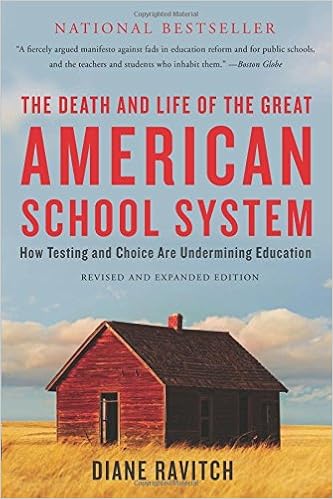
The Death and Life of the Great American School System: How Testing and Choice Are Undermining Education 3rd Edition


This link will take you to the opening pages of the revised “Death and Life of the Great American School System: How Testing and Choice Are Undermining Education.” The book was originally published in 2010. It became a surprise national bestseller.
The publisher at Basic Books, Lara Heimert, invited me to lunch a year ago and made an unusual offer. She said that I could revise the book any way I wanted. This was an extraordinary offer. Publishers usually warn you not to add or subtract unless you keep the line count exactly the same. They want to avoid the expense of resetting the entire book. But I was offered the opportunity to change, add, delete as I wished. It was an offer I could not refuse.
The two big changes I made were these:
I removed my long-standing support for national standards and tests in light of the Common Core debacle.
Second, I revised my estimation of the 1983 report, “A Nation at Risk,” which gave rise to the myth that American education was broken.
I hope you will take the time to read this new edition. It reflects much of what I have learned from YOU on this blog over the past four years.


Pending Teachers’ Strike in Chicago Reflects Long and Convoluted Funding Crisis | janresseger

Pending Teachers’ Strike in Chicago Reflects Long and Convoluted Funding Crisis | janresseger:

Pending Teachers’ Strike in Chicago Reflects Long and Convoluted Funding Crisis

Image result for Pending Teachersโ€™ Strike in Chicago Reflects Long and Convoluted Funding Crisis

The Chicago Teachers Union has voted to strike next Tuesday, October 11. The union has not had a contract for over a year, and in threatening to strike, teachers are not only expressing dissatisfaction with the contract offered by Chicago Public Schools but also with years of state funding cuts and financial mismanagement that culminated over the summer in worries that the school district faced bankruptcy. Over 90 percent of teachers participated in the vote that authorized the strike, and of those, 95.6 percent voted to strike.
Here are some of the issues teachers are protesting in the contract itself.  First, during negotiations in years past, teachers agreed to give up salary increases when the District agreed to pay a higher percentage of their pension contributions. But in this contract, reports Sarah Karp for WBEZ News, the salary increases proposed by the district are contingent on teachers giving up what they negotiated in previous years and “paying 7 percent more of the employee contribution into the pension fund.”  Karp explains further: “That… offer would give teachers an 8.73 percent raise over four years, but teachers would pay 7 percent more into their pension fund and between 1.5 percent and 3 percent more for health insurance. Teachers would also get salary increases based on experience and education, called steps and lanes.  Considering the increase into the pension fund and payments to health insurance, steps and lanes would be the mechanism by which most teachers would see an increase in compensation.”  “One of the biggest sticking points for the union is that the offer Chicago Public Schools has made could result in some teachers getting less pay at the end of the contract compared to the beginning.”
But salary and benefits are only part of what teachers are protesting in Chicago. The Sun Times quotes a union spokesperson who explains that the vote “should come as no surprise to the Board, the mayor or parents because educators have been angry about the school-based cuts that have hurt special education students, reduced librarians, counselors, social workers and teachers’ aides, and eliminated thousands of teaching positions.” Significant staff cuts Pending Teachers’ Strike in Chicago Reflects Long and Convoluted Funding Crisis | janresseger:


CURMUDGUCATION: The Choices Charters Hate

CURMUDGUCATION: The Choices Charters Hate:

The Choices Charters Hate


One of the evergreen arguments in favor of modern charters is that they will be laboratories of innovation. Freed from the constraints of the public school system, charters will whip up brand new educational approaches, pedagogical discoveries that somehow nobody has ever whipped up before. Once they have freed the edu-genii, they will then unleash these cool new ideas on the whole education world, and all schools will work better because the charters were allowed to figure out brilliant new techniques that the public schools could not.

That's how it's sold. But that's not how it works.


First, charters have displayed no special ability to think of brand new educational ideas that nobody has ever thought of before. Longer day, longer year, only teach the kids that are easy to teach-- none of these are new ideas. Pay teachers less and give them no say in how the school is run-- also not new ideas, but also not particularly good ones, either.

But even if charters are whipping up new edu-concepts, that doesn't mean they want to share. The modern charter is born of corporate culture, and one basic principle of corporate culture is that Ford does not send its best ideas over to Chrysler management.

No, in the corporate world many contracts come with strict non-competition clauses. So it should be no surprise to find the same thing going on in the charter world. In fact, it should be no surprise to discover that charters want to straightjacket their teachers as much as possible.

Meet Mike Kowalski.

Mike Kowalski was a teacher for the Mystic Valley Regional Charter School. Like most charters, 
CURMUDGUCATION: The Choices Charters Hate:

See Ed. Dept. Guidance on Using Federal Aid for School Turnarounds Under ESSA - Politics K-12 - Education Week

See Ed. Dept. Guidance on Using Federal Aid for School Turnarounds Under ESSA - Politics K-12 - Education Week:

See Ed. Dept. Guidance on Using Federal Aid for School Turnarounds Under ESSA

Image result for big education ape School Turnarounds
How can schools and districts use federal money intended for at-risk and needy students to improve general learning conditions? The U.S. Department of Education has some suggestions.
Last month, the department released "Supporting School Reform by Leveraging Federal Funds in a Schoolwide Program." It specifies how schools can use federal money to drive comprehensive turnaround efforts and help all of their students, regardless of whether those children are identified as Title I (or disadvantaged) students. 
Which schools can operate schoolwide programs using federal aid for disadvantaged students? These include schools in which at least 40 percent of students are in poverty, schools that receive a waiver from that 40-percent threshold, and certain schools that received waivers under the School Improvement Grant program. As we wrote not long after ESSA passed, a much larger number of schools could potentially qualify for the second category under the new law. And the guidance also hits on a common message about ESSA: that it's supposed to help schools move away from a narrow focus on a few subjects.
"The new law allows SEAs and LEAs the opportunity to broaden their definitions of educational excellence, while maintaining critical civil rights for all students," the guidance states. "Additionally, the ESSA includes provisions designed to enable SEAs and LEAs to focus on providing students the diverse, integrated curriculum and learning experiences necessary for a well-rounded education."
After conducting a study to find out the needs of failing or at-risk students, the guidance highlights a few possible examples of schoolwide programs that can be paid for with Title I money (and that can become part of a new improvement plan or added to an existing one). Some of these possible strategies, which must be evaluated annually, include:
  • "High-quality preschool or full-day kindergarten and services to facilitate the transition from early learning to elementary education programs."
  • "Counseling, school-based mental health programs, mentoring services, and other strategies to improve students' nonacademic skills."ESSA_button.jpg
  • "School climate interventions (e.g., anti-bullying strategies, positive behavior interventions and supports)."
  • "Equipment, materials, and training needed to compile and analyze student achievement data to monitor progress, alert the school to struggling students, and drive decision making."
  • "Devices and software for students to access digital learning materials and collaborate with peers, and related training for educators (including accessible devices and software needed by students with disabilities)."
  • "Two-generation approaches that consider the needs of both vulnerable children and parents, together, in the design and delivery of services and programs to support improved economic, educational, health, safety, and other outcomes that address the issues of intergenerational poverty."
Both the 2015 and 2016 versions of the guidance do some myth-busting—they make clear, for example, that Title I money used for schoolwide programs don't just have to be used on reading and math instruction, and that Title I aid can be used for children in preschool. 
And if you've made it this far, check our our recent "Moving the Needle" special report on school improvement strategies in the age of ESSA, including one in which we examine how states and districts are trying to find new flexibility when it comes to spending federal dollars. 
ESSA Schoolwide Guidance (September 29, 2016)

Don't miss another Politics K-12 post. Sign up here to get news alerts in your email inbox.


Mike Klonsky's SmallTalk Blog: Heading back to Standing Rock

Mike Klonsky's SmallTalk Blog: Heading back to Standing Rock:

Heading back to Standing Rock

  Flyer on the campus of the University of New Mexico in Albuquerque
I'm on my way to Bismarck this morning where I will pick up some goods and head back down to the Standing Rock encampment. What's different about this trip is that I will be joined on Friday by two vans filled with Chicago high school and college students.

The trip has been organized by our local community organization, Logan Square Neighborhood Association. My wife, Susan is an LSNA board member whose report to the board following last trip to Standing Rock in September helped encourage this trip. The main spark for the journey came from a youth leadership program organized by LSNA. Several in the group received DNA test results revealing their Native ancestry.

The students tell me, they see the struggle in North Dakota as their own.

This should be a great learning experience for all of us, especially being there on Columbus DayIndigenous Peoples Day to support Native American rights and the struggle to stop the Dakota Access Pipeline.


Among the students heading to Standing Rock
Our last trip to Standing Rock ended with a quick return to Chicago to witness the birth of our new granddaughter, Isadora. This time, I plan to be back in time to walk the picket lines with striking Chicago teachers who've been working without a contract for more than a year. As of now, it looks like 26,000 CTU members will hit the bricks on October 10th.

Thanks go out to all those who contributed money and who are still dropping off badly-need supplies, at the LSNA office, including warm clothing and medical supplies, to bring up to the encampment. The students are still about $1,500 short of their goal to pay for their journey to North Dakota. So if you haven't already contributed, you can still do it here. 

Special thanks go out to Barbara Madeloni, president of the 110,000-member Massachusetts Teachers Association (MTA) who sent us a nice-sized personal check. Barbara is a staunch advocate for students and Mike Klonsky's SmallTalk Blog: Heading back to Standing Rock:


BRIDGEGATE: Kelly has a good day– and who knew Christie and Cuomo were BFFs? |

BRIDGEGATE: Kelly has a good day– and who knew Christie and Cuomo were BFFs? |:

BRIDGEGATE: Kelly has a good day– and who knew Christie and Cuomo were BFFs?


Bridget Anne Kelly, the former aide to Gov. Chris Christie on trial in federal court in Newark, had a good day  Tuesday (10/4/16) thanks to the cross-examination work of her lawyer, Michael Critchley.
Critchley’s not argumentative, not bombastic. He doesn’t intimidate. And, when he’s discussing a set piece with government witness David Wildstein in the continuing political soap opera known as Bridgegate, he might as well  be at a bar in West Orange trading comments about a playoff game with neighborhood denizens.  Forceful but friendly.
And that’s how, in just one day, Critchley led Wildstein into two important admissions in front of the jury that tended to exculpate Kelly, his client. Almost three.
The first was that, in the middle of a discussion about how all the Big Boys running the state were discussing how to put together a package of lies to be foisted on the people of the state as a “report” on how the traffic jams at the George Washington Bridge happened, Critchley went down a list of about five top aides to Christie who were authors and then slipped in:
“Ms. Kelly had nothing to do with the report, did she?”
“No, sir,” said Wildstein about the woman who was deputy chief of staff to Christie. This didn’t help Bill Baroni, her co-defendant, who was deputy executive director of the Port Authority–Wildstein said he was an author.

Critchley (NJ Law Journal)

Now, Wildstein already has accused Kelly of “instructing” him to begin the Fort Lee blockade. It should strike the jurors as odd that, while she played a major role in the event itself, she played no role in putting together the cover-up story.
In another context, Critchley also got Wildstein to admit to saying about Kelly that “she never made a decision on her own.” The witness complained Critchley had confused him–but the words were out there for the jury to hear.
Critchley also came very close to getting Wildstein to admit that Christie “approved” the plan to close the Fort Lee lanes at the George Washington Bridge to punish the BRIDGEGATE: Kelly has a good day– and who knew Christie and Cuomo were BFFs? |:


Anger Grows in Nashville « Dad Gone Wild

Anger Grows in Nashville « Dad Gone Wild:

ANGER GROWS IN NASHVILLE

img_0309

I think Diane Ravitch said it best last week: “Nashville, you have a problem.” In case you are new to the game, back in July, Nashville got a new Director of Schools, and while there was a sigh of relief that he wasn’t of the reformer ilk, he’s raised plenty of other red flags since he started work here. This past week, even more started to pop up.
Either due to my last blog post or independently, Phil Williams, an investigative local journalist with Channel 5 News, has begun asking many of the same questions that I have been asking. In an attempt to preempt the potential damage, Metro Nashville Public Schools (MNPS) released a series of communications. The first was under the guise of a“fact checking” sheet. Everybody loves a fact checker these days, but the problem is, this one didn’t counter any facts. Instead, it confirmed that the Chiefs were driving luxury vehicles and commanding much larger salaries than last year. Salaries that were not designated in the budget that was approved just a few months ago. Here’s another hint: justifications that involve how special you are as opposed to everybody else will usually fall on deaf ears.
What this “fact check” does is try to move the conversation away from whether administrators are receiving these benefits and instead make an argument that it is justified. My argument is, where did the money come from? In the recently approved budget, neither English Learner programs nor literacy programs were fully funded. Yet somehow we’ve magically found money to raise administrator’s salaries by $20,000 or more in one fell swoop. More than that, we’ve dramatically grown central office despite Anger Grows in Nashville « Dad Gone Wild:


Gates Foundation Money Connects Common Core and ESSA | deutsch29

Gates Foundation Money Connects Common Core and ESSA | deutsch29:

Gates Foundation Money Connects Common Core and ESSA

Image result for Gates Foundation Money Connects Common Core and ESSA

The Every Student Succeeds Act (ESSA) includes the following prohibition regarding the federal government’s luring states into adopting specific standards, assessments, or content, including the Common Core State Standards (CCSS):
‘‘SEC. 8526A. PROHIBITION AGAINST FEDERAL MANDATES, DIRECTION, OR CONTROL.
‘‘(a) IN GENERAL.—No officer or employee of the Federal Government shall, through grants, contracts, or other cooperative agreements, mandate, direct, or control a State, local educational agency, or school’s specific instructional content, academic standards and assessments, curricula, or program of instruction developed and implemented to meet the requirements of this Act (including any requirement, direction, or mandate to adopt the Common Core State Standards developed under the Common Core State Standards Initiative, any other academic standards common to a significant number of States, or any assessment, instructional content, or curriculum aligned to such standards), nor shall anything in this Act be construed to authorize such officer or employee to do so.
‘‘(b) FINANCIAL SUPPORT.—No officer or employee of the Federal Government shall condition or incentivize the receipt of any grant, contract, or cooperative agreement, the receipt of any priority or preference under such grant, contract, or cooperative agreement, or the receipt of a waiver under section 8401 upon a State, local educational agency, or school’s adoption or implementation of specific instructional content, academic standards and assessments, curricula, or program of instruction developed and implemented to meet the requirements of this Act (including any condition, priority, or preference to adopt the Common Core State Standards developed under the Common Core State Standards Initiative, any other academic standards common to a significant number of States, or any assessment, instructional content, or curriculum aligned to such standards).’’ (page 312).
However.
In August 2016, the Gates Foundation has managed to connect ESSA and CCSS in the form of two grants totaling almost $18 million.
The first is to CCSS co-owner, the Council of Chief State School Officers (CCSSO), so that CCSSO can help states with their ESSA plans:

Date: August 2016
Purpose: to support states as they develop and implement Every Student Succeeds Act plans
Amount: $10,000,000
Though CCSS is not explicitly mentioned in this $10 million Gates grant, CCSSO is Gates Foundation Money Connects Common Core and ESSA | deutsch29:


The 50-year struggle to put teachers at the center of quality education | Huffington Post

The 50-year struggle to put teachers at the center of quality education | Huffington Post:

The 50-year struggle to put teachers at the center of quality education

Image result for World Teachers Day.

Today, schools, parents and kids in numerous countries around the world are celebrating World Teachers Day. The celebration marks the day fifty years ago when, at a special conference in Paris convened by two United Nations agencies, the International Labour Organization (ILO) and the United Nations Educational, Scientific and Cultural Organization (UNESCO), delegates from 75 countries adopted an international standard on a profession facing many challenges. The ILO/UNESCO Recommendation concerning the Status of Teachers (1966) sets out the rights and responsibilities of teachers, and calls for adequate training, salaries and support. It further stresses the importance of involving teachers and their organizations in the setting of their working conditions and education policy in general.
The adoption of the Recommendation was an important step in addressing the teacher paradox: while good teachers have always been recognized as critical for national development, they often faced working conditions that made their profession difficult and unattractive to qualified people. This paradox continues today. Research has indicated that the impact of a good teacher on a learner greatly outweighs other factors such as school infrastructure and textbooks, yet in many developing countries teacher salaries remain too low to attract or retain good teachers. Even in many developed countries, according to a recent study by the OECD, primary and lower secondary teachers earn 78 and 80 per cent respectively of similarly-educated workers.
Teachers also often do not receive adequate training. The recently published 2016 Global Education Monitoring Report shows that in sub-Saharan Africa, more than half of pre-primary and a quarter of secondary school teachers are untrained. Wages and training are even worse among teachers hired on short-term contracts, a widespread practice in countries scrambling to fill teacher shortages. These poor conditions contribute to the high attrition rates and absenteeism that have plagued many countries in their pursuit of developing a quality teaching force. And each year, the ILO deals with cases of teachers being dismissed, assaulted or imprisoned for participating in trade union activities.
Fifty years after its adoption, therefore, we believe that the Recommendation on the Status of Teachers remains highly relevant, and the world community must continue to ensure that its promises are fulfilled. There are signs of hope. In a number of countries, teachers enjoy the respect and working conditions commensurate with their responsibilities. Almost all countries have recognized the importance of teachers and in setting out relevant policies and management mechanisms. And it has been a remarkable achievement for teacher organizations to have the importance of their profession recognized in the 2030 Sustainable Development Agenda, the UN’s development blueprint.
Yet the Recommendation still challenges us to do much more. In view of declining public budgets, we need to tackle the challenge of education financing through fairer tax regimes, alternative revenue schemes, and well-governed public-private partnerships. Financing solutions, whether public, private or a mix of both, need to be dependable and sustainable, and ensure equity for all learners. We need to improve teacher training and qualification requirements to match the demands of the profession. Teachers need to be paid adequately in relation to other professions with similar requirements to ensure that good and motivated young people are attracted to teaching. Teachers must be held accountable for their performance, yet we need to resist over-simplified accountability schemes that reduce the complex interaction of teaching to convenient numbers.
And above all, and here the 1966 Recommendation is very clear, teachers need to be involved at all levels of policy- and decision-making that affect them. Policy makers must resist misguided notions that teacher unions are an obstacle to education reform, and fight efforts to curtail the fundamental right of teachers to join associations in their professional interest. Experience has shown that good faith social dialogue - institutionalized and regular consultation, sharing of information, and where appropriate, negotiation - between teachers and their employers can be solid way forward to sustainable education reform and effective teachers. Teachers are the key to a sustainable future, and on this World Teachers Day, we would do well to reflect on how to empower this noble profession.
Guy Ryder, Director-General, International Labour Organization (ILO)The 50-year struggle to put teachers at the center of quality education | Huffington Post:
 Image result for World Teachers Day.

Tuesday, October 4, 2016

Charters and Choice: Research Shows Negative Impact - Living in Dialogue

Charters and Choice: Research Shows Negative Impact - Living in Dialogue:

Charters and Choice: Research Shows Negative Impact 


The contemporary school reform movement was rooted in the Michael Deaver, Lee Atwater, Karl Rove, and Dick Morris era of public relations spin.  Being able to hire the best possible public relations expertise, reformers borrowed from Deaver’s success in using photos of Ronald Reagan getting off his helicopter, with his hand cupped on his ear, not being able to hear or answer the questions that reporters shouted at him.  He and his successors understood the truism that, “the eye always predominates over the ear when there is a fundamental clash between the two.”
Accountability-driven reformers also drew upon another legacy of Reagan era public relations – the proliferation of “think tanks” publishing “papers” that are touted as research.  Deep-pocketed donors fund an alphabet soup of advocacy organizations to publish “pseudo-studies” that typically conclude that test-driven, choice-driven policy experiments “can” increase student performance.  Since most commentators will read no more than the studies’ abstracts or the sponsors’ press releases, the papers provide an endless supply of soundbites and power points. The press continually gets eye-fulls of graphics indicating that accountability and charter schools can increase student performance. Rarely are these studies peer reviewed and almost none ask the questions that policy researchers should investigate. Few ask what will be the most likely results of reforms.  These papers shout out the supposed benefits of favored policies while ignoring their inherent costs.
Learning from the Federal Market-based Reforms: Lessons for the Every Student Succeeds Act (ESSA), edited by William Mathis and Tina Trujillo, is a wonderful corrective for the unfortunate trend of twisting evidence to reach predetermined edu-political agendas.  Learning from the Federal Market-based Reforms is a part of the National Education Policy Center series of publications, and it comes from a perspective that is very different than that of test-driven, competition-driven reformers. In contrast to so much of the research generated by reform advocates – where the best papers are often science-informed but shun the scientific method – the NEPC’s work measures up to the highest standards of  academic excellence.  As with most social science, the contributors to this 697 page anthology come with a perspective(s), but they are objective and intellectually honest.
“The Impacts of School Choice Reforms on Student Achievement,” by Gary Miron and Jessica Urschel, is one of the anthology’s best examples of an analysis which is essential for the discussion of charter schools and other forms of school choice.  It evaluates of the quality and the social scientific rigor of studies on the effectiveness (in terms of raising test scores) of vouchers, home schools, magnet schools, online learning and charter schools.  It then calculates how much each of those approaches increase or decrease (or fail to make much of a difference to) student performance.  In other words, Miron and Urschel provide a thoroughly researched but readable guide into the benefits these policies can contribute. Moreover, their graphics convey both the number and the quality of the studies, and whether they produce slightly or very positive or negative or mixed results.  These scattergrams thus provide a Rorschach test.  Readers are free to decide whether the various forms of choice are likely to produce gains that are big enough to justify policies that also have costs.
Starting with the last issue, Miron and Urschel only found three meaningful studies in terms of student performance results for virtual schools.  All three focused on virtual charters. Like the pro-reform CREDO, “The Impacts of School Choice Reforms on Student Achievement” concludes that students in the virtual schools made far smaller gains in comparison to demographically similar students in brick and mortar schools.  Miron and Urschel also conclude that the 19 studies of home schools were mostly of lower quality, while the 15 studies of vouchers were of higher quality.  The Weighted Mean Gains of home schools were the highest of all approaches (1.33 on a +2 to a -2 scale), while the voucher gains were the second-highest (.62). I doubt many people, regardless of their opinions on home schooling and vouchers will be determined by the test score increases that they produce.  Home school decisions will include a great deal of consideration of the downside of not sending children to a public school with their peers. Vouchers debateCharters and Choice: Research Shows Negative Impact - Living in Dialogue:
Image result for Market-based Reforms