Latest News and Comment from Education

Thursday, September 15, 2016

A MUST READ - Kevin Rennie: Judge Decides Disabled Kids Not Worth Teaching - Wait What?

A MUST READ - Kevin Rennie: Judge Decides Disabled Kids Not Worth Teaching - Wait What?:

A MUST READ – Kevin Rennie: Judge Decides Disabled Kids Not Worth Teaching

Image result for Judge Decides Disabled Kids Not Worth Teaching


Hartford Courant columnist, blogger, lawyer and former legislator, Kevin Rennie, has a MUST READ commentary piece in the Hartford Courant today about Judge Moukawsher’s outrageous and mean-spirited attack on Connecticut children who require special education services.
Reposted below, you can read and comment on Kevin Rennie’s piece at:   http://www.courant.com/opinion/op-ed/hc-op-rennie-ct-school-moukawsher-disabled-0918-20160915-column.html
Kevin Rennie writes;
Compassion has been declared unconstitutional by a Superior Court judge. Our leaders refuse to condemn his brutal assault on those with disabilities. Delusions rule as Connecticut enters an age of shame.
Thomas Moukawsher, a judge, Malloy appointee and former Democratic organization foot soldier, read his meandering, sloppy decision on public school funding on Sept. 7. Then, otherwise comprehending people seemed not to understand what they had heard. The plaintiffs, a coalition of municipalities and education organizations, had sued for billions in new state spending but did not get it. They nevertheless declared victory.
Disclosure: I knew Moukawsher well when he was a banking lobbyist, during his one term in the legislature and for several years after that. I have not spoken to him in nearly 20 years.
The organizations in the coalition have maintained an indecent silence on what the decision says about providing an education for 15 percent to 17 percent of public school students with special needs. The reader will struggle to find an island of thought in the decision’s sea of bilge, but there is one on the subject of people with disabilities: It is irrational and unconstitutional, Moukawsher declaimed from the bench, to continue to provide an eduction for many of them.
The 20th century taught us that when societies turn on people with disabilities, they often do not stop there. They inflict misery on others and everlasting shame on themselves. Connecticut must not join them in the darkness.
If you want to know what an attack on freedom under the rule of law looks like, peruse the education funding decision. Special education was not an issue the plaintiffs raised. The attorney general, defending the state, warned 
A MUST READ - Kevin Rennie: Judge Decides Disabled Kids Not Worth Teaching - Wait What?:


 Connecticut Attorney General Jepsen to appeal CCJEF v. Rell ruling


Claiming that the State of Connecticut “far exceeds” what it needs to spend on public education, Attorney General George Jepsen announced today that he will appeal the recent court decision in the CCJEF v. Rell school funding lawsuit.
While Connecticut Superior Court Judge Thomas Moukawsher ruled Connecticut’s school funding program was irrational and unconstitutional, the judge went far afield of the actual case, using his decision to condemn Connecticut’s teachers and public schools and promoting his own version of a corporate education reform agenda.
An appeal will mean Connecticut’s Supreme Court will eventually weigh in on the ruling and confirm whether Connecticut’s elected officials must finally address Connecticut’s broken school funding formula.
The following is Attorney General Jepsen’s statement;
Statement from AG Jepsen on Next Steps in CCJEF v. Rell
Attorney General George Jepsen today issued the following statement to announce that the state will seek a direct appeal to the Connecticut Supreme Court of the ruling issued by the Superior Court last week in the case ofConnecticut Coalition for Justice in Education Funding v. Rell:
“Under our system of government, state education policy is determined by the Legislative and Executive Branches and implemented under a strong tradition of local control by municipal school boards and, ultimately, teachers. This decision would wrest educational policy from the representative branches of state government, limit public education for some students with special needs, create additional municipal mandates concerning graduation and other standards, and alter the basic terms of educators’ employment – and entrust all of those matters to the discretion of a single, unelected judge.
“For the public and legislators to trust the legitimacy of such a dramatically new system and the policies it produces, they must know that the ruling mandating it is legally correct. There are strong arguments that the trial court exceeded its authority and the standards articulated by the Connecticut Supreme Court, and so today we are asking that court to review this ruling.
“Despite its order, the trial court correctly determined that the state far exceeds its minimum constitutional obligations for providing equitable access to adequate education. Nevertheless, the ruling identified profound educational challenges that remain and must continue to receive serious and sustained attention – and action – at every level of government. Nothing about this appeal prevents policymakers from immediately addressing those challenges, and I urge them to do so without delay.”
More about this development and previous media coverage via links below:
CCJEF V. RELL MEDIA COVERAGE
CT Mirror
Hartford Courant
CT Newsjunkie
Stamford Advocate
Connecticut Post
New York Times
Links to the actual decision
Judicial Department – http://jud.ct.gov/CCJEFvRell.pdf

Related Statements:

Commentary pieces:

Schools Matter: How Opt Out Could Remain Legitimate, But Won't

Schools Matter: How Opt Out Could Remain Legitimate, But Won't:

How Opt Out Could Remain Legitimate, But Won't


The last national conference held by United Opt Out in February featured Green presidential candidate, Jill Stein, long-time radical educator, Bill Ayers, and radical intellectual, Chris Hedges.  The line-up for the conference scheduled for next month in Houston is quite different.

The October UOO conference at the Hilton will be be co-sponsored by an AFT affiliate, the Houston Federation of Teachers, and the headliners will contain no radicals, free or otherwise.  Featured will be education economist and KIPP sympathizer, Samuel Abrams, along with Diane Ravitch's lieutenant at NPE, Julian Heilig.  In short, UOO has become the latest casualty of cooptation by the corporate unions, and just in time, it seems, for AFT/NEA/NPE to, perhaps, claim a victory of sorts for the opt out movement that they now control.

Even though the annual testing requirement for public schools remains a part of the ESSA federal statute going forward, the ominous plan for future testing accountability would impose test data gathering, storage, and sharing every day, rather than just once a year.  Assessment, under the new scheme that will receive federal millions under ESSA, will be as ubitiquous as getting on and off the bus.  So even as Randi and Lily are already leading testing victory laps for a false win not yet won, such a "victory" would come at an expense that no parent, student, or teacher can afford to pay.

You see, the new personalized testing paradigm on the horizon, if implemented, will not only change the face of school as we know it, but it will jeopardize the physical and mental health of children, as well as abridge their rights to privacy and the 
Schools Matter: How Opt Out Could Remain Legitimate, But Won't:


Donald Trump Dances to His Billionaire Backers’ Tune on School Choice - The Daily Beast

Donald Trump Dances to His Billionaire Backers’ Tune on School Choice - The Daily Beast:

Donald Trump Dances to His Billionaire Backers’ Tune on School Choice


Donald Trump was never a major presence in the school-choice world—he didn’t give give to activist groups, or back New York’s growing charter-school movement. But over the last few months he’s begun loudly singing their praises, a major change of thought that coincides with the growing influence within his campaign of donors—many with hedge fund backgrounds—who help fund that movement.
Trump’s campaign has framed the new emphasis as part of his new effort to reach out to black and Hispanic voters. His polling numbers with both demographics are abysmal, and he needs all the help he can get. But the real calculus behind his shift is likely more complicated. And it puts him in the middle of a debate that involves billionaire hedge-fund bosses, multimillion-dollar pension sums, and—in theory—every school child in America.
A handful of hedge fund bosses have long played outsize roles in the school-choice movement, which looks to increase enrollment in charter schools and give families vouchers to spend at the school of their choice. Several of those bosses are now backing Trump, just as he seems to have finally embraced their cause. Robert Mercer, for instance, heads a fund called Renaissance Technologies, and his family foundation has spent big to boost pro-school choice efforts. And John Paulson, another major Trump backer who heads a hedge fund, has poured millions into New York’s Success Academy charter school network.
Investopedia reported in March of this year that the federal tax code provides benefits to hedge funds that invest in charter schools. In 2000, then-President Bill Clinton set up a tax credit for banks and private equity funds that lend nonprofits the money they need to start charter schools.
“By combining the various credits with the interest from the loan itself, a lender can almost double his investment over the seven-year period,” wrote Juan Gonzalez at the New York Daily News. Not bad!
Trump, of course, isn’t a hedge-fund guy. And he’s criticized tax policies that give them special perks. He also hasn’t been a big school-choice guy; hebriefly mentioned charter schools in his 2000 book The America We Deserve, but otherwise stayed mum on them until launching his 2016 bid. He mentioned them briefly at the Miami Republican primary debate in March, saying Ben Carson supported them.
And in April, Ben Carson told The Washington Post that he had encouraged Trump to start talking about school choice.
“He’s been very enthusiastic about that suggestion,” Carson continued. “He’ll have to follow through and get through to those kids and families who don’t feel like they’re getting the best possible education.”
But despite that alleged enthusiasm, Trump still didn’t make much of a point to praise the charter-school movement.
In the meantime, he took a little heat for his silence. A few hours before he delivered his convention speech on July 21, the Washington Examiner ran a story headlined, “GOP megadonor wants Trump to start praising school choice.” The piece suggested that Betsy DeVos—one of the most powerful Republican mega-donors, and an ardent backer of charter schools—wouldn’t back Trump unless he started vocally praising the school-choice movement.
A few hours later, in Trump’s convention speech, he alluded to the charter-school movement.
“We will rescue kids from failing schools by helping their parents send them to a safe school of their choice,” he said. “My opponent would rather protect bureaucrats than serve American children.”
Less than a month later, Trump’s support for school choice had ramped up from understated to explicit. On Aug. 17 in West Bend, Wisconsin, he explicitly endorsed the school-choice movement.
“On education, it is time to have school choice, merit pay for teachers, and to end the tenure policies that hurt good teachers and reward bad teachers,” he said.
EdWeek noted that the mogul mentioned school choice at least three times in August: in West Bend, in his major economic policy speech in Detroit, and again during a Donald Trump Dances to His Billionaire Backers’ Tune on School Choice - The Daily Beast:

Former NFL Quarterback Supports Public Schools. That’s Right. PUBLIC Schools! | gadflyonthewallblog

Former NFL Quarterback Supports Public Schools. That’s Right. PUBLIC Schools! | gadflyonthewallblog:

Former NFL Quarterback Supports Public Schools. That’s Right. PUBLIC Schools!

dictionary
So I’m in my classroom today, teaching, when I see something that stops me cold.
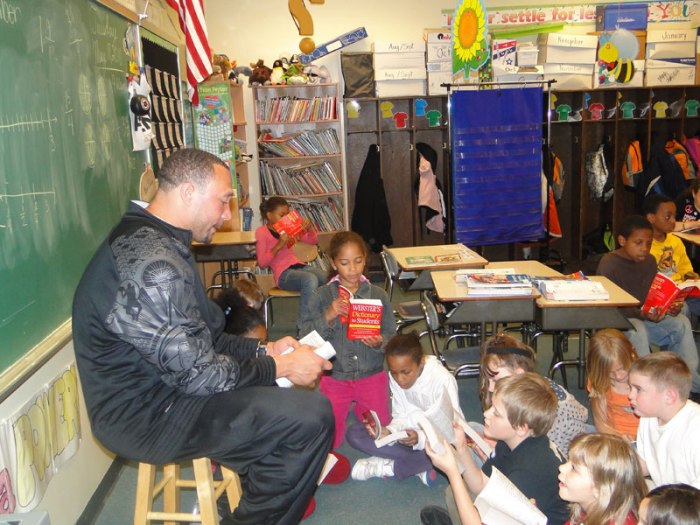
The door opens and in comes former Steelers backup quarterback Charlie Batch.
My mouth falls open. I don’t know what I was talking about. Vocabulary words or something.
The class of 8th graders falls silent, too. All eyes are on the two of us.
Batch looks me right in face with a big smile.
“Here you go,” he says and hands me a shopping bag full to bursting with school supplies and an extra-large tub of hand sanitizer.
By this time I’m probably blushing and grinning like my teeth are about to escape my face.
I hope I was able to mouth a “Thank you,” before he left, but I’m not really sure.
It all kind of happened in a daze.
He came. He gave me supplies. He left.
I guess I shouldn’t have been so taken by surprise.
Batch is a frequent face in my district. After all, he graduated from here, himself, before moving on to college and professional sports.
At the beginning of every year, Batch brings school supplies to every teacher in every building in the district. This was just the first time I was actually in the classroom when he dropped them off. Usually he sneaks in when I’m at lunch duty or Former NFL Quarterback Supports Public Schools. That’s Right. PUBLIC Schools! | gadflyonthewallblog:


Opt Out is DEAD | BustED Pencils

Opt Out is DEAD | BustED Pencils: "Opt Out is DEAD"

Opt Out is DEAD
Image result for big education ape Opt Out is DEAD

In its current form.
Did I get your attention? Good. Because right now I feel like I back peddled five years ago to the time when several of us started an FB page to create opt out guides/resources for each state. At that time, we/opt outers were mocked, ignored, and ostracized. Lots of big wig activists and educational groups treated us like the plague.  Opt out was not cool.
We have entered a new phase of activism – and it feels a bit like starting over. It’s now September of 2016 where everyone and their mother loves opt out – even New York RegentRoger Tilles!!!  Opt out has gone mainstream!!!!
When opt out starting going mainstream, it felt okay at first, but then, suddenly – it didn’t. Why was everybody sharing the opt out love??? Did humanity suddenly return? Um, no. I don’t trust easily and something felt amiss. And I always listen to my gut feelings and research to confirm these feelings.
Backtrack to March of 2015.
We at UOO discovered the ECS “opt out” guide and I pointed to  it on my blog.  ECS is partially funded by Pearson, among other folks.  Of course  we asked ourselves, why was ECS creating a state by state opt out guide? Since when did Pearson and the other corporate cronies want to help citizens figure out how to opt out?
Many of us started fishing. We discovered more. Opt out was a big fish in a little pond. We’d been had. Hook. Line. Sinker.
In October 2015 I wrote this – it was clear that opt out was on the way out as competency-based education (daily online curriculum and testing) entered.
Opting out of the end of year test now served the needs of the .01%. The opt out movement had been co-opted. The end goal – all along – was daily online testing – via online modules that break down learning into discrete skills that must be mastered – all under the guise of personalizing learning to better meet the needs of individual learners. Not only did they plan to personalize the academic skills per child, they also planned to tap into a child’s emotions and behaviors to further tailor the learning to the child’s needs (look up SEL/social-emotional learning) – all with the end goal to create more profit for the .01%.
Opt Out, in its current form, was dead.
But – let me make something very clear.  We needed the opt out movement to generate a pool of aware citizens – we needed it to build relationships. We, the people, helped fuel a movement of questioning, civil disobedience, and strategic problem solving – all absolutely necessary for this next phase of strategic actions . Opt out was necessary to save not only our public schools, but this planet. The opt out movement is and was important. But, we Opt Out is DEAD | BustED Pencils: "Opt Out is DEAD"


Ohio charter-school grant labeled ‘high risk’

Ohio charter-school grant labeled ‘high risk’:

Ohio charter-school grant labeled ‘high risk’

Image result for big education ape ohio charter schools


The U.S. Department of Education is letting Ohio keep its $71 million grant to expand charter schools.
But, it is designating the grant “high risk” and upping oversight to ensure there is no fraud.
The Ohio Department of Education must, among other restrictions:
  • Create a database that shows charter schools’ academic, operational and financial performance;
  • Submit documentation to the U.S. Department of Education for each withdrawal from the grant account;
  • Post semi-annual financial reports to show how the grant is being used;
  • And hire an independent monitor to oversee implementation of the special restrictions.
The new rules were announced Wednesday in a letter from the U.S. Department of Education’s Stefan Huh to Ohio’s Superintendent of Public Instruction, Paolo DeMaria. Huh's letter states that while the review of Ohio’s grant application didn’t find any significant inaccuracies, there were enough concerns raised to merit extra scrutiny.
In particular, Huh noted the “circumstances under which a key ODE staff member departed.” That’s a reference to David Hansen, a high-ranking Ohio education official who resigned in 2015 after he was accused of playing with charter-school rankings to protect poor performers.
The $71 million grant, spread out over several years, was first announced in September 2015. It was part of a package of more than $157 million for charter schools nationwide, and Ohio – known for its shaky performance when it comes to charter schools – got the biggest chunk of the pie. By comparison, the Illinois Department of Education got the next-biggest grant: $42.3 million.
Opponents said U.S. officials were throwing good money after bad and rewarding a system fraught with corruption. The Cincinnati Educational Justice Coalition sent a letter to then-U.S. Secretary of Education Arne Duncan asking him to cancel the grant and give the money to traditional public schools instead.
In November, the U.S. Department of Education essentially put the grant on hold while it reviewed Ohio's application.
ODE spokeswoman Brittany Halpin said the department is happy with the news it can move forward with the grant and dedicated to following the new stipulations.
"Ohio’s accountability system is stronger thanks to reforms in the state’s charter school law," Halpin wrote in an email. "The department now has greater authority to ensure that quality sponsors oversee schools and we’re able to provide incentives to sponsors that have track records of success. We’ve also taken steps to ensure the new sponsor evaluation system is clear, transparent and consistent with rule and law."
In a call with reporters on Wednesday, U.S. Sen. Sherrod Brown, D-Ohio, praised the restrictions. He called Ohio's for-profit charter system a "disgrace" and said the new checks will ensure the grant is properly spent.
Some charter schools are thriving in Ohio, Brown said, but “too many, particularly online for-profits .. aren’t meeting the needs of our students.
"Children pay the price for this mismanagement, and it costs taxpayers money."


Brown, one of several politicians to push for tougher restrictions after the grant was first announced, said the money might have been wasted without this extra oversight.
 Ohio charter-school grant labeled ‘high risk’:

ABCs of Classrooms at Risk: DON’T just #OPTOUT – Missouri Education Watchdog

ABCs of Classrooms at Risk: DON’T just #OPTOUT – Missouri Education Watchdog:

ABCs of Classrooms at Risk: DON’T just #OPTOUT

ipads-fingers

What are we doing to our kids?
Cancer doesn’t care if you are Democrat or Republican.  The dollars invested in the edtech industry don’t care if your child is Democrat or Republican either.  Why  then do we let this broken two party system divide us when it comes to education and doing what is best for our children?  Put children’s health and safety first.  Always.
A is for always protect kids and the American Academy of Pediatrics.
We know, despite campaigns from the tobacco industry that said otherwise, smoking cigarettes does have a direct link to causing cancer.  The sugar industry certainly has helped to prove the point recently, that data can be manipulated and studies and media can be bought.  So now, ask yourself this, remember those warnings from pediatricians about too much  TV and limited screen time?According to the American Academy of Pediatrics (AAP),  2015, kids were astonishingly spending 7 hours a day on “entertainment” media.
The American Academy of Pediatrics (AAP) released these guidelines for children and adolescents using media, recommending no more than two hours per day of any type of entertainment screen time for kids ages 3 to 18 and none for children 2 or younger. The guidelines cover media such as Internet and texting as well as TV, movies and video games.- Reported March 2014, Washington Post
How come we aren’t limiting screen time in school?
Instead, the federal government and the broadband industry are teaming up to bring Wi-Fi connectivity (via the FCC’s Lifeline) to all communities and schools.  The White House is also promoting classroom connectivity,  1:1 computers, chromebooks, or ipads for each child. ESSA has freed up Billions of dollars to spend on expanding technology use in the classroom. That’s MILLIONS of classrooms full of screens, Wi-Fi, online curriculum, online assessments and student data all bundled together for and by the industry. The federal government is actually giving grants for every textbook you replace with their “free” online curriculum.
glow kids
B  is for Billions of dollars.
Interestingly, there is now research proving that screen time is addictive, showing dopamine receptors in our brains react to screens equally as strong as receptors react to cocaine addiction.   Glow Kids author explains in TIME Magazine that screens in schools, edtech is a $60 Billion Hoax that is harming children.  We don’t see that posted on the US Dept of Ed or State Dept of Ed websites.   Nor do we see the studies that show memory retention,  scores on tests, academic performance are actually worse on screens. But we do see the federal government investing millions more into technology and data collection.
report-card-c
C  is for Cancer.
The Big (C).

How Do We Rebuild Democratic Communities for Education? - Bridging Differences - Education Week

How Do We Rebuild Democratic Communities for Education? - Bridging Differences - Education Week:

How Do We Rebuild Democratic Communities for Education?

Image result for How Do We Rebuild Democratic Communities for Education?

Dear Harry and friends,
I'm fascinated by how differently we come at this topic which, I think, we are at heart in agreement. But, I'm trying to figure out our differences.
As you know I love Public Achievement. It serves a very different purpose than the kind of Community Service projects we did at CPESS and Mission Hill, which were more "just" getting kids out into the world, seeing the world in a different role—as co-workers versus as students. It also offered chances to meet adults who might interest them, engage them and be part of their future network. It did all that pretty well.
But, it didn't directly take on the democratic engagement issues that matter so much to both of us—at least not directly. Interestingly, a few of the questions we "required" everyone to look into were: How are decisions made at your place of work? How is the organization run? Who has power? etc.? Demystifying power relations in the workplace is important in a democracy after all.
I've also always appreciated your use of the word commonwealth, with its history of what you call co-creation. That phrase also resonates. The best classrooms and schools are precisely co-creations. Part of what worries me in the world today, and in the movement for increasing school choice (which I aided in its early stages—maybe alas) is that it focuses entirely on individual choice, not communities choosing together. It splits communities apart rather than bringing them together. I still see the face-to-face community as the solid bulwark of democracy that has no replacement that I know of—whether in the workplace or in the neighborhood. Maybe we (and here I suspect I do not speak of my generation as part of that "we") must invent another type of community that can serve the purposes the old one did? The on-line ones I know are interesting, but I don't see them replacing unions or communities—but maybe they will come to do so. 
Your words on the subject of hyper-individualism were much appreciated, and that issue is a real danger for democracy, just as the absence of individualism is a danger to democracy as well! That's the dilemma.
Among the other things that school choice (vouchers, charters, etc.) gives rise to is ethnic and partisan separatism. Instead of schools being designed to meet the dreams of all of their students and families, each school seeks its own separate clientele. It makes life easier—which is one reason it appealed to me. But it also too often turns into re-segregation—there was never much desegregation anyway I suppose. Like TV news stations, each with very different audiences, we see how dangerous segregated communities have turned out to be—ala Trump et al.
So, I see, as I write, how actually we are saying mostly the same thing. I think I'm personally bridging what I started this letter thinking were differences!
In the sphere of schooling, perhaps we are focused on different "enemies"? I'm immediately mostly frightened by the success that conservatives have had in attacking even the thin public education we have had. Yes, it needed to be attacked, but our attack is over quite different failings of schools as we know them. In the puzzling climate we now live, we need ways to shift the focus from how schools help individuals to grab the scarce future opportunities kids are faced with, to building communities that can rebuild democracies that provide futures for all children.   
What might be the center of such a movement, and what language would help it thrive? We're not alone in this, which gives me hope. Maybe it even bridges a divide between us and many a conservative.

Massachusetts’ Question 2: Regarding Marty Walz’s Pro-Charter Reasonings | deutsch29

Massachusetts’ Question 2: Regarding Marty Walz’s Pro-Charter Reasonings | deutsch29:

Massachusetts’ Question 2: Regarding Marty Walz’s Pro-Charter Reasonings


Save Our Public Schools - https://saveourpublicschoolsma.com/
On September 13, 2016, the Boston Globe reported on a UMass Boston debate concerning Question 2, a ballot issue that Massachusetts voters will face at the polls on November 08, 2016.
Representing the pro-charter set was former Massachusetts Representative Marty Walz (D- 8th Suffolk District), who is also senior advisor to Democrats for Education Reform in Massachusetts (DFER-MA). (For an informative, brief look at DFER, seethis post by Pennsylvania teacher and blogger Peter Greene.)
In this post, I respond to particulars related to Walz’s pro-charter-expansion stance.
Walz maintains that “local control …got us into this situation,” and by “this situation,” Walz means, “thousands of students are being left behind by their school districts.”
So, according to Walz, if Massachusetts rid itself of local control, then those “thousands of left-behind students” would no longer be “left behind.”
Indeed. Without local control, those students might conveniently and completelydisappear from any school roster.
Goodbye “left behind”; hello “gone.”
If Walz had her way, then there would only be individual, non-elected boards comprised of corporate and financial executives to oversee a school or a network of schools. So, if any students leave a school or network (whether encouraged to do so by that school/network or not), then the school (or network) responsibility ends there.
Massachusetts would be free to emulate Louisiana’s all-charter Recovery School District (RSD), a “portfolio” district (one where “there is no single entity responsible for all children”)– and one where assistant superintendent Dana Peterson publicly admitted that he doesn’t know how many students just disappear from those portfolio-ed, New Orleans schools.
But let us return to Walz’s sweep against local control of Massachusetts schools Massachusetts’ Question 2: Regarding Marty Walz’s Pro-Charter Reasonings | deutsch29:

Set Up to Fail – EduShyster

Set Up to Fail – EduShyster:

Set Up to Fail


A former teacher says an acclaimed college-prep charter school in New Orleans is setting students up for failure…
By Jake Guth
sci1There’s an old adage that if something seems too good to be true, then it likely is. Sci Academy, one of New Orleans’ top-rated charter schools, exemplifies that adage. As a success story/victim of New Orleans Public Schools, depending on which way you want to view it, I approached my job interview at Sci Academy with a big grain of salt. The Craigslist ad for a coach described an academically-driven school that was attempting to start an athletics program.
I still remember how blown away I was by my first visit to the school—how it was unlike any *public* school I’d ever seen: the polite kids I interacted with, the noticeable absence of discipline problems. The red flags should have gone up right away. Like the fact that I had no experience coaching. Or that I was given the keys to a room that was used as the school storage closet and told to clear it for a weight room. Or that there was no budget and the equipment was all donated, meaning that the helmets were well past the three-year certification usage limit and many of the pads were moldy. None of it mattered. I was 24 years old, a minority from New Orleans, and I’d landed what seemed like a dream job.
I am ashamed to admit it, but I drank the Kool-Aid and asked for refills. Being surrounded by mostly young, many non-certified educators, all of whom have really big dreams and aspirations of making a difference in the lives of kids, while being force-fed a steady diet of talk about perseverance and the *Stockholm Paradox* will do that to you.
Image result for sci academy new orleansI could see for myself that Sci was doing all the wrong things, yet claiming phenomenal graduation rates and supposedly putting kids in college *to succeed.* The Kool-Aid was losing its flavor. But I didn’t quit. I’d started advising students my first full year at Sci and I quickly built powerful relationships with them. I worried that, if I left, they might completely shut down towards an adviser who wasn’t able to reach them like I could, and who would then respond by punishing them for their failure to cooperate. I made a commitment to the 12 kids I was advising that I’d stay for a full four years in order to Set Up to Fail – EduShyster:


Connecticut educator’s open letter concerning Judge Moukawsher’s recent ruling - Wait What?

Connecticut educator’s open letter concerning Judge Moukawsher’s recent ruling - Wait What?:

Connecticut educator’s open letter concerning Judge Moukawsher’s recent ruling

Image result for open letter

Randall Smith is a social studies teacher and debate coach at Joel Barlow High School.  The following is his open letter to Superior Court Judge Thomas Moukawsher in response to his recent ruling in the CCJEF V. Rell lawsuit;
As a teacher in his sixteenth year in education, I wish to offer Judge Thomas Moukawsher both praise and some advice in response to his recent landmark ruling.
On the issue of funding, I applaud him for holding our collective feet to the fire to come up with a cost-sharing formula that is fair to disadvantaged communities. His laser-like focus on abolishing achievement gaps echoesBrown v. Board of Ed., which challenged Topeka and the entire country to make good on the Constitution’s promise to give all Americans “equal protection of the laws.” The fact that it has been decades since Sheff v. O’Neillwas handed down and so little progress has been made toward ending disparities in resources is indisputably disgraceful.
But despite the best of intentions, in an overly-broad ruling Judge Moukawsher has also prescribed some other remedies that I believe would lead us to repeat past mistakes at great cost to many. I respectfully ask the Judge and state leaders to seek policies that are not just rational, but ones proven to actually work in practice. Borrowing a phrase from another judge, I argue further that many of his demands “are decided upon an economic theory” which a large part of education research does not entertain.
In just about every area of education policy Judge Moukawsher asks us “to get rid of an irrational policy and adopt a rational one.” This is a loaded phrase with a long history in American law. It originates in the 1819 case,
Connecticut educator’s open letter concerning Judge Moukawsher’s recent ruling - Wait What?:


NY Times Muddles Education Debate | janresseger

NY Times Muddles Education Debate | janresseger:

NY Times Muddles Education Debate

Image result for School Reform

Last week, Connecticut Judge Thomas Moukawsher released a school funding decision in the case, Connecticut Coalition for Justice in Education Funding v. Rell.  Judge Moukawsher found Connecticut school funding unconstitutional, but at the same time his decision was anything but clear.  The Connecticut Supreme Court had already recognized the state’s allocation of educational resources and their alleged deficiencies, and had remanded the case back to the lower court with the expectation that the judge would examine the evidence and determine to what degree Connecticut’s level of investment in the plaintiff school districts meets the adequacy standard.  Writing for the Stamford Advocate, Wendy Lecker, an expert on school finance and an attorney with the Education Law Center, explains: “At trial, the CCJEF plaintiffs (had) put forth overwhelming evidence of severe resource deficiencies of inputs such as: academic and social intervention for at-risk students and students with special needs; guidance counselors, social workers, nurses, services for English Language Learners, music, art and other subjects; and reasonable class size. Judge Moukawsher’s charge was to examine the resources in the districts at issue in the case…. However, nowhere in the opinion does the judge systematically look at the actual resources present or absent in each district.” (On Tuesday, this blog commented on the Connecticut decision).
In his decision, the Connecticut judge also chose to range far beyond the funding issue at the center of the case.  In his decision, Judge Moukawsher condemns a range of policies and practices in education that have little to do with school finance. The decision is confusing and the NY Times, which has covered the decision, has neither identified nor explained the pertinent issues. Instead, praising the decision as A Holistic Ruling on Broken Schools, the NY Times Editorial Board declares: “These rulings have focused mainly on money. But a sweeping opinion issued last week by a state judge in Connecticut went beyond criticizing funding policies. He ordered the state to revamp major aspects of the system—including special education services, teacher evaluations and hollow requirements that ‘in some places have nearly destroyed the meaning of high school graduation and left children rising from elementary school to high schools without knowing how to read’…. The blistering ruling should shame lawmakers, who have for decades looked away from the problem of NY Times Muddles Education Debate | janresseger: