Latest News and Comment from Education

Tuesday, September 13, 2016

ECOT online school funding fight reaches court: ECOT says state rules are "unenforceable," state says ECOT is "absurd" | cleveland.com

ECOT online school funding fight reaches court: ECOT says state rules are "unenforceable," state says ECOT is "absurd" | cleveland.com:

ECOT online school funding fight reaches court: ECOT says state rules are "unenforceable," state says ECOT is "absurd"

Image result for big education ape ECOT


 COLUMBUS, Ohio - The state's fight overwhether the giant ECOT online school deserves the $106 million in state money it receives hit the courtroom today, with ECOT lawyers saying the state is using rules that are "unenforceable" and the state saying the school's objections are "absurd."

The school and Ohio Department of Education are expected to be before Franklin County Common Pleas Judge Jennifer French for the next three days to present their differing views on a crucial issue: Whether online schools have to show that students actually participate in their online classes, or just that the schools provide classes.
In opening arguments this morning, lawyer Marion Little said state rules and a 2003 contract with ODE only require the Electronic Classroom of Tomorrow to prove that students are enrolled, not that they are engaged in their lessons.
Little said that e-school funding is set by enrollment but the state this year has tried to "merge" the "distinct" and separate ideas of participation with enrollment to audit the school and put its funding at risk.
"They tried to rewrite the law," Little said.
He said that having to prove that students are participating is a much higher standard than traditional schools have to follow. Those schools receive state aid, he noted, even if students skip class.
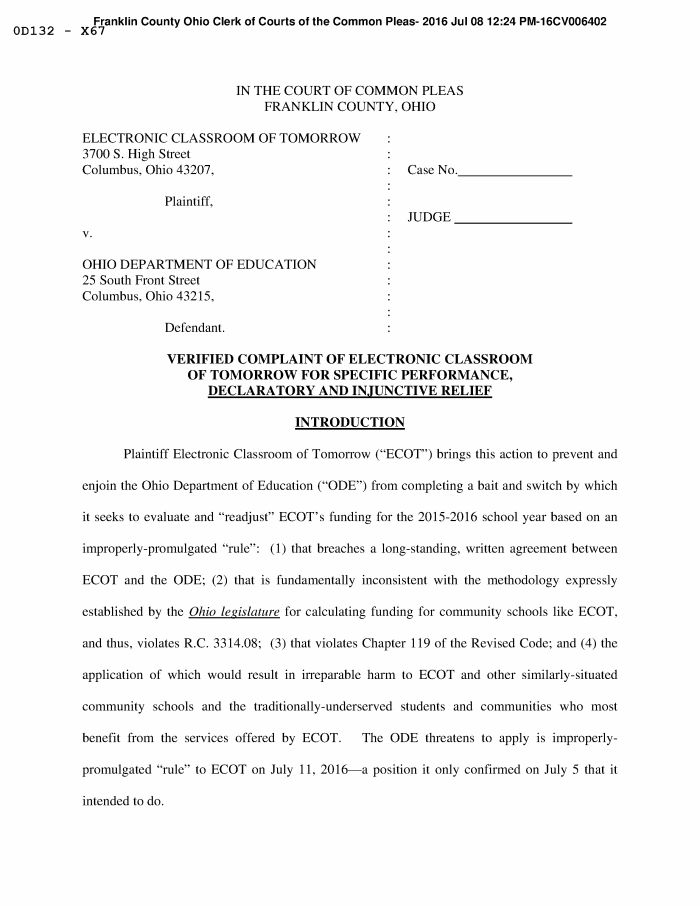
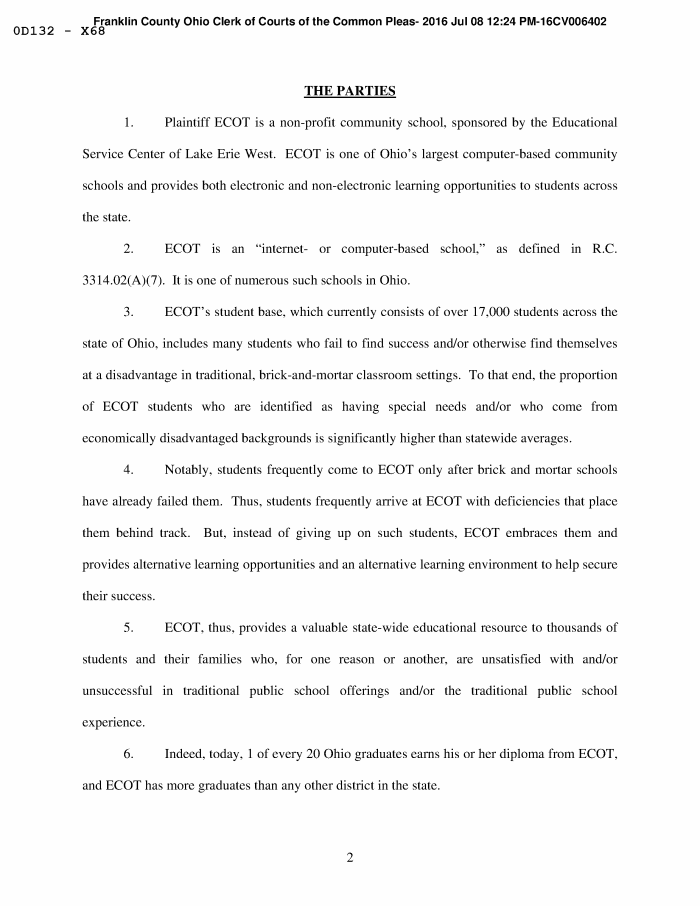
He also told the court of a 2003 agreement between the state and ECOT outlining what documentation the state would look at to determine funding for the school. It does not list any required documents showing time logged on to the school's system or other records of participation.
Little said that contract did not have a time limit and was never officially changed, so expecting more documentation now is unfair.
"We have an enforceable agreement that has not been complied with," he said.
See below for a copy of that contract, attached to an earlier filing by ECOT in the case.
Douglas Cole, the lawyer representing ODE, countered by saying ECOT's position that "participation is irrelevant to receiving $106 million dollars" is absurd.
"Taxpayers deserve to know that their hard-earned dollars are actually going toward an education," Cole said. "Students actually deserve to an education, not merely offered the possibility of one."
Cole also argued that the "contract" with ECOT resolved a dispute at that time but is not binding now. 
We'll have more here soon.
As we have reported previously, the state is seeking proof that students are spending more than one hour a day online, as early reviews showed,
Because the school in the past has not had to provide documentation of the work that its students do, school leaders have said it's unfair to expect the documentation retroactively for the just-finished 2015-16 school year.
If the state makes ECOT show evidence of how much time its students spend learning or else lose some of its state funding, ECOT Superintendent Rich Teeters told supporters this summer that the school's future is in danger.
In the 2014-15 school year, 38,500 students took their classes on computers from home through an online school. Ohio, along with California and Pennsylvania, is one of the top states in the country for the number of kids in online schools, according to the National Alliance for Public Charter Schools (NAPCS).
For the 2015-16 school year, Ohio paid online schools $267 million to educate those students -– more than a quarter of what it paid all charter schools in the state.
ECOT and Ohio Virtual Academy, with 15,000 and 11,000 students, are the largest online schools in Ohio.
The contract in question makes up pages 18-20 of the file below. ECOT online school funding fight reaches court: ECOT says state rules are "unenforceable," state says ECOT is "absurd" | cleveland.com:
THE DEBATE OVER CHARTER SCHOOLS


DOCUMENT
PAGES
TEXT
Zoom


The U.S. Has Started Tracking Religious Discrimination In Schools | Huffington Post

The U.S. Has Started Tracking Religious Discrimination In Schools | Huffington Post:

The U.S. Has Started Tracking Religious Discrimination In Schools

It’s high time.

Image result for Religious Discrimination In Schools

The United States government is taking a big step to curb religious discrimination in schools.
The U.S. Department of Education announced a series of initiatives this summer to address religious discrimination in public schools, including a new website with legal information regarding students’ religious rights.
For the first time ever, the agency’s Office for Civil Rights will require schools to report the number of incidents involving religious-based bullying and harassment using an online data collection platform. The office also updated its online complaint form to clarify to schools the kinds of incidents that will fall into this category.
The department’s move comes at a crucial time, as the country grapples with disconcerting levels of anti-Muslim sentiment. 
There have been roughly 100 hate crimes committed against Muslims in the U.S. since the Paris terror attacks in November 2015, according to the group Muslim Advocates. Georgetown University’s Bridge Initiative found that there were more acts of anti-Muslim violence and vandalism in 2015 than in any year since Sept. 11.
The Huffington Post has also recorded more than 260 acts of anti-Muslim violence, discrimination and political speech in the United States this year. 
In the wake of terror attacks carried out by self-declared Muslims in Paris and San Bernardino, California last year, U.S.-based nonprofit group Crisis Text Line saw amajor uptick in Muslims reaching out for help. The number of users ― many of them teenagers ― who referenced being Muslim and experiencing bullying and harassment increased by 6.6 times shortly after the Paris attacks in November 2015, the group’s director of communications told CNN.
Muslim students and those of other targeted faiths and ethnicities aren’t protected from such harassment at school. In a 2014 survey, the California chapter of the Council on American-Islamic Relationships found that 55 percent of Muslim students surveyed reported experiencing bullying based on their religious identity while at school.
One in five students said they had experienced discrimination by a school staff member.
Many advocates and educators blame political rhetoric in part for what they see as The U.S. Has Started Tracking Religious Discrimination In Schools | Huffington Post:
 Image result for religion in schools

In Perplexing Decision, Connecticut Judge Fails to Raise the Bar for Adequate School Funding | janresseger

In Perplexing Decision, Connecticut Judge Fails to Raise the Bar for Adequate School Funding | janresseger:

In Perplexing Decision, Connecticut Judge Fails to Raise the Bar for Adequate School Funding

Image result for Connecticut Judge Fails Adequate School Funding

Last week, Connecticut Judge Thomas G. Moukawsher found Connecticut’s system of education unconstitutional.  Here is how Elizabeth Harris of the NY Times describes the decision in the eleven year old case, Connecticut Coalition for Justice in Education Funding v. Rell: “Reading his ruling from the bench for more than two hours, Judge Thomas Moukawsher of State Superior Court in Hartford said that ‘Connecticut is defaulting on its constitutional duty’ to give all children an adequate education.  Judge Moukawsher’s decision was a response to a lawsuit filed more than a decade ago that claimed the state was shortchanging the poorest districts when it came to school funding. What separates the decision from those in dozens of similar suits around the country is that rather than addressing money only, it requires the state to rethink nearly every major aspect of its system.”  It is expected that Judge Moukawsher’s decision will be appealed.
In a wishful and foolishly simplistic front-page analysis for the NY Times—an analysis that muses on national issues of education policy and misunderstands the legal implications of the Connecticut decision, Kate Zernike compliments Judge Moukawsher’s wide-ranging condemnation of Connecticut’s entire system of education: “(H)is unsparing 90-page ruling read and resonated like a cry from the heart on the failings of American public education… He criticized ‘uselessly perfect teacher evaluations’ that found ‘virtually every teacher in the state’ proficient or exemplary, while a third of students in many of the poorest communities cannot read even at basic levels… Though his ruling was about Connecticut, he spoke to a larger nationwide truth: After decades of lawsuits about equity and adequacy in education financing, after federal efforts like No Child Left Behind and Race to the Top, after fights over the Common Core standards and high-stakes testing and the tug of war between charter schools and community schools, the stubborn achievement gaps between rich and poor, minority and white students persist.”
While anyone who has been paying attention to decades’ of so-called efforts to reform American public education can certainly sympathize with Zernike’s frustration, Harris quotes William S. Koski, a school finance expert at Stanford University, who notes that Judge Moukawsher did not decide the issue the court was charged to address—inadequate school funding in Connecticut’s poorest school districts: “Most of these school finance lawsuits are In Perplexing Decision, Connecticut Judge Fails to Raise the Bar for Adequate School Funding | janresseger:


Massachusetts Ballot Question 2: The Union Money, and More | deutsch29

Massachusetts Ballot Question 2: The Union Money, and More | deutsch29:

Massachusetts Ballot Question 2: The Union Money, and More


Save Our Public Schools - https://saveourpublicschoolsma.com/


On November 08, 2016, Massachusetts voters will be deciding whether or not to lift the cap on the number of charter schools in the state. The ballot measure, known as Question 2, would open the door for “up to 12 new charter schools or enrollment expansions in existing charter schools each year.”
As of September 09, 2016, several ballot committees have filed funding reports with the Massachusetts Office of campaign and Political Finance (OCPF).
To date, there are five ballot committees associated with Question 2.
Four ballot committees are in support of raising the charter cap. As of September 09, 2016, together they have raised roughly $11 million (accounting for the fact that Yes on 2 turned around and gave its money to Campaign for Fair Access, and Expanding Educational Opportunities gave most of its money to Great Schools Massachusetts):
One committee opposes Question 2:
In sum, the five ballot committees have raised roughly $17.8 million on Massachusetts’ Question 2 as of September 09, 2016. (Note: I accounted for money sent from one committee to another. Had I not accounted for such overlap, the totalwould look like $18.8 million.)
Money Opposing Question 2
Save Our Public Schools, the lone committee opposing Question 2, has received 83 contributions. The largest contributors include the following (with some making multiple contributions):
In-state:
  • Massachusetts Teachers Association: $4,169,622
  • American Federation of Teachers (Boston): $251,823
Out-of-state:
  • National Education Association (Washington, DC): $1,900,000
  • American Federation of Teachers (Washington, DC): $450,000
Also noteworthy in this era of the billionaire purchasing of elections:
  • Largest out-of-state contribution from an individual: $50
  • Most of the money funding Save Our Public Schools (62 percent, or $4,169,622 /$6,777,696) comes from a Massachusetts-based organization
Thus, there are no out-of-state billionaires providing substantial funds to Save Our Massachusetts Ballot Question 2: The Union Money, and More | deutsch29:

California Charter School Scandals Shows the Movement Is a Vehicle for Fraud & Corruption

California Charter School Scandals Shows the Movement Is a Vehicle for Fraud & Corruption:

The Charter School Movement Is a Vehicle for Fraud and Corruption As it is presently constituted.

Image result for big education ape california charter school accountability


  I may have mentioned, we have a red-hot ballot initiative up here in the Commonwealth (God Save It!) in which we are asked whether or not we want to lift the cap on the number of charter schools in the state. The usual suspects and the usual out-of-state money are weighing in heavily on the YES side of things; their ads continually portray charters as merely an extension of the existing public school system even though experience everywhere tells us that the people who are making big bank of education "reform" generally, and on charters in specific, insist that they be allowed to run their businesse…er…schools independently of the school boards that manage the rest of the public system. In other words, all they want from the public school system is money and suckers.

The latest example of this comes to us from California where, as The Washington Post informs us, the charter system is a complete and utter dog's breakfast.
There is a never-ending stream of charter scandals coming from California. For example, a report released recently (by the ACLU SoCal and Public Advocates, a nonprofit law firm and advocacy group) found that more than 20 percent of all California charter schools have enrollment policies that violate state and federal law. A Mercury News investigation published in April revealed how the state's online charter schools run by Virginia-based K12 Inc., the largest for-profit charter operator in the country, have "a dismal record of academic achievement" but has won more than $310 million in state funding over the past dozen years.
Roll that number around in your head, especially if your kids go to a public school where they have to pass the hat for art supplies. That's $310 million in public money for lousy results. If the corporations and oligarchs financing education "reform" want to spend $310 million to run schools, they should spend their own damn money to do so.
California has been the Wild West on this frontier for quite some time now, California Charter School Scandals Shows the Movement Is a Vehicle for Fraud & Corruption:
Image result for big education ape california charter school accountability

The Fight to Bring Transparency to California’s Charter Schools | Alternet

The Fight to Bring Transparency to California’s Charter Schools | Alternet:

The Fight to Bring Transparency to California’s Charter Schools
“Does Jerry Brown want his legacy to be the anti-democratic privatization of our public schools?”


Aimee Roylance was thrilled when her son was accepted into Livermore Valley Charter School in 2010. The traditional public schools in their part of the Bay Area were cash-strapped and struggling, and the K-8 charter school, with a waiting list 300 kids long, was known to be an excellent alternative. Sure enough, her son thrived at Livermore Valley, thanks to its diverse programming and strong leadership of its well-liked principal. Eventually, Roylance enrolled her younger two children at Livermore Valley, too.
“The experience overall was very positive,” she says. But she didn’t know what was going on behind the scenes.
She first heard inklings of financial and management troubles at the school early this year. Curious, she used her real estate background to look up the tax status of the land parcels on which the school sat – and found the charter was months behind in payments. Soon, Roylance and other parents were packing board meetings of the Tri-Valley Learning Corporation, the nonprofit that operates the school, demanding answers that didn’t come. Board members, Roylance claims, refused to address their tax troubles, release budget information or explain how they were using public funds. The board limited public comment at its hearings, changed meeting locations and released only snippets of pertinent financial documents, says Roylance. Livermore Valley didn’t return a request for comment by press time, but the charter school’s troubles have continued to mount: Tri-Valley is now under investigation by the Alameda County District Attorney for fraud, mismanagement of its foreign exchange program and child endangerment.
Roylance believes many of these problems could have been avoided if Livermore Valley and its operator were required to be more transparent. “I don’t think [management] would have been able to take advantage of the system,” she says. “If there was more transparency, the public would have known what was going on. We could have avoided a lot of the trauma we went through.”
Roylance isn’t alone in such beliefs. An alliance of teachers, community activists and state officials is advocating that California’s charter school industry – the largest in the country, with more than 1,200 charter schools statewide—be held to the same accountability standards as traditional public schools. It’s calling for the passage of Assembly Bill 709, which would require charter schools to follow open-records and open-meeting laws, and disclose how they use taxpayer funds, as well as to prohibit charter board members from profiting from their schools. Currently, that bill sits on the desk of Governor Jerry Brown, who launched two charter schools while mayor of Oakland and has a history of opposing new charter regulations. But maybe, hope activists, with scandals and public outcry mounting, California’s charter schools are ready to be held accountable.
When the first charter school law passed in Minnesota in 1991, the idea was that these independently run schools would boast increased inventiveness and accountability, since they’d be run by parents, teachers and community members who’d have the students’ best interests at heart. But as the charter movement The Fight to Bring Transparency to California’s Charter Schools | Alternet:
Governor's charter schools in Oakland reap big donations - latimes - http://articles.latimes.com/2011/aug/08/local/la-me-brown-charities-20110808

Big Education Ape: Governor “Charter School” | tultican - http://bigeducationape.blogspot.com/2016/06/governor-charter-school-tultican.html

Image result for 'Kids Not Profits'

U.S. GAO - School Vouchers: Private School Choice Programs Are Growing

U.S. GAO - School Choice: Private School Choice Programs Are Growing and Can Complicate Providing Certain Federally Funded Services to Eligible Students:

Private School Choice Programs Are Growing and Can Complicate Providing Certain Federally Funded Services to Eligible Students

Image result for private school choice program

Participation in voucher and education savings account (ESA) programs, which fund private school tuition and other educational expenses, has more than doubled in the past 5 years, and available information about the characteristics of participating students varies. From school years 2010-11 through 2014-15, the number of students participating in these private school choice programs—which are regarded as an alternative to public schools—grew from approximately 70,000 to 147,000. During that time period, funds provided for students also increased substantially, from approximately $400 million to $859 million, according to GAO's survey of all voucher programs and ESA programs operating in 2015 and related follow-up. This growth reflects both creation of new programs and expansion of existing ones. GAO's survey also found that student eligibility is often based on their disability status or family income. However, the information programs have about student characteristics varies and cannot be compared across all programs because of differing data collection methods or definitions for characteristics like race and ethnicity, disability status, and income.
Voucher and ESA programs generally placed some requirements on participating private schools, according to GAO's review of program documents, survey responses, and interviews with program officials. For example, in GAO's survey, 18 of 20 voucher programs and one of two operating ESAs reported that teachers must meet minimum education requirements, such as having a bachelor's degree. Similarly, 17 voucher programs and one ESA reported requiring schools to measure student performance, for example, with the same tests required for public school students. Fewer private school choice programs reported that they restrict the admissions criteria schools may use for private school choice students. Private school officials GAO interviewed identified students' disciplinary or academic history as common admissions considerations.
Federal laws and regulations for two key federal education grant programs require public school districts to provide “equitable services,” which may include speech therapy or reading tutors, to eligible private school students, and the Department of Education (Education) provides general guidance on these requirements. However, Education's guidance does not specifically address providing these services to students participating in private school choice programs. Education officials said they had not received any recent inquiries on the subject, but officials in all four states GAO visited—comprising half of all private choice programs and two-thirds of participating students—said that vouchers and ESAs complicate their efforts to implement these requirements. Further, although Education officials said that a student's participation in private school choice programs does not affect the federal equitable services requirements, officials GAO spoke to in two states expressed confusion about whether a student's participation in these programs changed their eligibility for these services. Providing quality information to clarify requirements and responsibilities—including adapting to emerging trends—is a key federal internal control. Providing such information would help clarify how to implement equitable services requirements in the context of growing private school choice programs.

Why GAO Did This Study

Voucher and ESA programs fund students' private school education expenses, such as tuition. In school year 2014-15, 22 such school choice programs were operating nationwide, all but one of which was state funded. Under two federal grant programs, one for students with disabilities and one for students from disadvantaged areas, districts are required to spend a proportionate amount of their federal funds to provide equitable services for eligible private school students, and this population includes eligible students in private school choice programs. GAO was asked to review these topics.
This report examines 1) participation in private school choice programs and the characteristics of students, 2) program requirements for participating private schools, and 3) how Education supports districts' efforts to deliver these federally funded services in the context of school choice programs. GAO reviewed relevant federal laws and regulations, surveyed all voucher and ESA programs as of fall 2015, and interviewed Education officials and other stakeholders. GAO also reviewed documents and interviewed state, public school district, and private school officials in a nongeneralizable sample of 10 private school choice programs in four states, selected to include programs with large enrollment and a range of eligibility criteria.

What GAO Recommends

GAO recommends Education include in its guidance information about providing equitable services in the context of private school choice programs. Education agreed with our recommendation.
For more information, contact Jacqueline M. Nowicki at (617) 788-0580 or nowickij@gao.gov.
U.S. GAO - School Choice: Private School Choice Programs Are Growing and Can Complicate Providing Certain Federally Funded Services to Eligible Students:


Additional Materials:

Students Who Play Do Better in School - The Atlantic

Students Who Play Do Better in School - The Atlantic:

Students Who Play Do Better in School 


Google the definition of play and the first thing that pops up is this: “[To] engage in activity for enjoyment and recreation rather than a serious or practical purpose.”
Jack Shonkoff, the director of the Center on the Developing Child at Harvard University, finds that language supremely frustrating. “It’s not taking a break from learning when we talk about play,” he told me, rattling off a litany of cognitive, physical, mental, and social-emotional benefits. “Play is one of the most important ways in which children learn.”
But in the mid-2000s, the federal No Child Left Behind education law—which emphasized test scores—prompted some schools to scale back recess (along with art and music) to spend more time on math and reading. Other schools eliminated recess because it was the source of a disproportionate number of discipline issues and a headache for administrators. The rollback wasn’t quite as extreme as some of the headlines seemed to indicate (After all, what better way for opponents of the law to push back than to put out the word that recess was on the chopping block?), but it did leave hundreds, even thousands, of kids without time during the school day to play outside. Some studies suggested that as many as 40 percent of school districts across the country reduced or cut recess. Even today, only a handful  of states actually require recess. And many of the students affected by recess cuts were low-income children, disproportionately black and Students Who Play Do Better in School - The Atlantic:


Parent awareness of California school finance accountability law abysmal | USC News

Parent awareness of California school finance accountability law abysmal | USC News:

Parent awareness of California school finance accountability law abysmal

More than half of the people surveyed by the PACE/USC Rossier poll — and nearly half of those with school-age kids — say they are unaware of the state’s Local Control Funding Formula

Image result for Local Control Funding Formula
rents are among the many Californians who say they have not heard or read about the state’s school funding and accountability system that aims to increase public input in school spending decisions, according to the latest results of the annual PACE/USC Rossier School of Education poll.
Fifty-four percent of the registered voters who participated in the statewide poll said they were unaware of the Local Control Funding Formula. That is a slight improvement since 2015 when 65 percent of poll respondents had not heard about the law, but somewhat worse than 2014 when only 45 percent had not heard about it.
Enacted in 2013, the funding formula replaced a 40-year-old system that relied primarily on categorical funding for schools. It also gave new flexibility and a weighted student funding formula allocating additional tax dollars for high-needs students. It requires districts to engage their communities in spending decisions.
Thirty-five percent of the poll participants this year were parents with children under 18, most of them enrolled in public schools. Although those respondents seem to have the most at stake in school matters, nearly half (45 percent) said they had never heard or read about the law.
“The lack of awareness among Californians continues to raise serious questions about the implementation of one of the key tenets of the Local Control Funding Formula – meaningful stakeholder engagement in the development of district goals and decisions around resource allocation,” said Julie Marsh, a co-director of the nonpartisan Policy Analysis for California Education (PACE), researcher for the poll and an associate professor of education at USC Rossier School of Education.
She added: ”Without awareness, it will be hard to encourage participation, and without participation, how can districts ensure that all voices are heard? Low numbers of aware and watchful citizens also compromises accountability for achieving the policy’s equity goals.”
Among those who are aware of the law, support is high – 63 percent (versus 24 percent opposed) – and is strongest among Democrats (74 percent) and among young voters aged 18 to 29 (74 percent).
“It’s good to see that voters support the goals of the Local Control Funding Formula,” said Karen Symms Gallagher, dean of the USC Rossier School of Education. “We’re already seeing a real, positive change from this policy, and school leaders need to make sure that their local communities know that as well.”
The school finance law allocated more money to districts that have more English-language learners, low-income students, foster children and homeless children and provided districts with greater flexibility over spending. When respondents were informed of this, 71 percent said they favored the policy, as did 71 percent who were parents with children in school and 76 percent of parents without school-aged children.
The state funding formula system was designed to encourage more community member involvement in district resource decisions. However, 88 percent of the respondents said they were unaware of public meetings or events where they could help set goals, provide input into spending, review their school’s progress and/or develop its Local Control and Accountability Plan.
Districts are required to involve the public in making and reviewing those plans, which guide them in fulfilling state priorities, such as improving college readiness and student performance. The plans aim to increase engagement with students, their families and communities, and create a healthy learning environment.

Getting involved

More than 60 percent of voters said they want to be involved in decision-making at their local school, such as helping their local public school set goals and in reviewing the school’s progress, and helping to decide how best to allocate resources to advance their school’s goals. They were equally interested in assisting their local school district in these ways.
However, very few voters – just 5 percent – have done so. Attendance was only slightly higher among parents (9 percent) and parents with children in school (11 percent) who said they participated in any meetings related to the policy.
Voters with no interest in participating in school or district decision-making gave a few reasons: chiefly that they have no children in school, followed by a lack of information and experience about school issues and no time to Parent awareness of California school finance accountability law abysmal | USC News:


Turkey submits formal request for US to detain Fethullah Gulen - FT.com

Turkey submits formal request for US to detain Fethullah Gulen - FT.com:

Turkey submits formal request for US to detain Fethullah Gulen


Turkey asked Washington to detain Fethullah Gulen, a US-based cleric it blames for a failed coup in July, marking the first step in a legal battle to extradite Mr Gulen.
The provisional arrest warrant was requested by Turkey’s Justice Ministry, said Anadolu, a semi-official news wire, citing unidentified sources. A Justice Ministry official declined to comment, citing the sensitivity of the issue. Turkey has said it has credible evidence linking Mr Gulen and his followers to the putsch, which killed nearly 250 people. Mr Gulen denies any role in the coup.
Mr Gulen’s extradition from a farm in Pennsylvania, where he has lived in self-imposed exile since the late 1990s, has become the core issue in the relationship between the two Nato allies, with Turkish President Recep Tayyip Erdogan bristling at the US’s demand for more evidence.
Talks over Mr Gulen’s status overshadowed a recent G20 meeting between Mr Erdogan and US President Barack Obama, even as the US and Turkey continued to co-operate on a military push into northern Syria.

Turkey: Gulenist crackdown
MUGLA, TURKEY - JULY 24: Police conduct a road check to capture the wanted plotter soldiers who involved in an assassination attempt against Turkish President Recep Tayyip Erdogan in Marmaris District after the Parallel State/Gulenist Terrorist Organization's 15th of July's failed military coup attempt, on July 24, 2016 in Marmaris District of Mugla, Turkey. Parallel State is a terrorist organization leaded by U.S.-based cleric Fetullah Gulen, who is accused of a long-running campaign to overthrow the state through infiltrating into Turkish institutions, particularly the military, police and judiciary, forming a parallel state. (Photo by Orhan Cicek/Anadolu Agency/Getty Images)
Even those who claim to have suffered discrimination by the movement fear its suppression is going too far after the attempted coup
The US has sent extradition experts to Turkey to guide the process, and has “more lawyers working on this case than any other extradition in recent history”, said Vice-president Joseph Biden during his visit to Turkey late last month. “I know of no other case where as much time is being spent to make sure we find enough data to meet a court standing.”
The request for the warrant, though, is the first time Turkey has made any formal attempts to have Mr Gulen extradited in spite of a very public falling-out between him and Mr Erdogan, who once counted Mr Gulen among his allies.
In late 2013 Mr Erdogan blamed followers of Mr Gulen for manufacturing evidence that showed him and his closest advisers involved in large-scale corruption. Instead of seeking his extradition, Mr Erdogan launched a purge of police and judicial official, replacing judges, prosecutors and police investigators.
Turkish government officials allege that Mr Gulen’s followers went on to deepen their infiltration of the military, making the July 15 coup attempt possible. The failure of that coup has resulted in a purge that has claimed upwards of 100,000 jobs in the military, media, schools, universities and police, while several thousand are either still being detained or arrested.Turkey submits formal request for US to detain Fethullah Gulen - FT.com:


Monday, September 12, 2016

The Racism of School Closures

The Racism of School Closures:

The Racism of School Closures


As parents, students and teachers celebrate the start of a new school year, many communities across the country are facing the pain of having their schools permanently closed.
Politicians and policy leaders—Democrats and Republicans alike—support dealing with schools that show poor results on standardized tests by shutting them down.
School closings happen all the time, and the number of students affected is increasing at an alarming rate.
The total number of public schools in the country, which steadily increased throughout the 1980s, 90s, and early 2000s, has been drifting downward since 2007, despite an expandingstudent population. According to data compiled by the National Center for Education Statistics, the number of students affected by school closures increased from less than 1,000 in 1994 to more than 1,800 in 2011.
Why are all these schools closing?
An Urban, Racial Problem
School closures are most common in urban school districts. As education correspondent Rachel Cohen recently wrote for the American Prospect,
“In urban districts across the United States – from Detroit to Newark to Oakland – communities are experiencing waves of controversial school closures as cash-strapped districts reckon with pinched budgets and changing politics.”
Part of what’s driving closures in these communities, Cohen reports, is the lack of financial resources to address decaying infrastructure. Many urban school buildings were built more than fifty years ago and need extensive repairs or upgrades to accommodate new technology and building requirements. “But the federal government offers virtually no economic assistance to states and local districts trying to shoulder the costs of building repairs,” Cohen explains. States have been withholding funds from these schools since the nation’s economy slid into recession in 2008.
But aging school buildings aren’t the only reason schools are closing. A 2014 report from the civil right groups Journey for Justice Alliance found that incidents of school closures correlated strongly with race. The report declares:”America’s predominantly black and Latino The Racism of School Closures: