Latest News and Comment from Education

Thursday, August 11, 2016

Create A+ Days That Last all Year! A Back-to-School Guide

Create A+ Days That Last all Year! A Back-to-School Guide:

Create A+ Days That Last all Year! A Back-to-School Guide

back to school

It’s that one glorious time of year when new and veteran teachers, administrators and education support professionals (ESPs) are drawn together by that much-anticipated milepost: the first day of school.
In this back-to-school guide, we offer ideas for first-year and veteran educators. You’ll find tips for conducting class, managing your classroom, and making fresh-faced students feel comfortable. Educators will also share grassroots organizing suggestions on how to advocate for your students and school. Make it an epic year!
LaurieJonesLaurie Jones, speech communications/literacy coach, Mission Oak High School, Tulare, California
‘Something’ to Break the Ice
We have six feeder schools to our high school. Many of our kids don’t know one another on Day One and tend to clique with their eighth-grade buddies. To mix up this grouping in the classroom, I buy two decks of cards. The first deck I split up and tape to each desk. The second deck gets passed out randomly at the door. Students find their seat when they find their match. We then move into the “something” interview. I hand out a paper that says, “Five Things: Something everyone knows about me, something most people know about me, something some people know about me, something a few people know about me, and something no one knows about me.” I split the kids in half and number them off. They find their matching number and interview that person using the five prompts. After the interview, they introduce that person to the class. This breaks down barriers, gets the kids thinking about how people perceive them, and gives many of us the few laughs we need to break the tension of the first day!
Welcome New Teachers and ESPs
As a literacy coach for our school, I mentor all new English teachers. Though most conversations revolve around classroom management and pedagogy, I always encourage [educators] to attend our CTA (California Teachers Association) luncheons and meetings. As new educators, CTA can be their voice. When discussing CTA, I like to hear about their love and support of the teaching profession. I then tie that passion in with CTA’s mission. I do the same with ESPs, who are equally committed to the education and safety of our students. We have an interesting job . . . surrounded by youth, a parent’s most precious commodity. For the sake of the students, we need to make sure clarity can be found when there are disputes between district administrators and school staff.
kelli_whisenhurtKelli Whisenhunt, Gifted/Talented Specialist Teacher, Ginnings Elementary School, Denton, Texas
1,2,3 . . . Grades are Done!
Connecting with my students and calling them by name on the first day is essential. It makes me feel like I am off to a good start. Learning names can come naturally, but it can help to place name tags on their desks. Then, there is my student number system. It is a lifesaver. Students receive a number corresponding to their place in the alphabet. From day one, students know their number and use it to line up. The number also corresponds to their place in the grade book. As students hand in papers, I call out their numbers.
Eventually, they just know when to come up and hand them in because they are so used to the number system. Once I have the papers in order, they are easy to record in the grade book. I just flip through, and the work of recording the grades is done. Of course, the number system is for managerial purposes. Bulletin board displays at Create A+ Days That Last all Year! A Back-to-School Guide:
Big Education Ape: BACK TO SCHOOL: A parent’s guide to K-12 school success - http://bigeducationape.blogspot.com/2016/08/back-to-school-parents-guide-to-k-12.html

How Is Testing Like Goldilocks and the Three Bears? | Diane Ravitch's blog

How Is Testing Like Goldilocks and the Three Bears? | Diane Ravitch's blog:

How Is Testing Like Goldilocks and the Three Bears? 


Three years ago, I wrote about a heroic educator in upstate New York who wrote bluntly about the current obsession with testing, ranking all students based on their test scores. Her name is Teresa Thayer Snyder. I called her a hero educator. She was at that time the superintendent of Voorheesville, New York, a small and high-performing district. She spoke out against the rigging of test scores on the new Common Core tests, which caused scores across the state to collapse. Because of her courage and integrity, I named her to the blog’s honor roll.
Now Superintendent Snyder is leading another district, Green Island Union Free District, and she has spoken out again about the stupidity of annual standardized testing, which tells us nothing that we don’t already know.
She writes:
NY State Tests and The Three Bears
I am certain every reader remembers the story of Goldilocks breaking and entering into the cottage of The Three Bears. After wreaking havoc on their household, seeking a chair, a bed, and a bowl of porridge that was “just right” she dozed off in baby bear’s bed until she was awakened by the three bears’ return, at which time she ran off into the forest and was never seen by the bears again.
Such it is with New York State testing for children in grades 3 through 8. In the desperate attempt to find a test that is “just right” the State (and other States) has experimented for the past several years. Sadly, in the pursuit of “just right,” thousands of children have been subjected to assessments that were anything but. The results are in again, and while the powers that be are claiming gains in proficiency, analysts are suggesting that the gains are the result of lowering the bar that signifies achievement. Whatever—the point that should not be missed is that the raising or the lowering of the bar is entirely unrelated to the experience of children in the tested grades.
The test results again show that children in wealthy schools are more proficient than children in poverty; that children in regular education are more proficient than children who are differently abled; that children whose first language is the same as the test writers are more proficient than children for whom that language is a new language. These outcomes are so stable over time that one wonders why we need an expensive and extensive testing program to reveal these results. Indeed, standardized tests have been telling this story since their inception over a century ago.


What standardized tests have also been telling us for all these years is that there is very little correlation, if any, between outcomes on these tests and success in life. Recently, I was with a group of young women, all 30-something young adults. In the course of the conversation, standardized testing came up (I swear it was not I who brought it up!!). A litany of anxiety poured forth. Person after person articulated how much they hated those days of testing they had experienced in their k-12 education. One after another made statements such as “they made me feel stupid;” “I was always so disappointed as I worked so hard.” I finally How Is Testing Like Goldilocks and the Three Bears? | Diane Ravitch's blog:

Debating charter schools: Julian Vasquez Heilig vs. Howard Fuller – Cloaking Inequity

Debating charter schools: Julian Vasquez Heilig vs. Howard Fuller – Cloaking Inequity:

Debating charter schools: Julian Vasquez Heilig vs. Howard Fuller


It’s rare that the media brings a balancing perspective to education reformers arguments for anti-democratic, top-down, private control and privatization of our public schools.
This week it happened.
I debated charters schools with Howard Fuller, Professor and Chairman of the Black Alliance for Educational Options, on Andre Perry’s WBOK 1230 AM #FREECOLLEGE show.
We also discuss the NAACP and Black Lives Matter education platforms.
For more on what’s going wrong with charters click here.
Please Facebook Like, Tweet, etc below and/or reblog to share this discussion with others.
Want to know about Cloaking Inequity’s freshly pressed conversations about educational policy? Click the “Follow blog by email” button on this page.
Twitter: @ProfessorJVH

Schools that accept ‘no excuses’ from students are not helping them - The Washington Post

Schools that accept ‘no excuses’ from students are not helping them - The Washington Post:

Schools that accept ‘no excuses’ from students are not helping them

I should know; I taught in one.

Get 20% Off w/code: RLEGEN16

When I taught at a charter school, I once gave out 37 demerits in a 50-minute period. This was the sort of achievement that earned a new teacher praise in faculty-wide emails at Achievement First Amistad High School, in New Haven, Conn.
Amistad is a No Excuses school, in the mold of high-profile charter networks such as KIPP and Success Academy. The programs are founded on the notion that there can be “no excuses” for the achievement gap between poor minorities and their more affluent, white counterparts. To bridge that gap, they set high expectations and strict behavioral codes. School days are long. Not a moment is to be wasted. Classes even rehearse passing out papers quickly so they can save every second for drilling academic content. Instruction is streamlined with methods that data says lead to strong performances on standardized tests, which lead to college acceptances.
In May, Amistad’s students decided they’d had enough of compliance. One morning, they refused to attend classes and instead marched to protest the school’s racism and draconian discipline system. In a way, they were taking after their school’s namesake: Nearly 200 years ago, the Amistad was a slave ship whose cargo rebelled, then demanded education as well as freedom.
Amistad’s students were mostly protesting the fact that their school doesn’t have more minority teachers: Achievement First says 17 percent of its faculty members at its five New Haven schools are black or Latino, which is roughly what I saw at Amistad. But the problem goes far beyond the racial composition of the faculty. More important, the students would benefit from teachers who treated them as equals in dignity and the pursuit of knowledge and wisdom.
The Achievement First network, like many No Excuses schools, hammers its students from their first days with the notion that each of them will graduate from college. To do so, they must work hard. At school, students encounter careful uniform checks and communal chanting of motivational slogans. And because students will face professional standards in college and the workplace, No Excuses schools insist that they start young. Posture and eye contact are important, even for 16-year-olds. Class is not to proceed without total compliance.
By some measures, the methods work. At Amistad, for example, 100 percent of graduates are accepted to college, many to very selective ones. And yet such charter schools have often been criticized as excessively harsh. A New York Times story last year described Success Academy students peeing their pants because they were not permitted to go to the bathroom during practice tests. That harshness looks worse when it is carried out mostly by white teachers against students who are overwhelmingly black and Hispanic.
On my first day teaching 10th-grade English, I broke with No Excuses protocol. I wanted my students to fall in love with ideas; I wanted them — not me, and certainly not some figure behind a desk at Achievement First headquarters — to control their own confrontation with difficult concepts. So I had them rearrange their desks into a circle and gave them a short but baffling text by Jorge Luis Borges. The kids struggled. More than a few of them broke the behavioral code (slouching, talking to classmates, shouting out their reactions to the reading or m my queries). But they worked hard and asked questions. At the end of the class, one student thanked me: “I’ve never thought about such big ideas before,” she said.
From that day, the school’s administration, which learned about the violation, had my number. An administrator watched my class every day. If I didn’t fully enforce the school’s code — under which demerits must be issued for slouching, looking at the wrong person or even taking notes when not explicitly directed to — the administrator would correct me on the spot.
Soon, questions were forbidden. In an email to the faculty, the school’s principal explained that the 10th grade was not doing well. Evidence included the fact that students were hugging each other in the halls. As a solution, the principal presented a rule: “There Are No Questions.” He explained: “Every time you engage with a question, you effectively A) go off your carefully planned lesson pacing, B) put one student over the rest of the class and C) kill momentum.”
Amanda Pinto, the school’s communications director, told me last month that, at Amistad, “kids are asking questions all the time.” She noted that banning “unsolicited questions full Schools that accept ‘no excuses’ from students are not helping them - The Washington Post:

Parent trap: Parent volunteer policies at two local charter schools violate California law, says ACLU

New Times SLO - Publishing Local News and Entertainment for over 29 years in San Luis Obispo County, CA

Parent trap: Parent volunteer policies at two local charter schools violate California law, says ACLU

A report by the Southern California ACLU raised concerns over parent volunteer policies at some of the state’s charter schools, including two in SLO County. - PHOTO BY CHRIS MCGUINNESS
SCHOOL’S OUT
A report by the Southern California ACLU raised concerns over parent volunteer policies at some of the state’s charter schools, including two in SLO County.
PHOTO BY CHRIS MCGUINNESS


It’s long been common knowledge that children do better in school when their parents take an active role in their education, but some SLO County charter schools may be taking that concept too far.
An Aug. 4 report from the Southern California branch of the ACLU (American Civil Liberties Union) alleges that some of California’s charter schools have illegal policies that force parents to volunteer their time, denying students whose parents can’t meet those requirements equal access to an education as guaranteed in the state’s constitution.
According to the report, titled “Un-Equal Access,” both the Bellevue-Santa Fe Charter School in San Luis Obispo and theAlmond Acres Charter Academy in San Miguel currently have such policies on the books. 
While charter schools can encourage parent volunteering, the report indicated that many have policies that either openly mandate or strongly infer that volunteering is required, and the policies neglect to specifically state that parent/guardian volunteering is not mandatory for a child to be enrolled in or attend the school.
“Familial support and engagement are important ingredients of student success. … However, charter schools that require parent/guardian involvement cross the line between encouraging healthy participation and excluding certain student groups,” the report stated.
Bellevue-Santa Fe’s written policy states that the school “encourages” parents to work a minimum of six hours a month at the school. While the number is just a suggestion, a section on “volunteer opportunities” noted, “Violations of this policy may result in intervention by an administrator.”
Bellevue-Santa Fe administration did not respond to a request for comment from New Times.
Almond Acres Charter Academy’s policy is more explicit and states that parents and guardians are “expected to participate in the operation of the school.” The policy also notes that its “family participation responsibilities” include a specific commitment of six hours per month for one enrolled child, and 10 hours per month for two or more enrolled children. 
Almond Acres administration did not respond to requests for comment on its policy. 
Under California law, charter schools are independent public schools that can be organized and founded by parents, teachers, or community organizations. While they are privately controlled and can get non-governmental funding, charter schools also receive tax dollars like any other public school, which means that they must abide by state law, admit all students who wish to attend, and are barred from enacting admission policies or requirements that restrict or create a barrier to a child’s right to enroll.
Rigel Spencer Massaro, an attorney with Public Advocates, a Sacramento-based nonprofit law firm that partnered with the ACLU to create the report, said parent volunteer policies like those at Almond Acres and Bellevue-Santa Fe restrict equal access because they could exclude or dissuade parents and guardians who couldn’t meet the required hours. 
“We know that low-income parents are often working two or three jobs,” Massaro said. “The little spare time they have is used to directly care for their families. It could discourage a family from applying altogether.”
The report noted that such policies could also negatively impact students in foster care, group homes, students raised by elderly relatives, and students whose parents have intensive work and child-care obligations. 
This isn’t the first time the two charter schools have been called out for their parent volunteer policies. In 2014, Public Advocates released a report on so-called “forced parent work” policies in the state’s charter schools. Both Bellevue-Santa Fe and Almond Acres were among 166 California charters schools with parent volunteer policies the organization believed were illegal. The report prompted the California Board of Education to issue a formal statewide advisory, clarifying that the state law prohibited schools from requiring volunteer hours or payment in lieu of those hours as a condition of admission, enrollment, or participation in a school.
Both reports called on charter schools to change those policies and encouraged parents to file complaints with the school’s “authorizers” if they did not. Authorizers for charter schools are usually the public school districts where a charter is located. Those districts are charged with providing oversight and accountability.
The San Luis Coastal Unified School District, the authorizer for the Bellevue-Santa Fe Charter School, did not respond to requests for comment from New Times. San Miguel Joint Union School District is the authorizer for Almond Acres Charter Academy. Superintendent Curt Dubost said that concerns about the charter’s parent volunteer policy were brought to the district’s attention in the past, and Almond Acres made “all the necessary changes” to its literature on the policy at the direction of the district. 
“We were aware of the concern, and it’s my impression that it’s been addressed to make sure we are in full compliance with the law,” Dubost said. “And if that isn’t the case, we will address it to make the necessary changes.”
The two SLO County charter schools are part of 253 charter schools that the report cited for parent volunteer or other policies that the ACLU report claims are exclusionary and violate the law. That number accounts for roughly 20 percent of all charter schools in the state. Massaro said that how closely they are monitored depends mostly on the ability, resources, and motivation of authorizers like the San Luis Coastal and San Miguel school districts.
“Unfortunately it’s sort of the Wild West out there when it comes to accountability for charter schools,” she said. New Times SLO - Publishing Local News and Entertainment for over 29 years in San Luis Obispo County, CA


What's Driving the Opt-Out Movement? | Teachers College Columbia University

What's Driving the Opt-Out Movement? | Teachers College Columbia University:

What's Driving the Opt-Out Movement? 

The belief that high-stakes testing promotes rote learning and is unfair to teachers, a TC survey finds

Report Cover
Download report: “Who Opts Out and Why?


 Teachers College unveiled the findings of Who Opts Out and Why?the first national, independent survey of the “opt-out” movement—which reveals that supporters oppose the use of test scores to evaluate teachers and believe that high-stakes tests force teachers to “teach to the test” rather than employ strategies that promote deeper learning. The new survey also reports concern among supporters about the growing role of corporations and privatization of schools.

Oren Pizmony-Levy
Oren Pizmony-Levy, Assistant Professor of International & Comparative Education
“For activists, the concerns are about more than the tests,” saidOren Pizmony-Levy, TC Assistant Professor of International and Comparative Education, who co-authored the study withNancy Green Saraisky, Research Associate and TC alumna. “We were surprised that the survey reveals a broader concern about corporate education reform relying on standardized test-based accountability, and the increased role of ‘edu-businesses’ and corporations in schools.”
Who Opts Out and Why? also reveals that opt-out proponents oppose high-stakes, standardized testing because they believe it takes away too much instructional time.  
The survey follows recent reports that the opt-out movement in New York has neither grown nor faded. In its July 29 report on 2016 standardized test scores, New York State disclosed that about 21 percent, or an estimated 250,000 of the approximately 1.1 million eligible public school students across the state, declined to take the tests. These figures do not significantly differ from the previous year, when New York State led the nation in combined math and English Language Arts test refusals.
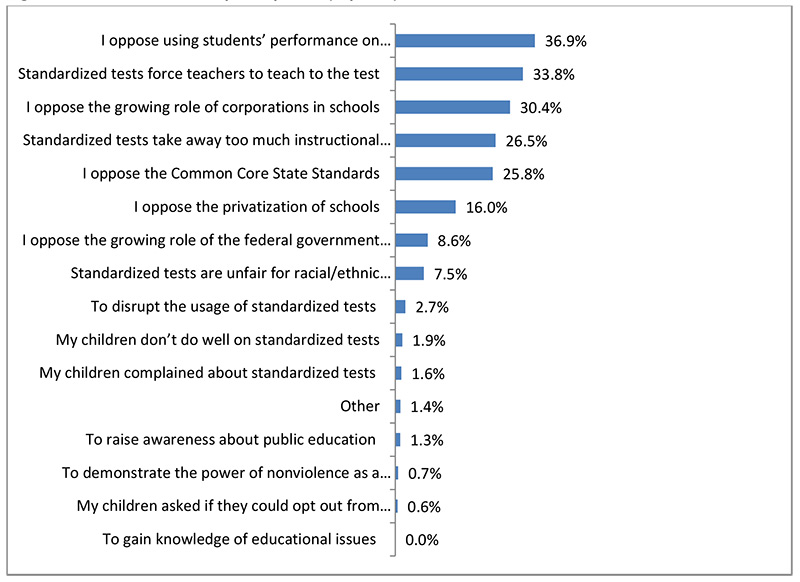
Among the national survey’s 65 questions, respondents were asked to pick the two top reasons why they participated in opt-out activities. The answers revealed that:
  • 36.9 percent said they oppose using students’ performance on standardized tests to evaluate teachers;
  • 33.8 percent said they believe standardized tests force teachers to “teach to the test” by using drilling and worksheets to promote memorization of test answers rather than more complex, inquiry-based learning strategies;
  • 30.4 percent said they oppose the growing role of corporations in schools;
  • 26.5 percent said they believe standardized tests take away too much instructional time;
  • 25.8 percent said they oppose the Common Core State Standards (CCSS); and
  • 16 percent said they oppose the privatization of schools, a concern that is closely tied to fears about the growing role of corporations in public schools.
Nancy Green Saraisky (Ph.D. '15)
Nancy Green Saraisky (Ph.D. '15), Assistant Adjunct Professor
“The survey’s quantitative and qualitative data, which include detailed written answers by respondents, give the first comprehensive and nuanced insights into the often complex attitudes and motivations of opt-out participants and sympathizers,” said Green Saraisky. “The written responses especially reveal that the opt-out movement is offering a broad critique of current education reform that focuses on accountability based on standardized testing.”
Figure 4-14
Motivations for participation (top two). Click here to zoom.
Pizmony-Levy and Green Saraisky designed and electronically administered Who Opts Out and Why?through links on the webpages and social media channels of opt-out groups. From 1,641 responses gathered from 47 states, from January through March 2016, the survey also gives a more detailed picture of who the movement’s supporters are and their background.
It shows that opt-out proponents reject not only the popular narrative that public education in America is failing, but also the notion that, even if it were, more standardized testing would fix it. “People in the opt-out movement are not saying the whole system is broken,” said Green Saraisky. “They’re not anti-testing; they’re anti-standardized testing.”
Respondents believe that opting out “is about political challenge to current educational reform,” Pizmony-Levy said. “Policy makers need to take opt-out supporters seriously and pay attention to what motivates them and what ideas they bring to the table.”
The complete Who Opts Out and Why? survey and results can be downloaded here.

War Of Words Heats Up Between Chicago Public Schools And Teachers Union: Chicagoist

War Of Words Heats Up Between Chicago Public Schools And Teachers Union: Chicagoist:

War Of Words Heats Up Between Chicago Public Schools And Teachers Union

KarenLewisJesseSharkeyCTUPresser3_23_16.jpg
CTU President Karen Lewis and Vice President Jesse Sharkey at a press conference on March 23, 2016. (Photo by Aaron Cynic/Chicagoist)
Both the Chicago Teachers Union and Chicago Public Schools officials are ratcheting up their rhetoric after CPS released its proposed budget Monday.
In a Tuesday meeting with the Tribune’s Editorial Board, Chicago Public Schools CEO Forrest Claypool said that teachers would have to accept the contract they rejected earlier this year or classrooms would face cuts.
"The alternative is cuts to the classroom,” Claypool told the Editorial Board. "We don't believe it's the right thing to do, and we're hopeful that upon reflection the teachers union will understand that's not the right thing to do either."
The district’s proposed $5.4 billion budget already contains more than $200 million in cuts. It also relies heavily on the State of Illinois coming through on its promise to cover some pension costs, and the CTU accepting a contract it already rejected.
The union rejected a contract in January because the district wanted to eliminate its 7 percent pension pickup. But the district’s proposed budget assumes that teachers will walk back the rejection and take the offer. Lewis however, has said otherwise.
"If the Board of Education imposes a 7 percent slash in our salaries, we will move to strike,” she said at a Monday press conference.
Claypool has said that the only entity involved in the district’s fiscal woes has been the union. He’s argued that the state has agreed to put up money, that CPS has made additional cuts and that the City of Chicago is plunking down extra tax revenue.
"That leaves only the teachers' union as the obstacle to, you know, protecting our classrooms,” Claypool said.
On Monday though, Lewis said that teachers were already giving all they could:
“And, though educators have already returned about $2 billion in salary and benefits to the district, with $100 million being returned this year alone, we are being asked to give more when there is nothing left to give. Understand that budget cuts impact students; they include cuts to programming, staffing and services.”
CTU Vice President Jesse Sharkey said that putting the blame on teachers was “hypocritical and unacceptable.”
"I think if he wants to take a look at who's been doing the cutting and who's responsible for the cutting, he should look in the mirror," said Sharkey.
The potential of another strike means that both sides will continue to heat up the war of words between them. But while officials are trying to force all of the blame on the teachers, the oft used “CPS is broke on purpose” retort from the union has merit. The Sun-Times reports that some central office departments are seeing increases in both their budgets and staff, and it appears that some new departments have been created.
And while the revenue from Emanuel’s massive property tax hike is certainly needed, that seems to be one of the only revenue streams either he or the district have been willing to entertain. While Claypool says “there is no pot of gold,” he seems to be leaving out that there is at least somemoney available if the city were to implement any number of progressive tax solutions that have been floating around for years, along with the city’s TIF slush fund.
While many of those ideas have been written off at one time or another, usually because they hit the wealthiest (who happen to be a big donor base) hardest, they’re worth seriously considering. Eventually, there might not be anything left to cut. War Of Words Heats Up Between Chicago Public Schools And Teachers Union: Chicagoist:


Call Common Core train back to station - Connecticut Post

Call Common Core train back to station - Connecticut Post:

Call Common Core train back to station


Several years ago I had a long telephone conversation with Allan Taylor, chair of the Connecticut State Board of Education, about my issues with the Common Core State Standards (CCSS) and Smarter Balanced Assessment Consortium (SBAC). At the end of the conversation, Mr. Taylor said, “The train is out of the station.”
I asked when “the train” would be evaluated; he replied, “When the test scores are in.”
The test scores are in, and the news is not good: the train is pulling some very inadequate policies and practices into our schools. Since implementation of the CCSS in 2010, the National Assessment of Educational Progress (NAEP) has gone down markedly for the first time since 1990, especially for students of color.
Kentucky, the first state to implement the CCSS, is scoring lower than ever, and that state’s students of color have been particularly poorly served.
The CCSS were hastily written, not by educators, but by a small group of entrepreneurs. Bill Gates, who funded the CCSS, has recently conceded that he should have listened to teachers. The developmentally inappropriate CCSS-based tests, SBAC and PARCC, lack validity and reliability.
The Connecticut Education Association (CEA) has called for the removal of SBAC, citing its harm to children. More than one hundred researchers have asked for a moratorium on the CCSS and SBAC; seven states have pulled out. Connecticut remains in the consortium. For the sake of our children, Connecticut should get out, too.
My concerns about the CCSS and SBAC have remained the same for six years:
• The focus is on only math and literacy, to the exclusion of science, social studies, the arts, and physical education.
• No early childhood educators helped to develop the CCSS, and the resulting tests show it. They make failures of young children who can’t pass developmentally inappropriate tests.
• There are mandated percentages of content students must read—70 percent informational by high school, and 50 percent informational, 50 percent fiction in the elementary years. In mandating these percentages and taking the focus off literature, we are flying in the face of our own success. China is trying to emulate our broad range of fictional reading for children at the very moment we are reducing it. Neil Gaiman reports that China sent representatives to Silicon Valley to learn the key to Call Common Core train back to station - Connecticut Post:

Common Core Curriculum and California | Temple City Tribune

Common Core Curriculum and California | Temple City Tribune:

Common Core Curriculum and California


 It is hard to remember any issue that has sparked such a debate in education as the Common Core Curriculum. California finds itself in the minority by supporting the recent national roll out. According to the California Teachers Association, 88 percent of the membership backs the program. The national number, supplied by Education Next, is far different at 50 percent.

Many parents are confused over the necessity of the Common Core Curriculum and feel they have had little if any involvement in the process. The concern is that the Common Core standards will bring down the system. It is believed courses will be taught for testing success at the lowest level. The Common Core State Standards Initiative answered this and other concerns explaining:
“Since this work began, there has been an explicit agreement that no state would lower its standards. The standards were informed by the best in the country, the highest international standards, and evidence and expertise about educational outcomes.” This and other concerns are addressed online at: www.corestandards.org/about-the-standards/myths-vs-facts.
The original California budget for discretionary spending on the program was an astronomical $2.4 billion, awarded over the last two years. The 2016-2017 plan seeks an additional $1.2 billion. Many are concerned with the limited number of restrictions on its use – the money will be quickly lost in the bureaucracy, with no real accountability, despite the program’s massive documentation. The math requirement is covered in 162 pages and English in 98.
The documents present very distinct goals at each grade level. In grade 1 math, for example, guidelines call for basic addition and subtraction, ability to tell time, and basic understanding of shapes. In grade 1 language arts, for example, standards require the ability to re-tell the story, understand illustrations, and who is telling the story.
The state has supplied practice tests to prepare students at each grade level. The English exam reflects in many ways the “old school” method as demonstrated by the test samples. The math portion has created the most controversy by recreating the process. It is best to refer to the attachment for a better understanding: www.testprepreview.com/common-core-test-prep.htm.
The question now becomes, is this tremendous amount of money reflected in improved student results? Quite simply the answer is “no,” according to Ed Surge.Com. Test scores show California students in grades 3 to 8 and 11, fall below the national level. Only 44 percent of California’s 3.2 million test takers met or exceeded the English language arts portion. With math, the number within the meet/exceeds category dropped to 34 percent.
As with a majority of testing, socioeconomics played a large role in the success rate of the student. White and Asian students fared much better than Hispanics and Blacks.
“There are some notable disparities in how different groups performed: 65 percent of English language learners, 46 percent of African-American students, 41 percent of Native American students, and 39 percent of Hispanic students scored in the lowest grade category (‘Standard Not Met’), versus 12 percent for Asian students and 18 percent for white students. The gap is even more pronounced for the mathematics portion of the test. And students in non-economically disadvantaged households were more than twice more likely to meet or exceed proficiency standards than their less fortunate peers.” To view full test results, search “Common Core Test Results” at www.edsurge.com.
In 2015, California ranked 31 nationally, as far as graduation rates are concerned (www.scpr.org/news/2015/03/17/50397/mixed-news-for-california-in-national-high-school). The score does not speak well especially for the disadvantaged. Whether the Common Core Curriculum is the answer to insure California improves its educational standards is yet to be determined. One measurement of its success can be found in the increased interest parents now have in the education process and courses. The key is to keep parental involvement in the forefront, working with educators to ensure California regains its footing as a national education leader.Common Core Curriculum and California | Temple City Tribune:

Parents sue Florida Board of Education over standardized testing | WTSP.com

Parents sue Florida Board of Education over standardized testing | WTSP.com:

Parents sue Florida Board of Education over standardized testing


SARASOTA, Fla. (WTSP) - Parents of students held back in third grade because they refused to take a test sued the Florida Board of Education, the education commissioner and several school boards in an attempt to get the rule changed Tuesday.
Wendy Chastain is one of the plaintiffs in the case. Her son should be starting the fourth grade this month in Sarasota, but he may not be allowed because he opted out of a state standardized test measuring reading proficiency.
"His grades right here are all Bs and then down here it says 'Retained in 3rd Grade,' " said Chastain, showing her son’s report card. "When I learned that our property taxes and teacher evaluations were based on that test I did not want that to come off the backs of our children."
“I’d always felt that the tests where … I wasn’t sure about those tests and when I learned that you can refuse them,” added Chastain. “I didn’t hear anything from them about being retained until the end of the school year. It was in an email.”
"Students who are similarly situated are not being treated equally,” said civil rights attorney Andrea Flynn Mogensen, who filed the lawsuit on behalf of the plaintiffs. “Different districts have not been given the proper guidance from the department on how to handle a student who’s opted out of testing, how to make a determination whether they have reading proficiency and that has led, in our view, to wrongful retentions for some children.”
“The fallout,” added Flynn Mogensen, “is that you can have an honor roll student with straight As, with no reason to think that they have any deficiency in reading who doesn’t promote because they opted out of the testing, whereas a student who may have average grades and a poor test score will promote simply because they took the test.”
"I'm not really worried about it actually,” said Chastain. “I felt confident since the lawyer was willing to take the case on."
Flynn Mogensen went on to add that her clients are only seeking a clear avenue for children and their families in Florida if they opt out of the testing.
“They’d really to see an emphasis measuring the child’s actual abilities rather than the emphasis being on the testing and participation in testing,” she said.
Flynn Mogensen said she had asked the court for emergency injunctive relief and reached out to school districts and state board for a temporary injunction because the school year was just days away at the time the lawsuit was filed. As of our interview, she had not heard back on those requests.
Here is background on the story:

California youth leaders rally for police and education reforms | Inquirer Global Nation

California youth leaders rally for police and education reforms | Inquirer Global Nation:

California youth leaders rally for police and education reforms

marching
Youth from all over California marching around the Capitol before the Free Our Dreams rally on the West steps of the State Capitol on August 8. CONTRIBUTED

SACRAMENTO, California – Over 400 youth leaders rallied on the steps of the State Capitol steps Monday, August 8, demanding end to police abuse and calling for better schools.
Participants of the #FreeOurDreams rally urged policymakers to pass legislation demanding police accountability, ending the criminalization of youth, and promoting safe and successful schools. The rallyists represented the California Alliance for Boys and Men of Color
Though seventy percent of California’s youth are of color, persistent inequalities in the criminal justice, immigration and education systems have kept them locked up or locked out of opportunity, rally organizers said.
Following the rally, the participants made over a hundred visits with their local representatives to discuss solutions for justice, health, safety and the success of young people of color.
Allowing youth voice
“Today is about allowing and cultivating the youth voice and making it sing, and having it be heard in the halls of power, where the legislative policy decisions are being made,” said Assemblymember Rob Bonta (Dem-Oakland), who, along with Assemblymember Reginald Byron Jones-Sawyer, Sr. (Dem-Los Angeles), chairs the Assembly Select Committee on the Status of Boys and Men of Color.
The rally was preceded by the Assembly Select Committee on the Status of Boys and Men of Color annual progress hearing, where youth leaders from Southern, Central and Northern California gave feedback on the programs and policies supported by the Alliance for Boys and Men of Color related to health, education, employment, juvenile justice, and safety.
Santa Ana youth David Celedon told the committee how a typical high school fight left caused his expulsion and forced him to attend remedial school just because police wrongly labeled the fight a “gang-related incident.”
Now Celedon is trying to remove this gang association and seal his record before he turns 18. “I am in fear that I was put into a gang database,” he told the committee, referring to a secret tracking system that allows police to label youth a gang member without their knowledge and with little recourse to contest the allegation. Celedon spoke in support of AB 2298, one of many bills being considered this week, which would bring due process and transparency to this secret database.

bonta
Assembly Select Committee on the Status of Boys of Men of Color Chairs, Rob Bonta, the first Filipino American member of the State Legislature (left) and Reginald Byron Jones-Sawyer Sr. (right), addressing youth questions. CONTRIBUTED


Select Committee

The Select Committee was established by Assembly Speaker John Perez in 2011. It has partnered with the Alliance for Boys and Men of Color to hold hearings across the state, collecting testimony from more than 2,000 youth, community members, government officials, researchers,] and policy experts about problems, community-led solutions, and policies the state could enact to improve outcomes for its boys and young men of color. The testimonies helped form an action plan with 67 policy priorities, many of which have subsequently been introduced as bills and become California law.
“We need to renew our vows to our black, brown, and [Asian Pacific Islander] youth,” Assemblymember Jones-Sawyer said during the select committee hearing. “As parents, neighbors, voters and policymakers, the greatest gift [we can give them] is ensuring access to success.”
The August 8 hearing also gave state agencies—including the Departments of Health & Human Services, Labor & Workforce Development, Corrections & Rehabilitation, and the Board of State and Community Corrections—the opportunity to testify about 


Read more: http://globalnation.inquirer.net/142600/california-youth-leaders-rally-for-police-and-education-reforms#ixzz4H24XoJPG
Follow us: @inquirerdotnet on Twitter | inquirerdotnet on Facebook