Latest News and Comment from Education

Wednesday, August 10, 2016

CURMUDGUCATION: MA: The Swift Boating of Public Schools

CURMUDGUCATION: MA: The Swift Boating of Public Schools:

MA: The Swift Boating of Public Schools


Massachusetts is heating up. Perhaps no state has better exemplified the fierce debate between public school advocates and fans of modern education reform. Ed reformers captured the governor's seat, the mayoral position of Boston, commissioner of education, and the secretary of education offices, and yet have consistently run into trouble since the day they convinced the commonwealth to abandon its previous education standards in favor of the Common Core Standards-- which were rated inferior to the Massachusetts standards even by the guys paid to promote the Core.


These days the debate has shifted to the issue of charter schools. Specifically, the charter cap. Currently Massachusetts has a limit on how many charter schools can operate in the Pilgrim state. The people who make a living in the charter biz would like to see that cap lifted, and the whole business will be put to a public referendum in November.

So well-heeled charter fans have collected a few million dollars, and they have hired DC-based SRCP Media, most famous for the Swift Boat campaign that sank John Kerry's candidacy. The Swift Boat campaign was also a demonstration of the fine old political rule, "When the truth is not on your side, construct a new truth."

So is SRCP manufacturing truth in Massachusetts?

Spoiler alert: Yes.

It appears that the multi-million dollar ad buy will lean on that old favorite-- charter schools are 
CURMUDGUCATION: MA: The Swift Boating of Public Schools:


Mike Klonsky's SmallTalk Blog: New legislators' report on reform is a step up from current policies

Mike Klonsky's SmallTalk Blog: New legislators' report on reform is a step up from current policies:

New legislators' report on reform is a step up from current policies

“High-performing countries have consciously decided to prioritize education over testing.” — State Senator Joyce Elliott, D-Ark.
Will a Clinton administration bring a shift in federal education policy? Will we see a break from corporate-style reform practices--racing to the top, no child left behind, testing madness, school closings and the unfettered move to privately-run charter schools that marked the Obama/Duncan era? We can only guess right now.

Recent Clinton speeches to the teacher union conventions sounded good. But we've all been there before. The new party platform plank on education reflects some positive changes pushed mainly by Sanders members of the platform committee. But platforms are soon forgotten once November is in the rear view.

The latest indicator that change may be in the wind comes from a new report from a bipartisan group of state legislators who studied and were impressed by the most successful approaches in Finland and other developed countries. "No Time to Lose: How to Build a World-Class Education System State by State’. 

The 28 legislators and staff members focused on the highest performing countries on PISA to Mike Klonsky's SmallTalk Blog: New legislators' report on reform is a step up from current policies:

Why the Black Lives Matter movement has to take on charter schools

Why the Black Lives Matter movement has to take on charter schools:

Why the Black Lives Matter movement has to take on charter schools

Education reform’s race problems mirror unequal treatment in criminal justice system


ack school systems are treated like black men and women in America. Urban schools are broken up, experimented upon and policed in efforts to improve them. The reformers expect students, teachers and parents to be grateful and accept test score growth in return, just as black communities were expected to be grateful when crime dropped even as incarceration rates rose.
But finally, the same voices decrying the unequal treatment of black communities by the criminal justice system are turning to the unequal treatment of black communities in school reform.
The Black Lives Matter collective – representing approximately 50 organizations – released an official platform last week titled a Vision for Black Lives. Its education section called for an end to the privatization of education and petitioned for more community control of schools. A list of demands included “a moratorium on charter schools and school closures.” The NAACP also took a stand against charters at their annual national convention by approving a resolution that calls for a moratorium on the expansion of privately managed charters. It has yet to be approved by the national board.
Zero-tolerance policies in the criminal justice system are the first cousins of zero-tolerance policies in schools. African Americans are incarcerated at nearly six times the rate of whites. African American public school students aresuspended three times more than their white counterparts. So it’s ironic many in the current reform movement actually believe they should be embraced by Black Lives Matter and the NAACP, even though many of the theories and practices many of us are fighting against in the criminal justice arena are still openly embraced by many charter schools: Sweating the small stuffwalking on white lines and no-tolerance discipline, all of which are not exclusive to charter schools, but have certainly characterized the sector.
What took black activists so long to turn their attention to how black lives are discounted in school reform? One reason: the imposition of charters — which have expanded much faster in cities versus suburban and rural areas — undermined the power of black communities to fight back.
The charter takeover of New Orleans is a case in point.
When I accepted a role to run a charter schools network in New Orleans, I hitched a wagon to an existing effort of the University of New Orleans to live up to its urban mission to build capacity of its neighbors. Equipped with a college of education faculty, student-teachers and external support, UNO was positioned to uplift Why the Black Lives Matter movement has to take on charter schools:

CURMUDGUCATION: ACLU: Illegal California Charter Practices + Refresh the Resolve

CURMUDGUCATION: ACLU: Illegal California Charter Practices:

ACLU: Illegal California Charter Practices


The ACLU recently issued a report outlining a variety of widespread illegal practices among California charter schools. The report is worth reading in detail because it gives an impression of just how widespread these practices of restricting student enrollment are, creating one more situation in which "school choice" means that schools get to choose students.


California law is pretty clear that charters may not "enact admissions requirements or other barriers to enrollment and must admit all students who apply, just as traditional public schools cannot turn away students." How do California charters violate those rules? Let's count the ways.

Deny admission  to academically struggling students.

Charters are not allowed to bar students because of academic requirements, but at least twenty-two do, with everything from requiring particular coursework to a cut-off grade at their previous public school.

Deny extra chances to struggling students.

Charters should give struggling students more chances to succeed, but some penalize students for failing to keep up academically.

Barriers to English Language Learners.

While some charters work hard to assist ELL students, others have policies in place to make it harder for such students, some as transparent as requiring a minimum score on a language arts assessment (one school requires the applicant to be no more than one year behind grade level). Others use more subtle techniques, like including no Spanish on applications and school materials. But charters may 
CURMUDGUCATION: ACLU: Illegal California Charter Practices:


Refresh the Resolve


Of course, we're all on different schedules across the country, but here in NW PA, it's a little under three weeks till school gets started. (Boy, shouldn't we do something about that? I mean, a student moving from PA to TN would find themselves suddenly several days behind, or one moving the other way would have to do the first day all over again, so we probably need a Common Core School Calendar so that we are all always on the same page on the same day. But I digress.)

In the weeks before school starts, I try to focus on my personal big picture to get myself cranked back up for school.

You know how it is. In the back of your head, you have ideas about big important concepts and respecting and building on the humanity of every student and over-arching themes that you want to thread through the whole year's instruction. And then before you know it, it's October and your thoughts about the many important domains of student learning and growth are being pushed aside by concerns like if Chris laughs that annoying laugh at some inappropriate moment one more time, you are going to bust a gut. 

There is a dailiness to teaching that can get in the way of our highest, best intentions. I want to stay focused on global objectives about language use, but right now I have to make sure I have enough scissors that work safely. I want to make sure each class starts with a warm welcome, but I just found out that the copy room didn't send down all my copies. I want to have a full and open discussion of the readings, but today the period was cut short and interrupted three times.

So it's an important part of my work to try to keep my focus, remember what I'm doing and why. It has become even more important for me since I've spent so much time staring into the maw of education reform and the many forces intent on breaking down public education in this country (and others). 

When you first learn to drive, you have to learn where to look. If you get so scared of the telephone 
Refresh the Resolve

Study says Ohio’s virtual charters can’t replace the traditional school experience

Study says Ohio’s virtual charters can’t replace the traditional school experience:

Study says Ohio’s virtual charters can’t replace the traditional school experience

Adding to the stack of research about problems with online-only schools


Virtual charter schools can give students who are falling behind in traditional schools a chance to find success in an alternative learning environment. But can virtual charter schools fully replace the traditional face-to-face school experience?

New York University professor June Ahn, the author of a new studyexamining the state of Ohio’s virtual charter schools published by the Thomas B. Fordham Institute, doesn’t think the current virtual school model can do that. In fact, he said that thinking of virtual charter schools as complete alternatives to traditional schooling might even be contributing to students’ poor academic performance.
“I think packaging this as a school might be setting us up for failure,” Ahn said, referring to virtual charter schools. “School is a lot more than just putting content up online.”
In Ohio, students who want to take even just one online course—whether it’s to make up for a course they failed or to take an advanced course in a subject they excel in—must opt out of their local school entirely and take all of their courses online. They do not have the option to combine elements of face-to-face schooling with online studies in a virtual charter school. As a result, some students may not be getting the social and emotional support they need to be successful in virtual charter school programs, the study said.
According to Ahn, students attending virtual (online-only) charter schools, especially those who enrolled because they were falling behind, are missing out on what he called “the rich social ecosystem” of relationships with peers and teachers that could support and motivate their learning.
The study took a close look at the demographics of students enrolled in Ohio’s virtual charter schools. It found that the majority of students who attend virtual charter schools are low-achieving; they Study says Ohio’s virtual charters can’t replace the traditional school experience:

Schools Matter: Selling SEL (Social Emotional Learning)

Schools Matter: Selling SEL (Social Emotional Learning):

Selling SEL (Social Emotional Learning)

Get 20% Off w/code: RLEGEN16
Work Hard, Be Hard: Journeys through "No Excuses" Teaching


By the late 1960s, James Comer had begun to implement public school interventions in New Haven, CT that focused on the social and emotional needs of children living in poverty.  This was the beginning of the modern social-emotional learning movement. 

Principals, parents, teachers, and social services professionals worked together to evaluate and alter school programs that these stakeholders deemed to be exacerbating behavioral problems among poor children in New Haven.  To the surprise of no one,student attendance and achievement improved as a result, as did overall school climate and relationships among students and between students and staff:


In the late 1960s, during his early days at Yale School of Medicine's Child Study Center, James Comer began piloting a program called the Comer School Development Program. It was, as he wrote later in a 1988 Scientific American article, centered on his speculation that "the contrast between a child's experiences at home and those in school deeply affects the child's psychosocial development and that this in turn shapes academic achievement."

The School Development Program focused on two poor, low-achieving, predominately African American elementary schools in New Haven, Connecticut, that had the worst attendance and the lowest academic achievement in the city. With help from the program, the schools established a collaborative-management team composed of teachers, parents, the principal, and a mental health worker. The team made decisions on issues ranging from the schools' academic and social programs to how to change school procedures that seemed to be engendering behavior problems.

By the early 1980s, academic performance at the two schools exceeded the national average, and truancy and behavior problems had declined, adding momentum to the nascent SEL movement.
Then with the birth of the "no excuses" movement and zero tolerance policies in schools during the 1990s, the focus of social-emotional learning shifted away from attempts to alter school environments to take into account the effects of poverty on children.  Instead, the new social-emotional learning began to shift toward altering children so that become immune to the effects of poverty, thus capable of high test scores without the need for expensive social interventions or time-consuming community input. 

Soon thereafter there began the incessant glorification by the media of high test scores from the KIPP Model charter schools, 
Schools Matter: Selling SEL (Social Emotional Learning):

Teachers’ pay trails that of other workers with college degrees | EdSource

Teachers’ pay trails that of other workers with college degrees | EdSource:

Teachers' pay trails that of other workers with college degrees

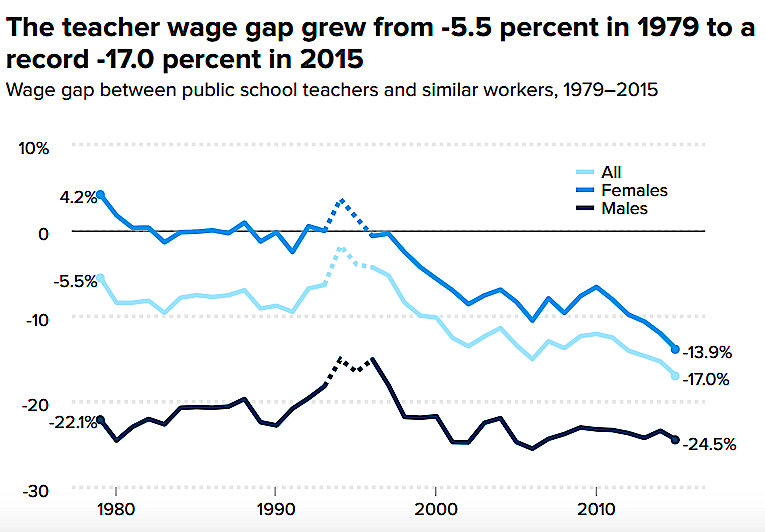
The report noted that its analysis includes controls for age, education, race/ethnicity, geographical region, marital status, and gender. Data for 1994-95, the dotted lines, are extrapolations.


 Pay for teachers has stagnated nationally over the past two decades, and fallen behind earnings of other workers with college degrees, the Economic Policy Institute, a Washington-based nonpartisan think tank, concluded in a report released Tuesday.

In 1994, teachers earned on average 1.8 percent less than other comparable workers; by 2015, they earned 17 percent less, adjusted for inflation. Factoring in total compensation, including health benefits and pensions, teachers earned the same as other workers with college degrees in 1994 but 11 percent less by 2015, the report found.
The report suggests that the pay gap or “penalty,” as the institute calls it, could complicate the efforts by California and other states to solve a teacher shortage and compete for high-achieving college graduates. “If the policy goal is to improve the quality of the entire teaching workforce, then raising the level of teacher compensation, including wages, is critical to recruiting and retaining higher-quality teachers,” the study said.
“It will be a big lift to increase compensation by 11 percent, but it’s important to move in that direction,” Larry Mishel, president of the institute and co-author of the report, said in an interview.
The average pay of public school teachers decreased by $30 per week – 2.6 percent – from 1996 to 2015 in inflation-adjusted dollars while weekly wages of all college graduates rose 9.6 percent, from $1,292 to $1,416, during that period.
The average teacher in America makes 77 percent of what other workers with a college degree earn, based on 2011-15 data in the report; the closest state to parity is Wyoming, where the gap is only 1.5 percent. In only five states are teacher weekly wages less than 10 percent behind.
California teachers earned 86 percent of the salaries of other workers with college degrees, the 10th-highest among the states, the report said. Since the late Teachers’ pay trails that of other workers with college degrees | EdSource:

Spooky new video urges Georgia voters to reject Gov. Deal’s state takeover of schools | Get Schooled

Spooky new video urges Georgia voters to reject Gov. Deal’s state takeover of schools | Get Schooled:

Spooky new video urges Georgia voters to reject Gov. Deal’s state takeover of schools

This new video in opposition to Gov. Nathan Deal’s state takeover plan is certainly dramatic. I’m not sure this spare, spooky approach will work in persuading voters to reject the constitutional amendment giving Deal the power to take over failing schools. Voters face the question in November.
However, the video links viewers to a Georgia PTA page, which explains the amendment in greater detail.
The PTA link brings viewers to a critique of Deal’s Opportunity School District. Among the criticisms cited in the presentation: The vague languageof the amendment, the transference of school funds, assets and control to a superintendent appointed by the governor, and the marginalization of parents in the takeover process.
Take a look at the new video and tell us what you think.


LAUSD'S FALSE OVERPAYMENT LITIGATION AGAINST TEACHERS AND WHAT THEY CAN DO ABOUT IT - Perdaily.com

LAUSD'S FALSE OVERPAYMENT LITIGATION AGAINST TEACHERS AND WHAT THEY CAN DO ABOUT IT - Perdaily.com:

LAUSD'S FALSE OVERPAYMENT LITIGATION AGAINST TEACHERS AND WHAT THEY CAN DO ABOUT IT

pro se.jpg


 Whether it is fabricating charges against more expensive high seniority teachers to get rid of them or subsequently adding insult to injury by making bad faith false allegations of overpayment against them, both actions are predicated on the idea that a teacher now without salary or benefits will be hard pressed to mount a legal defense.

For those of you teachers and other LAUSD employees who have been so falsely charged with having been overpaid, what follows is a way you can finally and reasonably defend yourself. Linked below is an "Answer" to LAUSD's false allegations of overpayment that you can use along with the blank forms and content necessary to defend yourself in court.
Copy the information from my attached sample "Answer" below into the blank template provided, if the facts are the same in your case. Then cut and paste the following as indicated into the blank forms provided at the bottom. Be sure to change case number, if yours is not the same. Then all you have to do is file the documents with the court and pay the filing fees.
(Form PLD-C-010 two pages)
Affirmative Defenses
1. This Court lacks jurisdiction because the causes of action alleged in the First Amended Complaint arise under a Collective Bargaining Agreement (CBA) entered into by LAUSD and United Teachers Los Angeles (UTLA), the alleged overpayment of wages is a subject of mandatory collective bargaining under the Educational Employee Relations Act (EERA), and the interpretation of issues arising under a CBA are subject to the exclusive initial jurisdiction of the Public Employee Relations Board (PERB). Therefore, LAUSD has not satisfied the procedural prerequisite that it exhausted its administrative remedies under the EERA.
2. Neither the First Amended Complaint nor any cause of action alleged therein alleges facts sufficient to state a cause of action against this answering defendant.
3. The damages, if any, were the result of the negligence, fault, incompetence, carelessness, want of due care, and defective design and operation of the LAUSD payroll LAUSD'S FALSE OVERPAYMENT LITIGATION AGAINST TEACHERS AND WHAT THEY CAN DO ABOUT IT - Perdaily.com:

The Heart of Learning | Johnathan Chase | LinkedIn

The Heart of Learning | Johnathan Chase | LinkedIn:

The Heart of Learning

The Heart of Learning

I was recently singing along with my favorite Elvis Costello song; "(What's So Funny 'Bout) Peace, Love, and Understanding?" and as the song finished my thoughts returned to education reform and I began to ponder; what's so wrong with more agency, mindfulness, and character development in the classroom?


"So where are the strong 
And who are the trusted? 
And where is the harmony? 
Sweet harmony.
‘Cause each time I feel it slippin’ away, just makes me wanna cry. 
What’s so funny ’bout peace love & understanding?"
Reading the lyrics above, I couldn't help but notice how relevant this song is when it comes to questions of character and the 2016 Presidential Campaign.
Donald Trump is living proof how important it is that our students learn to be empathetic citizens and develop emotional intelligence, so they will be ready to participate in constructive civic engagement as adults. 
Common Core fails to fulfill the "readiness" standards it claims to ensure for every student because it is more concerned with producing text-dependent The Heart of Learning | Johnathan Chase | LinkedIn:


Experts Reject Christie’s School Funding Idea: Steal from Poorest Schools to Aid Rich Suburbs | janresseger

Experts Reject Christie’s School Funding Idea: Steal from Poorest Schools to Aid Rich Suburbs | janresseger:

Experts Reject Christie’s School Funding Idea: Steal from Poorest Schools to Aid Rich Suburbs


In late June, Governor Chris Christie proposed an amendment to New Jersey’s state constitution for the purpose of imposing a new flat school funding plan across his state. Christie’s new idea is to give every school district across New Jersey the same per pupil state aid of $6,599. It would be up to local school districts to make up for cuts in what they now receive from the state, even though most poor school districts do not have the fiscal capacity to raise the rest. Christie’s stated reason is to lower taxes in the wealthy suburbs that have already been able to raise most of their school funding locally by levying millage on their local property.
In late June, the NY Times editorial board summarized the plan: “(A) flat amount would make it impossible for poor communities to provide a sound education for disadvantaged children who need classrooms with more resources.  The state is required by law to send more money to those communities because they simply don’t have the tax base or property values to raise additional revenues on their own.  The New Jersey Supreme Court mandated this approach inAbbott v. Burke, a case named for Raymond Abbott, a student in Camden who received no services for a learning disability and was barely literate at the age of 15.  The court ruled in 1990, and in many rulings since, that New Jersey was bound by the State Constitution to fund districts at a level that allows all children to receive an education that enables them to participate in the economy and a democratic society… The 31 New Jersey school districts…known as ‘Abbott Districts’ educate nearly a quarter of the state’s students, more than 40 percent of its poor children and 56 percent of its English language learners.”
Christie’s plan would neither account for the disparities in school districts’ capacities to raise local revenue (disparities growing from the very different valuation of taxable property from school district to school district) nor recognize a central principle of educational equity, namely that some children need more services at school and those services cost money. The political philosopher Benjamin Barber defines this principle clearly in his 1992 book on public education, An Aristocracy of Everyone: “Equality is achieved not by handicapping the swiftest, Experts Reject Christie’s School Funding Idea: Steal from Poorest Schools to Aid Rich Suburbs | janresseger:

The Political Crisis Machine and Education Reform Ad Infinitum | the becoming radical

The Political Crisis Machine and Education Reform Ad Infinitum | the becoming radical:

The Political Crisis Machine and Education Reform Ad Infinitum

We must imagine that if we were able to peak inside the imagination of politicians in the U.S., we would see only one scene on a loop:


Especially when our political leaders are addressing education, they cannot resist the urge to wallow in crisis discourse and to promise Utopian outcomes.
As I have documented before, the rush to declare public schools an abject failure and then offer prescriptions for bureaucratic reforms began at least in the 1890s with the Committee of Ten. Periodically, the exact same scenario repeats itself—not unlike the inevitable rebooting of superheroes that plagues the comic book industry, which can retell only the same origin stories over and over again.
In recent history, education reform experienced a Hulk-like transformation with A Nation at Risk (“We are in CRISIS!!!”) under Ronald Reagan—although it was a lie—spurring the accountability era.
Education reform over the past thirty years has been an endless parade of NEW!!! standards and NEW!!! high-stakes tests as well as a silly string of inane names for political policies that appear to have been generated by an Orwellian computer program: Goals 2000: Educate America Act, No Child Left Behind, Every Student Succeeds Act.
At their core, however, has been the same-old-same-old: Education is in CRISIS!!! but here is the reform solution (just like the last reform solution).
If politics is anything in the U.S., it is finding yourself in a hole and continuing to dig.
This first report explains why there’s no time to lose in rebuilding state education systems. However NCSL’s study group still has questions—and surely the reader does too—about how to design and implement these systemic changes in the states. Where should legislators begin—teacher recruitment or preparation, standards, assessments, early learning? How should states realign their resources? Do some of these policies fit together better into an actionable package? There is still much to learn and discover.
This report combines the CRISIS!!! we have come to expect with the breezy tone of an NPR story on education.
The opening of the Executive Summary reads like a brilliant parody from The Onion— filled with false but enduring claims:
The bad news is most state education systems are falling dangerously behind the world in a number of international comparisons and on our own National Assessment of Educational Progress, leaving the United States overwhelmingly underprepared to succeed in the 21st century economy.
Fact Check: Decades of evidence have proven that there is NO CORRELATION between measurable The Political Crisis Machine and Education Reform Ad Infinitum | the becoming radical: