Latest News and Comment from Education

Wednesday, July 27, 2016

CURMUDGUCATION: Vocabulary and the Assessment Problem

CURMUDGUCATION: Vocabulary and the Assessment Problem:

Vocabulary and the Assessment Problem


The teaching of vocabulary is a good microcosm of some of the biggest problems of education.

We know how to teach vocabulary badly. It's a process that has been refined and perfected over decades, and even if you don't use it as a teacher, you probably knew it as a student. The basic outline looks something like this:

1) Get list of vocabulary words
2) Go through the motions of some sort of practice activity
3) Cram words* into your brain
4) Take test
5) Forget words completely

* If teacher is prone to matching or multiple choice tests based on the teacher's one and only acceptable version of the word definition, you need only cram enough to recognize the definition when you see it, which requires minimal brain space. Recognition is not full fluency, as witnessed by everyone who still retains enough high school French to understand what they hear, but can no longer speak it.

Nobody on God's green earth believes that this process produces students with larger, more effective vocabularies.


But teachers still do it (and for years I was one of them) because it's quick and efficient and simple and, best of all, it's a system that students can quickly learn to game, which means that we can point to all our test result data and declare, "Look at how successful I am!" Meanwhile, students get good papers to put up on the fridge. It's the oldest bad deal in the annals of education. You help me look like I'm teaching something, and I will help you look like you're learning something.

The heart of the problem lies with the definition of "success."

The definition of successfully teaching vocabulary is that students use the new words correctly in the 
CURMUDGUCATION: Vocabulary and the Assessment Problem:


The Gardener and the Carpenter
Earlier this month, Dr. Alison Gopnick appeared in the Wall Street Journal plugging some thoughts from her soon-to-be-published book The Gardener and the Carpenter: What the New Science of Child Development Tells Us About the Relationship Between Parents and Children. Gopnick's point is about parenting, but it has direct implications for the teaching world as well. Gopnick argues that modern paren
This Non-Standardized Country
Two weeks, 5800 miles, and about 16 states (it's a stretch to count Colorado). Plus several days with my daughter, son-in-law, and grandson. I don't usually do photo essays here, but I want to show you just some of what I saw. This is home. This is what we're used to seeing. Here's downtown Cleveland, where a railroad era central building makes a backdrop for a modern monument. Off to our right is

K12 Inc - The Pride of Wall Street - Wait What?

K12 Inc - The Pride of Wall Street - Wait What?:

K12 Inc – The Pride of Wall Street


Writing in their 2015 Annual Report, K12 Inc. Chairman and Chief Executive Officer Nathaniel Davis said;
Our strategy is simple: optimize student success, support market expansion in collaboration with current and future partners, and pursue targeted revenue growth.
Hyping their status as the leader in the for-profit corporate education reform industry, the company reported added;
The U.S. Market for K-12 education is large and online learning is gaining greater acceptance.
The notion that the country’s public school children are little more than lucrative profit centers for Wall Street investors has been growing since Rupert Murdoch famously called America’s public schools, a $500 billion untapped economic opportunity.
And by way of explaining the pro-charter environment and their ongoing success collecting public money, K12 Inc. explained;
Many parents and educators are seeking alternatives to traditional classroom-based education for a variety of reasons.  Demand for these alternatives is evident in the expanding number of choices available to parents and students.  For example, public charter schools emerged in 1988 to provide an alternative to traditional public schools and, have seen enrollments grow by 225% over the past 10 years….and there are approximately 6,400 public charter schools operating in 42 state and the District of Columbia with an estimated enrollment of over 2.5 million students.
While much of the attention related to education reform has focused on charter schools, the Common Core and the Common Core testing frenzy, Internet based, online virtual K12 Inc - The Pride of Wall Street - Wait What?:

Why I Will Vote for Hillary Clinton | Diane Ravitch's blog #DNC #DemsInPhilly

Why I Will Vote for Hillary Clinton | Diane Ravitch's blog:

Why I Will Vote for Hillary Clinton


I cast my first vote in 1960, when I was 22. That was before 18-year-olds were allowed to vote. I voted for John F. Kennedy, and I worked in his campaign. I was thrilled when he visited campaign headquarters, and I got to shake his hand. He was exciting and dynamic.
At the time, critics said he was no better than Richard Nixon.
They talked about his father, his money, his privilege, his Roman Catholicism; rumors swirled about his private life but were never reported by the media.
Public opinion was so divided about JFK, even among Democrats, that Arthur M. Schlesinger Jr. felt compelled to write a short book called“Kennedy or Nixon: Does It Make Any Difference?” Of course, he argued that Kennedy was infinitely preferable to Nixon. Kennedy was elected by a razor-thin margin. Some people said that the corrupt Daley regime in Chicago put him over the top.
Democrats were even more divided in 1968 when Hubert H. Humphrey ran against Nixon. Liberals were angry at Humphrey because he had loyally served as LBJ’s vice-president and had not spoken against the war in Vietnam. I worked in the Humphrey-Muskie campaign and organized an event on October 31, 1968, in Manhattan. We didn’t have much money, so we rented a big, shabby labor hall on West 34 street in Manhattan. It was a ragtag affair with a lineup of wonderful speakers: John Kenneth Galbraith, Arthur Schlesinger Jr., Herman Badillo, and a parade of other liberal notables of the time. Vice-Presidential candidate Ed Muskie was supposed to drop in. Actress Shelley Winters moderated. In the middle of Galbraith’s endorsement of the Democratic ticket, two people in the front row jumped up, took off their raincoats, and ran stark naked onto the stage, where they presented Galbraith with the head of a pig. Shelley Winters threw a pitcher of water at them. The one security officer on duty began chasing them around the stage, and it was like a scene out of the Keystone Kops. Meanwhile, in the back of the room, about 15 protestors marched in, carrying a North Vietnamese flag, banging a drum and chanting “Ho Ho, Ho Chi Minh, Viet Cong are gonna win!”
By the time the protestors moved out, the rally collapsed, Muskie didn’t drop in.
Nixon was holding his own rally across the street at Madison Square Garden, and he had no protestors. Security was tight, and no one got in without credentials.
Our event was a debacle. I knew that night in my heart that Nixon would win.
Fast forward to today.
There are two major party candidates for the presidency, and one of them will be elected in November.
I am an idealist and I fight for what I believe in, but I am also a realist. Either Donald Trump or Hillary Clinton will be elected president.
I will support and vote for Hillary Clinton. I am not telling anyone else how to vote. I am telling you why I am voting for Hillary.
To begin with, I think that Donald Trump is the most unqualified person in my lifetime to be a major party candidate. I think that a presidential Why I Will Vote for Hillary Clinton | Diane Ravitch's blog:

Convention delegates want to know if Clinton would mirror Obama on K-12 | PBS NewsHour #DNC #DemsInPhilly

Convention delegates want to know if Clinton would mirror Obama on K-12 | PBS NewsHour:

Convention delegates want to know if Clinton would mirror Obama on K-12

President Barack Obama stands with Democratic U.S. presidential candidate Hillary Clinton during a Clinton campaign event in Charlotte, North Carolina. Photo by Brian Snyder/Reuters
President Barack Obama stands with Democratic presidential candidate Hillary Clinton during a Clinton campaign event in Charlotte, North Carolina. Photo by Brian Snyder/Reuters

Hillary Clinton, the presumptive Democratic presidential nominee, loves to tell voters that her administration would pick up the policy baton from President Barack Obama.
But, with the Democratic National Convention under way this week, it’s tough to say how true that will be when it comes to K-12 education. That’s an area where Obama has antagonized many of the teachers that make up the Democratic Party base during his first six years in office, by tying teacher evaluation to test scores, encouraging districts to turn their low-performing schools into charters and more.
Clinton, who was never a fan of those policies when she ran for president in 2008, has worked hard to distance herself from them on the campaign trail this go-round, too. Instead, she’s talked about building on Obama’s legacy on the set of issues he’s talked about more in his second term, including expanding access to early-childhood education, pairing academics with health and other services and broadening school accountability beyond test scores.
Still, the perception that Clinton and Obama are on the same K-12 page could hurt Clinton here as she tries to win over delegates who supported her opponent in the primaries, Vermont Sen. Bernie Sanders.
“I think we need to work on her,” said Jonathan Singer, a member of the Colorado General Assembly who introduced a bill to dramatically reduce testing in the Centennial State, and a Sanders delegate. “She has to make it very clear that we have to start investing in teachers and showing that we trust them.”
Democratic Party Priorities
Adding to Clinton’s challenges on K-12: She will be looking to soothe worried fans of education redesign who might think she’s too cozy with the National Education Association and the American Federation of Teachers.
Both unions gave Clinton an early endorsement over Sanders, despite big pushback from their members. And Clinton told them earlier this month that they’d always “have a seat at the table” if she wins the White House.
“The worry is that what they hear is that the table is going to have only two seats,” said Charles Barone, the director of government relations for Democrats for Education Reform, which supports Democrats who favor charters, performance pay, high standards and more.
But he said, he gets why Clinton has released very specific proposals on college access and expanding access to early-childhood education, while she has yet to specifically outline her K-12 vision. “I think it’s politically understandable you’d want to focus on the Convention delegates want to know if Clinton would mirror Obama on K-12 | PBS NewsHour:


Who’s Teaching Your Student? Questions to Help You Find Out

Who’s Teaching Your Student? Questions to Help You Find Out:

Who’s Teaching Your Student? Questions to Help You Find Out

portrait of caucasian teacher and blackboard

It’s hard to believe that it’s time for school to start again. As parents and children visit schools with anticipation, parents might want to ask their student’s teachers about their instructional backgrounds.
School districts used to be fairly vigilant about ensuring teachers had the right state credentials. That may no longer be the case. But a parent has the right to know who’s teaching their child.
All around the country, school districts are reporting teacher shortages. Orlando is the latest. The fear is that quality teachers have left, and schools will resort to hiring inexperienced and unprepared individuals with little understanding of the needs of students.
Students spend between 175 and 180 days in school, and/or between 900 and 1,000 hours in the classroom, with teachers. This is a long time during formative years. One bad teacher or crummy school year can have a lasting effect.
I would ask a teacher about their qualifications in elementary, middle and high school. I’d even find out what kind of child development preparation my preschool teacher had Who’s Teaching Your Student? Questions to Help You Find Out:

Anne Holton, wife of Clinton’s running mate, resigns as Va.’s education secretary #DNC #DemsInPhilly

Anne Holton, wife of Clinton’s running mate, resigns as Va.’s education secretary - The Washington Post:

Anne Holton, wife of Clinton’s running mate, resigns as Va.’s education secretary

Tim Kaine takes the stage with his wife, Anne Holton and daughterAnnella Kaine, after winning the seat as a U.S. Senator for Virginia in November of 2012. (Jahi Chikwendiu/WASHINGTON POST)
Anne Holton has stepped down as Virginia’s education secretary following the selection of her husband, Sen. Timothy M. Kaine (D-Va.), as Hillary Clinton’s running mate.
Clinton announced Friday that Kaine, former mayor of Richmond and former governor of Virginia, would join her presidential campaign as her vice-presidential choice. In her announcement, Clinton praised Holton’s work in Virginia.
Tuesday, Virginia Gov. Terry McAuliffe (D) lauded Holton’s service, highlighting her work to reform the state’s standardized testing regime — known as Standards of Learning or SOL — and to raise education funding.
“During her tenure, Anne has been a constant and powerful voice for students, teachers and schools, and her lifelong dedication to serving Virginia’s young people, especially the children at the margins, has had a lasting impact in the Commonwealth,” McAuliffe said in a statement. “Over the past two years, we have worked together to achieve significant accomplishments, including substantial investments in K-12 and higher education, innovative SOL reform, and life-changing work in some of Virginia’s most challenged school divisions.”
Holton and Kaine have both been powerful advocates for education. Kaine championed early childhood education as governor of Virginia, and that has been a centerpiece of Clinton’s education platform. As first lady of Virginia, Holton advocated for finding stable homes for teens in foster care.
McAuliffe tapped Holton, a longtime advocate for foster youth and a former juvenile court Anne Holton, wife of Clinton’s running mate, resigns as Va.’s education secretary - The Washington Post:
Anne Holton, Tim Kaine's wife, resigned as Virginia's education secretary.
Kaine's wife resigns Virginia state position, joins campaign - POLITICO - http://www.politico.com/story/2016/07/anne-holton-resigns-education-secretary-226228

Delaware Education Funding: Teacher Salaries For District & Charters By Student – Exceptional Delaware

Delaware Education Funding: Teacher Salaries For District & Charters By Student – Exceptional Delaware:

Delaware Education Funding: Teacher Salaries For District & Charters By Student

FY2016DistrictTeacherSalaries
Teacher Salaries.  This is the bulk of the costs in education.  As it should be.  Teachers are the lifeblood of a child’s education.  The funding for teachers should always be the highest cost for any school, whether it is in a district school or a charter school.  With that being said, below are what our districts and charter schools pay for teachers.  But as with the article on overall spending, it is all in relation to how many students a district or charter has.  There are several opinions that can be drawn from these pictures, but as with all these articles, the percentage of high-needs students can play a huge factor, especially when it comes to special education.  But we can see, based on the numbers, that having too many new teachers may save money in the short-term but it doesn’t bode well for students.
With this article, we have the first charter schools to suffer from what I call BAP: Bad Accounting Practices.  Delaware Military Academy and Delaware College Prep are not included in this because it would be impossible to figure out their teacher salaries.  For the sole reason that they put ALL their salaries under a code of “General Salaries”.  There is no breakdown of teacher, principal, head of school, secretaries, and so forth.  I know their authorizer, Red Clay, has approached them about this with absolutely no change whatsoever.  And Del. Military Academy already had a run-in with the State Auditor a few years back over personal spending.  Del. College Prep had their charter revoked by the Red Clay board and closed at the end of June.
Before you react to the first picture, I would like to remind everyone that the number of students in each district is the biggest factor in all of this.  Some district and charter accounting gurus may look at these and think I have all my numbers wrong.  If they are looking at just the state code that falls under teacher salaries, most of them would be right.  But for the purposes of this article and to get a true understanding of how teachers are paid overall in our districts and charters, I added the following together to come up with the teacher salaries: teacher salaries, academic excellence (essentially a bonus for some teachers), what are known as Extra Pay for Extra Responsibility categories (Sports, Extra-Curricular, and Misc.), Visiting Teachers, and the three Related Services for special education that only about half the districts use for special education teachers (Basic, Intensive, and Complex).  There is absolutely no way to determine how many teachers are tenured or have more experience at each district or charter.  But these are straight-out salaries and do Delaware Education Funding: Teacher Salaries For District & Charters By Student – Exceptional Delaware:


Charter schools reason for Mayor Kevin Johnson’s bad behavior? – Cloaking Inequity

Charter schools reason for Mayor Kevin Johnson’s bad behavior? – Cloaking Inequity:
Charter schools reason for Mayor Kevin Johnson’s bad behavior?

I currently live in Sacramento. If I had a nickel for every time someone asked me if I hang out with Kevin Johnson and Michelle Rhee— I’d be rich. Really!? Why would I? See Michelle Rhee vs. Julian Vasquez Heilig on Twitter. In our Twitter conversation, Rhee deflected deflected deflected my points about charters.
This week, the Rhee/Johnson charter interests have resurfaced in a new article by Deadspin entitled Secret Emails Show Kevin Johnson Spying On, Attempting To Bankrupt Enemies. The article focuses on the release of Kevin Johnson mayoral emails that he has fought long and hard in court to prevent releasing… and there is an interesting twist… charter schools.
The plot is essentially this. Rhee and Johnson via their previously well-funded non-profits (StudentsFirst and Stand Up— both of which are essentially defunct) have pressed incessantly for charter schools. How is this related to Johnson/Rhee, the litigated emails and also the National Conference of Black Mayors (NCBM)? Deadspin writes:
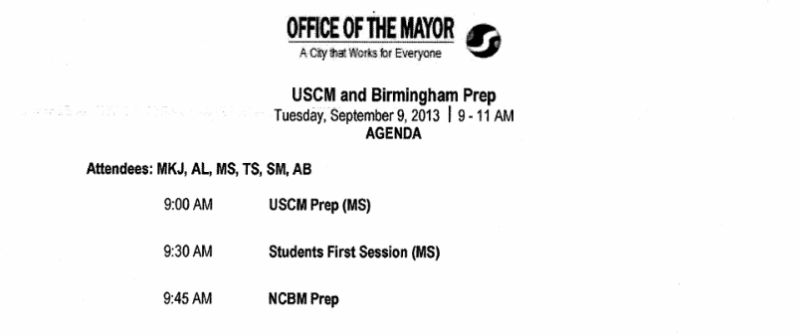
The latest batch of documents—totaling several hundred pages—shows that Johnson’s misuse of attorney/client privilege staved off potential political embarrassments, many of them NCBM-related. He was, to give one telling example, preventing the release of his schedule for Sept. 9, 2013, which included preparation for a trip to Birmingham, Ala. The listed rehearsals included a “Students First Session” followed by “NCBM Prep.”
StudentsFirst is the charter school advocacy group founded by Michelle Rhee. (Johnson is also a major player in the school privatization movement.) The email that Johnson tried so hard to hide provides a reminder that he and Rhee went to Birmingham together to exploit the attention being given the 50th anniversary of bombing of the 16th Street Church. Amid the solemn commemorations of that seminal moment in the American civil rights movement, they co-hosted a town hall meeting promoting charter schools.
rhdvcnhn5osbtjlnwtpv.png


One of the reasons Johnson would presumably want this played down is that the NCBM has historically opposed charter schools, and didn’t like Johnson using their group to further an education agenda that both membership and leadership vehemently opposed. Former NCBM president Robert Bowser told me in 2014 that the group had made their stance clear to Johnson after he proposed a resolution to get the NCBM to endorse charter schools. “We took a vote and said, ‘Hell no!’ to his resolution,” Bowser said. “The black mayors are not Charter schools reason for Mayor Kevin Johnson’s bad behavior? – Cloaking Inequity:


Change Lives Be A Teacher Day - Year 2016 (CA Dept of Education)

Change Lives Be A Teacher Day - Year 2016 (CA Dept of Education):

State Schools Superintendent Tom Torlakson, Serving as Acting Governor, Declares "Change Lives – Be a Teacher Day" in California


SACRAMENTO—As his first official act as Acting Governor, State Superintendent of Public Instruction Tom Torlakson today issued a proclamation declaring "Change Lives – Be a Teacher Day" in California.
Torlakson, who started his public service career as a high school science teacher and coach, encouraged talented and committed people all over the state to consider pursuing an education career.
Governor Brown, Lieutenant Governor Gavin Newsom, and most other statewide constitutional office holders are at the Democratic National Convention in Philadelphia. The State Constitution and the Government Code require that the Superintendent of Public Instruction serve as Acting Governor when those other statewide office holders are absent from California.
Torlakson assumed duties as Acting Governor on Monday (July 25, 2016) evening and will serve until Thursday (July 28, 2016) afternoon, when Governor Brown is scheduled to return.
On Friday, Torlakson will be the kickoff speaker for a "Better Together: California Teachers Summit" at Sacramento State University, one of nearly 40 simultaneous education events held statewide that day.
The proclamation follows:
Are you a talented, passionate, dedicated, and high-quality person who wants to make a profound difference in the lives of young people and your community? California needs you.
California needs you to consider becoming a teacher.
Teachers play a pivotal role in helping young people get excited about learning and reaching success in 21st century careers and college.
But California has a teacher shortage. School districts, with an influx of new funding, are looking to lower student-teacher ratios and reinstate classes and programs that were reduced or eliminated during the lean budget years of the Great Recession.
The California Commission on Teacher Credentialing last year issued 15,000 credentials but projected a need for 7,000 more. In mid-October of 2015, two months after the school year started, the statewide educator job portal EdJoin still listed nearly 4,000 open teaching positions—double the number listed at that time in 2013.
Enrollment in California’s teacher preparation programs has declined significantly in the last eight years.
Specialized credentials are in high demand. In mathematics and science, the number of preliminary credentials awarded to new, fully-prepared teachers dropped by 32 percent and 14 percent, respectively, over the last four years. In special education, the number of credentials issued dropped by 21 percent.
We want students from your communities and from your schools to learn how rewarding it is to be a teacher. Most of those students will return to their communities and serve as role models.
Teaching isn’t just a job. It isn’t just a career. It’s a calling. It’s a commitment to your community, your students, and most of all, a commitment to the future.
You can learn more about becoming a teacher at www.teachcalifornia.org External link opens in new window or tab.
Whether you are a student, a para-educator, or a career changer, please consider becoming a teacher. Make the difference of a lifetime.
Now Therefore I, Tom Torlakson, Acting Governor of the State of California, do hereby proclaim July 26, 2016, as "Change Lives - Be a Teacher Day."
# # # #
Tom Torlakson — State Superintendent of Public Instruction
Communications Division, Room 5206, 916-319-0818, Fax 916-319-0100
Last Reviewed: Tuesday, July 26, 2016

Mike Pence's education record - Business Insider

Mike Pence's education record - Business Insider:

A cornerstone of Mike Pence's political record has experts cleanly divided


After Republican presidential nominee Donald Trump selected Indiana Governor Mike Pence as his running mate, Hillary Clinton ripped into the choice.
"Mike Pence is one of the most extreme vice presidential picks in a generation," Clinton said at an American Federation of Teachers conference in Minneapolis on Monday.
"And he’s one of the most hostile politicians in America when it comes to public education,” she continued.
It was searing criticism, especially as Pence has made education the cornerstone of his policy agenda since he assumed governorship over the Hoosier State in 2013.
While it's expected that Clinton would be critical of Trump and Pence while stumping in Minneapolis, the attack highlights Pence's divisiveness when it comes to education policies.

School vouchers

Gov. Mike Pence embraces a preschool student at the Shepherd Community Center Wednesday, Feb. 26, 2014, in Indianapolis. Pence has had trouble winning support from lawmakers for his proposed preschool voucher program. (AP Photo/Tom LoBianco)Gov. Mike Pence embraces a preschool student at the Shepherd Community Center Wednesday, Feb. 26, 2014, in Indianapolis.AP Photo/Tom LoBianco
As governor, Pence has championed a number of school choice policies, like Indiana's voucher program, that affect funding at public schools. Vouchers allow families to redeem tuition funding if they choose to send their children to private, rather than public, schools.
Pence has won big in his push to expand the state's voucher program, successfully lifting the cap (previously $4,800) on the amount of money families can receive when sending their children to private schools. In fact, Indiana's voucher program is now one of the largest in the nation, according to the New York Times.
Opponents of voucher programs argue that they siphon essential funding from already meager public school budgets to other schools, and at their worst, are unconstitutional, as they use taxpayer-funded vouchers to benefit religious schools.
"Pence's K through 12 education agenda has had serious, deleterious consequences for public education," Bob Arnove, the Chancellor’s Professor Emeritus of Educational Leadership & Policy Studies at Indiana University, told Business Insider.  "He’s let ideology and religious convictions trump, and that's no pun intended, the common good."
John P. Bean, professor emeritus at Indiana University, also believes Pence's school choice policies to harmful to the public education system.
"Pence’s promotion of school choice seems to be a thinly disguised handout to private religious schools at a time when public schools need more funding to function well," Bean told Business Insider via email.
That opinion seems to be debated.
"Pence's record in defending and advancing educational opportunity and access is strong, and Mike Pence's education record - Business Insider:


 Big Education Ape: Penceland - Voucher Capital of America: Are vouchers costing or saving taxpayer dollars? - http://bigeducationape.blogspot.com/2016/07/penceland-voucher-capital-of-america.html


Big Education Ape: Koch Brothers’ Friends Funding Mike Pence | Hoosier School Heist Blog -http://bigeducationape.blogspot.com/2015/07/koch-brothers-friends-funding-mike.html
Big Education Ape: Schools Matter: The Real Story Behind Mike Pence’s Charter School Speech -http://bigeducationape.blogspot.com/2015/07/schools-matter-real-story-behind-mike.html
Big Education Ape: The bigot Mike Pence and his neighbor Bruce Rauner. | Fred Klonsky -http://bigeducationape.blogspot.com/2016/07/the-bigot-mike-pence-and-his-neighbor.html
Big Education Ape: BREAKING NEWS - Trump goes with anti-public education running mate - Wait What? -http://bigeducationape.blogspot.com/2016/07/breaking-news-trump-goes-with-anti.html
Big Education Ape: The big trouble in Indiana public schools, as explained by a troubled educator - The Washington Post - http://bigeducationape.blogspot.com/2016/02/the-big-trouble-in-indiana-public.html

Hoosier School Heist TV is Doug Martin's channel featuring videos of his book tour across Indiana speaking on the corporate takeover of public education. Order Hoosier School Heist at http://hoosierschoolheist.com/.
Follow Hoosier School Heist on Facebook: https://www.facebook.com/HoosierSchoolHeist
Tweet with Doug Martin at: https://twitter.com/DougMartinED

Once all but left for dead, is cursive handwriting making a comeback? - The Washington Post

Once all but left for dead, is cursive handwriting making a comeback? - The Washington Post:

Once all but left for dead, is cursive handwriting making a comeback?

In this file photo from 2013, a fourth grader at St. Francis International School in Silver Spring, Md. practices cursive writing. Once thought to be on its way out, cursive instruction is hanging on as states are moving to require that students learn it. (Sarah L. Voisin/The Washington Post)

Cursive writing was supposed to be dead by now. Schools would stop teaching it. Kids would stop learning it. Everyone would stop using it. The Common Core standards adopted by most states in recent years no longer required teaching cursive in public schools, and the widespread reaction was succinct: good riddance.
But like Madonna and newspapers, cursive has displayed a gritty staying power, refusing to have its loop de loops and curlicues swept to the dustbin of handwriting history. Just last month, Louisiana passed a law requiring that all traditional public schools and public charter schools begin teaching cursive by third grade and continue through 12th grade. Arkansas legislators passed a law mandating cursive instruction last year. And 10 other states, including Virginia, California, Florida and Texas, have cursive writing requirements in their state education standards.
The cursive comeback is championed by a mix of educators, researchers, parents and politicians who lament the loss of linked-letter writing and cite studies that learning cursive engages the brain more deeply, improves fine motor dexterity and gives children a better idea of how words work in combination.
And some also just like the way it looks.
“I think it’s really discouraging to get a note from a college graduate that is printed like a second-grader,” said Beth Mizell, the Louisiana state senator who introduced the cursive writing bill in her state.
The Republican lawmaker said she acted when she heard from a surveyor who told her he couldn’t find young people who could read the notes on old land documents. A grandmother, Mizell said she was shocked to find out that students were no longer learning cursive in school.
“It seemed we had made a decision that was arrogant on our part that we didn’t think these kids needed something that we had taken for granted, that was our way of communicating for Once all but left for dead, is cursive handwriting making a comeback? - The Washington Post:


Standardized tests - Houston Chronicle

Standardized tests - Houston Chronicle:

Standardized tests

Legislators should use survey findings to fix test protocols at Texas' public schools.

Teachers find our current testing culture demoralizing. Not only would scaling back on the testing culture improve student performance, but most teacher organizations agree that fewer and more meaningful tests and less test preparation time would help attract better candidates to the teaching profession. (File photo) Photo: Darren Abate, FRL
Photo: Darren Abate, FRL Teachers find our current testing culture demoralizing. Not only would scaling back on the testing culture improve student performance, but most teacher organizations agree that fewer and more meaningful tests and less test preparation time would help attract better candidates to the teaching profession. (File photo)

The sight of little kids bending over their desks and filling in answer bubbles with No. 2 lead pencils has been a staple of the educational experience for so long that these kids have had kids. Few seem to be entirely happy with the role our state plays in the high-stakes testing culture of our public schools, yet this culture seems to have developed a life of its own.
That may be changing. In an unusual twist, the State Board of Education recently turned the tables on a system that rates students and teachers and asked the public to rate our state's testing policies.
The SBOE's customer satisfaction survey arose after a lengthy grass-roots process and aims to engage people informed by front-line experience in our schools. Although it wasn't a random survey, it had considerable reach, and its findings lay the groundwork for those seeking to improve our state's assessment and accountability system.
The discontent of many of the 27,186 people surveyed comes through loud and clear: "Texans believe we have too many tests, schools are spending too much time preparing for the state assessments, and too much class time working on the preparation," according to Donna Bahorich, Standardized tests - Houston Chronicle:


ALEC 2016 Agenda Boosts Charters, Coal, and Other Corporate Funders | PR Watch

ALEC 2016 Agenda Boosts Charters, Coal, and Other Corporate Funders | PR Watch:

ALEC 2016 Agenda Boosts Charters, Coal, and Other Corporate Funders

The American Legislative Exchange Council will push bills to protect failing charter schools, silence political speech, and obstruct environmental protections in the ALEC 2016 agenda introduced at its annual meeting in Indianapolis this week.
ALEC faces renewed public attention as it gears up for the annual meeting, where corporate lobbyists sit side-by-side with state legislators in luxury hotels to vote as equals on "model bills" that then get pushed to become law in states across the country.
As the Center for Media and Democracy has reported, Donald Trump chose an ALEC ally, Indiana Governor Mike Pence, as his running mate, while his party's 2016 platform was clearly stamped in the Koch-fueled ALEC mold.

Pence Pushed ALEC Agenda in the Hoosier State

As Governor, Pence appointed an ALEC staffer to his cabinet, and pushed parts of the ALEC agenda into law, such as anti-worker bills like repealing the prevailing wage and privatizing public schools in various ways. He even sent a letter to state legislators urging them to join ALEC, which is widely described as a corporate bill mill. ALEC is funded by Koch Industries, Peabody Energy, huge global tobacco and drug companies, and other corporations that pay a premium to access ALEC lawmakers.
Conveniently for him, this year's meeting will be held in the snazzy J.W. Marriott in downtown Indianapolis. Pence is scheduled to deliver a keynote address at lunch on Wednesday, then is slated to speak at an evening reception on school "reform" jointly hosted by the Center for Education Reform (CER) and the Jack Kemp Foundation (JKF).
If Pence had time to stay for a few task force meetings, here are some of the new "model bills" he would find voted on behind closed doors by ALEC legislators alongside corporate lobbyists and representatives of special interest groups that are part of the State Policy Network (SPN).

Second Chances for Failing Charter Schools

The for-profit education companies that help fund ALEC, like K12, Inc., have a track record of poor results that tends to result in a high rate of school closures. K12, which was founded in part by junk bond fraudster felon Michael Milken, has a seat and a vote on ALEC's corporate board.
Two new bills being considered by what ALEC now dubs its "Education and Workforce Development Task Force" could help poorly performing charters stay open without having to improve.
Under the Assessment Choice Act, instead of using a uniform assessment for students statewide, charters' authorizers would take their pick from a "menu" of tests, unlike traditional public schools.
If propping up test scores isn't enough to save a charter from closure, the "Student and Family Fair Notice and Impact Statement Act" promises to add new hurdles. Before closing or restructuring a charter school, this act would not just require that families be notified. It would also create a public hearing process in which parents, teachers, and "experts" could give testimony about the school, and the charter board would be allowed to suggest a response plan.
In case it wasn't obvious that the bill is meant to keep the charter in operation, the drafter of that model bill added:
"[drafting note: it should be clear the school can present an alternative for supporters of the school to rally around.]"
School privatization proponents have slowly been dropping the pretense that the "school choice" movement is about ALEC 2016 Agenda Boosts Charters, Coal, and Other Corporate Funders | PR Watch:

Tuesday, July 26, 2016

Hillary Clinton Advocates For Community Schools Model | ThinkProgress

Hillary Clinton Advocates For Community Schools Model | ThinkProgress:

Hillary Clinton Advocates For Community Schools Model

Democratic presidential candidate Hillary Clinton speaks at the American Federation of Teachers convention at the Minneapolis Convention Center in Minneapolis, Monday, July 18, 2016.
In a recent speech before the American Federation of Teachers, Democratic presidential nominee Hillary Clinton’s voice cracked as she discussed major inequities in the quality of education that students from low-income families receive.
“That’s a stain on all of us. Let’s create more community schools, more partnerships between schools and services and nonprofit organizations. Let’s pledge that we’ll give children who need it the mental health services that they deserve,” Clinton said.
Community schools — which provide social services to students on the school premises and prioritize community and parent engagement — have been around for a long time, particularly in low-income neighborhoods. Baltimore, New York City, and Chicago have almost 400 community schools put together and Oakland has almost 30 of these community hubs. But the concept has only recently gained steam on a national level as a potential solution for the closing opportunity gaps between low-income and middle class and wealthy children in schools across the country.
Advocates for equity in education favor a community schools approach because, by including social services and health services within or near the school building, educators can better address social factors outside of the school’s control. For example, if a student wants to speak with a mental health professional, they can go to an office nearby.
Educators argue that if factors such as illness, hunger, and mental health issues were addressed at school, children would ultimately be more successful.
“If a student is hungry at school, they will not be able to learn. If a student has health issues, of course they won’t be able to learn or perform on tests. None of this can happen unless the fundamental needs of the students and families are met,” said Marina Marcou-O’Malley, policy director for the Alliance for Quality Education of New York’s Public Policy and Education Fund. She added that the goal is to make the school environment “a welcoming and positive place” for struggling students.
Over the past several years, major cities have made huge strides toward developing more community schools.
New York’s Board of Regents, for instance, met earlier this month to discuss how schools can qualify for funding from a $75 million pot set aside for community schools. This $75 million marked major progress for groups pushing for community school expansion, such as Alliance for Quality Education of New York, Coalition for Educational Justice, Make the Road NY, and Hillary Clinton Advocates For Community Schools Model | ThinkProgress: