Latest News and Comment from Education

Monday, July 25, 2016

Is Stress in the Classroom Contagious?

Is Stress in the Classroom Contagious?:

Is Stress in the Classroom Contagious?

stress in the classroom
When teachers are feeling overwhelmed, they may not be the only ones paying the price. Students’ stress levels are being elevated as a result of their teacher’s exhaustion, and maybe vice versa. This may not come as a major surprise, but a just-released study from the University of British Columbia  (UBC) is the first that has established a strong link – a “stress contagion” – between a teacher’s occupational stress and a student’s physiological strain.
The results, says co-author Eva Oberle, highlight the need to properly address the lack of support in too many schools. “Our study is a reminder of the systemic issues facing teachers and educators as classroom sizes increase and supports for teachers are cut.”
To examine the link between teacher burnout and student stress in the classroom, the researchers collected saliva samples from over 400 elementary school children at 17 public schools in a large school district in Vancouver. They then analyzed the cortisol levels, the hormone used as the biological indicator of stress (previous research identifies increased cortisol levels in students with stressful experiences at school). A separate survey completed by 17 teachers was used to asses their “burnout level.”
What they found was that students’ cortisol levels were much higher in those classrooms led by a teacher who had reported feeling overwhelmed or exhausted.
But what came first – the higher cortisol level or teacher burnout? That’s not clear, according to the study. On one hand, a high-stress classroom climate could certainly result from lack of educator support, which can diminish a teacher’s classroom management skills. This in turn can lead to a chaotic or at least ineffective learning environment that heightens student stress.
On the other hand, stress could originate from students’ misbehavior, causing teachers to feel overwhelmed and report higher levels of burnout. Many educators “have fewer resources to form nurturing and supportive relationships with students, and tend to be less responsive to students’ needs,” the report states.
Teachers need adequate resources and support in their jobs in order to battle burnout and alleviate stress in the classroom. If we do not support teachers, we risk the collateral damage of students.” – said Kimberly Schonert-Reichl.
Whatever the origin may be, says Oberle, “we consider the connection between student and teacher stress a cyclical problem in the classroom.”
The causes and convergence of teacher and student stress has been a growing concern over the past decade. Research has consistently shown that stress levels in newer educators especially is leading many of them to exit the profession within five years. A 2014 Gallup survey revealed 46% of all K-12 teachers report high daily stress. The research into impact on students at all grade levels has also expanded, as academic and social pressures are now widely recognized as a very serious problem.
“Student and teacher stress feed of each other,” says Denise Pope, an education Is Stress in the Classroom Contagious?

The on-line scam called K12 Inc. - Wait What?

The on-line scam called K12 Inc. - Wait What?:

The on-line scam called K12 Inc.


While children play in the summer heat, parents in Massachusetts and 31 other states across the country are being bombarded with advertisements for the online “learning” giant, K12 Inc., a for-profit virtual school system that is part of the ongoing movement to divert public funds away from traditional schools and give the taxpayer money to privately owned and operated charter and on-line entities that supporters claim are the future of public education in the United States.
But the truth surrounding these corporate education reform strategies fall far short of their advertising claims, a fact that is especially true when it comes to the growing online or virtual charter school industry.
As California’s Mercury News explained in a major investigative series this past spring,
The TV ads pitch a new kind of school where the power of the Internet allows gifted and struggling students alike to “work at the level that’s just right for them” and thrive with one-on-one attention from teachers connecting through cyberspace. Thousands of California families, supported with hundreds of millions in state education dollars, have bought in.
But the Silicon Valley-influenced endeavor behind the lofty claims is leading a dubious revolution. The growing network of online academies, operated by a Virginia company traded on Wall Street called K12 Inc., is failing key tests used to measure educational success.
Fewer than half of the students who enroll in the online high schools earn diplomas, and almost none of them are qualified to attend the state’s public universities.
In fact, a series of academic studies have revealed that despite collecting hundreds of millions of dollars in taxpayer money, most virtual schools are utterly failing when it comes to actually educating children.
Reporting on a major study conducted in 2015 by Stanford University, the Washington Post wrote,
Students in the nation’s virtual K-12 charter schools — who take all of their The on-line scam called K12 Inc. - Wait What?:

Insider or Outsider? : Superintendents in Big Cities | Larry Cuban on School Reform and Classroom Practice

Insider or Outsider? : Superintendents in Big Cities | Larry Cuban on School Reform and Classroom Practice:

Insider or Outsider? : Superintendents in Big Cities


In Los Angeles Unified School District, the school board appointed an insider–Michelle King–superintendent earlier this year after a string of prior superintendents came from outside the district.
In New York City, Mayor Bill De Blasio appointed an insider–Carmen Farina– Chancellor in 2014 after Mayor Michael Bloomberg had appointed three outsiders since 2000.
These appointments of insiders to big city districts, people who spent their careers within the district as teachers, principals, and district office administrators, are the exception, not the rule. For large urban districts the rule has been appoint outsiders who promise major changes in course to solve serious problems.
Why is that?
Outsiders have been appointed time and again in these districts because the unspoken and strong belief was that the serious educational, social, and political problems besetting the schools needed an innovative, energetic, outsider, unbeholden to those inside the district. An outsider, policy elites assumed, would shake the system by the scruff of its neck in turning around a failing district–disrupt is the fashionable word today. Insiders who had risen through the ranks would prize stability while looking for incremental improvements. Insiders have been immersed in a network of relationships with peers and subordinates would be reluctant to disturb bureaucratic procedures, rules in effect for decades, and bonds of affection and respect for long-time peers and subordinates. Insiders would be loath to importing new staff and  innovations from elsewhere. They would rather seek new ideas and programs from sharp, knowledgeable insiders.
These strongly held beliefs about insiders and outsiders have shaped the appointment of superintendents to big city posts for well over a half-century.
In brief, the folk wisdom surrounding superintendents or chancellors heading urban districts says to appoint insiders if you like what has been happening in the system under the exiting superintendent in order to extend and protect what is working well for students, teachers, and the community. Stability and tweaking what works is the order of the day when insiders are appointed school chiefs. However, if you dislike what has been happening in the system, the dysfunctions, Insider or Outsider? : Superintendents in Big Cities | Larry Cuban on School Reform and Classroom Practice:


About the Louisiana Voucher Program, Where Failure Really Is an Option | deutsch29

About the Louisiana Voucher Program, Where Failure Really Is an Option | deutsch29:

About the Louisiana Voucher Program, Where Failure Really Is an Option

school choice cover

School Choice: The End of Public Education? 


On May 19, 2016, Louisiana citizen James Finney submitted a public records request for data concerning student voucher applications submitted by the initial deadline of February 27, 2016, for the 2016-17 school year.
On July 21, 2016, the Louisiana Department of Education (LDOE) sent Finney this data file. (Note: This file is useful for deciphering school site codes.)
Louisiana’s voucher program has a poor reputation. In January 2016, the Brookings Institute published a piece entitled, “When Winners Are Losers: Private School Vouchers in Louisiana.” In February 2016, US News and World Report published an article entitled, “Evidence Mounts Against Louisiana Voucher Program.” In March 2016, Louisiana state superintendent John White was called out by state board members for promoting a report that said vouchers saved money in the face of testimony before the board that they actually cost more.
The point of the voucher program is that it is supposed to provide a means to exit “failing” public schools. But the voucher schools themselves seem to be playing catch-up to the supposedly “failing” feeder schools. In December 2015, Danielle Drelinger of the Times-Picayune noted the following based on the only available data on voucher school outcomes for 2014-15:
The Louisiana Education Department released scores Thursday (Dec. 17) for 37 of the state’s more than 130 voucher schools. These are the larger programs, which educated about two thirds of the 7,382 voucher students. The state does not calculate scores for the other schools because they don’t have enough students taking tests. …
Several indicators were still low in 2015:
  • If the voucher schools were their own school system, it would be the fifth-worst of 76 in the state.
  • Sixteen voucher schools scored fewer than 50 points out of a total of 150. In most years, that would grade out as an F on the state’s public school grading scale. …
So, the safe discussion to have is about gains… gains from pathetically, embarrassingly failing to less-pathetic, less-embarrassing failure, kind of like half-drowning but trying to pass it off as progress toward competitive-swim quality:
But Education Department officials said the program was moving in the right direction: …
  • Despite the low absolute ranking, “The scholarship program’s increases in student achievement outpaced the majority” of public school systems,” Education Department officials wrote in a fact sheet.
Sure, on the whole, Louisiana’s voucher schools are flunkie, but in 2015, at a greater cost to the public than the public schools that they are trailing, voucher schools are, uh, less flunkie.
Let’s look at some numbers derived from that 2016-17 voucher application data file.
7,807 students who met the qualification for income eligibility applied for vouchers in 2016-17, where income eligibility means that the household income cannot exceed About the Louisiana Voucher Program, Where Failure Really Is an Option | deutsch29:

Julian Vasquez Heilig: My Thoughts on Mike Pence and Education – Cloaking Inequity

My Thoughts on Mike Pence and Education – Cloaking Inequity:

My Thoughts on Mike Pence and Education

The electorate in 2016 will be the most diverse in history. A Pew research report released earlier this year found that nearly one-in-three eligible voters on Election Day will be Hispanic, Black, Asian, or another racial or ethnic minority.
It’s no secret that Donald Trump is polling poorly among Latino, Asian American and African American voters. A Wall Street Journal/NBC News national poll found that 82 percent of registered Latino voters viewed the Republican presidential nominee unfavorably. The Wall Street Journal also reported that three quarters of Latinos plan to vote for Democrat Hillary Clinton in the fall.
According to a survey of Asian American voters, only 19 percent of Asian Americans view Trump favorably. This problem is particularly acute with African American voters. In a Wall Street Journal/NBC/Marist poll, Donald Trump garnered zero percent support among African Americans in the swing states of Ohio and Pennsylvania.
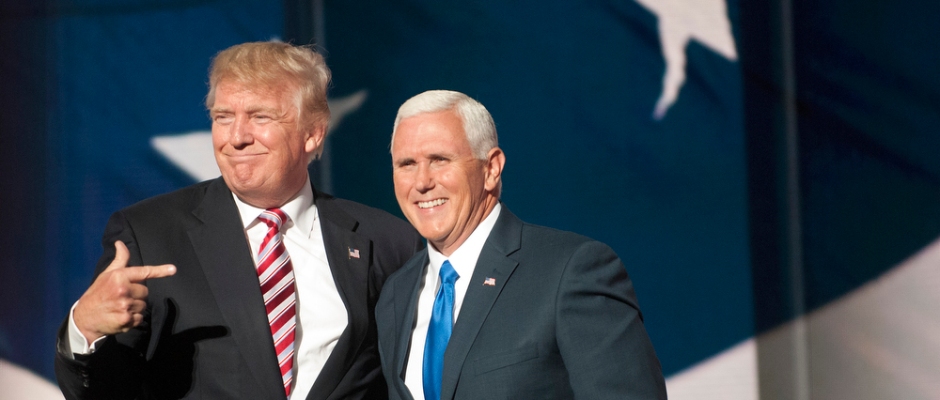
Kevin Chavous, a former Obama 2008 advisor, ex-Washington, D.C. council member and current board member of American Federation for Children, has suggested picking Indiana Gov. Mike Pence could help in his standing with black and Latino voters, because of the governor’s support for charter schools.
“Bringing minority-supported issues into [the Trump] campaign could pose a real threat to Hillary,” Chavous stated in a press release. “Selecting Governor Pence as VP will bring a major education reform advocate to Trump’s administration. Pence is a major supporter of charter schools and has worked to expand them in Indiana.”
But a press release by the American Federation of Teachers took Pence to task for his support of education policies that sap dollars from public My Thoughts on Mike Pence and Education – Cloaking Inequity:

Schools Matter: Understanding KIPP Model Charter Schools: Part 2

Schools Matter: Understanding KIPP Model Charter Schools: Part 2:

Understanding KIPP Model Charter Schools: Part 2

Get 20% Off w/code: RLEGEN16
Part 1 here.

Even though my book was published in March 2016, I continue to document the experiences of former KIPP Model charter school teachers, whose grueling experiences in "no excuses" charter schools are at the core of Work Hard, Be Hard: Journeys Through "No Excuses" Teaching.

My most recent interview was with Danielle, who taught for an Arkansas KIPP school in 2015.  Like many other KIPP Model teachers, Danielle describes a school where she received lots of criticism but almost no instructional or curricular support.  She described a school where most of the teachers who stay more than a year are from Teach for America (these teachers are looking to have their school loans reduced by completing their 2-year TFA commitments). 

Danielle described a school that tried to turn children into "zombies" who would follow orders and maintain strict compliance to unbending rules.  She described a draconian discipline system that offered ineffective punishments and no counseling, thus turning children into repeat offenders who are either suspended or sent to a tiny room that she described as a "prison cell" without windows, which was staffed by a bus driver.  She described a school without counselors or librarians or a library. 

Danielle talked about the KIPP Foundation's active role in perpetuating a system based on outward appearances that concealed a deeply dysfunctional organization, where shortcuts were encouraged to push students through the system whether or not learning occurred.  She was particularly bothered by a directive to provide a 55 point curve in her subject in order to keep passing rates high.  She talked about a system of perpetually-changing expectations and requirements, where teachers and students could not keep up with the incessant churn of altered rules and regulations. 

Danielle described a system that required of teachers more than any teacher could ever sustain over time.  She talked of teachers who yelled at children and who screamed out of frustration, teachers who ate on the run and who remained on-call until 9 PM each evening.  Much of what Danielle experienced has been experienced by other teachers who have been chewed up and discarded by a system of profligate human capital consumption.  Danielle's story will part of an unedited volume of interviews to be published late next year.

Below is Chapter 2 from Work Hard, Be Hard . . . If you are considering teaching in a charter school or if you know someone who is thinking about enrolling a child, please read this and share it widely. 


Chapter 2
Broken Windows Theory and the KIPP Teaching Model

The limitation that was put upon outward action by the fixed arrangements of the typical traditional schoolroom, with its fixed rows of desks and its military regimen of pupils who were permitted to move only at certain fixed signals, put a great restriction upon intellectual and moral freedom. Straitjacket and chain-gang procedures had to be done away with if there was to be a chance for growth of individuals in the intellectual springs of freedom without which there is no assurance of genuine and continued normal growth. –John Dewey (1938/2007)

         As we pointed out in Chapter 1, underpinning the “new paternalism” of the 1990s was the belief that social order demanded that any rule infraction, whether on city streets, homeless shelters, or in schools Schools Matter: Understanding KIPP Model Charter Schools: Part 2:

The Gulen Movement’s Collision Course With The Turkish State

The Gulen Movement’s Collision Course With The Turkish State:

The Gulen Movement’s Collision Course With The Turkish State

Fethullah Gulen (left) had been a close ally Recep Tayyip Erdogan (right), but their relationship gradually soured over time. (file photo)


Since Turkey’s failed July 15 coup, the Turkish authorities have accused U.S.-based cleric Fethullah Gulen of being behind the attempted takeover of power. It is an explanation that is widely accepted across Turkey. A brief look at the history of Gulen's movement helps explain why.
What Does The Movement Want?
Gulen was originally a supporter of Said Nursi, an Ottoman-Kurdish scholar from the Hanefi school of Sunni Islam. But in the 1970s, Gulen formed a sect of his own that people later called "Gulen Camaati" (Gulen community or movement).
Like any other Islamic sect under the strictly secular and pro-military Turkish governments, Gulen’s community was banned and operated largely underground until 1983. But, unlike other religious communities, which were mainly teaching the Koran and performing private religious prayers, Gulen’s group became increasingly politicized. Businessmen began to donate money and the movement became a political player among conservative and religious groups of Turkey.
"[Gulen] wrote at that time that he wanted to train 'courageous, selfless men' for society," says Rusen Cakir, a leading expert on Turkish Islamic groups. "It was about them training and planting young people in different important layers of the government: the police, the justice system, the Interior Ministry, and even the army."
But, unlike more transparent political parties, Gulen's sect kept everything secret. It was never clear how many members the group had, who they were, and what exactly they were seeking to do politically. It was widely rumored that his movement, and all its related "foundations" and businesses, were getting wealthier and more and more people were joining his community, but there was little categorical evidence to support this.
How Big Is The Movement?
It is almost impossible to quantify the size of the Gulen movement's membership or its wealth. By many estimates, over the course of some 40 years, the movement has gathered tens of thousands of supporters. 
Gulen has repeatedly denied having a "network." He has said that people may sympathize with him in any government institution even without an organized network, as is the case with other political parties. But analyst Cakir says that directing school graduates to choose positions selected by "community guides"-- members of the Gulen movement who counsel younger members -- was not something any other political party was doing.
Why Did The Movement Clash With The Turkish State?
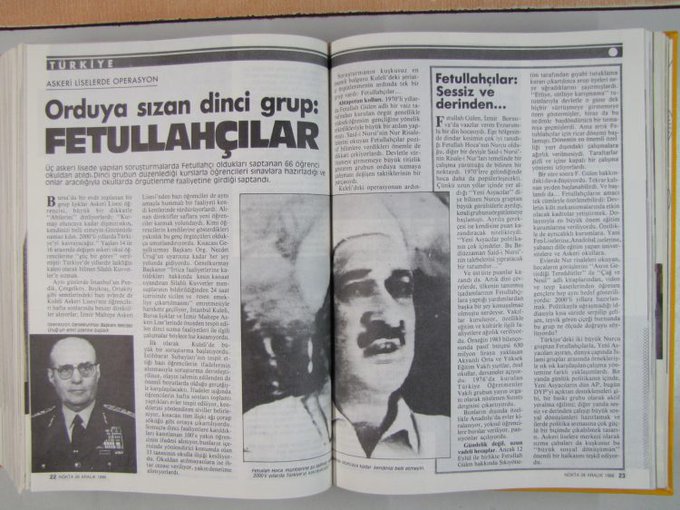
In the 1970s, the government, army, and security services tried to clean up their ranks and remove those they perceived to be Gulenist "implants."  And in the 1980s, secular parties and magazines (like Nokta from 1986, which is pictured below) were warning against secret "Fethullahists" in the army. 
Working up the ladder in the army and civil service, Gulen supporters helped other members of the movement join their ranks. In 2010, prior to a national exam for entrance into government agencies, exam questions were reportedly communicated among Gulen movement members to ensure their passing the exam. 
While Gulen was gathering and guiding supporters, his schools both in Turkey and abroad were bringing him fame and popularity. Critics say that running those successful schools was a "cover" for his "infiltration" of government, although raising the level of Turkey's education and culture was always one of Gulen’s stated goals. 
In 1999, secret recordings of Gulen's speeches were played on state television. In them, he called on his supporters to "silently and patiently" infiltrate government agencies and wait for "the moment" of change. "If you act too soon, you'll have Turkish state institutions on your back," he said. 
Under increasing pressure from secular media and government, Gulen emigrated to the United States in 1999. His movement, though, kept growing.
Why Did The Relationship With Erdogan Turn Sour?
In the 2000s, Gulen already had scores of loyal supporters at high levels of the police, justice system, media, education, and even the army. He was also a close ally of Recep Tayyip Erdogan, who becameThe Gulen Movement’s Collision Course With The Turkish State:


US Commander Campbell: The man behind the failed coup in Turkey

US Commander Campbell: The man behind the failed coup in Turkey:

US Commander Campbell: The man behind the failed coup in Turkey

The organizer and financial distributor of the coup attempt turns out to be an ISAF ex- US commander, investigation reveals

A former U.S. commander of the International Security Assistance Force (ISAF), a NATO-led security mission in Afghanistan, was the organizer of the July 15 military coup attempt in Turkey, sources said.

General John F. Campbell was one of the top figures who organized and managed the soldiers behind the failed coup attempt in Turkey, sources close to ongoing legal process of pro-coup detainees said.

Campbell also managed more than $2 billion money transactions via UBA Bank in Nigeria by using CIA links to distribute among the pro-coup military personnel in Turkey.

The ongoing investigation unveiled that Campbell had paid at least two secret visits to Turkey since May, until the day of the coup attempt.

The coup plot that was foiled by the comprehensive effort of Turkish Nation, including its citizens, politicians, media and police forces, was organized by the Fethullah Terrorist Organization (FETO) led-by so-called cleric Fethullah Gülen who has been living in self-exile in America for several years.

American Intelligence, Military and other institutions are accused of supporting the FETO leader Gülen and his gangs for the military coup.


Military sources said Campbell, who was the commander of ISAF between August 26, 2014 and May 1, 2016, had made some top secret meetings in Erzurum military base and Adana İnicrlik Airbase.

İncirlik Airbase has been used by the U.S. Military for conducting the anti-Daesh campaign in Syria.

Military sources said that Campbell was the man, who directed the process of trending / blacklisting the military officers in the base.

If the coup attempt was successful, Campbell would visit Turkey in a short time, according to the sources.

Transition of $2 billion from Nigeria to Turkey

The Nigeria branch of the United Bank of Africa (UBA) was the main base for the last six-months of money transactions for the coup plotters.

Millions of dollars of money has been transferred from Nigeria to Turkey by a group of CIA personnel.

The money, which has been distributed to an 80-person special team of the CIA, was used to convince pro-coup generals.

More than 2 billion dollars were distributed during the process leading to the coup.

After taking money from their bank accounts, the CIA team hand delivered it to the terrorists under the military dresses.

Categorizing the military officers

The sources said that some familiar figures in the Eastern and Southeastern part of the country had taken active roles during the process, while the members of the Gülenist gang have been used in central and eastern region.

All officers who command a group of soldiers in a patrol station, unit, company, regiment, brigade, division, corps, or army were kept in close surveillance.

In 2015, the pro-Gülenist officers in the İncirlik base established an investigation desk. They drew the map of all soldiers under their command. They investigated the soldiers' trends, their personalities and family background.


All soldiers were categorized in three groups: opponents, neutrals, and supporters.

A commander from the smallest patrol station to all military units had been blacklisted under the process.

Soldiers who were marked as opponents to the junta, was debarred from the “financial support.”

The military personnel who were in a neutral position received a difference in the amount of money, according to the importance of their position and ranks.

The money transactions were started in March 2015 through the commissioned “courier”.

The supports who also were categorized as “those who will move with us,” were provided a huge amount of money.

All soldiers and officers in this category were considered as the devoted members of the FETO terror group.

A bag with a large amount of money was found in the room of Brigadier General Mehmet DiÅŸli, one of the top military officials detained for leading the coup attempt.


 US Commander Campbell: The man behind the failed coup in Turkey: