Latest News and Comment from Education

Tuesday, June 14, 2016

The K-12 Records of Some Mentioned as Hillary Clinton Running Mates - Politics K-12 - Education Week

The K-12 Records of Some Mentioned as Hillary Clinton Running Mates - Politics K-12 - Education Week:

The K-12 Records of Some Mentioned as Hillary Clinton Running Mates


Unlike with presumptive GOP presidential nominee Donald Trump, it's pretty easy to find wonky details about Hillary Clinton's K-12 resume. So it will be relatively easy work to see, once the Democrats' presumptive nominee decides on a vice presidential running mate, where and how that running mate's record on education matches up with the former secretary of state's.
Who are some of the names being bandied about as potential Clinton running mates, and what have they done with respect to public schools? You can find out below.

JuliĆ”n Castro

Castro is U.S. Secretary of Housing and Urban Development. He joined forces with Secretary of Education John B. King Jr. and Secretary of Transportation Anthony Foxx earlier this month to write a "Dear Colleague" letter encouraging leaders in education, housing and transportation to take action to promote socioeconomic and racial diversity
DNC_CastroBlog-thumb-400x267-3949.jpg
For education leaders, the letter said, such action could include drawing school attendance boundaries that focus on providing "equal access to high-quality schools" and increasing the diversity of the surrounding communities; considering "safe passage" to schools when developing school sites; and work with transportation and housing communities to share more information about schools.
But in the education community, Castro is perhaps best known for his work to expand prekindergarten while mayor of San Antonio through an increase in the sales tax, which city voters approved in 2012. Castro spoke about the importance of education in a speech earlier the same year at the Democratic National Convention. Not every school district serving San Antonio students eagerly leaped aboard the pre-K expansion plan, however.
Castro also strove to increase access to higher education through his "Cafe College" initiative, which aims to provide various resources to help San Antonio students enter higher education.

Elizabeth Warren

One of the key words to know about Warren when it comes to education is "oversight." Elected to the U.S. Senate in 2012, the Massachusetts Democrat serves on the Senate Elizabeth-Warren-blog.jpgeducation committee and has contributed to the debate surrounding the Every Student Succeeds Act, which Warren voted for back in December. Specifically, she's been a major advocate for robust federal oversight when it comes to accountability and funding.
She and other Democratic senators wrote a letter making this case to the Education Department earlier this year.
But she might be best known for her strong views on student loans for higher education. For example, she's been highly critical of how the department has approached student-loan fraud, specifically with respect to Navient, the company formerly known as Sallie Mae that holds millions of loans to students.
And she wants the government to be a tougher watchdog when it comes to monitoring for-profit colleges

Bernie Sanders

Would Clinton pick her main rival for the Democratic nomination? If so, she'd be selecting a senator who, like Warren, serves on the Senate education committee. In fact, if Clinton wins the presidency and a few other pieces fall into place (not least of which would be Democrats taking control of the Senate), there's a chance Sanders could end up being the committee chairman.
In any event, you can find out some key elements of Sanders' education record from our 2016 election guideBernie-Sanders-blog.jpg
Like Warren, he voted for ESSA, but he gave a thumbs-down to the No Child Left Behind Act back in 2001. On the campaign trail, he proposed making public colleges and universities tuition-free. He's been a skeptic of standardized tests. And he's highlighted inequities in K-12 education—noting, for example, that black students are more likely to be suspended or taught by inexperienced teachers than their peers. 
Back in April, Jane Sanders, the candidate's wife, gave an interview to The Nation magazine in which she emphasized the need for teachers to be paid more, and the support they both shared for teachers' unions. 

Tim Kaine

Thumbnail image for Tim-Kaine-blog.jpgThe Democratic senator from Virginia is a big fan of career and technical education. In fact, he introduced an amendment making career and technical eduation a core subject
to the Senate's reauthorization of the Elementary and Secondary Education Act—ultimately, that provision became part of ESSA.
He also praised ESSA for including a provision allowing states to use Title IV money to teach students about safe relationships.
Kaine also served as the Democratic governor of Virginia from 2006 to 2010. Not long before he left office, he ordered a review of minority students' participation in gifted academic programs. At the time, Kaine expressed concern that they were underrepresented in such programs.
"[I]t's critical we assess any disproportionate barriers to enrollment so we can ensure students of all backgrounds have the opportunity to participate," Kaine said in a statement in 2009.

Sherrod Brown

The Ohio Democratic senator doesn't have a particularly lengthy K-12 resume compared to others. In 2012, he was part of a group of Democratic and Republican lawmakers who urgedSherrod-Brown-blog.jpg President Barack Obama's administration not to forget about rural schools when awarding money from the Race to the Top competitive-grant program.
In 2011, Brown co-authored the "Ready for Schools Act" with former North Carolina Democratic Sen. Kay Hagan. The idea of the bill was "preparing elementary schools to educate all children."
"A 'ready' elementary school has school principals and educators who understand and use developmentally appropriate curricula, assessments, and teaching practices; involves and engages families; and works cooperatively with the early-childhood programs for younger children to create a positive transition into the early grades of school," a press release announcing the bill stated.
Among other things, the bill aimed to create a "positive environment" for children and classroom experiences that catered to the needs of each individual student. It also sought appropriate assignments for teachers and principals based on their degrees and certification.
Photos: San Antonio Mayor JuliĆ”n Castro addresses the Democratic National Convention in Charlotte, N.C., in 2012. J. Scott Applewhite/AP; Sen. Elizabeth Warren, D-Ma.,  questions witnesses in April during a Senate Specials Committee on Aging. Manuel Balce Ceneta/AP-File; Sen. Bernie Sanders, I-Vt., smiles as he is asked about running for president during a news conference on Capitol Hill in Washington last year. Carolyn Kaster/AP; Sen. Sherrod Brown, D-Ohio speaks to members of the media after his meeting in April with Judge Merrick Garland, President Barack Obama's choice to replace Antonin Scalia on the Supreme Court. Sait Serkan Gurbuz/AP-File; Sen. Tim Kaine, D-Va., gives a 'thumbs-up' as he takes his seat at the head table for the National Prayer Breakfast in Washington in February. Pablo Martinez Monsivais/AP-File.The K-12 Records of Some Mentioned as Hillary Clinton Running Mates - Politics K-12 - Education Week:

Don't miss another Politics K-12 post. Sign up here to get news alerts in your email inbox.
Follow us on Twitter at @PoliticsK12.


Springfield School Board urges parents to OK student ‘opt-out’ of state Smarter Balanced tests | Local | Eugene, Oregon

Springfield School Board urges parents to OK student ‘opt-out’ of state Smarter Balanced tests | Local | Eugene, Oregon:

Springfield School Board urges parents to OK student ‘opt-out’ of state Smarter Balanced tests

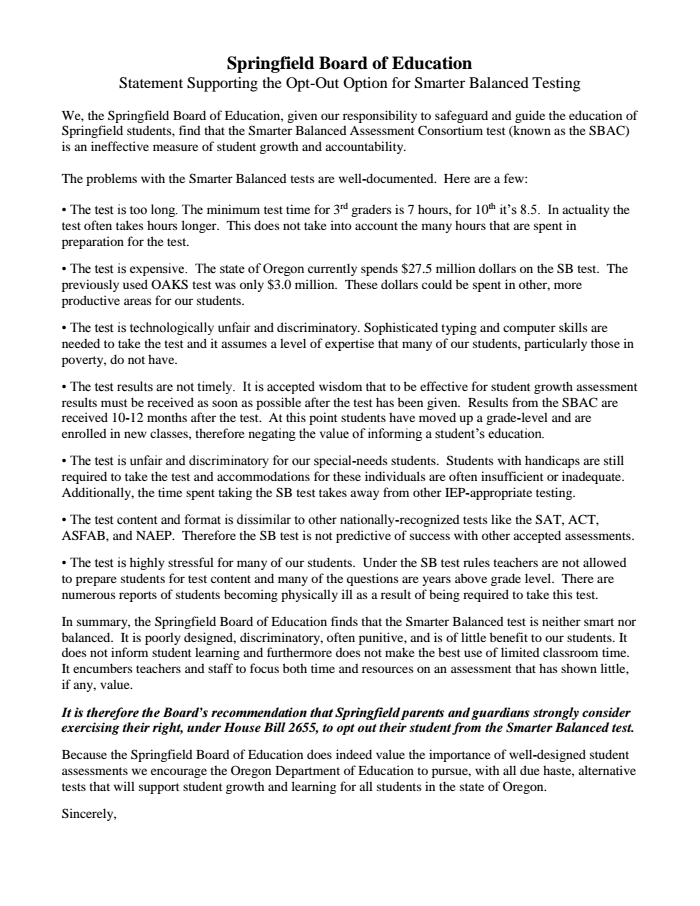
The Springfield School Board on Monday evening urged parents and guardians to allow their children to opt out of the state-mandated Smarter Balanced Assessment Consortium test.
Calling the test an “ineffective measure of student growth and accountability,” the five-member board unanimously approved a statement recommending that parents and guardians “strongly consider exercising their right” under state law to “opt out their student from the Smarter Balanced test.”
The test is designed to assess students’ knowledge of the Common Core standards, a set of learning goals for each grade level that most states, including Oregon, have adopted.
Board Chairman Jonathan Light said the test was never created for students’ benefit.
“It was designed to compare districts and teachers, not to help students learn,” he said. “As a board member, I just don’t feel like it’s OK to encourage our students to participate in something that doesn’t help them in any way.”
Light said he wants other districts to follow suit.
“I really feel like school boards have to stand up for what’s right for their students,” Light said. “We all need to come together and say something. If we could all do it, it would make a huge difference.”
A state law passed last June gives parents the right to opt out their children for at least the next six school years. It requires schools to notify parents and students of that right at the start of each year.
Before last June, parents could opt their children out of the test only because of a disability or religious reasons.
The board’s statement contains a list of what it described as problems with the Smarter Balanced test. They include the test Springfield School Board urges parents to OK student ‘opt-out’ of state Smarter Balanced tests | Local | Eugene, Oregon:


 DOCUMENT

TEXT
Zoom
p. 1
«
Page 1 of  1
»
Springfield-School-Board-Opt-Out-Statement
Contributed by: Chris Frisella, The Register-Guard


Monday, June 13, 2016

Florida Shooter’s Strongest Ally Was The American Gun Lobby | gadflyonthewallblog

Florida Shooter’s Strongest Ally Was The American Gun Lobby | gadflyonthewallblog:

Florida Shooter’s Strongest Ally Was The American Gun Lobby

os-orlando-shooting-pulse-nightclub


“America is absolutely awash with easily obtainable firearms. You can go down to a gun show at the local convention center and come away with a fully automatic assault rifle, without a background check, and most likely without having to show an identification card. So what are you waiting for?”
-American-born al-Qaeda spokesmen Adam Yahiye Gadahn
Omar Mateen considered himself a terrorist.
He wanted to make that clear to posterity before ending a shooting rampage he initiated in Florida yesterday that left 50 dead and dozens more injured – the worst mass shooting in U.S. history (so far).
During the carnage at an Orlando gay nightclub, he allegedly called 911 to pledge his allegiance to ISIS. He just wanted us to know that.
Now that the shooter’s gone, just as he would have wished, pundits are making a lot of this phone call. Though his family claims he wasn’t particularly religious, media Florida Shooter’s Strongest Ally Was The American Gun Lobby | gadflyonthewallblog:


Education and the Commercial Mindset | Deborah Meier on Education

Education and the Commercial Mindset | Deborah Meier on Education:

Education and the Commercial Mindset
mindset
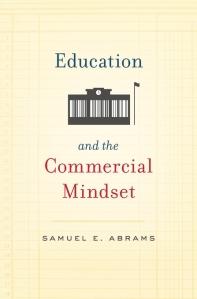
This is book that you should rush out and buy/read. The author, Samuel E. Abrams is currently the director of the National Center for the Study of Privatization in Education, Teachers College, Columbia. When I first saw the title and the source, I did not think it would be a book I would be enthusiastic about.
However, I discovered immediately that the author taught for a number of years at NYC’s Beacon High School, which I know and respect. So I decided maybe my biases were unfair. Indeed I was wrong to be wary. Chapter One should be a must for all those who want (or should want) to understand the period we are in and the issues confronting us. If you can’t imagine reading the whole book—start there. Then decide.
Actually every chapter that follows is important including one on charters with a focus on KIPP—which Abrams is more sympathetic to than I am. But like the rest of the book he presents the issues with lots of documentation and data, and he presents KIPP fairly. He covers considerable territory with some historical background on every topic he deals with for those who love it. His final chapters on schooling in other distant lands focuses on the Nordic nations with a lot, of course, on Finland.
I could quibble with this or that, I won’t until after you’ve had a chance to read it.
The books gave me insights that make me realize the task we face here in the United Statesis in some ways harder. Most of the other countries he describes—and in fact most of the nations in the world—are more homogeneous than the United States. In addition, as Abrams reminds us over and over, none of the nations that get compared with us have anywhere close to the inequality in wealth of the USA, nor the degree of poverty. This shocks me over and over again. It is easier to imagine that what you want for your child should be available to all children when you imagine that all children could be yours. The “others” are too foreign—in all senses—for too many Americans. It is easier to create a sense of grievance—an us versus them mindset in the USA. It is easier to believe that some kinds of families don’t deserve to get the best because they will only misuse it, squander it, or it wouldn’t even be good for them—they need something different (and cheaper).
The countries he describes, he argues, have a very strong sense of the communal Education and the Commercial Mindset | Deborah Meier on Education:


CURMUDGUCATION: Jeb Bush's Education Vision

CURMUDGUCATION: Jeb Bush's Education Vision:

Jeb Bush's Education Vision

After his attempt to be the New Coke of GOP Presidential politics, Jeb Bush has retreated to his signature issue-- privatizing education. He's back at the head of his advocacy group the Foundation for Excellence in Education (FEE), and he's even back to cranking out magazine copy about his vision of a better tomorrow for US schools.

The National Review has given Bush a platform with "Saving America's Education System" (though the URL reads, weirdly, "jeb-bush-education-school-reform-future-disruption-technology"), and it presents one more re-vision of unapologetic reformsterism. So now that Bush has gotten the band back together, will he play some of his greatest hits for us? Let's see.

Don't Throw Money

One of our favorites kicks in in the very first sentence, where Bush notes that the school year has now ended and "another $620 billion has been spent." He follows that up immediately with the observation that we spend more money on education than almost any other industrialized nation. But we still have achievement gaps. Also, Bush will throw in the most bogus of bogus statistics, saying that "only 8 percent of high school grads are truly college and career ready."

That's wrong for several reasons. First, the Education Trust report from which he plucks that statistic actually says that "only 8 percent of high school graduates in 2013 completed a full college- and career-prep curriculum." That is a bizarrely demanding definition of college and career ready that would, for just one example, rule out a student who attended a CTE welding program. But then, Education Trust is a Gates-funded, reform-pushing advocacy group, so it's not surprising that they would push a statistic that is so easily debunked (are 92% of college freshmen in remedial courses and/or flunking out because they were unprepared for college?)

Of course, we don't really know, still, what college and career ready look like. We have no proven 
CURMUDGUCATION: Jeb Bush's Education Vision:


Sticking to Democracy Is Hard - Bridging Differences - Education Week

Sticking to Democracy Is Hard - Bridging Differences - Education Week:

Sticking to Democracy Is Hard


Editor's Note: Bridging Differences will be on a hiatus after this post. It will return in September.
Deborah Meier continues her conversation with Harry Boyte. To read their full exchange, please visit here.
Dear Harry and friends,
Yes, the culture that enables us to maintain democracy is hard to create and sustain. Without it, the society seems always to be "returning" to one or another top-down structure. I use the term "return" because I suspect that some form of "patriarchy"—rule of the "strong"—may be the easier path, the one we too often fall back on in desperate times. "If only" there were a leader who could, we too often complain....
What makes it harder is that few places really believe in the mission of educating people for democracy. It would be odd indeed if schools to prepare cooks never did any cooking, or a shoe-makers training didn't include the making of shoes. I find it equally odd that schools to prepare the young to assume the obligations of running their society—of being members of its ruling class, its citizens—have no opportunity to rule anything (except surreptitiously ruling those weaker than them), or to witness and experience what self-rule is like even for the adults in their world in precisely the institutions designed to prepare them to practice democracy. It's so odd, one is right to question intent. Not even well-educated adults in schools can honestly say to their charges: "The rules in this place are here because we the adults have decided they should be."
While required to argue in behalf of democracy's virtue in running the city, state, and nation, we hardly explain even to ourselves why it won't work in the far less complex setting of school x or y. In 1930 there were 150,000 school boards with significant authority. Today there are fewer than 15,000, while the population has doubled. That shift was man-made. In fact, the idea that those closest to the life of the school are provided with virtually no power and those furthest from the individual school are given substantial power is taken for granted today. What is taught, what is important and what not, how to assess it, how its members are disciplined, how long recess will be if at all, how to choose its employees and principals, as well as how to fire them, what and how families can or can't be involved, etc., are not even in the hands of most principals, who in turn are accountable not to his or her constituents but to superintendents, mayors, legislators, powerful foundations, et al.
Democracy may be the greatest invention. But is it too complicated to expect it to work in an individual school?
It's related to the difference between "organizing" and "mobilizing." Even organizing rests essentially on to what degree the people have "organized themselves." The term "self-governance" implies this, but does it represent what really happens? It's why I've never liked the term "change agent"—and even find "organizer" suspect.
When one's independence is fragile, if nonexistent, and one's family's safety dependent almost totally on others, democracy looks utopian. Solidarity is a response to such powerlessness. This too is risky. It takes a leap of faith that is not always easy to call upon. Example: A timid teacher asks me if I will present her grievance at the next principal-led meeting. I agree. But after I have presented her grievance the principal asks, "Who else is worrying about this?" Silence.
And this happened even though the formal rules of the game protected her from retribution. But it requires a "culture" of solidarity and democracy—in the union and the staff—that even schools, especially schools, discourage.
Designing and sustaining such a culture for a single school, within a system operating otherwise, is tough. This past month, having watched a small democratically designed NYC school being wiped out—even if sometimes for "good reasons" that do not, however, convince those on site—I'm reminded, Harry, of your other point. Over and over one has to start where people are, to get to know and care for each other, which is an advantage small schools like CPE have had. CPE, for example, was started without a principal position and with fewer than six to seven classrooms in mind. The city eventually demanded a licensed principal and a larger population. Still, it received flexibility from the union contract, e.g., with regard to staff decisions on many issues generally spelled out in a contract and from an unusual local district re: curriculum and much else. But its democratic internal life became ever thinner.
What such schools often counted on, alas, was a godfather with the singular power to give needed protection. A thin reed to rest on for a healthy democracy.
I'm watching the decline of schools like CPE after more than 40 years—endangered as well by gentrification, privatization, and standardization. But there are new efforts afoot to take back "subsidiarity"! (Look it up. It's a useful concept for our times.) We will, I see it emerging, rebuild a force within our public schools, and maybe some of the mom and pop charters, on behalf of a simple idea: Education for democracy works when it's for, by, and of the people.


Ed Dept Proposes New Regulations to Protect Students and Taxpayers from Predatory Institutions

Education Department Proposes New Regulations to Protect Students and Taxpayers from Predatory Institutions | U.S. Department of Education:

Education Department Proposes New Regulations to Protect Students and Taxpayers from Predatory Institutions


The Department of Education today proposed regulations to further protect student borrowers and taxpayers against predatory practices by postsecondary institutions. The regulations clarify, simplify, and strengthen existing regulations that grant students loan forgiveness if they were defrauded or deceived by an institution. The proposed regulations would also hold financially risky institutions accountable for their behavior and ban schools’ use of legal clauses to sidestep accountability.
This new regulatory effort builds on the Obama Administration's commitment to protect taxpayers' and students' investments and ensure that all Direct Loan borrowers can engage in a process that is efficient, transparent and fair when applying for a loan discharge based on the misconduct of the institution.
“We won’t sit idly by while dodgy schools leave students with piles of debt and taxpayers holding the bag,” said U.S. Secretary of Education John B. King Jr. “All students who are defrauded deserve an efficient, transparent, and fair path to the relief they are owed, and the schools should be held responsible for their actions.”
The proposed regulations would streamline relief for student borrowers who have been wronged and create a process for group-wide loan discharges when whole groups of students have been subject to the misconduct. They also establish triggers that would require institutions to put up funds if they engage in misconduct or exhibit signs of financial risk.
Additionally, the proposed regulations require financially risky schools and proprietary schools in which students have poor loan outcomes to provide clear, plain-language warnings to prospective and current students, and the public. The rules also make it simpler for eligible students to receive closed-school discharge.
Finally, in a major step to protect student borrowers and prevent schools from shirking responsibility for the injury they cause, the proposed regulations would prohibit the use of so-called mandatory pre-dispute arbitration clauses and class action waivers that deny students their day in court if they are wronged. Under these regulations, schools would no longer be able to use their enrollment agreements, or other pre-dispute arbitration agreements or clauses in other documents, in order to force students to go it alone by signing away their right to pursue relief as a group, or to impose gag rules that silence students from speaking out.
“These regulations would prevent institutions from using these clauses as a shield toskirtaccountabilityto their students, to the Department and to taxpayers,” saidU.S.Under Secretary of Education Ted Mitchell.“By allowing students to bringlawsuits againstaschool for alleged wrongdoing,the regulations removethe veil of secrecy, create increased transparency, and give borrowers full access to legal redress."
Last September, the Department began a negotiated rulemaking process to clarify how Direct Loan borrowers who believe they have been wronged by their institutions can seek relief and to strengthen provisions to hold colleges accountable for their actions. Current provisions in federal law and regulations allow borrowers to seek discharge of their Direct Loans if their college's acts give rise to a state law cause of action.
The third and final session of negotiated rulemaking was held in March, but the committee did not come to a consensus on a draft of the rule. The Department took the committee’s feedback into account when drafting this proposed regulation.
The proposed rule publishes in the Federal Register on June 16, and the public comment period ends Aug. 1. The Department will publish a final regulation by Nov. 1.
The proposed regulations build on years of work by the Obama Administration to protect students and taxpayers from fraudulent or failing institutions of higher education. Those efforts include the landmark Gainful Employment regulations ending Federal student aid eligibility for career colleges that are not paying off for their students, establishing tougher regulations targeting misleading claims by colleges and incentives that drove sales people to enroll students through dubious promises, requiring States to step up their oversight through the state authorization regulation, creating a new Enforcement Unit to protect students and taxpayers from unscrupulous colleges, and calling for improved accreditation practices that focus on student outcomes.Education Department Proposes New Regulations to Protect Students and Taxpayers from Predatory Institutions | U.S. Department of Education:
 More Resources

Crowded field for Washington schools chief race | KOMO

Crowded field for Washington schools chief race | KOMO:

Crowded field for Washington schools chief race 

160612_dorn'.jpg
SEATTLE -- There's a crowded field of candidates vying to be Washington's next superintendent of public instruction, but the three top candidates all bring something new to the contest.
The list includes a lawmaker and community college administrator, an award-winning teacher and administrator, a school nurse who runs the school health program across the state, and six others who mostly want to have their voices heard.
Incumbent Randy Dorn has decided not to seek re-election, leading several candidates to enter the field.
Chris Reykdal, who has represented Tumwater in the state Legislature for five years, would be the first superintendent in recent history with children in public school if elected.
Erin Jones, who works for the Tacoma School District as a teaching coach and program administrator, is the first African-American woman to run for statewide office in Washington state.
Robin Fleming, who runs Office of Superintendent of Public Instruction's health services program, would be the first nurse to become superintendent of public instruction.
Only Reykdal, Jones and Fleming have raised more than a few hundred dollars for their campaigns, according to the state Public Disclosure Commission, although a fourth candidate who dropped out of the race also had raised thousands of dollars.
The field will be narrowed in the Aug. 2 state primary. The top two candidates will advance to the Nov. 8 general election.
The three leading candidates bring different approaches to the job held by Dorn for the past eight years. Dorn, a former lawmaker and union official, was hard to miss in Olympia and made sure his views were heard by lawmakers and the Washington Supreme Court, which decided in 2012 that the way the state pays for public schools was unconstitutional.
Fleming says she would leave the work of how to finish answering the Supreme Court's so-called McCleary decision up to lawmakers and would not follow Dorn's more bombastic Crowded field for Washington schools chief race | KOMO:


We Can Recover From The School Choice Movement | Dr. Edward F. Berger

We Can Recover From The School Choice Movement | Dr. Edward F. Berger:

We Can Recover From The School Choice Movement


We have over 20 years of data about charter schools (partial schools) and how they have benefited or damaged public education and children. Originally, the purpose of charter schools was to free educators with new insights and give them the support they needed to create education programs that would improve our public schools. Many effective educators believed they could demonstrate ways to break out of the old top-down coercive systems (the factory system) and make our public schools more effective. Now, after 20+ years of experimenting, we must identify the effective charter schools and make certain that what they have learned and demonstrated is integrated into our comprehensive schools.
“Choice” is a marketplace idea wrongly applied to education. The assumption that most parents have the information they need to make intelligent decisions about the education their children need, and the education children need to be effective citizens, has been proven wrong. School choice has failed to improve our schools. In fact, choice has created a chaos of confusion for parents who have risked (gambled) on moving their children out of comprehensive education programs to place them in partial education programs. The costs of these misguided experiments is evident in high dropout rates, incomplete educations, and damaged children. Criminal activities created by intentional lack of accountability and unfettered access to our public tax dollars is horrendous. In addition, the experiment has resulted in massive duplication of services that sap money needed for our children and increase the cost of education for no valid reasons.
Politicians, ideologues, so-called libertarians, and crooks attracted by profit motives, took over the charter school experiment. They decided, with no educational data to back their decisions, that charter schools, regardless of whether they worked for children or not, whether they served America’s need for an educated populous or not, would become stand-alone schools that could be run with little accountability, certification, or even democratically elected boards. Now, tax money is often used to create private Real Estate empires. Our tax dollars that we pay for children and their education are siphoned off to individuals, corporations, and companies that contract with charters to provide “services.” Is it any wonder that hedge fund operators and the self-appointed reformers see charter schools and outfits like K-12 as income generators? Is it any wonder that the FBI and other law enforcement agencies cannot keep up with the criminal activities of those milking the system? These thefts are criminal even if approved by legislatures. Are you surprised that the largest Charter School operator in America is a We Can Recover From The School Choice Movement | Dr. Edward F. Berger:


A void in oversight of charter schools (By Wendy Lecker) - Wait What?

A void in oversight of charter schools (By Wendy Lecker) - Wait What?:

A void in oversight of charter schools (By Wendy Lecker)


Surprise!  Connecticut taxpayers are giving privately owned and operated charter schools more than $110 million a year, with little to no oversight.  Meanwhile, Connecticut Governor Dannel Malloy and the Democratic controlled state legislature are implementing the deepest cuts in state history to Connecticut’s public schools.  The budget cuts, along with the inadequate funding allocated for public schools mean Connecticut’s public school students will be getting less, while local property taxpayers will be charged even more.
In another MUST READ piece, public education advocate and columnist Wendy Lecker reports on the void in oversight of Connecticut’s charter schools.
Wendy Lecker writes;
One would think that after the scandals involving Connecticut’s two large charter chains, Jumoke and Achievement First, Connecticut’s education officials would finally exert some meaningful oversight over Connecticut’s charter sector.
One would be wrong.
This week the Connecticut Mirror reported that Education Commissioner Dianna Wentzell dismissed a complaint against Bridgeport Achievement First, for using uncertified teachers for 47 percent of its staff, in violation of Connecticut statute. Wentzell unilaterally decided that the law allowing complaints against public schools does not apply to charters; despite the fact that charters receive more than $100 million each year in public taxpayer dollars.
Wentzell disregarded the data showing Achievement First’s misdeeds, claiming the State Department of Education (SDE) will wait until the charter 
A void in oversight of charter schools (By Wendy Lecker) - Wait What?:


CURMUDGUCATION: An Educated Person

CURMUDGUCATION: An Educated Person:

An Educated Person


A while back, blogger Starr Sackstein took a whack a two part question-- has the definition of an educated person changed, and should our education delivery system change with it. My gut reaction, my visceral answer, is "Not really, and not really." But I didn't really have anything to back up my gut, so I've been mulling over this for a while. What were my viscera thinking when they passed along this answer.

Part of my reaction is to some embedded assumptions that Sackstein includes in the question. She contemplates the twelve years of education in various disciplines, and then pivots to larger questions:

Upon successful completion of high school, being "educated" meant a student went to a college of his/her choosing to major in a subject area that would yield a respectable job and potentially go on to higher education to ensure relevancy in his/her career path.  

Students in my generation and earlier generations did this dutifully, if being "educated" was a value they or their families' held.

I'm not sure I buy this narrative, particularly if we go back a few generations. High schools only really caught on during the period between 1910 and 1940 (ish). You can find a variety of numbers, but the basic pattern is evident-- in 1910 only about 20% of US teens were enrolled in high school, and only about half of those finished. The Depression kicked the crap out of high school education, with teachers widely unemployed and many school districts simply shutting down. By 1940, high school attendance was still far, far short of 100%.

And if we're talking about college education, while it's stylistically appropriate for Sackstein to use "his/her," in 1947 barely half a million women went to college. In 1970, roughly a third of all 
CURMUDGUCATION: An Educated Person: