Latest News and Comment from Education

Tuesday, June 7, 2016

Schott’s National Opportunity To Learn Campaign | Education Reform For Equity And Opportunity

Schott Foundation for Public Education:


Schott’s Opportunity to Learn Network

We work to unite a growing coalition of advocates and organizers from across the country working to ensure that all students have access to a high quality public education.
The OTL Network includes local, state and national organizations, grassroots community leaders, policymakers, youth organizers, business leaders and philanthropic partnersLearn more about our OTL Network
The Boston Alliance of LGBTQ Youth (BAGLY)
BAGLY: The Boston Alliance of Gay, Lesbian, Bisexual and Transgender Youth, is a youth led, adult supported social support organization, committed to social justice, and creating, sustaining and advocating for programs, policies and services for the LGBTQ youth community.http://www.bagly.orghttps://www.facebook.com/baglyhttp://twitter.com/baglyincRegion: Northeast
Philadelphia Student Union
The Philadelphia Student Union is a youth-led organization that builds the power of young people to demand a high quality education in the Philadelphia public school system.http://www.philadelphiastudentunion.orghttps://www.facebook.com/215studentunion/https://twitter.com/215studentunionRegion: Northeast
Massachusetts Communities Action Network (MCAN)
Massachusetts Communities Action Network (MCAN) is a network of faith-based community organizations in MA working for economic and racial justice.http://www.mcan-pico.org/https://www.facebook.com/mcanpicohttps://twitter.com/mcanpicoRegion: Northeast
Kids Rethink New Orleans Schools
Kids Rethink New Orleans Schools is a youth organizing and leadership development organization that uses participatory education and action research to build organizing and leadership skills of New Orleans youth.http://www.therethinkers.orghttps://www.facebook.com/kidsrethink/https://twitter.com/RethinkNOLARegion: South
Families and Friends of Louisiana’s Incarcerated Children (FFLIC)
Families and Friends of Louisiana’s Incarcerated Children (FFLIC) is a grassroots membership-based organization working to transform the systems that put children at risk of prison.http://www.fflic.orghttps://www.facebook.com/FFLICLA/https://twitter.com/ffliclaRegion: South
Executives' Alliance to Expand Opportunities for Boys and Men of Color
The Executives’ Alliance is a national philanthropic alliance that will evaluate promising approaches, advocate for effective public policy and systems change, and invest in young men as assets for America’s future.http://bmafunders.org/alliance/Region: National
Education Voters of Pennsylvania
Education Voters Pennsylvania works to ensure our political leaders adopt and implement a pro-public education agenda. Ed Voters PA holds political leaders accountable if they fail to do so and supports elected officials who lead the way to high quality public education. http://www.educationvoterspa.org/https://www.facebook.com/ed.v.pahttps://twitter.com/edvoterspaRegion: Northeast
BreakOut!
BreakOUT! seeks to end the criminalization of lesbian, gay, bisexual, transgender, and questioning (LGBTQ) youth to build a safer and more just New Orleans.http://www.youthbreakout.org/http://www.facebook.com/YouthBreakOUThttp://www.twitter.com/youthbreakoutRegion: South
Coalition for Educational Justice
Led by parents, the NYC Coalition for Educational Justice is organizing a movement to end the inequities in the city’s public school system. CEJ is a collaborative of community-based organizations and unions whose members include culturally diverse parents, community members, students and educators.http://www.nyccej.orghttps://www.facebook.com/NYCCEJhttps://twitter.com/cejnycRegion: Northeast
Arkansas United Community Coalition (AUCC)
Founded in 2010, AUCC works to build capacity in Arkansas’ immigrant and multiethnic communities through grassroots organizing, trainings, awareness- and coalition-building campaigns and guided practice in community building.http://arkansascoalition.orghttps://www.facebook.com/Arkansas-United-Community-Coalition-184442584967912/http://twitter.com/aucc_arkansasRegion: South
Schott Foundation for Public Education:


The civil rights problem in US schools: 10 new numbers | 89.3 KPCC

The civil rights problem in US schools: 10 new numbers | 89.3 KPCC:

The civil rights problem in US schools: 10 new numbers

129505 full
LA JOHNSON/NPR
It's a rare and remarkable view into America's public schools and the challenges that continue some 60 years after Brown v. Board of Education: The Civil Rights Data Collection survey.
Since 1968, the federal government has been sending it to the nation's schools to gauge educational access and enforce civil rights law.
Today, the U.S. Education Department released its 2013-2014 CRDC results, covering more than 95,000 schools and 50 million students.
Needless to say, there's a lot to wade through, but these are some of the numbers that jumped out at us (links are to previous NPR coverage).
  • 49.7 percent of public school students are students of color: 24.7 percent Hispanic or Latino of any race, 15.5 percent black or African-American, 4.8 percent Asian, 3.1 percent two or more races.
  • 6.5 million students missed 15 days of school or more. That's 13 percent of all students and 18 percent of all high school students. This chronic absenteeismindicator is new to this year's report.
  • Black preschoolers are 3.6 times more likely to be suspended than white preschoolers.
  • 51 percent of high schools with high black and Latino enrollment also haveassigned police officers.
  • 1.6 million students attend a high school with a police officer but no guidance counselor.
  • Black students are 2.3 times more likely than white students to be referred to law enforcement or arrested as a result of a school incident.
  • Fewer than 3 percent of English language learners are in gifted programs, though they make up 11 percent of students at the schools that offer those programs. Similar disparities exist for black and Hispanic students.
  • For the first time, the Education Department asked about educational services for young people in justice facilities, including jails and prisons. 21 percent of these facilities offer less than a full school year of instruction.
  • Black and Latino students make up 38 percent of those enrolled at schools that offer AP courses — but less than a third of students taking AP courses. Similar disparities were found in advanced math and science courses like chemistry, physics, algebra II and calculus.
  • In schools with high black and Latino enrollment, 10 percent of teachers were in their first year, compared to 5 percent in largely white schools.


 The civil rights problem in US schools: 10 new numbers | 89.3 KPCC:

Millions of U.S. Students Chronically Absent | US News

Millions of U.S. Students Chronically Absent | US News:

Millions of U.S. Students Chronically Absent

18 percent of high school students are chronically absent.


 Nearly 1 in 5 high school students is "chronically absent" from classes, and the percentage of students who miss at least 15 days in the course of an academic year only rises among students of color.

The findings, Secretary of Education John King said, “tear at the moral fabric of the nation.”
“These data should serve as a sobering reality check,” he said on a press call Monday.
The data come from the latest release from the Education Department’s Office for Civil Rights. The biennial data set provides a snapshot of the education experiences of more than 50 million students in 95,000 schools across the U.S. during the 2013-2014 school year.
“The civil rights data collection shows a picture of opportunity offered and opportunity denied and to whom,” said Catherine Lhamon, the assistant secretary at the Office for Civil Rights. “It represents the real experiences of real students.”
For the first time, the data set includes in-depth information on chronic absenteeism, as defined by students who miss 15 or more of the school year's roughly 180 days.
In total, more than 6.5 million students – 13 percent of all students in the U.S. – are chronically absent. That figure includes 18 percent of all high school students, or 3 million students, and 11 percent of elementary school students, or 3.5 million students.
In high school, 20 percent or more black, Latino, American Indian or Alaskan Native, and Native Hawaiian or Pacific Islanders are chronically absent, as are multiracial students and those still learning English.
The data also show that chronic student absenteeism exists where the majority of teachers are also frequently absent. For example, black students represent 15 percent of all students, but 21 percent of chronically absent students who attend schools where more than half of teachers were absent for more than 10 days.
“These data are a call for action and an urgent call for action,” King said “Particularly distressing are the numbers for students of color. When you think about the impact, more than one-fifth of African-American students in high school being chronically absent Millions of U.S. Students Chronically Absent | US News:

16 Schools Where Students Opted Out of Tests Got Penalized by State - Windsor Terrace - DNAinfo New York

16 Schools Where Students Opted Out of Tests Got Penalized by State - Windsor Terrace - DNAinfo New York:

16 Schools Where Students Opted Out of Tests Got Penalized by State


BROOKLYN — The state has penalized 16 high-performing city schools — potentially costing them each up to $75,000 in grant money — because of their exam opt-out rates, DNAinfo New York has learned.
These schools were on track to win recognition from the state as“Reward Schools" — an annual honor that makes schools eligible to apply for grants — but were not included in the list because they failed to meet a 95 percent participation rate on the exams, state education officials confirmed. 
“While U.S. Department of Education [USDE] guidelines allow states to impose sanctions on districts specifically for failure to meet participation requirements [of the tests], including the withholding of state funds, New York State has not taken such action against any district or school,” State Education Department spokeswoman Jeanne Beattie said.
“However, under New York’s flexibility waiver approved by USDE in 2010, a school must meet all applicable participation rate requirements to be designated as a Reward School and therefore eligible for a grant.”
The move is at odds with public promises not to penalize schools, teachers or students in any way for choosing to opt out of the controversial tests.
Gov. Andrew Cuomo said in August: "I don’t believe there are sanctions for opt-outs. And parents, at the end of the day, parents are in charge and parents make the decisions."
And Public Advocate Letitia James, this April, wrote a letter to families, stating: “I want to remind you that, as parents, you have the right to opt your child out of this exam with no consequences to you, your child, or your child’s school."
And, in a bid to calm parents' concerns about the test, the state temporarily discontinued using the tests to evaluate teachers and lifted time limits on the test for all students.
The state declined to release the full list of schools it shut out of the Reward Schools list.
However, DNAinfo learned of several schools that were dropped in Brooklyn’s District 15 — which spans from Boerum Hill to Park Slope and Sunset Park and has among the 16 Schools Where Students Opted Out of Tests Got Penalized by State - Windsor Terrace - DNAinfo New York:


Transgender Teacher: 'Being Trans Isn't Anything to be Ashamed of'

Transgender Teacher: 'Being Trans Isn't Anything to be Ashamed of':

Transgender Teacher: ‘Being Trans Isn’t Anything to Be Ashamed of’

Dusty Rader

Last month, Connecticut teacher Dusty Rader had a “teachable moment” with his students at Avon High School in Avon, Conn. During a school-wide conversation about school climate and bullying, and talk of the recent North Carolina law that prohibits transgender people from using bathrooms that match their gender, Rader told his students that he is transgender. “I don’t think I have anything to hide from my students, and I don’t want them to think I do. My mantra is that being trans isn’t anything to be ashamed of.” Recently, Rader talked to NEA Today about his coming out, and how his fellow educators across the U.S. can support their transgender students.
So you recently made a very significant, personal announcement to your students. What prompted that discussion, and how did it go?
DR: My principal had been talking for a couple of days with the kids about bullying and school climate… I was listening to him, and thinking a lot of stuff is going on, especially in North Carolina. Also I was thinking I want to be open with the kids. I want them all to know that they can be proud of who they are. So I used his conversation about bullying to say that what’s happening in North Carolina is the work of bullies who haven’t been stopped, and that their bullying of trans people affects real people. In fact, it affects me!
For a lot of the kids, the thing in North Carolina wasn’t a tangible thing until I said something. One said he’d never thought of it as something that affected ‘real’ people until then. Of course a lot of them were like, ‘What? I never guessed!’
Tell us a little about your own experience as a student, coming out as a transgender man…
DR: I came out in November 2008, during my senior year of high school. I already presented as male, so what changed then was the language. My chosen pronouns became ‘he/him.’ For me, I had a lot of support, and I didn’t have much trouble. I was in a public school, Glastonbury (Conn.) High School, and I know there were definitely teachers there who would have stood up for me if I had problems. There were teachers who were like, ‘If that’s who you are, that’s who you are, and we’re going to support you no matter what.’
I had it really easy, but I know a lot of people who didn’t. I have a friend who dealt Transgender Teacher: 'Being Trans Isn't Anything to be Ashamed of':


Privacy advocates accuse Obama administration of failing to properly protect student data - The Washington Post

Privacy advocates accuse Obama administration of failing to properly protect student data - The Washington Post:
Privacy advocates accuse Obama administration of failing to properly protect student data


A coalition of organizations and individuals concerned about student privacy rights is accusing the Obama administration of failing to properly protect student data from unauthorized disclosure and is petitioning the Education Department to strengthen a federal law to prevent the unauthorized disclosure of kids’ personally identifiable information.
The petition, sent to U.S. Education Secretary John King, says changes made to the Family Educational Rights and Privacy Act, known as FERPA, over the past several years have allowed education agencies and organizations to share student data with third parties without permission from students or their parents. It also says that the department has failed to protect data from major breaches, which have occurred at a number of schools and colleges.
Here are some of the examples of data breaches given in the petition:
* A University of Maryland database containing 287,580 student, faculty, staff and personnel records was breached in 2014; the “breached records included name, Social Security number, date of birth, and University identification number.” The breached records included records going as far back as 1992.
* In 2015, unauthorized individuals gained access to the University of Berkeley’s Financial System and gained access to Social Security numbers and bank account information for approximately 80,000 students, vendors, staff, and current and former faculty. By some estimates, the breach impacted “approximately 50 percent of current students and 65 percent of active employees.”
* Indiana University also reported that it had stored names, addresses and Social Security numbers for “approximately 146,000 students and recent graduates” in an “insecure location” for almost a year, thus potentially exposing students to identity theft and other forms of fraud.
The petition asks that the Education Department establish new rules within FERPA for encryption, privacy-enhancing techniques and breach notification. Among the signatories are the members of the advisory board of the Electronic Privacy Information Center, a Washington, D.C.-based nonprofit public interest research group that focuses on civil liberties issues and the First Amendment, as well as groups including the American Association of School Librarians and the Consumer Federation of America.
The Education Department has come under stern criticism from Congress and its own Inspector General’s Office for its handling of student data. In a 2014 report, the department’s Inspector General’s Office said:
“While the Department made progress in strengthening its information security program, many longstanding weaknesses remain and the Department’s information systems continue to be vulnerable to serious security threats.
In November, lawmakers at a hearing held by the full House Oversight and Government Reform Committee, took Danny Harris, the chief information officer of the Education Privacy advocates accuse Obama administration of failing to properly protect student data - The Washington Post:


They stole the fricking school bus seat belt money again! - Wait What?

They stole the fricking school bus seat belt money again! - Wait What?:

They stole the fricking school bus seat belt money again!

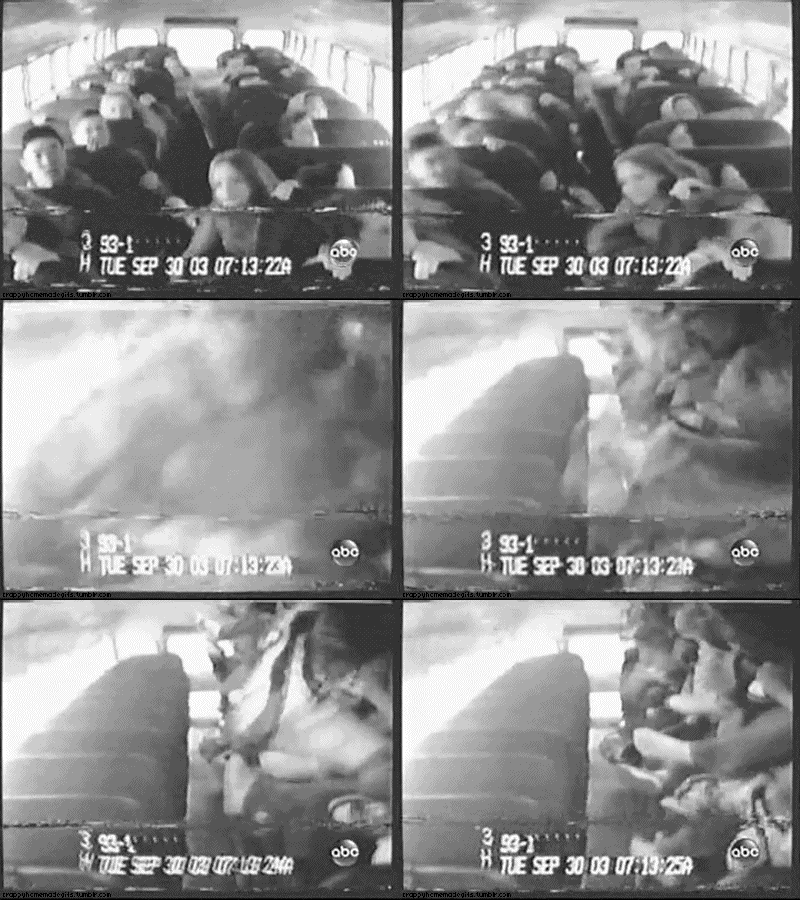
Hidden deep inside the new state budget bill negotiated by Governor Dannel Malloy and Democratic legislative leaders, and approved last month by the Democrats in the General Assembly, was a provision that, once again, transferred the money that had been set aside to help school districts retrofit school buses with seat belts into the general fund.
As Wait, What? readers know, this is not the first time Governor Malloy and the Democrats have stolen the School Bus Seatbelt Account in order to make the state budget balance.
Since taking office, Malloy has reached into the special school seat belt fund four times, grabbing close to $10 million dollars.
Rather than use the funds for their intended use – to protect our children – Malloy and the Democrats simply grabbed the money to plug holes in the state budget.
This time, rather than adopt a fair and honest budget, the Democrats added Section 28 to Senate Bill 501 which “transferred” $2 million from the School Bus Seatbelt Account to the General Fund.  The legislature also swept $2 million from the Seat Belt fund to address a small part of the $250 million Fiscal Year 2016 budget deficit.
Previous Wait, What articles on this issue can be found via the following links:
The Train Wreck of the Democrats’ State Budget. [Or for long-time Wait, What? readers file under – Not the Fricking School Bus Seat Belts again!] (6/3/2015)
The School Bus Seat Belt Account was created following the tragic January 2010 school bus accident on Route 84 in Hartford that killed a Rocky Hill student who was attending one They stole the fricking school bus seat belt money again! - Wait What?:


Was LA Times Practicing Independent Journalism When They Ranked Teachers? - Living in Dialogue

Was LA Times Practicing Independent Journalism When They Ranked Teachers? - Living in Dialogue:

Was LA Times Practicing Independent Journalism When They Ranked Teachers? 


By Anthony Cody.
A fresh debate has emerged in the aftermath of the Los Angeles Times’ critique of the Gates Foundation’s education reform project. As I noted here, they seem to have forgotten their own role in promoting the Gates Foundation’s efforts – namely, their “Teachers investigation,” in which they hired an economist, and using several years of test score data, generated and published their very own VAM ratings for thousands of Los Angeles teachers.
Here was the debate on Twitter:
I tweeted my post:
LA Times Criticizes Gates & Deasy, Forgets OWN rolehttp://www.livingindialogue.com/la-times-criticizes-gates-deasy-forgets-role/ 
Alexander Russo retweeted this, adding: The publication of teachers’ scores is one of the most questionable pieces of edjournalism of the last decade. (and he has posted a followup here.)
I replied: thank you. These ‘journalists’ won 2nd place award fr. EWA for this hatchet job on teachers
Greg Toppo, who covers education for USA Today, and is Vice President of the Education Writers Association, replied:
“Say what you will about the stories. They are not journalists in quotes.”
To which I replied:
“If you define journos so as to exclude bloggers due to the latter’s advocacy, that applies to LAT also.”
Greg Toppo then replied:
“No. Journos, LAT included, go where evidence sends them, sometimes badly but always independently.”
So let’s dig in a bit here, because obviously Twitter is not the place to reach any real clarity.
A bit of context underscores why it is useful to delve into the ethics of this work. I have been engaged in a bit of a debate with the leaders of the Education Writers Association for the past couple of years, since they Was LA Times Practicing Independent Journalism When They Ranked Teachers? - Living in Dialogue:


CURMUDGUCATION: Maybe Old Teachers Don't Suck

CURMUDGUCATION: Maybe Old Teachers Don't Suck:

Maybe Old Teachers Don't Suck

A repeated refrain among some reformsters is that we need to get rid of tenure, job protections, and seniority rules for teachers because the system is clogged with washed-up uncaring has-beens and when budgets are slashed and staffing is cut, it's the hot young rock stars of education that are thrown out on the street (oddly enough, their concern over this issue never translates into calls to knock it off with the budget slashing, but that's another conversation).

But what if older teachers didn't suck?

This month the Learning Policy Institute released a new research brief, Does Teaching Experience Increase Teacher Effectiveness? The report is a meta-analysis, a study of studies that looks at thirty studies over the last thirty years. And it turns out that maybe older teachers don't suck.


I'm going to start with my usual caveat-- many of these studies use student scores on the Big Standardized Test as a proxy for student achievement or teacher effectiveness or general swellness of the school, and it needs to be said that this is crap. The BS Tests are not a measure of student achievement; they are a measure of student ability to take BS Tests. We'll be able to accomplish a lot more in the world of teacher training, development, and effectiveness when we start talking about the real marks of excellent teaching instead of this standardized test baloney. But test scores are the measure reformsters have chosen, and I'm provisionally willing to use reformster tools to disprove reformster policy ideas, because if they can't win on their own court with their own ball and their own rules, that's just further proof that they should get out of the game.

That said, here are what study authors Tara Kini and Anne Podolsky found.

1) Teacher experience raises student "achievement" throughout the teacher's career. The gains are 
CURMUDGUCATION: Maybe Old Teachers Don't Suck:


Schools Matter: Gulenist Caprice Young lies in a Magnolia Science Academy Press Release

Schools Matter: Gulenist Caprice Young lies in a Magnolia Science Academy Press Release:

Gulenist Caprice Young lies in a Magnolia Science Academy Press Release


“Magnolia should be ashamed of this reprehensible behavior; attempting to use innocent students and parents as human shields to hide their criminal activity” — Robert Amsterdam, Esq.
This video segment is significant in that Gülenist Caprice Young claimed in her most recent "press release" and "protest" smear of those investigating her corporate charter cult that LAUSD had found no connection between Magnolia Science Academy (MSA) and the Gülen charter network. The video puts to lie Young's assertion. Clearly there was an intentional misrepresentation in Magnolia's press release.
The same MSA press release stated that LAUSD has never found any irregularities with Magnolia's finances. This assertion, repeated by Young on numerous occasions, is an intentional misrepresentation on both her and the corporate charter chain's part.
Magnolia, its parent Pacifica Institute, and their cult leader Fethullah Gülen are all high profile Armenian Genocide deniers. To make matters worse, their entire public relations campaign is paid for with money that is supposed to be used in classrooms. 


Big Education Ape: KILLING ED: 120 American Charter Schools and One Secretive Turkish Cleric - http://bigeducationape.blogspot.com/2016/01/killing-ed-120-american-charter-schools.html

Big Education Ape: Update: Gulen Harmony charter school network accused of bias and self-dealing Dallas Morning News - http://go.shr.lc/1qV85Hm
Big Education Ape: Turkey Links Texas Charter Schools to Dissident - WSJ - http://go.shr.lc/1OW1ZfV

Big Education Ape: Magnolia Science Academy - A Gulen Charter School: Gulen Magnolia Science Academy links discussed at LAUSD board meeting - http://bigeducationape.blogspot.com/2016/06/magnolia-science-academy-gulen-charter.html

LA Returns Schools to Local New Orleans Board; But Schools Remain Charters, Still Unequal | janresseger

LA Returns Schools to Local New Orleans Board; But Schools Remain Charters, Still Unequal | janresseger:

LA Returns Schools to Local New Orleans Board; But Schools Remain Charters, Still Unequal


You may have read that Louisiana Governor John Bel Edwards signed a law in mid-May to shut down the Louisiana Recovery School District and return schools to the locally elected school board. Like me, you may also have wondered what this will mean in a district where all the schools are now charter schools. Will the charter schools once again become traditional public schools? Not a chance. What has happened is that an extra layer of state intrusion into the affairs of the school district has been eliminated. The rest is not yet clear.
Here is how some people have tried to explain the transition, beginning with Emma Brown in the Washington Post: “Many charter school advocates describe it as an inevitable next step in the city’s bold education experiment, and one that could serve as a road map for other cities grappling with how to manage and coordinate a large number of charter schools… But some critics say it is a whitewash, written to appear as if local control over public education will be restored when the bill really leaves most of the power in the hands of the unelected boards of directors who run each of the city’s charter schools…  (T)he parish school board—which already runs a half-dozen schools and oversees more than a dozen charter schools—would be prohibited from interfering with school-level decisions about a litany of issues, including instruction, schedules, staffing, contracting and collective bargaining.  Instead, the district superintendent and board members would be responsible for reviewing schools’ performance and deciding whether they have met their targets and should be allowed to continue operating.”
Mercedes Schneider, a New Orleans teacher and blogger describes the transition a little more technically, but it still isn’t clear how it all will work: “The charters to be returned can petition the local school board and state board for permission to act as their own independent school board (‘local education agency,’ or LEA). If approved, then the charter acting as its LEA will be overseen directly by the state. The state board is to establish administrative procedures so that the state superintendent has the authority to revoke a charter’s LEA authority and return it to the local school board. The state board is to determine financial and other conditions that the LEA charters must meet in order to continue to receive public money. Any charters (whether choosing to act as their own LEAs or not) will continue to have control over issues such as LA Returns Schools to Local New Orleans Board; But Schools Remain Charters, Still Unequal | janresseger: