Latest News and Comment from Education

Monday, June 6, 2016

A Lost Generation of North Carolina Children Due to Greed and Privatization of Public Schools

Public schools feel threat from push for vouchers and for-profit charter schools | News & Observer:
A Lost Generation of North Carolina Children Due to Greed and  Privatization of Public Schools


Q&A With Education Secretary John B. King Jr.: ESSA and More ESSA - Politics K-12 - Education Week

Q&A With Education Secretary John B. King Jr.: ESSA and More ESSA - Politics K-12 - Education Week:

Q&A With Education Secretary John B. King Jr.: ESSA and More ESSA


U.S. Secretary of Education John B. King Jr. sat down with Politics K-12's Alyson Klein in his office late Friday afternoon to talk about the many twists and turns in implementation of the new Every Student Succeeds Act, as well as a few broader issues. King's reputation as a policy nerd is earned. He dives pretty deep into the weeds here. Some broader questions come toward the end of the interview—we've marked the turning point if you want to skim. 
Here's an abridged transcript of our chat. For clarity's sake, we've paraphrased the discussion that followed some questions; in those cases we've set off portions of King's responses in direct quotes. 
You've made it clear since Day One that equity is going to be your number one priority as secretary. Can you talk to me a little bit about how the Every Student Succeeds Act and its regulations further that goal? 
The Every Student Succeeds Act is reauthorization of the original Elementary and Secondary Education Act of 1965 and has to be viewed in the context of the Civil Rights Act of 1964 and the Voting Rights Act of 1965. That civil rights legacy was very important to the president an important part of why the president felt it was a good law. One, by committing states to high standards for all students to make sure that all students graduate ready for college and careers, and two, ensuring trong state systems of accountability with meaningful flexibility, but clear civil rights guardrails. Three, maintaining the commitment that Title I resources [for disadvantaged students] will go to the highest-needs students and help the highest-needs students to be successful. And four, the commitment to preschool and the commitment to innovation, which have both been priorities for the administration from the start.

In-the-Policy-Weeds

You are calling for states to come up with one summative rating for their schools. But some states like California and Kentucky are already considering crafting systems that look at a broader range of indicators. Some are concerned that the one summative rating is too limiting. Why did you require it, and is there any flexibility there?
There is flexibility for how states implement that summative rating, and so states could use the A through F approach that some states have used. States could use categories of schools similar to the approach that is in place today in many states. So there's room for states to take different approaches to get to that summative rating. ... But we think there's real value in parents, educators, policymakers having a clear sense of which schools are struggling and need the most support and which schools are excelling, and there's evidence from many areas around the country that that clarity is helpful for directing resources and ensuring improvement in schools that need help.
So you think having just a few ratings for each school, say one on growth, one on proficiency, one on another indicator, wouldn't provide the kind of clarity that a single summative score would provide?
It's more a summative rating that identifies those schools that most need help and those schools that are excelling. The benefit of a summative rating is clarity, which those schools are [underperforming] so that you can provide the supports that are needed.  [A senior department aide chimed in here to note that any other indicators or data that states use in developing a school's rating also must be made public, so parents and communities will get both the overall score and what went into it. King also added here that the summative rating can be a category, it doesn't necessarily have to be a number or a letter.]
Why three categories on each of the indicators?
The goal is really differentiation, that's what the law requires, that you differentiate performance between schools. We want to understand, again, which schools are struggling and which are excelling so we can direct resources and support to those that are struggling and also learn from those schools that excelling. But states have flexibility; as long as they meet that minimum threshold, they could have many more levels if they so choose.
There's been some questions about some of the restrictions that you've put on the indicators of school quality or students' opportunity to learn. The indicator that states pick has to be somehow linked to student achievement. I've heard you talk recently about access to arts education and citizenship education. Do you think there's a clear link between those efforts and improving student achievement?
In a word, yes, King does: "I think the goal really of this requirement is that states are thoughtful as they engage with their stakeholders about how the indicators will help students be successful in the long run."
For example, he said, research shows that looking at chronic absenteeism is likely to help pinpoint schools that are struggling in a way that looking at average daily attendance—which isn't as differentiated—would not.
As for arts and citizenship education, "We know students who have a strong foundation in social studies and science do better as readers," he added pointing specifically to Dan Willingham's research at the University of Virginia. Access to the arts, he added, can also help students' academic progress. He pointed to "Turnaround Arts" schools.
There's been some early criticism of your requirements around consistently underperforming subgroups of students—some, including the Education Trust, worry that the requirements you put around this aren't strong enough and could allow states to set the bar too low. What's your response to that early criticism?
King noted that we are still in the public comment phase of the regulatory process—he encouraged feedback on this issue. And he added, "The law importantly says you have to focus on the performance of every subgroup. The regulations importantly propose flexibility for every state in setting goals and interim targets. We set a limit on the time period that can be used for defining consistently underperforming [subgroups] which we think will help to ensure that states and districts act meaningfully when they have subgroups that are underperforming."
What was your take on the Congressional Research Service report that found no statutory basis for the administration's interpretation of the supplement-not-supplant (SNS) provisions in the law? What your next steps on SNS?
King noted that this issue was discussed at length when a committee of educators and advocates tried to negotiate rules for ESSA, and that some adjustments were made during that process. King said the department is taking in all that feedback as it hashes out its next proposal on the rule. 
But it doesn't sound like that next proposal is likely to go in an entirely new direction from the department's controversial draft regulations, which Sen. Lamar Alexander, R-Tenn., an author of ESSA, and others see as serious overreach.
"We remain committed to the principle that the dollars have to be supplemental and that the inequities that we see between schools within districts are inconsistent, not only with the words 'supplement-not-supplant,' but the history of that provision ... We still see today places where districts are spending 25 percent, 30 percent more on the education of affluent students than low-income students. You can't reconcile that with the words supplement-not-supplant."
King also noted that Democratic senators including Sens. Chris Murphy of Connecticut and Elizabeth Warren of Massachusetts, and others have backed the department up on its approach. 
Are you concerned, though, that when you leave office that states will challenge your regulations in court? Does that worry you, keep you up at night?
What keeps me up at night is the inequity between schools. What keeps me up at night is that you can go ten blocks [within a district] and see many more resources in a school that serves affluent kids then a school that serves low-income kids.  ... We know what those resource inequities translate into for students. They translate into some students having access to college counselors, other students not, some students having access to Advanced Placement, other students not, some students having access to effective teachers ... other students not. It's the resource inequities that worry me.
But are you worried that if you push too far on regulations, your work will be undone by lawsuits?
I'm confident that the regulation that we ultimately put forward will be consistent with the law.

Out of the Weeds For a Bit

ESSA puts some restrictions on the education secretary. What do you see as the most important lever you have remaining? Regulations? Civil rights enforcement? The bully pulpit?
"I think it's a combination of all of those," King told Politics K-12. "Implementation of ESSA has the potential to be a tremendous lever  ... to get there we will need strong regulations. We will need to provide technical assistance and guidance for states" particularly on meeting the needs of student subgroups that are underattended to, "such as students in foster care, homeless students, students in special education." 
On the bully pulpit, he noted that there's a national conversation going on about diversity in schools. He mentioned that the administration has proposed a $120 million program to promote integration, Stronger Together. (King didn't say this, but Congress is really unlikely to kick in any funding for that initiative this year.)  
King added, "it's important that we are calling attention to the benefits of diversity in schools and looking at how we support states and districts in voluntary efforts to improve socioeconomic Q&A With Education Secretary John B. King Jr.: ESSA and More ESSA - Politics K-12 - Education Week:


Sunday, June 5, 2016

WATCH: John Oliver unloads on Donald Trump and his shady ‘university’ — and it is epic

WATCH: John Oliver unloads on Donald Trump and his shady ‘university’ — and it is epic:

WATCH: John Oliver unloads on Donald Trump and his shady ‘university’ — and it is epic

John Oliver on Last Week Tonight -- HBO screen grab


nday evening, Last Week Tonight host John Oliver devoted the opening segment of his show to the widening scandal over Donald Trump’s fraudulent Trump University — and his commentary rivaled his Drumpf episode.
After touching upon Trump’s racist comments about Judge Gonzalo Curiel’s decision to release documents on the get-rich-quick school, the host took a deep dive into revelations about the so-called “university” and its “hand-picked instructors.”
“Trump University wasn’t even a university. Which makes you wonder what the fuck was in Trump Steaks?” Oliver said before suggesting the steaks might possibly have been possum meat.
“But the name was just the beginning,” he continued. “Because, remember how he had ‘handpicked instructors?’ Well, according to his own depositions, he did not personally select instructors for live seminars, and he was unable to recall the names of key faculty members.”
Oliver added, “According to the sworn testimony from several former employees, many instructors and mentors had no experience buying and selling real estate. In fact, one had previously worked as a salesman for Lowe’s, while another had been district manager for Buffalo Wild Wings.”
After pointing out that a former employee claimed the school was in the business of selling “false hopes and lies,” Oliver conceded that Trump University did have some similarities to real schools, puckishly adding, “Every university has sold some of its students false hopes and lies. It’s just that most of the time they call it a ‘theatre arts degree.'”
After detailing high pressure techniques found in the Trump University “typo-ridden playbooks” —  telling salespeople to not let prospective students walk because, “Money is never a reason for not enrolling in Trump University; if they really believe in you and your product they will find the money. You are not doing any favor by letting someone use lack of money as an excuse,” — Oliver unloaded on Trump.
“’Lack of money is not an excuse’ is not what single parents need to hear, it is what Donald Trump needs to hear when a fifth company of his inevitably files for Chapter 11 bankruptcy,” he exclaimed.
Noting that prospective students were also promised an opportunity to have their WATCH: John Oliver unloads on Donald Trump and his shady ‘university’ — and it is epic:


American is becoming a majority-minority nation. It’s already happened in our public schools

American is becoming a majority-minority nation. It’s already happened in our public schools:

Tomorrow’s Test

For the first time, there are more students of color than white students in our public schools. How we confront this change will determine the fate of this generation—and the country.


160603_TEST_Hero
f you want to know what America will look like in a generation, look at its classrooms right now. In 2014, children of color became the new majority in America’s public schools. Over the last 20 years, the number of Hispanic public schoolchildren has more than doubled, and the number of Asians has swelled by 56 percent. The number of black students and American Indians grew far more modestly—but the number of white students fell by about 15 percent.
160605_TEST_logo
The majority-minority milestone has arrived in our public schools early—a consequence of white children’s overrepresentation in private schools and the relative youthof America’s black and Hispanic populations. It is not a fluke. It is a preview of a transforming country. 
Demographers predict that non-Hispanic whites will make up less than half of the country’s population by 2044, if not before. This change will affect not just our workplaces and our institutions but entire communities the country over. It will also transform our politics—in fact, it already is. Donald Trump’s success in the Republican primaries testifies to the growth of white-identity politics based on a fear of an historical “other” upending the established order.
We live in a country where minorities frequently face worse outcomes than their white counterparts and where racial fault lines cut deeply through our public life. Right now, schools and school systems across the country are confronting a question that our society at large will need to answer in the coming years: Do Americans have the will and understanding to build a more inclusive, and less deeply segregated, nation? InAmerican is becoming a majority-minority nation. It’s already happened in our public schools:


The Washington Teacher: No Ballots For You: WTU Prez Liz Davis Sabotages Union Elections!

The Washington Teacher: No Ballots For You: WTU Prez Liz Davis Sabotages Union Elections!:

No Ballots For You: WTU Prez Liz Davis Sabotages Union Elections!

By Candi Peterson, WTU General Vice President


Statements or expressions of opinions herein 'do not' represent the views or official positions of DCPS, AFT, Washington Teachers' Union (WTU) or its members. Views are my own.

Disclaimer: I am not a member of the WTU Contract Negotiations team.
Here we go again. Washington Teachers’ Union (WTU) elections were supposed to be held in May 2016 and we are almost at the end of the school year with no ballots in sight. Ballots for union officer’s elections HAVE NOT BEEN MAILED TO UNION MEMBERS despite a WTU election timeline, which required them to be mailed on May 31st.  It is important to note that even that even the May 31st date is delayed as Officers-elect are required to be installed at the May meeting.

For those of you have been around six years or more – you may remember that former WTU President George Parker did not adhere to the union elections schedule in 2010. This delayed union elections until November 2010 and AFT, WTU’s parent organization imposed a “limited administratorship” to take over union elections for The Washington Teacher: No Ballots For You: WTU Prez Liz Davis Sabotages Union Elections!:


(D) (R) “Make Illinois Great Again”: Lies, Theft, and Posturing | Reclaim Reform

(D) (R) “Make Illinois Great Again”: Lies, Theft, and Posturing | Reclaim Reform:

(D) (R) “Make Illinois Great Again”: Lies, Theft, and Posturing


Illinois is a microcosm of every state. The austerity programs in the wealthiest and most powerful country in the world are insane behaviors. The wealthiest is the poorest? This is lunacy.
Yet we are all exposed to this schizophrenic magical thinking every day. Democrats (D) and Republicans (R) cook-up this concoction while adding their own artificial ingredients and chemically dangerous preservatives.
Illinois State Senator Daniel Biss (D) is a cook/concoctor whose goal is re-election at the expense of all we hold fair and just.
Close schools, force children to take expensive and educationally worthless state mandated high stakes tests, force even dying children to undergo these preparations and tests, give American tax money to a foreign testing/text company which avoids fair American taxes, declare children with special needs as not having special needs, do not feed the poor, declare that people who have no state certification in teaching are more competent to teach than experienced and certified teachers with credentials, arrest and imprison people with mental illnesses and/or low intelligence, scapegoat underpaid teachers for causing the financial crisis of states and banks, keep the homeless homeless, legalize paying employees an unlivable wage for years as highly profitable corporations make billions of dollars each year, hand over hard earned taxes from people to corporations as incentives to continue underpaying employees, pass laws (unread by lawmakers) that are thousands of pages long and written by corporate funded foundations and institutions, run prisons (D) (R) “Make Illinois Great Again”: Lies, Theft, and Posturing | Reclaim Reform:


High Test Scores Do Not Prevent Closure Due to Fraud: Atlanta’s Latin American Charter | deutsch29

High Test Scores Do Not Prevent Closure Due to Fraud: Atlanta’s Latin American Charter | deutsch29:

High Test Scores Do Not Prevent Closure Due to Fraud: Atlanta’s Latin American Charter


Between my time as both public school student and public school teacher, I have been involved in numerous fundraisers. But never have I had to ask for money to keep my school open because an administrator cleaned us out.
In March 2016, the Latin Academy Charter School in Atlanta did just that: In the face of being stiffed for over half a million dollars by a former school manager, the schoolwas trying to figure out how to raise $250,000 to keep it open throughout the summer of 2016.
There was even word of an anonymous donor willing to shell out a conditional $1 million to keep the school operational.
But it didn’t work.
How would one run a campaign to keep the school afloat after the previous administration robbed it blind? Kids in matching uniforms holding signs, “Help us recover from an obscene fraud. A quarter-mil will do.”
A sad story for the 200-plus students affected. And for their families. And for the community.
Latin Academy Charter School had been subject to independent audits; however, it appears that the 2015 audit was overdue in 2016 (this is mentioned in one of the High Test Scores Do Not Prevent Closure Due to Fraud: Atlanta’s Latin American Charter | deutsch29:
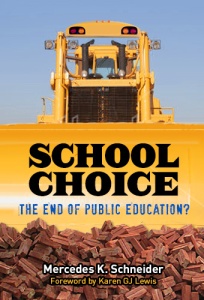
Coming June 24, 2016, from TC Press:
School Choice: The End of Public Education? 
school choice cover

Save Our Schools March – SOS Coalition Event @ Lincoln Memorial & Howard University!

Save Our Schools March – SOS Coalition Event @ Lincoln Memorial & Howard University!:

People’s March for Public Education & Social Justice


Save Our Schools March

2016-Register_Now

The planning for the 2016 SOS Coalition People’s March for Public Education & Social Justice is well underway. Below are the details for July 8th-10th, but the big news is thatthe march and rally will be at the Lincoln Memorial and the SOS Activists Conference will be at Howard University! Our coalition of grassroots groups, union organizations, and activists is growing, so join the mass gathering of children and adults who are rallying and marching in support of education and social justice this summer!

Meet us in DC, and celebrate democracy by living it!
Haga click aquí para versión en español

2016-Schedule_of_Events

July 8th ~ Rally & March at the Lincoln Memorial

  • 10:30 a.m. – Pre-rally festivities on the big stage and in the crowdTeachers_March_on_Washington_-_YouTube
  • 12:00 p.m. – Rally
  • 2:30 p.m. – March to The White House & Lafayette Park
Speakers and performers include:
Diane RavitchJonathan KozolRev. William J. Barber II,Jamaal BowmanDenisha JonesRuth RodriguezBishop John SeldersYouth DreamersJesse HagopianGus MoralesBrett BighamUnited Opt OutJulian Vasquez HeiligYohuru WilliamsLisa Rudley, Jitu Brown, Dyett Hunger Strikers, Tanaisa Brown, Barbara Madeloni, Sam Anderson, Mike Klonsky, Michelle Gunderson, Jeremy DudleyBarry Lane, Family von BATs, The BAT Band, Terry Moore, DC Labor Chorus…and more!

July 9th ~ SOS Coalition Activists Conference at Howard University

Join us in strategizing for continued activism in our home communities and beyond at The Save Our Schools Activists Conference: New & Experienced Organizers Working for Public Education & Communities. Attend activist workshops for individuals and groups (including families and youth) so we can return to our communities as leaders, organizers, participants, artists, and/or performers. This event is designed for new, emerging, and seasoned activists, and it includes numerous activities and sessions for children and youth!
2016-Register_Now
Speakers and collaborators at the event are local, national, and international organizers of all ages who will facilitate our work in developing campaigns in hometowns via grassroots work, social media, the arts, and a deep commitment to the voice of the public being heard. Workshop topics and facilitators include:
  • The Need For Black & Latino Community Control – Sam Anderson, NYC Coalition for Public Education, & Ruth Rodriguez
  • Using the Power of Your Voice to Promote Social Justice & Unionism – Sonya Romero
  • The Struggle for Democratic Schools with Deb MeierJonathan Kozol, & Mike Klonsky
  • Youth Organizing Youth – Tanaisa Brown & the Newark Students Union
  • Moving the Opt Out/Test Refusal Movement Forward – Melissa Tomlinson & Cindy Hamilton
  • Special Education Advocacy – Julie Borst, Nancy Bailey, & Terry Kalb
  • The Dyett Hunger Strikers
  • Lessons Learned from Dreaming – The Youth Dreamers
  • NEW LENS – The Student Led Film Group from Baltimore
  • Collaborative Community Fighting & Winning Against Privatization – Michelle Fine
  • TFA 5 Years Later – David Greene, Chad Sommer, Emma Howland-Bolton, Julian Vasquez Heilig, & Tina Andres
  • Broadening the Aims of Opt Out – United Opt Out National Admins
  • Testing, Assessment, and Accountability – Monty Neill from FairTest
  • Activist School Board Members and Unionists Working Together for Social Justice in Schools and Communities – Bess Altwerger& Erika Strauss Chavarria
  • Black Lives Are More Than a Score – Jesse Hagopian
  • Global Education Reform – Mercedes Martinez, Jose Soler, and Alto Al SIMCE
  • History Lessons for High Impact Actions – Troy Grant
  • Social Media and the Education Revolution – BATs Admins
  • Social Justice Teaching – Michelle Bollinger
  • Equal Opportunity Now: Fighting to Defend Public Education in Detroit and Across the Nation – Nicole Conaway & Tania Kappner
  • Hip Hop Advocacy – Jeremy Dudley (Dudley aka Origin)

Activities for children include:

  • Making Your Voice Heard: Spoken Word Poetry – Newark Students Union
  • Martial Arts as Social Justice – Ricardo Rosa & Tracey Drum
  • Yoga in Every Classroom! – Julianna Dauble
  • Let’s Write a Song for Our Schools Together – Terry Moore & Becca Ritchie
  • “That’s not fair!!” – Rick Meyer & Bess Altwerger
  • Cooperative Games and Sports
  • Artful Resistance, Reading, & Response
  • Read Aloud for Social Justice
2016-Schedule_of_Events

July 10th ~ Coalition Summit Work Session

This is an opportunity for coalition organization members, as well as new and experienced organizers, to convene over a breakfast planning session. This will be a working session where we will debrief and begin planning and organizing the next steps for the movement.
Are you eager to help us do the work to save our schools? Join us! Save Our Schools March – SOS Coalition Event @ Lincoln Memorial & Howard University!:

Education Reformers Get Smart | Johnathan Chase | LinkedIn

Education Reformers Get Smart | Johnathan Chase | LinkedIn:

Education Reformers Get Smart

Education Reformers Get Smart

Education reformers have adopted "Would you believe...?" tactics and strategies from the Mawell Smart play book to "sell" the academic benefits of the Common Core State Standards and the efficacy of standardized assessments that are aligned to them.


When it comes to ensuring that students will be "ready" for college and careers, the PARCC web site confidently explains...
"The PARCC CCR Determinations in ELA/literacy and mathematics describe the academic knowledge, skills, and practices in English language arts/literacy and mathematics students must demonstrate to show they are able to enter directly into and succeed in entry-level, credit-bearing courses and relevant technical courses in those content areas at two- and four-year public institutions of higher education.
The CCR Determination will provide policymakers, educators, parents, and students with a clear signal about the level of academic preparation needed for success in these postsecondary courses. It will provide a strong indicator of college and career readiness that can be used to set performance goals at any level and show progress towards those goals.
Finally, students who attain a CCR Determination in ELA/literacy and/or mathematics will have a tangible benefit – direct entry into relevant entry-level, credit-bearing courses without need for remediation at Education Reformers Get Smart | Johnathan Chase | LinkedIn:

Parents & Teacher union-backed candidates form majorities on Big 3 suburban school boards - City & Region - The Buffalo News

Teacher union-backed candidates form majorities on Big 3 suburban school boards - City & Region - The Buffalo News:

Teacher union-backed candidates form majorities on Big 3 suburban school boards


Christine Cavarello is a PTA mom, proud graduate of Kenmore East High School, and concerned about how changes in education affect children and their love of learning.
She’s on the steering committee of two local groups leading the opt-out movement to shift the focus of education from testing to learning.
In short, she’s the perfect candidate to win the endorsement of teachers – and she did.
She will join the Kenmore-Town of Tonawanda School Board on July 1.
Cavarello is one of 35 candidates out of 38 endorsed by teacher unions in Western New York who won election to a local school board last month, according to New York State United Teachers (NYSUT).
Candidates endorsed by teachers unions in Erie County’s three largest suburban districts – Ken-Ton, West Seneca and Williamsville – won by overwhelming margins. In the last five years, 75 percent of candidates with teacher endorsements won election in the three districts. That includes two elections where Williamsville candidates ran unopposed, so teachers made no endorsements.
So union-backed candidates form the majority on those big three district boards.
Local teachers’ unions have always endorsed candidates for School Board. But with high-profile fights about the future of education in New York State, new attention is being given to union-endorsed candidates.
Changes in education – from the shift to a more teacher-friendly chancellor and Board of Regents, to how the state handles Common Core standards, high-stakes testing and school and teacher accountability – will be felt at the local level. And each School Board must approve teacher evaluation plans and teacher contracts with their teachers.
Cavarello said the teachers union support was a big factor in her win.
“I think that says a lot about what’s going on – not only in the district, but education in general,” said Cavarello, a lifelong district resident. “I know teachers everywhere feel like they’re not really being listened to. Corporations, the governor and all these people who don’t know about education are telling us what we should be doing. We need to be listening to the teachers more because they’re the experts in the classroom.”
But teachers aren’t the only ones who have a stake.
“We think teachers are obviously incredibly important to the education process and Teacher union-backed candidates form majorities on Big 3 suburban school boards - City & Region - The Buffalo News:


Charter Schools 25 Years Later—and What to Expect in the Future

Charter Schools 25 Years Later—and What to Expect in the Future:

Charter Schools 25 Years Later—and What to Expect in the Future

jack russell dog  as a surprise, singing birthday song  like karaoke with microphone ,behind funny cake,  wearing  red tie and party hat  , isolated on white background
The charter movement has since expanded to include 43 states plus the District of Columbia, and over 2.5 million students—or about 5 percent of the total K-12 public student population.
Arianna Prothers, Education Week June 4, 2016
Charter schools are 25 years old. My, how time flies.
Yesterday, Education Week printed an interview with Ember Reichgott Junge, the Democratic state senator who sponsored the charter school legislation first signed into law in Minnesota.
School reformers have always sold charter schools as exciting and groundbreaking schools, but, as most know, and as you can see from Reichgott Junge’s interview, charter schools, in general, never lived up to the hype.
Charter School Corruption
First, Reichgott Junge speaks a lot about how charter schools continue to need Charter Schools 25 Years Later—and What to Expect in the Future: