Latest News and Comment from Education

Friday, May 20, 2016

New Legislation Uses “Cyber Attack Threat” To Shield Delaware’s Student Data Mining Tactics – Exceptional Delaware

New Legislation Uses “Cyber Attack Threat” To Shield Delaware’s Student Data Mining Tactics – Exceptional Delaware:

New Legislation Uses “Cyber Attack Threat” To Shield Delaware’s Student Data Mining Tactics

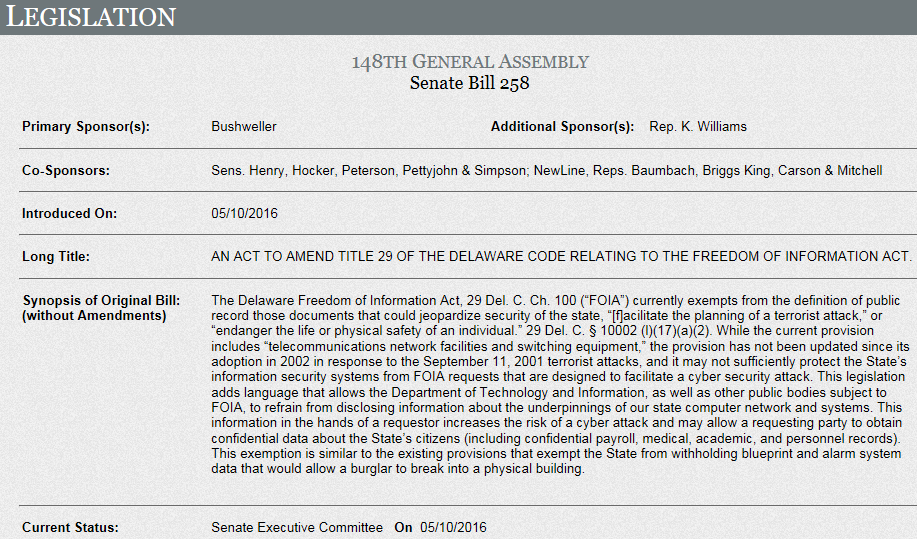
Delaware Governor Jack Markell sure is going out with a bang.  New legislation introduced a week ago in the Delaware Senate all but ensures any citizen requesting information on student data mining in Delaware will be met with a resounding no.  While the legislation mentions nothing about student data, it talks about the Delaware information technology system.  This bill would prevent a citizen from filing a FOIA request for the following:
Information technology (IT) infrastructure details, including but not limited to file layouts, data dictionaries, source code, logical and physical design of IT systems and interfaces, detailed hardware and software inventories, network architecture and schematics, vulnerability reports, and any other information that, if disclosed, could jeopardize the security or integrity of an information and technology system owned, operated or maintained by the State or any public body subject to the requirements of this Chapter.
SB258
On the surface, it looks like a great bill.  But the key words in this legislation are in the data dictionaries.  This defines how a system operates and what is included in it.  You can see one from the Delaware DOE below, from 2012:
The below are recommendations made to the Delaware DOE from Education Insight.  Some of the key words in this document pertain to exactly what is happening now, in current talk and pending legislation.  But the parties who come up with these ideas are trying to make it seem like this is brand new.  The jig is up.  This was planned a long time ago.
The four-year plan for DOE data systems as outlined in Race to the Top will result in a significant expansion in the amount of data available for use within the Departmentand for sharing with outside organizations. This 
New Legislation Uses “Cyber Attack Threat” To Shield Delaware’s Student Data Mining Tactics – Exceptional Delaware:

Another Brick From the Wall: When Education Reformers Fail Badass Teachers Association

Badass Teachers Association:

Another Brick From the Wall: When Education Reformers Fail

By Dr. Michael Flanagan, Co-Director BATs Action Team


I will be honest; I really enjoy stories where corrupt and greedy education reformers just epically fail. Now granted for the past ten years or so reformers have been cashing in big time on the backs of school children and their teachers. Continually racking up public tax dollars in one way or another. Money for charter schools. Money for Teach For America. Money for Pearson etc. etc.

These reformers have been successfully embezzling public school funding, attacking teacher rights, and disregarding collective bargaining agreements all while generating huge profits for test companies and vulture capitalists. As this has been happening countless numbers of parents, teachers, activists and students have organized to push back against the billionaires and their political shills through grassroots efforts, often to no avail. Our protests are met by reformer stonewalling.

The seemingly insurmountable money and power behind these education reformers brings to mind Pink Floyd’s: The Wall. Teachers and parents have faced the brick wall of Common Core, vouchers, charter schools, anti union lawsuits and high stakes testing from the likes of the Fordham Institute, the Broad Foundation, The Walton’s, the Koch’s, David Welch, Bill Gates, the mainstream media, governors, the Department of Education and the President of the United States.

However, lately I am seeing more “Karma” like stories. There are more articles like; Pearson's stock is dropping, or Pearson’s New York State contract is canceled. Common Core has been voted out in several states and Teach For America is laying off employees. A school board in San Francisco actually voted TFA out. I have especially enjoyed watching charter schools like Success Academy and Gulen Charters facing criticism, while some Ohio charter operators have actually been indicted. I applaud how hundreds of thousands of parents opted out of state tests in New York (myself included) while Friedrichs v. California and Vergara v. California both fail spectacularly. Just this past week Sheri Lederman won her case against value added measures of Badass Teachers Association:

Snapshot of the Teaching Profession: What's Changed in a Decade?

Snapshot of the Teaching Profession: What's Changed in a Decade?:

Snapshot of the Teaching Profession: What’s Changed Over a Decade?

snapshot of the teaching profession
There’s no doubt that the past decade or so has been hugely challenging for educators and for the public schools where they teach.  From the failure of No Child Left Behind to the devastating budget cuts following the Great Recession to the vilification of the teaching profession stirred up by the education reform movement, it’s clear why public education advocates hope the next ten years is more promising.
And yet, for many aspects of the teaching profession, the more things have changed, the more they have stayed the same, at least according to new federal data contained in the 2014 Digest of Education Statistics, released in May by the National Center of Education Statistics (NCES). A wide variety of subjects are covered, including funding, student enrollment, attitudes on education, demographic profiles, international comparisons. There’s also quite a bit of information on public school teachers – who they are, where they work, what they teach, and what they earn – and the trends that have shifted (or not) over the past decade or so. Here are just a few takeaways from the data:
1. If you are a classroom teacher, you are still probably a White female. In 2011-2012, there were approximately 3.2 million public school teachers in the United States, a marginal increase from just over 3 million in 2000 and slightly less than the 3.4 million in 2008 just before the country was slammed by the Great Recession.
The gender and racial disparities in the profession persist. In 2000, 84 percent of teachers were white, dipping slightly to 83 percent in 2012. During that time period, the percentage of Hispanic teachers increased the most to around 7 percent. The year 2014 marked the first time White students did not represent a majority in the nation’s public schools, calling more attention to the wide representation gap between educators and their students.
The teaching is still an overwhelmingly female profession. In 2012, 76 percent were women, a slight increase over 74 percent in 2000.
teacher student racial gap
2. The profession is both grey and green…for now.  In the 2012-13 school year, 12 percent of teachers had only 1-3 years full-time teaching experience, an uptick from 9 percent the previous year. Over this one-year period, however, those educators with more than 20 years under their belt also increased by 4 percent to 21 percent. Between 2008 and 2013, the number of teachers age 60 and over declined marginally as many in that age group are retiring, a process that Prof. Richard Ingersoll of the University of Pennsylvania says signals the end of what he calls the “greying of the profession.”
Teachers today are also more likely to have earned an advanced degree. In 2012, 56 percent hold at least a masters degree, compared to 47 percent in 2000.
3. U.S. teachers spend a lot of time in the classroom. The NCES data also looks at Snapshot of the Teaching Profession: What's Changed in a Decade?

Publisher's ultimatum in test leak riles educators

Publisher's ultimatum in test leak riles educators:

Publisher's ultimatum in test leak riles educators

A long-simmering dissatisfaction over standardized testing came to a head this month when an academic uploaded a handful of test items to the Internet and promptly got a note from the test’s creator, threatening legal action if she didn’t take down the items — and name her source.
The academic, Celia Oyler of Columbia University’s Teachers College, took down the items, which she said came to her anonymously. But the episode is irking educators and other observers who already believe that the powerful forces behind the tests are hijacking not just the educations of millions of children but, in this case, teachers’ rights to free speech. They note, for instance, that tweets about the episode have been taken down at the test publisher's request.
The controversy began nearly two weeks ago, when Oyler posted a lengthy essay by an anonymous teacher who set out to show that the fourth-grade reading test designed by the non-profit Partnership for Assessment of Readiness for College and Careers, or PARCC, is “developmentally inappropriate” for the children taking it this spring in a handful of states. The blog post included details from three test items.
Five days later, after other bloggers had shared the post, Oyler got an e-mail from PARCC CEO Laura Slover, who respectfully asked her to remove the items. They were protected by copyright, she said, and were “live” test questions, still being used in schools. The postings, Slover said, “threaten the utility of the assessments, both as their administration is completed over the next few weeks and in versions of the assessment to be administered in the future.”
She said the anonymous teacher, who’d admitted in the essay that he or she had “breached a written undertaking not to reveal any of the material,” was clearly avoiding personal responsibility by remaining anonymous. Slover said PARCC would waive any damage claims if Oyler would take down the items and “turn over to us any information you may have about the teacher.”
She had 24 hours to comply.
In an interview, Oyler said that if PARCC set out to threaten her, it worked: “It took me five minutes to take those items down,” she said. “Of course it took me another 10 minutes to start finding a lawyer.”


PARCC is one of two groups commissioned to create tests based on new Common Core standards in math and reading. The standards — and the tests — have come under fire from critics on both the left and right, with a few educators saying the tests are poorly written and force teachers to squeeze out more satisfying subjects that schools have traditionally taught.
“You’re no longer permitted in many places to engage in rich, project-based, authentic learning, which is how we know children learn,” Oyler said. “We know this from years and years of research.”
In a few cases, tests items simply didn’t make sense: in one incident in 2012, students piloting a Common Core reading test complained about a baffling question involving a talking pineapple who challenges a hare to a race, only to lose and be eaten by the other animals. One suburban New York principal noted that the question had been used before and “confused students in six or seven different states.”
Common Core complaints have even bubbled up to the presidential race, where most of the Republican candidates have advocated getting rid of the standards Publisher's ultimatum in test leak riles educators:
Big Education Ape: PARCC's ultimatim in test leak riles educators | KGW.com http://bit.ly/25cs8Ef
Big Education Ape: No secrecy for tests used on our children! | Parents Across America http://bit.ly/1To8Bbh
Big Education Ape: The First Rule of Test Club is We Don’t Talk About Test Club | gadflyonthewallblog http://bit.ly/1To7R5P
Big Education Ape: NYC Public School Parents: Should excerpts from the high-stakes PARCC exams be allowed under th... http://bit.ly/1rPwK12
Big Education Ape: An Open Letter to PARCC CEO Laura Slover | deutsch29 http://bit.ly/1R43CYu
Big Education Ape: NYC Public School Parents: Read the blog post that PARCC doesn't want you to see -- and then sh... http://bit.ly/1R43s3m
Big Education Ape: PARCC CEO to Prof Who Posts “Live” Test Items: Reveal Your Informant | deutsch29 http://bit.ly/1TbeUzQ

Mapping education research and judging influence | Brookings Institution

Mapping education research and judging influence | Brookings Institution:
Mapping education research and judging influence


 Executive Summary

Education research is a vast, multi-disciplinary field. In trying to understand it or make judgments about importance, influence, or where the action is, it can be helpful to see the big picture and not be swayed by where we happen to sit in the field. A map of education research derived from citation data can help us see the big picture. Responses to one of my recent Evidence Speaks postings and its relation to the annual Education Week Edu-Scholar Influence Rankings serve as an example of how a map might help. 

Introduction 

Education research is a large field involving, among others, psychologists, economists, sociologists, anthropologists, and political scientists, working on diverse problems and issues. When we make judgments about the field, we might tend do so from the vantage point of our own research community. A map of education research can help us appreciate other perspectives, allowing us to moderate and refine our judgments.
Responses to one of my own Evidence Speaks postings and the recent Education WeekRHSU Edu-Scholar Influence Rankings provide examples of how a map showing the big picture can broaden our understanding.[i]
In my earlier posting, based on a bibliometric analysis of the education literature, I reported that the three largest research communities within the field were Instructional Design (called Cognitive Load Theory in that posting), Motivation, and Science Education. Among the most highly cited, influential, and currently active scholars in these communities were John Sweller, Richard Mayer, Albert Bandura, Herbert Marsh, and Michelene Chi. This made perfect sense to me because for the past 35 years, I have been viewing education research from my own perspective grounded in psychology and cognitive science.
Some readers pointed out that many education researchers might never have heard of cognitive load theory or how mental representations affect solving physics problems. This is a valid criticism.
My claims looked particularly dubious when compared to the RHSU Edu-Scholar Public Influence Rankings. Each year Rick Hess ranks the 200 scholars (hereafter, the public influence scholars) who have most influenced the national discourse on education during the previous year. Instructional design and science education do not leap out from the names on that list. Heading the list for 2016 were Diane Ravitch, Linda Darling-Hammond, Howard Gardner, and Gary Orfield. None of the scholars I mentioned even appear on it.
A map of education research can help us understand this divergence in view. It also generates some interesting questions about the Influence Rankings. The rankings tend to over-represent scholars working in some research communities and under-represent others. Interestingly, it under-represents scholars working on instruction and subject-matter learning. Why might this be the case?

Analysis

A document co-citation map represents the semantic and intellectual structure of a research field by depicting co-citation relations among cited documents. The map used in this analysis is based on 2,327 articles published during 2014 in the top quartile (by impact factor) of Web of Science Education and Education Research journals (52 journals). These articles cite 90,000 other articles, i.e., there are 90,000 nodes in the co-citation map. Note that thesecited articles are not necessarily published in education research journals. They are published in journals representing numerous disciplines other than education: psychology, sociology, anthropology, policy studies, economics, linguistics, and neuroscience. The map contains 2,775 citations authored by 195 of the 200 public influence authors. A community detection algorithm applied to the co-citation network identifies over 110 research communities within it.[ii] The largest communities contain around 5–6 percent of the citations.
One can compare the distribution of citations to the work of public influence authors across the research communities to the distribution of all citations across the communities. This reveals communities within which public influence authors are over, under, or comparably represented compared to the field as a whole. One research community contains over 16 percent of the 2,775 public influence author citations.
Note that the citation data is used to map the field, to identify research communities, and to determine which scholars appear in which community. The analysis does not assume that highly cited researchers are necessarily influential outside of the academic literature. The number of times a scholar is cited or co-cited is not important in generating the map. No citation threshold is employed. We want to see where scholars appear on the map, even those cited only once. Identifying scholars who influence public discourse is a different task than identifying highly cited or co-cited scholars within the education research community; although, one might hope, or expect, that many of the public influence scholars are also among the academically prominent.
Table 1 shows the results. Community labels are derived from inspection of the cited references, (including book titles and reports) and the journals in which they were published. The labels are intended to capture the main theme of each community. The research foci of the communities are obvious from the labels with possibly two exceptions. Instructional Design focuses on research that attempts to design instructional interventions sensitive to limitations on human working memory (cognitive load). Politics and Education contains work on the political implications and political commitments of education and education policies, i.e., Common Core or state involvement in early childcare and parenting.Mapping education research and judging influence | Brookings Institution:


Thursday, May 19, 2016

Community Expresses Outrage Over California Charter Schools Association Expenditures In California 43rd Assembly Race | Asbarez.com

Community Expresses Outrage Over Special Interest Expenditures In California 43rd Assembly Race | Asbarez.com:

Community Expresses Outrage Over California Charter Schools Association  Expenditures In California 43rd Assembly Race


 GLENDALE—Education leaders gathered to jointly condemn the California Charter Schools Association and the Laura Friedman for Assembly campaign for disseminating misinformation to voters and trying to buy the 43rd California Assembly race. The press conference featured over a dozen community leaders including Los Angeles Unified School Board President Steve Zimmer and Glendale Board of Education Member Christine Walters.

“It’s very important that we’re here today in the 43rd Assembly District that has become the latest battle ground in the effort to privatize, corporatize, and takeover our public education system here in Los Angeles County,” stated LAUSD Board President Steve Zimmer in his remarks before concerned parents, local teachers, representatives of the California School Employees Association (CSEA) and United Teachers Los Angeles (UTLA).
“I’m very proud to stand with colleagues today, to stand with Ardy Kassakhian, who has become the latest target in this effort. Let me be very, very clear: there are interest groups in the State of California – most especially the California Charter Schools Association – who are attempting to outright buy Assembly seats, Senate seats, local school board seats,” highlighted Zimmer.
Financial disclosures show that over $1,000,000 has been spent by the special interest group to influence the outcome of the election by smearing Ardy Kassakhian’s record as Glendale City Clerk contrary to the truth, including reporting by the Los Angeles Times that has noted that Ardy Kassakhian has “greatly improved the voting experience for Glendale’s citizens.”
“I chose to support Ardy a long time ago because Ardy has authentically supported public schools since long before he decided to run for this job,” stated Glendale Board of Education Member Christine Walters. “The reason I’m here today is less about Ardy and more about the ugliness and deception that I have seen over the last few weeks.”
Prominent community activist and President of the East Area Progressive Democrats Hans Johnson noted, “We are here out of a profound concern that outside interests are seeking to buy this election and unduly influence the outcome through spending from outside Glendale.”
Frank Higginbotham from the Glendale Teachers Association stated, “The Glendale Teachers Association endorses Ardy Kassakhian for the 43rd Assembly District.  He is the only candidate that fully supports public education and will give our children a voice in Sacramento.”  Higginbotham concluded by noting that Ardy “is the only candidate we trust to stand up for public schools and to fight the billionaires trying to privatize our public education system for their profit.”
The press conference was attended by a host of other local leaders including Glendale City Council Member Zareh Sinanyan, Glendale City Treasurer Rafi Manoukian, Glendale Community College Board President Tony Tartaglia, Glendale Community College Board Member Dr. Vahé Peroomian, Glendale Board of Education Member (ret.) Sandy Russell, Burbank Board of Education Member Dr. Armond Aghakhanian, and Former Burbank Teachers Association President Kim Allender.
About Ardy Kassakhian
Ardy Kassakhian grew up and attended public schools in Glendale. He was first elected Glendale City Clerk in 2005. As Clerk, he has reduced government waste by introducing environmentally sound practices, made election information easier to access and worked to increase voter participation. Ardy graduated from UCLA and the Executive Program at Harvard University’s Kennedy School of Government. He lives with his wife Courtney and their young son in Glendale.
Ardy Kassakhian is running to represent Assembly District 43, which includes the communities of Burbank, Glendale, La Cañada Flintridge, La Crescenta-Montrose and the Los Angeles neighborhoods of Atwater Village, East Hollywood, Franklin Hills, Hollywood Hills, Los Feliz and Silver Lake. The primary election will be held on June 7, 2016. To learn more about Ardy Kassakhian, visit his website at www.ArdyforAssembly.com or follow him on Facebook and Twitter. Community Expresses Outrage Over Special Interest Expenditures In California 43rd Assembly Race | Asbarez.com:

Republic of Turkey Targets Houston-Based Charter School | The Texas Tribune

Republic of Turkey Targets Houston-Based Charter School | The Texas Tribune:

Republic of Turkey Targets Houston-Based Charter School

Lawyers working for the Turkish government plan to file a complaint with the Texas Education Agency next week against Houston-based Harmony Public Schools, alleging financial malfeasance and other misconduct, school officials said.
The Republic of Turkey, where President Recep Tayyip Erdogan is waging a well-documented war against critics, hiredLondon-based Amsterdam & Partners last fall “to conduct a global investigation into the activities of the organization led by moderate Muslim cleric Fethullah Gulen,” according to the firm's website. Gulen is a reclusive Turkish expatriate living in Pennsylvania whom news reports have linked to Harmony and other U.S. charter schools. Harmony, which focuses on science and math education, is the second-largest charter network in the United States and the largest in Texas. It operates 46 schools here where nearly 31,000 students are enrolled.
Amsterdam filed a civil lawsuit against Gulen in December in U.S. district court accusing him of being a terrorist and building a "parallel structure" within the police and judiciary to topple the government, according to a Reuters report. In March, Turkish authorities issuedan arrest warrant for Gulen and his brother. 
Harmony officials have vehemently denied any connection to Gulen and say the complaint, which they learned about by accident, is a politically motivated attack by Erdogan following a June 2015 election in which his party lost its 13-year majority control.
The Justice and Development Party (AKP) regained its hold on parliament in a subsequent vote, but Harmony officials note that Erdogan’s party received little support in the summer election among Turkish Americans who voted absentee.
“It’s a witch hunt,” said Soner Tarim, Harmony’s CEO.
An Amsterdam & Associates lawyer, John Martin, on Thursday confirmed the firm's plans to file a complaint with the state against Harmony but declined to immediately offer further details. The firm has enlisted the help of longtime Austin lobbyist and Republican political consultant Jim Arnold, who registered as an agent for the Turkish government last month. Arnold did not respond to calls or an email requesting comment. 
In February, the firm filed a complaint with the California Department of Education urging the agency to conduct an investigation into the financial practices of the Magnolia Public Republic of Turkey Targets Houston-Based Charter School | The Texas Tribune:
Big Education Ape: Every parent and community member should see the Killing Ed film | Parents Across America http://bit.ly/1U2Ph0m

Are We Addicted to ‘School Reform’? | The Merrow Report

Are We Addicted to ‘School Reform’? | The Merrow Report:

Are We Addicted to ‘School Reform’?


I recently came across a blog I posted in early 2012, one that was ‘liked’ by more than 4,700 readers.  It’s called “Drowning in a Rising Tide of….” and I wrote it while the latest National Commission was studying the state of public education.
Here’s part of what I wrote back then, followed by what the Equity and Excellence Commission eventually reported, and then by my own observations.

MY BLOG EXCERPTS: “The educational foundations of our society are presently being eroded by a rising tide of mediocrity that threatens our very future as a Nation and a people.”
Surely everyone recognizes the 5-word phrase. Some of you may have garbled the phrase on occasion — I have — into something like ‘Our schools are drowning in a rising tide of mediocrity.”
But that’s not what “A Nation at Risk” said back in 1983. The report, issued by the National Commission on Excellence in Education, was a call to action on many levels, not an attack on schools and colleges. “Our societyand its educational institutions seem to have lost sight of the basic purposes of schooling,” the Report states, immediately after noting that America has been “committing an act of unthinking, unilateral educational disarmament.” (emphasis added) Schools aren’t the villain in “A Nation at Risk;” rather, they are a vehicle for solving the problem.
Suppose that report were to come out now? What sort of tide is eroding our educational foundations? “A rising tide of (fill in the blank)?”
This is a relevant question because sometime in the next few months another National Commission, this one on“Education Equity and Excellence,” will issue its report. This Are We Addicted to ‘School Reform’? | The Merrow Report:

Every parent and community member should see the Killing Ed film | Parents Across America

Every parent and community member should see the Killing Ed film | Parents Across America:

Every parent and community member should see the Killing Ed film

KillingEdSharon


For less than $20, you can learn everything you need to know about the Gulen (aka Charter/Harmony/etc.) chain of charter schools and the Turkish imam behind the largest charter school network in the United States.
The Killing Ed film is now available on dvd online.
Our wonderful founding member, Sharon Higgins, is truly the star of this important documentary. Her brave and persistent digging into the Gulen movement and its power strategy was critical to public exposure of the sinister workings of this cult which uses charter schools as a front for collecting U.S. taxpayer dollars for its operations and for bringing its members into the U.S. from Turkey.
Turkey 2Why do so many parents allow their children to attend these schools? Some may be unaware of the schools’ deep connection to Turkey. The public relations effort by Gulen is as powerful as it is misleading. But even a little attention ought to raise some red flags…starting with the Turkish flags the schools display and the fact that many or most of the teachers, administrators, and board members are Turkish.
Gulenists like to accuse their critics of bigotry or racism. Killing Ed makes it clear that all parents and communities should be up in arms against this organized threat to democratic public schooling which our tax dollars are funding.
Buy a copy of Killing Ed and watch it with your friends and family. And instead of watching our congressional representatives take off on yet another junket to Turkey courtesy of the Gulen movement, we should insist that they turn off the pipeline of funds flowing freely to a secretive cult. We should insist that they put an end to any federal support for charter schools that are not accountable to the public through elected school boards. And each one of us should send our Senators and Congresspeople a copy of Killing Ed so that they will stop being the dupes of this dangerous organization.
- See more at: http://parentsacrossamerica.org/parent-community-member-killing-ed-film/#sthash.D9xrKZLT.dpuf


NJ Charter schools on the rise, but critics worry about the kids left behind | New York's PIX11 / WPIX-TV

NJ Charter schools on the rise, but critics worry about the kids left behind | New York's PIX11 / WPIX-TV:
NJ Charter schools on the rise, but critics worry about the kids left behind


 HACKENSACK, N.J. -- Charter schools are growing across our region, and they’re expanding rapidly in New Jersey.
Governor Christie visited Bergen Arts & Science Charter School in Hackensack today, where he touted the school’s 93 percent graduation rate.
“It’s the type of accomplishment that we want to replicate at charter schools throughout the state, and at traditional public schools as well,” said the Governor.
Christie pointed to senior Abigail Yashiro as an example of what can be accomplished in the right educational setting. Yashiro was 1 of only 2 New Jersey students chosen to represent the state in the United States Senate Youth Program, an honor that Governor Christie had earned when he was in high school.
“I can confidently say that my attendance here has given me personalized attention that has made me the best student and the best leader I can be,” said Yashiro.
But critics are still concerned about the children charters do not take from the traditional public schools.
“The charters kind of cream off the less expensive, easier to educate students,” said Dr. Julia Sass Rubin, an associate professor at Rutgers University Edward J. Bloustein School of Planning and Public Policy. "The more challenging students are left concentrated in the district schools.”
New Jersey Department of Education data shows that traditional public schools keep a higher percentage of children with special needs, kids learning to speak english and the poorest of the poor.
In Hackensack for example, 7 percent of charter school students have special needs. In Hackensack’s traditional public schools, 18 percent of the student population are special needs.
School districts also see their funding cut when charters move in. Tax dollars follow the students who transfer and state aid must be divided. Meanwhile, the traditional public school district continues to bear the brunt of many costs.
"For example, districts pay all transportation expenses for district residents who attend charter, private, and district schools,” she said, "Charter schools do not pick up any of that."
Recently, the Superintendent of Schools in Montclair, New Jersey drafted a letter to the state listing finances as the number one reason why a charter school should not be allowed to move in.
“The diversion of funds would be a tremendous financial burden to the school district,” said Roland Bolandi, Montclair’s Interim Superintendent.
He estimates the district will lose about $2.6 million if the proposed Fulbright Academy Charter School is allowed to open. If Fulbright grows as projected, that amount could rise to $4.7 million.
“Furthermore, budget reductions due to the loss of state aid have already impacted staff, NJ Charter schools on the rise, but critics worry about the kids left behind | New York's PIX11 / WPIX-TV:


Public Schools With a President Bernie Sanders

Public Schools With a President Bernie Sanders:

Public Schools With a President Bernie Sanders

A green tree alone in sand desert
What would education be like with a President Bernie Sanders? Would he stand by public schools and public school career teachers?
I think between Hillary Clinton and Donald Trump, Bernie Sanders would be better to fight against the troubling school reforms that have plagued public schools for years. Most of what can be gathered about Sanders and his educational agenda supports that.
But there are still concerns which I list below.
Here are the positives:
  • He voted against No Child Left Behind and was especially against high-stakes standardized testing.
  • He stood by Chicago’s principal and public school activist Troy LaRaviere and students, teachers and parents. He spoke out against LaRaviere’s firing.
  • He, like Clinton, opposes private charter schools and school vouchers.
  • He gets that poverty directly affects students and is concerned about health care, mental health, nutrition, and other supports. He wants wrap-around Public Schools With a President Bernie Sanders:

New Study Connects the Dots Between School Funding Choices and Student Achievement Education Law Prof Blog

Education Law Prof Blog:

New Study Connects the Dots Between School Funding Choices and Student Achievement, Highlighting the Dangers of Retrenchment in Courts


 The Educational Testing Service (ETS) released a new study by Bruce D. Baker, Danielle Farrie, and David G. Sciarra, analyzing the connections between improving school finance systems,improving educational outcomes and closing achievement gaps. After working through multiple factors and layers of data, the report zeroes in on the effects of school funding on pupil-teacher ratios and salaries.  It them shows how those two factors relate to the achievement gap between low and middle-income students.  The findings are rather impressive:

  • These higher spending levels translate into higher statewide staffing levels—more teaching staff per pupil.
  • These higher spending levels translate into more competitive statewide teacher wages.
  • Increased targeted staffing to higher poverty schools within states is associated both with higher measured outcomes of children from low-income families and with smaller achievement gaps between children from low-income and children from non-low-income families.
More specifically, they "show that the level and distribution of pupil-to-teacher ratios are highly and consistently sensitive, both across states and over time, to changes to the level and distribution of school district current spending; that is, more spending, holding other factors constant, drives lower pupil-to-teacher ratios, and fairer spending across districts within states drives fairer pupil-to-teacher ratios. Spending also drives the competitiveness of teacher wages. States with higher spending have more competitive wages, all else being equal. And as one might expect, available spending and the equity of that spending remain contingent on the revenues that support that spending. Increased state support provides the opportunity for improved equity of current spending, whereas the stability of both state and local revenues dictates the overall level of spending."
The point about sensitivity to change "over time" is key to appreciating the significance of the deep cuts in education funding since the recession and the failure to replenish those funds even once state tax revenues rebounded. As I argue in a recent article, courts would normally serve as the check against states' wholesale abandonment of their constitutional duty to deliver equal and adequate educational opportunities.  Unfortunately, as the Texas Supreme Court decision from last week shows, courts are increasingly shying away from their duty. As they do so, they place the very right to education in jeopardy both in the short and long term--the effects of which will be far worse than the legislative stand-offs that courts are seeking to avoid now. A full discussion of this new trend is available here.

Russ on Reading: What is a "Just-Right" Class Size in Public Schools?

Russ on Reading: What is a "Just-Right" Class Size in Public Schools?:

What is a "Just-Right" Class Size in Public Schools?

This post is adapted from my book, A Parent's Guide to Public Education in the 21st Century, now available in print and Kindle versions.

Class size matters. Class size matters because it is an issue that impacts the lives of the children in the classroom, the work load of the teacher and the school budget. Teachers and their representatives argue for smaller class sizes, while school boards try to balance parent and teacher desires for small classes, with the demands of keeping the budget under control. Apparently, private schools think class size matters. They advertise small class size in an effort to attract students to their schools.

Intuitively, most parents and teachers think class size matters, but from a research standpoint the impact of class size has been harder to pin down.  At the heart of the argument is the question, “Do the academic gains achieved through smaller class sizes justify the cost of hiring more teachers to accommodate those lower class sizes?” Some education reformers have even suggested that children would be better off if schools would identify their best teachers and then pay those teachers more to accept more students in their classes.

A research study done in Tennessee is considered the gold standard of class size studies because of its rigorous experimental design. This so-called STAR study(1995) found that students in small classes learned more than students in larger classes and were more likely to complete school and attend college, but those small classes were so small that the STAR study simply rekindled the cost/benefit debate.

More recently, Northwestern University professor Diane Whitmore Schanzenbach published a study through the National Education Policy Centerthat summarized what we know about class size. Considering all the research as a whole Schanzenbach concluded that

·         Class size is an important determinant of student outcomes, and one that can be directly determined by policy.
·         The evidence suggests that increasing class size will harm not only children’s test scores in the short run, but also their long-run human capital formation. Money saved today by increasing class sizes will result in more substantial social and educational costs in the future.
·         The payoff from class-size reduction is greater for low-income and minority children, while any increases in class size will likely be most harmful to these populations.
·         Policymakers should carefully weigh the efficacy of class-size policy against other potential uses of funds. While lower class size has a demonstrable cost, it may prove the more cost-effective policy overall (NEPC, 2014).

So, class size does matter and it matters especially for low-income and minority children and it is likely to be worth the taxpayers’ money to attempt to keep Russ on Reading: What is a "Just-Right" Class Size in Public Schools?:

This ed-reform trend is supposed to motivate students. Instead, it shames them. - The Washington Post

This ed-reform trend is supposed to motivate students. Instead, it shames them. - The Washington Post:

This ed-reform trend is supposed to motivate students. Instead, it shames them.

A third-grade teacher on why "data walls" don't work.

Launa Hall says posting her students’ test scores made it harder to connect with them. (iStock)

 My third-graders tumbled into the classroom, and one child I’d especially been watching for — I need to protect her privacy, so I’ll call her Janie — immediately noticed the two poster-size charts I’d hung low on the wall. Still wearing her jacket, she let her backpack drop to the floor and raised one finger to touch her name on the math achievement chart. Slowly, she traced the row of dots representing her scores for each state standard on the latest practice test. Red, red, yellow, red, green, red, red. Janie is a child capable of much drama, but that morning she just lowered her gaze to the floor and shuffled to her chair.

In our test-mired public schools, those charts are known as data walls, and before I caved in and made some for my Northern Virginia classroom last spring, they’d been proliferating in schools across the country — an outgrowth of “data-driven instruction” and the scramble for test scores at all costs. Making data public, say advocates such as Boston Plan for Excellence, instills a “healthy competitive culture.” But that’s not what I saw in my classroom.
The data walls concept originated with University of Chicago education researcher David Kerbow, who in the late 1990s promoted visual displays to chart students’ progress in reading. Kerbow called these displays “assessment walls,” and he meant them to be for faculty eyes only, as tools for discussion and planning. But when that fundamentally sound idea met constant anxiety over test scores in K-12 schools across the United States, data walls leaked out of staff-room doors and down the halls. Today, a quick search on Pinterest yields hundreds of versions of children’s test scores hung in public view.
Diving Into Data,” a 2014 paper published jointly by the nonprofit Jobs for the Future and the U.S. Education Department, offers step-by-step instructions for data walls that “encourage student engagement” and “ensure students know the classroom or school improvement goals and provide a path for students to reach those goals.” The assumption is that students will want to take that path — that seeing their scores in relationship to others’ will motivate them to new heights of academic achievement. They are meant to think: Oh, the green dots show my hard work, yellow means I have more work to do, and red means wow, I really need to buckle down. Now I will pay attention in class and ask questions! I have a plan!
How efficient it would be if simply publishing our weaknesses galvanized us to learn exactly This ed-reform trend is supposed to motivate students. Instead, it shames them. - The Washington Post: