Latest News and Comment from Education

Monday, May 9, 2016

Schools Matter: Riding the 'Turnaround' Merry-Go-Round in the Continuing Assault on Philadelphia Public Schools: Part IV

Schools Matter: Riding the 'Turnaround' Merry-Go-Round in the Continuing Assault on Philadelphia Public Schools: Part IV:

Riding the 'Turnaround' Merry-Go-Round in the Continuing Assault on Philadelphia Public Schools: Part IV

The Philadelphia School Reform Commission – April 28, 2016


 Crossing the Rubicon
  
The Rubicon has been crossed in the privatization assault on Philadelphia public schools. On Thursday, April 28th, the Philadelphia School Reform Commission voted to turn three more public schools over to charter companies.

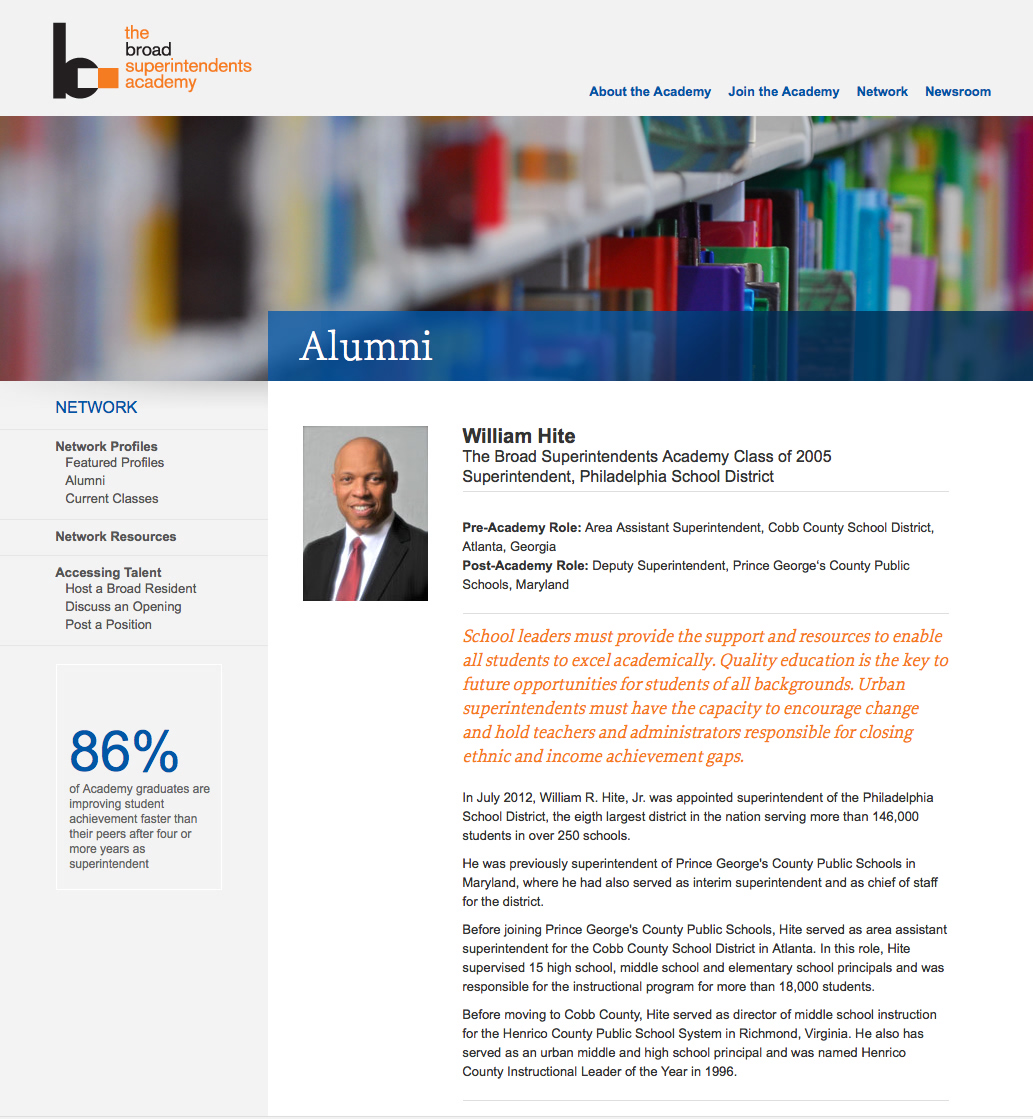
The Battle for Wister has been decided in favor of Mastery Charters over the objections of many parents at the school. (See The Battle for Wister in Part I of this series.)  What makes this turnover different than all preceding turnovers is that Wister, even by Broad graduate Superintendent Hite’s own admission, had been making progress as a public school. The School Reform Commission (SRC) reversed his decision one week after Hite had withdrawn Wister from the turnaround list. No more can the SRC claim that the turnover of a public school to a charter company is based on the pretense that their “data” shows a school is a “failing school”. It is now clear for all to see that the drive for privatization is based on the market interests of corporate education reform, not education.

Also to be turned over to charter companies that have a dubious history, are Jay Cooke Elementary to Great Oaks Charter and Samuel B. Huey Elementary to Global Leadership Academy.

These turnovers went forward despite the SRC’s Charter School Office presenting strong evidence that many charters up for their five-year renewals are performing no better, or worse, than the public schools they replaced. In addition, Philadelphia Newsworks' reporter Kevin McCorry observed, based on Newsworks analysis, “the most consistent thing about school ‘progress’ as captured by the SPR [the District’s School Progress Report] is inconsistency.” He wrote,

There are many reasons to be wary about relying too heavily on the School District of Philadelphia’s main tool for measuring school quality [SPR] – especially when it comes to making high-stakes decisions about closures, staffing shake-ups and charter conversions.

Despite this evidence, along with protests from parents, students, teachers and community members, the SRC is forging ahead with turnovers to charters and disrupting the lives of thousands of students and staff. Like all corporate education reform, it presents its decisions as being based on “failed schools” due to “bad teachers and administrators”. That these turnarounds are happening only in low-income neighborhoods gives the lie to this claim. The educational opportunities of children from low-income families will not change by moving school professionals from one school to another, year after year. What must change are the economic circumstances of these families.

The Latest Spin of the Turnaround Merry-Go-Round in Philadelphia Schools

Data show segregation by income (not race) is what's getting worse in schools - The Hechinger Report

Data show segregation by income (not race) is what's getting worse in schools - The Hechinger Report:
Data show segregation by income (not race) is what’s getting worse in schools
The intersection of poverty and race is producing larger and more alarming achievement gaps


 There’s a new narrative that U.S. schools are “resegregating” along racial lines. The U.S. Commission on Civil Rights used the word “resegregation” on the headline of a recent press release and scheduled a briefing on the subject for May 20. And the word “resegregation” gets bandied about frequently at education conferences and in the press.

But academic researchers, speaking at a May conference for education journalists in Boston, said they don’t see evidence of a worsening racial separation across the country, as if whites and minorities who once learned in the same classrooms were now heading to different schoolhouses. What they do see is an increasing number of minority students in public schools, and an increasing number of schools that are dominated by minority students, but both trends are keeping pace with the increase in the minority population overall.

It’s the U.S. population that’s changing, not a redistribution of races in our schools, as the word resegregation implies. White students now make up less than half the public school population, and there are fewer of them to spread around.

It’s worth remembering that even at the peak of integration, in the late 1980s, schools were still quite segregated. White students tended to go to schools that were majority white, minorities to schools that were largely minority. For a school that was already, say, 70 percent minority, an influx of immigrants could easily tip the population into the 90 percent camp. This could happen without policy makers pulling the plug on integration, or families picking up and moving into separate, more racially homogenous school districts.

“We have segregation, and increases in concentrations of low-income minorities,” said Sean Reardon, a sociologist at Stanford University. “But it doesn’t mean that school systems have begun to allocate students more unevenly.”

Yes, the percentage of minorities is rising at many schools. But to prove increased racial segregation, you would need to show that the number of minority students in many schools is increasing faster than the increase in the minority population. You can find examples of that in some regions and communities, but the data don’t show that for the nation as a whole. Similarly, you would need evidence of white students flocking away from minorities. Instead, the data show that the typical white student is going to school with more minorities. So-called “white” schools are becoming more integrated. Back in 1996, for example, the average white student attended a school that was 81 percent white. That figure is now below 75 percent, according to the most recent data.

From the perspective of an individual black or Hispanic student, who sees his or her school getting “browner,” it may feel like a distinction without a difference. It certainly feels segregated when there are many more schools today in which minority students number more than 90 percent of the student body.  Today, the typical minority student is less exposed to white students at school.

To be sure, certain school districts have “resegregated.” But desegregation court orders have expired in fewer than 500 districts. While that sounds like a large number, it’s small compared to the more than 12,000 school districts across the country. Ann Owens, a sociologist at the University of Southern California, explained that she hasn’t yet seen evidence that these instances of resegregation have been large enough to drive the numbers nationally.

What Reardon and Owens are finding is another kind of segregation in the schools — along income lines. Rich families are increasingly pulling away from poor ones, and sending their kids to different schools. At the same time, more families are living in poverty. According to a February 2016 paper published by Stanford’s Center for Education Policy Analysis, income segregation between different school districts increased 15 percent between 1990 and 2010. Within large districts, the segregation of students who are eligible and ineligible for free lunch increased by about 30 percent during the same 20 years.

And here’s the rub: this increase in poverty is more pronounced in minority schools. That is, the poverty rate in predominantly minority schools is rising faster than the poverty rate in predominantly white schools, according to Reardon’s calculations.

This new income segregation is now exacerbating Data show segregation by income (not race) is what's getting worse in schools - The Hechinger Report:


Hedging Education

Hedging Education:
Hedging Education
How hedge funders spurred the pro-charter political network.


 This article is a preview of the Spring 2016 issue of The American Prospect magazineSubscribe here

Not too long ago, school board races were quaint affairs. Even in big school districts, candidates usually only had to raise a few thousand dollars to compete.
But as the movement to marketize public education gained momentum, advocates broadened their focus from the federal level to state and local governments. There, where campaign costs were substantially lower than in federal elections, the well-funded movement could more effectively leverage its political money.
One of the starkest casualties of that strategic shift has been the American school board election. A network of education advocacy groups, heavily backed by hedge fund investors, has turned its political attention to the local level, with aspirations to stock school boards—from Indianapolis and Minneapolis to Denver and Los Angeles—with allies.
In recent years, this powerful upstart operation has had tremendous, albeit somewhat stealthy, success playing politics at the local level, by cultivating reform leaders in areas with disappointing schools and a baseline desire for change. They have looked to building a state philanthropic infrastructure that can sustain local efforts beyond one election.
The same big-money donors and organizational names pop up in news reports and campaign-finance filings, revealing the behind-the-scenes coordination across organizational, geographic, and industry lines. The origins arguably trace back to Democrats for Education Reform, a relatively obscure group founded by New York hedge funders in the mid-2000s.

The Hedge Fund Connection

The hedge fund industry and the charter movement are almost inextricably entangled. Executives see charter-school expansion as vital to the future of public education, relying on a model of competition. They see testing as essential to accountability. And they often look at teacher unions with unvarnished distaste. Several hedge fund managers have launched their own charter-school chains. You’d be hard-pressed to find a hedge fund guy who doesn’t sit on a charter-school board.
Consider Whitney Tilson. Straight out of Harvard, Tilson deferred a consulting job in Boston to become one of Teach For America’s first employees in 1989. Ten years later, he started his own hedge fund in New York. Soon after that, Teach For America founder Wendy Kopp took him on a visit to a charter school in the South Bronx. It was an electrifying experience for him. “It was so clearly different and so impactful,” Tilson says. “Such a place of joy, but also rigor.”
The school was one of two original Knowledge Is Power Program schools—better known as KIPP—which has since grown into a prominent charter network with nearly 200 schools in 20 states plus the District of Columbia, serving almost 70,000 students, predominately low-income and of color.
But back then, charter schools were still a rather unfamiliar novelty to most people. Tilson, however, was convinced that they were the future of education. He started dragging all his friends, most of whom were hedge fund investors, from Wall Street up to the South Bronx to see the KIPP school. “KIPP was used as a converter for hedge fund guys,” Tilson says. “It went viral.”
Many critics of the corporate education-reform movement are quick to accuse proponents of seeking to cash in on the privatization of one of the United States’ last public goods. And while there certainly are those in ed-reform circles who stand to benefit from a windfall of new education technology, testing, and curriculum services, hedge funders by and large do not fit that stereotype. Theirs is more of an ideological and philanthropic crusade, rather Hedging 
Education:


Donald Trump on education: Wrong, wrong and wrong - The Washington Post

Donald Trump on education: Wrong, wrong and wrong - The Washington Post:
Donald Trump on education: Wrong, wrong and wrong


 Donald Trump, the presumptive Republican presidential nominee, doesn’t talk all that much about education issues, but when he  does, it is usually about the Common Core, rankings and spending. And usually he is wrong, wrong and wrong.

In one Trump ad this year, he hit all three in just a few sentences:
“I’m a tremendous believer in education. But education has to be at a local level. We cannot have the bureaucrats in Washington telling you how to manage your child’s education. So Common Core is a total disaster. We can’t let it continue. We are rated 28th in the world, the United States. Think of it, 28th in the world. And, frankly, we spend far more per pupil than any other country in the world. By far. It’s not even a close second.”
And on May 2, he said:
Now, if you look at education. Thirty countries. We’re last. We’re like 30th. We’re last. So we’re last in education. If you look at cost per pupil, we’re first. So we — and by the way, there is no second because we  spent so much more per pupil that they don’t even talk about No. 2. It’s ridiculous.
Talk about ridiculous.

Republican presidential candidate Donald Trump has been repeating some false statements over and over again. Here are the last four of his claims that the Post's Fact Checker gave Four Pinocchios. (Jenny Starrs/The Washington Post)
For one thing, the United States is not “last in education.” He is presumably talking about education outcomes and appears to be referring to international rankings of students, of which there are several based on different tests given in different countries.
There is, for example, the Program for International Student Assessment, better known in the education world as PISA, which is given every three years to 15-year-olds around the world in Donald Trump on education: Wrong, wrong and wrong - The Washington Post:


Sunday, May 8, 2016

Detroit lawmakers say DPS bills appear to be part of a conspiracy - WXYZ.com

Detroit lawmakers say DPS bills appear to be part of a conspiracy - WXYZ.com:

Detroit lawmakers say DPS bills appear to be part of a conspiracy


LANSING, Mich. (WXYZ) - The House of Representatives is expected to vote on controversial bills that would address the Detroit Public Schools financial crisis.
One thing is clear. No Detroit lawmaker is likely to vote in support of the bills.
This is one of two proposals in Lansing right now in response to the district’s financial crisis. The other was put together by the Senate.
So what do the bills (House Bills 5382, 5383, 5384, and 5387)  being debated right now do and why are Detroit lawmakers so against them? There are several issues.
Detroit lawmakers say it is about power. The House plan would delay the election of a school board in Detroit until next year.
“That is unacceptable. Our children have suffered long enough under emergency managers,” said Rep. Sherry Gay-Dagnogo (D-Detroit).
It is also about busting unions. 
Republicans on the House Appropriations Committee, which voted for the bill - sending it to the full House - made it clear they are unhappy with the protests by Detroit teachers that closed schools.
The protests happened after teachers said they learned they were facing payless paydays because the district was underfunded by the state, and protested to ensure they are given what they are owed. 
Many Republican lawmakers say the teachers should have stayed in the classroom teaching kids, not participated in such political actions.
The proposals would create a new school district and throw out current labor contracts. They would potentially decrease the pay of teachers in Detroit, by allowing the district to use uncertified teachers.
Republicans say this would address the teacher shortage.
“Teachers are professionals. You don’t put uncertified teachers in just Detroit Schools,” said Sen. Coleman Young II (D-Detroit) “You wouldn’t do that with anyone else. You wouldn’t say to address the pilot shortage, we are going to take away the certification to become Detroit lawmakers say DPS bills appear to be part of a conspiracy - WXYZ.com:


OKCPS suspensions more complex than just race - NonDoc

OKCPS suspensions more complex than just race - NonDoc:

OKCPS suspensions more complex than just race

Hallway
(Morguefile.com)

Conservative school reformer Mike Petrilli has criticized the U.S. Office of Civil Rights (OCR) and its recent agreement to settle a complaint against the Oklahoma City Public School District for racially disparate suspension rates.
Petrilli cites the OCR’s finding that, “African American students are 62 percent more likely to be given in-school suspensions in Oklahoma City than are white students.” He adds that African Americans in Oklahoma City are three times likelier to be poor than whites. Petrilli concludes:
Oklahoma City will suspend fewer students, possibly putting student learning and safety at risk, because nobody was willing to challenge the federal government’s questionable assumptions. Oklahoma politicians were up in arms over the feds’ heavy-handedness on the Common Core; why are they so willing to be pushed around on student discipline?
Petrilli is half right in criticizing the OKCPS suspensions and the OCR, but he seems unaware of how complex these issues are. Below is just one example of how I learned how complicated the process of creating safe and orderly schools is.

NCLB undermines code of conduct

When John Marshall H.S. was given relatively more power to enforce its code of conduct, we improved more than any secondary school in the district. Our principals had always OKCPS suspensions more complex than just race - NonDoc:


School districts are a big reason for the rise in income segregation in the U.S., study says - LA Times

School districts are a big reason for the rise in income segregation in the U.S., study says - LA Times:

School districts are a big reason for the rise in income segregation in the U.S., study says

Who are your classmates?
Who are your classmates? (Anne Cusack/Los Angeles Times)
It's no secret that in searching for a home, parents scrutinize nearby schools. The wealthy can afford to live in neighborhoods with small school districts, where most other students are wealthy, too.
Now, a new study out of USC lends credence to the notion that this decision-making process is partially responsible for the rise in America's income segregation between 1990 and 2010.
In the country's 100 largest metropolitan areas, "income segregation is nearly twice as high among households with children as among those without," according to the study from USC sociologist Ann Owens, published in the American Sociological Review in late April.
The study's second major finding is that among the families that  have children in those large areas, there is more income segregation in areas that encompass more school districts. 
Of course, it's difficult to attribute all income segregation to schools.
Almost three-fourths of children attended the school to which the district assigned them in 2007, according to a government report Owens cites, suggesting that parents want to live near their child's school.
Take Los Angeles: Parents could live in the boundaries of the huge Los Angeles Unified School District, but many wealthy families choose to live in cities like Beverly Hills, which are higher-income and have their own school districts with more concentrated resources. 
Los Angeles is slightly less segmented than the average large county in Owens' study. 
In Los Angeles County in 2010, the average high-income family with children lived in a place where 34% of their neighbors were in the top fifth of earners with $116,466 or more, and 12% were in the bottom fifth of the population, making $22,246 or less, Owens found.
High-income Angelenos living without children are less segregated: on average, they lived in places where 31% of neighbors earned $116,466 or more and 14% earned $22,246 or less. 
Average L.A. families with children in the lowest fifth of earners lived in neighborhoods where 28% had similar incomes, and 10% of neighbors were in the highest fifth of earners. Poor people without children were more likely to be exposed to wealthy neighbors: For the average household without children at the poorest income level, 26% of households had similar incomes and 16% of neighbors were in the top fifth.  
And it's more than just geography that divides them. Poor parents are spending about the same on children as they have for decades, but wealthy parents are spending more than ever before. That spending can come in the form of tutoring, extracurriculars or a house in a wealthy neighborhood and an in-demand school district, said Sean Reardon, Stanford's professor of poverty and inequality in education.
Families with children are "seeking out more advantageous environments for their kids at a rate that’s higher than it was in earlier decades," said Jennifer Jennings, a New York University sociology professor who studies education policy and income.
So why does this matter? This study can influence housing policies moving forward, said Reardon.
When wealthy people are concentrated in one area, the resources they give to their schools and to their School districts are a big reason for the rise in income segregation in the U.S., study says - LA Times:


CURMUDGUCATION: Instructional Googling

CURMUDGUCATION: Instructional Googling:
Instructional Googling


Robert Pondiscio is in US News sounding the alarm about teachers who develop their own materials either on their own or by googling their way to instructional strategies, on his way to noting that the "dirty little secret" of education is that the quality of instructional techniques is an afterthought, and probably not so great. But I think he's managed to mis-represent the problem and add to it all at once.

Here's the cold open.

If you caught your pediatrician Googling "upset stomach remedies" before deciding how to treat your child and homebrewing medications over an office sink, you might start looking for a new pediatrician. So how would you feel if you learned that Google and Pinterest are where your child's teacher goes to look for instructional materials?

If my pediatrician was stumped by a tricky diagnosis, I would expect her to consult other experts in the field and go look through the literature about the ailment. And because my pediatrician is a trained professional, I'd be unlikely to view treatment that she developed and used based on her professional knowledge and judgment as a "home brew." 

So right up front, let's dispose of the notion that Google and Pinterest are automatically bad news. For many teachers they have become the modern equivalent of walking across the hall and saying, "I can't quite get Chris to understand how to work with mixed fractions. Have you got anything that you've had success with?" Google and Pinterest (and few dozen other sites) make it possible to walk across thousands of other halls and ask millions of other fellow professionals what professional advice and materials they might have to offer. This is not a bad thing.

Like any tool, it can be misused. Teachers need that most important of 21st century research skills-- the ability to tell Good Stuff from Crap. And of course the interwebs can enable lazy teachers, but this is not a new phenomenon-- it's simply the 21st century equivalent of your old teacher who just 
CURMUDGUCATION: Instructional Googling:


ICYMI: Some edu-reading for the day

Many a varied readings for today.

How Not To Explain Success

Remember all that noise a year ago about the "triple package" of traits that lead to success. Yeah, that was probably baloney.

Why the New SAT Isn't As Transparent As the College Board Wants You To Believe


What?! David Coleman's College Board is busy blowing marketing smoke?! I am shocked. Shocked!!

Black and Brown Boys Don't Need To Learn Grit; They Need Schools To Stop Being Racist

Yes, it's been said before. It should be said repeatedly until the message sinks in.

DPS sickout a sympton of Lansing's ill behavior

The Detroit Free Press has a few things to say about the Detroit teacher sick-out and just who is responsible

School Vouchers Are Not a Cure for Segregation

At Jersey Jazzman, Mark Weber has been writing a three-part (so far) explanation of just how much voucher systems do not help segregation. Essential reading, with charts and graphs and facts and stuff.

Rely on Local Actors Instead of Faulty Information To Make Judgements About School Quality

Reform fans Jay Greene and Mike Petrilli have been dialoguing about the finer points of testing and evaluation etc, with Greene attacking some reformster orthodoxy. Here he answer the question of what to do if the test data says the school sucks but the people there think it's great. Shouldn't be a radical notion, but that's where we are...

You Won't Believe This (Unless You Know Chicago)

The Chicago Public School system has decided to try to take down principal Trot LaRaviere. Here's his own account of the sequence of events. If this doesn't make you angry, I'm not sure anything will.

We Did Everything the State Asked-- Didn't Matter

A teacher in Georgia gives voice to the frustration of trying to make a reformster regime happy. 

CURMUDGUCATION http://bit.ly/1hqZ7wL

Reader Faves


TBFURMAN: The Manufactured Federal Blindness Toward The Gulen-Linked Charter Schools

TBFURMAN: The Manufactured Federal Blindness Toward The Gulen-Linked Charter Schools:

The Manufactured Federal Blindness Toward The Gulen-Linked Charter Schools


 The strange, pervasive federal blindness when it comes to the Gulen Movement-- what's it about? My guess is that it's just the fruit of an intensive influence-seeking campaign-- in other words, it's manufactured. But who knows?


Anyway, let's go down the list.
Dan Mihaloupoulos reported yesterday that the federales recently "awarded" the Gulen-linked charter almost $340k for various stuff that will no-doubt be purchased from firms sprouted within the growing closed economy that helps grow the Movement.  Remember this? Tiniest part of the tip of the iceberg. The feds apparently aren't going to wait until the conclusion of the ongoing FBI investigation of Concept to hand them more money.

Read Dan's report for the monkey business with the "advisory board." It's one of the fundamental m.o's across the Movement, a potemkin board of people who have literally no idea.

I don't know how the Gulenists got so "in" at the Department of Education, but I bet gifts of travel, 
check it out
campaign contributions, and relentless awards, honors and glomming-on played their part.  Please don't make me go through my notes for pictures of prominent Gulenists posing with Arne Duncan. It's a whole genre on Twitter. 

[Local Note: before I move on, let's just observe that Sunny Chico is on that list along with Arne Duncan. Chico was a start-up consultant during the original charter application of Chicago Math and Science Academy; then she received one of their random awards in 2006, and was junketed to Turkey at least once, along with Gery Chico, I am almost 99% certain. It's a relentless campaign of courting the influential.]

On a lighter notethis actually happened last week. 

The Navy's "Key Influencer" program invites people who have great influence over the lives of young people to take a ride in an F-18 jet.
Yes, a superintendent of one of the big Gulen-linked schools in New York state will be soaring in the sky with the Blue Angels next month. I don't know what the deal is with the Air Force, but they're in a love-fest with the Gulen Movement.  I bet if someone did a little digging, she or he would find the telltale signs--- the junkets, the awards, etc.

I might point out that the Air Force has always had a certain conservative religious fervor, and the Gulen Movement has a bit of a track record in working these people when there's a deal to be made. I wonder if the Gulenists honed in some particularly fundamentalist person influential in the Air Force, or perhaps several.

Incidentally, the particular superintendent mentioned above works at a school founded by one of Concept's co-founders, even though all of these schools are supposedly totally 
TBFURMAN: The Manufactured Federal Blindness Toward The Gulen-Linked Charter Schools:

Gulen's American Empire
Gulen Charter Schools in the USA http://bit.ly/275368i

How the schools serve the Gulen Movement - Gulen Charter Schools http://bit.ly/2753rYE

Picture

WGN: Chicago Corruption Runs “Very Deep & Very High” – Troy LaRaviere's blog

WGN: Chicago Corruption Runs “Very Deep & Very High” – Troy LaRaviere's blog:

WGN: CHICAGO CORRUPTION RUNS “VERY DEEP & VERY HIGH”


Watch this video of Chicago’s WGN News connecting the dots from Troy LaRaviere’s removal, to corruption in the Mayor’s Office.WGN: Chicago Corruption Runs “Very Deep & Very High” – Troy LaRaviere's blog:

Big Education Ape: Troy LaRaviere Learns about Free Speech in Rahmistan http://bit.ly/1SQ0xms

Big Education Ape: Public Schools Belong to the People—Not Just Mayors, CEOs, or the President http://bit.ly/1SqqMua

Big Education Ape: Outspoken CPS principal known as Emanuel critic ousted from Lakeview school - Chicago Tribune http://bit.ly/1plvMIe

Big Education Ape: Troy LaRaviere: Corrupt public servants. SUPES and Barbara Byrd-Bennett. | Fred Klonsky http://bit.ly/2751iMF

Big Education Ape: Chicago Principal Troy LaRaviere stops by to Bust some Pencils. 03/29 #‎Chuy2015‬ ‪#‎imwithchuy‬ http://bit.ly/2751jQF

Big Education Ape: Principal known as Emanuel critic reprimanded by mayor's school board - Chicago Tribune http://bit.ly/2751cVo

Are we asking too much of US teachers? Poll reveals widespread frustration. - CSMonitor.com

Are we asking too much of US teachers? Poll reveals widespread frustration. - CSMonitor.com:

Are we asking too much of US teachers? Poll reveals widespread frustration.

The vast majority of teachers surveyed by the Center on Education Policy said that they feel unheard by policymakers at the federal, state, and district levels.

A teacher (r.) looks over papers with students at Arlington High School in Nebraska. A survey of US educators reveals that a large percentage of teachers feel they are not getting the support they need.Tammy Real-McKeighan /The Tribune/AP


 Are the expectations and demands for public school teachers too high? According to a new poll, they might be.

The poll, which was conducted by the advocacy organization Center on Education Policy, found that while teachers themselves may feel reasonably satisfied with the state of their own classroom, when it comes to the profession itself, the vast majority feel discontented and unheard by policymakers at both the state and national level.

"The last decade has been a turbulent time for many teachers," Maria Ferguson, CEP's executive director, said in a press release. "Teachers seem to be growing weary of the demands being placed on them and the inability to get their voices heard."


CEP found that 46 percent, or nearly half, of teachers said state or district policies impeded their teaching. The vast majority of those surveyed, 94 percent, said their opinions weren't taken into account in state or national decisions, and 77 percent said the same was true at the district level.
When asked what would improve their teaching experience, 49 percent of teachers said they needed more planning time during the school day and 47 percent requested smaller class sizes.
Reexamination of the amount of time spent preparing for and taking standardized tests could alleviate the stresses teachers currently face in the classroom, the findings suggest.
"One size does not fit all," one teacher told the pollsters. "I differentiate my instruction; the state needs to differentiate their testing."
The majority of teachers that CEP surveyed said they felt they spend too much time preparing students for state and district-mandated tests. A majority also said they felt students spend too much time taking these required tests. Others said they would not eliminate the tests students are required to take, but merely cut back on how often they are supposed to take them.
Teacher strikes have made headlines in recent months as teachers in Chicago, Detroit, and elsewhere have organized large-scale protests both in support of their fellow teachers and against an education system they say is failing them and their students. In Detroit, the latest in a series of recent "sickout" protests drew 1,562 teachers and closed 94 out of 97 schools. Teachers in Detroit engaged in a districtwide sick-out earlier this week after hearing that of the possibility that they might not get paid over the summer if the district runs out of money. 
Still, some teachers told CEP that despite the challenges they face, they are motivated to stay because of the children they teach and the work they get to do.
"[One of the most rewarding aspects of teaching is] helping students realize that it’s alright to have dreams and goals and they can reach those dreams and goals," one teacher told CEP.
Related stories

Saturday, May 7, 2016

The Mom Factor vs. Helicoptering

The Mom Factor vs. Helicoptering:

The Mom Factor vs. Helicoptering

?????????????????????


 Happy Mother’s Day! I hope all moms and families have a beautiful Sunday.

Isn’t it interesting that Mother’s Day and Teacher Appreciation Week are close together? Perhaps it is because teaching and nurturing children (no matter how old a child is) are similar. When mothers (and dads) unite with teachers, there is no end to the positive influence they can have on students and schools. Yet, often such nurturing becomes fodder for school reformers to accuse parents of helicoptering.
This CNN article about the Opt Out movement is a good example. The report from a year ago describes how many New York parents kept their students from taking the high-stakes standardized tests. The article itself is quite good.
But CNN prefaces it with a video by the author, journalist Kelly Wallace, who talks about parents who overstep boundaries and don’t let their children experience failure. She indirectly accuses parents of keeping their children from something better by not permitting them to take the tests. She wants them to stop being helicopter parents.
But are parents, especially moms, helicoptering when they stand against harmful school reforms?
  • Are moms who keep their children from high-stakes testing helicopter parents? Or, are they savvy enough to realize the high-stakes testing scam is The Mom Factor vs. Helicoptering: