Latest News and Comment from Education

Tuesday, February 23, 2016

Market "Reform" Is Destroying Public Education - Linkis.com

Market "Reform" Is Destroying Public Education - Linkis.com:

Market "Reform" Is Destroying Public Education

aaaBuchheitChalkboard2
Latoya and Jalesa, both 26, grew up on the west side of Chicago, attending Calhoun Public School during the day and stepping across the street to Marillac Social Center for after-school programs. They lived in a tough neighborhood. Latoya said the summer gunshots came as often as the sound of ice-cream truck bells in the suburbs. But everyone knew each other on those two blocks; kids walked together, to and from school and in the evenings. Parents -- most of whom had gone to Calhoun -- also knew each other, often through volunteer work at the social center.

In 2013 Calhoun was one of 50 schools closed by Mayor Rahm Emanuel. It was shut down despite a committee recommendation that it remain open. Jalesa and Latoya, who still work at the center as they pursue other career interests, said the children are scattered now. Most of them take buses to a variety of public and charter schools outside the once-intimate neighborhood. Some have to walk a few blocks, some have to cross busy streets. None of them gather together before and after school, as they used to do on the grounds of Calhoun.

K-12 Education is Getting Worse

A shocking new OECD report says that among developed countries the U.S. has the highest percentage of youths ages 16-19 with low numeric skills, and the 3rd-highest percentage with low literacy skills.

SAT scores in 2015 were the lowest since the test was revised in 2005. Math scores for fourth-graders and eighth-graders dropped for the first time since the tests were first administered in 1990.
Market "Reform" Isn't Working

The unsatisfactory results, according to the Washington Post, "reflect a troubling shortcoming of education-reform efforts."

Technology-based instruction is apparently doing more harm than good. An analysis of "Programme for International Student Assessment" (PISA) scores led to the conclusion that "While PISA results suggest that limited use of computers at school may be better than not using computers at all, using them more intensively than the current OECD average tends to be associated with significantly poorer student performance." The American Statistical Association cautioned against the use of standardized student test scores for teacher evaluations. Online instruction, not surprisingly, is likely the worst form of schooling, as suggested by Stanford's CREDOresearchers: "Innovative new research suggests that students of online charter schools had significantly weaker academic performance in math and reading, compared with their counterparts in conventional schools."

The Three Big Sins of Charter Schools

Charter schools generally perform no better than public schools, as summarized by the nonpartisan Spencer Foundation and Public Agenda: "There is very little evidence that charter and traditional public schools differ meaningfully in their average impact on students' standardized test performance." Yet in at least three ways Market "Reform" Is Destroying Public Education - Linkis.com:
Market "Reform" Is Destroying Public Education - Linkis.com:

.@DavidCBerliner hosts 2015 Bunkum Award – Cloaking Inequity

.@DavidCBerliner hosts 2015 Bunkum Award – Cloaking Inequity:

.@DavidCBerliner hosts 2015 Bunkum Award


 I am honored to be a National Education Policy Center fellow. One of the most exciting and incredible things that they do is the Bunkum Awards! It’s the annual salute to the worst education think tank work in the United States. They write:

With the Oscar celebration next week, and the Emmys and Pulitzers on the way, the National Education Policy Center announces this year’s winner of its Bunkum Award. We invite you to enjoy our 10th annual tongue-in-cheek salute to the most egregiously shoddy think tank reports.
It’s not easy to laugh when data are manipulated and made to fit foregone conclusions or when the research literature is misrepresented or ignored and low-quality or dishonest “evidence” has real impact on policy and on children. As best they can tell, polar bears aren’t laughing at reports from the American Petroleum Institute.
Yet “humor is one of the best ingredients of survival,” according to Aung San Suu Kyi—whose travails have been far weightier than ours. So we will persevere in our commitment to having a bit of fun each year with the evidentiary farce-lympics.
The Think Twice Think Tank Review Project arose as a response to the often-outsized policy influence of glossy, well-publicized reports that have not been vetted by peer-review. These reports regularly wrap themselves in the veneer of research, but we are frequently little more than propaganda masquerading as social science.
This year’s awards announcement, available on the NEPC website, is hosted by Dr. David Berliner, the Regents’ Professor Emeritus and former dean of the College of Education at Arizona State University. Berliner is a member of the National Academy of Education and the International Academy of Education, a Fellow of the Center for Advanced Study in the Behavioral Sciences, a past president of the .@DavidCBerliner hosts 2015 Bunkum Award – Cloaking Inequity:

Annual Financial Data - Financial (CA Dept of Education)

Annual Financial Data - Financial (CA Dept of Education):

Annual Financial Data

Unaudited year-end data in downloadable, self-extracting files (i.e., SACS, J-200).

 Each year, California's kindergarten through grade twelve (K–12) school districts, county offices of education, charter schools, and joint powers agencies, all commonly known as local educational agencies (LEAs), submit annual financial reports to the California Department of Education (CDE). The Financial Accountability and Information Services (FAIS) Office, within the CDE, is responsible for annually collecting, reviewing, and preparing these financial data for dissemination.

The prior year's data are usually available around March of each year. Please be sure to read the readme.txt and/or documentation.doc files associated with the file type and year you are downloading. They contain detailed information about that year's data. Due to the size of the files, these data sets are processed using the Microsoft Access database application.
If you would like to be notified when these data sets are available for a future year, please send a blank message to join-school-district-financial-data@mlist.cde.ca.gov to subscribe to our mailing list.
Also, selected information from these data sets is available at the Ed-Data Web site External link opens in new window or tab..

LEA Revenue and Expenditure Report SACS Data

In 1997–98, some LEAs began reporting their financial data in the new standardized account code structure (SACS) format using CDE's SACS Financial Reporting Software. Each year, more LEAs converted their financial systems to report in SACS. In order to have consistent statewide data during the transition, the CDE converted the SACS data back to a J-200/400/600 (J-200) equivalent format to produce a statewide set of data. In 2003–04, for the first time all LEAs reported in SACS. For comparison purposes, the CDE converted the 2003–04 statewide data to J-200 and posted both sets of data. However, beginning with 2004–05, only the SACS format is available.
SACS Unaudited Actual Data Sets
The following database(s) contains data for county offices of education, school districts, joint powers agencies, and those charter schools that filed year-end unaudited actual (UA) data in the SACS format.

Charter School Alternative Form Data

Beginning with fiscal year 2003–04, charter school financial reporting was required by Education Code sections 1628 External link opens in new window or tab. and42100 External link opens in new window or tab. (as amended by Assembly Bill 1994, Chapter 1058, Statutes of 2002). The following data sets contain data for the charter schools that used the Charter School Alternative Form. The data sets also include information indicating how the remaining charter schools reported their year-end unaudited actual financial data.
Charter School Alternative Form Unaudited Actual Data Sets
2014–15 Charter School Alternative Form Unaudited Actual Data (EXE: 1MB)
For fiscal year 2014–15, out of an anticipated 1,189 charter school unaudited actual reports, 1,175 reports were received. This data set contains data for the 481 charter schools that used the Charter School Alternative Form.
2013–14 Charter School Alternative Form Unaudited Actual Data (EXE: 1MB)
For fiscal year 2013–14, out of an anticipated 1,133 charter school unaudited actual reports, 1,125 reports were received. This data set contains data for the 452 charter schools that used the Charter School Alternative Form.
2012–13 Charter School Alternative Form Unaudited Actual Data (EXE)
For fiscal year 2012–13, out of an anticipated 1,096 charter school unaudited actual reports, 1,070 reports were received. This data set contains data for the 431 charter schools that used the Charter School Alternative Form.
2011–12 Charter School Alternative Form Unaudited Actual Data (EXE)
For fiscal year 2011–12, out of an anticipated 1,001 charter school unaudited actual reports, 991 reports were received. This data set contains data for the 392 charter schools that used the Charter School Alternative Form.
2010–11 Charter School Alternative Form Unaudited Actual Data (EXE)
Note: This database was re-released May 4, 2012 to reflect a minor update to the Charters table.
For fiscal year 2010–11, out of an anticipated 914 charter school unaudited actual reports, 909 reports were received. This data set contains data for the 346 charter schools that used the Charter School Alternative Form.
2009–10 Charter School Alternative Form Unaudited Actual Data (EXE)
For fiscal year 2009–10, out of an anticipated 829 charter school unaudited actual reports, 814 reports were received. This data set contains data for the 318 charter schools that used the Charter School Alternative Form.
2008–09 Charter School Alternative Form Unaudited Actual Data (EXE) 
For fiscal year 2008–09, out of an anticipated 770 charter school unaudited actual reports, 743 reports were received. This data set contains data for the 290 charter schools that used the Charter School Alternative Form.
2007–08 Charter School Alternative Form Unaudited Actual Data (EXE) 
For fiscal year 2007–08, out of an anticipated 738 charter school unaudited actual reports, 688 reports were received. This data set contains data for the 258 charter schools that used the Charter School Alternative Form.
2006–07 Charter School Alternative Form Unaudited Actual Data (EXE) 
For fiscal year 2006–07, out of an anticipated 630 charter school unaudited actual reports, 617 reports were received. This data set contains data for the 232 charter schools that used the Charter School Alternative Form.
2005–06 Charter School Alternative Form Unaudited Actual Data (EXE)
For fiscal year 2005–06, out of an anticipated 598 charter school unaudited actual reports, 569 reports were received. This data set contains data for the 213 charter schools that used the Charter School Alternative Form.

2004–05 Charter School Alternative Form Unaudited Actual Data
 (EXE)
For fiscal year 2004–05, out of an anticipated 591 charter school unaudited actual reports, 509 reports were received. This data set contains data for the 164 charter schools that used the Charter School Alternative Form.
2003–04 Charter School Alternative Form Unaudited Actual Data (MDB; 2MB) 
For fiscal year 2003–04, a total of 447 charter schools reported unaudited actual financial data. This data set contains data for the 148 charter schools that used the Charter School Alternative Form.

LEA Revenue and Expenditure Report J-200 Data

Until fiscal year 2003–04, the J-200 Unaudited Actual Financial Reports were used by some LEAs to report their balance sheet accounts, revenues by sources, and expenditures by types. Gradually, more and more LEAs reported using SACS. In 2003–04, all LEAs reported in SACS for the first time. For fiscal year 2003–04, the CDE converted the SACS data into the old J-200 format for comparison purposes. However, beginning with fiscal year 2004–05 data, only the SACS format is available. The SACS data are no longer converted to the J-200 format as included in the following data sets.
J-200 Unaudited Actual Data Sets

Program Cost Accounting Report (J-380) Data

Beginning with fiscal year 2003–04 data, the Annual Program Cost Data Report (J-380) is no longer collected as a separate report. Please refer to the SACS unaudited actual data sets above for files that include program cost data in the SACS format.
Prior to fiscal year 2003–04, as included in the following data sets, the J-380/580/780 (J-380) Annual Program Cost Data Reports were used by LEAs to report their unaudited actual expenditure information by program. As conversion to SACS progressed, fewer and fewer LEAs submitted J-380 data.
Program Cost Report Data Sets
Questions:   Financial Accountability & Information Services | sacsinfo@cde.ca.gov | 916-322-1770

Senate Will Consider Confirming John King, but He’s Unlikely to Repair Arne Duncan’s Damage | janresseger

Senate Will Consider Confirming John King, but He’s Unlikely to Repair Arne Duncan’s Damage | janresseger:

Senate Will Consider Confirming John King, but He’s Unlikely to Repair Arne Duncan’s Damage

The word was that John King would remain an acting U.S. Secretary of Education for the remainder of President Barack Obama’s administration.  In January, Lyndsey Layton reported for the Washington Post, “King… will retain the ‘acting’ modifier for the rest of President Obama’s time in office.  He has not been nominated by the president, and he will not undergo the confirmation process required of Cabinet-level officers under the Constitution.”  But just over a week ago, another report in the Washington Post announced, “President Obama has nominated John B. King Jr. to officially lead the Department of Education, where he has served as acting secretary since the start of the year.  Officials at the White House had said before the announcement that the president was encouraged by the bipartisan support King has received in Congress, especially the commitment Sen. Lamar Alexander (R-Tenn.) has made for a speedy consideration of his nomination.”
It will be surprising if John B. King, Jr.—whether confirmed as secretary or continuing to serve as a mere acting secretary— accomplishes earth-shaking policy while he serves for the next few months.  The federal Elementary and Secondary Education Act was reauthorized late in 2015 while Arne Duncan remained the Secretary of Education, and the new Every Student Succeeds Act is significant for unbuckling—at the federal level—teachers’ evaluations from their students’ test scores.  This is a significant correction by Congress, whose members reached bipartisan agreement to reduce Duncan’s overt attack on school teachers, and John King has said he will try further to repair that breach that attacked the millions of professionals we count on to fill our nation’s classrooms.  It’s unlikely, however, that King will further reduce test-and-punish, and he won’t have the power to undo the teacher blaming across the statehouses that Arne Duncan set in motion when his Department of Education conditioned the receipt of federal waivers on states’ passing their own laws to tie teachers’ evaluations to students’ test scores.  Pushing back that wave of legislation will require months and years of effort by advocates across the states.
But John King’s confirmation hearing has now been scheduled in the Senate on this coming Senate Will Consider Confirming John King, but He’s Unlikely to Repair Arne Duncan’s Damage | janresseger:

Superintendent got A Piece of the Action Charter School Kick Back| SanDiegoUnionTribune.com

Superintendent got charter commission | SanDiegoUnionTribune.com:

Superintendent got portion of charter revenue
Steve Van Zant’s contract included charter stipend


 he charter schools that Steve Van Zant ushered in while at the helm of the Mountain Empire Unified School District paid off in multiple ways to the former superintendent, while setting the stage for animosity and litigation that would linger for years throughout San Diego County.

Written into Van Zant’s contract was a stipulation that he personally receive 5 percent of the revenue brought in from every charter authorized by the school board, according to documents obtained by The San Diego Union-Tribune.
On top of his $130,000 salary running a district with barely 2,800 students at the time, Van Zant earned between $19,000 and $25,000 a year from what amounted to a charter school commission, according to Mountain Empire financial records. Van Zant profited yet again when some of the charters went on to hire his EdHive consulting firm, which charged as much as $100,000 to provide back-office services among other billable offerings.
Van Zant’s financial interests in growing charters has raised new questions about the arrangements amid a countywide charter school growth spurt. How charter schools are authorized has drawn scrutiny across California, with legislators and state officials considering ways to restrict the process.
The 13 independent-study charters authorized under Van Zant from 2008 through 2013 helped the superintendent professionally by delivering revenue to the cash-strapped district that was still recovering from the state’s fiscal crisis. By approving charters to operate in other districts, Mountain Empire could claim a percentage of the charter’s revenue for oversight and other services without any significant threat to its enrollment or state attendance funds.
Under Van Zant, the district earned as much as $500,000 a year from charter schools.
Van Zant, 53, has declined repeated requests for an interview through his attorney Garland Peed. Mountain Empire’s seven school board members have been unavailable for comment.
Kathy Granger, who replaced Van Zant as superintendent of Mountain Empire, said there are no plans to approve new charters.
“What's going on with charters now, I would say the board is probably more aware now because of my leadership style,” Granger said. “Certainly as I’ve learned new things, I’ve been surprised about the way things were rolled out or created here.”
Van Zant is due in Superior Court on Thursday for a readiness hearing related to a felony conflict-of-interest Superintendent got charter commission | SanDiegoUnionTribune.com:


More Than 200 Compton School Teachers Call in Sick | NBC Southern California

More Than 200 Compton School Teachers Call in Sick | NBC Southern California:

More Than 200 Compton School Teachers Call in Sick


Some 200 Compton Unified School District teachers called in sick as contract negotiations continued between the teachers and the district. John CƔdiz Klemack reports for the NBC4 News at 5 p.m. on Monday, Feb. 22, 2016. (Published Monday, Feb. 22, 2016)
More than 200 Compton Unified School District teachers called in sick Monday as contract negotiations continued between the teachers and the district.
School Board Vice-President Micah Ali said 207 teachers, including 44 who teach at Compton High, called in sick. The other schools included Bursch Elementary, Kelly Elementary and Centennial High.
"It is unfortunate that these teachers chose to miss work today in relation to what appears to be their dissatisfaction with negotiations between the District and Compton Educators Association," said Superintendent Darin Brawley in a statement.
Brawley said the district had anticipated the alleged sick-out and prepared to send more staff to the schools. The district called in substitutes and administrators from different departments to keep an eye on students.

207 Compton Teachers Call in Sick

[LA] 207 Compton Teachers Call in Sick
More than 200 teachers in Compton called in sick. John CƔdiz Klemack (Published Monday, Feb. 22, 2016)
Ali said the district would go bankrupt if the district went along with a proposal to increase teachers' wages.
Monday marks the third time in the last two years that Compton's teachers have been accused of calling a sick-out - a day when workers agree to call out sick as a form of protest.

Dozens of Teachers Purposely Call in Sick

[LA] Dozens of Teachers Purposely Call in Sick
Teachers in Compton Unified School District staged at sick-out Wednesday in protest of a school bond ballot measure passed the day before. Kathy Vara reports for the NBC4 News at 5 & 6. (Published Wednesday, Nov. 4, 2015)
"It's not a coincidence," said one parent on Monday. "The first time I came to enroll my daughter there was no teachers, there was almost all substitutes. My daughter has been here for three months. The school is not organized and teachers seem like they don't care about the students."
The teachers' union has not returned messages seeking comment.More Than 200 Compton School Teachers Call in Sick | NBC Southern California:


Malloy proposes plan to punish your neighbors if you opt your child out of the Common Core SBAC testing fiasco - Wait What?

Malloy proposes plan to punish your neighbors if you opt your child out of the Common Core SBAC testing fiasco - Wait What?:

Malloy proposes plan to punish your neighbors if you opt your child out of the Common Core SBAC testing fiasco


 It should be impossible to believe that any Connecticut public official would propose a plan to punish your neighbors if you opt your child out of the unfair, inappropriate and discriminatory Common Core SBAC testing scheme, but when it comes to “My Way or No Way” Governor Dannel Malloy, the level of arrogance and vindictiveness is unmatched.

Tomorrow – February 24, 2016 – the Connecticut General Assembly’s Education Committee will be holding a public hearing on legislation that Governor Malloy and Lt. Governor Wyman submitted as part of their destructive proposed state budget, a spending plan that that coddles the rich while making massive cuts to vital health, human service and education programs.
When it comes to their new proposed education agenda, it is bad enough that Malloy and Wyman plan to give more money to the privately owned but publicly funded charter school industry while making the deepest cuts in state history to Connecticut’s public schools, but in a little understood piece of proposed legislation, the Malloy administration is trying to sneak through legislation that would give his Commissioner of Education and the political appointees on his State Board of Education a new mechanism they would use to punish taxpayers in certain communities where more than 5 percent of parents opt their children out of the wasteful and destructive Common Core SBAC testing program.
Until now, the Malloy administration’s primary mechanism to try and force parents to have their children participate in the SBAC/NEW SAT testing was to mislead and lie to parents about their rights, while at the same time, threatening that the state would withhold Title 1 federal funding that is supposed to be used to help poor children if a school district’s opt out rate was greater than 5 percent.
But now Malloy and his team are going a step further.  Their newest proposal is hidden Malloy proposes plan to punish your neighbors if you opt your child out of the Common Core SBAC testing fiasco - Wait What?:

Unions concerned with Pearson investments. | Fred Klonsky

Unions concerned with Pearson investments. | Fred Klonsky:

Unions concerned with Pearson investments. 

ChartBuilder
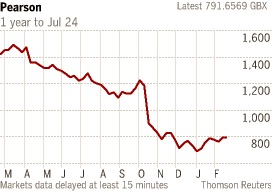
 The impact of opt out and the movement against high-stakes testing has been impressive when it comes to Pearson’s bottom line.

The British publication Professional Pensions reports that Pearson, a UK-based company that controls much of the U.S. school testing business, has lost 42% of is share value in the last year.
Chicago Teachers Pension Fund, Trade Union Fund Managers and 130 individual shareholders joined Unison in the resolution that will be heard at Pearson’s annual general meeting this April.
The resolution said the company was over-reliant on the education testing programme in the US, which had been affected by a recent change in the law and was also becoming increasingly unpopular. It comes as the company revealed last month it was axing 4,000 jobs – 10% of the company’s workforce.
The resolution is being issued jointly by Unison and the coalition of unions. It says that Pearson is over-reliant on the education testing in the US. It comes as the company revealed last month it was axing 4,000 jobs – 10% of the company’s workforce.
Unison Capital is a major investment firm, which owns 33,000 shares of Pearson.
The coalition of unions and public employee pension funds, including the Unions concerned with Pearson investments. | Fred Klonsky:

Mike Klonsky's SmallTalk Blog: We pahked the cah...

Mike Klonsky's SmallTalk Blog: We pahked the cah...:

We pahked the cah...

 We visited Hahvahd yesterday, only to find Chicago students tearing it up academically and politically, as expected.


First, we went over to the Law School where dozens of students have been occupying the Wasserstein Lounge,trying to create a learning environment more relevant and safe for students of color. Occupiers I talked with, including Chicagoan and Whitney Young alumKeaton Allen, want more focus on critical race theory and more African-American profs.

Yesterday's speaker at the protest was none other than Harvard law prof Lani Guinier. Who could be more relevant at a time when Republicans have sworn to stonewall any Scalia replacement chosen by President Obama? Prof. Guinier is the first woman of color ever appointed to a tenured professorship at that institution.

Keaton Allen & Amanda Klonsky
But in 1993, President Bill Clintonpulled back Guinier's nomination as attorney general in the face of a brutal and racist negative Republican-led media campaign, referring to Guinier as a "quota queen." One New York Times opinion piece falsely claimed that Guinier was in Mike Klonsky's SmallTalk Blog: We pahked the cah...:

Who won the education ‘award’ nobody wants to receive? - The Washington Post

Who won the education ‘award’ nobody wants to receive? - The Washington Post:

Who won the education ‘award’ nobody wants to receive?


There are education awards and then there are education awards.
In the first category — those that people in education don’t generally mind winning — we could put the $1 million Global Teacher Prize, given by the Varkey Foundation, the philanthropic arm of GEMS Education, which is the K-12 education company that owns and operates its own GEMS schools in a handful of countries, including Egypt, Abu Dhabi and Uganda.
The foundation, whose honorary chair is former president Bill Clinton, promotes the prize as “the Nobel” of teaching — as there is no actual Nobel prize in education — in an effort to show the importance of teaching in societies around the world. Its first awardee, in 2015, was Nancie Atwell, renowned founder of the Center for Teaching and Learning, an award-winning nonprofit independent K-8 demonstration school in Edgecomb, Maine, where she teaches seventh- and eighth-grade writing, reading and history. The second annual award will be given soon.
But nobody in education genuinely likes winning the Bunkum Award.  Presented annually by the National Education Policy Center at the University of Colorado at Boulder, it is given for what presenters say is “shoddy” educational research based on weak data, questionable analysis and overblown recommendations.
The award gets its name from Buncombe County, N.C., where, in 1820, Rep. Felix Walker delivered “a speech for Buncombe” on whether Missouri should be admitted to the United States as a free or slave state, and he rambled on so much that his colleagues yelled at him to stop. From then on, “bunkum” came to mean long-winded nonsense.
The 2015 winner was just announced, and it was the National Alliance for Public Charter Schools. It was announced by David Berliner, the regents’ professor emeritus and former dean of the College of Education at Arizona State University, and you can watch the “presentation” in the video below. Berliner is a member of the National Academy of Education and the International Academy of Education, a fellow of the Center for Advanced Study in the Behavioral Sciences, a past president of the American Educational Research Association, and a widely recognized scholar of educational psychology and policy.
Here’s the award announcement:
This year’s winner is the National Alliance for Public Charter Schools, for Separating Fact from Fiction: What You Need to Know about Charter Schools. The National Alliance (NAPCS) describes itself as “the leading national nonprofit organization committed to advancing the charter school movement.”Separating Fact from Fiction is a fetching, sleek publication adorned with 15 charming photos of smiling children keeping watch over 21 easy-to-digest, alleged “myths” followed by responses that the report generously describes as “facts.” YetSeparating Fact from Fiction might more honestly be titled:
Playing 21 with a Stacked Deck
or
Blackjacked! 21 Attempts to Club Sound Policy.
Before turning to a small sampling of the report’s problems, however, we’ll offer a compliment: To the credit of the report’s authors, the 21 so-called myths do a good job covering many of the important issues raised by the rapid growth of the charter school sector. Alas, this comprehensive coverage is wasted. The 
Who won the education ‘award’ nobody wants to receive? - The Washington Post:


Why the Roots of Police Violence Lead Back to Segregated Schools - Yahoo News

Why the Roots of Police Violence Lead Back to Segregated Schools - Yahoo News:

Why the Roots of Police Violence Lead Back to Segregated Schools

Why the Roots of Police Violence Lead Back to Segregated Schools


 Integrated public schools have long been touted as a key to boosting the achievement of disadvantaged students. Yet at a time when experts and analysts confirm the nation’s public schools are becoming more segregated, a new report suggests that integration should top the education reform agenda—and that the benefits go far beyond academics.

According to How Racially Diverse Schools and Classrooms Can Benefit All Students, a reportreleased this month by The Century Foundation, whites and minorities learning together in classrooms could help solve problems ranging from the black-white achievement gap to policeusing excessive force against African Americans.
“The advocates of racially integrated schools understand that much of the recent racial tension and unrest in this nation—from Ferguson to Baltimore to Staten Island—may well have been avoided if more children had attended schools that taught them to address implicit biases related to racial, ethnic, and cultural differences,” wrote the report’s authors.
Having students of different racial and economic backgrounds attend the same school helps them learn and socialize with people who aren’t like them, according to the report. Day-to-day interactions with a variety of peers, it adds, can challenge students’ biases or fears about other racial groups, boost intergroup understanding, and help eliminate prejudice.
“What if that police officer had gone to a more racially diverse school...[and learned] to understand the history of race and different cultural perspectives? How might some of those incidents [have] played out differently?” Amy Stuart Wells, a professor at Teachers College of Columbia University and the report’s coauthor, said to The Huffington Post. “These police officers, many of them are in their 20s and 30s and grew up in an era where schools have been resegregating.”
In the report, Wells and her colleagues wrote that “interracial respect, understanding, and empathy is what we should all strive for in our increasingly diverse society. There is no institution better suited to touch the lives of millions of members of the next generation than our public schools.”
Along with healing racial divisions, integrating schools could be central to America’s continued global prosperity. The report cites several amicus briefs submitted in the most recent legal battle over affirmative action, the United States Supreme Court case Fisher v. University of Texas. The briefs show the majority of top companies are looking for employees from diverse backgrounds who can work well with a wide range of people. “Without qualified people from different racial and cultural backgrounds, and, even more importantly, ‘cross-cultural competence’ among employees and management, U.S. corporations will be ill-equipped to compete in an increasingly diverse world,” wrote the authors.
Diverse public schools, with access to better resources and teachers, can produce a better-educated workforce too. Black and Latino students perform better in integrated schools, substantially reducing the black-white achievement gap many districts have struggled to close with no drop-off in the performance of white students. But while the benefits of integrated schools seem clear, reversing racial polarization is easier said than done.
“We have made tremendous progress in race relations in this country, [but] it’s still the big, big elephant in the room that we’re not addressing,” Tyrone Howard, associate dean of equity, diversity, and inclusion at the University of California, Los Angeles’ Graduate School of Education and Information Studies, told TakePart.
“We still have white families opting to send their kids to schools that are predominantly white,” Howard said. “That says something. It doesn’t go the other way around.”  
The problem is twofold, Howard argues: Whites have negative stereotypes about minorities in general, and they have the perception that majority-black or Latino schools typically get the short Why the Roots of Police Violence Lead Back to Segregated Schools - Yahoo News: