Latest News and Comment from Education

Thursday, February 18, 2016

Random Thoughts. Teacher unions aren’t all white. | Fred Klonsky

Random Thoughts. Teacher unions aren’t all white. | Fred Klonsky:

Random Thoughts. Teacher unions aren’t all white.

RANDOM


 A couple of years ago Lily Eskelson Garcia was running for president of the National Education Association and I was an Illinois IEA Retired delegate to the national Representative Assembly. Lily came and spoke to our Retired Conference that precedes the RA.

During the Q&A that followed Lily’s talk I asked her about the decline in the number of public school teachers of color and what our union was going to do about it.

Garcia never gave an action response, although she agreed that the decline in teachers of color was a scandal.

In Chicago the number of African American teachers in CPS has gone from nearly 70% of the teaching staff to under 20% over the past decade or so.

That doesn’t mean that public school teachers are now all white.

I posted yesterday about the few faces of teachers of color among those selected as excellent by the NEA Foundation. We have over three million members in the NEA. They are not all white.

Excellent teachers are not just the Random Thoughts. Teacher unions aren’t all white. | Fred Klonsky:

Should Teachers Have Strong Opinions? | gadflyonthewallblog

Should Teachers Have Strong Opinions? | gadflyonthewallblog:

Should Teachers Have Strong Opinions?

istock_000013919699_490x356
I am an opinionated person. I am also a public school teacher.


Those two things should not be mutually exclusive.


You should not have to give up the one to be able to do the other.


Teachers should not have to relinquish their judgment in order to run an effective classroom. In fact, you might expect good judgment to be a prerequisite to doing the job well.


Yet it seems many people disagree. They like their teachers tame, docile and opinion-free.


That’s just not me.


Now don’t get me wrong. I’m not saying teachers should instruct their students to think just like them. I’m not saying they should indoctrinate or unduly influence the young people in their care.Should Teachers Have Strong Opinions? | gadflyonthewallblog:

Schools Matter: ESSA Questions? Ask Diane Ravitch to Ask Lamar Alexander

Schools Matter: ESSA Questions? Ask Diane Ravitch to Ask Lamar Alexander:


ESSA Questions? Ask Diane Ravitch to Ask Lamar Alexander

“I still wonder why we, over time, don’t make every public school a charter school.” He continued, “You couldn’t do it all overnight, but you could do it over 20, 25 years. - See more at: http://www.aft.org/ae/winter2014-2015/kahlenberg_potter#sthash.y5Y6mha1.dpuf
I don't know why we, over time, don't make every public school a charter school....You could not do it overnight, but you could do it over 20, 25 years."--Lamar Alexander, 2013
Lamar Alexander has spent the last thirty years working in one capacity or another to realize the Reagan dream of privatizing public schools.  

First as governor of Tennessee in the 1980s, he poured millions of scarce education dollars into an unwieldy and unfair performance pay scheme that gave recognition and pay raises principally to teachers in well-funded leafy suburbs.  


In the early 1990s, Alexander used his leverage as U. S. Secretary of Education to attempt toreward his former business associate, Chris Whittle, with federal contracts to fund hundreds of Whittle's corporate Edison Schools. 


As Secretary, Alexander also worked closely with Diane Ravitch to promote the creation of national curriculum standards, and he worked closely with Bill Clinton to raise the conjoined policymaking influence of the National Governors Association and the Business Roundtable.  As a result, the NGA would come to have tremendous influence in shaping the carpet bombing testing strategy used in the NCLB war on public schools.


After 2002 when Alexander was elected to the U. S. Senate, he worked to solidify the testing accountability influence of NCLB, and just in time for the final push for the reauthorization of ESEA, he was named Chair of the 
Senate Committee on Health, Education, Labor, and Pensions.

With the help of his old friend, Diane Ravitch, who helped to quell any fears of and to tamp down any resistance to the new states rights version of ESEA, Alexander was able to push through a bill that now has the best chance ever to attain his goal of complete privatization of all public schools, via corporate charter.  


So if you have any questions about how ESSA will help children or parents or teachers or public schools, NPE wants you to ask Diane to ask Lamar.  What a nice couple they would make!


. . . .I think it is important to stop looking for purity among our allies. We don’t want to be a tiny band of zealots. We want—I want, maybe not “we”–everyone who shares a commitment to children, to the teaching profession, and to public schools, to join together to change the climate of opinion. We can’t do that by demonizing those who approach the issues differently but share our goals. Progressive social movements die when they spend as much energy criticizing their allies as they do with their adversaries.--Diane Ravitch comment below this post.

Schools Matter: ESSA Questions? Ask Diane Ravitch to Ask Lamar Alexander:

Mass media deception on charter school test scores | Seattle Education

Mass media deception on charter school test scores | Seattle Education:

Mass media deception on charter school test scores

shhh


 It’s interesting how much charter schools really do not want to be public schools beholden to public scrutiny.

Case in point, 74, a slick media rag brought to you by the Walton’s and Bloomberg, and the News Tribune both came out with the same story about students in charter schools making great progress after being in their schools a mere five months. Amazing.
The author of the Tribune article wrote she had met with folks from Summit charter school and they shared with her how well their students were doing.
In the article she wrote  that the charter school was (illegally) receiving public funding through the Mary Walker School District, but apparently that was a minor detail for the writer and overlooked.
What was also overlooked was any request by the author for this source of information.
I reached out to the author of the article and asked if she had a source on the test scores. I have not received an answer yet and its been two days. Maybe she’s still looking.
After seeing articles at both news sites, I got curious.
I asked around, where was this information? If a public school made such an announcement, there would be a webpage with dis-aggregated scores and all the information on the type of test given, when it was given, the number of students who took the test and the location of the schools to get a sense of the demographics.
No one seemed to know where all this information was so I asked one of our school board directors, Sue Peters, if she had any idea in terms of the source of this rather Mass media deception on charter school test scores | Seattle Education:

Senate committee schedules confirmation hearing for John King as education secretary - The Washington Post

Senate committee schedules confirmation hearing for John King as education secretary - The Washington Post:
Senate committee schedules confirmation hearing for John King as education secretary


The Senate education committee plans to consider President Obama’s nominee for education secretary at a confirmation hearing at 2 p.m. on Feb. 25.
John King Jr. has been serving as acting secretary of education since his predecessor, Arne Duncan, stepped down at the end of 2015.
It had initially appeared that Obama would not formally nominate King, forgoing the confirmation process. But White House officials said they were encouraged by the bipartisan support that King has received so far.
The administration also wants to have King in the official role as Congress considers higher education legislation, according to officials who asked not to be named because they were not authorized to speak publicly.
Sen. Lamar Alexander (R-Tenn.), chairman of the education committee, said last week that he was pleased that the administration had nominated a secretary and promised a “prompt and fair hearing.”
“For proper accountability, especially as we work with the administration on implementing the new law governing elementary and secondary education, it is important to have in charge of the department a member of the president’s cabinet confirmed by the United States Senate,” Alexander said in a statement.


Emma Brown writes about national education and about people with a stake in schools, including teachers, parents and kids.Senate committee schedules confirmation hearing for John King as education secretary - The Washington Post:


Pressure-cooker meetings have come with school districts’ budgeting freedom | The Modesto Bee

Pressure-cooker meetings have come with school districts’ budgeting freedom | The Modesto Bee:

Pressure-cooker meetings have come with school districts’ budgeting freedom


For decades, schools in California had their spending basically laid out for them by the state. A makeover in school funding has freed district spending from those controls, and those fail-safes. Local control counts on communities tuning in and speaking up.
Money for classroom teachers, janitors and district office administrators came in the biggest pot. Another little wallet held money for textbooks – just for textbooks. Money for school buses went into another pocket, just for transportation. Legislators wanted children to have music lessons, so another envelope full of money came just for arts instruction and instruments.
There were 57 separate wallets for state set-asides, from gang-risk intervention to readers for blind teachers. Predetermined spending took up 40 percent of the budget.
You see the thinking here. Everything legislators wanted to be sure happened, they set aside in a special, restricted purse that could not get lost in the big pot of employee salaries and overhead. Bargaining came down to a question of lower class sizes (more teachers) or higher pay, more aides or more administrators.
Creating the budget each year mostly happened in the business office, using a massive accounting program that tracked every dime in up to 233 separate fields for state and federal funding programs. When the state passed its budget, agile fingers flew in the finance department, cranking out a budget that in large part was a done deal.
School boards made decisions within the categories, such as which textbooks to buy and which grades would have bands or singing lessons. They had final say on the balancing act in salaries and class size. But for the most part, there was no budging the budget numbers. The system got more cumbersome and carved up every year, until the Great Recession forced talk of reform.
Then, with the punch of a ballot in 2012, Proposition 30 ushered in an era of local control. Gone were almost all of the categories. Gone was the loose change rattling around in not-Pressure-cooker meetings have come with school districts’ budgeting freedom | The Modesto Bee:


Read more here: http://www.modbee.com/news/local/education/nan-austin/article60717521.html#storylink=cpy


Peggy Robertson | BustED Pencils

Peggy Robertson | BustED Pencils:

The Kenneth S. Goodman “In Defense of Good Teaching” Award Winner

In his letter of nomination for Peggy Robertson, Ian Altman writes: “For as long as Peggy has worked with students and teachers, she has been a tireless and compassionate advocate for both.” Peggy has been a literacy coach and literacy interventionist at Jewell Elementary School in Aurora, Colorado. In this role, she has developed inquiry processes for students to pursue more self-directed learning. In addition, she has provided professional development for teachers including dialogue about reflective practices. Were this not enough, Peggy created the United Opt Out organization (www.unitedoptout.com) and, along with colleagues, built it into a national movement that has had demonstrable and newsworthy effects, leading to massive standardized test refusals in New York and many other states. In 2012, Peggy helped to lead a protest in Washington D.C. called “Occupy the DOE,” which called out politicians of both major parties Peggy Robertson | BustED Pencils:

Gates: Funding Reform for Longer Than You Think – Save Maine Schools

Gates: Funding Reform for Longer Than You Think – Save Maine Schools:

Gates: Funding Reform for Longer Than You Think


In “How Bill Gates Funded the Swift Common Core Revolution,” journalist Lyndsey Layton tells the story of how David Coleman, CEO of College Board, and Gene Wilhoit, Executive Director of the Council for Chief State School Officers, approached Bill Gates with a “new approach to transform every school in America.”
The “new approach,” of course, was the Common Core State Standards.
“The duo needed money,” writes Layton,“[and] a champion who could overcome the politics that had thwarted every previous attempt to institute national standards.”
According to the article, Gates deliberated for weeks before at last coming back with his answer: he was in.
What followed was the swift Gates takeover of our public schools.
bill-gates-money.jpg
Would that it were so simple!
The truth is that Gates has been funding a much broader effort to fundamentally remake our public education system for far longer Gates: Funding Reform for Longer Than You Think – Save Maine Schools:

What School Walk-Ins Teach Us

2/18/2016 – What School Walk-Ins Teach Us:

Education Opportunity Network -


What School Walk-Ins Teach Us

THIS WEEK: Doing Pre-K Wrong … Viral Video Stokes Democratic Party Division … Segregation Produces Criminals … How Basics Improve Schools … New Crackdown On For-Profits

TOP STORY

What School Walk-Ins Teach Us

By Jeff Bryant

“This week, thousands of teachers, parents, students, and community supporters of public education demonstrated nothing could be further from the truth in a series of “walk-in” protests in over 30 cities involving 900 schools … What’s important … is to hear why the walk-ins are happening and what protestors are saying.”
Read more …

NEWS AND VIEWS

We’re Doing Preschool All Wrong, Says New Book

Huffington Post

“A childhood development specialist at Yale University … argues that preschools are no longer giving children enough room to play, leading them to become less inquisitive, curious thinkers … One culprit is the accountability movement in K-12 education … Preschool has become more focused on academics, but not necessarily more effective in nurturing a child’s cognitive development.”
Read more …

This Viral Video Of A Teacher Berating A Student Is A Window On The Charter School Debate

Vox

Education reporter Libby Nelson writes, “A secretly recorded video of a teacher at a well-known New York charter school berating a first-grader … is getting a lot of attention … But the fight over charter schools is also bigger than New York – it’s part of a broader division within the Democratic Party on education.”
Read more …

How Segregated Schools Turn Kids Into Criminals

The Washington Post

“Resegregation caused the test score gap … to widen between white kids and black kids, as well as between poor kids and rich kids. Now, an even more troubling lesson has emerged. It turns out that segregated schools can become potent incubators of crime.”
Read more …

Learning From London About School Improvement

The News And Observer

Former New York Times education editor Edward Fiske and Duke University professor Helen Ladd write, ” Since the late 1990s, the academic performance of elementary and secondary school students in London has risen dramatically … due largely to significant gains in the 13 boroughs … that have the greatest concentrations of low-income and ethnic-minority students … English educators … rather than experimenting with governance or structural changes … focused their attention on time-honored fundamentals.”
Read more …

Education Department Takes Aim At Errant For-Profits

US News & World Report

“The Department of Education is creating a Student Aid Enforcement Unit to respond more quickly to allegations of illegal actions by higher education institutions … The announcement of the enforcement unit is the latest in a series of steps taken by the Obama administration over the last seven years aimed at more tightly regulating the for-profit college industry.”
Read more …
 2/18/2016 – What School Walk-Ins Teach Us:

Why Most State Education Report Cards are Like Cookies Without the Sugar – Cloaking Inequity

Why Most State Education Report Cards are Like Cookies Without the Sugar – Cloaking Inequity:

Why Most State Education Report Cards are Like Cookies Without the Sugar

Once when I was in high school, a friend handed me a plate of chocolate chip cookies. They looked delicious! But just as I was about to eat one, she snatched them back. They looked great on the outside, she told me, but they tasted terrible.  She had left out a key ingredient—sugar.
This story is exactly how I think about the numerous state education report cards making the rounds.  Instead of  filling you with great, inspiring information, most of these glossy, colorful reports are misleading and ideological. They are basically not worth consuming.
One of the mechanisms so-called education “reformers” have used to promote their top-down, privatization agenda for public education is the state-by-state education report card. Organizations such as Students FirstAmerican Legislative Exchange Council (ALEC), Thomas B. Fordham Institute, and Education Next have recently released report cards for each of the fifty states.
2ChocolateChipCookies.jpgWhat’s wrong with these state report cards? Most state-by-state ratings focus primarily on outcomes, such as state standardized test scores, and basically ignore educational inputs—the ingredients—that make public education successful. These report cards are obsessed with accountability systems that look like bold education “reform,” but that favor top-down, private control of public schools, with dubious results for kids.
Take just two examples.
Students First, an organization started by the controversial District of Columbia education reformer Michelle Rhee, issued report cards giving positive ratings to states if they allowed for parent trigger. Parent trigger is a policy that allows parents (in any given year) to vote to turn over a school and all of its public property to a corporation with a simple majority vote. The Students First report also gave states favorable ratings for prioritizing states’ and mayor’s’ ability to take over school districts. Top-down hostile takeovers of schools by states and mayors have a long and documented history of underwhelming performance and failure.
The state education reports issued by ALEC, a prominent corporate lobbying group that promotes neoliberal model legislation across public Why Most State Education Report Cards are Like Cookies Without the Sugar – Cloaking Inequity:


What out Washington State legislators CAN do to equitably fund educaton | Seattle Education

What out Washington State legislators CAN do to equitably fund educaton | Seattle Education:

What out Washington State legislators CAN do to equitably fund educaton

its-time


 I’ve seen enough dancing around the real issues of funding education in Washington State by our legislators and it’s time  for them to get serious or get another job.

From the Washington Budget Policy Center (who made a great presentation at the Stanford Center last year about funding education in our state hosted by the Seattle PTSA and the League of Women Voters):

Declining Revenue Projections Show It’s Time for Policymakers to Get Serious about Meeting Washington’s Needs

The new forecast of Washington state tax collections makes it clear that lawmakers can no longer assume the growing economy will automatically generate the resources needed to fund court-mandated improvements to schools, mental health, and other important priorities for our state.
The Washington State Economic and Revenue Forecast Council’s projection that state tax resources will be more than $500 million lower than previously forecasted over the next four years means policymakers must get serious about generating new revenue to invest in the progress and well-being of our state and its people.
The diminished tax resources ($78.2 million lower for the current 2015-17 budget cycle; $435.6 million lower in the 2017-19 budget cycle) present a significant challenge to House and Senate budget writers. The writers should be cautious about tapping budget What out Washington State legislators CAN do to equitably fund educaton | Seattle Education:

How Habits Support Democratic Schooling - Bridging Differences - Education Week

How Habits Support Democratic Schooling - Bridging Differences - Education Week:

How Habits Support Democratic Schooling

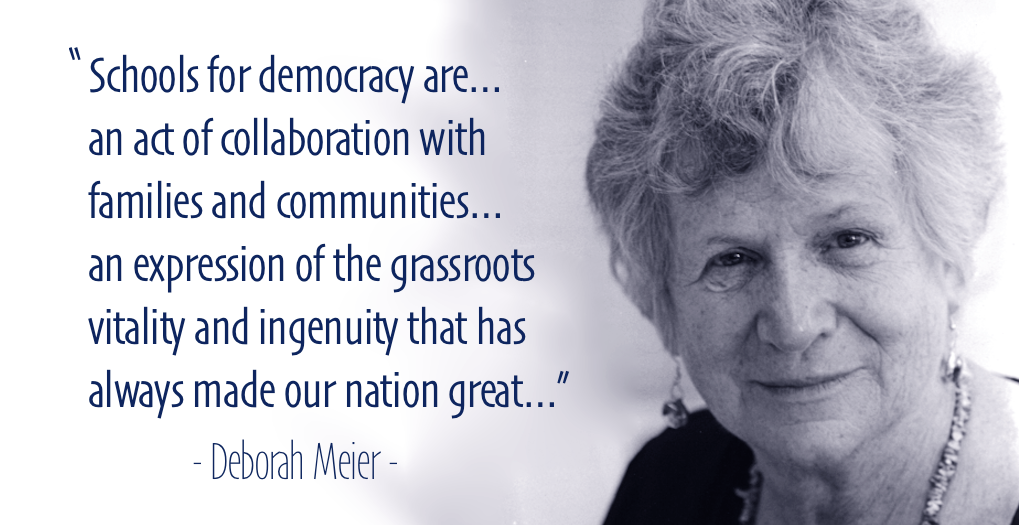
Deborah Meier continues her conversation with Harry Boyte. To read their full exchange, please visit here.
Dear Harry and friends,
Thinking about "habits of mind"—as you take it up in your final paragraph—is a good reminder that schools serve purposes beyond those of the school itself. Public schools serve ends that being raised just at home, church, or other personally chosen private institutions may not serve. If we tax "the people" to educate other people's children as well as their own, the process must serve the common good, to pass on those underlying understandings that hold us together. It gets complicated!
When we started Central Park East Secondary School in 1995, we faced a huge task. CPESS was to be a public East Harlem school with an incredible amount of promised independence—including devising our own definition of what a graduate should be able to demonstrate publicly in order to receive our state-endorsed diploma.
It was a weighty responsibility, blessed by a surprising number of powerful people, including the New York state superintendent of schools, Tom Sobol. The opening staff, about eight of us, met together to tackle these issues in 1995 and every year after to tinker and revise as we went along. But we held on to a few essentials decided on that very first year.
The "Five Habits of Mind" (and heart) were never codified into one particular wording. Over the years we, the kids, and our admirers tinkered with them, expressing them in many different ways that seemed to add rather than take away from our original thinking. I liked that fact.
The first was kind of old-fashioned: "How do we know what we know? Or: What's the evidence?"
The second—although the order in which we developed them wasn't intended to claim any special rank—was something like: "Could it have been different? How else, supposing that?"
The third was: "Is there another viewpoint—in fact, viewpoints? Who and why?"
The fourth was: "Is there a pattern? How are things related to each other? What are the connections?"
And finally, fifth: "Who cares? Why does it matter and to whom?"
We sometimes summarized the five as "habits of the heart": "open," "skeptical," and "empathetic."
We agreed that all the "stuff" we tackled in our curriculum would be subject to these five habits of mind, defining the themes we developed for the six years or more students typically spent at our school (grades 7-12).
We added some "habits of work"—like being reliable ("I can count on you"), collaborative, and committed to each other.
The focus was on "habits"—mind or heart—not just "knowing how." E.g., I know how to put my keys in the designated place every evening when I come home, but I'm not in the habit of doing so.
It's precisely in times of stress and crisis that we most need to have good habits. Democracy is a messy idea, and in practice it's messier still. It's precisely in states of crisis that we count on such habits. We wanted the number to be small and open to many ways of saying and seeing them. We wanted them to fit our different academic disciplines, but we wanted them to apply beyond the classroom—to the playground, our neighborhoods, and our society at large.
The math teachers, the science teachers, the English teachers, and the history teachers all felt very comfortable with the five. "Does it matter?," for example, can apply narrowly to our particular academic discipline, as well as to ordinary and extraordinary civic and personal endeavors. We avoided "cause-and-effect" language on purpose for the broader term of "connections and patterns."
We rejected the term "academic" as having a very questionable popular meaning—irrelevant, dull—quite the opposite of our intent. We liked the term "intellectual"—as a term that could and should be applied to the work of all citizens.
These five served us well and, 12 years later, were the basis for Mission Hill, a K-8 school in Boston. But, good as they are, I'd not favor mandating them. We may not have to always reinvent the wheel, but "buying in" is not sufficient either. It turns out that democracy itself must be reinvented over and over as contexts change and words come to take on different meanings and importance.
Does this make any sense for graduate study, Harry? Or citizen education? What's missing?
Deb
 How Habits Support Democratic Schooling - Bridging Differences - Education Week:

Thomas B. Fordham Releases a Report on Quality of Common Core Tests, ACT, and MCAS: A Debate | Diane Ravitch's blog

Thomas B. Fordham Releases a Report on Quality of Common Core Tests, ACT, and MCAS: A Debate | Diane Ravitch's blog:
Thomas B. Fordham Releases a Report on Quality of Common Core Tests, ACT, and MCAS: A Debate


The Thomas B. Fordham Institute commissioned and published an evaluation of the “content and quality of the next generation assessments,” specifically, the Common Core assessments (PARCC and SBAC), as well as ACT Aspire, and the Massachusetts Comprehensive Assessment System (MCAS). The report’s introduction was written by Michael Petrilli and Amber Northern of the Institute; the report itself was written by researchers Nancy Doorey and Morgan Polikoff. The introduction and link to the report appear in this post; the following posts will debate the study and its findings.
The authors of the report concluded that the Common Core assessments (PARCC and SBAC) were superior to the ACT Aspire and the MCAS.
This is the central finding:
Here’s just a sampling of what we found:
Overall, PARCC and Smarter Balanced assessments had the strongest matches to the CCSSO Criteria.
ACT Aspire and MCAS both did well regarding the quality of their items and the depth of knowledge they assessed.
Still, panelists found that ACT Aspire and MCAS did not adequately assess—or may not assess at all—some of the priority content reflected in the Common Core standards in both ELA/Literacy and mathematics.
The report is long, but the meat of the report can be easily accessed. It is important that you wrap your mind around the report because the next post will challenge its findings.
Since many of you are teachers and have administered some of these tests, feel free to add your voice to the debate.Thomas B. Fordham Releases a Report on Quality of Common Core Tests, ACT, and MCAS: A Debate | Diane Ravitch's blog:


 Richard Phelps, a testing expert, believes in the value of standardized testing but he does not like the Thomas B. Fordham Institute’s report on “next generation assessments.” To put it mildly. He calls it “pretend research.”

Phelps long ago wrote a report for the Thomas B. Fordham Institute, defending standardized testing. But in this case, he excoriates the TBF study. To begin with, he points out the TBF has received millions of dollars from the Gates Foundation to promote the Common Core standards, so he questions its objectivity as a funder of research.
Here are his main objections:
This latest Fordham Institute Common Core apologia is not so much research as a caricature of it.

Instead of referencing a wide range of relevant research, Fordham references only friends from inside their echo chamber and others paid by the Common Core’s wealthy benefactors. But, they imply that they have covered a relevant and adequately wide range of sources.
Instead of evaluating tests according to the industry standard Standards for Educational and Psychological Testing, or any of dozens of other freely-available and well-vetted test evaluation standards, guidelines, or protocols used around the world by testing experts, they employ “a  Richard Phelps: The Fordham Report on Assessments is “Pretend Research” | Diane Ravitch's blog