Latest News and Comment from Education

Tuesday, January 5, 2016

Playa Vista dispute reflects classism as major issue facing LAUSD - LA School Report

Playa Vista dispute reflects classism as major issue facing LAUSD - LA School Report:

Playa Vista dispute reflects classism as major issue facing LAUSD


The school board vote was simple, but the matter is far more complex, drawing a focus to an issue many within LA Unified find uncomfortable to talk about: classism.
The issues involved in the Playa Vista Elementary Schooldispute are a microcosm of complexities within the second largest school district in the country. They involve noise and air pollution, freeways and airports, pitting charter schools with traditional public schools, school over-crowding, district budget cuts and an increase in demand to teach the students’ parents in an ever-growing adult education program at LAUSD.
And, it also involves classism: With the area in question a part of Los Angeles that includes million dollar beach houses and families with yachts as well as some of the most notorious gang-infested housing projects in the city, where do children go to school?
The friction began when Playa Vista Elementary opened in 2012, offering a highly-regarded STEM program for kindergarten through fifth grades. It had 36 classrooms at the time but has now grown to 540 students with no more space available. New housing under construction nearby suggests that by 2020, the school will need to accommodate 400 more students in 14 more classrooms.
For now, some of the classroom space for Playa Vista is housed at Wright Middle School, which also has 19 classrooms on campus for the Westside Innovative School House charter elementary school (WISH). The district is looking for a new home for the charter classes and is considering renovating the adult school at Emerson, which was originally built as an elementary school.
Now, there are families who want a separate middle school, and don’t want their charter children going to school with traditional school students. They even issued apress release in that regard. Parent and longtime resident Lisa Hamor said the conflict has resulted in “pitting schools against schools, and potentially students against students with little or no regard for our students or our existing school communities and their desire for a quality education.”
The school board voted to conduct a feasibility study to see about locating the charter school at the Westchester-Emerson Community Adult School and upgrading Wright’s science lab, as it seeks to deal with increasing enrollment at the local schools — one of the only areas in Los Angeles where enrollment is burgeoning.
Underlying any final decision are issues of diversity.
In one of his final speeches as superintendent, made at last month’s board meeting,Ramon Cortines recounted how the issues are playing out across the district. Playa Vista dispute reflects classism as major issue facing LAUSD - LA School Report:

He’s acting, but the nation’s new education secretary is for real - The Washington Post

He’s acting, but the nation’s new education secretary is for real - The Washington Post:

He’s acting, but the nation’s new education secretary is for real


John B. King, Jr. settled into the rocking chair before a group of cross-legged kindergartners and fielded a question from a little boy.
“Wait, are you a president?” the boy asked the grown-up in the grey suit, who was escorted into their small classroom at JoAnn Leleck Elementary School in Silver Spring, Md., by an army of photographers, cameramen, reporters and assorted school and county officials.
“No, but I work for the president,” King said with a smile. “He’s very nice.”
King is the nation’s acting education secretary, replacing Arne Duncan, who relinquished the job last week after seven years as one of the most influential policy makers for the country’s 100,000 public K-12 schools.
King, who turned 41 on Tuesday, will retain the “acting” modifier for the rest of Obama’s time in office. He has not been nominated by the president, and he will not undergo the confirmation process required of most Cabinet-level officers under the Constitution.
“Decisions around nominations are decisions for the president to make,” King said, when asked if his “acting” status will make it more difficult for him to execute his duties. “I will say the authorities of the acting secretary are the same as authorities of the secretary.”
Republican Congressional leaders in both the Senate and the House say they want King to undergo the vetting process.
“I personally recommended to President Obama in December that he nominate a Secretary of Education and that, if he did, our education committee would consider him or her in January and that — barring some sort of ethical lapse found in the confirmation process — I would work to confirm that nominee before the end of the month,” said Sen. Lamar Alexander (R-Tenn.), chairman of the Senate education panel and a former education secretary under President George H.W. Bush.
“For proper accountability, especially as we work with the administration on implementing the new law governing elementary and secondary education, it He’s acting, but the nation’s new education secretary is for real - The Washington Post:

Sacramento City School Board—A Teacher on the School Board | Ellen Cochrane

Sacramento City School Board—Area Two Highlights 2015 | Ellen Cochrane:

Sacramento City School Board—Area Two Highlights 2015


A Teacher on the School Board
Ellen Cochrane
Ellen Cochrane
Sacramento City School Board
Trustee Area 2


The New Year holds much promise for Sac City, as well as many challenges. It seems that better economic times will offer a boost to the districts finances. However, the responsibilities of the district are complex and urgent and will require every new penny gained from taxes and a careful spending of resources. I consider votes on the budget to be one of the most important parts of my job.
When you contact elected officials you should hear back from them, promptly. The feeling that you’re yelling down a well is thoroughly unacceptable. One simple first year goal was to respond quickly to every constituent contact, via email, letter, phone or in person. So it goes for 2016, if you need anything SCUSD related—Call Me! (916) 457-2725.
At the beginning of last year retired teachers faced a crisis with health care when changes were abruptly made without a board vote. Under board direction the district has returned retirees’ health benefits as they were at the beginning 2015. Our retired teachers are secure.
Teachers will enter into contract negotiations this year. I support a 10% raise in teachers’ salaries and retention of solid health care benefits. While this raise may seem extraordinary, it will bring SCUSD teachers into parity with surrounding districts, which pay significantly higher salaries. Last year we started the school year with more than 80 unfilled credentialed positions. We cannot attract and retain new teachers unless we can compete with other districts. This spring I will participate in university visits (with district personnel) to promote the job openings in SCUSD. If you know of anyone who is interested in a teaching career, let me know!
Summer school of yore is no more, and most activity and elective courses are gone. Even credit recovery is not always available; however, SCUSD does have a bright spot. Visions 2000 Foundation’s College Prep Math & Reading Academy at Sac State is committed to addressing the critical needs and interests of students in the public school system. It is a model of summer school intervention that works with and supports SCUSD. In the dearth of summer school opportunities, it’s a bright light. One of my goals this year is to begin reinstating summer school programs.
Broader district endeavors include the 5 Year Strategic Plan, Local Control Spending, Restorative Justice, and contract negotiations. If you have any specific questions about these major issues feel free to contact me.
Area Two Highlights
Caleb Greenwood Elementary —Caleb continues to develop its International Baccalaureate (IB) program, which was authorized as a Primary Years Program in the spring of 2015. The school is part of the kindergarten-through-12th grade International Baccalaureate track for Kit Carson Middle School.
David Lubin Elementary—The students, teachers and parents are two years into developing a full STEAM program. Congratulations to the school.
Phoebe Hearst Elementary—This no-boundary school is gearing up for open enrollment. All parents have the ability to apply, but spaces are limited.
Tahoe Elementary—Tahoe neighborhood school is in the process of program reassessment. With a strong neighborhood association, new principal, dedicated staff and parents the New Year will bring many new ideas for the community to consider.
Theodore Judah Elementary—Ground will break for a new stick-built building this year. This is one of the first non-portable district additions in many years. The school boundary now includes McKinley Village. I advocated unsuccessfully for additional school crossing signage on Elvas Avenue at 40th street, but will continue to request Sacramento City School Board—Area Two Highlights 2015 | Ellen Cochrane:

John King Talks ESSA, Priorities for 2016, and Being an 'Acting' Education Secretary - Politics K-12 - Education Week

John King Talks ESSA, Priorities for 2016, and Being an 'Acting' Education Secretary - Politics K-12 - Education Week:

John King Talks ESSA, Priorities for 2016, and Being an 'Acting' Education Secretary


John King, the newly minted acting education secretary, dropped by Joanne Leleck Elementary School at Broad Acres in Montgomery County, Md., to welcome students back from the holiday break, highlight the school's use of new federal money for preschool—and chat with reporters.
King, who replaced recently-departed education Secretary Arne Duncan, outlined his top three priorities for his single year in office:IMG_1056.JPG
 "One is to focus on equity and excellence in all of our schools. Two is to lift up teaching," King said. He said he's the product of New York City public schools and that teachers helped get him to the place he's in today.
And he had one higher education goal: "We need to focus as a country on getting back to first in the world in college completion," which will mean making sure students graduate from high school ready for the challenges of post-secondary education. (King also outlined these same three areas in a letter to U.S. Department of Education staff earlier this week, and we wrote about them here.)
King doesn't think the newest edition of the Elementary and Secondary Education Act will have a big impact on whether or not he's able to move forward with that agenda.
"The president signed the Every Student Succeeds Act because he believes and we believe that it builds on the civil rights legacy of the law. We are confident we can work together with states and ensure that implementation of the new law advances equity and excellence in our schools. The key will be to make sure states use their new flexibility around accountability and intervention systems in ways that are [focused] on equity and opportunity for the highest-need students," he said.
King held up Montgomery County—just outside Washington, D.C.—as an example of a district that's doing a good job of meeting the needs of a diverse population. (Incidentally, King is a Montgomery County parent. His daughters—a 4th grader and a 7th grader—attend school in the district.)
Does it matter that King is "acting"?  Some GOP aides on Capitol Hill have raised eyebrows behind the scenes about the fact that King was never put up for Senate confirmation—either for his current gig or for his previous post as a senior aide filling the role of deputy secretary, the No. 2 job John King Talks ESSA, Priorities for 2016, and Being an 'Acting' Education Secretary - Politics K-12 - Education Week:

CURMUDGUCATION: Friedrichs for Dummies

CURMUDGUCATION: Friedrichs for Dummies:
Friedrichs for Dummies


So you've been hearing about Friedrichs vs California Teachers Association, but not paying close attention. You know the unions are upset about it (but when aren't the unions upset about something), and you've heard that the Supreme Court is going to hear it, but you've put off learning more because it all seems so contentious and does anybody really want to seek out more conflict in the education world these days? Besides, you aren't in California.

But lately you've been thinking you should tune in and sort this out. Luckily for you, the Wall Street Journal gave one of the vocal-but-not-lead plaintiffs, Harlan Elrich, room to lay out his case, and we can use it as an entry point.

Elrich lays out his own teaching history, which is not unlike my own--over thirty years, local involvement, not always happy with union choices (though I suspect for different reasons).

Elrich is unhappy with the union's political bent, and though he's less direct about this, the actual direction of that bent. He doesn't want to give money to the union's political activities that work against his own leanings. By law, unions must allow members to opt-out of such contributions (here in PA, contributions for political activities are an opt-in fund separate from dues), but Elrich believes essentially that all union activities, right down to local negotiations, are political. In a sense, that's true-ish-- matters of policy that are set by elected officials cannot avoid a hint of politics, and in the world of education, that means everything.

But Elrich's definition of "political decisions he doesn't agree with" is hugely broad. He does not like that the union gets him too high a salary at the expense of either his economically struggling neighbors or conditions such as class size.

Elrich hits another recurring theme in Friedrich plaintiff complaints, which is the evils of tenure. He tells a story of a teacher who clearly should have been gone from the classroom, but because the union negotiated all these protections, he was not released. Plaintiff Friedrich tells a similar story about a physically abusive teacher who was protected by the union.CURMUDGUCATION: Friedrichs for Dummies:

New State Board of Education member collects multi-million dollar contract via State Board of Education - Wait What?

New State Board of Education member collects multi-million dollar contract via State Board of Education - Wait What?:

New State Board of Education member collects multi-million dollar contract via State Board of Education


Ethics for public officials?  Not so much.
One of Governor Dannel Malloy’s recent appointees to the Connecticut State Board of Education is not only a representative of the charter school industry but his company is collecting a multi-million dollar contract that is funded and managed by the State Department of Education and the very board he has been appointed to.
Although this article was first published at Wait, What? on December 23, 2015, the Malloy administration has refused to comment.
A News Update from Jonathan Pelto and Wendy Lecker
While Connecticut’s public schools continue to suffer from inadequate state funding and Governor Dannel Malloy and his administration strive to undermine, dismiss and destroy the CCJEF school funding lawsuit that would finally ensure that Connecticut meets its State Constitutional obligation to provide all students with a quality education, Malloy’s corporate education reform initiative has fueled an unprecedented growth of charter schools in Connecticut.  The Charter School Industry now collects in excess of $100 million a year from Connecticut taxpayers.
Privately owned and operated, but funded with taxpayer dollars, Connecticut’s Charter Schools have consistently failed to educate their fair share of students that require special education services and English Language Learners who aren’t fluent in the English Language.
Achievement First, Inc., the large charter school chain with schools in New York, Connecticut and Rhode Island, earned national notoriety when news broke about the shocking number of kindergarten and first graders suspended at their schools.  The New State Board of Education member collects multi-million dollar contract via State Board of Education - Wait What?:

Mike Klonsky's SmallTalk Blog: Rauner tells POLITICO: 'I wasn't in Cuba. I was in, um...Europe.'

Mike Klonsky's SmallTalk Blog: Rauner tells POLITICO: 'I wasn't in Cuba. I was in, um...Europe.':

Rauner tells POLITICO: 'I wasn't in Cuba. I was in, um...Europe.'


“You’d be amazed at what we ate. I’m not going to tell you that.” -- Gov. Rauner
Natasha Korecki is one of my favorite reporters on the Chicago scene. I peruse her Illinois Playbook in POLITICO most mornings over breakfast. You should too.

It looks like she perused mine on Saturday when I raised the possibility that Gov. Rauner's secret vacation had taken him to Cuba to hang out with his pal, Rahm Emanuel.

Got that last piece from reliable sources who say they spotted the gov in Havana. Are reporters even curious? I mean, Rahm/Rauner wining and dining together in Cuba while the city sizzles and the state floods (literally).
To her credit, she took my charge seriously and undaunted by Rahm's previous hissy-fit over her colleague Mike Allen's broaching of the Cuba topic, Korecki put it right to the gov. Here's what she came away with.

 To the conspiracy theorists who believed Emanuel and Gov. Bruce Rauner were secretly puffing cigars and toasting Mojitos in Cuba on a joint, clandestine vacation -- not true. They were drinking Cuba Libres? No, no, no. While the two have been known to enjoy a pricey bottle of wine and fish together in their free time, the governor was in fact in Europe with his family on vacation over winter break. He paid Mike Klonsky's SmallTalk Blog: Rauner tells POLITICO: 'I wasn't in Cuba. I was in, um...Europe.':


No Child Left Behind is Gone. But What Does the New Ed Law Mean for K-12 Funding? - Inside Philanthropy

No Child Left Behind is Gone. But What Does the New Ed Law Mean for K-12 Funding? - Inside Philanthropy: Fundraising Intelligence - Inside Philanthropy:

No Child Left Behind is Gone. But What Does the New Ed Law Mean for K-12 Funding?


The latest version of the federal Elementary and Secondary Education Act was recently signed into law by President Obama. The new law, christened the Every Student Succeeds Act (ESSA), replaces its predecessor, the much-maligned No Child Left Behind Act (NCLB) of 2001. "Good riddance" sums up the sentiments of many educators regarding the demise of NCLB, but the question now is what ESSA means for students, their teachers and principals, and for the funders who support many K-12 initiatives and reforms. 
(See my earlier post on what ESSA means for funders and nonprofits in the early childhood ed space.)
While the new law is barely in the implementation stage, a look at its provisions reveals some important details for K-12 education and those funders who have made ed reform a key element of their grantmaking strategy.
Testing Here to Stay
Standardized testing in K-12 schools is not going away. ESSA largely preserves the requirements for standardized testing in grades three to eight and high school, much as NCLB did. However, in a step away from its predecessor, the new law offers states and school districts greater flexibility in the design of those assessment tools, as well as in accountability for results. This contrasts with the more punitive approach of NCLB, which triggered federally mandated improvement requirements for schools and districts that failed to meet academic performance standards.
In addition to continued testing requirements, states and districts must continue to disaggregate their assessment data by various student groups, such as low-income students, racial and ethnic groups, special education students and English language learners. This means the use of data to drive decisions will remain an important part of K-12 practices.
The prominent role for data in education decisions is good news for a wide variety of funders who have awarded millions in grants to boost the capacity of states and school districts to collect, manage, and understand their data. The Gates, Casey, Dell, and Ford foundations are among the leading funders of the Data Quality Campaign and similar organizations supporting better data use in education. But as we have seen, education data can be used (or misused) in a number of ways.
As a decision-making tool, data can act as a hammer or as a flashlight. Where NCLB advocated the hammer approach, piling costly sanctions and improvement measures on schools that fail to measure up based on standardized test results, the language of ESSA at least suggests a preference for the “flashlight” approach, in which data becomes a means for highlighting problem areas and populations, and is used for plans to address deficiencies. For low-performing schools, ESSA requires districts to work with teachers and school staff to develop evidence-based plans.
However, more punitive measures remain an option. If schools continue to founder after no more than four years under a district turnaround plan, states can step in with their own plans, including firing the principal or converting the campus into a charter school. 
High Standards (But Not Necessarily Common Core)
Contrary to the concerns of Obama administration critics, who feared the president would seize an opportunity to mandate the Common Core State Standards nationwide, ESSA requires only that states adopt “challenging” academic standards. The Secretary of Education is strictly prohibited from requiring or even encouraging states to adopt a particular set of standards, including the Common Core.


New Study Explores How New Orleans Families Choose Between Public and Private Schools | WWNO

New Study Explores How New Orleans Families Choose Between Public and Private Schools | WWNO:

New Study Explores How New Orleans Families Choose Between Public and Private Schools


When low-income students apply to school in New Orleans, they have three options: a handful of traditional public schools, mostly charter public schools, and private schools with voucher programs. How do these students and their families choose an option? A new study from Tulane's Education Research Alliance explores this question.
When given the choice, do families want to leave the public school system no matter what, or will they consider public schools? There's a reason this study takes place in New Orleans.
Jane Arnold Lincove is a co-author of the study. "It's only in New Orleans that we have data where we can observe a ranked order of parent preferences for public schools, charter schools and private voucher schools all together on one application," she says.
Lincove and fellow researchers looked at OneApp applications from 2013. They found half of private voucher school applicants also applied to public schools. About a third listed a public school as their top choice. Lincove says the study is an important step in assessing school voucher programs.
"The theory of vouchers as a strategy to improve the school system overall is that public schools will experience competition from private schools," she says. "And hopefully what they do to be more competitive is improve the academic quality of their school. But we don't have a lot of evidence that this even happens in voucher programs, that there are parents who might exit for private school but would be willing to use a public school if it offered the right type of program for their kid. So it's kind of promising for the idea that public schools actually compete with private schools when you have a voucher system."
The Education Research Alliance plans to release several more studies on the connection between public and private schools.New Study Explores How New Orleans Families Choose Between Public and Private Schools | WWNO:


With A Brooklyn Accent: The Magic of Community History-What Test Based Accountability and School Closings Ruined in the Bronx

With A Brooklyn Accent: The Magic of Community History-What Test Based Accountability and School Closings Ruined in the Bronx:

The Magic of Community History-What Test Based Accountability and School Closings Ruined in the Bronx

Yesterday, while going through my files to do the footnotes for a book of African American Bronx oral histories I was completing, I came upon a document that filled me with great sadness. It was a speech, and powerpoint presentation I gave in February 2006 to over 600 Bronx social studies teachers assembled at Lehman college about the musical traditions of the Bronx- supplemented by nearly 20 songs.

The response from the teachers, principals and assistant principals in the audience was incredible- some of them were dancing in the aisles- and out of this experience came the opportunity to work in over 20 Bronx schools doing community history projects, lectures and neighborhood tours. In every school I entered, the teachers, administrators, students and parents took ownership of the material I presented, creating amazing projects, presentations ,displays and musical performances. So incredible were these teacher/student developed projects that I decided to showcase them at the 2008 Organization of American Historians Convention at the New York Hilton. as an example of the kind of community history projects scholars all over the nation should be doing.
Little did I know, when I organized the program for the OAH, that within two years, all of these programs would be gone. By 2010 my invitations from Bronx schools would shrink to nearly zero, with one school in Morrisania, PS 140, being the only hold out.
What happened?
In 2007, under the aegis of a misguided Columbia law professor named 
With A Brooklyn Accent: The Magic of Community History-What Test Based Accountability and School Closings Ruined in the Bronx:


Common Core eases literary classics to the sidelines :: SI&A Cabinet Report

Common Core eases literary classics to the sidelines :: SI&A Cabinet Report :: The Essential Resource for Superintendents and the Cabinet:

Common Core eases literary classics to the sidelines


(Wash.) In some schools where Common Core rules the curriculum, only parts of Joseph Heller’s classic tale of a struggle and disillusionment is likely read, with the themes of “Catch-22” taught in tandem with other, more modern stories and visual aids.
Mostly gone are the days of reading the classics cover-to-cover, analyzing descriptive techniques, characters and themes through the use of one text, with the hope that students are keeping up with the additional chapters at home.
“It is true that the days for ‘Moby Dick’ or ‘Great Expectations’ might be numbered, but the question that teachers have to ask themselves is ‘What is the purpose of reading this text?’" said Mark Gardner, a high school English teacher in Clarke County, Washington.
“While it may seem like sacrilege, there are many goals that can be achieved by digging deeply into a series of well-curated selections of a text rather than all of it, and then relying on teacher lecture, lessons or even Sparknotes to fill in the gaps,” Gardner said in an interview.
Many of the changes taking place in English classrooms can be attributed to adoption of the Common Core, which calls for students to read more non-fiction in order to better prepare them for the type of informational materials they will encounter in college or the workplace.
In many cases, teachers now supplement novels with other texts, such as news articles or historical documents, or visual aids including maps or documentaries.
As an AP English and composition teacher in Montgomery County, Maryland, Ambereen Khan-Baker has included political cartoons and shorter, more complex texts while cutting out longer novels. Using multiple texts instead of focusing on one book has allowed her to teach diverse opinions.
“We still teach Shakespeare but there is less of an emphasis on that,” Khan-Baker said in an interview. “It’s about looking at the students; what are their needs, where are they right now and how can we address that?”
Modern works are added to the discussion more often as well, according to Gardner, who said that the recent wave of dystopian young adult literature can be compared and connected to materials long considered staples in the classroom, including George Orwell’s novels “Animal Farm” and “1984,” William Golding’s “Lord of the Flies” and Ray Bradbury’s “Fahrenheit 451,” or short stories such as Shirley Jackson’s “The Lottery.”

Flawed Assumptions about School Reform Strengthening the U.S. Economy | Larry Cuban on School Reform and Classroom Practice

Flawed Assumptions about School Reform Strengthening the U.S. Economy | Larry Cuban on School Reform and Classroom Practice:

Flawed Assumptions about School Reform Strengthening the U.S. Economy

Screen Shot 2016-01-05 at 11.09.39 AM
NYT: "While graduating from college in unprecedented numbers, [Millennials] are earning between 5 and 9 percent less (after adjusting for inflation) than what their elders were receiving at similar points in their careers. No other age group saw a similar decline." (2015: The Year in Charts)

“The ideas of economists and political philosophers, both when they are right and when they are wrong are more powerful than is commonly understood. Indeed, the world is ruled by little else. Practical men, who believe themselves to be quite exempt from any intellectual influences, are usually slaves of some defunct economist.”
― John Maynard Keynes
For years I have seen Keynes’s quote and thought little of it. In the past week, however, this economist’s reflection of nearly a century ago pinched me and got me thinking about school reform in the U.S. for the past three decades. Taken for granted is the rationale that U.S. students don’t measure up to international students; low test scores are signs that U.S. students are unable to enter successfully the new information-driven workplace. Moreover, jobs have disappeared. The new economy requires different and far more complex skills than the industrial-based one since the late-19th century. Students need to learn more, faster, and better. And graduates equipped with those skills–schools growing “human capital” is the jargon –will get high-paying jobs benefiting themselves and the economy will be stronger in the global marketplace benefiting society. That has been the rationale for over thirty years of school reform.
And here is where the influential ideas of “defunct economist[s]” enter the picture. Turn back the clock to A Nation at Risk (1983). The idea of the U.S. losing its global technological, scientific, and economic position was due, the report claimed, to the mediocrity of U.S. schools. Data showed that U.S. schools were failing. Evidence cited in the report pointed to low test scores of U.S. students compared to international students, high numbers of high school dropouts, low curriculum standards, and low salaries for teachers. The call for strengthened curriculum standards and tougher graduation requirements would lead, the report said, to a stronger economy.
Harnessed to the then dominant economic concept of  “human capital,” the public school’s job is to increase students’ knowledge and skills geared to a fast-changing world where information and services drives the economy. Those students equipped with high-tech and thinking skills will be more productive workers thus contributing to economic growth. Few policymakers challenged economists’ confidence in public school investments building a stronger economy.
Since then, beliefs in the growth of new technologies powering economic growth and productivity have led to state and federal laws–influenced strongly by economic thinking of “human capital,” economists–that called for far more intervention into local schools. No Child Left Behind (2002) crowned that Flawed Assumptions about School Reform Strengthening the U.S. Economy | Larry Cuban on School Reform and Classroom Practice:


We are opting our first grade son out of the MAP test—here’s our letter explaining why | I AM AN EDUCATOR

We are opting our first grade son out of the MAP test—here’s our letter explaining why | I AM AN EDUCATOR:

We are opting our first grade son out of the MAP test—here’s our letter explaining why

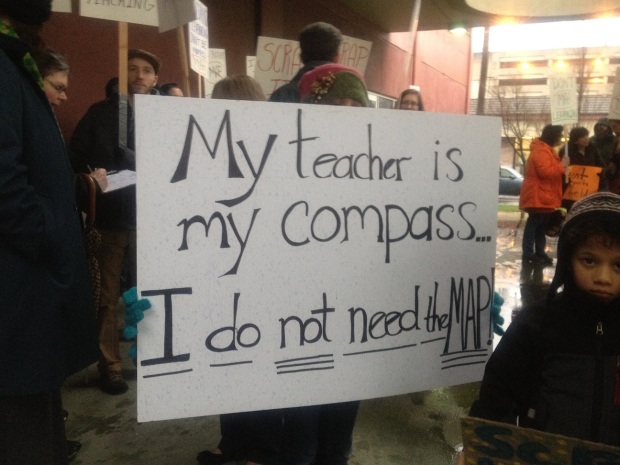
MyTeacherIsMyCompass
The infamous MAP test is set to be administered in my son’s school this week. The MAP test is a computerized test meant to measure students in math and reading. Seattle Public Schools initially required MAP kindergarten through high school, with multiple testing periods per year. In 2013, Garfield High School launched a boycott of the MAP test and numerous schools joined in refusing to administer the test. By the end of the year the district announced that it would  no longer requiring the MAP test at the high school level. Since then, the increasing pressure of the opt out movement and scrutiny on the role of high stakes testing in our education system have continued to reduce the use of the MAP test in the Seattle Public Schools.
mapTest_LibraryThe opt out movement has pointed out that the MAP test consumes too much class time, monopolizes computers and shuts down school libraries, is not linguistically or culturally appropriate for English language learners, and has a questionable validity (consider this research fromhttps://scrapthemap.wordpress.com:PowerPoint: The MAP test).
Most recently, the district reduced the number of times per year that kindergarten through 2ndgrades are required to administer MAP from 2-3 times per year to only once a year. However, there continue to be high stakes attached to MAP that can make it difficult for schools to reduce the number of times it is administered.
For example, schools that receive desperately needed extra levy funds from the city can lose funding if their test scores are not high enough. This is an egregious misuse of standardized test scores. Money for vital programs serving children in high poverty schools should never be cut based on a test that was not designed to be used for high stakes decisions.
Given all the specific problems with the MAP test, and the larger issue of misuse of standardized testing in general, my wife and I wrote this letter to our school’s principal opting our son out of the test this week:
Dear Principal,
Happy New Year! We hope you had a restful break.
We are writing to opt our first grade son out of all MAP testing for this 2015-2016 school year.
We are opting him out of standardized testing because we have seen the way an over-emphasis on scores has distorted what matters most in elementary education–such as creativity, being a good friend, communicating emotions, and problem solving. Ranking students based on test scores in the early grades can damage the self-esteem of late bloomers, and can distort the higher scoring students’ perceptions of themselves in relationship to their peers–these were our experiences growing up and we don’t want these scores to interfere with our son’s development. One of the most exciting aspects of our son’s education is the Spanish immersion program that has cultivated his love for language and laid the foundation for him to communicate with many more people across cultures and around the world – and yet none of this will be measured by the MAP test.
Opting out is a difficult decision this year, because of the way the scores can be used for high-stakes decisions around funding. It deeply saddens us that policy makers would deny funding to a school for any reason, but particularly one so narrow and tangential to real learning. Our son has excellent teachers and we think there is no substitute for their assessment of his progress.
We are deeply committed to our school community and look forward to working with you on these issues in years to come.
Thanks!

Like NCLB, new education law makes promises that will be hard to fulfill | EdSource

Like NCLB, new education law makes promises that will be hard to fulfill | EdSource:

Like NCLB, new education law makes promises that will be hard to fulfill

The profound question that anyone concerned about our children’s future – and the nation’s – is whether the Every Student Succeeds Act that President Barack Obama just signed will be any more successful than the law it replaced in realizing its lofty vision.

Almost 14 years ago to the day, on Jan. 2, 2002, former President George W. Bush signed the No Child Left Behind law that is now widely maligned, and in many quarters reviled.
“Today begins a new era, a new time in public education in our country,” Bush declared in the sweeping rhetoric that typically accompanies presidential signings of this kind. “As of this hour, America’s schools will be on a new path of reform, and a new path of results.”
His rhetoric was matched by the Democratic authors of the bill, who also trumpeted the transformational promise of NCLB. “This is a defining issue about the future of our nation and about the future of democracy, the future of liberty, and the future of the United States in leading the free world,” the late Sen. Edward Kennedy proclaimed. “No piece of legislation will have a greater impact or influence on that.”
Obama’s legslation was similarly launched with grand expectations.  Calling it a “Christmas miracle,” Obama declared, “I’m proud to sign a law that’s going to make sure that every student is prepared to succeed in the 21st century.”
Sen. Lamar Alexander, R-Tenn., the principal Republican author of the bill, said the law would “inaugurate a new era of innovation and excellence in student achievement by restoring responsibility to states and classroom teachers.”
Whether it will or won’t is, at this stage, unknown.
American Federation of Teachers President Randi Weingarten recalled a few years ago that she had “high hopes for NCLB when it was enacted in 2002.”
“I was not alone in being optimistic and heartened by the renewed federal commitment to supporting public education,” she said. “In particular, those of us committed to seeing all our students succeed, no matter their ZIP code, applauded the focused attention on eradicating the achievement gap.”
But, she noted, “hope, no matter its wellspring, can falter under the weight of reality.”
“Faith in the power of education has had both positive and negative consequences,” wrote David Tyack and Larry Cuban in “Tinkering Toward Utopia: A Century of Public School Reform.” “It has helped persuade citizens to create the most comprehensive system of public schooling in the world. But overpromising has often led to disillusionment and to blaming schools for not solving problems beyond their reach.”
The problem with both NCLB and the Every Student Succeeds Act is that both laws are not made up of a set of  reforms that have been carefully tested and Like NCLB, new education law makes promises that will be hard to fulfill | EdSource:

Bradley Foundation’s Radical Education Privatization Campaign Rolls On | One Wisconsin Now

Bradley Foundation’s Radical Education Privatization Campaign Rolls On | One Wisconsin Now:

Bradley Foundation’s Radical Education Privatization Campaign Rolls On

Updated Research Finds Over 130 Organizations Part of $108 Million-Plus Propaganda Campaign

school student
MADISON, Wis. — In recent years, the unaccountable private school voucher program dramatically expanded in Wisconsin while state public schools suffered the 4th largest budget cuts in the nation. What’s the explanation for the shift in priorities when, according to independent studies, vouchers fail to produce any significant increase in student achievement? Updated research from One Wisconsin Institute exposing the right-wingBradley Foundation’s spending over $108 million in support of education privatization from 2005 to 2014 provides some answers.
“The Bradley Foundation supports the radical privatization of public schools in Wisconsin and across the nation,” commented One Wisconsin Institute Executive Director Scot Ross. “And it seems there’s no limit to how much they will pay to try to get their way, spending over $108 million between 2005 and 2014 to buy the help of over 130 organizations.”
Key findings of the updated “P Is For Payoff” report include: 
  • Bradley Foundation head Michael Grebe, a political insider who chaired Gov. Walker’s presidential and gubernatorial campaigns, continues to orchestrate a massive propaganda campaign to advance the privatization of public education;
  • An analysis of IRS Form 990 records and Bradley Foundation reports reveals over 130 organizations supportive of their education privatization agenda and working to advance their cause have received over $108 million from 2005 through 2014;
  • Bradley’s tactics have continued to evolve, now featuring litigation to advance their privatization agenda and intimidate opponents. Leading the effort is the Wisconsin Institute for Law and Liberty which since its inception in 2011 has been larded with over $2 million from Bradley;
  • According to the nonpartisan Legislative Fiscal Bureau, the voucher program will cost Wisconsin taxpayers over $1.1 billion from 2011 through the end of the 2015-17 budget cycle. Meanwhile, a new report found that Wisconsin schools have suffered the 4th biggest cuts in in the nation through 2014.
Original research by One Wisconsin Institute in 2013 first exposed the Bradley Foundation as a leading player in the campaign to gut public education and promote the unaccountable, radical privatization of K-12 education. The Milwaukee-based group spent millions to support organizations, think tanks, journalists and right-wing academics. They engaged in a campaign that manufactured a crisis, singled out their enemies, generated a cure, justified their scheme with pseudo-science, broadcast their message through the media, helped elect politicians to advance their agenda and kept them in line with high-powered lobbyists and well-funded pressure campaigns.
Ross concluded, “Wisconsin families and public schools are left paying the price as billions of dollars that could have been used for public education are siphoned off for the Bradley Foundation’s ideologically driven experiment. Until a majority of policy makers are willing to stand up to the Bradley Foundation’s millions, Wisconsin’s tradition of great public schools will remain under assault.”


Mom: What do I expect from my children’s elementary school? Certainly not this. - The Washington Post

Mom: What do I expect from my children’s elementary school? Certainly not this. - The Washington Post:

Mom: What do I expect from my children’s elementary school? Certainly not this.

Laura Eberhart Goodman  is a former classroom teacher and writer on “The Synapse” on Medium. Her work has been published on the YouShare Project, and in the upcoming IAGC (Illinois Association for Gifted Children) annual journal. You can find her musings on the value of creativity, unstructured play, and the importance of preserving childhood on her blog,Boilsdown.com, where this piece appeared. She was raised on a farm north of Baltimore, Maryland and currently resides in Richmond, Virginia, with her husband and two children. In this post. she writes about her concerns about the experiences her children are having at elementary school. It’s not what she had hoped for or expected.

By Laura Eberhart Goodman
When I put my children on the bus in the morning, the wish I call out to them after kissing their heads, is, “Have a good day!” Pure and simple.
Now, I know that not every day can be a birthday party, and not all things in life should be made into a fun activity. My wish is not overly naïve or idealistic, it is simply that they enjoy their day at school.  It is my hope that even if there are moments of the day when things don’t go well, or times when they are frustrated, or they find something to be particularly challenging, the overall feeling when they return home is not negative.
I want them to have had enough positive experiences, enough moments of engagement, enough creativity and fun built into their day that “good” is the predominant mood descriptor.
That is not currently the case.
The children that I get off of the bus are exhausted. They are frustrated. They are overworked. They are burned out. I feel as if I should make them a weak whiskey on the rocks, hand them their pipe and slippers, and leave them alone for an hour to decompress.
It takes them a bit of time before they can think of something positive to tell me, and usually it ends up being something that happened during recess or lunch. I would blame the teachers for this bleak attitude, but I was one, and I know that the teachers are just as tired, frustrated and overworked. Their teachers are trying to inject as much fun into the day as possible, but are obligated to keep up with deadlines, adhere to the curriculum, and meet the standards. No, this pressure is coming from high above. And it is squishing my children with its weight.
For my elementary school aged children, I care more about whether or not they love going to school than I do about their academic progress. I am clever enough to know that if they are enjoying themselves at school, they will learn. Academics follow naturally if the proper environment for learning is there.
From a parental perspective, a good learning environment is one with positive energy. The teachers want to be there, and the children want to be there. No Mom: What do I expect from my children’s elementary school? Certainly not this. - The Washington Post: