Latest News and Comment from Education

Wednesday, December 9, 2015

ESEA Rewrite Passes Senate, Heads to President's Desk - Politics K-12 - Education Week

ESEA Rewrite Passes Senate, Heads to President's Desk - Politics K-12 - Education Week:

ESEA Rewrite Passes Senate, Heads to President's Desk

Politics K-12


Washington
Hear that collective whoop from the Capitol? That's the sound of education advocates and lawmakers cheering at the finish line as the first rewrite of the Elementary and Secondary Education Act in more than a dozen years sails through Congress and on to the White House. 
The U.S. Senate on Wednesday approved the rewrite of the withering No Child Left Behind Act—the current version of the ESEA—by a bipartisan margin, mirroring the vote of 359 to 64 in the U.S. House of Representatives just days earlier. President Barack Obama is expected to sign the bill as soon as this week. 
But even as educators and policymakers celebrate passage of the Every Student Succeeds Act, the next set of battles—over how the measure will be regulated in Washington and implemented in states—may just be getting started. 
The bill, sponsored by Sens. Lamar Alexander, R-Tenn., and Patty Murray, D-Wash., and Reps. John Kline, R-Minn., and Bobby Scott, D-Va., would roll back the federal footprint in K-12 education for the first time in nearly a quarter century, putting states in the driver's seat when it comes to accountability, teacher evaluation, school turnarounds, and more.
At the same time, it seeks to maintain what Murray and Scott call important "guardrails" to fix flailing schools and help close the achievement gap between traditionally overlooked groups of students—those in poverty, racial minorities, students in special education, and English-language learners—and their peers. (Everything you ever wanted to know about the bill here.) 
And ESSA slims down the U.S. Department of Education—consolidating nearly 50 programs into a giant block grant—and aims to crack down on the U.S. Secretary of Education's authority when it comes to standards, assessments, school turnarounds, teacher evaluation, and other areas.
It's an open question how the prohibitions on the secretary's power will square with the bill's accountability requirements. Scott said last week he's confident the secretary of education will have enough power to enforce the new law.
But some policy analysts still see plenty of ambiguity and unanswered questions. (More on that below.)

Gearing Up For Implementation 

More important even than the regulatory process in Washington, though, may be the work that goes on in statehouses across the country over the next year as implementation begins.
Under ESSA, states will get to decide whether to stick with teacher evaluations through student outcomes (in place in 42 states and the District of Columbia) and the common-core standards in place in more than 40 states. The Obama administration pushed both those policies—plus aggressive school turnarounds—under its waivers from the NCLB law. 
And, even though ESSA would maintain annual tests, states could dial back the role those assessments play in school ratings and accountability, in favor of other factors, like school climate, teacher engagement, and access to advanced coursework.
The changes to teacher evaluation and the potential rollback of testing's importance have Lily Eskelsen Garcia, the president of the 3 million member National Education Association, pretty excited. (See who else supports the bill here.) 
"We will see the end of test and punish," she said in an interview Tuesday. "We will see the end of hit your cut score or somebody gets punished." 
Despite claims that Congress is broken, NEA was able to work with a "really thoughtful group" of lawmakers to get many of the changes to ESEA it had been seeking for years, Eskelsen Garcia said.
The next task? Helping state affiliates pull off the same thing. "If we can do that in Congress, our counterparts on the state level have some hope of doing something with even a hostile legislature," she said.
Teachers' unions aren't the only ones who see ESSA as an opportunity to influence the direction of state and local systems going forward. 
The Leadership Conference on Civil and Human Rights, which offered a measured endorsement of the bill, is taking seriously language calling for broad community engagement in developing state and district plans to implement the law.
"This [bill] provides leverage about what needs to be done differently, but it is not the end all and be all. It is a framework," said Liz King, the conference's director of education policy Tuesday.
The civil rights community can help local advocates work with districts, states, and educators to make sure traditionally overlooked students get access to their fair share of resources, and that accountability plans call for district and state supports to kick in when they are falling behind, King said.
Of course, there will be work to do inside Washington as well, King said. "On the accountability side, we're going to be there at the table on the development of regulation, helping partner [organizations] understand where they can be engaged." 

Regulatory Head-Scratchers

The regulatory process, slated to kick off in coming months, could call for the department to puzzle through some wonky head-scratchers—with potentially serious implications for the future of accountability, one former education department staffer said.  
"The bill leaves a lot of gray, murky areas and uses some words that are open to interpretation," said Chad Aldeman, now an associate partner at Bellwether Education Partners. "Depending on what the secretary tries to do, I think it could open him up to lawsuits."
Case in point: In what could be a win for the civil rights community, ESSA calls for states and districts to flag, and help fix, schools where traditionally overlooked groups of students are "consistently underperforming." But what, exactly, does that phrase mean? And do states get to define it, or does the Education Department? 
Questions like that could be complicated by the bill's lengthy laundry list of prohibitions on the secretary's authority. That language is largely seen as a rebuke to Duncan, who Republicans say overstepped the bounds of his office big time in issuing conditional waivers (aka flexibility from NCLB in exchange for certain policy promises).
Duncan, who gave a sunny speech on the bill Tuesday, is stepping down this month, leaving John B. King Jr., the former New York commissioner, as acting secretary. King will put the Obama administration's final stamp on the law.
But ESSA won't be fully in place until the 2017-18 school year, which could leave a lot of the work of monitoring and implementation to the next administration. 

Bipartisan Balancing Act 

For his part, Alexander, who championed the provisions clamping down on the education department, doesn't think there's room for the agency to overstep its bounds.
"This bill specifically prohibits the secretary from issuing regulations that aren't authorized by law. That's in there several times," he said in a quick interview Tuesday. And he isn't expecting a stormy implementation process. Instead, he said, it willl likely build on the law's bipartisan support in Congress—and be largely handled in states and districts.  
When it comes to school turnarounds, standards, and teacher evaluation, "school districts and states can immediately make those decisions again without having to come to Washington and play 'Mother May I' and ask the U.S. Secretary for permission," Alexander said.  
And Murray sees ESSA as hitting a particular sweet spot: It's meant to get away from the "one-size-fits-all" nature of NCLB, without stepping back from of the law's focus on protecting vulnerable kids. States and districts will still have to set high expecations for all children and put in place "evidence-based" interventions when schools need them, she said in a quick interview Tuesday.
She'll be watching closely to make sure the legislation's balance is maintained, she added. 
"Passing a bill is not the end of your job here," Murray said.
Sen. Patty Murray, D-Wash., center, joined by Senate Minority Leader Harry Reid, D-Nev., right, and Sen. Chuck Schumer, D-N.Y., speaks to reporters Tuesday after the Senate voted overwhelmingly to end debate on the makeover of the No Child Left Behind Act, setting up a final vote on the legislation on Wednesday.  Murray was a chief architect of the bill along with Sen. Lamar Alexander, R-Tenn. 
--J. Scott Applewhite/AP

Don't miss another Politics K-12 post. Sign up here to get news alerts in your email inbox.


The Exit Interview: Arne Duncan on His Legacy and the Future of Higher Education - Yahoo News

The Exit Interview: Arne Duncan on His Legacy and the Future of Higher Education - Yahoo News:

The Exit Interview: Arne Duncan on His Legacy and the Future of Higher Education

The Exit Interview: Arne Duncan on His Legacy and the Future of Higher Education


Arne Duncan will go down as one of the most influential education secretaries in history.
Duncan, 51, will soon step down after serving for seven years as the United States secretary of education, making him one of President Barack Obama's longest-serving cabinet members and the second-longest-serving education secretary since the Department of Education was established in 1979.
During his time in office, Duncan has presided over an unprecedented growth of the size and scope of the federal government's role in K-12 education, enacting a $4.35 billion Race to the Top grant program that enticed states to enact a number of reforms, including performance-based pay for teachers and controversial Common Core standards for math and reading. On issues of higher education, Duncan's department has been similarly aggressive, overhauling the student loan industry, cracking down on for-profit colleges and combatting sexual assault on campus.
But that expansion of federal authority has come with its fair share of criticism, and Duncan is leaving office bruised by attacks from both the left and the right. In July 2014, delegates of the National Education Association, the largest teacher's union, called on Duncan to resign, citing his emphasis on school standards and standardized testing. Congress has taken steps to roll back many of the reforms Duncan has championed, and the House of Representatives recently votedto scale back the Education Department's authority over states and local school districts, with the Senate expected to do the same. On the campaign trail, Republican presidential candidates Sens. Marco Rubio of Florida and Rand Paul of Kentucky have called for eliminating the federal Education Department altogether.
With the education secretary's legacy on the line, Mic sat down with Duncan in the department's offices in downtown Chicago on a recent Friday afternoon for a wide-ranging conversation to take stock of his record, particularly on issues related to higher education. At 6'5'', Duncan is a towering presence with a warm personality and tendency to speak frankly.
Although he said he is proud of his accomplishments while in office, Duncan also said he is leaving unsatisfied, with parts of his ambitious agenda stymied by partisan politics. He has a run-through-the-doors attitude and bristles at what he sees as the glacial pace of change in Washington.
Asked to grade himself on how he has handled higher education issues, Duncan's answer was telling: "Incomplete."
"There's still so much further to go," he said. "No one should be satisfied. Know that I'm not. I'm far from satisfied."
The background: Duncan grew up in the Hyde Park neighborhood of Chicago's South Side. He graduated from Harvard University in 1987 and pursued a career as a professional basketball player with a four-year stint in Australia. In 1992, Duncan returned to Chicago to become the director of an education nonprofit focused on low-income students. It was during this time that he forged a unique bond with a little-known Illinois state senator named Barack Obama, a fellow hoops enthusiast. The two became close friends and regular partners in pick-up games.
Duncan was appointed CEO of Chicago Public Schools in 2001, a position he held until 2008. He said the experience profoundly shaped his view of the federal government's role in education.
"When I ran the Chicago public schools, the Department of Education was not always my friend," he said, recounting an episode in which he battled the department over cutting federal funding to an after-school tutoring program. "In fact, it rarely was. I went to Washington very skeptical about the federal government's role."
When Obama tapped Duncan as education secretary in 2008, Duncan suddenly found himself at the head of a department he had long viewed as unable or unwilling to pursue large-scale, meaningful change. But an influx of billions of dollars in education spending included in thestimulus package passed in 2009 gave Duncan unprecedented resources to implement reforms across the country.
He said that experience opened his eyes to what was possible with the resources and powers of the federal government at his disposal.
"Going in, if someone would have said, 'You can put $1 billion behind early childhood education. You can help encourage and incentivize 40-plus states to raise standards and think about setting assessments differently. You can put $40 billion into Pell grants without going back to taxpayers for a nickel,' I would've been like, 'I'm in! Can't be true,'" he said.
Early momentum eventually gave way to pitched battles over the department's newfound authority. Critics on the left and the right fault him for consolidating power over education policy in Washington, a criticism Duncan acknowledged, but flatly rejected.
"I think most of the critique we get is that we've done more than some folks would like," he said. "My dead honest critique of all of us, and I'll put myself at the top of the list, is we have not moved fast enough. There's a desperate need, and desperate urgency, and we don't act with that urgency."The Exit Interview: Arne Duncan on His Legacy and the Future of Higher Education - Yahoo News:

Mark Zuckerberg says he’s learned from his school reform mistakes. Has he really? - The Washington Post

Mark Zuckerberg says he’s learned from his school reform mistakes. Has he really? - The Washington Post:

Mark Zuckerberg says he’s learned from his school reform mistakes. Has he really?


Facebook founder Mark Zuckerberg and his wife, Priscilla Chan, recently announced to the world, on the occasion of the birth of their daughter Max, that would, over time, donate 99 percent of their Facebook stock they own — worth many billions of dollars — to “advance human potential and promote equality for all children. Education will play a big role in their philanthropy, they said, sparking concerns among some school activists about how they plan to invest. Here’s a piece raising these issues, from Leonie Haimson, a leader in national efforts among advocates to protect student data as well as founder of the group Class Size Matters.

By Leonie Haimson
It’s been a startling time for parents concerned about children’s data privacy and the outsourcing of instruction to education technology companies. First was the recent news that the V-tech breach had exposed the personal data of more than 6.3 million children – rather than the 200,000 that was first described. The Hill reported:
The information exposed for children includes names, gender and birthdates. Security experts who have reviewed the data say that it is possible to link children’s information with their parents’ data, thereby revealing the kids’ full addresses and other information.
Stolen data for the parents includes mailing and email addresses, security questions used for password resets, IP addresses, passwords and download histories…Chat logs between parents and children were also inappropriately accessed, as well as photos of children.
Then the Electronic Frontier Federation filed a complaint with the Federal Trade Commission against Google for violating the student privacy pledge the company signed the year before. The complaint alleges that Google is collecting and data-mining the information of students while logged into their Google Apps for Education accounts at school:
While Google does not use student data for targeted advertising 
Mark Zuckerberg says he’s learned from his school reform mistakes. Has he really? - The Washington Post:

Durham teachers union fights privatization efforts | News & Observer

Durham teachers union fights privatization efforts | News & Observer:

Durham teachers union fights privatization efforts


The Durham Association of Educators has launched a campaign to fight those pushing to privatize public schools.
“Public schools are under attack,” said Bryan Proffitt, president of the Durham Public Schools teachers’ union, the Durham Association of Educators.
“It’s a well-funded, well-coordinated attack that is actually international in its effort,” he said. “And everybody needs to be clear that this attack has one goal, and that’s the privatization of public schools so folks that have resources can find one more place to suck profit out of this economy.”
Proffit spoke at a meeting held by the Durham Council of PTAs and the Durham Association of Educators, which has about 600 members. About 70 parents, teachers and community members attended.
Privatization advocates are framing the attack, Proffitt said, by saying schools aren’t meeting the needs of young people, specifically poor and/or students of color.
They are also advocating for less funding in areas that would help these students, such as public housing, public transportation and public assistance, Proffitt said.
The push has created a national and local “myth” that public schools are failing, he said. In Durham, the myth has led to white families abandoning the system for charter and other schools.
While challenges in schools are real, he said, so are successes.
“The truth behind the myth of Durham Public Schools is that most of the people that tell the stories have never stepped foot in them,” Proffitt said. “They rely on media, anecdotes, and they believe a story that damns our public schools.”
In response, the association sought to debunk the ideas that Durham Public Schools wereDurham teachers union fights privatization efforts | News & Observer


Read more here: http://www.newsobserver.com/news/local/community/durham-news/article48518060.html#storylink=cpy

New bill would ban charter schools from paying for ads with tax dollars | cleveland.com

New bill would ban charter schools from paying for ads with tax dollars | cleveland.com:

New bill would ban charter schools from paying for ads with tax dollars

ecot ad.jpg
An ad for the Electronic Classroom of Tomorrow (ECOT), Ohio's largest charter school. A new bill from Senate Minority Leader Joe Schiavoni would prevent schools from spending tax dollars on ads like these. Note: We do not know how ECOT paid for this ad.


COLUMBUS, Ohio - The state would ban charter schools from using tax money to pay for advertising under a new bill introduced in the Ohio Senate today.
The proposal from Senate Minority Leader Joe Schiavoni, a Boardman Democrat, would prevent charter schools from using any tax dollars on "advertising, recruiting, or promotional materials."
Schiavoni said he regularly sees Youngstown-area charter schools having festivals, placing yard signs and advertising themselves as "tuition-free academies" to attract students.
"Public schools can't do this, so why should a charter school use tax dollars to do it?" he asked.
Those ads, paid for by the Ohio Coalition for Quality Education, ask listeners to pressure legislators to adopt the so-called "Similar-Students Measure." The coalition wants the state to use the measure immediately, despite legislators voting just two months ago to study the plan before taking any vote. 
Schiavoni's bill does not prevent charters from using donations or other money to promote themselves, just from using tax money the schools receive from the state on a per-student basis.
His proposal comes soon after school board members from across the state asked the legislature to restrict charter school ads, just in different ways.
The Ohio School Boards Association (OSBA) decided at its annual conference last month to ask the legislature to ban advertising for low-performing charter schools.
And it wants the legislature to require all charter schools to report their graduation rates and Performance Index in all ads. Performance Index is a catch-all calculation of student test scores for multiple grades and subjects.
Damon Asbury, OSBA's director of legislative services, said his members would New bill would ban charter schools from paying for ads with tax dollars | cleveland.com:

THE DEBATE OVER CHARTER SCHOOLS

State review could stretch definition of Common Core standards | POLITICO

State review could stretch definition of Common Core standards | POLITICO:

State review could stretch definition of Common Core standards

state-review-could-stretch-definition-common-core-standards
A student works in an eight grade algebra class at Holy Spirit School in East Greenbush, N.Y. (AP Photo/Mike Groll)


ALBANY — As the Common Core task force and state Education Department ready their recommendations for the governor, the reviews raise the prospect of a new set of education standards that isn't recognizable as Common Core.
The Common Core, a framework composed of more than 2,000 rigorous education standards, was adopted by New York State in 2011 as part of its buy-in to the federal Race to the Top program. Education policy makers and task force members who are now tasked with reviewing the standards have discussed how much they can change, how much they should change and even the possible need to change the name of the standards to reflect the modifications — moves that would seemingly relieve copious political contention and play to growing public discontent regarding the Common Core.
“Every state has to weigh what would make sense for them because there are consequences,” said Carrie Heath Phillips, program director for College-and Career-Readiness Standards at the Council of Chief State School Officers.
If states add too much to the standards, it could bog down the teaching process, and if states take too much out, it could reduce the standards' effectiveness, Heath Phillips said. Too many changes would also damage the Common Core's interstate uniformity.

MORE ON POLITICO

“That’s the real flag that goes up,” Heath Phillips said. “The goal that states were looking towards with developing standards is that they would have standards that would prepare our kids to be college and career ready, that this would create greater consistency for students [and] if they move state to state, they would have similar expectations, and for teachers as well.”
The state education department, under end-of-session legislation, is currently examining the standards for possible changes. In September, Cuomo also appointed a Common Core task force to review the standards, calling for a “total reboot” of the state education system.
Task force recommendations are expected to be in to the governor this week, in time for his January State of the State address. The education department review will continue through June.
Both reviews come after a massive test refusal movement in April when more than 20 State review could stretch definition of Common Core standards | POLITICO:

The Charter School Teacher Who Suffers from Test Depression

The Charter School Teacher Who Suffers from Test Depression:

The Charter School Teacher Who Suffers from Test Depression
Updates from the school "reform" movement.


Thanks again to Diane Ravitch's blog, we get directed to a post by a woman named Emily Kaplan, who worked at a celebrated charter school in Boston, and who now works in a public school because the charter school sounds like a tiny step up from kiddie boot camp. The beginning of this post makes me depthlessly sad.
On the wall to their right is a list of the class averages from the last six network assessments (taken by all second graders across the charter network's three campuses), all of which are in the 50s and 60s. Even though these two-hour tests are designed by network leaders to be exceptionally challenging—a class average of an 80% is the holy grail of teachers, who use their students' scores to compete for status and salary increases—this class's scores are the lowest in the school, and the students know it. The teacher speaks to them in a slow, measured tone. "When I left school here yesterday, after working hard all day to give you a good education so you can go to college, I felt disappointed. I felt sad." Shoulders drop. Children put their faces in their hands. "And do you know why?" The teacher looks around the circle; children avert their eyes. One child raises her hand tentatively. "We didn't do good on our tests?" The teacher nods. "Yes, you didn't do well on your assessments. Our class average was very low. And so I felt sad. I went home and I felt very sad for the rest of the day."
I have heard—and I have engaged in—much mockery concerning the use of pedagogical guilt in my Catholic elementary education, but never did I think that by getting an "F" in The Charter School Teacher Who Suffers from Test Depression:

Diane Ravitch and Anti-Apartheid Hero Albie Sachs Join Tom Needham on The Sounds of Film

Public Education Advocate, Diane Ravitch, and South African Anti-Apartheid Hero, Albie Sachs, Join Tom Needham on Long Island’s The Sounds of Film Show | Long Island New York:

PUBLIC EDUCATION ADVOCATE, DIANE RAVITCH, AND SOUTH AFRICAN ANTI-APARTHEID HERO, ALBIE SACHS

 JOIN TOM NEEDHAM ON LONG ISLAND’S THE SOUNDS OF FILM SHOW

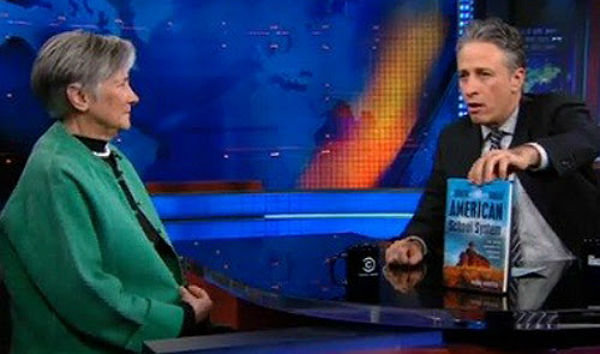
Ravitch001
Public Education Advocate Diane Ravitch in an appearance on Comedy Central’s Daily Show with Jon Stewart. Photo Credit: Comedy Central.
Long Island Press Releases

(Long Island, NY) Public Education Advocate, Diane Ravitch will be a featured guest on Tom Needham’s The Sounds of Film this Thursday at 6 P.M. on 90.1 FM, WUSB. Diane Ravitch is a nationally-known historian of education, an educational policy analyst, a New York University research professor and was the former assistant Secretary of Education under President George H. W. Bush. She is also the author of many books including The Language Police: How Pressure Groups Restrict What Students Learn, The Death and Life of the Great American School System: How Testing and Choice Are Undermining Education and Reign of Error: The Hoax of the Privatization Movement and the Danger to America’s Public Schools. She is one of the county’s leading voices against charter schools, common core and standardized tests. In addition, she has been a strong supporter of Long Island’s Opt Out movement.
Ravitch has argued, “Testing is not teaching. It steals time from instruction. Making it so important that it leads schools to narrow the curriculum, cutting funding for the arts, eliminating social workers and counselors, cutting recess and physical education. Making testing so important that it leads to states and districts gaming the system, to schools shedding low-scoring students, to cheating, to teaching to the test, and to other anti-educational actions.”
Also joining Tom Needham on the program is South African Anti-Apartheid Activist, Constitutional Judge and writer, Albie Sachs, and director Abby Ginzberg, who will be discussing their Peabody winning-documentary Soft Vengeance: Albie Sachs and the New South Africa. The film reveals how as a young lawyer, Albie defended those committed to ending apartheid in South Africa. For his actions, he was imprisoned in solitary confinement in Cape Town, tortured through sleep deprivation and forced into exile. In 1988 he was blown up by a car bomb set by the South African security forces in Maputo, Mozambique, which cost him his right arm and the sight of one eye, but miraculously he survived and after a long year of rehabilitation in England, he recovered. Returning to South Africa following the release of Nelson Mandela, Albie helped write the new Constitution and was then appointed as one of the first 11 judges to the new Constitutional Court, which for the past 20 years has been insuring that the rights of all South Africans are afforded protection.
Albie Sachs once explained what motivated him,” We were fighting against a system, a system of injustice. We weren’t fighting against a race. We were fighting for a better country, a better society. That system, which had not only oppressed and imprisoned black people in terms of their hopes and their possibilities, but imprisoned whites in fear, narrowness, arrogance and greed. That’s what liberation meant. That’s what emancipation meant.”
The Sounds of Film is the nation’s longest-running film themed radio show. For over 27 years, the program has delivered a popular mix of interviews and music to listeners all over Long Island, parts of Connecticut and streaming live on the Internet at wusb.fm. Recent guests include William H. Macy, Michael Moore, Billy Joel, the Nation’s Katrina vanden Heuvel, comedienne Lisa Lampanelli, Rev. Jesse Jackson, Nile Rodgers, composer Howard Shore and author/activist Chris Hedges. Public Education Advocate, Diane Ravitch, and South African Anti-Apartheid Hero, Albie Sachs, Join Tom Needham on Long Island’s The Sounds of Film Show | Long Island New York:

Tuesday, December 8, 2015

College option to jail for lesser crimes

College option to jail for lesser crimes:

College option to jail for lesser crimes


 People charged with first-time nonviolent felonies will get an opportunity to go to college rather than jail under a program launched Monday by Philadelphia District Attorney Seth Williams and Community College of Philadelphia.

The "Future Forward" pilot, scheduled to begin in the spring with 10 to 15 students, is one of a growing number of alternative programs introduced by Williams to help those accused of lesser crimes turn their lives around.
The program is for defendants facing trials for nonviolent felonies, such as drug sales, forgery, car theft, and commercial burglary. No one previously convicted of a violent offense is eligible.
"We're going to give these people the opportunity," Williams said. "Instead of going to jail, go to college."
The effort is believed to be the first of its kind in the country, said Julius Lang, director of training and technical assistance at the Center for Court Innovation, a New York City nonprofit. He said he heard about the Philadelphia program at a national conference in Washington two weeks ago "and loved it."
"One of the major risk factors with reoffending is lack of employment . . . so focusing a program especially addressing that risk factor is just a smart thing to do," he said, "and to do it in a creative way where existing educational institutions like community colleges partner with the prosecutor's office and try to get potential employers to buy into this idea. This is what we need to see a lot more of in this country."
Williams, who said the idea came to him in the shower one day, wanted to give more Philadelphians a shot at higher education and at the same time keep their records clean and reduce recidivism.
Those eligible must be at least 24, have earned a high school diploma or GED, meet

Read more at http://www.philly.com/philly/news/20151208_College_option_to_jail_for_lesser_crimes.html#pvtbSBULaUq1fPLK.99

UTLA- NOT REALLY A UNION - Perdaily.com

UTLA- NOT REALLY A UNION - Perdaily.com:

UTLA- NOT REALLY A UNION

UTLA.jpg


(Mensaje se repite en Español)

In the attempt to unionize the charter school teachers of Alliance College Ready Public School by the United Teachers Los Angeles (UTLA), it is hard- if not impossible- to know which side represents the lesser of two evils for teachers caught between them, since it is clear to me that with or without a union public school teachers have become employees at will whether or not they have tenure or union representation.

While I have always been a supporter of unions, because I know from history just how bad any worker- white collar or blue collar- is treated when they do not have the power that collective bargaining and the ultimate threat of a strike gives them, the present reality for teachers and others represented by unions like UTLA is that once targeted by their employer- be it LAUSD or Alliance College Ready Public School, if UTLA succeeds in getting their teachers to join UTLA- UTLA has and will do nothing to stop any teacher's removal, even if it is clear that there is absolutely no legal or reasonable justification for such action.

Simply stated, Alliance College Ready teachers without a union are presently employees at will, subject to being legally fired without cause. What these teachers don't understand is that even if they vote to join UTLA, they will remain de facto employees at will subject to firing at will, since UTLA has stood by for the last 6 years while its own dues paying members- 87% of whom are over 40 and at the top of the salary scale- have been removed by LAUSD from UTLA- NOT REALLY A UNION - Perdaily.com:


New school improvement agency makes four key hires | EdSource

New school improvement agency makes four key hires | EdSource:

New school improvement agency makes four key hires


SOURCE: CALIFORNIA COLLABORATIVE FOR EDUCATIONAL EXCELLENCE WEBCAST.
Carl Cohn, executive director of the California Collaborative for Educational Excellence, discusses the need for staffing at a recent meeting of the agency's board.
The state agency charged with overseeing school improvement under California’s new accountability system has chosen four top administrators, putting it in a position to move ahead next year with its work.
The Legislature established the California Collaborative for Educational Excellence two years ago in the law creating the Local Control Funding Formula and approved a $10 million budget for the new agency. But the agency, led by a five-person board of directors, has been running in neutral while the State Board of Education chooses the metrics for deciding when county offices of education and the agency will provide support for – and eventually intervene in – districts that fail to reach their academic  goals. The state board must adopt the first set of these measurements, called rubrics, by next fall.
The agency’s executive director, Carl Cohn, a former state school board member and superintendent in Long Beach and San Diego, announced the new hires. They are:
  • Aida Molina and Socorro Shiels as education directors. Molina is assistant superintendent of Academic Improvement and Accountability for the Bakersfield City School District and, since 2011, a member of the State Board of Education appointed by Gov. Jerry Brown. She is also a former commissioner of the California Commission on Teacher Credentialing. Shiels is superintendent of the Santa Rosa City School District and was recently named a board member of FCMAT, the state Fiscal Crisis and Management Assistant Team, which assists school districts in financial trouble.
  • Sujie Shin as the director of research and data assessment. Shin is co-director of the Research for Standards, Assessment, and Accountability Services program at the education research agency WestEd in San Francisco and has held assessment and research jobs in Washington, D.C., Philadelphia, and New York.
  • Joshua Daniels as director of outreach and communications. Daniels, a current member and past president of the Berkeley Unified school board, is staff attorney for the California School Boards Association and the Education Legal Alliance, which handles litigation for the school boards association.
In creating its name, the Legislature indicated that the new agency should take a less dictatorial and punitive approach to school improvement than the federal government prescribed during the past decade under the federal No Child Left Behind Act. Consistent with that, Cohn said all four hires have what he and the board want – “a passion and commitment to equity and serving the underserved and a belief in the right drivers of reform,” including New school improvement agency makes four key hires | EdSource:

Charter School Annual Oversight Checklist | Fiscal Crisis & Management Assistance Team

Charter School Annual Oversight Checklist | Fiscal Crisis & Management Assistance Team:


Charter School Annual Oversight Checklist


FCMAT’s Charter School Annual Oversight Checklist is provided as a tool for charter schools’ authorizing agencies and for charter schools themselves. Please read the News Alert below for important background and practical information regarding the checklist document and its intended use.
The checklist is provided in both PDF (Adobe Acrobat) and Microsoft Word formats. The PDF file can be filled out and printed using Adobe Acrobat Reader; however, the full version of Adobe Acrobat is needed to save the document in electronic format once it is completed.

The Students Always Do That | The Jose Vilson

The Students Always Do That | The Jose Vilson:

The Students Always Do That

revolvingdoor


Real talk: I haven’t been feeling myself lately.
We’ve had a plethora of school program changes. In sum, I ended up with me having five periods of five classes. I don’t blame anyone in my building. I do find it inappropriate to make such hefty changes in freaking December, more so for the students than for me or the adults in the building. I’m also not one to make thoughtless changes for the benefit of test scores, because if I wanted to work in a test-prep factory, I would have.
The custodians had to install a revolving door for my classroom. Or at least that’s what I imagined.
With all that in mind, I fully intended on rolling under my covers when my alarm went off a few days ago. I still found my shoes and socks on my feet, v-neck over my collared shirt, slacks rustling while I made my way to the bodega. I ask for my tostada y cafe, the usual when I have a long day. I ran into one of my newly acquired students. I see him at least twice a week, but never knew him except for his awkward maneuvers through the tight grocery lanes.
Today, he decided to turn around, wish me good morning, and say, “Mr. Vilson, your class is already one of my favorite classes.”
See? Like, it’s like people know that the more kids I get, the more I’m just gonna make do. Every time I cover a class, I find myself wondering what it’d be like to teach that specific class. With these new classes, I let them sit where they liked so I could memorize their names in two days (!), then sit them with folks they can work with. I’m catching them up in the things I already did with my other The Students Always Do That | The Jose Vilson:

Seattle Schools Community Forum: Clarity on WA State Charter Schools from Charter Commission? Fuhgeddaboudit

Seattle Schools Community Forum: Clarity on WA State Charter Schools from Charter Commission? Fuhgeddaboudit:

Clarity on WA State Charter Schools from Charter Commission? Fuhgeddaboudit

1. Forget about it - the issue is not worth the time, energy, mental effort, or emotional resources. 
2. Definitively "no." 


That was one uneventful and less-than-insightful Charter Commission meeting.


There was a brief two minutes of administrative work (minutes), then about a 15-minute executive session and then about 15 minutes of real business.

What was that real business?  Basically, giving the Executive Director, Joshua Halsey, the authority to do the work to shut down the Commission's operations.

Halsey did a  "frame up" of where they are.  He said the Supreme Court's ruling on reconsideration (and delay of implementation of ruling) left the Commission in "unprecedented territory."  He said their office had talked to other state agencies, archives, Governor's office and Auditor's office about how to bring "this agency to a close and wind down operations."  (No date given but probably by the end of next week.)

He also said that they"may need to bring the contracts w/schools to a wind-down and working with OSPI about how that process may work.  He said there are rules within the law about closing a charter contract but not under these conditions and timeline.

If a school does want to end its contract, it will go thru Halsey.

Chair Steve Sundquist asked about 
Seattle Schools Community Forum: Clarity on WA State Charter Schools from Charter Commission? Fuhgeddaboudit: