Latest News and Comment from Education

Tuesday, October 6, 2015

Learning Matters: The Truth about Our Schools—In England and the U.S.

Learning Matters: The Truth about Our Schools—In England and the U.S.:

Learning Matters: The Truth about Our Schools—In England and the U.S.

photodune-5569089-england-flag-xs


School privatization is happening around the world. It should come as no surprise that many countries have the same draconian reforms foisted on their public schools like the U.S. I find it interesting to learn how other countries run their schools and the similarities and differences between their systems and ours.


Learning Matters: The Truth About Our Schools is by Roger Titcombe, who frequently posts about education issues in England on the respected Local Schools Network (LSN). While some language differences exist with terms, it is easy to see the likenesses in our systems.


Their Academies are like our charter schools, and when reading about them it is a bit uncanny to see the similarities. Roger writes:


Academies are independent schools and despite being paid for by the taxpayer the sponsors have had complete power to dictate how and what pupils learn. Much bizarre and educationally doubtful experimentation was taking place based on the Learning Matters: The Truth about Our Schools—In England and the U.S.:

Is the Los Angeles school board speaking truth to power, or was that Pope Francis? — PS connect

Is the Los Angeles school board speaking truth to power, or was that Pope Francis? — PS connect:

Is the Los Angeles school board speaking truth to power, or was that Pope Francis?


When I say AALA, think Associated Administrators of Los Angeles, not Allah. This was no mosque, after all.
The AALA Fall Reception took place last Wednesday at the Plaza Center at the Cathedral of Our Lady of the Angels. Maybe, with Pope Francis making the most sense of anyone in the halls of Congress last week, AALA was hoping some of that holy mojo would rub off on all the board members, senior district staff and administrators present. There was no mention of any sacredness of the spot by AALA president, Juan Flecha, separation of church and state and all. Still, it was not business as usual.
The AALA event was rousing. The speakers--especially the board members--seemed inspired.

California State Superintendent, Tom Torlakson offered a benediction of sorts and then the more personal messages followed. Board President Steve Zimmer, with his usual preachy oratorical flare, paid tribute to the superintendent.
"What Ray Cortines has done is one of the most incredible acts of public service I have ever seen," Zimmer said. He went on to thank the administrators, particularly in light of the horrific news of the high number of shootings in Los Angeles neighborhoods over the weekend, for being the rock that students and families lean on in such times. He reminded everyone there that school is the center of many communities.

Zimmer closed by reassuring the administrators in the wake of the privateers' declaration of war against LAUSD, saying, "We are going to walk through this fire together."

George McKenna offered the parables and personal anecdotes to which we've become accustomed. "We can't just fight to fight; we have to fight to win. When the elephants fight, only the grass gets trampled," he said.

McKenna's best line, which seemed to either search for encouragement or to serve as a warning, was, "We're either going Is the Los Angeles school board speaking truth to power, or was that Pope Francis? — PS connect:

John King’s appointment signals Obama isn’t backing down on an aggressive education agenda - The Hechinger Report

John King’s appointment signals Obama isn’t backing down on an aggressive education agenda - The Hechinger Report:

John King’s appointment signals Obama isn’t backing down on an aggressive education agenda


esident Obama doubled down on his commitment to the nation’s underserved students by selecting Dr. John King to succeed Arne Duncan as Acting Secretary of Education. Clearly, this administration has no plans of backing away over the next fifteen months from the aggressive education reform agenda it began pursuing six years ago.

At his heart, King is a passionate advocate for kids. He knows what it’s like to need an advocate, having lost both of his parents at age twelve. He also knows how important an individual teacher can be, having been personally uplifted by the too-often-overlooked educators who dedicate their lives to teaching the nation’s students.

His dedicated heart comes to this new position encased in a body bearing numerous battle scars. His previous experience as commissioner of education for the state of New York will serve him well in the legislative wrestling ring that has been made of the nation’s capital. He knows the fault lines in the fast-moving education policy environment.

Related: What Arne Duncan did to American education and whether it will last

Having pushed an aggressive state agenda of Common Core State Standards, more rigorous assessments, teacher evaluations, charter schools, and other education reforms, King will draw upon his experience of successes and setbacks in his deep commitment to do the right things for kids. My guess is that King will acknowledge making mistakes, but transforming the U.S. education system from the classroom to the legislative committee room requires both change and occasional failures. What is important is what is learned — and improved upon — from these experiences.

King left New York while the hard work of implementing higher standards and increasing support for teachers in implementing these standards across 700 districts began sapping political support from the statehouse. By stepping down, he removed the obvious symbol for growing opposition while giving his successor the opportunity to continue consolidating gains, including the commitment to providing professional development support to ensure there is a well-prepared teacher in every classroom.

King is ready to continue advancing the Obama administration’s agenda, including fighting against sequestration cuts to education programs and unveiling regulations to measure and improve the quality of teacher preparation programs. He has been an ardent supporter of the DREAM (Development, Relief, and Education for John King’s appointment signals Obama isn’t backing down on an aggressive education agenda - The Hechinger Report:

Duncan’s successor must make sure to partner with the disenfranchised - The Hechinger Report

Duncan’s successor must make sure to partner with the disenfranchised - The Hechinger Report:

Duncan’s successor must make sure to partner with the disenfranchised

Reform should be done with communities, not to them


Arne Duncan will go down as the most influential secretary in U.S. history.

He maximized federal powers to push states to serve all students when those states clearly were not. But pushing from the top isn’t sustainable.

And after Duncan’s seven hard-fought years, we may have realized the zenith of federal authority because of Duncan’s tenure.

Although Congress is negotiating authorization of the Elementary and Secondary Education Act – the legislation that outlines the federal role – improvements will have to come from the bottom up for the foreseeabA bottom up approach may be for the better; black and brown families certainly can’t trust states to create equitable educational systems. Students of color are less likely to have experienced and effective classroom teachers.

States impose racially biased out-of-school suspension and expulsion policies that hurt black and brown communities. Merit-based student financial aid programs favor middle- to upper-income families instead of first-generation collegians. And the stubborn outcomes for black, brown and low-income families say more about a system of inequality than anything about student potential.

The same legislators who erode voting rights for minority groups, permit housing discrimination and enforce racist criminal justice systems also write public education policy. In education, the federal government has a similar role in protecting citizens from civil rights violations.

The historic inabilities of states to deliver quality public schools for disenfranchised groups consistently confirm the fed’s most important role – enforcing civil rights violations, especially those facilitated by state policy. Duncan served this role very well.

Black, brown and low-income folks need higher academic standards. The rigor behind Common Core had even middle class whites crying to opt out. Families and policymakers also need data that can tell us how well students are learning.

Duncan’s insistence for common metrics addressed this need. Families also need states to intervene when it’s clear that little is being done to turnaround failing schools. Duncan doubled down on Bush’s No Child Left Behind accountability system. The only relief states could receive from NCLB’s hard penalties was to accept a reform package from Duncan.Duncan’s successor must make sure to partner with the disenfranchised - The Hechinger Report:


We must despise our kids: Our ugly war on teachers must end now - Salon.com

We must despise our kids: Our ugly war on teachers must end now - Salon.com:

We must despise our kids: Our ugly war on teachers must end now

Republicans and Democrats can agree on one thing: Demonizing teachers. It's the "reformers" doing the most harm


We must despise our kids: Our ugly war on teachers must end now


Last week’s jobs report showed the labor market decelerating. This appears to be thefifth straight year that promising signs in the winter end up softening in the summer and fall. And indicators like the labor force participation rate (which is at a 38-year low) and wage growth (which has stagnated for decades, including in what should be a surge period since the Great Recession) make it look even worse.
But Elise Gould of the Economic Policy Institute dug out perhaps the worst numbers in the report. With September’s data in, we can see how many teachers went back to school this year. And Gould finds that the tremendous gap that opened up when local budgets crashed during the recession has not come close to being filled.
At the peak, we had 8.1 million public K-12 education teachers and staff in July 2008. Seven years later, we have far less, 7.8 million, despite a larger population of students that need to be served. According to EPI, the local public education shortfall, accounting for additional student enrollment, is 410,000 jobs.
This means that classrooms built for 25 or 30 students now have 35 or 40 in them. It means that kids don’t get the same level of personalized instruction, or in some cases any attention at all. It means that programs like art and music have to be excised, or extracurricular activities, simply because there are no resources available to staff them.
Obviously the main culprit of this tremendous and damaging shortfall in student learning is austerity budgeting around the country. Most funding for public schools comes from the states, and they have not rebounded to pre-recession funding levels, nor have they made education enough of a priority to keep up. Though teaching children is routinely stated as our nation’s most important priority in political campaigns, we treat it in the exact opposite manner in budget documents.
But there’s a bigger point to be made here, first brought up by blogger Duncan Black, aka Atrios. Speaking of teachers, Atrios wrote, “who could have predicted that demonizing them, cutting salaries and benefits, and reducing job security might make it a slightly less attractive option for people.”
The amazing thing is just how bipartisan this campaign to denigrate the American teacher has been. We know about the war on public employees on the Republican side, from Scott Walker on down. States under Republican control have routinelyeliminated collective bargaining rightscut retirement benefits, and generally made teaching a less lucrative profession. They’ve also painted a picture of greedy teacher’s unions who deserve “a punch in the face,” according to presidential candidate Chris Christie. Another candidate, John Kasich, signed a law to create a “CEO” position for school districts, armed with the power to override some elements of union contracts.
But putting that expected belligerence aside, teachers have faced assault from their nominal allies for the entirety of the Obama administration. The end of Arne Duncan’s tenure as education secretary puts this into stark relief.
Duncan’s support for charter schools with fewer worker protections, and a “Race to the Top” program that used federal money as a carrot to force states to change their education policies, won rebuke from major teachers unions. He pushed getting rid of “bad teachers” through evaluations that many have criticized as inaccurate. He said that Hurricane Katrina was the best thing to ever happen to the education system in New Orleans, basing this notion on certain test scores improving (largely by We must despise our kids: Our ugly war on teachers must end now - Salon.com:


The Dismal Toll of the War on Teachers

The Dismal Toll of the War on Teachers:

The Dismal Toll of the War on Teachers


What is among the first actions that brutal totalitarian regimes take upon assuming power? They imprison, exile or “disappear” teachers.
Dictators employ such harsh tactics because of the role teachers play in society. Teachers provide not only a crucial link to our cultural past but also exercise critical influence on the present and the future. Teachers train future citizens on how to think and creatively challenge accepted wisdom, which can threaten the power of tyrants.
But before we rush to congratulate ourselves on how well teachers are treated in our free society, we need to recognize the multiple ways in which damage has been caused to the profession.
The United Nations Educational, Scientific, and Cultural Organization (UNESCO) established World Teachers’ Day—celebrated every year on October 5 since 1994—as a result of concerns about the historically low status of teachers and their mistreatment.
As a researcher who studies the history of schooling in the United States, I can testify that Americans have long had a deep and enduring ambivalence about teachers: We value their work, but we pay them less respect and less moneythan those in many other comparable professions. There are plenty of signs that teaching as a vocation is in trouble in the U.S.
The Problem of Teacher Turnover
Look at how enrollments in teacher preparation programs have plummeted in the last few years in U.S. schools.
The hardest-hit state—California—experienced a 53 percent decline between 2008 and 2013. Other states are not too far behind—Michigan, for instance, experienced a 38 percent drop, and Texas a 19 percent reduction, during the same period.
Several high-profile educators have either decided to “hang up their chalk” or encouraged others to avoid the profession altogether.
And what is causing good, experienced educators to flee the ship of teaching?
Teacher turnover has long been an area of concern (teachers depart at a higher rate than comparable professions). The more precise reasons for recent departures are under scrutiny, but we can point to a variety of likely causes.
First, teachers have experienced heavy attacks from a number of directions over the past 15 years.
Ever since the passage of the No Child Left Behind Act in 2001, which accelerated an ongoing education accountability movement, teachers and schools have felt under immense pressure to improve the annual yearly progress of their students on statewide standardized tests and demonstrate that they are “highly qualified.”
Researchers who investigated these concerns found that teachers generally applaud efforts to improve academic standards, instruction and teacher qualifications. But many of these policies have had profound unintended consequences.
For example, because of the differences between state policies, teachers and schools in one state can be punished for student achievement scores that in other states would be rewarded.
Second, the accountability movement has led many policymakers, especially those keen on finding ways to measure the worth of all things, to fasten onto “value-added measures” (VAM) as a way of evaluating teacher performance.
The idea behind VAM is that yearly student test scores can be used not only to track student achievement but also as a way to measure the instructional impact of their teachers.
Dealing With Tests and Fixing Poverty
On the face of it, such instructional assessments might seem like a reasonable approach. But there are many pitfalls to using a test originally designed to measure students to evaluate teachers.
So much so that eminent scholars in the field of statistics, economics, psychology and education have issued urgent warnings to policymakers that VAM are far too flawed to be of any value in teacher assessment.
Despite such caution, many states have moved forward with the implementation of evaluation systems that employ VAM as a primary mechanism for teacher evaluation, a development that is sure to signal to many The Dismal Toll of the War on Teachers:

Are changing labor laws silencing the teachers’ voice? | Brookings Institution

Are changing labor laws silencing the teachers’ voice? | Brookings Institution:

Are changing labor laws silencing the teachers’ voice?


Many states have made significant changes to the laws governing public sector labor relations in recent years, changes that are already impacting teachers unions’ efforts to maintain membership. Most of the controversy in Wisconsin – and other states undergoing similar labor retrenchment – has centered on economic consequences such as government spending and worker wages. Yet, states’ ongoing efforts to redesign public sector labor law may prove even more consequential for the political power and influence of public employees unions in the years ahead.
As his critics are quick to emphasize, Gov. Scott Walker weakened collective bargaining rights for the public employees whose unions have historically been strong supporters of the Democratic Party (e.g., teachers and state, county, and municipal employees). This change leaves the state’s more Republican-friendly police and firefighter unions intact, showing that politicians believe union-friendly labor laws help enhance the political effectiveness of union interest groups. In a forthcoming article in The American Journal of Political Science, Patrick Flavin (Baylor University) and I examine just how instrumental one union-favored policy—mandatory public sector collective bargaining laws enacted in the 1960s and 1970s—have been to union efforts to mobilize their supporters in electoral politics.
In particular, we looked at data on the political participation of public school teachers from 1956 to 2004. During this time period, 34 states adopted mandatory collective bargaining laws for teachers, which enabled us to compare the political activity of individual teachers before and after their unions operated with the benefit of a mandatory bargaining law. Substantively, our quantitative analysis found that the effect of a teacher working in a mandatory bargaining law environment significantly influences his or her likelihood of participating in politics (e.g., campaign contributions, volunteering, attending political meetings).  The big surprise is that this effect of the bargaining law environment is greater than the effect of a teacher’s household income, education, and union membership status. We further identified increased contact (outreach) from organized groups (i.e. teacher unions) seeking to mobilize rank-and-file teachers as a likely explanation for this finding.
What specifically about mandatory bargaining laws helped catalyze political participation among teachers? For one thing, the onset of collective bargaining in the public sector conferred an assortment of benefits (often formal and contractual) to teacher unions at the organizational level, benefits that in turn made it easier and less costly for unions to focus on recruiting rank-and-file employees to participate in politics. To mention just two small examples: it is quite common to find collective bargaining agreements (CBAs) that provideAre changing labor laws silencing the teachers’ voice? | Brookings Institution: 

High-stakes testing, Common Core focus of education forum - City & Region - The Buffalo News

High-stakes testing, Common Core focus of education forum - City & Region - The Buffalo News:

High-stakes testing, Common Core focus of education forum


Two leading advocates in a movement to scale back high-stakes testing in schools will be featured at an education forum at 6:30 p.m. Tuesday at Niagara Falls High School.
Carol Burris, a retired principal who has frequently written about the impact of testing and other education reform measures, will be the guest speaker at the event, “Public Education Now: Reform, Resistance and Solutions in New York State.” Diane Ravitch, a former assistant secretary in the U.S. Department of Education, education historian and author, will deliver a message via video during the event.
The forum is free and open to the public. Seats and parking are available on a first-to-arrive basis.
Burris was a principal at South Side High School on Long Island until earlier this year, when she retired to advocate for rolling back high-stakes tests linked to teacher evaluations, the Common Core standards and other controversial policies New York State leaders have rolled out in public schools in recent years. Burris, who was named Principal of the Year by the School Administrators Association of New York State 2013, is now the executive director of the Network for Public Education. Burris and Ravitch spoke Monday night at West Seneca West High School.
The forum will include discussions
on the impact of the Common Core standards and high-stakes testing, the movement to refuse state standardized tests, education reform and local control issues.

At the forum on Monday, organizers said, Burris criticized a new task force created by Gov. Andrew Cuomo to review the Common Core standards as a “sham” and called for a larger effort on behalf of parents to refuse state standardized assessments.High-stakes testing, Common Core focus of education forum - City & Region - The Buffalo News:

Monday, October 5, 2015

Bill Ayers and the Education Revolution - UNITED OPT OUT: The Movement to End Corporate Education Reform

Bill Ayers and the Education Revolution - UNITED OPT OUT: The Movement to End Corporate Education Reform:

Bill Ayers will be a keynote at the UOO conference this February in Philly. We asked him, What does the education revolution look like?


Bill Ayers and the Education Revolution - UNITED OPT OUT: The Movement to End Corporate Education Reform:


Help fund the 2016 UOO Conference


Jerry Brown, Arne Duncan had deep, long-standing disagreements | EdSource

Jerry Brown, Arne Duncan had deep, long-standing disagreements | EdSource:

Jerry Brown, Arne Duncan had deep, long-standing disagreements


In 2013, after years of butting heads over policy differences, U.S. Education Secretary Arne Duncan praised Gov. Jerry Brown for showing “real vision, real courage” in leading the passage of a school funding formula that steers substantially more money to English learners and low-income students.

Duncan, who announced Friday he would resign as secretary in December, had a problematic relationship with Brown. In their shared focus on improving the education of low-income, minority children, and their support of charter schools and the Common Core State Standards, Duncan and Brown are simpatico. But for the seven years that Duncan has been education secretary, pointed and seemingly irreconcilable differences have defined their relationship. The governor of a solidly Democratic state and a Democratic president’s point man on education were like two ships colliding in a sea of policy disagreements.
The most visible was Brown’s opposition to using standardized test scores as a significant part of a teacher’s evaluation. Its refusal to use test scores disqualified California for extra points in its two failed applications for a share of $4.3 billion in the Race to the Top competition intended to promote school and district innovation.
The state was also disqualified for a state waiver from the penalties of the No Child Left Behind law.
The test score requirement and Duncan’s statement last year in support of the court ruling in the Vergara case, overturning teacher tenure Jerry Brown, Arne Duncan had deep, long-standing disagreements | EdSource:


Jersey Jazzman: John King, New SecEd, Is The King of Student Suspensions

Jersey Jazzman: John King, New SecEd, Is The King of Student Suspensions:

John King, New SecEd, Is The King of Student Suspensions 


If you read the news reports following the announcement of John King as our new Secretary of Education, you'd think he had run some of the most successful schools in the country. Here, for example, is Vox:

1) He's the founder of a successful charter school chain

Unlike Duncan, King has been a classroom teacher: He taught for three years, two of them in a charter school, after getting his master's degree in teaching from Columbia University. In 1999, he became co-director of Roxbury Prep, a Boston charter school renowned for getting high test scores despite serving an exclusively low-income black and Latino student body. King, the New York Times wrote in 2011, was instrumental in designing the charter school's curriculum and disciplinary structure — including required school uniforms and rules against talking in the hallways. [emphasis mine]
John King, hand-picked by President Obama to lead out nation's schools, took the lead in designing Roxbury Prep's discipline policies. How has that played out? - See more at: http://jerseyjazzman.blogspot.com/2015/10/john-king-new-seced-is-king-of-student.html#sthash.lAwFI2az.dpuf


Mike Klonsky's SmallTalk Blog: Tribune's disgusting editorial on gun violence. Did McCarthy's people plant it?

Mike Klonsky's SmallTalk Blog: Tribune's disgusting editorial on gun violence. Did McCarthy's people plant it?:

Tribune's disgusting editorial on gun violence. Did McCarthy's people plant it?


City Council Black Caucus chairman Ald. Roderick Sawyer (6th), at podium, and members on Monday call for the firing of Chicago Police Supt. Garry McCarthy. | Rich Hein/Sun-Times
In August, you [aldermen] had more than 40 people shot on four consecutive weekends. In the deadliest September since 2002, you had 60 people killed. Aldermen, for too long you've avoided wearing a jacket for Chicago's mayhem. -- Tribune editorial
The Tribune's Oct. 1 editorial, Aldermen, own Chicago violence, has the same rotten odor as their previous ones calling for a "Mussolini-type dictator" to run the schools and for a "Katrina-like disaster" to hit Chicago.

This time though, they've actually outdone themselves, shifting blame for the dramatic rise in gun violence that has occurred during the Rahm/McCarthy years, onto black and Latino communities and their aldermen. It reads as a total ass-Mike Klonsky's SmallTalk Blog: Tribune's disgusting editorial on gun violence. Did McCarthy's people plant it?:

CURMUDGUCATION: Can Philly Super Do His Job?

CURMUDGUCATION: Can Philly Super Do His Job?:

Can Philly Super Do His Job?


Today the Daily News in Philly ran an editorial declaring, "Let Philly Schools Chief Hite Do His Job." The editorial writer is pretty much full of it; nevertheless, I agree that Hite should get to do his job. In fact, I wish somebody would make him do his job.

The issue at hand seems to be that Superintendent Hite is getting ready to privatize some more of the Philly school district. Some of the charter operators being brought in include Big Picture Foundation of Rhode Island and the ever-delightful Renaissance schools.

I could get into the issue of charters taking over public schools, or the track record of these particular operators, or the history of Hite and the Philly district. But I don't want to draw attention away from the most striking part of this story.

The superintendent of a major public school district is turning public schools over to charter operators.

The union says that the schools are failing because they've been starved for resources. The Daily News, saying that these schools stunk even in flush times in Philly, calls out other factors--

In fact, the thread that binds all of the schools on the list is that they are failing to educate the students who attend them. Their test scores are lower than low, some have experienced high 
CURMUDGUCATION: Can Philly Super Do His Job?:

VIDEO: Hundreds rally as national union president calls for respect, dignity for Scranton teachers - News - The Times-Tribune

Hundreds rally as national union president calls for respect, dignity for Scranton teachers - News - The Times-Tribune:

Hundreds rally as national union president calls for respect, dignity for Scranton teachers


Hundreds of Scranton teachers, led by the national president of their union, demanded today that the school district treat them with respect and dignity.

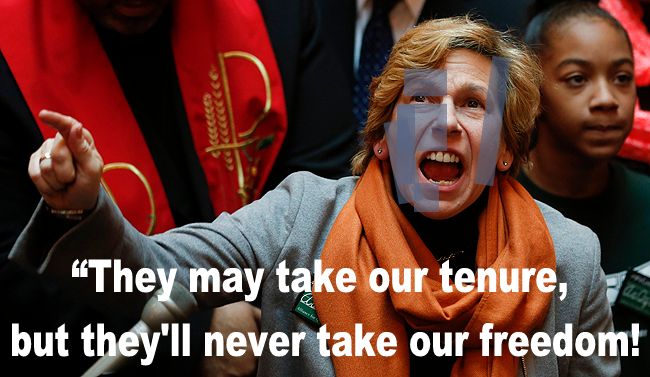
On the sixth day of the strike, most of the union’s 940 teachers and paraprofessionals filled the sidewalk and closed a lane of traffic in front of the district’s Administration Building. American Federation of Teachers President Randi Weingarten gave an impassioned plea for a fair contract.

“You are striking for what kids need. You are striking for their future and shame on this board of education and shame on this superintendent,” she said during her second visit to Scranton in the last month.


As Ms. Weingarten spoke, some district employees peered out the windows. Many of her comments were directed at the school board and to the new superintendent, Alexis Kirijan, Ed.D.

“If you, madam superintendent, really believe in kids the way you so profess, then you get to the bargaining table and negotiate 24-7,” Ms. Weingarten said. “How do you come in from Atlanta in July, and the first thing you do is create a strike in this great city of Scranton?”

Mary Delmar, a teacher at Kennedy Elementary School, said union members stand together, eliciting cheers from fellow employees.

“We have never been treated like this before,” she said. “We are being treated so disrespectfully.”

Teachers also carried boxes into the building’s lobby containing petitions with 11,000 signatures that called for a fair contract for Scranton teachers.

“What’s fair for one is fair for all, 2.5 percent for all,” teachers chanted, making reference to the superintendent’s contract, which calls for automatic 2.5 percent raises.

Teacher Dawn Hafner grabbed a megaphone to help lead the chants.

“The longer we’re out, the stronger we get,” she and the teachers said.

When reached after the rally, Dr. Kirijan said she does not understand where teachers get the idea that she does not respect them.

“I have visited their classes several times and showed them a great deal of respect. I respect anyone who chooses the hard profession of a teacher,” she said. “I don’t measure respect by money. Maybe they’re confusing that.”

Dr. Kirijan also said she did not create the strike. The teachers called the strike, and they have the right to do that, she said.

“Any decisions that are being made per the teachers contract, those decisions are not being made solely by me. I work for the board of education,” she said. “We are trying to do the right things for the right reasons. Our budget can only stretch so far. We stretched the budget beyond what we could possibly comfortably do, to get teachers a contract that could be satisfactory to them, but it’s not.”

Dr. Kirijan said she was brought to the district to improve achievement and resolve the district’s financial challenges.

“The school district is broke. You really can’t give what you don’t have,” she said. “I’m here to straighten out the financial 


CLICK HERE TO READ THE REST AND SEE VIDEO of RANDI IN ACTION: Hundreds rally as national union president calls for respect, dignity for Scranton teachers - News - The Times-Tribune:

BustED Pencils Trending News: Duncan dunked; Bye Bye Standardized; Busting Pencils | BustED Pencils

BustED Pencils Trending News: Duncan dunked; Bye Bye Standardized; Busting Pencils | BustED Pencils:

BustED Pencils Trending News: Duncan dunked; Bye Bye Standardized; Busting Pencils


newsboy_bustedpencils-logo_full color

BustEDstretch
Deputy Secretary of Education John B. King, Jr., Really?!!

Education Secretary Arne Duncan stepping down

BustEDstretch
Standardized tests SAT/ACT on the way out, good students are in!  Bye Bye Standardized.
What one college discovered when it stopped accepting SAT/ACT scores

BustEDstretch
Schools being creative in spite of Standardized testing!  This is what happens when you allow the “professionals” in this “profession” to do their jobs.  They find a way to help kids regardless of the numerous obstacles in their way.  Way to Bust some Pencils!!
Class in Session: Lessons from the Healthiest Schools in the Nation

Get BustED Pencils Trending News to come right to your in-box!
Enter your email under “SUBSCRIBE” on our Home or Trending News page atbustedpencils.com