Latest News and Comment from Education

Friday, August 28, 2015

A Perfect Storm: The Takeover of New Orleans Public Schools

New Orleans Education Equity Roundtable | Issues around equity in education in New Orleans:

A Perfect Storm Part 1: 17 Days in November


A Perfect Storm: The Takeover of New Orleans Public Schools is the first in a series of short videos, that reveals the real story behind the creation of the nation’s first all charter school district. These videos are made possible with the support of  The Schott Foundation and The New Orleans Education Equity Roundtable. They are produced in partnership with Bayou and Me Productions.
For the past seven years, state education officials and corporate school reformers have touted the dramatic turnaround of New Orleans public schools. National media outlets have published numerous articles and TV news stories of the miracle in New Orleans citing unprecedented academic achievement where parents finally had School Choice.
This first Perfect Storm video focuses on the illegal takeover and the academic failure of the Recovery School District. The film features interviews with leaders in the New Orleans education community who were faced with the daunting task of reopening schools immediately following Hurricane Katrina.New Orleans Education Equity Roundtable | Issues around equity in education in New Orleans:

A Perfect Storm Part 2: The Illusion of Choice

Latest Videos on Educational Equity


NEWS FLASH on SBAC:  Beware the cozy relationship between Malloy and the Education Reform Industry. - Wait What?

NEWS FLASH on SBAC:  Beware the cozy relationship between Malloy and the Education Reform Industry. - Wait What?:

NEWS FLASH on SBAC:  Beware the cozy relationship between Malloy and the Education Reform Industry.


Prior to the Malloy administration even announcing that they would be releasing the 2015 SBAC results today, the state’s two major corporate funded education reform lobby groups, ConnCAN and the Connecticut Council for Education Reform (CCER), invited reporters to join a “media call” in which the groups would discuss the SBAC results.  Then, just as quickly, the call was cancelled.
As we learned this morning – Friday, August 28, 2015 – Governor Malloy’s administration is finally releasing the 2015 SBAC results this afternoon, but the super-secret nature of the information didn’t stop ConnCAN and CCER from announcing on Wednesday that they were holding a “press call” this morning so that the two pro-Common Core, pro-Common Core testing, pro-charter school, anti-teacher advocacy groups could discuss the SBAC results with the media — prior to those results actually being released.
And then, when questions arose about what communication had taken place between the Malloy administration and the two lobbing groups, ConnCAN and CCER quickly cancelled the media call, leaving one wondering whether the Malloy administration broke the law by refusing to give information about the SBAC results to the media and Connecticut citizens while actually providing the information to the two private lobbying entities.
Here is what ConnCAN and CCER sent out:
ConnCAN and CCER to Host Press Call and Outline Expectations for the Smarter Balance Assessment Results
***Media Press Call on Friday, August 28, 2015 at 10:00 AM EST***
Please Click Here to Register for the Call
–Call-in number will be made available upon registration–
Media Participants Should Dial-In 5-10 Minutes Prior to Call Start Time
New Haven, CT — The Connecticut Coalition for Achievement Now (ConnCAN) has teamed up with the Connecticut Council for Education Reform (CCER) to host a press briefing call, which will walk reporters through their 
NEWS FLASH on SBAC:  Beware the cozy relationship between Malloy and the Education Reform Industry. - Wait What?:


CT SBAC Results – It’s a Friday afternoon in August – Good time to release the results – Today at noon!


 Governor Dannel Malloy’s administration is finally ready to release the 2015 SBAC results!


Two months after parents in Washington State and Oregon were informed about how their state’s children did on the unfair, inappropriate and discriminatory Common Core SBAC tests, Connecticut will finally get the news today about how our children “performed” on the absurd testing fiasco.

The first rule of modern government and politics is that when you don’t want people to know something, release the information on a Friday.  If possible, a Friday in August is best time to make something “public” if the goal is to make sure the public doesn’t actually hear about it.  The technique is an “art form” and strategy that the Malloy administration has used repeatedly over the past five years.

So now, after the spending more than $50 million dollars in state funds over the post two years on the new Common Core standardized testing scheme, and local school districts spending millions more, the Connecticut State Department will be revealing the test results this afternoon… A Friday afternoon in August.

In addition, apparently the wait for the CMT/CAPT Science test is finally over as well.  While the Common Core and Common Core testing scheme has obliterated the usefulness of the Math and English Language tests, the traditional testing process is still being used to measure whether students are learning the state’s science curriculum.

Unfortunately, the education reform industry’s definition for being “college and career” ready http://jonathanpelto.com/

Students in New Orleans Speak Out | EduShyster

Students in New Orleans Speak Out | EduShyster:

Students in New Orleans Speak Out


Students in New Orleans speak out, and ask some hard questions…
IMG_1120Early Friday morning students arrived at their schools only to find that it was no regular morning. Pasted on the walls all around the schools were large black & white posters. But these were not your typical posters. These posters had facts, questions, and statisticsregarding New Orleans public charter schools and their inhabitants — former students, teachers, principals, and CEOs. Some posters had questions on them that referenced the firing of over 7,000 teachers post-Katrina: *The black math teacher from 2004 who lived in your neighborhood, where are they?* And some questioned the salaries of school principals and administrators compared to the quality of the schools they run: *Your principal makes $100,000 a year, but why is your school only a ‘D’ school?* These are only a few of the many posters that were found at several high schools across the New Orleans area, including Lake Area, Sci Academy, Warren Easton, and Landry Walker.
IMG_1119Students at these schools and others had a lot to say about the posters and the questions they posed.  Responding to the question, *Your homie from the class of 2013…where are they now?* one high school student answered, *Most of the people I knew in the class of 2013 are currently in college, or didn’t finish and plan to go back this year. That makes me anxious and worry about if I can finish college when I’m ‘supposed’ to and wonder what happened to throw them off track. It makes me feel sad that people go into college unsure of their main drive and because of being rushed into it, they lose track of what they really want.*
Another student nearby answered as well saying, *Most of them are still in college but a few are struggling to have somewhere to stay and are still trying to get into college. Students in New Orleans Speak Out | EduShyster:

CURMUDGUCATION: No, NYT, Common Core Is Not About Knowledge

CURMUDGUCATION: No, NYT, Common Core Is Not About Knowledge:

No, NYT, Common Core Is Not About Knowledge


In today's New York Times, Natalie Wexler offers an op-ed from some parallel universe in which Common Core and reformsterism are-- well, maybe Opposites Day is today and I missed the memo.

She opens by arguing that the Big Standardized Test is not narrowing the curriculum, claiming that it's narrow anyway, and right off the bat she establishes herself as someone who doesn't understand how schools work. Heck, back in 1977 elementary teachers only spent 50 minutes per day on science and social studies, and that has only dropped by ten minutes. Some quick math tells us that over 180 days, that's a loss of 30 hours of instruction. I know in the private sector, ten minutes is nothing, but in a classroom, ten minutes is plenty of time to Get Some Stuff Done-- and it adds up quickly.

But that's just the overture. Wexler then launches into a full-blown opera about the romance between Common Core and Rich Content, the kind of knowledge-heavy education championed by guys like E. D. Hirsch. This shows a profound mis-understanding of the Common Core.

While critics blame the Common Core for further narrowing curriculums, the authors of the standards actually saw them as a tool to counteract that trend. They even included languagestressing the importance of “building knowledge systematically.”

... Most educators, guided by the standards alone, have continued to focus on skills.

So Wexler's theory is that we're supposed to close read the standards and see, buried somewhere between a gerund phrase and optional appendices, a mandate to include rich content.

Like the rest of the rich content crowd, Wexler is so sure that rich content knowledge has to be there, she has convinced herself that it is.

She is wrong.

The standards are clearly focused on "skills" (whether the "skills" are really skills or not is another debate). David Coleman, the writer of the ELA standards, has given plenty of detailed and hugely 
CURMUDGUCATION: No, NYT, Common Core Is Not About Knowledge:


PA: Teachers Agree To Work For Free

Its financial recovery plan rejected by the state, Chester Uplands School District now faces the grim reality that it cannot meet its payroll. The cause is simple-- obscenely profitable charter schools are bleeding the public system dry.

And (fun fact) the three charters in question--  Chester Community Charter SchoolWidener Partnership Charter School, and the Chester Charter School for the Arts-- none of the three enroll high school students (though CCSA is "growing" a high school program year by year).

The Chester Uplands District, long financially strapped, already has a state receiver (it was the state that proposed the financial rescue plan that the court rejected). There aren't many options left, and so the teachers have taken the ultimate hit for the team-- they have agreed to work without pay.Otherwise the public school system will not open. The district has been pushed to the wall before (here's news from 2012 that seems familiar).

That's over 300 employees. Teachers and support staff met Thursday and after hearing from the state-appointed receiver about just how dire things are, resolved that they “will work as long as 

Mike Klonsky's SmallTalk Blog: Rahm to both Dyett hunger strikers and Little Black Pearl: "We don't need no stink'n public school in Bronzeville."

Mike Klonsky's SmallTalk Blog: Rahm to both Dyett hunger strikers and Little Black Pearl: "We don't need no stink'n public school in Bronzeville.":

Rahm to both Dyett hunger strikers and Little Black Pearl: "We don't need no stink'n public school in Bronzeville."

Rahm, Clark, Claypool & Jackson


Rahm Emanuel, cynical bastard that he is, never intended to put a school back in Dyett. From the time he closed this, the last public open-enrollment high school in Bronzeville, his plan was always to sell the building to the real estate developers -- like he's done recently with Von Humboldt in Humboldt Park and Trumbull (to Svigos Real Estate Group) in Andersonville. The awarding of the Obama Library in Washington Park has only made the incentive greater.

Like his predecessor Daley, Rahm would sell of every foot of this city's public space that wasn't nailed down, if he could. And maybe he can. The erosion of public space and public decision-making has been a hallmark of the regime's strategy of gentrifying and whitenizing the city. It's New Orleans without the flood. A quarter-million African-American citizens have left Chicago in the past decades.

Now it appears that the board's RFP for a new school at Dyett was a ruse. After 11 days of surviving on liquids and with several of the hunger strikers needing medical treatment (see the warning from local health professionals) , they've been told by Board Pres. Frank Clark (former ComEd C.E.O), that game is up. Rahm, 
Mike Klonsky's SmallTalk Blog: Rahm to both Dyett hunger strikers and Little Black Pearl: "We don't need no stink'n public school in Bronzeville.":

Christopher Cerf is a liar and a con-man who wants to divide Newark | Bob Braun's Ledger

Christopher Cerf is a liar and a con-man who wants to divide Newark | Bob Braun's Ledger:

Christopher Cerf is a liar and a con-man who wants to divide Newark


Of all the lies, half-truths, canards and other deceptions the new state boss of Newark schools dumped on the people of Newark at his first public appearance Tuesday, to me, this was the most repugnant: He said that, to comply with seniority rules, he had to lay off some of the most “beloved” teachers who worked for the city.
With those few words, Christopher Cerf, a failed entrepreneur who lives in Montclair, clearly showed just how poisonous he intends to be as the man who finishes the job Gov. Chris Christie set out to do–destroy Newark as a united, cohesive community politically strong enough to play a role in state politics.
First let’s start with this: There is no measure of “belovedness” on any teacher evaluation form I have run across in more than 50 years of writing about education. Who knows which teachers are “beloved” and which are not?
Sure, we all have memories of teachers we loved, but that’s a far cry from the superintendent of schools–a former state education commissioner–declaring with the assuredness of fact that the Newark school district was forced by nasty old union rules to lay off “beloved” teachers.
Cerf admitted he knew very little of Newark and couldn’t get the names of his subordinates right–and yet he pretends he knows, for a fact, that teachers who were “beloved” were laid off while teachers who were not, or were somewhat or Christopher Cerf is a liar and a con-man who wants to divide Newark | Bob Braun's Ledger:

Jersey Jazzman: Karen Lewis on Carly Fiorina: "That's a Lie"

Jersey Jazzman: Karen Lewis on Carly Fiorina: "That's a Lie":

Karen Lewis on Carly Fiorina: "That's a Lie"


Carly Fiorina was one of the six Republicans to participate in Campbell Brown's education summit (which was really nothing more than a teachers union-bashing fest). As I pointed out, Fiorina was stunningly ill-informed and incoherent on education policy.

But that flies in the face of the conventional wisdom about her recent surge in the polls. Ostensibly, she showed she was a serious candidate in the first Republican debate, demonstrating a command of policy that impressed voters. But her appearance with Brown actually displayed the opposite: Fiorina doesn't much care if she can back up her facts of not, so long as they help her score political points.

For example:


"It’s why the head of the teachers union in Chicago, when they struck, against Mayor Rahm Emanuel, it’s why she could say: 'We can’t be held accountable for the performance of students in our classrooms because too many of them are poor and come from broken families.' So what was she saying? If you’re poor and come from a broken family we can’t teach you because you can’t learn. That is not the American way."
That's from her interview with Brown; Karen Lewis is the union leader Fiorina is referring to. It's a damning accusation, especially considering Lewis is a teacher herself, with many years of experience in the Chicago Public Schools chemistry labs.

I thought it was worth asking Lewis what she thought of this attack. As usual, she minced no words:


"It's a lie. I never said that, but Fiorina has
- See more at: http://jerseyjazzman.blogspot.com/2015/08/karen-lewis-on-carly-fiorina-thats-lie.html#sthash.Lt3TDu6a.dpuf

Stay Positive and Pace Yourself: A Survival Guide for First-Year Teachers - NEA Today

Stay Positive and Pace Yourself: A Survival Guide for First-Year Teachers - NEA Today:

Stay Positive and Pace Yourself: A Survival Guide for First-Year Teachers


challenges_for_first_year_teachers


The 2015-16 school year will be my second year in the classroom. I am looking forward to the start of school with far less trepidation than I did a year ago. My first year in the classroom was hard – there’s no way around it. But I survived. For better or worse, the struggles of are fresh in my mind and I’d like to pay it forward and hopefully support some new first-year teachers in our important profession.
To be clear, the first year is going to be enormously challenging no matter what. It is educator boot camp. However, understanding how to navigate it can make a big difference. Here I’ve identified some of the most important advice that I followed (or wish I had followed), and even though my experiences are from a high school English classroom, I think they translate into all grades and contexts.
Don’t Add to the Pressure
Although it is important to have an appropriate and positive mindset about what you can do, many new teachers forget to bring this same mindset to the things that theycannot do. Your job is to be the best first-year teacher you can be.  Give yourself permission to take  a few short cuts that are in no way reflective of the educator you will be years down the road. Even though you have Stressed teacheralready learned so much in student teaching, you still face an enormous learning curve that happens as you jump to full-time teaching. You will absorb so many things every day, but may have trouble articulating and applying what you have learned. And because you’re trying to apply numerous subtle layers to everything you do (planning, grading, seating charts, anything!), it will initially slow you down. As a morale booster, constantly remind yourself that school work will take you much longer now, but that won’t always be the case.
For example, before starting full time, it took me 30 minutes to grade one essay – which is an impossibly slow speed once you have 100+ students. Know that you will adjust and you need to cut corners as you do so. Also, keep in mind that you cannot nor should not grade every piece of work each student completes. In fact, for your students to gain the skills you want to teach them, they need to practice them so Stay Positive and Pace Yourself: A Survival Guide for First-Year Teachers - NEA Today:

Watch Poverty in School Districts Escalate Before Your Very Eyes - CityLab

This Map From EdBuild Shows Increasing Rates of School District Poverty Since the Recession - CityLab:

Watch Poverty in School Districts Escalate Before Your Very Eyes

Since the recession, more children than ever are living in impoverished school districts.


For parents with multiple kids under one roof, being poor has a compounding effect. That’s why in America, children make up 23 percent of the population but 33 percent of all people in poverty.
If that isn’t staggering enough, those children are concentrated together at school. 25 percent of the nation’s school districts contain 82 percent of children living in poverty. And the communities defined by those districts have swollen since the Great Recession. In 2006, there were 15.9 million studentsliving within school districts where the overall child poverty rate was 20 percent or higher. In 2013, there were 26.3 million—a stunning 60 percent increase over just seven years.
Now, that doesn’t meant that all 26.3 million of them are living in poverty, or even attending public school. But it does mean that about half of all U.S. children live in places where a significant number of families are just scraping by.


EdBuild, a nonprofit that advocates for public school funding, has released an interactive map (shown above, courtesy of the Huffington Post) that shows all the U.S. school districts where the student poverty rate exceeded 20 percent, 30 percent, and 40 percent, time-lapsed from 2006 to 2013. It’s based on Census SAIPE data, which measures poverty in small units, such as school districts and counties. You can zoom in and search to see how your local district or region has fared.
Southern states have seen population expanding overall, with poverty levels rising in tandem. In the Midwest, it’s more of a deepening of poverty, as high-income families flee and low-income residents are left in concentration. Florida, ground-zero of the foreclosure crisis and among the slowest states to recover from the recession, is probably the most jaw-dropping example of poverty concentrating in school districts: In 2013, 76.3 percent of Florida children lived in districts where the student poverty rate was more than 20 percent. In 2006, those districts contained only 6 percent.
If those numbers (or the maps below) are so dramatic that they’re hard to believe, note that there may be some caveats to EdBuild’s data. Kye Lippold, a research associate at the Urban Institute, points out that the Census changed their methodology for computing school district poverty levels in 2010, which might explain at least part of the jump between 2009 and 2010. So it’s hard to say whether EdBuild’s exact numbers are completely accurate; it would take a more complex analysis to figure that out.
But, Lippold adds via email, “It is very likely true that the number of students in high-poverty districts has increased… the Great Recession could be expected to have this effect.”
That seems indisputable. And it’s certainly true that when your community is poor, your school district suffers in turn. In many states and localities, per-student spending is dramatically lower in poor school districts than it is in This Map From EdBuild Shows Increasing Rates of School District Poverty Since the Recession - CityLab:

Poll: California voters back Prop. 30 extension in support of public schools | USC News

Poll: California voters back Prop. 30 extension in support of public schools | USC News:

Poll: California voters back Prop. 30 extension in support of public schools


(Photo/USGA)


 As optimism about the state of California’s public schools continues to rise, a strong majority of California voters would back the reauthorization of Proposition 30 to channel additional money to public campuses, according to a new poll released today.
The PACE/USC Rossier School of Education Poll shows 63 percent of voters are in favor of extending at least one provision of Prop. 30 — the tax increase on high incomes or the sales tax hike or both — that is set to expire at the end of 2016. Only 28 percent of voters said both fiscal provisions should be allowed to expire, the poll showed.
Approved by the voters in 2012, Prop. 30 temporarily increased the state sales tax by a quarter cent and the personal income tax rate on people earning more than $250,000 a year to fund public education and other government programs.
Six in 10 voters said California should be spending more on schools, as opposed to 26 percent who said the state’s public schools have enough money, the poll showed.
“Since the inception of this poll in 2012, we have identified valuable trends that not only reflect the opinions of the state’s voters but also influence policymakers in Sacramento,” said USC Rossier School Dean Karen Symms Gallagher. “The latest results indicate a growing confidence in our public school system as voters are clearly willing to provide greater financial support to education.”

Less enthusiasm for Prop. 13

Voters were comparatively less enthusiastic about proposed changes to Proposition 13, which sets limits on property taxes. Changing the rules on the taxation of business and commercial property would raise an estimated $6 billion to $10 billion per year, of which 40 percent would go to public schools. A slight majority of voters — 51 percent — said they would support changes to Prop. 13, as compared to 39 percent who would oppose it.
“Although voters want more invested in education, we don’t see an underlying appetite for more extreme measures, such as making changes to Prop. 13,” said Jeff Harrelson, chief operating officer of the Republican polling firm MFour Mobile Research, part of the bipartisan team with the Democratic polling firm Tulchin Research that conducted the PACE/USC Rossier Poll. “Policymakers should be prepared to engage in an extended voter education effort on this issue.”
Said Ben Tulchin, president of Tulchin Research: “Voters believe California’s public schools have made some progress over the last few years. As a result, a large majority of California voters wants to extend Proposition 30, particularly its tax on the wealthy, in order to continue this progress.”
California voters have become less pessimistic about the state of their public schools. Between 2012, when the question was first asked, and 2015, the percentage of voters who say the state’s public schools have gotten better more than doubled, from 7 percent to 17 percent. During that same time period, the percentage of voters who said public schools were getting worse declined, from 57 percent to 39 percent. Thirty-six percent of voters said public schools had stayed the same.
When asked about their neighborhood public schools, 17 percent of California voters said they had gotten better, up from 11 percent in 2012. Thirty-four percent of voters said their local public schools had gotten worse, down from 45 percent in 2012. Thirty-eight percent of voters said local public schools had stayed the same.
“Voters are clearly not satisfied with the state of California’s public education system, but they are beginning to see their schools moving in the right direction,” said David Plank, executive director of PACE. “They still see a lot of room for improvement, but this is a very encouraging trend.”

What is the Local Control Funding Formula?

Sixty-five percent of California voters said they have never heard or read about the Local Control Funding Formula(LCFF), Gov. Jerry Brown’s 2013 reform under which billions of dollars have been funneled to school districts to directly help English learners, foster children and students from low-income families, and an additional 21 percent said they had not heard or read much about it, the poll showed. Only 14 percent of voters said they had heard or Poll: California voters back Prop. 30 extension in support of public schools | USC News:

#FightForDyett -- What Real Organizing Looks Like: Parents Stage Hunger Strike at Dyett High School | Black Agenda Report

#FightForDyett -- What Real Organizing Looks Like: South Side Chicago Parents Stage Hunger Strike at Dyett High School | Black Agenda Report:

#FightForDyett -- What Real Organizing Looks Like: South Side Chicago Parents Stage Hunger Strike at Dyett High School


by the Real News Network


Call Chicago mayor Rahm Emanuel's office at 312-744-3300. Tell him the whole world is watching, he can give the parents their high school back RIGHT NOW. Call Alderman Will Burns at 773-536-8103 with the same message."
JAISAL NOOR, PRODUCER, TRNN: Welcome to the Real News. I'm Jaisal Noor in Baltimore.

In education news from Chicago, a dozen parents and activists have entered the fifth day of a hunger strike to demand officials adopt a community-developed plan for the future of Dyett High School.

SPEAKER: We know this is political. We know this is about ignoring black parents, because that's what this is about. This is racist, and Stevie Wonder can see that.

NOOR: The city is currently considering several proposals, and has scheduled a public hearing for September. Chicago Public Schools says their process is community-driven, and will select the best educational option. Located in the predominantly African-American neighborhood of Bronzeville on Chicago's South Side Dyett has long been a center of community struggle, especially since it was slated for closure in 2012.

Now joining us to discuss this are two guests. We're joined by Jitu Brown. He's a longtime Chicago education activist. He was with the Kenwood Oakland Community Organization. We're also joined by Pauline Lipman, professor of educational policy studies and the director of the Collaborative for Equity and Justice in Education at the University of Illinois, Chicago. Thank you both for joining us.

JITU BROWN: Thank you.

NOOR: So Jitu, we know you're joining us from outdoors, #FightForDyett -- What Real Organizing Looks Like: South Side Chicago Parents Stage Hunger Strike at Dyett High School | Black Agenda Report:

Thursday, August 27, 2015

#FightForDyett A Group Of Chicago Residents Are Starving Themselves To Save A School

A Group Of Chicago Residents Are Starving Themselves To Save A School:

A Group Of Chicago Residents Are Starving Themselves To Save A School

A dozen protestors have been on a hunger strike since August 17


A group of Chicago residents finished the 11th day of a hunger strike Thursday in an attempt to move the Chicago School Board to make a decision over the fate of a local school, Dyett High School. 
The group of 12 has been going without solid food since Aug. 17, even after medical professionals expressed concern for their health.
While Dyett was once slated to close, the Chicago School Board is now set to weigh plans to reconstitute the school, although this process has been rife with delays. The protestors -- part of the Coalition to Revitalize Dyett High School -- want the board not only to take immediate action, but also to accept their proposal to reopen the school as a district-run one that focuses on science.
The hunger strike has so far caused two protestors, Jeanette Taylor-Ramann and Irene Robinson, to spend time in the hospital. Both protestors still intend to forgo food for the indefinite future, fellow protestor Jitu Brown told The Huffington Post.


As a result of these health issues, a group of medical professionals urged Chicago Mayor Rahm Emanuel to intervene.
 "We consider the current situation to be a deepening health emergency in our city," said a letter from a group of medical professionals delivered to the mayor Thursday, per DNAinfo. "It is one you can abate by reaching out to the strikers, entertaining their grievances and accepting their proposal."
As of Thursday afternoon, the mayor had still not reached out to protestors. A request for comment from his office was not returned.
In 2013, Emanuel closed 49 Chicago schools that were underutilized and academically low-performing -- a move that angered many local residents and advocates for neighborhood A Group Of Chicago Residents Are Starving Themselves To Save A School:

New Orleans Recovery School District, ACT Outcomes, and Falling Through the Cracks | deutsch29

New Orleans Recovery School District, ACT Outcomes, and Falling Through the Cracks | deutsch29:

New Orleans Recovery School District, ACT Outcomes, and Falling Through the Cracks


This post includes information on Louisiana’s Class of 2015 ACT scoring outcomes and is chiefly focused upon the Recovery School District (RSD) in New Orleans. It is as much a post about who in RSD is taking as it is about who is not.
According to the Louisiana Department of Education (LDOE) district enrollment counts for February 2015, Orleans Parish School Board (OPSB) enrollment is 13,173, and New Orleans RSD enrollment at 30,448.
In July 2015, Jessica Williams of Nola.com published information about the Louisiana’s Class of 2015 district ACT composite scores. In that article, Williams included a search engine for ACT composites related to schools and districts. Specifically, Williams’ search engine allows one to look up some schools/districts to see 1) the number of seniors who took the ACT, 2) the percentage of those seniors who scored at or above 20 on the ACT, and 3) the percentage of seniors who scored at or above 18 on the ACT.
According to Williams’ search engine, 1065 Class of 2015 seniors took the ACT; 21.1 percent scored 20+, and 36.7 percent scored 18+.
These are low percentages, but one might expect as much given that the RSD Class of 2015 ACT composite was 16.6.
What is also noteworthy is the number of RSD seniors: 1065 for a district of 30,448 students.
Using the LDOE district enrollment counts for February 2015 and Williams’ ACT-New Orleans Recovery School District, ACT Outcomes, and Falling Through the Cracks | deutsch29:

Controversial psychologist found working at special ed schools | EdSource

Controversial psychologist found working at special ed schools | EdSource:

CONTROVERSIAL PSYCHOLOGIST FOUND WORKING AT SPECIAL ED SCHOOLS


He is among the nation’s leading believers in “aversive therapy,” in which students with behavior disorders are pinched, deprived of food and shocked with electricity to control their behavior. For more than 30 years, state attorneys generalU.S. congressmenand the U.N. Special Rapporteur on torture have alleged his methods violate the health, safety and educational rights of children with disabilities.
Now Matthew Israel has been tripped up by investigators at the California Department of Education for a seeming technicality: failing to submit school-employment paperwork.
Prompted by a citizen complaint, state investigators found that Israel is working as a behavior analyst or administrator for two Antioch special education schools run by his wife, Judy Weber-Israel, without being listed on the schools’ applications for state certification, as required by the California Education Code. Nor were the school districts that send students to the schools – including Antioch Unified, Oakland Unified, River Delta Unified and Mt. Diablo Unified – notified that Israel had been added to the roster of licensed staff, as required by the Education Code.
Upon closer inspection, investigators found that the schools, known as Tobinworld II and Tobinworld III, did not have records that proved Israel had cleared a U.S. Department of Justice criminal background check, held a valid license or credential or passed a tuberculosis test, as required by the Education Code.
The state investigation concluded that Matthew Israel is designing behavioral intervention plans and “is not qualified to do so.”
As a result of these failures, effective Aug. 24, the California Department of Education has suspended the certification of Tobinworld II and Tobinworld III, a status that prohibits the schools from accepting new referrals from school districts. The schools may continue to operate with their current students and the state has established a series of deadlines, starting with Sept. 16 and ending Dec. 31, for them to address noncompliance issues before their certification status is reconsidered.
Israel, who holds a Ph.D. in psychology from Harvard and well as a J.D. from Harvard Law School, was licensed in California as a psychologist in 1978, but his license expired in 1987. His job duties at Tobinworld II included designing special education behavioral intervention plans, which are strategies to encourage students to act appropriately. State regulations specify that such plans must be designed by staff members who hold a valid license to practice psychology or a related specialty, an appropriate teaching credential, or a Controversial psychologist found working at special ed schools | EdSource:

'Every Kid Is Money' New Orleans Post-Katrina Charter Schools Foster Unhelpful Competition - US News

New Orleans Post-Katrina Charter Schools Foster Unhelpful Competition - US News:

'Every Kid Is Money'

Principals see dollar signs instead of students in New Orleans' post-Katrina charter schools.


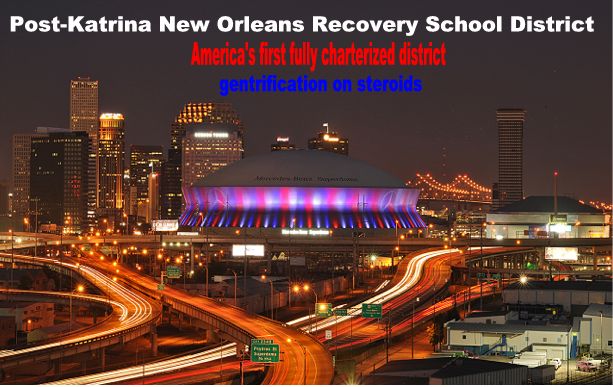
This week commemorates a grim anniversary. Ten years ago, Hurricane Katrina devastated New Orleans. It wiped out the entire public school system and cleared the way for what has become the nation's first fully charterized district. In the New Orleans Recovery School District, traditional neighborhood public schools are gone, replaced by privately run charter schools.
Compared to the pre-Katrina period, students' scores on state mandated tests are up and dropout rates are down. Based on these numbers, some commentators, including various Republican presidential candidates, are calling for the New Orleans model of education reform to be replicated elsewhere; however, there are important questions to be asked before any copycat efforts should be attempted.
One of these questions is explored in a report released earlier this year, which has been making waves in the education research community. Based on an award-winning dissertation by Huriya Jabbar, the report examines how school principals navigate the competitive waters of a charterized school district. Competition is the central premise upon which a system of school choice is built; such a system assumes that popular schools will be sought out by students and parents, while unpopular schools will either have to up their games and find ways to become more appealing to their clients or go out of business. The report examines the extent to which these concerns weigh on the minds of principals and how they respond to them.
The study shows that in all but one of the 30 randomly selected New Orleans schools, school leaders did view other schools as competitors. The principals understood competing for students as synonymous with competing for taxpayer money, as each student would bring additional money from local, state and federal sources. One principal quoted in the report explained, "Every kid is money," and another noted, "Enrollment runs the budget; the budget runs the enrollment."
Though the image of a principal with dollar signs in her eyes as she looks at students may be disturbing, the most disconcerting findings in the report were that principals did not respond to these competitive pressures in ways that might be good for students.
Only one-third of the schools responded to competition by trying to improve academics or instruction. In fact, principals in the so-called "failing" schools were even less likely than those in the "non-failing" schools to focus on strengthening the academic program and student learning.
In one-third of the schools, leaders admitted "matter-of-factly" that they engaged in strategies to screen and select their students, even though such practices were not permitted and all but two of the schools were expected to enroll any student who applies and is chosen for admission through random lottery. The "creaming and cropping" strategies principals used included deliberately courting more affluent families at special invite-only open houses, counseling out families whose children "might hurt their test scores," and not filling seats left empty by students not returning to school, either because they were pushed out or because they chose not to return.
The most common response to competition reported by leaders was to direct more money and resources into marketing efforts, including advertising and hiring brand consultants.
As media pundits and politicians commemorate the 10 year anniversary of Katrina, many will point to competition and choice as the drivers of improvement in New Orleans student outcomes. Though the validity of such claims remains disputed by educational researchers, it's clear that competition inspires school leaders to make different decisions about how they allocate funds and expend their time and energy.
These principals may not be acting in ways that policymakers would expect, but the question remains: Are they acting in ways that citizens will tolerate? Is it acceptable to spend tax dollars on slick advertising campaigns, or as Jabbar calls it, "glossification," at the expense ofNew Orleans Post-Katrina Charter Schools Foster Unhelpful Competition - US News: